The Church at War

Why would Christian Scriptures commend people for waging war? War, after all, is nearly universally condemned – even as it remains a relentless curse in various corners of our world.

One young pastor was “charged” with a duty that belongs, by biblical extension, to all believers. “This charge I entrust to you [that] you may wage the good warfare, holding faith and a good conscience” (1 Timothy 1).

The reason followers of Jesus are encouraged to actively train for and engage in war is because our enemies are not other human beings. We discussed this fact in our last conversation, as we considered the theological concept of the Church Militant.

To call the Body of Christ “militant” is misleading to those who don’t understand spiritual warfare, the fact that “we do not wrestle against flesh and blood, but against . . . the cosmic powers over this present darkness . . .” (Ephesians 6).

Unfortunately, because all of us are imperfect (i.e. fallen), Christians can sometimes fail to distinguish between our true enemies and those who witlessly follow their banner. For an excellent discussion of this, from a Roman Catholic perspective, I recommend you read “The Church Militant or the Church Belligerent?

Another worthwhile read is “G.K. Chesterton and the March of the Church Militant.” There, Joseph Pearce shares Chesterton’s vivid description about how Gothic cathedrals visualize the martial aspect of the Christian Church.

The truth about Gothic [architecture] is, first, that it is alive, and second, that it is on the march. It is the Church Militant; it is the only fighting architecture.

All its spires are spears at rest; and all its stones are stones asleep in a catapult. In that instant of illusion, I could hear the arches clash like swords as they crossed each other. The might and numberless columns seemed to go swinging by like the huge feet of imperial elephants.

The graven foliage wreathed and blew like banners going into battle; the silence was deafening with all the mingled noises of a military march; the great bell shook down, as the organ shook up its thunder.

The thirsty-throated gargoyles shouted like trumpets from all the roofs and pinnacles as they passed; and from the lectern in the core of the cathedral the eagle of the awful evangelist crashed his wings of brass (“The Architect of Spears”).

As a master of words and wit, Chesterton’s writing rarely disappoints. You can download a free copy of The Man Who was Chesterton, which includes this essay, from Internet Archive.

C.S. Lewis did more to equip us for spiritual warfare with The Screwtape Letters than a thousand clergy with a hundred thousand sermons. As one Baptist theologian summed it up in an article about spiritual warfare:

On the subject of spiritual warfare, Lewis is a helpful guide. I’ll remember what he taught: There is an enemy. He seeks my destruction. And this is war.

There is a brilliant quote about this supernatural confrontation, ascribed (apparently in error) to the historical Martin Luther.

If I profess, with the loudest voice and the clearest exposition, every portion of the truth of God except precisely that little point which the world and the devil are at that moment attacking, I am not confessing Christ, however boldly I may be professing Christianity.

Where the battle rages the loyalty of the soldier is proved; and to be steady on all the battle-field besides is mere flight and disgrace to him if he flinches at that one point.

C.S. Lewis echoes this sentiment in The Magician’s Nephew. When Aslan questions the humble man whom he would crown the first King of Narnia, he poses a query which reveals the man’s courage and humility.

“And if enemies came against the land (for enemies will arise) and there was war, would you be the first in the charge and the last in the retreat?”

“Well, sir,” said the Cabby very slowly, “a chap don’t exactly know till he’s been tried. I dare say I might turn out ever such a soft ’un. Never did no fighting except with my fists. I’d try – that is, I ’ope I’d try – to do my bit.”

“Then,” said Aslan, “you will have done all that a King should do.”

If anyone would follow Christ, neutrality is not an option. Though some temporary retreats are inevitable, in God’s strength, we are empowered to continue our (in reality, the Lord’s) advance.

The battlelines are drawn, and they are real. As C.S. Lewis proclaimed in “Christianity and Culture” – “There is no neutral ground in the universe. Every square inch, every split second is claimed by God, and counterclaimed by Satan.”


The image above, “Livonian Sword Brother” (a member of a military monastic order) was created by JLazarusEB and is used here in compliance with the Creative Commons CC BY-NC-ND 3.0 License.

Thoughts on the Church Militant

C.S. Lewis understood better than most the spiritual warfare that rages, unseen for the most part, around all human beings.

And, as veterans of the bloody trenches of the First World War, Lewis and his good friend J.R.R. Tolkien had learned more than they desired about the tactics and sheer violence of combat.

Many of those wartime lessons translated directly into a spiritual context. However, I recently realized how poorly the concept of immobile trenches relates to our challenge to take up our crosses and follow our Savior.

You see, the Christian life is many things, but there is one thing discipleship never is – static. As theologian Tilemann Heshusius (1527-1588) wrote: “Christian soldiers always either advance or retreat.”

In battle there is nearly always an ebb and a flow, as forces advance on one front and temporarily shift back on another. In his essay “The World’s Last Night,” C.S. Lewis observes “In battle men save their lives sometimes by advancing and sometimes by retreating.” The same is true for the Christian life in general. We are either advancing, or falling back. Our relationship with God is not stagnant.

The New Testament includes many military metaphors and allusions, intended to equip us for victory in our spiritual battles.

The Apostle Paul refers to believers as “fellow soldiers.” In a letter to a young pastor, he extols the model of the soldier, who keeps his focus on the mission.

Share in suffering as a good soldier of Christ Jesus. No soldier gets entangled in civilian pursuits, since his aim is to please the one who enlisted him.

Then there is the familiar passage which uses the image of the “whole armor of God” to describe in detail how Christians are to be prepared for faithful service. You can read the entire passage here.

These military accoutrements are necessary because “we do not wrestle against flesh and blood, but against the rulers, against the authorities, against the cosmic powers over this present darkness, against the spiritual forces of evil in the heavenly places” (Ephesians 6:12).

This is the reason one aspect of the Christian Church’s nature has been described as the “Church Militant.” This describes the Church battling evil while awaiting Christ’s return, for the Final Judgment, when it will become the “Church Triumphant.” The former is the context for familiar hymns such as “Onward Christian Soldiers,” composed by a prolific Anglican priest in the nineteenth century.

Onward, Christian soldiers,
   marching as to war,
With the cross of Jesus
   going on before!

Christ, the royal Master,
leads against the foe;
Forward into battle,
see his banner go!
     . . .

At the sign of triumph
   Satan’s host doth flee;
On, then, Christian soldiers,
   on to victory!

Hell’s foundations quiver
   at the shout of praise;
Brothers, lift your voices,
   loud your anthems raise.

The WWI trenches are the archetype of static, immobile frontlines. Disease festered, and morale decayed like the muck sucking at the soldiers’ boots. As recognized by sixteenth century theologians and C.S. Lewis alike, wars are rarely won simply by maintaining a defensive position. Movement is an essential element of warfare.

Hopefully more of that movement consists of advances against the enemy, than retreats. But we will consider that aspect of spiritual war in our next post.

Until Then

Those interested in learning more about military strategy, particularly as explored by another veteran of the War to End All Wars, Sir B.H. Liddell Hart,* like Lewis and Tolkien, returned home to Britain from the front lines, as a casualty. (Britannica states more than a third of the British forces became casualties, in contrast to 76% of Russians, 73% of French, and 8% of Americans.)

Liddell Hart’s wisdom extends beyond the battlefield itself.

The downfall of civilized states tends to come not from the direct assaults of foes, but from internal decay combined with the consequences of exhaustion in war (“The Objective in War,” a lecture delivered in 1952 to the United States Naval War College).


* Sir Basil Henry Liddell Hart (1895-1970) was a military historian and theoretician. A number of his works are in the public domain and available for free download from Internet Archives. These include A Greater than Napoleon, Scipio Africanus and Why Don’t We Learn from History?

C.S. Lewis and Military Service

home guard stamp

If you were going to enlist in the military, which branch of the armed forces would you choose? And why?

The choice would have great consequences. The simple fact is that despite their similar charters, not all branches are created equal. Your choice will influence countless aspects of your life, including your post-military employment options and even the likelihood of whether or not you’ll survive your enlistment.

Gallup recently completed research into which branch of the armed forces most Americans would encourage someone to join. The Air Force came out on top.

Americans hold all branches of the U.S. military in high regard, but that does not necessarily translate into a desire to see their loved ones enlist. Fewer than half would be likely to recommend joining the Coast Guard (48%), Marines (43%) or Army (41%) to their children or grandchildren, while a majority would be likely to recommend the Navy (53%) or Air Force (64%).

As a chaplain, I heard some amazing reasons for people’s choice of service. One Army NCO told me, “I was leaning toward the Air Force until the Army recruiter pulled out this huge poster covered with every imaginable weapon, and said, ‘we’ll teach you how to use all of these.’” Not a bad technique for persuading testosterone-fueled eighteen-year-olds to sign on the dotted line.

One young woman who had served a tour in the Marines told me she didn’t even consider another option. “It was the Corps or nothing,” she said, before shouting “Semper Fi!” The USMC has the advantage of requiring fewer recruits and has brilliantly fostered a reputation as “the most prestigious of the military branches.”

A common motivator for Navy recruits seems to be the exotic locations of many of their installations. Can’t argue with that. Most of them are located on or near coasts, while the Air Force strategically places its bases where a falling aircraft would have the smallest chance of injuring someone on the ground. Places like Lubbock, Texas, where I served my first active duty tour at Reese AFB. [The people in Lubbock are amazing patriots.]

The Coast Guard, a sometimes-military organization, attracts people interested in their search and rescue ethos. This despite the fact that most of their mission involves enforcing laws and protecting the nation’s borders.

The Air Force draws lots of recruits who are interested in pursuing technical fields. The other services have similar career paths, of course, but the clear perception is that the Air Force offers the most. Still, it’s a bit embarrassing to share here the reason one friend of mine chose the USAF. Actually, it was his reason for choosing the chaplain assistant career field in particular. “I told them at basic training that I would take any job where I worked in a climate-controlled environment.” He was serious, but the last laugh was on him. When we deploy to the field, chaplain assistants are not only responsible their own safety, they have to protect their noncombatant chaplains as well (in any weather).

The different branches of the military go to war against their nation’s enemies—but they also maintain intense rivalries with their sister services. This competition is usually fun to observe . . . as long as alcohol is not in the vicinity.

C.S. Lewis’ Military Service

In the United Kingdom, the Navy is the senior service. Seems fitting for an island nation. That doesn’t mean that the Army traditions, which date back to historic militias, lack prestige.

During the First World War, C.S. Lewis was exempt from the draft. This, because he was from Northern Ireland. Despite this, he followed his brother Warren into the Royal Army.

Warnie was a career officer, graduating in 1914 from an expedited course at the Royal Military College, Sandhurst. Jack, in contrast, was one of many young college students who were subjected to a far more rapid training regimen, commissioned, and shipped off to the front.

In 1918 C.S. Lewis was severely wounded. One writer summarizes this event quite effectively.

The Lewis who crawled away from the carnage was not yet the C.S. Lewis of The Chronicles of Narnia, The Space Trilogy, The Screwtape Letters and Mere Christianity. Then, he was like so many others who fought in World War I—just another wounded soldier desperate not to bleed to death.

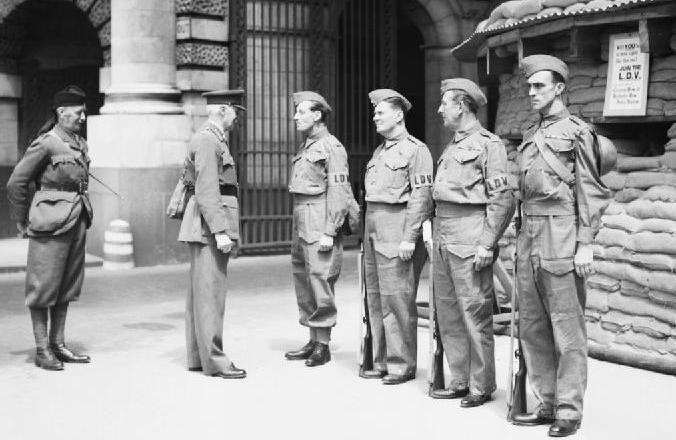
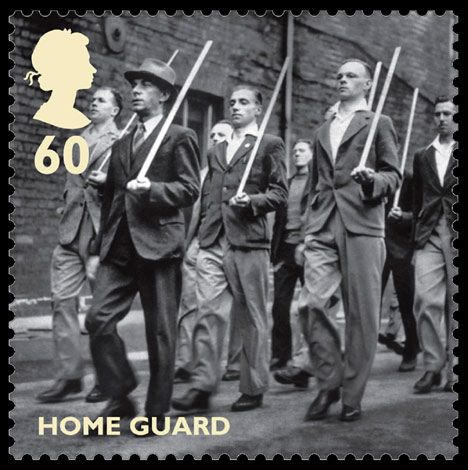
Eventually Lewis would wear another “military” uniform during the Second World War—that of the Home Guard (originally called the “Local Defence Volunteers”). But that is a curious story for another day. Lewis patrolled Oxford in a uniform similar to those portrayed in the photos on this page.

Lewis did not have formal personal ties to the Navy, although his maternal grandfather, a Church of Ireland priest, had served as chaplain in the Royal Navy.

During WWII Lewis developed a warm relationship with members of the Royal Air Force. He offered lectures at a number of installations and taught at the RAF Chaplain School. Although his first lecture began rather inauspiciously, his work with the airmen proved extremely fruitful.

Lewis is a fine example of the man of gentle demeanor who “does his duty” when called upon by his country. Had his lifetime not overarched two global conflicts, he would have been utterly content to remain a civilian and wear the “uniform” of an Oxbridge professor.

home guard


The Urgent Need for Chivalry

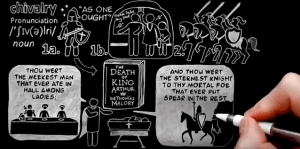
chivalryWith all the nations of the world engaged in power struggles—or cowering behind the protection of their more courageous allies—C.S. Lewis’ essay on “The Necessity of Chivalry” demands our attention.

Yes, the very word “chivalry” reeks of a bygone era that has been superseded and relegated to history books. But those who consider the concept outdated impoverish their lives and quite possibly contribute to the violent spirit of our age.

Warfare is not an abstract concept to the millions—yes, millions—of people who are surrounded by vicious threats every hour. Britain itself was in this position when Lewis penned these words during the Battle of Britain.

As he wrote, three days before Winston Churchill’s most famous speech, Lewis commended those same few to whom so many owed so much. It was 1940, and Germany’s advance had yet to be halted. Ultimate victory in the world conflagration would remain uncertain for years.

It is in this milieu, but not only for this context, that Lewis challenges us to combine the chivalrous values of meekness and ferocity.

Lewis argues that in the chivalrous “knight,” true humility and the capacity for great (but moral) violence are merged. The result is not a schizophrenic warrior, but a noble defender of what is good.

Indeed, even apart from wartime, it is vital that society has heroes to protect sheep from wolves. In a moment I will share with you a brief video featuring an amazing artistic rendering of this essay on chivalry.*

In the essay, Lewis’ examples span Western history. He uses Launcelot as the archetype of the chivalrous man. And he offers the hope and evidence that chivalry is not extinct. A veteran of the previous war, he wrote at the outset of the Second World War:

Launcelot is not yet irrecoverable. To some of us this war brought a glorious surprise in the discovery that after twenty years of cynicism and cocktails the heroic virtues were still unimpaired in the younger generation and ready for exercise the moment they were called upon. Yet with this “sternness” there is much “meekness;” from all I hear, the young pilots in the R.A.F. (to whom we owe our life from hour to hour) are not less, but more, urbane and modest than the 1915 model. (“The Necessity of Chivalry”)

And accordingly, in our own day there are many serving in uniform who exemplify the same virtues. Would, though, that all who bear arms could be described thusly.

Some who are reading these words may regard chivalry as a “sexist” concept. It is not. Certainly no more than courage, strength and virtue could be deemed such. The fact that Lewis’ historical examples of society’s defenders are men simply reflects history.

In the seventy-five years since he wrote, it has become evident that women too can easily embody both meekness and unyielding courage. One need look no further than the ranks of the military and law enforcement to see this borne out.

Chivalry for the Civilian

It would be a tragic mistake to think that chivalry is only required during war. It is a vital, daily necessity of all social life. And the increasing incivility of the world suggests its erosion. (Many attribute this in part to the anonymity of the internet, which allows bullies to savage others anonymously and without mercy.)

This is what Lewis was saying when he described Launcelot as being “not a compromise or happy mean between ferocity and meekness; he is fierce to the nth and meek to the nth.”

After all, it is not the bland or “lukewarm” person who makes this world a better place. It is upon chivalrous men and women that the majority of the vulnerable must ever rely.

Each of us needs to be willing to examine our own lives for the union of these two traits: courage that does not surrender to what is wrong, and meekness that is gentle, calm and patient with others.

These are the values that we need to promote in our communities, media and schools. Because what we instill in receptive minds is precisely that which will take root. To use more contemporary terms, the “programming” these young minds are subject to will directly influence the behaviors that they “output.”

Let us do all we are capable of, to be, and to raise up, what is chivalrous. After all, despite all of the utopian promises of those who believe humanity is capable of purifying itself, the evidence shows otherwise. As Lewis said,

There was, to be sure, a rumour in the last century that wolves would gradually become extinct by some natural process; but this seems to have been an exaggeration.

Enjoy this fine presentation of  “The Necessity of Chivalry.”

_____

* This video is a creation of CSLewisDoodle, about which I have written before. (Their name may sound quaint, but the expertise with which they visualize Lewis’ words is astounding.)

Misinterpreted Symbols

finn planeFew symbols evoke the intense reaction caused by the swastika. Regardless of the color in which it is rendered, it is inescapably associated with the Nazi insanity of the Third Reich.

And yet, for millennia it meant something else. And even today, in many lands it is recognized as representing something completely different.

I recently read a fascinating article* about the 1939-40 Winter War between the Soviet Union (Hitler’s “ally” at the time!) and tiny Finland. The Finns fought valiantly, and although in the peace settlement they forfeited territory to the insatiable communists, they inflicted terrible casualties on the aggressors.

Finnish bitterness toward the Soviets, due to their invasion, led them to ally with the Germans once the nonaggression pact between Germany and the Soviet Union ended. Without any sympathy for Nazi beliefs, they naturally hoped to regain the land they had been forced to surrender in 1940.

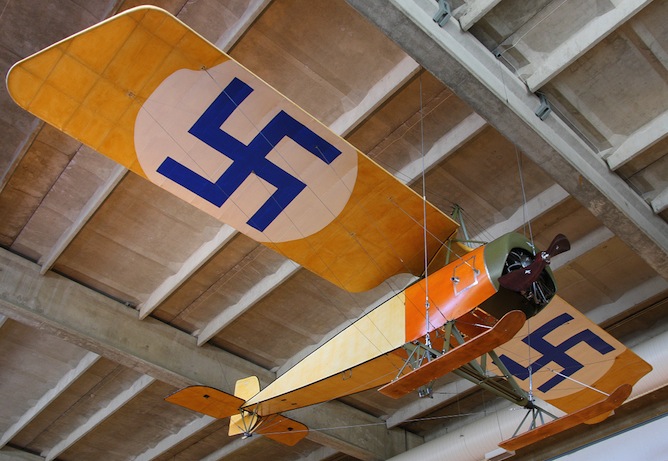
Prior to the Finnish alliance with Germany, the swastika already served as the official symbol of their small but talented Air Force. Ironically, they had adopted it in homage to the Swedish noble who donated one of the first foreign planes imported to fight the Russians.

The plane pictured above is the modest aircraft donated by Count Eric Von Rosen. The symbols adorning it are based on his personal crest, which was in turn based upon ancient Viking runes. It represented good luck.

After the decisive defeat of the National Socialist Party, the offensive symbol was virtually wiped away. However, as one writer says, “Although de-Nazification was enforced throughout Scandinavia, it was taken rather lightly in Finland, where the symbol had become an integral symbol for their Air Forces.

This is understandable because in Finland, the symbol meant something completely different than the common association linked to Hitler’s mania.

This should serve as an important lesson for those of us who work with words (which in large part are symbolic). A meaning we may consider patently obvious might turn out to be missed entirely by a reader for whom the “symbols” mean something else entirely. In Mere Christianity C.S. Lewis provides an entertaining illustration of this.

There is no need to be worried by facetious people who try to make the Christian hope of “Heaven” ridiculous by saying they do not want “to spend eternity playing harps.” The answer to such people is that if they cannot understand books written for grown-ups, they should not talk about them.

All the scriptural imagery (harps, crowns, gold, etc.) is, of course, a merely symbolical attempt to express the inexpressible. . . . People who take these symbols literally might as well think that when Christ told us to be like doves, He meant that we were to lay eggs.

The fact that we know the swastika has an ancient pedigree, and that it continues to mean something completely different than Nazism in some locales today, is unlikely to calm the minds of the vast majority of people who will never become comfortable with it.

Turning to Lewis once more we find a dynamic image that is perfectly apropos to our discussion of the swastika as a symbol. Symbols, he reminds us, are inherently powerful. Although written in a different context (“Williams and the Arthuriad”), Lewis could easily have had in mind the preeminent symbol of Nazism and the Holocaust when he wrote:

A symbol has a life of its own. An escaped metaphor—escaped from the control of the total poem or philosophy in which it belongs—may be a poisonous thing.

_____

* You can download a copy of “The Winter War” from Air Force magazine at this link.

Why War?

bulletsI recently read a profound statement penned by G.K. Chesterton. Although he was not a military veteran himself, he was absolutely on target when he wrote: “The true soldier fights not because he hates what is in front of him, but because he loves what is behind him.”

Terrible things are happening today in Syria. Yesterday, over lunch, I “debated” one of my sons regarding the merits (and drawbacks) of American intervention in that Levantine cauldron.

He believes we can’t “stand by” while the world watches as a civil war rages around another of the world’s mad dictators. I argued the United States isn’t morally responsible to serve as the world’s guardian of peace. And, even if we as a single, fallible, divided people were accountable . . . what about the violence and injustice in so very many other places. Sudan, Myanmar (Burma), the Congo, and scores of other lands cry out for intervention on behalf of the oppressed.

There is an almost unlimited amount of injustice around the globe today. And, looking in the mirror, it’s evident we have problems to resolve right here.

Sending American troops to intervene in foreign civil wars is ugly business. Taking sides against dictators does not always provide a safer and more just world—we need look no further than the so-called Arab Spring to reveal that.

I was proud to serve my nation—and causes I believed in—during the liberation of Kuwait and the retaliation for the September 11 attacks on the United States a decade later.

I am now retired from active duty, and I’ve lived long enough to witness how little positive fruit seems to follow war.

Like C.S. Lewis, I remain persuaded that some evils are so malevolent (Hitler, for example, comes to mind) . . . that they must be confronted. As he wrote in “The Conditions for a Just War,”

If war is ever lawful, then peace is sometimes sinful.

At the same time, however, war is something into which we should never rush. It demands our conscious consideration of the cost and an accurate determination that the blood spilled—include that of noncombatants inevitably caught up in the horror—is a price worth paying.

It is that question which moral men and women must debate and ponder.

“Learning in War-Time” is a brilliant essay included in the collection which goes by the name of Lewis’ speech, “The Weight of Glory.” In the essay, Lewis discusses the seriousness of war. As a combat casualty during the First World War, he vividly understood its nature.

However, as a Christian, Lewis recognized that warfare is not the worst thing that can befall a human being.

What does war do to death? It certainly does not make it more frequent: 100 percent of us die, and the percentage cannot be increased. It puts several deaths earlier, but I hardly suppose that that is what we fear. Certainly when the moment comes, it will make little difference how many years we have behind us.

Does it increase our chances of painful death? I doubt it. As far as I can find out, what we call natural death is usually preceded by suffering, and a battlefield is one of the very few places where one has a reasonable prospect of dying with no pain at all.

Does it decrease our chances of dying at peace with God? I cannot believe it. If active service does not persuade a man to prepare for death, what conceivable concatenation of circumstances would? Yet war does do something to death. It forces us to remember it.

True. To die at enmity with God is a fearful thing. Still, even better than coming to faith during war (Lewis would surely agree), is recognizing God’s love and living a life of peace.