Individualism, License Plates & C.S. Lewis

One of the peculiar things about the United States is the extreme degree to which people are driven to stand out from the crowd. We are able to do this with our automobiles, for example, in a rather odd way.

C.S. Lewis was immune to the temptation discussed here, since he was never a fan of cars, as I discussed in “C.S. Lewis & Automobiles.”

In his autobiography, Lewis declared “I number it among my blessings that my father had no car, while yet most of my friends had, and sometimes took me for a drive.” Those who are curious about Lewis’ dichotomy concerning vehicles, should refer to that post.

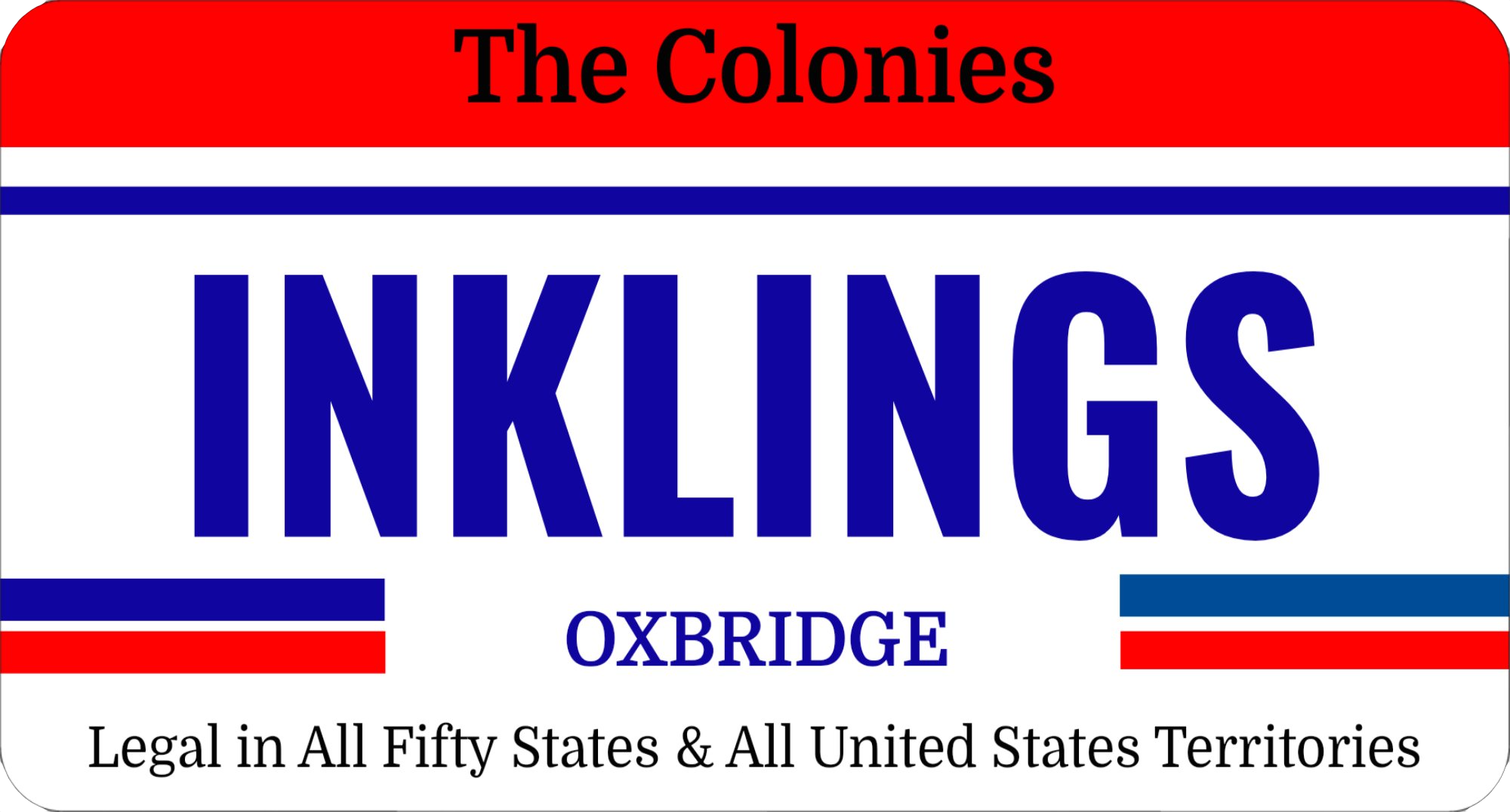
I don’t know how many other countries do this, but in most of the United States states, people have the option of getting random numbers and letters on their license plates – or opting for so-called vanity plates.

These individually emblazoned metallic placards perform a sort of Third Estate heraldic device. They often include variations on surnames or words significant to the bearer.

Obviously, offensive words are prohibited, but they are frequently quite creative. Here are a few examples: SO 4CHN8 and its opposite, EN-V ~  GONA B L8 which is probably an insufficient excuse to the cop who pulls you over ~ IBMEUBU with its live and let live philosophy versus URAMESS ~ UH AS IF from California, of course ~ IOU DAD from a grateful child ~ BWAHAHA and the clearer message from Vermont, BBRRRR ~ TWOCUTE can either refer to attractive twins, or to an illiterate narcissist ~ BBQ=LUV celebrates a common American favorite ~ and, this provocative phrase ITS A SIN. Hundreds more examples are online if you’re curious.

It’s fascinating that Americans will pay often exorbitant surcharges to individuate their auto plates. Especially in light of the fact that we already have different plates for each of the 50 states and a Federal District (for our national capital), as well as others for Territories and Protectorates. Prepare yourself. Seriously, prepare for a shock.

All of the 8,331 License Plates in America

States now offer a vast menu of personalized plate options for a dizzying array of organizations, professions, sports teams, causes and other groups.

Such plates typically include a surcharge to support the theme identified on each choice, as for Maryland’s Beekeepers, Barbershop Quartet Singers, or the Baltimore Bicycling Club. And we mustn’t forget their plate promoting the museum of the B&O Railroad (of Monopoly fame).

How can we arrive at that unbelievable number? Well, consider Illinois, for example. They boast no fewer than forty different options related to military alone. Hawaii has the fewest overall varieties at fourteen. Maryland, likely desperate for revenue, actually has nine hundred and eighty-nine. I am curious why they bothered to stop short of an even thousand.

Add to that the fact that nineteen states do not require a license on the front of the car, which invites the substitution of an individualized alternative. Consequently, there are statutes ensuring “most states also require that you do not mount your plate upside down.” In many of these, you would be legally allowed to mount decorative or business plates, but not alternative license plates, misleadingly different from your true registration.

Individuality run amok. The chaos sadly seems strikingly American.

Which brings me to the reason I was thinking about this unusual topic. Heading to church on Sunday I saw a plate with a curious message. It was one of my state’s options for Fire Fighters. The message it bore consisted of just three letters: UGH.

What does that convey to you? Since it appeared on a vocational emblem, my thought is that it reflects the feelings of someone who has grown tired of their profession. The best construction I can imagine is someone frustrated by the fact that after every fire they suppress there will come another. Resulting in a sense of futility or ennui. If you interpret it differently, please let me know.

I mean, we’ve all had ugh-days. But to feel ugh enough about life to indelibly express it this way . . . well, all I could do was hope it was an unconventional joke, and offer a quick prayer for the driver, in case it wasn’t.

C.S. Lewis offered many insights about our God-given individuality and uniqueness. Individualism, as a driving force, however, is something different. I recently read a wonderful article about how Lewis assessed individualism’ interplay with collectivism – two relentless forces in many Western cultures. “C.S. Lewis on Individualism, Equality and the Church” focuses on a World War Two speech delivered at Oxford and published as “Membership.”

Our personal uniqueness is not accidental. As C.S. Lewis wrote in The Problem of Pain,”

[God] makes each soul unique. If He had no use for all these differences, I do not see why He should have created more souls than one. Be sure that the ins and outs of your individuality are no mystery to Him; and one day they will no longer be a mystery to you.

In contrast, hyper-individualism is normally deleterious. Yet, the fact that God regards us as precious, irreplaceable beings, and calls each of us by our personal name, is wondrous news. It can accomplish two things related to the discussion above: (1) it puts personalized license plates in their proper perspective, and (2) it reminds us that even though we occasionally feel frustrated or despondent, our overall life attitude should never be summed up with an ugh.


Editor’s Note: In the interest of journalistic transparency, yours truly, while experiencing many moves, has participated in the automotive bacchanalia described above. Twice I secured military-related plates, Alabama’s Desert Shield/Desert Storm veterans and Illinois’ POW/MIA remembrance commemorations. In addition, while stationed in Guam, I secured plates with my surname.

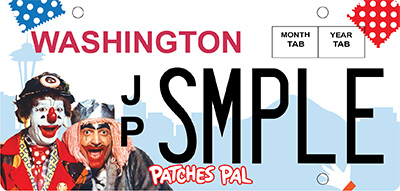
I have asked my children to have me hospitalized for dementia should I ever decide to order our Washington State J.P. Patches Pal license plate. The reasons for that decision are obvious.

C.S. Lewis and Flags

flag globe.png

Do you find flags interesting? Even inspirational, perhaps?

A recent article on the subject reminded me that one of my early avocations was as a vexillologist. If you also enjoy learning about flags, you can become a vexillologist too (ability to spell the title not required).

The article discussed the diversity of America state and territory flags. Some are rather mundane, featuring state seals on single colored fields. While my own Washington State flag falls into this category, the fact that the first president’s face dominates the seal makes it rather attractive. Many seals though, are terribly busy and jumbled.

The Nebraska flag is so bland that it once flew over the state capitol for several days, before anyone noticed it was upside down.

One of the most distinctive flags is that of New Mexico, which features “the sun symbol of the Zia Pueblo. The red and yellow imitate Spain’s national colors, paying tribute to the region’s colonial heritage.”

You can view all of the American flags here, if you are interested.

Or, if you are more interested in international flags, you can see and read about them here (compliments of the CIA).

The best part of the article, “Fifty Flags” by John J. Miller, is the author’s citation of C.S. Lewis.

The main purpose of a flag is to unite people behind patriotic, military, or civic causes. A good flag stirs emotions, tingling spines at Olympic ceremonies and encouraging soldiers to hold fast.

“In battle it is not syllogisms that will keep the reluctant nerves and muscles to their post in the third hour of the bombardment, wrote C.S. Lewis in The Abolition of Man. “The crudest sentimentalism . . . about a flag or a country or a regiment will be of more use.”

Inspired by this passage, I’ve gleaned several more references that the Oxford scholar makes to flags.

Quotations from C.S. Lewis Mentioning Flags

The flag serves as the emblem of a nation as it projects its image beyond its own borders.

After breakfast [Lord Bern] asked Caspian to order every man he had into full armor. “And above all,” he added, “let everything be as trim and scoured as if it were the morning of the first battle in a great war between noble kings with all the world looking on.”

This was done; and then in three boatloads Caspian and his people, and Bern with a few of his, put out for Narrowhaven. The King’s flag flew in the stern of his boat and his trumpeter was with him. (Voyage of the Dawn Treader)

The absence of a flag or identifiable markings leaves an enemy uncertain about how to proceed.

Inside, he was wondering if there were any way of getting rid of these unwelcome visitors. Had he known that Caspian had only one ship and one ship’s company with him, he would have spoken soft words for the moment, and hoped to have them all surrounded and killed during the night.

But he had seen a ship of war sail down the straits yesterday and seen it signaling, as he supposed, to its consorts. He had not then known it was the King’s ship for there was not wind enough to spread the flag out and make the golden lion visible, so he had waited further developments. (The Voyage of the Dawn Treader)

The enthusiastic waving of flags can be a visible manifestation of patriotic fervor. In a letter to his brother, written between the wars, Lewis describes conversation with an Anglican priest, William Stead, who had just returned from Italy.

Lewis is rather dismissive of the priest’s comparison of Italy and Great Britain because, unlike Lewis and his brother Warnie, the cleric had never been to the front lines.

Stead, fresh back from Venice and Rome, gave as his verdict that “Italy was a pleasant surprise to him. He had always imagined the Italians a degenerate people but found that they were really quite go ahead and up to date.”

They were also more patriotic than the English, for they were always waving flags and went mad over the name of Italy whereas “he had never found that Englishmen showed any great enthusiasm over the mention of England.”

They and their landscape were, he said, hardy and vigorous whereas one always felt the softness of England. Stead is an American and has not been to the war. (All My Road Before Me: The Diary of C. S. Lewis)

A flag can also be used to gain the attention of a friend or potential ally. Lewis uses the image in his first letter to Charles Williams, who would join him in the Inkling writing community. The story of their mutual respect is fascinating. Williams response to Lewis begins, “My dear Mr Lewis, If you had delayed writing another 24 hours our letters would have crossed.”

I never know about writing to an author. If you are older than I, I don’t want to seem impertinent: if you are younger, I don’t want to seem patronizing. But I feel I must risk it. A book sometimes crosses one’s path which is so like the sound of one’s native language in a strange country that it feels almost uncivil not to wave some kind of flag in answer.

I have just read your Place of the Lion and it is to me one of the major literary events of my life—comparable to my first discovery of George Macdonald, G. K. Chesterton, or Wm. Morris.

In “Religion Without Dogma?” Lewis includes a flag as one of the symbols with more inherent inspirational power than can be uncovered in a lifeless religion. He is discussing spiritualism, which offered supposed communication with ghosts wandering through an ill-defined afterlife.

A minimal religion compounded of spirit messages and bare Theism has no power to touch any of the deepest chords in our nature, or to evoke any response which will raise us even to a higher secular level—let alone to the spiritual life. The god of whom no dogmas are believed is a mere shadow. He will not produce that fear of the Lord in which wisdom begins, and, therefore, will not produce that love in which it is consummated.

The immortality which the messages suggest can produce in mediocre spirits only a vague comfort for our unredeemedly personal hankerings, a shadowy sequel to the story of this world in which all comes right (but right in how pitiable a sense!), while the more spiritual will feel that it has added a new horror to death—the horror of mere endless succession, of indefinite imprisonment in that which binds us all . . .

It can never be a controller or even a rival to our natural sloth and greed. A flag, a song, an old school tie, is stronger than it; much [stronger are] the pagan religions.

The flag can delineate the leading edge of an advance into enemy territory. Lewis uses this notion with great effect in his treatise on pain.

No doubt Pain as God’s megaphone is a terrible instrument: it may lead to final and unrepented rebellion. But it gives the only opportunity the bad man can have for amendment. It removes the veil; it plants the flag of truth within the fortress of a rebel soul. (The Problem of Pain)

In his essay “Answers to Questions on Christianity,” Lewis uses the flag as a metaphor for where one’s ultimate loyalty lies.

When I first became a Christian . .  . I thought that I could do it on my own, by retiring to my rooms and reading theology, and I wouldn’t go to the churches and gospel halls; and then later I found that it was the only way of flying your flag; and, of course, I found that this meant being a target.

It is extraordinary how inconvenient to your family it becomes for you to get up early to go to church. It doesn’t matter so much if you get up early for anything else, but if you get up early to go to church it’s very selfish of you and you upset the house.

If there is anything in the teaching of the New Testament which is in the nature of a command, it is that you are obliged to take the Sacrament, and you can’t do it without going to church.

A Final Observation on Flags & War

In one of Lewis’ less well-known essays, “Talking about Bicycles,” he discusses a fascinating procession through which many of our experiences pass. “Let’s give them names. They are the Unenchanted Age, the Enchanted Age, the Disenchanted Age, and the Re-enchanted Age.”

His illustration using the example of marriage is excellent, and accurately describes the chronicle of many if not most marital unions. It is, however, in his example related to war that he mentions the symbol of the flag.

Let’s take an example that may interest you more. How about war? Most of our juniors were brought up Unenchanted about war. The Unenchanted man sees (quite correctly) the waste and cruelty and sees nothing else.

The Enchanted man is in the Rupert Brooke or Philip Sidney state of mind [both were poets whose lives were cut violently short in war]—he’s thinking of glory and battle-poetry and forlorn hopes and last stands and chivalry.

Then comes the Disenchanted Age—say Siegfried Sassoon [another poet who survived WWI, in contrast to his contemporary, Brooke].

But there is also a fourth stage, though very few people in modern England dare to talk about it. You know quite well what I mean. One is not in the least deceived: we remember the trenches too well. We know how much of the reality the romantic view left out.

But we also know that heroism is a real thing, that all the plumes and flags and trumpets of the tradition were not there for nothing. They were an attempt to honour what is truly honourable: what was first perceived to be honourable precisely because everyone knew how horrible war is. And that’s where this business of the Fourth Age is so important.

C.S. Lewis did, indeed, recall the trenches. He understood the horrors of war, but had matured in his viewpoint to become reenchanted with its glory. Flags, pennants and guidons are visible emblems of its chivalry and honor. Lewis would certainly concur with the declaration of Robert E. Lee, commander of the Confederate States of America army, that “it is well that war is so terrible, otherwise we should grow too fond of it.”

Fortunately, flags fly far more commonly in peace than they do in war. Their peaceful fluttering is far more familiar to the masses than their battle shorn visage. May that always remain true.

_____

The image at the top of the page is copyrighted by its creator, Joel Lisenby, and used with permission.