
Elven Inspiration from Space

A newly captured image of a supernova remnant in our Milky Way galaxy has me curious about where J.R.R. Tolkien may have gained inspiration for the elegant style of his Elvish scripts.*

America’s NASA has gifted all of Earth’s citizens with an array of stunning, and enlightening images. Recently, the James Webb Space Telescope directed its focus to Cassiopeia A, created thousands of years ago when a star 11,000 light years away went supernova. 

It may be my imagination, or perhaps its an elevated mental talent for “core object recognition,” but for some inscrutable reason, I have recognized in the aftermath of the explosion faint echoes of Elvish script.

The light from Cassiopeia A (or Cas A, as we pseudo-astronomers refer to it) “first reached us around 340 years ago. As that was approximately 272 years before The Lord of the Rings was published, Tolkien had ample time to analyze the spectacular light source. Even factoring in the fact that the stories were composed between 1937 and 1949, the supernova’s existence had been known for a millennia and a half before LOR was written. 

I will leave it to other researchers to determine just how Tolkien was able to gain a detailed view of the explosion’s aftermath. My purpose here is to simply alert the public to the unexplainable parallel between the cosmic residue and Tolkien’s own renditions of Elvish writing as he perceived it. 

In a moment, I will allow the self-evident facts to speak for themselves.

Like his friend C.S. Lewis, Tolkien was a student of astronomy. As Professor Kristine Larsen says, “J.R.R. Tolkien based the stars and constellations of his created world of Middle-earth on ‘real world’ astronomy.” Dr. Larsen, a preeminent “Tolkienian Astronomer,” has published widely on the subject. 

Of particular interest to readers of Mere Inkling will be “Medieval Cosmology and Middle-earth: A Lewisian Walk Under Tolkienian Skies,” which can be downloaded here. In the essay, Larsen points out,

. . . as is well known in Tolkien scholarship, during and after writing The Lord of the Rings Tolkien made various attempts to more closely align his cosmology with 20th century astronomical knowledge.

Fortunately for those of us who are drawn to the mythological textures of his legendarium, Tolkien never completed this “radical transformation of the astronomical myth” (as son Christopher termed it), but it is important to understand that this tension existed within Tolkien’s mind.

Having narrowly escaped the snare of surrendering to twentieth century astronomical theories, Tolkien preserved the mythical spirit of his cosmology. Larsen’s essay considers “whether or not Tolkien’s subcreation would, in reality, pass muster as a medieval cosmology, as defined by Lewis.” Thesis established, she takes readers on a pleasing journey. “So let us take a stroll under Middle-earth skies, and observe just how well the Dome of Varda matches with Lewis’s challenge.”

Returning to Cas A

As the images below will clearly illustrate, the preservation of the medieval nature of Middle Earth’s heavens does not mean that Tolkien ignored the realities of interstellar space. As I said a moment ago, the visual proof is definitive.
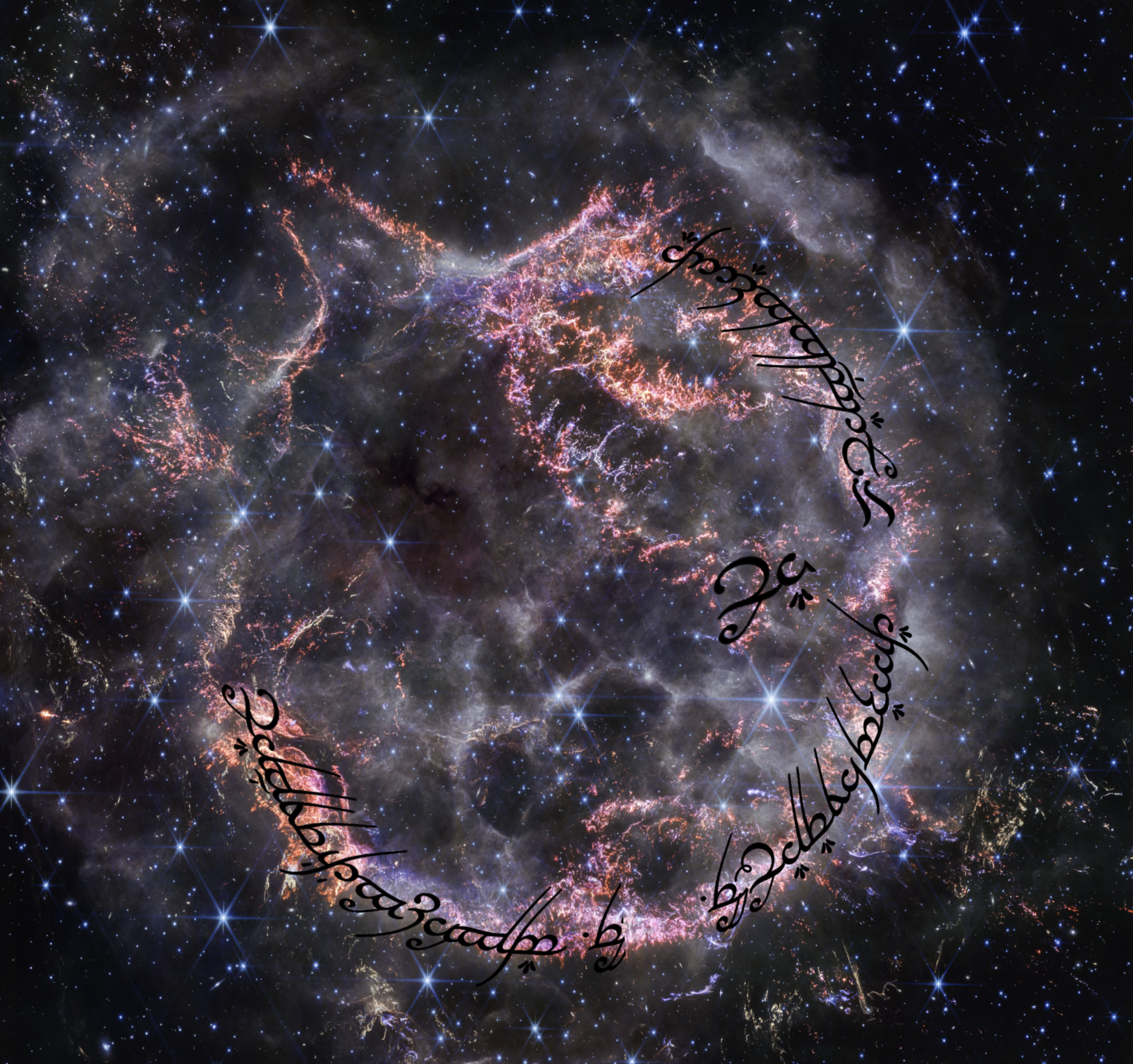
The fluid strokes of Tolkien’s Elven scripts are clearly foreshadowed in the plumes of this cosmic canvas. 
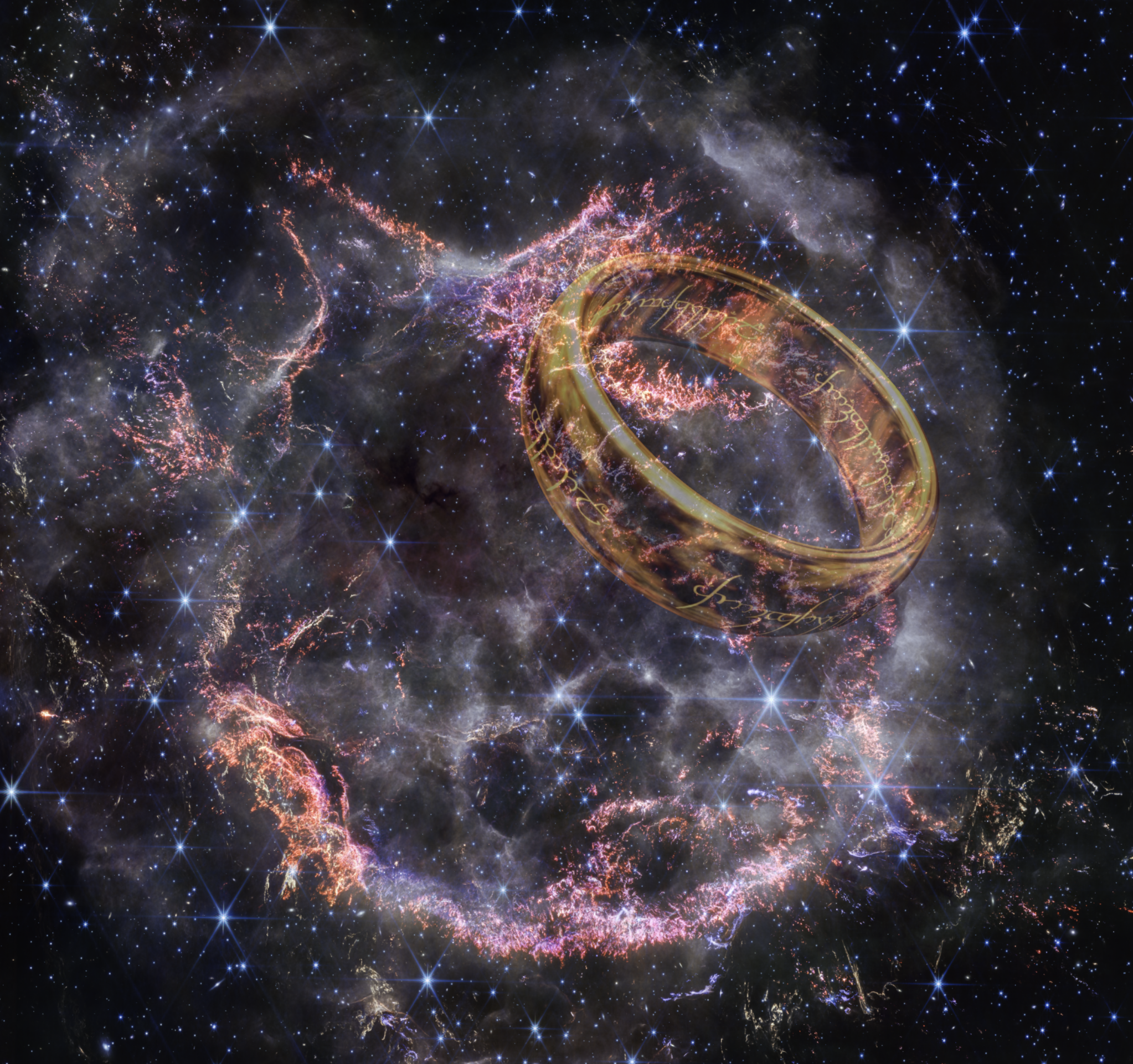
This image speaks fluently for itself.
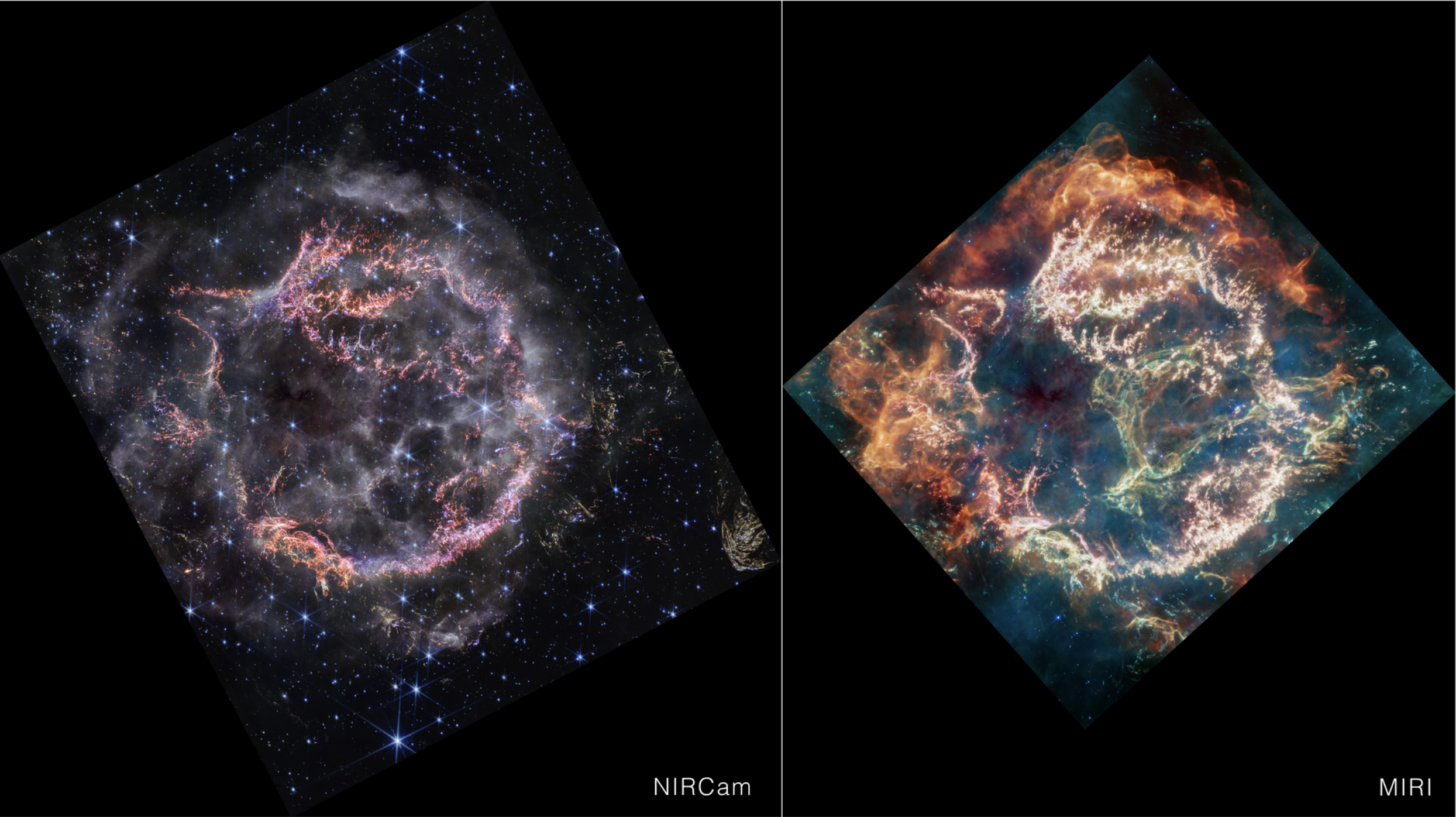
This pair of images from NASA contrasts the Near-Infrared and Mid-Infrared observations. It is quite possible the second influenced J.R.R. Tolkien’s perceptualization of Sauron’s eye. (Admit it, you see the dramatic similarities.)

We may never learn how Tolkien was able vividly see the details of Cassiopeia A with the earthbound telescopes accessible eighty years ago. Nevertheless, the evidence provided herein is irrefutable.

It seems fitting, when pondering the majesty of the stars as echoed in a masterpiece of literary subcreation, to close with an observation by Tolkien’s friend, C.S. Lewis. In an early letter to a close friend, Lewis described the wonder he experienced in reading Dante’s Paradise.

Here Lewis lyrically shares an experience of spiritual ecstasy which, this writer humbly suggests, can be shared by many, as we stand in awe of the majestic intricacy of the universe our Creator has fashioned.

[I read] Aristotle’s Ethics all morning, walk after lunch, and then Dante’s Paradiso for the rest of the day. The latter has really opened a new world to me. I don’t know whether it is really very different from the Inferno [Owen Barfield] says it’s as different as chalk from cheese – heaven from hell, would be more appropriate!) or whether I was specially receptive, but it certainly seemed to me that I had never seen at all what Dante was like before.

Unfortunately the impression is one so unlike anything else that I can hardly describe it for your benefit – a sort of mixture of intense, even crabbed, complexity in language and thought with (what seems impossible) at the very same time a feeling of spacious gliding movement, like a slow dance, or like flying. It is like the stars – endless mathematical subtility of orb, cycle, epicycle and ecliptic, unthinkable & unpicturable, & yet at the same time the freedom and liquidity of empty space and the triumphant certainty of movement.

I should describe it as feeling more important than any poetry I have ever read. . . . Its blend of complexity and beauty is very like Catholic theology – wheel within wheel, but wheels of glory, and the One radiated through the Many (The Letters of C.S. Lewis to Arthur Greeves).

Perhaps it was one of these very wheels – or rings – that Tolkien observed so many years ago in the heavens?


* For those who are interested in fonts for your computers, you can download Tolkien-inspired typefaces here.

Free Books Offered Monthly

Would you like to receive free books for the simple exchange of a short, honest review of them? If so, join me at LibraryThing. Best of all, they offer additional benefits for readers (and writers).

You may already have a free account there, since they offer a book cataloging system connecting you to fellow readers, which appeals to many book lovers.

They also offer TinyCat, which is a sophisticated cataloging system designed for small libraries. And it is free for personal use! I don’t have the time to input my own library, despite all of their tools for making that easy, but it could well work for you. [Warning: if your library includes more than 20,000 items, it may be a tad too large.]

Requesting a book for review is simple. Each month they list a bunch of new, mostly self-published titles that are available. You express your interest and they distribute the quantity that are available. You can see current offerings here: LibraryThing Early Reviewers.

The truth is that I rarely request a title. The vast majority are fiction, while my tastes strongly lean toward nonfiction. Even there, available time restricts my interests to a handful of topics. Still, I wrote a review about a book I received entitled  A Curmudgeon’s Guide to Postmodern Times: Aphorisms. (I am a sucker for thought-provoking maxims, especially if they are witty.) More on my review in a moment.

In the past I’ve written book reviews for military and theological journals. Most publications offer specific guidelines as to what they desire in a review. If you opt to ignore these, you are wasting everyone’s time. Most online sites are more tolerant.

Writing Book Reviews

Writing effective reviews is an art in itself. To do it well requires some conscious effort. To simply describe something as “good” or “boring” is basically not worth the effort. You need to think about what you, as a potential reader, are interested in knowing about a title before you invest your time and money in procuring it.

It appears there are hundreds of online sites describing the process. This one from Grammarly is a quick, clear read. One piece of their advice relates directly to my latest review.

Remember that you’re reviewing a book that another human poured their heart and soul into to write. Express your honest opinion, but don’t be nasty about it.

That sentiment is similar to one I just read in an old magazine I was perusing.

Concerning satire, I’ve always followed the rule laid down by an old college professor: “I only pick on those I love.” If I have trouble loving someone, it’s better if I refrain from jokes, satire, and teasing.

C.S. Lewis & the Art of Reviewing Books

If one were to tally all the reviews that have been written about the works of C.S. Lewis, their number might rival the grains of sand spread around the world’s beaches.*

It is unsurprising that Lewis, being a professor of English literature, wrote a significant number of book reviews himself. Some of the most notable are gathered in Image and Imagination. While the volume includes a number of valuable essays, it is the collection of his published book reviews which are of interest to us today.

You see, in Image and Imagination we encounter ten of his reviews written about books authored by his fellow Inklings. These include Owen Barfield, J.R.R. Tolkien and Charles Williams. The volume is edited by Walter Hooper, who ably introduces each of the reviews, and provides unique insight. For example, he notes C.S. Lewis’ ongoing debate with Owen Barfield about anthroposophy.

Barfield’s conversion to Anthroposophy . . . marked the beginning of . . . the ‘Great War’ between [the two friends]. . . . While the ‘Great War’ had ended years before, the problem Lewis faced in reviewing Romanticism Comes of Age is that it contains in the Introduction and other places Barfield’s ‘case’ for Anthroposophy (“Who Gaf Me Drink?”).

Lewis’ review of the culmination of the Lord of the Rings is worth the full price of the collection. Doesn’t the following ring true?

The other excellence is that no individual, and no species, seems to exist only for the sake of the plot. All exist in their own right and would have been worth creating for their mere flavour even if they had been irrelevant.

Treebeard would have served any other author (if any other could have conceived him) for a whole book. His eyes are ‘filled up with ages of memory and long, slow, steady thinking.’

Through those ages his name has grown with him, so that he cannot now tell it; it would, by now, take too long to pronounce. When he learns that the thing they are standing on is a hill, he complains that this is but ‘a hasty word’ for that which has so much history in it (“The Dethronement of Power”).

On My Review of the Curmudgeon’s Concerns

My recent review (to which I referred above) was not easy to write. What made it difficult was my mixed opinion of the aphorisms chosen for the publication. Most were quite interesting, and a few were downright brilliant. The problem was the strong bias of the author when he addressed two “controversial” topics – politics and religion.

Unlike Mark Twain, to whom I refer in the review, this author forsakes humor when he deplores subjects with which he disagrees. Twain made it clear how he stood, but usually in a manner that left even his opponents entertained. This particular book is much more “curmudgeonly,” in that some of it is delivered in an ill-tempered, alienating manner.

If you are curious in seeing how I threaded the needle of honestly reviewing a book with problematic material, you can read it here. While praising many aspects of the book, I did make one critical observation related to an aphorism related to The Chronicles of Narnia.

Greene even invokes my favorite author to mischaracterize Christianity. “C.S. Lewis depicted God as a lion. The lion, of course, is a predator.” So much for agnus dei and Aslan’s manifestation as a lamb.

A Final Encouragement

If you are a writer, or an aspiring writer, consider writing some book reviews. It can provide a more welcoming entrée into the publishing world than other features. Write it in a style similar to the reviews they normally run, and be sure to read any guidelines they provide for contributions. As with other submissions, it’s best to query first. Best of luck!


* The World Atlas estimate of 2.5 to 10 sextillions may suggest this estimate of Lewisian reviews may be hyperbole. But at least I did not refer to the number of stars, which is estimated at 10 to 200 sextillion.