Anxiety & Nighttime

Everyone experiences some anxiety, but it is only considered a “disorder” when it negatively affects one’s quality of life. Sadly, that level has been reached by nearly twenty percent of Americans.

An estimated 19.1% of U.S. adults had an anxiety disorder in the past year. Past year prevalence of any anxiety disorder was higher for females (23.4%) than for males (14.3%). An estimated 31.1% of U.S. adults experience any anxiety disorder at some time in their lives (National Institute of Mental Health).

As one specialist puts it, “there’s a very strong, well-documented bidirectional link between sleep and mental health issues like anxiety.” And it can become a vicious cycle: “If you have poor sleep, you’re at greater risk of a mental health issue. And if you have a mental health condition like anxiety, you’re more likely to develop a sleep disorder.”

Those “disorder” figures are only for anxiety passing a problematic threshold. Feeling some anxiety is a normal part of life, even for Christians. (Fortunately, however, we have an Intercessor who alleviates anxiety in our fallen lives.)

Do not be anxious about anything, but in everything by prayer and supplication with thanksgiving let your requests be made known to God. And the peace of God, which surpasses all understanding, will guard your hearts and your minds in Christ Jesus (Philippians 4:6-7).

The universality of experiencing anxiety is evidenced by the etymology of the word itself. The Latin anxius simply means troubled or worried (i.e. anxious). 

In his classic Letters to Malcolm: Chiefly on Prayer, C.S. Lewis addresses the negativity associated with being anxious, that actually worsens the problem.

Some people feel guilty about their anxieties and regard them as a defect of faith. I don’t agree at all. They are afflictions, not sins. Like all afflictions, they are, if we can so take them, our share in the Passion of Christ.

So, if most of us admit to experiencing some worry, the question posed by a recent article in TIME is whether the anxiety peaks at night. While not universal, “research has long suggested that, for many people, anxiety symptoms spike and mental health otherwise suffers at night.” While the piece cited several reasons, it left out two causes I consider self-evident.

The article points to studies about how substance abuse and suicidal behavior rise “after midnight,” and how “the racing thoughts that plague many anxiety sufferers are at their worst in the evening.” While I didn’t read the linked research, these statements are simply descriptive of the problem.

As for identified causes, the studies point to our diminished ability to “regulate emotions” as we tire. The issue of isolation is noted as a second factor, since “the rest of the world is asleep.” Further, the lack of daytime distractions may set the stage for “runaway anxiety” as we ponder the “what ifs” of the future. Another logical finding is that anxiety builds as we sleep poorly because we are worrying, which makes us prone to becoming even more anxious.

So What are the Uncited Factors?

First, it seems to me that the darkness of night itself is a major consideration. Since primordial times, night was foreboding. Sharpened wooden or stone-tipped weapons offered little enough defense when we could see predators (beast or human). Our ability to make fires and light candles ignited trifling circles of light that barely penetrated the shadows.

The uncertainty about what lurks in those shadows remains with us today. Just consider how quickly chaos can arise when there are power outages and the “protection” offered by light instantly evaporates.

Related to this is the simple fact that bad things (like crimes), increase during darkness. While many unlawful acts certainly occur during daylight hours, many of the most violent and heinous crimes, such as rape, occur after the sun sets. You can compare many variables at this website

It is simply common sense to recognize we are more vulnerable to violent attack when darkness masks attackers’ identities. The Book of Job vividly describes this lawless predilection.

There are those who rebel against the light,
    are not acquainted with its ways,
    and do not stay in its paths.
The murderer rises before it is light,
    that he may kill the poor and needy,
    in the night he is like a thief.
The eye of the adulterer also waits for the twilight,
    saying, ‘No eye will see me;’
    he veils his face.
In the dark they dig through houses;
    by day they shut themselves up;
    they do not know the light.
For deep darkness is morning to all of them;
for they are friends with the terrors of deep darkness (Job 24:13-17).

While the increased criminal behavior during darkness may have been omitted due to the tacit acknowledgment that it is a factor, my second observation was quite possibly overlooked due to ignorance or prejudice.

The Spiritual Consideration

I am convinced there is a spiritual component to our wariness related to darkness. Even those secularists dismissive of this reality would likely recognize this as a common perception. After all, it is no accident that stories (ancient and modern) depict wicked gatherings and malevolent supernatural events as taking place primarily at night.

The Scriptures discuss this Light/Dark dichotomy extensively. One of the clearest examples comes in the explanation for why sinful people choose to reject the coming of Christ.

In the beginning was the Word, and the Word was with God, and the Word was God. . . . In him was life, and the life was the light of men. The light shines in the darkness, and the darkness has not overcome it. . . .

[Jesus said] “For God so loved the world, that he gave his only Son, that whoever believes in him should not perish but have eternal life. For God did not send his Son into the world to condemn the world, but in order that the world might be saved through him. Whoever believes in him is not condemned . . . the light has come into the world, and people loved the darkness rather than the light because their works were evil.

For everyone who does wicked things hates the light and does not come to the light, lest his works should be exposed. But whoever does what is true comes to the light, so that it may be clearly seen that his works have been carried out in God” (John 1–3, selected verses).

Because darkness helps mask unsavory behavior, author Dave Jenkins advises people to be vigilant regarding their own temptations. He shares his personal story attesting to his contention that “night time for many men and women is danger time.”

This certainly is not God’s desire for any of us. As “The Godliness of a Good Night’s Sleep” concludes, “sleep, it seems, is no fallen necessity, nor merely a fleshly temptation, but a divine gift.”

In The Screwtape Letters, C.S. Lewis’ brilliant exploration of diabolic strategies, the senior demon advises his protégé, how to rob humanity of this blessing.

There is nothing like suspense and anxiety for barricading a human’s mind against the Enemy. He wants men to be concerned with what they do; our business is to keep them thinking about what will happen to them.

But fortunately, humanity’s first Enemy does not have the final say in the matter.

Even During the Darkest Night

We need never be alone nor despair in the night. In fact, even the trials posed by anxiety can become a pathway to a more intimate reliance and relationship with God.

Perhaps most famously, this concept has been associated in Christian circles with “Dark Night of the Soul,” a poem written by Saint John of the Cross in the sixteenth century. In an upcoming post, we will consider John’s life and the controversial actions which followed his death.


The Church at War

Why would Christian Scriptures commend people for waging war? War, after all, is nearly universally condemned – even as it remains a relentless curse in various corners of our world.

One young pastor was “charged” with a duty that belongs, by biblical extension, to all believers. “This charge I entrust to you [that] you may wage the good warfare, holding faith and a good conscience” (1 Timothy 1).

The reason followers of Jesus are encouraged to actively train for and engage in war is because our enemies are not other human beings. We discussed this fact in our last conversation, as we considered the theological concept of the Church Militant.

To call the Body of Christ “militant” is misleading to those who don’t understand spiritual warfare, the fact that “we do not wrestle against flesh and blood, but against . . . the cosmic powers over this present darkness . . .” (Ephesians 6).

Unfortunately, because all of us are imperfect (i.e. fallen), Christians can sometimes fail to distinguish between our true enemies and those who witlessly follow their banner. For an excellent discussion of this, from a Roman Catholic perspective, I recommend you read “The Church Militant or the Church Belligerent?

Another worthwhile read is “G.K. Chesterton and the March of the Church Militant.” There, Joseph Pearce shares Chesterton’s vivid description about how Gothic cathedrals visualize the martial aspect of the Christian Church.

The truth about Gothic [architecture] is, first, that it is alive, and second, that it is on the march. It is the Church Militant; it is the only fighting architecture.

All its spires are spears at rest; and all its stones are stones asleep in a catapult. In that instant of illusion, I could hear the arches clash like swords as they crossed each other. The might and numberless columns seemed to go swinging by like the huge feet of imperial elephants.

The graven foliage wreathed and blew like banners going into battle; the silence was deafening with all the mingled noises of a military march; the great bell shook down, as the organ shook up its thunder.

The thirsty-throated gargoyles shouted like trumpets from all the roofs and pinnacles as they passed; and from the lectern in the core of the cathedral the eagle of the awful evangelist crashed his wings of brass (“The Architect of Spears”).

As a master of words and wit, Chesterton’s writing rarely disappoints. You can download a free copy of The Man Who was Chesterton, which includes this essay, from Internet Archive.

C.S. Lewis did more to equip us for spiritual warfare with The Screwtape Letters than a thousand clergy with a hundred thousand sermons. As one Baptist theologian summed it up in an article about spiritual warfare:

On the subject of spiritual warfare, Lewis is a helpful guide. I’ll remember what he taught: There is an enemy. He seeks my destruction. And this is war.

There is a brilliant quote about this supernatural confrontation, ascribed (apparently in error) to the historical Martin Luther.

If I profess, with the loudest voice and the clearest exposition, every portion of the truth of God except precisely that little point which the world and the devil are at that moment attacking, I am not confessing Christ, however boldly I may be professing Christianity.

Where the battle rages the loyalty of the soldier is proved; and to be steady on all the battle-field besides is mere flight and disgrace to him if he flinches at that one point.

C.S. Lewis echoes this sentiment in The Magician’s Nephew. When Aslan questions the humble man whom he would crown the first King of Narnia, he poses a query which reveals the man’s courage and humility.

“And if enemies came against the land (for enemies will arise) and there was war, would you be the first in the charge and the last in the retreat?”

“Well, sir,” said the Cabby very slowly, “a chap don’t exactly know till he’s been tried. I dare say I might turn out ever such a soft ’un. Never did no fighting except with my fists. I’d try – that is, I ’ope I’d try – to do my bit.”

“Then,” said Aslan, “you will have done all that a King should do.”

If anyone would follow Christ, neutrality is not an option. Though some temporary retreats are inevitable, in God’s strength, we are empowered to continue our (in reality, the Lord’s) advance.

The battlelines are drawn, and they are real. As C.S. Lewis proclaimed in “Christianity and Culture” – “There is no neutral ground in the universe. Every square inch, every split second is claimed by God, and counterclaimed by Satan.”


The image above, “Livonian Sword Brother” (a member of a military monastic order) was created by JLazarusEB and is used here in compliance with the Creative Commons CC BY-NC-ND 3.0 License.

Thoughts on the Church Militant

C.S. Lewis understood better than most the spiritual warfare that rages, unseen for the most part, around all human beings.

And, as veterans of the bloody trenches of the First World War, Lewis and his good friend J.R.R. Tolkien had learned more than they desired about the tactics and sheer violence of combat.

Many of those wartime lessons translated directly into a spiritual context. However, I recently realized how poorly the concept of immobile trenches relates to our challenge to take up our crosses and follow our Savior.

You see, the Christian life is many things, but there is one thing discipleship never is – static. As theologian Tilemann Heshusius (1527-1588) wrote: “Christian soldiers always either advance or retreat.”

In battle there is nearly always an ebb and a flow, as forces advance on one front and temporarily shift back on another. In his essay “The World’s Last Night,” C.S. Lewis observes “In battle men save their lives sometimes by advancing and sometimes by retreating.” The same is true for the Christian life in general. We are either advancing, or falling back. Our relationship with God is not stagnant.

The New Testament includes many military metaphors and allusions, intended to equip us for victory in our spiritual battles.

The Apostle Paul refers to believers as “fellow soldiers.” In a letter to a young pastor, he extols the model of the soldier, who keeps his focus on the mission.

Share in suffering as a good soldier of Christ Jesus. No soldier gets entangled in civilian pursuits, since his aim is to please the one who enlisted him.

Then there is the familiar passage which uses the image of the “whole armor of God” to describe in detail how Christians are to be prepared for faithful service. You can read the entire passage here.

These military accoutrements are necessary because “we do not wrestle against flesh and blood, but against the rulers, against the authorities, against the cosmic powers over this present darkness, against the spiritual forces of evil in the heavenly places” (Ephesians 6:12).

This is the reason one aspect of the Christian Church’s nature has been described as the “Church Militant.” This describes the Church battling evil while awaiting Christ’s return, for the Final Judgment, when it will become the “Church Triumphant.” The former is the context for familiar hymns such as “Onward Christian Soldiers,” composed by a prolific Anglican priest in the nineteenth century.

Onward, Christian soldiers,
   marching as to war,
With the cross of Jesus
   going on before!

Christ, the royal Master,
leads against the foe;
Forward into battle,
see his banner go!
     . . .

At the sign of triumph
   Satan’s host doth flee;
On, then, Christian soldiers,
   on to victory!

Hell’s foundations quiver
   at the shout of praise;
Brothers, lift your voices,
   loud your anthems raise.

The WWI trenches are the archetype of static, immobile frontlines. Disease festered, and morale decayed like the muck sucking at the soldiers’ boots. As recognized by sixteenth century theologians and C.S. Lewis alike, wars are rarely won simply by maintaining a defensive position. Movement is an essential element of warfare.

Hopefully more of that movement consists of advances against the enemy, than retreats. But we will consider that aspect of spiritual war in our next post.

Until Then

Those interested in learning more about military strategy, particularly as explored by another veteran of the War to End All Wars, Sir B.H. Liddell Hart,* like Lewis and Tolkien, returned home to Britain from the front lines, as a casualty. (Britannica states more than a third of the British forces became casualties, in contrast to 76% of Russians, 73% of French, and 8% of Americans.)

Liddell Hart’s wisdom extends beyond the battlefield itself.

The downfall of civilized states tends to come not from the direct assaults of foes, but from internal decay combined with the consequences of exhaustion in war (“The Objective in War,” a lecture delivered in 1952 to the United States Naval War College).


* Sir Basil Henry Liddell Hart (1895-1970) was a military historian and theoretician. A number of his works are in the public domain and available for free download from Internet Archives. These include A Greater than Napoleon, Scipio Africanus and Why Don’t We Learn from History?

When the Angel is a Demon

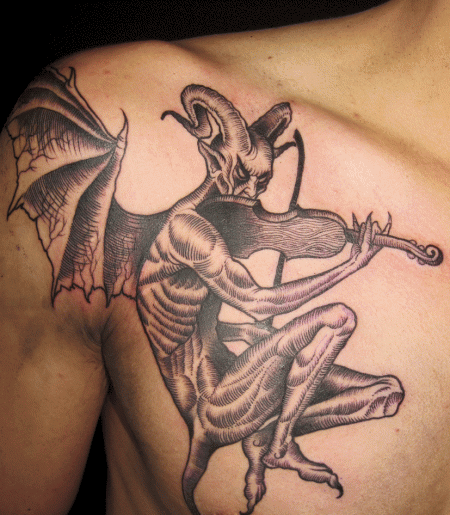
devil tatoo

Not every supernatural being claiming to be an angel really is.

C.S. Lewis’ most familiar discussion of fallen angels (also refered to as demons) appears in The Screwtape Letters. In the preface, he describes the equally disastrous errors people can fall into when pondering the occult.

There are two equal and opposite errors into which our race can fall about the devils. One is to disbelieve in their existence. The other is to believe, and to feel an excessive and unhealthy interest in them. They themselves are equally pleased by both errors, and hail a materialist or a magician with the same delight.

In a separate discussion, Lewis acknowledges the different opinions Christians can have on the subject, and he notes that it is not a salvific concern.

No reference to the Devil or devils is included in any Christian Creeds, and it is quite possible to be a Christian without believing in them. I do believe such beings exist, but that is my own affair. Supposing there to be such beings, the degree to which humans were conscious of their presence would presumably vary very much.

I mean, the more a man was in the Devil’s power, the less he would be aware of it, on the principle that a man is still fairly sober as long as he knows he’s drunk. It is the people who are fully awake and trying hard to be good who would be most aware of the Devil . . .

Of course, they don’t want you to believe in the Devil. If devils exist, their first aim is to give you an anaesthetic—to put you off your guard. Only if that fails, do you become aware of them. (“Answers to Questions on Christianity”)

I have mentioned in the past one of my seminary professors who served in Madagascar as a medical missionary. He had since become a successful psychiatrist. When he left for Africa, he did not believe in the existence of demons.

A final observation about demons, or devils as he typically refers to them: they act in a manner opposite to God. In That Hideous Strength, he includes the observation that, “In fighting those who serve devils one always has this on one’s side; their Masters hate them as much as they hate us.”

This echoes a truthful dialectic.

God loves everyone, even those who hate him. While Lucifer hates everyone, even those who love him.

An Ancient Illustration

I’ve been reading recently wisdom from the Desert Fathers and Mothers. They left ancient Roman cities to pursue spiritual growth as hermits and monks beginning in the middle of the third century.

The history of Christian monasticism is fascinating. All the way up to our own day, male and female monastics of Orthodox, Roman Catholic, and Protestant traditions have pursued holiness by this particular path.

A common occurrence for desert monks involved waging spiritual warfare of a more intense nature than most of us ever experience. I particularly enjoyed the following encounter (which reminded me of Martin Luther’s advice about ridiculing Satan and his minions). The following episode comes from an ancient collection of Desert sayings.

“The devil appeared to a monk disguised as an angel of light, and said to him, ‘I am the angel Gabriel, and I have been sent to you.’ But the monk said, ‘Are you sure you weren’t sent to someone else? I am not worthy to have an angel sent to me.’ At that the devil vanished.”

Good riddance, C.S. Lewis and I would agree.


The image above is of a tattoo whose “wearer” will one day experience great remorse.