
Interplanetary Life

death valley stars

How many galaxies exist out there? How many stars? How many planets? Billions upon billions, apparently.

Of all of those myriad worlds, how many boast life?

C.S. Lewis pondered that subject in an essay entitled “Religion and Rocketry.” He said that either result—an absence of life, or an abundance of living creatures throughout the cosmos—can be used by atheists to deny the existence of our Creator.

In my time I have heard two quite different arguments against my religion put forward in the name of science. When I was a youngster, people used to say that the universe was not only not friendly to life but positively hostile to it.

Life had appeared on this planet by a millionth chance, as if at one point there had been a breakdown of the elaborate defenses generally enforced against it. We should be rash to assume that such a leak had occurred more than once. Probably life was a purely terrestrial abnormality. We were alone in an infinite desert. Which just showed the absurdity of the Christian idea that there was a Creator who was interested in living creatures.

But then came Professor F.B. Hoyle, the Cambridge cosmologist, and in a fortnight or so everyone I met seemed to have decided that the universe was probably quite well provided with habitable globes and with livestock to inhabit them. Which just showed (equally well) the absurdity of Christianity with its parochial idea that Man could be important to God.

Lewis, brilliant and honest, then predicts the future. Believers and cynics alike, he says, will seek to interpret all new data in a fashion that proves their own, preexisting beliefs.

This is a warning of what we may expect if we ever do discover animal life (vegetable does not matter) on another planet. Each new discovery, even every new theory, is held at first to have the most wide-reaching theological and philosophical consequences.

It is seized by unbelievers as the basis for a new attack on Christianity; it is often, and more embarrassingly, seized by injudicious believers as the basis for a new defence.

Fascinating as these comments are, they merely represent Lewis’ introduction to the subject. The heart of his concern is this—what would it mean if we should one day encounter alien beings created by God on a distant world?

In a moment I’ll share with you one of the most provocative thoughts Lewis expresses in this essay, but first take a moment to watch this amazing reminder of the vastness of our universe and the power of its Creator.

A video presentation like this can leave us feeling rather small, lost in the abyss of an immeasurable vastness. Or, it can inspire us. It can baptize us with an increased appreciation for the majesty of the One who loved each of us so profoundly that he sent his only begotten Son into the world to redeem us from destruction. I hope your reaction is the latter.

I promised another fascinating observation from Lewis, and here it is. He poses the question of precisely what might transpire if humanity encounters another sentient race. His Christian interpretation may shock some readers, but I believe he is right.

It sets one dreaming—to interchange thoughts with beings whose thinking had an organic background wholly different from ours (other senses, other appetites), to be unenviously humbled by intellects possibly superior to our own yet able for that very reason to descend to our level, to descend lovingly ourselves if we met innocent and childlike creatures who could never be as strong or as clever as we, to exchange with the inhabitants of other worlds that especially keen and rich affection which exists between unlikes; it is a glorious dream.

But make no mistake. It is a dream. We are fallen. We know what our race does to strangers. Man destroys or enslaves every species he can. Civilized man murders, enslaves, cheats, and corrupts savage man. Even inanimate nature he turns into dust bowls and slag-heaps. There are individuals who don’t. But they are not the sort who are likely to be our pioneers in space.

Our ambassador to new worlds will be the needy and greedy adventurer or the ruthless technical expert. They will do as their kind has always done. What that will be if they meet things weaker than themselves, the black man and the red man can tell. If they meet things stronger, they will be, very properly, destroyed.

Lewis continues, addressing related themes in this amazing work that seems more prescient each year. He next compares our encounters with fallen, and unfallen races. I highly commend the essay, which appears in The World’s Last Night and Other Essays.

If you prefer a fictional consideration of these same topics, I encourage you to read C.S. Lewis’ Cosmic Trilogy (Out of the Silent Planet, Perelandra, and That Hideous Strength).

_____

Appreciation goes to a retired USAF chaplain colleague of mine, Chuck McGathy, for bringing this Hubble video to my attention.
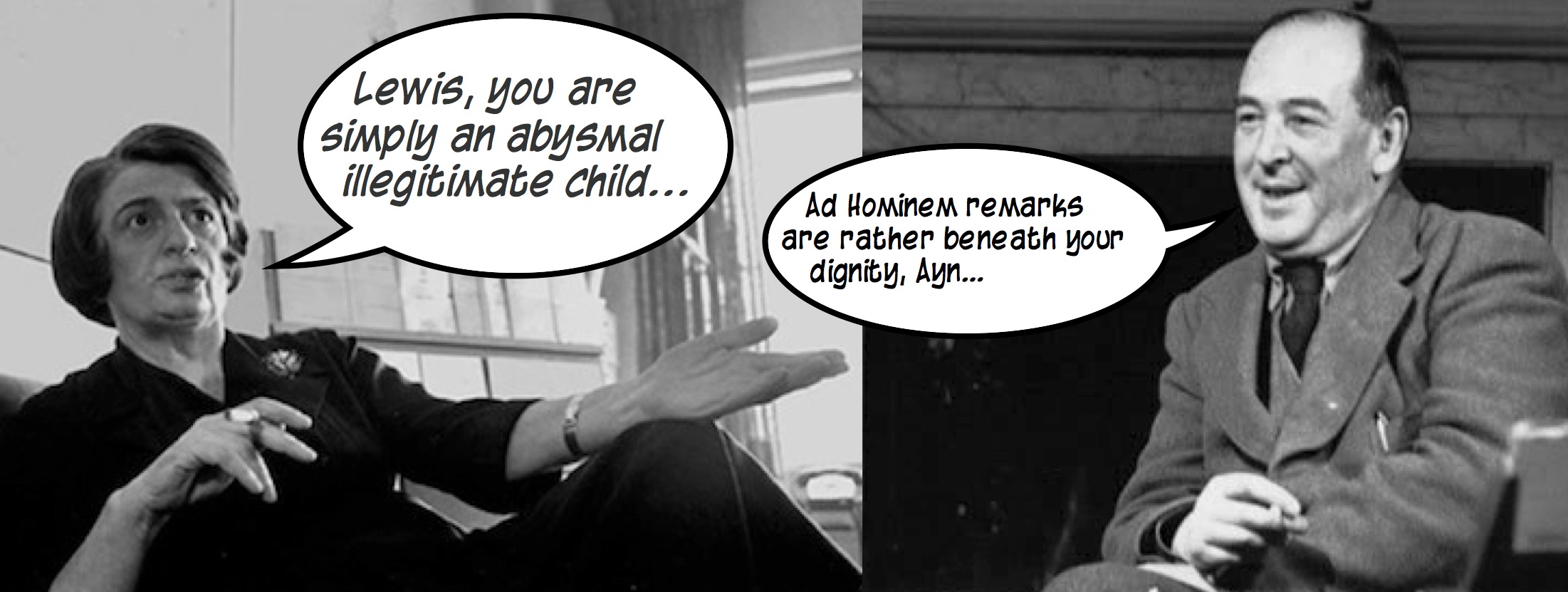

C.S. Lewis Shrugged

csl & randI just watched another documentary about the controversial Ayn Rand, who wrote Atlas Shrugged. The program, “Ayn Rand & the Prophecy of Atlas Shrugged,” claimed that book is the number one selling hardcover in history (following the Bible, of course).

Although I haven’t read it, I witness it’s growing influence as it becomes more frequently referenced in political discussions. It is a favorite (sometimes even referred to as the “gospel”) of Libertarians.

Rand was a Soviet refugee, and much of what she anticipated, has come to pass. Unbridled government regulations, she predicted, would strangle creativity and production. The welfare state would collapse upon itself as it eroded the incentive to work. In her call for less government interference and oversight, she echoes the concerns of growing numbers of Americans on both the left and the right.

This reflects a reversal of her argument’s reception when it was published. In 1957, the dystopian novel apparently did not receive a single positive review. After William F. Buckley published a scathingly negative review, she never spoke to him again.*

And that raises one of the problems with Rand’s work. In actuality, this flaw is a failing common to all literature. It is difficult to separate what is written from its author. This is especially true when the person who wields the pen possesses a unique or outlandish personality. This was certainly the case with Rand. One of her primary goals was to be provocative.

The title of this column was inspired by a recent post I read entitled, “Ayn Rand Really, Really hated C.S. Lewis.” You can read it at First Things.

In the article, Matthew Schmitz provides excerpts of Rand’s underlining and marginalia (notes) in her copy of Lewis’ Abolition of Man. His opening paragraph says it all, though. [Warning: Those offended by rude language should skip the next paragraph.]

Ayn Rand was no fan of C.S. Lewis. She called the famous apologist an “abysmal bastard,” a “monstrosity,” a “cheap, awful, miserable, touchy, social-meta­physical mediocrity,” a “pickpocket of concepts,” and a “God-damn, beaten mystic.” (I suspect Lewis would have particularly relished the last of these.)

Lewis’ indomitable spirit, as hinted at in Schmitz’ parenthetical comment, is precisely what inspired the title of my post.

So, why am I discussing Rand’s work at all, if she so despised Lewis? Well, because I want to explore just why she was so offended by his philosophy.

There is great irony present here. While Rand devotees and serious Christians would share many fears about oppressive governments . . . they are ill-suited allies.

Despite this commonality, the basic reasons for distrusting secular institutions, and more expressly, their solutions to the problem are diametrically opposed.

For Lewis, the atheist turned Christian apologist, hope comes only from God, not from a laissez faire government. While most Christians do not believe in the “coerced compassion” of unlimited taxation to support people unwilling** to work, we utterly disagree with Rand’s elevation of selfishness as virtue.

And that last phrase is not hyperbole. Rand actually wrote a book entitled The Virtue of Selfishness. She viewed altruism as inherently illogical, and thus, essentially immoral.

So, it’s no surprise she disliked Lewis. He had been delivered from a self-centered worldview, and recognized that we have been created by a loving Father for a grand, and eternal purpose.

In the Christian worldview, selfishness provides evidence of our corruption by the Fall. Our disobedience—our selfish desire to have things our way—is at the root of humanity’s problems.

Altruism, giving of oneself for the welfare of another without anticipation of benefit, is—for the disciple of Jesus—a genuine virtue.

We’ll end this brief discussion of a complex subject with a passage from C.S. Lewis. It is a discussion of altruism (in the context of Moral Law) drawn from Mere Christianity. One can only imagine what Ayn Rand would write in the margins, but I’ll take my stand with Lewis.

Some of the letters I have had show that a good many people find it difficult to understand just what this Law of Human Nature, or Moral Law, or Rule of Decent Behaviour is. For example, some people wrote to me saying, “Isn’t what you call the Moral Law simply our herd instinct and hasn’t it been developed just like all our other instincts?”

Now I do not deny that we may have a herd instinct: but that is not what I mean by the Moral Law. We all know what it feels like to be prompted by instinct—by mother love, or sexual instinct, or the instinct for food. It means that you feel a strong want or desire to act in a certain way. And, of course, we sometimes do feel just that sort of desire to help another person: and no doubt that desire is due to the herd instinct. But feeling a desire to help is quite different from feeling that you ought to help whether you want to or not.

Supposing you hear a cry for help from a man in danger. You will probably feel two desires—one a desire to give help (due to your herd instinct), the other a desire to keep out of danger (due to the instinct for self-preservation).

But you will find inside you, in addition to these two impulses, a third thing which tells you that you ought to follow the impulse to help, and suppress the impulse to run away.

Now this thing that judges between two instincts, that decides which should be encouraged, cannot itself be either of them. You might as well say that the sheet of music which tells you, at a given moment, to play one note on the piano and not another, is itself one of the notes on the keyboard. The Moral Law tells us the tune we have to play: our instincts are merely the keys.

Another way of seeing that the Moral Law is not simply one of our instincts is this. If two instincts are in conflict, and there is nothing in a creature’s mind except those two instincts, obviously the stronger of the two must win. But at those moments when we are most conscious of the Moral Law, it usually seems to be telling us to side with the weaker of the two impulses. You probably want to be safe much more than you want to help the man who is drowning: but the Moral Law tells you to help him all the same.

And surely it often tells us to try to make the right impulse stronger than it naturally is? I mean, we often feel it our duty to stimulate the herd instinct, by waking up our imaginations and arousing our pity and so on, so as to get up enough steam for doing the right thing. But clearly we are not acting from instinct when we set about making an instinct stronger than it is. The thing that says to you, “Your herd instinct is asleep. Wake it up,” cannot itself be the herd instinct. The thing that tells you which note on the piano needs to be played louder cannot itself be that note.

_____

* “Big Sister is Watching You,” written by a former atheist Soviet spy turned Quaker capitalist, is available online here.

** By “unwilling,” I am referring to people capable of supporting themselves, but consciously choosing to live off of the produce of others. While some Christians feel morally compelled to support even these, most would follow the guidance found in II Thessalonians 3:

As for other matters, brothers and sisters, pray for us that the message of the Lord may spread rapidly and be honored, just as it was with you. And pray that we may be delivered from wicked and evil people, for not everyone has faith. . . . May the Lord direct your hearts into God’s love and Christ’s perseverance. . . .

In the name of the Lord Jesus Christ, we command you, brothers and sisters, to keep away from every believer who is idle and disruptive and does not live according to the teaching you received from us. For you yourselves know how you ought to follow our example. We were not idle when we were with you, nor did we eat anyone’s food without paying for it.

On the contrary, we worked night and day, laboring and toiling so that we would not be a burden to any of you. We did this, not because we do not have the right to such help, but in order to offer ourselves as a model for you to imitate.

For even when we were with you, we gave you this rule: “The one who is unwilling to work shall not eat.” We hear that some among you are idle and disruptive. They are not busy; they are busybodies. Such people we command and urge in the Lord Jesus Christ to settle down and earn the food they eat.

Literary Recycling

cecilialevy cupOur last column on providing new homes for neglected books got me thinking about the notion of “recycling” in its broader contexts.

And, even though C.S. Lewis died before the modern concept of environmentalism reached its full bloom, I wondered if he had written anything on related concerns. As prolific as Lewis was, if one is diligent there is a good chance they can find something with a (sometimes admittedly tenuous) correlation to nearly any subject.

Before proceeding, I have to provide the source of the amazing illustration on this page. It is a graphic example of the creative recycling of literature. This teacup comes from the artistic vision of a Swedish artist, Cecilia Levy. You can view other examples of her artistry at her website here, and if you wish to reproduce them elsewhere, be sure to request permission (just as I did).

Returning to the concept of environmentalism, I wish to avoid political implications here. In general terms, however, I think it is fair to say the Scriptures teach that humanity is a “steward” of creation, which belongs not to us, but to its Maker. As stewards, we have been entrusted to be responsible in our management (use) of nature’s abundance. Wanton destruction should be called what it is—sin.

Now, this general principle manifests itself in a wide spectrum of responses, and attitudes are always subject to change. I vividly recall the very first Earth Day celebrated in the United States. I’m sure that being a high school student in a huge southern California school reinforced the indelible nature of the memory.

My wife and I have been diligent recyclers for many years . . . and that extends far beyond newspapers and aluminum cans. We have used countless items until their usefulness has ended. (Long past when they should have been replaced, in the opinion of our children.) I attribute much of our thriftiness to growing up in low income families where luxuries were few. But it arises not from that background alone. We also have a sense of responsibility to others, and dispatching items that are still usable to landfills just seems wrong.

I imagine Lewis possessed somewhat similar sentiments. He didn’t manifest much of a flair for extravagance. I don’t think he devoted that much thought to material possessions. I once read (but can’t find the source) that his brother and roommate Warnie was a bit frustrated by Lewis’ lack of concern for maintaining articles that were still in decent condition. Major Lewis, being a military man, focused on utilitarian considerations. The specific items of concern in the incident were some dishes or “crockery” that Warnie deemed to still be fit for service.

Both men were seasoned veterans of rationing, of course. Their skills at stretching things to go as far as possible were conditioned by years of deprivation. Americans are typically shocked to learn that rationing persisted in Europe after the end of the war. In an era characterized by excess and waste it’s difficult for us to put ourselves in their mindset.

Ironically, my hunt for a Lewisian passage on ecological concerns had nothing to do with rationing. It was rewarded when I looked at his essay “Willing Slaves of the Welfare State.” (The work is included in the delightful collection, God in the Dock.)

In this essay, Lewis is describing scientific advances as morally neutral. It is the application we choose to put our knowledge to, that determines its rightness. One of his illustrations alludes to care of the world in which we live.

The first is the advance, and increasing application, of science. As a means to the ends I care for, this is neutral. We shall grow able to cure, and to produce, more diseases—bacterial war, not bombs, might ring down the curtain—to alleviate, and to inflict, more pains, to husband, or to waste, the resources of the planet more extensively. We can become either more beneficent or more mischievous. My guess is we shall do both; mending one thing and marring another, removing old miseries and producing new ones, safeguarding ourselves here and endangering ourselves there.

Brilliant. And utterly true.

I also want to pass on an interesting observation made several years ago in another blog. The author references Lewis’ mention of the related concept of “plentitude.” You can read Tim Hagen’s full post here.

Since I’ve been reading a lot of C.S. Lewis lately, I figured I could use (and abuse?) a couple quotes from him in suggesting a philosophy of responsible waste management.  The Discarded Image is a piece that brings to light our modern misconceptions about the “Dark Ages.”  A testimony of medieval literature, for example, is how systematized their view of the universe was.  This organization grew out of classical authors such as Apuleius of Numidia, from whom Lewis draws two principles: the Triad (the idea that two entities – such as soul and body – can only meet each other through a third medium – in this case, the spirit) and Plentitude.  Lewis summarizes Plentitude in stating: “The universe must be fully exploited.  Nothing must go to waste.”  In other words, if something had the capacity to be useful, the medieval mind found a use for it.

The concept of plentitude as described here reminds me of the way people living in harsh environments cannot afford to waste anything. Eskimos, for example, are said to use every part of the seals they harvest . . . meat, blubber, bone, sinew. None of it is cast aside.

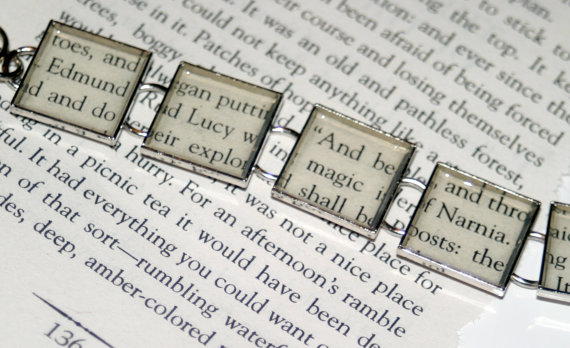
Let’s end these thoughts with another example of artistic creativity. This image shows how pages of a recycled copy of the Chronicles of Narnia can be recycled into jewelry. It comes from this commercial website which offers “one of a kind” items for sale. I don’t know whether this particular piece remains available, but I bet they would be willing to make you one of your very own if you’re interested. Then the cash from your wallet can be recycled into theirs. In exchange you’ll own a unique treasure that may become a wonderful conversation starter for many years to come.

narnia bracelet

Beware of Zoolatry

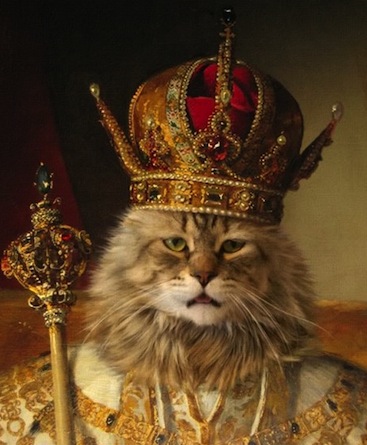
royal catWhen my wife and I dated, I praised her beautiful cat when I visited her home. The cat maintained that imperial posture and attitude that is common in virtually all felines. And that came as no surprise, since she was an Egyptian Mau, one of the most ancient of breeds. She passed on long decades ago, but her haughty, regal bearing is etched in my memory.

I thought of her today when I read the following in the December issue of First Things, in the executive editor’s column.

Wandering around the American Kennel Club’s big “Meet the Breeds” event with my two youngest children recently, I saw a big banner in the cat section proclaiming that a particular breed had been considered a god by an ancient civilization. Of course, our understanding of the genuine religious impulses of ancient religions has increased, but still, one of the gifts the Jewish people have brought the world is that no one who knows about the God of Abraham, Isaac, and Jacob is the least bit tempted to worship cats.

I mean, would you want to worship a murderous narcissistic psychopath? This is not an image of God to make anyone happy. If you’re going to worship an animal, why not the Border Collie, frantically eager to please, or the loving, soulful-eyed Lab? Or the alert and protective German Shepherd? Or the indomitable Saint Bernard? Or the classic loyal and even-tempered mutt?

I don’t intend to offend any cat lovers by repeating this observation—my son has an affectionate tabby he rescued as a kitten while a senior in high school, that’s welcome in our home anytime. Still, as an unrepentant dog person, and “papa” to a rescued border collie, the words above brought a smile to me.

C.S. Lewis painted a graphic image of one animal-headed deity. It was Tash, the god of the Calormenes. In The Last Battle, we see that in Narnia, the reality behind the lifeless image can be most terribly revealed.

In the shadow of the trees on the far side of the clearing something was moving. It was gliding very slowly Northward. At a first glance you might have mistaken it for smoke, for it was grey and you could see things through it. But the deathly smell was not the smell of smoke. Also, this thing kept its shape instead of billowing and curling as smoke would have done. It was roughly the shape of a man but it had the head of a bird; some bird of prey with a cruel, curved beak. It had four arms which it held high above its head, stretching them out Northward as if it wanted to snatch all Narnia in its grip; and its fingers—all twenty of them—were curved like its beak and had long, pointed, bird-like claws instead of nails. It floated on the grass instead of walking, and the grass seemed to wither beneath it. . . .

The others watched it for perhaps a minute, until it streamed away into the thicker trees on their right and disappeared. Then the sun came out again, and the birds once more began to sing. Everyone started breathing properly again and moved. They had all been still as statues while it was in sight. “What was it?” said Eustace in a whisper. “I have seen it once before,” said Tirian. “But that time it was carved in stone and overlaid with gold and had solid diamonds for eyes. It was when I was no older than thou, and had gone as a guest to The Tisroc’s court in Tashbaan. He took me into the great temple of Tash. There I saw it, carved above the altar.”

“Then that—that thing—was Tash?” said Eustace.

In our world, idolatry has certainly evolved since it’s pantheistic and zoolatrous beginnings. Today we are tempted by material indulgences and corruptions aplenty. While few of us impute divinity to animals or objects of stone or wood, we don’t have to look far to find something we deem worthy of adoration.

Our favorite idol is neither beast nor mammon. It is ourselves. As C.S. Lewis wrote in The Problem of Pain:

This act of self-will on the part of the creature, which constitutes an utter falseness to its true creaturely position, is the only sin that can be conceived as the Fall. For the difficulty about the first sin is that it must be very heinous, or its consequences would not be so terrible, and yet it must be something which a being free from the temptations of fallen man could conceivably have committed. The turning from God to self fulfils both conditions. It is a sin possible even to Paradisal man, because the mere existence of a self—the mere fact that we call it “me”—includes, from the first, the danger of self-idolatry. Since I am I, I must make an act of self-surrender, however small or however easy, in living to God rather than to myself. This is, if you like, the “weak spot” in the very nature of creation, the risk which God apparently thinks worth taking.

Now, this is a sin to which I frequently find myself succumbing. I far too often think first about my own desires and appetites . . . only later (if ever) becoming concerned with the needs of my neighbor.

No, it’s neither cat nor dog that needs to be evicted from the throne in my soul reserved for my Creator—it’s me.

Greek Mythology & Modern Humanity

narcissusThere is a very important mental health tome that describes psychological disorders in detail. It’s called The Diagnostic and Statistical Manual of Mental Disorders (DSM).

Since the American Psychiatric Association is constantly discovering new mental ailments—and they occasionally recognize that previously unhealthy mindsets and behaviors have become so pervasive they can no longer be considered aberrations—the DSM requires periodic revision.

The current authoritative version is DSM-IV-TR, or DSM, fourth edition, text revision. That means that if you were diagnosed with a defect according to the third edition standards, you may now have a clean bill of health. And, for those of you whose diagnosis is still included in DSM IV, don’t despair; they are currently consulting about version five, and who knows what psychoses may soon become “normal.”

I had to study these things during my seminary training, for my counseling work as a chaplain and civilian pastor. I was thinking about the manual recently as I pondered the spirit of Narcissus that seems to hold sway in our age. Like C.S. Lewis, I understand there is value in studying Greek and Roman myths, as many contain seeds of Truth. (Lewis’ appreciation for myth is most evident in Till We Have Faces, which is a reworking of one ancient Greek tale.)

Narcissus, of course, is the mythological Greek who was so consumed by his own handsomeness that he perished because he was unable to tear himself away from gazing at his own likeness. (The image above was painted by Michelangelo Caravaggio in the sixteenth century.)

Narcissism, which echoes his name, describes the unbridled vanity and self-concern (i.e. selfishness) that motivates growing numbers in our individualistic and hedonistic world. Since narcissism has become so rampant, the DSM now concerns itself only with “pathological narcissism.” That distinction will probably remain, even if Narcissistic Personality Disorder (NPD) is eliminated from the fifth edition as a distinct illness, as many have recommended.

God Save Us from the Narcissists

Pathological narcissists are terrible indeed. Their characteristic arrogance, envy, sense of entitlement and lack of empathy make them unhealthy members of society. In fact, large numbers of sociopaths and psychopaths are also narcissists.

But here’s the problem. At the rotten core of the disorder we find a putrid seed that negatively affects many of us who appear otherwise to be so normal. The source of the corruption is, in part, sinful pride.

Let’s take a look at the “diagnostic criteria” for NPD which confronted me when I first studied DSM III. (Perhaps you may wish to skip this section, since modest hints of some of these traits may strike close to home.) I’ve added my own introspective comments in italics.

Diagnostic criteria for 301.81, Narcissistic Personality Disorder:

A pervasive pattern of grandiosity (in fantasy or behavior) hypersensitivity to the evaluation of others, beginning by early adulthood and present in a variety of contexts, as indicated by at least five of the following:

(1) Reacts to criticism with feelings of rage, shame, or humiliation (even if not expressed).

— I’ve never “raged,” but it’s embarrassing to be criticized in public

(2) Is interpersonally exploitive: takes advantage of others to achieve his or her own ends.

— Never. I won’t tolerate manipulation–either as the manipulator or the manipulatee.

(3) Has a grandiose sense of self-importance, e.g., exaggerates achievements and talents, expects to be noticed as “special” without appropriate achievement.

— Have I told you lately about being Thespian of the Year when I graduated from high school . . ?

(4) Believes that his or her problems are unique and can be understood only by other special people.

— Not this trait, I’m aware everyone in this fallen world is faced with challenges . . . many of them worse than my own.

(5) Is preoccupied with fantasies of unlimited success, power, beauty, or ideal love.

— I do daydream about accomplishing special goals, although I never lusted after power and I accepted the facts about “beauty” long ago. I have, however, found ideal love, and we’ve been married 37 years!

(6) Has a sense of entitlement: unreasonable expectations of especially favorable treatment, e.g., assumes that he or she does not have to wait in line when others must do so.

— I’m the opposite. I always pick the longest and slowest line to stand in.

(7) Requires constant attention and admiration, e.g., keeps fishing for compliments.

— If people weren’t so frugal with compliments, I wouldn’t need to.

(8) Lack of empathy: inability to recognize and experience how others feel, e.g., annoyance and surprise when a friend who is seriously ill cancels a date.

— Nope. I really do care about others. That’s the reason good clergy and caregivers often suffer compassion fatigue.

(9) Is preoccupied with feelings of envy.

— Well, what about those cases where the person doesn’t deserve the honors they’ve received . . ?

There, I feel much better, having made a public confession of my almost-narcissistic human self-centeredness.

In his essay “Christianity and Culture,” C.S. Lewis warns that “A man is never so proud as when striking an attitude of humility.”

When we admit, instead, that there remains much in our soul that is base and prideful, we’re on the proper path. The course that leads to a rejection of Narcissus-in-us, and the embracing of what is precious in our neighbors and our world, is the road that leads to contentment.