Damnable Typos & the Bible

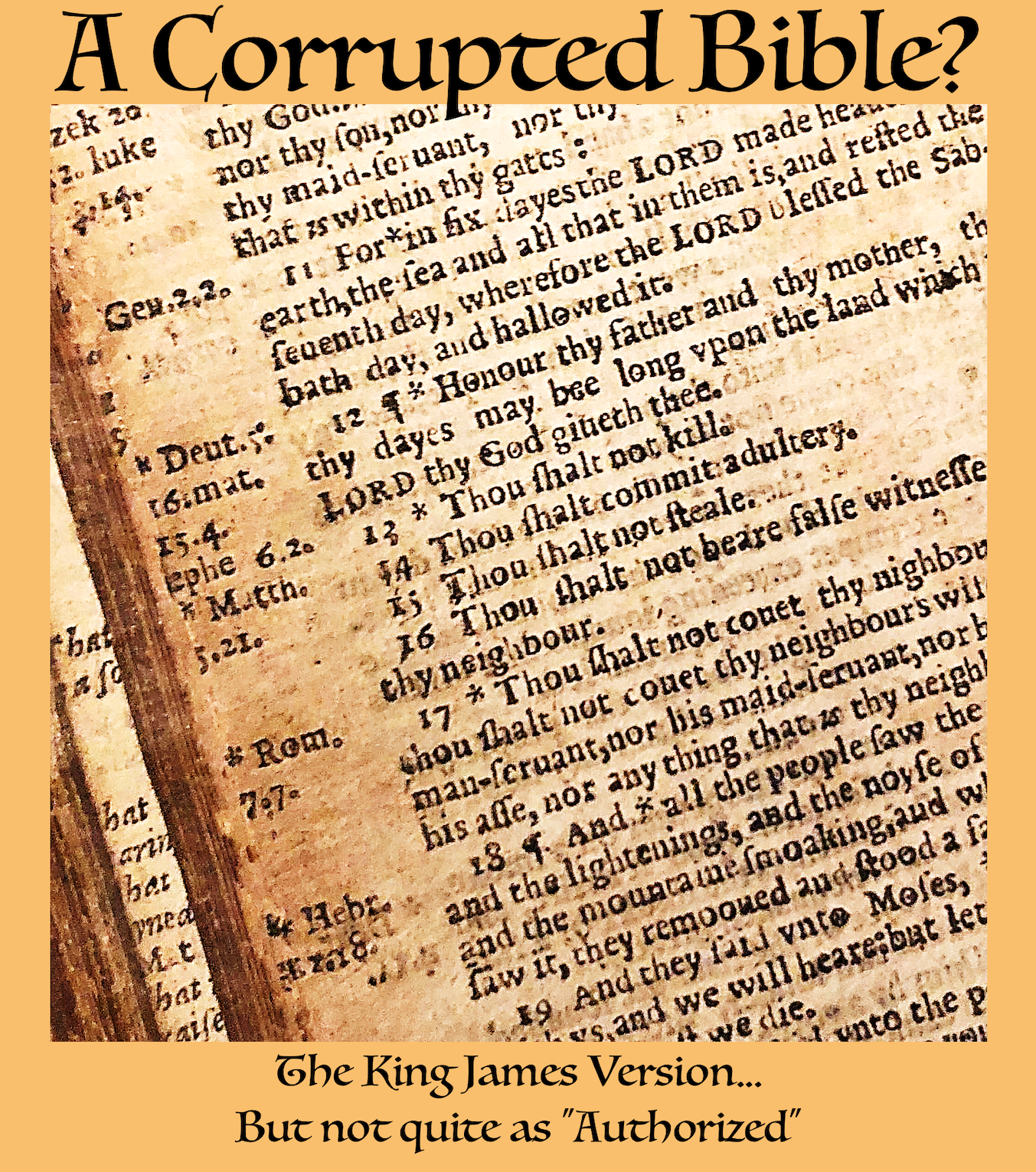
While the title of this post will be shocking to some, it’s far less scandalous than the typographical error discussed below. Due to two misprints appearing in a 1641 edition of the King James Bible (KJV), the publication has been labeled the “Wicked Bible.”

Translating the Scriptures is a necessary, and demanding, task. The early editions of the KJV (which was preceded by the Wycliffe Bible) reveal how vulnerable the words themselves were to being altered during the typesetting process.

I’ve written about this subject a number of times during the past decade, and even devoted a column to “C.S. Lewis’ School of Translation,” which is about something even more important than merely translating words. There I quote one of the great author’s deepest hopes.

What I want is to be the founder of a school of ‘translation . . .’ Where are my successors? (correspondence, 7 October 1945).

Returning to the seventeenth century book with its unfortunate errors, we witness an example of how even a solid translation can be derailed by careless (or malevolent) typesetters.

The magnitude of the mistake discovered in this particular edition caused its suppression, and most copies were destroyed. While some still exist in private hands, only fifteen remain in public collections. One of these made its way to New Zealand before being identified in 2018.

A Truly Scandalous Misprint

It would be one thing if a printer accidently dropped the final “e” from “breathe,” leaving the word “breath.” Even substituting an errant “w” for the “b,” would create an alternate word that would greatly muddle a passage . . . but still not appear remotely “wicked.” 

However, a 1631 mistake in an English Bible literally turned a passage – one of the Ten Commandments, no less – on its head. Rather than reading “Thou shalt not commit adultery,” this edition declares, “Thou shalt commit adultery” (Exodus 20:14).

The consequences of this disaster were significant, particularly for His Majesty’s official printers. In Cyprianus Anglicanus by royalist priest Peter Heylyn (1599-1662), we learn the details. (You can download a free facsimile of the volume which includes many other fascinating facts.) The passage related to the misbegotten tome reads as follows:

His Majesties Printers, at or about this time [1632], had committed a scandalous mistake in our English Bibles, by leaving out the word Not in the Seventh Commandment.

His Majesty being made acquainted with it by the Bishop of London, Order was given for calling the Printers into the High-Commission where upon the Evidence of the Fact, the whole Impression was called in, and the Printers deeply fined, as they justly merited.

Reports of Cases in the Courts of Star Chamber and High Commission, penned by Samuel Rawson Gardiner in 1886, includes a detailed account of the court’s findings. (Due to their uniqueness, I have transposed the full account, as found in two sections, as a footnote below.) One passage describes a second “gross error.”

. . . showed the two grossest errors, vizt. “Shalt commit adultery” and “great asse:” for “shalt not commit adultery” and “greatnesse…”

The second of these blunders occurs in Deuteronomy 5:24, which properly reads “Behold, the Lord our God hath shewed us his glory and his greatness.” (It should be noted that the word asse would most commonly be associated with donkeys.)

The magnitude of these mistakes can only be understood when one recognizes how reverentially the Scriptures were regarded at this time. C.S. Lewis would suggest that during an age when the Bible has been relegated to historic literature, it is difficult for us to comprehend the seriousness of this matter.

It is very generally implied that those who have rejected its theological pretensions nevertheless continue to enjoy it as a treasure house of English prose. It may be so. There may be people who, not having been forced upon familiarity with it by believing parents, have yet been drawn to it by its literary charms and remained as constant readers.

But I never happen to meet them. Perhaps it is because I live in the provinces. But I cannot help suspecting, if I may make an Irish bull, that those who read the Bible as literature do not read the Bible. (“The Literary Impact of the Authorised Version”).

In “Challenges in Printing Early English Bibles,” you can read about other Bibles featuring noteworthy mistakes. In two, “peacemakers” become “placemakers,” and “murmurers” are transformed into “murderers.” Another example, in the very first edition of the KJV, finds Jesus’ ancestor Ruth referred to by the male pronoun, due to the accidental dropping of an “s.”

More troubling is another early KJV Bible where “the text of Psalm 14 [reads], “The fool hath said in his heart there is a God,” rather than “The fool hath said in his heart there is no God.”

Worst of all, in terms of blasphemous connotations, would likely be the so-called “Judas Bible.”

In the 1609 Geneva Bible, the typesetters mistakenly replaced Jesus’s name with that of Judas. John 6:67 reads: “From that time many of his disciples went back, and walked no more with him. Then said Judas unto the twelve, Will ye also go away?”

Fortunately, modern editions of the Jewish and Christian Scriptures undergo thorough proofreading, so this sort of error is rare today. Still, typos will persist as long as the remotest possibility of error exists.

Those among us who have sought to have our writing published by traditional publishers may relate to the example with which we end. C.S. Lewis and J.R.R. Tolkien and even Mark Twain faced challenges working with some of their editors and publishers.

With all of the printing mishaps in the early English Bible, it is only appropriate that one of the editions was called “The Printers Bible.”

This text, published in about 1702, takes its name from a typesetting error found in Psalm 119, which should have read “Princes have per­secuted me without a cause” but was mistakenly printed as “Printers have persecuted me.”


Full references from Reports of Cases in the Courts of Star Chamber and High Commission by Samuel Rawson Gardiner (1886).

Mr Barker the printer. There is a cause begunne against him for false printeing of the Bible in divers places of it, in the Edition of 1631, vizt., in the 20 of Exod[us], “Thou shalt committ adultery”; and in the fifte of Deut[eronomy] “The Lord has shewed his glory, and his great asse”; and for divers other faults; and that they had printed it in very bad paper. And the Bishop of London showed that this would undoe the trade, and was a most dishonorable thing; that they of the church of Rome are soe carefull, that not a word or letter is to be found amisse in their Ladie’s Psalter and other superstitious books; and that we should not be soe carefull in printinge the sacred Scriptures; and that they in Holland, at Amsterdam, had gott up an English presse, and had printed the Bible in better paper, and with a better letter, and can undersell us 18d. in a Bible. Mr Barker and his partners endeavored in partt to excuse themselves, and had advocates to speake for them, and were willing to submitt, and promised to amend their faults; but the Court would not remitt their offense, but the cause was ordered to goe on.

The Printers having answered move the Court to passe by their oversight being the fault of the workmen but the King’s Advocate desired they might make their defense legally and the cause to go onto hearing: and that he might have liberty to put in additional articles against them. The Bishop of London would have the Church sett upright in her reputacion, that we are as carefull in printeing the Bible as they are of their Jesus’ psalter : and whereas the Printers say this is stirred up by the malice of one man against them; The Bishop saith he stirred not till the Bible was sould into his house, bought by his footman: and he saith the printinge is soe bbad and the paper too that, if it be not mended shortlie, they wilbe put downe by those of Amsterdam and their trade spoyled, and showed for the two grossest errors, vizt. “Shalt commit adultery” and “great asse:” for “shalt not commit adultery” and “greatnesse…” The Arch Bishop of Canterbury saith, that the Printers that print for his Matie have a very profitable place, and therefore should be more carefull. I knew the tyme when greater care was had about printeing, the Bibles especiallie, good compositors and the best correctors were gotten being grave and learned men, and the paper and letter rare and faire every way of the best; but now the paper is naught, the composers boyes, and the correctors unlearned: There is a farmer and he makes the benefit, and careth for nothing about it. They heretofore spent their whole time in printeing, but these looke to gaine, gaine, gaine, then they are not to be commended: Well, let them looke to it: and let the cause proceed, saith the ArchBishop. London. “There was a great deale of doo between you of this Citty and those of Cambridge heretofore about the priviledge of printeing the Bible and psalms which they of Cambridge claymed; then the Bible was exactlie printed, now you have forced the Cambridg printer to an agreement, now noe bible is right printed.

[It appears this volume itself would have benefited from having more diligent “correctors.” Perhaps most curiously, two spellings of the word printing – “printinge” and “printeing” – appear in this publication.]


Trivial Finale

catechicAll good things must draw to an end . . . and so it is that we wrap up our running review of interesting trivia questions from Catéchic, “the Catholic trivia game” by Tyco®.

Today we move beyond the miscellaneous historical and ecclesiastical subjects we have thus far considered. Prepare yourself for some serious literary and theological matters.

There were a fair number of questions asked about literary matters. Most related to authors (religious and secular) I have never read. However, some were of greater interest to me.

Who wrote the religious sonnet “Death Be Not Proud?”

John Donne

I hadn’t read that classic poem for years, and I’m grateful to the game for encouraging me to pause to reread it. If you are unfamiliar with this timeless verse, you can read it here.

Was the Gutenberg Bible the first book to be printed?

No. (Printing already existed in China.)

Actually, printing via woodblocks existed in various places. The great breakthrough came in the development of moveable type, and it did indeed exist in China before Gutenberg refined it in the West.

Was the first Bible printed in the New World in the English language?

No. (Algonquian, the predominant language of Northeastern Native Americans)

Now there is an edifying fact which reminds us of the importance of sharing the Good News with all people

Which alphabet is named after a saint?

The Cyrillic alphabet, developed by St. Cyril

And, ironically, used most prominently in the formerly atheistic republics of the Soviet Union.

A triad of questions about Roman Catholic periodicals.

What newspaper is generally thought of as the most liberal American Catholic weekly?

The National Catholic Reporter

Something I believe they are quite proud of. They offer online news here.

What newspaper is generally thought of as the most conservative American Catholic weekly?

The Wanderer

I had never heard of this lay publication, but you can read it online here.

How much does an issue of The Catholic Worker cost?

One cent

Amazing. I disagree with most of its political positions, but I have to admire the statement they make in continuing this practice.

The Catholic Worker newspaper is not online. Subscription or copy requests must be sent by regular mail . . . The newspaper was started by Dorothy Day herself in New York City in the 1930s. The price has been and will remain a penny a copy, excluding mailing costs. It is issued seven times per year and a year’s subscription is available for 25 cents (30 cents for foreign subscriptions) . . .

When the game addresses Roman Catholic history and dogma, it stays close to doctrinal boundaries. However, when it addresses interfaith and “Protestant” subject matter, it raises some issues which require comment.

Saint Olaf is the patron saint of which country?

Norway

I had to include this because my own heritage is half Norwegian. This despite the fact that dear Olaf was free in his use of the sword as an instrument for converting the Norse heathen. My hometown is Poulsbo, Washington, and its nickname is “Little Norway.” It is no surprise Poulsbo’s Roman Catholic parish is named in honor of Saint Olaf.

As far as we know, who erected the first Christian cross in the New World?

Christopher Columbus

Perhaps, but the first Christians setting foot in the so-called New World were likely Leif Erikson and those who accompanied him on the voyage from Greenland.

Name the politically influential American Catholic family sometimes known as “America’s Royal Family?”

The Kennedys

Although sadly some prominent Kennedys have not lived and served in a manner consistent with their religious profession.

As a Lutheran Christian, I was particularly eager to discover what sort of questions dealt with so-called “Protestant” matters. Here are a couple, with my personal observations added:

Before the Protestant Reformation, how many Christian Churches were there?

Two, Catholic and Orthodox

Sorry, only one. Both Roman Catholic and Eastern Orthodox communions confess a belief that there is only “one, holy, catholic and apostolic church.” It’s true that there was a schism* between the two, but there remains only one Christian Church, comprised of all who “believe and are baptized.”

During the 19th century, what Protestant group played a key role in settling the American West?

Church of Jesus Christ Latter-Day Saints (The Mormons)

The LDS Church is a distinct religion in and of itself. They would not regard themselves as “Protestant,” nor would Trinitarian Protestant traditions regard the LDS religion as belonging under that admittedly stretched label.

What is a member of any of the various Protestant groups characterized by their rejection of military service called?

A Mennonite

Hmmm . . . it’s a bit more complicated than that. Various Christian denominations (e.g. Quakers) discourage military service, along with non-Christian religions (e.g. Jehovah’s Witnesses). They, along with other individuals from more traditional church bodies whose consciences prevent them from serving in the armed forces, are more accurately called “pacifists.”

What was condemned as heresy at The Council of Trent?

The teachings of Protestant reformers such as Martin Luther.

And then there are those who would consider the Council of Trent itself to be a fount of heresy . . .

For which institution did Johann Sebastian Bach write his magnificent cantatas?

The Lutheran Church in Leipzig.

A gracious (ecumenical) acknowledgment of a musical genius who composed his works “soli Deo gloria.”

It will surprise no regular readers of Mere Inkling to see that we are closing with another reference to our favorite Inkling.

Which British author of children’s fantasies wrote an allegory about the Devil called The Screwtape Letters?

C.S. Lewis

One of C.S. Lewis’ masterpieces. I have blogged on them in the past, as the search bar to the right will reveal. Here is one column I’m particularly proud of, since it contributes a new piece of correspondence to the Screwtape corpus.

_____

* Schism is one of the most mispronounced words in the English language. Although “skizuh m” has become so commonplace that it is now “accepted,” the proper pronunciation is “sizuh m.” Of course, if you say it correctly everyone will think you are wrong . . . just like when you leave the “s” off of the biblical book of Revelation or properly pronounce psalm without the “l” (“sahm” instead of “salhm”).

If you missed the first two columns dealing with Roman Catholic trivia, you can check them out here: A Trivial Windstorm and Curious Christian Trivia.

Fit to Print?

amazonIt’s challenging enough to conduct painstaking research. But, only to have it become immediately obsolete by virtue of it’s own publication—that is simply too much.

Flying home from a whirlwind trip from the Pacific to the Atlantic, I came across an interesting analysis of how many sheets of paper would be required to print out the entire contents of the internet.

One hundred and thirty-six billion.

Didn’t sound like all that many when I read it. Why, that’s not even a fraction of the annual deficit here in the United States.

Still, it’s quite a few sheets of paper. As the article said, stacked on one another, the pile would tower 8,300 miles high. That sounds a bit more impressive.

The researchers determined eight million Amazonian trees would have to be sacrificed to provide sufficient pulp. Impressive. But then they turn about and make that very number far less remarkable by declaring that this total would constitute only 0.002% of the rainforest.

The Flaw in the Research

Sadly, as diligent and mathematical as the researchers were, there was a weakness in their model. You see, they did not factor in their own research. Immediately upon it’s publication, their numbers were obsolete.

In fact, because they meddled with the internet equilibrium, there were at least 36,000,000,002 pages. (And, although I am not a scientific researcher, I suspect there were even more.) And, despite my mediocre numerical skills, even I know that when I hit post with this column, the internet page counter will advance another digit.

More ominously, especially in light of our recent reflections about the dark web, is the following:

Also, it is thought the non-explicit web is only a mere 0.2% of the total internet, the rest encompassing the Dark Web. This would mean that printing the entire internet including the Dark web would use 2% of the rainforest.

This relates to the question that entered my mind when I read the original statistic. (And I was not even thinking about the garbage that oozes throughout the internet.)

A More Important Question

As entertaining as it might be to ponder how many pages of data exist on the web, there is a far more valuable question. How many pages of the material on the internet are worth printing out?

C.S. Lewis has a delightful passage about wasted newsprint in Surprised by Joy. Although he is specifically talking about how students should not squander time or attention on newspapers, his point extends beyond that to people of all ages, and to all media including the internet.

I think those are very wrong who say that schoolboys should be encouraged to read the newspapers. Nearly all that a boy reads there in his teens will be known before he is twenty to have been false in emphasis and interpretation, if not in fact as well, and most of it will have lost all importance.

Most of what he remembers he will therefore have to unlearn; and he will probably have acquired an incurable taste for vulgarity and sensationalism and the fatal habit of fluttering from paragraph to paragraph to learn how an actress has been divorced in California, a train derailed in France, and quadruplets born in New Zealand.

If Lewis were alive today, I have no doubt he would share my opinion that most of what is written both on- and offline, is not worth printing.

Perhaps someone should undertake a study of how many trees would need to be cut to print everything worthy of being printed? If they did so, I am fairly confident we would need not worry about the future of the Amazonian rain forest.

Corrupted Poetry

proofreadersA sloppy proofreader can ruin the most praiseworthy writing. (Just ask Mark Twain.)

If you’ve ever seen something you wrote poorly edited—or including introduced errors—you know personally just how criminal this is.

My choice of adjectives reveals that these tragedies are nearly always mistakes, and not malevolent. Despite that fact, they disrupt the flow and impugn the skill of truly good writers.

I was thinking about this subject today after running across the following passage during my research of the American Civil War. An 1861 newspaper lifted the following from an issue of the Boston Courier.

The Errors of the Press—“Really,” said a printer, in conversing with a literary man about errors of the press, “gentlemen should not place such unlimited confidence in the eyesight of our hard worked and half-blinded reader of proofs; for I am ashamed to say that we utterly ruined one poet through a ludicrous misprint.”

“Indeed! and what was the unhappy line?”

“Why, sir, the poet intended to say:

     ‘See the pale martyr in a sheet of fire;’

instead of which we made him say:

     ‘See the pale martyr with his shirt on fire.’”

The critics were down fierce on the poet; but we don’t see why. A man “with his shirt on fire” must be a highly poetical object, as his life would be in imminent danger.—Boston Courier.

I can easily picture the exhausted proofreader unintentionally substituting a burning garment for a consuming inferno. It made sense to him. And, since he was unlikely to have an ear tuned to poetic imagery, the practical reference to ignited clothing must be what the poet actually meant.

This reminds me that it’s impossible to have too many eyes cast upon the final draft of a work before it goes to print. Take care of your friends and family who offer you the gift of proofreading; their talents deserve to be appreciated and rewarded.

Mark Twain’s Thoughts on the Subject

Samuel Clemens got his own start in the newspaper business and knew firsthand how challenging proofreading was. However, that did not prevent him from venting about the poor proofreading of his novel More Tramps Abroad.

The following was written to his publishers in regard to the printer’s shortcomings. The 1897 letter clearly reveals Twain’s colorful (and occasionally vulgar) writing.

I give it up. These printers pay no attention to my punctuation. Nine-tenths of the labor & vexation put upon me by [them] consists in annihilating their ignorant & purposeless punctuation & restoring my own.

This latest batch [also has] my punctuation ignored & their insanities substituted for it. I have read two pages of it—I can’t stand any more. If they will restore my punctuation themselves & then send the purified pages to me I will read it for errors of grammar & construction—that is enough to require of another who writes as legible a hand as I do, & who knows more about punctuation in two minutes than any damned bastard of a proof-reader can learn in two centuries.

Conceive of this tumble-bug interesting himself in my punctuation—which is none of his business & with which he has nothing to do—& then instead of correcting mis-spelling, which is in his degraded line, striking a mark under the word & silently confessing that he doesn’t know what the hell to do with it!

The following year he wrote a mellower review of the work of the proofreader. Not in the heat of correcting a muddled manuscript, he was able to comment on the benefits afforded by good proofreading.

You think you are reading proof, whereas you are merely reading your own mind; your statement of the thing is full of holes & vacancies but you don’t know it, because you are filling them from your mind as you go along.

Sometimes—but not often enough—the printer’s proof-reader saves you–& offends you—with this cold sign in the margin: (?) & you search the passage & find that the insulter is right—it doesn’t say what you thought it did: the gas-fixtures are there, but you didn’t light the jets.

I must say that I have been rescued by my proofreaders far more frequently than I have been abused by them. May God grant you the same blessing.