Free C.S. Lewis Course

hillsdaleA free college course about C.S. Lewis? Too good to be true? No, it’s for real . . . and it’s offered by a well respected American College that traces its roots back more than 170 years. (Note, for the Europeans reading this, that makes it quite mature here in North America.)

Hillsdale college is currently offering its online course, “An Introduction to C.S. Lewis: Writing and Significance” at no charge. Here is the link to the enrollment page.

In addition to being a first class college today, Hillsdale has a very distinguished past. Founded in 1844, its leadership in the anti-slavery cause allowed it to host two speeches by Frederick Douglass. The first was delivered during the Civil War itself.*

C.S. Lewis offered a fascinating twist on the injustice of slavery. In an essay entitled “Equality,” written 80 years after Douglass decried slavery at Hillsdale, Lewis advocated democracy as an imperfect philosophy. I agree with his inference that despite its shortcomings, it is the least-flawed form of government.

I am a democrat because I believe in the Fall of Man. I think most people are democrats for the opposite reason. A great deal of democratic enthusiasm descends from the ideas of people like Rousseau, who believed in democracy because they thought mankind so wise and good that everyone deserved a share in the government. The danger of defending democracy on those grounds is that they’re not true. . . . I find that they’re not true without looking further than myself. I don’t deserve a share in governing a hen-roost, much less a nation. Nor do most people—all the people who believe advertisements, and think in catchwords and spread rumours.

The real reason for democracy is . . . Mankind is so fallen that no man can be trusted with unchecked power over his fellows. Aristotle said that some people were only fit to be slaves. I do not contradict him. But I reject slavery because I see no men fit to be masters.

This is the barest example of C.S. Lewis’ keen mind. Enrolling in the course will certainly introduce participants to much, much more.

Like most online resources, this class is offered for personal growth. While a certificate is offered to those who complete the course, it doesn’t result in formal college “credit.” That said, the course could also be of great benefit to a motivated high school student.

Formal studies, even those like this one for which we set a personal pace, are worthwhile. Not only do we profit from the wisdom of the team of professors. Most of us also benefit from the discipline a course offers. Left to our own devices, most of us would not end up with the well-rounded familiarity with Lewis’ work that this class promises.

Shared Wisdom from Douglass and Lewis

One contemporary author noted a parallel thought in the writings of these two men. Thomas Sowell is a distinguished thinker and a talented writer. (Traits he shares with these two gifted authors.) On his website** Sowell has an extremely selective collection of quotations, on which he pairs the following. The first was written by Frederick Douglass and the second by C.S. Lewis.

Everybody has asked the question. . . “What shall we do with the Negro?” I have had but one answer from the beginning. Do nothing with us! Your doing with us has already played the mischief with us. Do nothing with us! If the apples will not remain on the tree of their own strength, if they are wormeaten at the core, if they are early ripe and disposed to fall, let them fall! I am not for tying or fastening them on the tree in any way, except by nature’s plan, and if they will not stay there, let them fall. And if the Negro cannot stand on his own legs, let him fall also. All I ask is, give him a chance to stand on his own legs! Let him alone! (Frederick Douglass, “What the Black Man Wants”).

Of all tyrannies, a tyranny sincerely exercised for the good of its victims may be the most oppressive. It would be better to live under robber barons than under omnipotent moral busybodies. The robber baron’s cruelty may sometimes sleep, his cupidity may at some point be satiated; but those who torment us for our own good will torment us without end for they do so with the approval of their own conscience. (C.S. Lewis, “The Humanitarian Theory of Punishment”).

I think Sowell’s connection of these two excerpts is quite perceptive. Although he is an economist by PhD, I regard him as a brilliant sociologist as well.

Education is a worthwhile pursuit. It is one embraced by Douglass, Lewis and Sowell. Hillsdale’s invitation to enroll in this course allows all of us to engage in the same meaningful exercise. After all, learning is one of the pleasures that makes life truly worth living.

_____

* You can read about Douglass’ speeches at Hillsdale College here.

** This link will take you to Sowell’s website.

Misplaced Trust

trustingWhy do some nurses kill? Most people attracted to the nursing profession possess deep reservoirs of compassion for others. And yet, every once in a while we read about a nurse intentionally taking the life of a patient.

Today’s case comes from Italy, where a forty-two year old nurse is under investigation for thirty-eight possible cases of murder. And we are not talking about the ending of a life that some would term euthanasia.

Poggiali did not overdose them to end their suffering. She did it simply because they irritated her. She, or their relatives, bothered her.

One troubling aspect of the case could only happen today. Authorities have actually found a photograph on her phone where she is standing beside a deceased patient giving a “thumbs up” sign. (The article didn’t indicate whether this was a sickening “selfie,” or if there is another person at the hospital with a similarly demented sense of humor.

When people we implicitly trust violate our faith in them, it is jarring. We struggle to comprehend things when . . .

Medical professionals intentionally cause injury . . .

Clergy behave immorally, particularly when they attempt to justify it from the pulpit . . .

Police victimize rather than protect . . .

Teachers care more about themselves than their students . . .

Soldiers display cowardice rather than courage . . .

There is some good news here. It is precisely because these breaches of our expectations are the rare exception, that we are shocked by them. For the most part, people entrusted by the public with authority or power honor that trust.

(Let’s exclude, for our discussion here, the case of politicians, where that supposition would be hotly debated. As Lewis in his essay “Equality” wrote, “Mankind is so fallen that no man can be trusted with unchecked power over his fellows.”)

Our trust in people who occupy special positions goes so far as to be illogical. For example, we tend to think of actors or actresses as possessing the traits of various characters they have portrayed.

We laugh at the joke, “I’m not a doctor, but I play one on TV.” Yet, we’re still tempted to ask the person how we can best deal with our persistent cough or chronic rash.

We think of television cops as believing in law and order, but if we seriously considered the matter, we would recognize just how foolish that is. They are no more, or less, likely than anyone else in Hollywood to be law abiding.

An ongoing scandal reveals just how disorienting it can be to have our illusions shattered. It is the case of Stephen Collins. In the popular Seventh Heaven series, he played the ideal father. A pastor, no less. We mourn for the lives he has injured, and we subconsciously grieve our own disillusionment.

The solution to the problem is not in ceasing to trust others. Life from that perch would result in paranoia and alienation.

No, I think that it still makes sense to trust—within limits. I am willing to extend my trust to someone in a respected profession who I have just met. That is based on the profession’s self-policing of standards.* Most require minimal education and competence standards, and have mechanisms for decertifying those who violate professional ethics.

Still, when time allows, the best advice is probably to “trust and verify.” The time I take to verify whether the person’s credentials or claims are true corresponds to the importance of what I’m entrusting to them. I would leave my car with a mechanic far sooner than I would entrust my child to a babysitter.

Returning to the case with which we began, we assume that a hospital is one of the safest places to be. And, even in light of the latest tragedy, this remains true.

For every one nurse tempted to end a complainer’s life early, there are a hundred thousand** who are striving to prolong the lives of their charges.

Trusting should not only be viewed as something we extend to others. Each of us would do well to ponder for a few moments just how trustworthy we are. This is especially true for those of us in privileged or respected professions. However, it is no exaggeration to say that the measure of any woman or man is determined by the degree to which they have earned the trust of others.

Lewis writes about the nature of trust, as it relates to friendship. It doesn’t relate to trust imbued in societal roles, but rather in the trust that exists where a relationship is already present. Still, he expertly describes the interplay between mind and heart, when it comes to trust. And this explains, in part, why the betrayal of our trust causes us so much anguish, in mind and soul.

To love involves trusting the beloved beyond the evidence, even against much evidence. No man is our friend who believes in our good intentions only when they are proved. No man is our friend who will not be very slow to accept evidence against them. Such confidence, between one man and another, is in fact almost universally praised as a moral beauty, not blamed as a logical error. And the suspicious man is blamed for a meanness of character, not admired for the excellence of his logic. (“On Obstinacy in Belief”).

_____

* The fact that some “professions” don’t have any mandatory requirements or standards, means that I remain wary when I meet people sporting those titles. For example, in America it’s possible to “ordain” oneself (or buy a meaningless diploma or certificate online). Thus, when someone tells me they are a minister, I am eager to learn more (about their education, congregation, accountability, etc.). There are far too many hucksters out there to take a person’s word for it that they are a genuine minister of God.

** Perhaps a slight exaggeration, but I’d like to continue believing that the ratio is something wonderful like that, 1:100,000. Then again, if I think of it literally, in terms of how many are “tempted” to expedite the passing of an inconsiderate and ungrateful patient, I imagine the numbers might be rather less encouraging.

A Pair of Brilliant Writers

csl & chesterton

Sadly, politics are by definition nearly always polarizing. In the linguistic battleground of political warfare, we seem to more and more frequently encounter a “take no prisoners” attitude. It’s ominous.

I recently read the following words which describe, quite well I think, the positions of the two main rivals in virtually all political campaigns. (And, in this sentence, I’m referring to the military definition of “campaign.”)

“The whole modern world has divided itself into Conservatives and Progressives. The business of Progressives is to go on making mistakes. The business of the Conservatives is to prevent the mistakes from being corrected.”

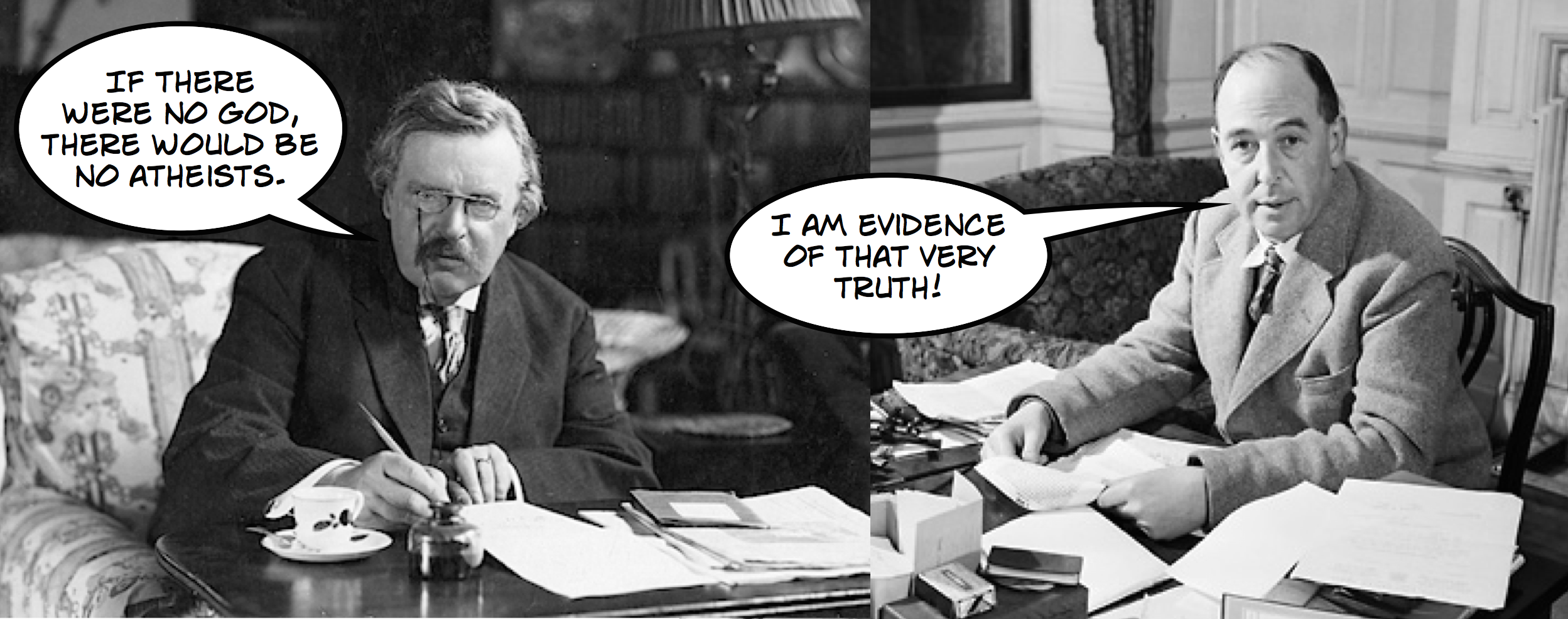
Some things never change. This cutting critique appeared nearly a century ago (in the 19 April 1924 issue of the Illustrated London News). It was penned by G.K. Chesterton, a British writer who was admired by many of his contemporaries, from a number of different perspectives. George Bernard Shaw, a Socialist, considered the conservative journalist a “man of colossal genius.”

Chesterton was one of the Christian writers whose faith made a significant impression on the unbelieving C.S. Lewis. Before encountering Jesus, the atheist Lewis resented the “intrusions” of Christian references into the writings of authors he otherwise enjoyed. He describes this conundrum delightfully in Surprised by Joy.

All the books were beginning to turn against me. Indeed, I must have been as blind as a bat not to have seen, long before, the ludicrous contradiction between my theory of life and my actual experiences as a reader. George MacDonald had done more to me than any other writer; of course it was a pity he had that bee in his bonnet about Christianity. He was good in spite of it.

Chesterton had more sense than all the other moderns put together; bating, of course, his Christianity. Johnson was one of the few authors whom I felt I could trust utterly; curiously enough, he had the same kink. Spenser and Milton by a strange coincidence had it too.

Even among ancient authors the same paradox was to be found. The most religious (Plato, Aeschylus, Virgil) were clearly those on whom I could really feed.

On the other hand, those writers who did not suffer from religion and with whom in theory my sympathy ought to have been complete—Shaw and Wells and Mill and Gibbon and Voltaire—all seemed a little thin; what as boys we called “tinny.” It wasn’t that I didn’t like them. They were all (especially Gibbon) entertaining; but hardly more. There seemed to be no depth in them. They were too simple. The roughness and density of life did not appear in their books. . . .

The upshot of it all could nearly be expressed in a perversion of Roland’s great line in the Chanson—Christians are wrong, but all the rest are bores. The natural step would have been to inquire a little more closely whether the Christians were, after all, wrong.

And C.S. Lewis, to his eternal joy, did just that. He inquired more deeply into the faith held by the writers he so respected. This included, of course, Chesterton. Echoes of Chesterton’s masterful expressions of Christian faith recur in the work of Lewis. For example, in his essay “Membership,” Lewis writes:

Equality is a quantitative term and therefore love often knows nothing of it. . . . Even in the life of the affections, much more in the body of Christ, we step outside that world which says “I am as good as you.” . . . We become, as Chesterton said, taller when we bow; we become lowlier when we instruct.

Similarly, in A Preface to Paradise Lost, Lewis describes how best to savor the historical work of writers from different eras. Although the reference to Chesterton here is given in passing, I will reproduce the larger passage in light of its insight into how best to benefit from what we read.

The things which separate one age from another are superficial. Just as, if we stripped the armour off a medieval knight or the lace off a Caroline courtier, we should find beneath them an anatomy identical with our own, so, it is held, if we strip off from Virgil his Roman imperialism, from Sidney his code of honour, from Lucretius his Epicurean philosophy, and from all who have it their religion, we shall find the Unchanging Human Heart, and on this we are to concentrate.

I held this theory myself for many years, but I have now abandoned it. I continue, of course, to admit that if you remove from people the things that make them different, what is left must be the same, and that the Human Heart will certainly appear as Unchanging if you ignore its changes. . . .

Instead of stripping the knight of his armour you can try to put his armour on yourself; instead of seeing how the courtier would look without his lace, you can try to see how you would feel with his lace; that is, with his honour, his wit, his royalism, and his gallantries out of the Grand Cyrus. I had much rather know what I should feel like if I adopted the beliefs of Lucretius than how Lucretius would have felt if he had never entertained them. The possible Lucretius in myself interests me more than the possible C.S. Lewis in Lucretius.

There is in G.K. Chesterton’s Avowals and Denials a wholly admirable essay called “On Man: Heir of All the Ages.” An heir is one who inherits and “any man who is cut off from the past . . . is a man most unjustly disinherited.” . . .

You must, so far as in you lies, become an Achaean chief while reading Homer, a medieval knight while reading Malory, and an eighteenth century Londoner while reading Johnson. Only thus will you be able to judge the work “in the same spirit that its author writ” and to avoid chimerical criticism.

G.K. Chesterton is well worth reading, and most fans of Lewis will appreciate his prodigious work. The best thing about Chesterton, is that since he entered the presence of his Lord in 1936, nearly everything he wrote is in the public domain. His essays, poetry, apologetic works—and even the tales of his fictional detective Father Brown—are readily accessible online.

For a friendly introduction to the relationship between Lewis and Chesterton, I recommend “Chesterton and Lewis, Side by Side.” In an issue devoted entirely to comparing the two pillars of Twentieth Century Christian apologetics, the St. Austin Review, we read:

In 1946, ten years after Chesterton died, Lewis wrote a short article defending Chesterton against the two charges with which he is still attacked—or dismissed—by most academicians: one, that he was popular, and two, that he was dated. Of course, Lewis is attacked for the same two reasons.

The entire article is available here. Those interested in one of the areas where Chesterton’s writing overlapped with that of Lewis and his good friend, J.R.R. Tolkien, will also enjoy “G.K. Chesterton: Fairy Tale Philosopher,” which is available here.

Powerful Names

missilesIt’s all in the name. The person who succeeds in naming (or labeling) something wields great power.

Whether it be a concrete object, or an idea, the power to name carries the power to shape perceptions.

Philosophically, we might agree that:

“That which we call a rose by any other name would smell as sweet” (Juliet, Romeo and Juliet).

But, if we are perfectly honest, calling it “skunk cabbage” might affect our perception of its aroma.

A classic example of the power of naming comes from the era of Norse exploration. In the ninth century, Vikings began settling in the inhospitably named “Iceland.” The island was majestic, and its spectacular glaciers and volcanoes still allowed room for extremely fertile farmsteads.

Less than a century and a half later, Erik the Red was exiled from Iceland. He sailed west and established the first colony on a much larger island that he enticingly named Greenland. Erik’s brilliant advertising ploy was quite effective, and hundreds of settlers joined him in the much harsher climes to Iceland’s west.

The specific appellations which led me to ponder the power that resides in naming once again,* actually came from a much more modern source—weaponry.

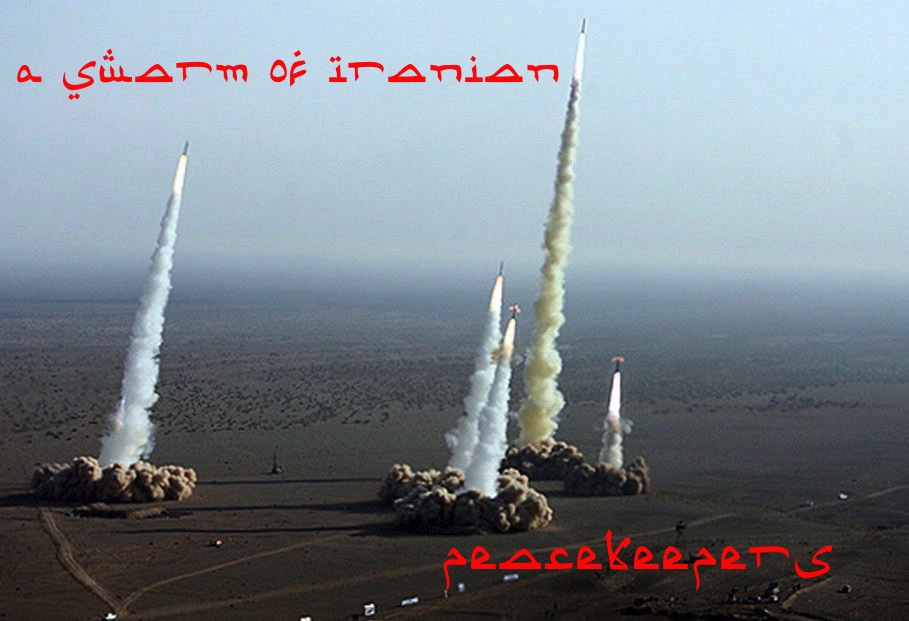
Military leaders have a knack for generating striking names. Often they are brilliant; occasionally they completely miss the mark. In either case, it’s curious to note the message their choice of nomenclature seeks to emphasize. Consider for a moment two different American missiles.

The AGM-114 Hellfire and the LGM-118A Peacekeeper

The reader naturally assumes the purpose of the former is to rain sulfur and brimstone down on the enemy, while the mission of the latter is to benignly maintain peace. One suspects, however, that being at the epicenter of either explosive device would be equally disastrous.

Another example we might consider is a bit more controversial, but fascinating nonetheless. Consider these labels for movements involved in the abortion debate.

Self-Preferred  ||  Used by Opponents  ||  Used by the Media

Pro-Choice  ||  Pro-Abortion  ||  Pro-Choice

Pro-Life  ||  Anti-Choice  ||  Anti-Abortion

It doesn’t require a brilliant intellect to comprehend the tone each of these labels evokes. Nor should it come as a surprise how the mainstream media tends to line up in the debate.

It’s all in the name. The person who succeeds in naming something wields great power.

C.S. Lewis was a master of language. He knew names exercise significant influence on how things are perceived. In the following passage from “The Humanitarian Theory of Punishment,” he describes how a powerful word—in this case “mercy”—can be dangerously misleading when applied to something inimical to itself.

Mercy, detached from Justice, grows unmerciful. That is the important paradox. As there are plants which will flourish only in mountain soil, so it appears that Mercy will flower only when it grows in the crannies of the rock of Justice: transplanted to the marshlands of mere Humanitarianism, it becomes a man-eating weed, all the more dangerous because it is still called by the same name as the mountain variety.

In another essay, “‘Bulverism:’ or, the Foundation of 20th Century Thought,” Lewis actually coins a word which has found favor with a literate subculture. The peculiar word he created conveys a sense of obtuse, opinionated self-smugness. (Yes, I may be reading just a little bit into “Bulverism,” but I really don’t think so. The aristocratic or remote sounding surname “Bulver,” the “ism” suffix and, of course, the “Bul” prefix all combine to engender an odd and unappealing impression.)

The subject Lewis addresses in this work is the unwillingness of disagreeing parties to honestly debate the merits of an issue. Instead, they rush to employ the invalid (and terribly effective) ad hominem approaches that characterize so much of modern politics.

C.S. Lewis is so talented (and ingenious) that he provides us with a biographical note on the fictional creator of the deficient form of “debate” prevalent in the modern era. “The modern method [of argument],” Lewis begins, “is to assume without discussion [your opponent] is wrong and then distract his attention from this (the only real issue) by busily explaining how he became so silly.”

In the course of the last fifteen years I have found this vice so common that I have had to invent a name for it. I call it “Bulverism.” Some day I am going the write the biography of its imaginary inventor, Ezekiel Bulver, whose destiny was determined at the age of five when he heard his mother say to his father—who had been maintaining that two sides of a triangle were together greater than the third—“Oh, you say that because you are a man.”

“At that moment,” E. Bulver assures us, “there flashed across my opening mind the great truth that refutation is no necessary part of argument. Assume your opponent is wrong, and then explain his error, and the world will be at your feet. Attempt to prove that he is wrong or (worse still) try to find out whether he is wrong or right, and the national dynamism of our age will thrust you to the wall.” That is how Bulver became one of the makers of the Twentieth Century.

. . . Bulverism is a truly democratic game in the sense that all can play it all day long, and that it gives no unfair privilege to the small and offensive minority who reason.

Sadly, Bulver’s disciples continue to increase, rather than diminish.

Since it was military missiles that initially got me thinking about the subject of the power of naming, it might be fitting to end with a few more evocative labels. They certainly elicit a wide range of impressions.

Condor: Argentina’s avian contribution

Piranha: Tiny but vicious and straight from Brazil’s Amazon

Velvet Glove: Canada’s mixed message

Sky Sword: China’s blending of the ancient and modern

Apache: French, which confuses this American veteran**

Meteor: A European offering sure to land hard if it doesn’t disappear in the atmosphere

Martel: Anglo-French venture they surely don’t want Islamists to think is a tribute to Charles Martel, Hero of the Battle of Tours***

V-1 Flying Bomb: Got to Hand it to the Germans for straight-forward labeling.

Rhinemaidens (Rheintöchter): There’s apparently Teutonic Poetry as well

Fateh: Iran’s “Conqueror”

Zelzal: Iran’s “Earthquake”

Sejjil: Iran’s “Baked Clay” (well we can’t expect all the Persian names to be winners)

Jericho: From Israel where we know whose walls tumbled down

Spike: Israeli and probably not a reference to Jael and the Book of Judges****

Hatf: Pakistani “Vengeance” (derived from the gentle sword of Muhammad)

Hyunmoo: Korea’s mythical “Guardian of the Northern Sky” (mayhap a reference to their aggressive northern neighbor)

Penguin: Those Norwegians really know how to frighten their enemies

Malakhit (Малахит): Just one of Russia’s curiously named explosives in their “mineral missile series”

Umkhonto: South African “Spear” from the Zulu tongue

The Brits are uniquely creative when it comes to naming missiles. They include: Blowpipe, Brimstone, Green Cheese, Rapier, Sea Skua and, of course, Fairey Fireflash and it’s less intimidating companion Fairey Stooge.

For some reason, I find a missile named “Green Cheese” particularly disconcerting. Whoever named that specific weapon was devilishly clever. If I were a world leader, I’d surrender immediately, rather than face a foe confident enough in their military prowess to use that sort of twisted culinary nomenclature for their armaments.

______

* I have written on the subject of personal names in the past.

** It just may translate as “Ruffian,” but I don’t think I want to go there, since it hints at political incorrectness.

*** It’s actually a combination of the missile’s guidance options: Missile, Anti-Radiation, Television. I’m sure the parallel with the Frankish defender of the Christian Church is a mere coincidence.

**** The fourth chapter of the Book of Judges.

Government & Baboons

I recently read an interesting article about battling terrorism from an international base in Djibouti. Many African nations have joined those from Europe and North America in trying to protect vulnerable villages from the ravages of violent extremism.

However, as readers of Mere Inkling know, we don’t deal with political matters here. Everyday life, yes. Writing and self-expression, of course. Faith, definitely. Imagination, most certainly. Current events are also on the table for consideration, insofar as they relate to the aforementioned subjects.

Politics though, as a subject in and of itself, is not on the Mere Inkling menu.

With that in mind, I want to share a passage from the Air Force magazine article. In a description of “a recent personnel recovery mission in Ethiopia,” it says,

The HC-130s landed at night on a pitch-black airstrip, but first had to make a “clearing pass” to scare a congress of baboons and a pod of hippopotamuses off the runway.

Quite a picture. However, the image itself only made part of the impression left on me by this sentence. More lasting was the reminder of what a group of baboons is called.

C.S. Lewis wrote a fascinating essay about government entitled “Democratic Education.” One of many of its many kernels of wisdom is this: “Democracy demands that little men should not take big ones too seriously; it dies when it is full of little men who think they are big themselves.”

Returning to the subject of animals, the second chapter of Genesis tells us,

Now out of the ground the Lord God had formed[f] every beast of the field and every bird of the heavens and brought them to the man to see what he would call them. And whatever the man called every living creature, that was its name. The man gave names to all livestock and to the birds of the heavens and to every beast of the field.

So, Adam named the animals, and I imagine that after her creation, Eve helped her husband refine some of those appellations. What I don’t know is this—exactly who decided how we label groups of the same species?

I would point out how apropos baboons being referred to as a “congress” is . . . except for two considerations. (1) The connection would be lost on many readers whose governments have parliaments, and (2) It turns out this is actually an error. The actual word for baboon bands is a “troop.” So much for their unfortunate association with an organization that has lost the confidence of nine out of ten Americans.

Here are a few of the familiar and unfamiliar collective nouns for a variety of animals, with some brief comments and questions.

Lions | Pride – Aptly named!

Prairie Dogs | Coterie – I never considered prairie dogs snobbish.

Kittens | Intrigue – I should have learned that from simple observation.

Finches | Charm – They really do, don’t they?

Wombats | Wisdom – Wisdom to Aussies, a mystery to me.

Pekingese | Pomp – Well, perhaps just slightly elitist.

Cobras | Quiver – Logical, given the prospect of meeting a group of vipers.

Peacocks | Ostentation – Much nicer than the “pride” option.

Barracudas | Battery – Same as electric eels, I suppose.

Crows | Murder – A term familiar to most literary folk.

Bullfinches | Bellowing – Huh? Sounds more hippopotamusish.

Cows | Kine – Have to thank the medieval English for this one.

Seabirds | Wreck – Beware when they fly overhead.

Bacteria | Culture – And what kind of civilization have they ever built?

Deer | Gang – Must be the teenagers, before they become a herd.

Cockroaches | Intrusion – Accurate, repulsive and ominous.

Guillemots | Bazaar – What’s a guillemot, and what is it selling?

Cormorants | Gulp – Didn’t their momma’s teach them to chew?

Cheetahs | Coalition – Wouldn’t “a ‘sprint’ of cheetahs” sound better?

Woodpeckers | Descent – Am I missing something here?

Clams | Bed – Not much else to do in the clam-world.

Turtledoves | Pitying – Meaning they take pity on us, not vice versa.

Bobolinks | Chain – Cute, but lost on Americans where they’re known as reedbirds or ricebirds.

Snails | Walk – Someone’s lacking a bit in creativity here.

Ravens | Unkindness – Speaking of unkind, who labeled them this?

Flamingoes | Stand – Come on now, isn’t that a bit obvious?

Giraffe | Tower – I guess the flamingoes aren’t the only ones.

Lice | Flock – That is way too nice a word for those vermin!

Alligators | Congregation – As a pastor, I simply don’t want to go there.

This is way too much fun, but I’d better stop now so I can revisit this theme in a year or so. Until then, if you learn who gave that unkind name to groups of ravens, let me know.

The Power of Names

babyC.S. Lewis was a man who recognized the power of a name. In fact, that awareness made the opening line of The Voyage of the Dawn Treader one of the most memorable in all of Christian literature: “There was a boy called Eustace Clarence Scrubb, and he almost deserved it.”

Names are used, of course, for identification. Throughout history, different countries have had different naming conventions. A rather common one featured the giving of a personal name to a child, with the patronym added to distinguish between individuals of the same name.

This led to distinctions such as James ben Zebedee of the Christian gospels or Leifr Eiríksson the first millennium explorer of North America. Hearkening back to my own Scandinavian roots, I favor the innovative example Ole Olson, or more commonly Ole Olsen. (The only problem with this name was that it failed to distinguish one Ole from the thousands of other Ole Olsons who dotted the steep coastlines of the Viking fjords.)

God too reveals the importance of names. In the Gospel according to Matthew we read:

But as he considered these things, behold, an angel of the Lord appeared to him in a dream, saying, “Joseph, son of David, do not fear to take Mary as your wife, for that which is conceived in her is from the Holy Spirit. She will bear a son, and you shall call his name Jesus, for he will save his people from their sins. (Matthew 1:20-21).

In one of the most powerful prophecies ever recorded, we hear various titles—in essence, names—of the Messiah Jesus.

For to us a child is born,

   to us a son is given;

and the government shall be upon his shoulder,

    and his name shall be called

Wonderful Counselor, Mighty God,

   Everlasting Father, Prince of Peace.

                                                             (Isaiah 9:6).

The reason that names are on my mind is because recent research has revealed that in America (well, California precisely, and assuming that data can be applied to the entire country) . . . the choice of baby names can even evidence the political leanings of the parents. Now, we’re not talking about parents who name their children directly in honor of a particular politician; it’s much more subtle than that.

Here are a couple of interesting facts gleaned from the study.

The results revealed that overall, the less educated the parent, the more likely they were to give their child either an uncommon name (meaning fewer than 20 children got the same name that year in California), or a unique name (meaning only one child got that name in 2004 in California). When parents had less than a college education, there were no major ideological differences in naming choice.

However, among college-educated whites, politics made a difference. College-educated moms and dads in the most liberal neighborhoods were twice as likely as college-educated parents in the most conservative neighborhoods to give their kids an uncommon name. Educated conservatives were more likely to favor popular names, which were defined as names in the top 100 in California that year.

The sounds of liberal and conservative names varied, too. For both boys and girls, liberals tended to pick more feminine-sounding choices, such as Liam, Ely and Leila names that include lots of L sounds and soft-A endings, including popular choices Ella and Sophia. Conservatives, on the other hand, tend to pick names with more masculine-sounding Ks, Bs, Ds and Ts, such as Kurt.

Beware of the temptation of attempting to jump aboard a naming fad. “Unique baby names can sometimes grate, however. In 2011 . . . an informal survey of hated baby names found that Nevaeh, or ‘heaven’ spelled backward, was the most commonly cited as a hated name. The name was invented in the 1990s and became the 31st most popular in the United States in 2007.”

My wife and I are surely in a minority. We chose the names for all three of our children based upon their meanings . . . a practice quite common in the Scriptures.

C.S. Lewis knew well the power of a name.

Perhaps it has sometimes happened to you in a dream that someone says something which you don’t understand but in the dream it feels as if it had some enormous meaning—either a terrifying one which turns the whole dream into a nightmare or else a lovely meaning too lovely to put into words, which makes the dream so beautiful that you remember it all your life and are always wishing you could get into that dream again. It was like that now.

At the name of Aslan each one of the children felt something jump in his inside. . . . Susan felt as if some delicious smell or some delightful strain of music had just floated by her. And Lucy got the feeling you have when you wake up in the morning and realise that it is the beginning of the holidays or the beginning of summer. (The Lion, the Witch and the Wardrobe).

It comes as no surprise to any Narnian sojourner that the very name of Aslan should so move his followers. After all, we too understand Who the great Lion is. For, as he once said to Lucy and Edmund, when asked if he was here in our world as well,

“Are—are you there too, Sir?” said Edmund.

“I am,” said Aslan. “But there I have another name. You must learn to know me by that name. This was the very reason why you were brought to Narnia, that by knowing me here for a little, you may know me better there.” (Voyage of the Dawn Treader).