Meandering Words

Sometimes we read for business. Other times we read for pleasure. Few people are so fortunate as to have these two purposes overlap.

When the goal is the former – the necessity of reading a particular document, our desire is usually to simply “get it done.” We want to arrive quickly at the point, so we can move on to some other project. In this context, digressions are definitely something to be avoided.

This is how military writers are taught to do their job. Deliver the goods immediately, with zero interest in the prose. (Well, apart from proper grammar and spelling.) This principle is frequently described with the acronym BLUF – bottom line up front. This approach makes sense, when lives can literally be on the line and the need to make sound decisions swiftly is urgent.

The Harvard Business Review puts it bluntly: “In the military, a poorly formatted email may be the difference between mission accomplished and mission failure.” Being the HBR, they naturally translate this concept for application in the business world.

If you are curious, you can freely download some of the military writing manuals available online. Warning: these manuals tend to include lots of tedious details that ironically appear to violate the BLUF principle itself!

Army Regulation 25–50 Preparing and Managing Correspondence

DOD Manual 5110.04, Correspondence Management

Canadian Armed Forces Junior Officer Development Programme

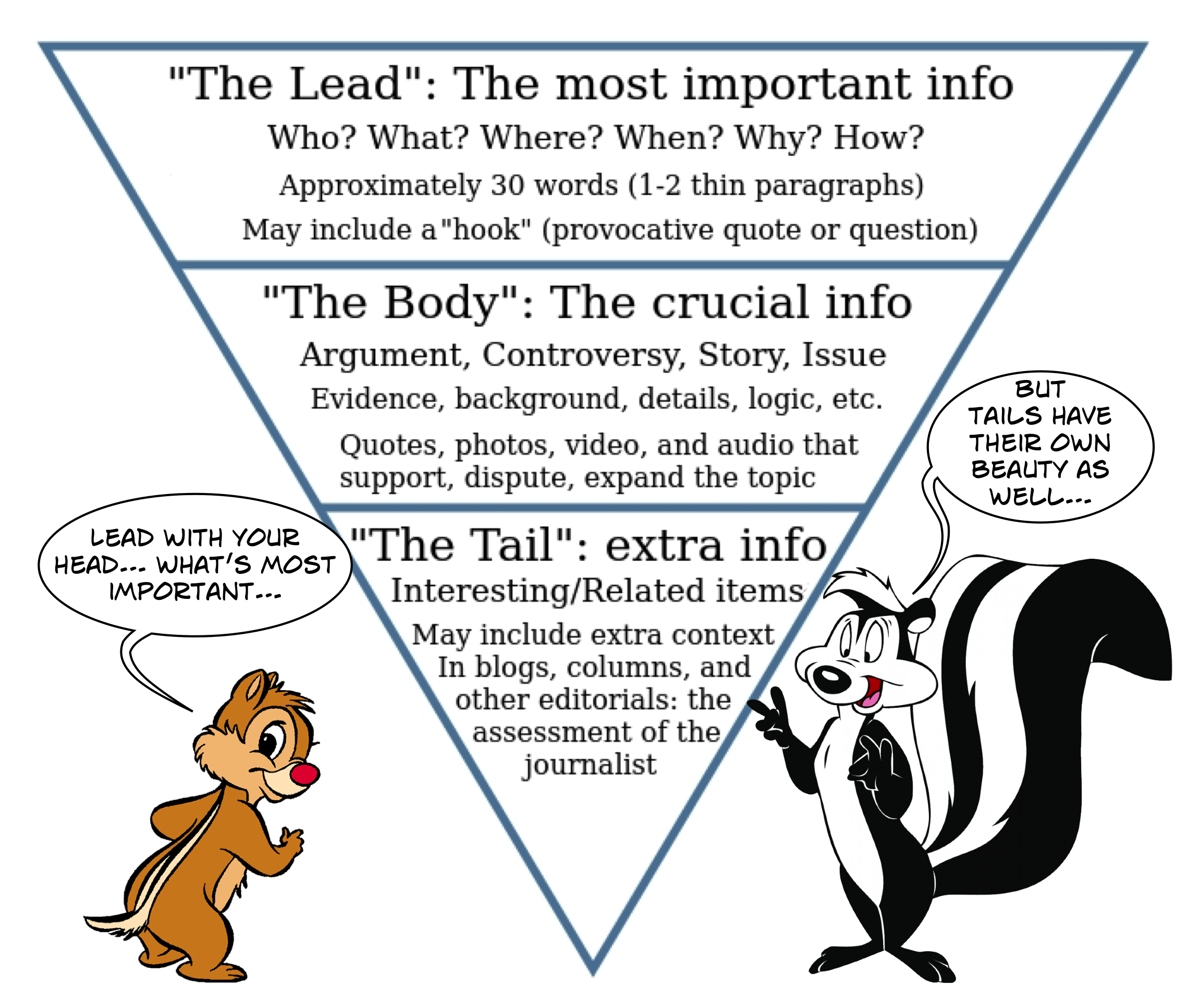
Similar to the military approach, we have the civilian version, which remains common in traditional journalism. (Even though printed newspapers continue to vanish, this approach is still found in many digital outlets.) This technique is referred to as the Inverted Pyramid Structure. Here is one concise definition:

The inverted pyramid is the model for news writing. It simply means that the heaviest or most important information should be at the top – the beginning – of your story, and the least important information should go at the bottom. And as you move from top to bottom, the information presented should gradually become less important.

The benefit of this strategy is that readers immediately learn the primary “news.” Only when they desire to supplement that information do they need to continue reading. Presumably the material follows in descending significance until they either finish the piece or it descends into minutiae of no interest to that particular reader.

The previously linked article notes one extremely important aspect of the inverted pyramid [emphasis added].

The inverted pyramid format turns traditional storytelling on its head. In a short story or novel, the most important moment – the climax – typically comes about two-thirds of the way through, closer to the end. But in news writing, the most important moment is right at the start of the lede.

And it is this traditional sort of storytelling to which we most often turn when we read for pleasure rather than as an obligation.

Reading for Enjoyment

Pleasurable reading is not, by definition, expeditious. It takes its time to tell a story, rather than rushing into a rapid information dump. In fact, when the narrative is savaged by unloading too much background or too many facts, it becomes hard to enjoy even when we want to like it.

Literature, even brief poetry, takes us on a journey. We go somewhere. We are transformed, albeit usually in an unmeasurable way. While the change may be small, it is quite distinct from the difference made by simply learning new facts.

While the journey itself may appear straightforward, in most cases there are often subtle alterations in its course. You might say a story intentionally tends to meander, which is why I titled this post as I have. Meander itself is a curious word.

Like so many words, meander has a literal and a figurative application. In a moment we will see each of these meanings entertainingly illustrated in C.S. Lewis’ correspondence.

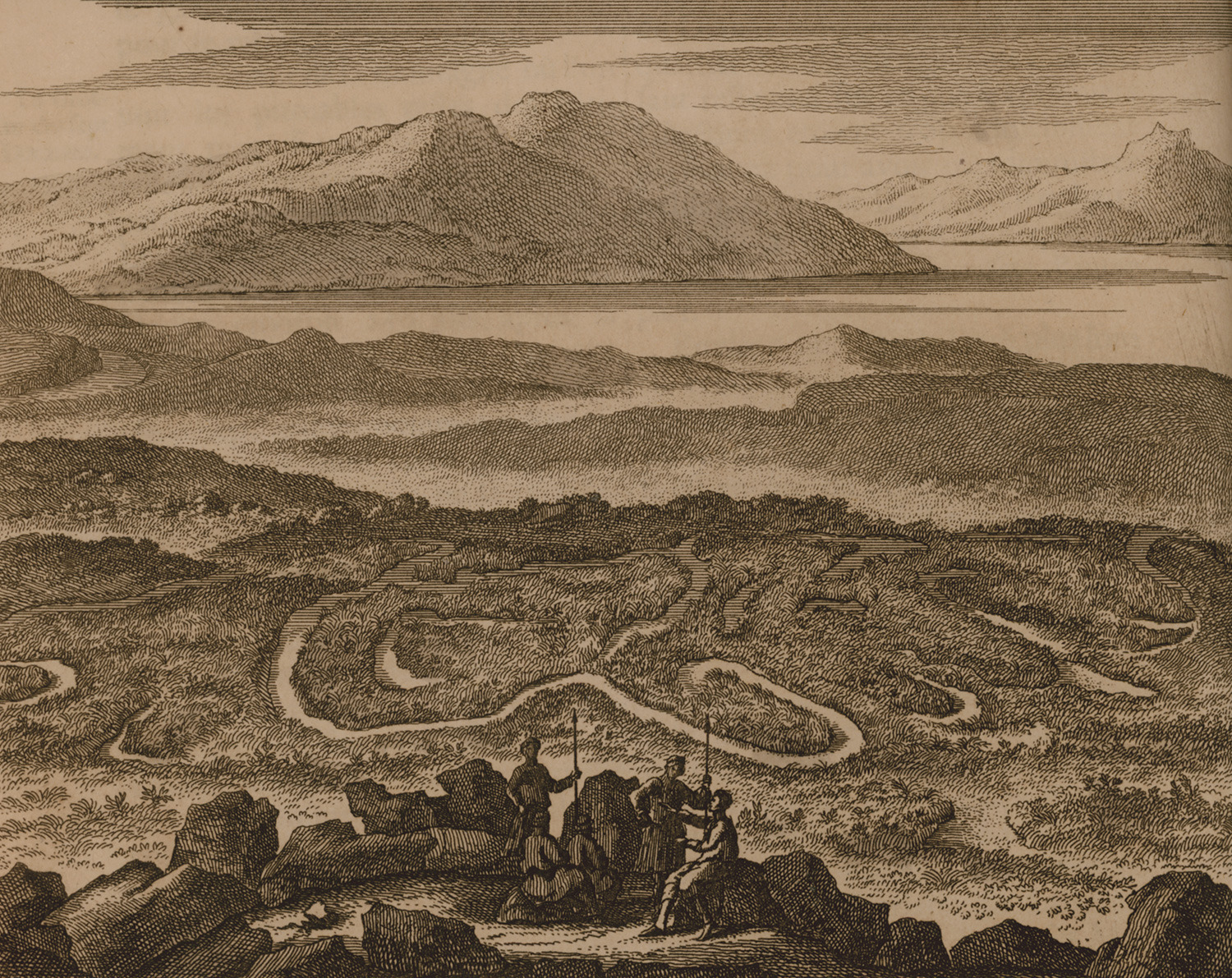
I began thinking about this intriguing word when I recently read about its source. It begins with an ancient kingdom in Asia Minor (modern day Türkiye). Lydia was independent for half a millennia before its king, Croesus, was defeated by Cyrus of Persia. One of Lydia’s lasting contributions to civilization came in the form of the minting of coinage.

Herodotus tells us they were the first to do so. This is, of course, a captivating story in its own right.One of the images used on one of their early coins was of the Maeander River, which meandered through their kingdom. The picture above, View of Maeander Valley, was published by Flemish artist Cornelis de Bruyn in 1714.

Did C.S. Lewis Meander?

Searching through Lewis’ writings, I did not find any examples of his use of this winding word. (Let me know if you’re aware of one.)

However, here are two enjoyable examples of his informal use of “meander” in his correspondence. The first, in a 1920 letter to his father, uses the word in its figurative sense.

I have two tutors now that I am doing ‘Greats,’ one for history and one for philosophy. . . . We go to the philosophy one in pairs: then one of us reads an essay and all three discuss it. . . . it is very amusing.

Luckily I find that my previous dabbling in the subject stands me in good stead and for some time I shall have only to go over more carefully ground through which I have already meandered on my own.

In the second occurrence, we find C.S. Lewis writing to his Brother Warnie in 1932. He describes, at some humorous length, the condition of the pond on their property. You can visit this same setting today in the C.S. Lewis Nature Reserve.

I have included the full discussion below. Suburbanites (and even more so, city-dwellers) may not be able to appreciate this story the way that people who have lived in the country can. Still, those with a minute to read the entire passage will likely enjoy the way Lewis meanders through his description of events. Oh, and lest you suffer unnecessary shock, be forewarned that Lewis uses the word “bathe” here not to refer to a “bath,” but to a plunge in the pond.

You will gather from this that summer has arrived: in fact last Sunday (it is Tuesday to day) I had my first bathe. You will be displeased to hear that in spite of my constant warnings the draining of the swamp has not been carried out without a fall in the level of the pond.

I repeatedly told both [the workmen] that the depth of water in the pond was sacrosanct: that nothing which might have even the remotest tendency to interfere with that must be attempted: that I would rather have the swamp as swampy as ever than lose an inch of pond.

But of course I might have known that it is quite vain ever to get anything you want carried out: and the pond is lower. However, don’t be too alarmed. I don’t think it can get any lower than it is now.

I don’t know how much of the draining operations Minto [Janie Moore] has described to you nor whether you understood them. In fact, remembering what a mechanical process described by Minto is like I may assume that the more she has said the less you know about it.

The scheme was a series of deep holes filled with rubble and covered over with earth. Into each of these a number of trenches drain: and from each of these pipes lead into the main pipe now occupying the old ditch between the garden and the swamp, which in its turn, by pipes under the lawn, drains into the ditch beside the avenue.

It was however useless to do all this as long as the overflow outlet from the pond (you know – the tiny runnel with the tiny bridge over near the Philips end of the pond) was meandering – as it did – over all the lower parts of the swampy bit. Nor was it possible to stop this up and deny the pond any outlet, as it would then have been stagnant and stinking in summer, and overflowing in winter.

It was therefore decided to substitute a pipe outlet for the mere channel outlet – which pipe could carry the overflow from the pond, through the swampy bit without wetting it, to the rest of the drainage system. When they first laid this pipe I said that its mouth (i.e. at the pond end) was too low and that it would therefore carry off more water than the old channel and so lower the pond.

The workmen shortly denied this but I stuck to my point and actually made them raise it. Even after they had raised it I was still not sure that it wasn’t taking off more water than the old channel did: so I have now had a stopper made which is in the mouth of the pipe at this moment. I have also given the spring-tap up beyond the small pond a night turned on, and I trust that by thus controlling in-flow and outflow of water I can soon nurse the pond back to its old level.

At any rate I don’t see how it can sink as long as its escape is bunged up. As to the degree of loss at present, as there are no perpendicular banks anywhere it is hard to gauge. I should think that the most pessimistic episode could hardly be more than ¾ of a foot: i.e. a difference one is unconscious of in bathing. Still I grudge every inch.

By the way, it has just occurred to me that the sinking may not be due to the draining at all: for the old ‘channel’ escape, when I looked at it just before the operations began, had certainly widened itself extremely from what I first remembered, and must have been letting out more than it ought. In that case the new pipe may have arrested rather than created a wastage.

One criticism some short-attention-span readers levy against Tolkien’s masterpiece, Lord of the Rings, is that too much time is spent traveling. Such critics overlook the reasons the author presented his saga in the manner he did. Well, for those desiring to simply jump from battle to battle, we now have graphic novels. All of the journeying in LOR has a purpose; it is far from mere “meandering.”

Tolkien detailed the travails of the Fellowship during their quest, and his maps allow students of the mythos to discern “Frodo and Sam traveled over a thousand miles from the Shire to Mount Doom in the Lord of the Rings trilogy, over multiple landscapes and terrains.” One of the colorful words created by Tolkien, that rolls off the tongue like a babbling brook, is the name of a river that crosses the Old Forest: Withywindle. (A withy is an Old English word for a willow, or slender twigs or branches.) Its course may not have been especially winding, but it definitely sounds like it should have been.

No one can deny the influence of J.R.R. Tolkien on fantasy literature. But the aforementioned shortening attention spans do deter some readers. Make no mistake about it, however, the traveling in the writings of the Inklings is not without purpose. Nor does it disrupt the story. Still, the less skilled among us should be cautious about mimicking their techniques. One author describes this hazard in the following way.

Ultimately, when you write, your goal should be to make sure that everything you write doesn’t meander, or in other words, moves in some way towards the conclusion of your story. Be that taking care of a subplot, a character arc . . . whatever, it needs to hit a step, or move towards it, on the path to the ultimate ending of your story.

Remember both pacing and the up and down of rising and falling tension. A meandering story stretches out a low point and breaks the pacing. You always want to keep your plot on a straight line to the ending. The characters, they can wander, as long as the plot doesn’t.

Thanks for meandering with Mere Inkling today. Isn’t it wonderful that God allows us these carefree moments, and life isn’t all about “getting things done?”
Teaching Kids to Write

banner

My grandkids have stunned me with their enthusiasm for writing. And all it took to inspire them was a very simple activity.

I invited our ten youngest grandchildren (aged 4 to 12) to write their own family newspaper. Although I devised our family publication myself, I’ve since learned that there are abundant resources—albeit of vastly different qualities—available online. You’ll find some links below.

The first challenge was to explain to them what a newspaper is. The irony is not lost on me that none of our four families currently subscribe to daily papers. It was more difficult than I anticipated to explain to all of the novice journalists precisely what newspapers are. I use the present tense, because the medium is not quite obsolete, despite the downward trajectory of most local papers. As an editorial in the Washington Post said this year, “newspapers have been dying in slow motion for two decades now.” And it seems to many the process is accelerating.

Nevertheless, as the proud veteran of high school and college newspaper staffs, and a former contributor to my hometown weekly, I believe such publications are ideal for developing writing skills. The passion overflowing from my writing bullpen has vastly exceeded my expectations, confirming my impression.

While it took a while to gather enough submissions for the first issue, they rushed to fill the second. When each was “published,” all of the kids immediately sat down and read their personal issues from proverbial cover to cover.

My endorsement of family newspapers does not carry over to the commercial press. Sadly, too much of what is presented as “objective reporting,” is patently subjective. I debated my journalism profs about that matter forty years ago, and the evidence has only grown more visible. I also agree with C.S. Lewis’ opinion that the majority of what passes for “news,” is superfluous or sensationalistic.

Even in peacetime I think those are very wrong who say that schoolboys should be encouraged to read the newspapers. Nearly all that a boy reads there in his teens will be seen before he is twenty to have been false in emphasis and interpretation, if not in fact as well, and most of it will have lost all importance.

Most of what he remembers he will therefore have to unlearn; and he will probably have acquired an incurable taste for vulgarity and sensationalism and the fatal habit of fluttering from paragraph to paragraph to learn how an actress has been divorced in California, a train derailed in France, and quadruplets born in New Zealand. (Surprised by Joy)

Perhaps ironically, Lewis did not hesitate to publish his own writings in worthy newspapers. Most notably, The Guardian (an Anglican newspaper printed between 1846 and 1951) published several of his essays. In addition, they presented to the world (in serial form) both The Screwtape Letters and The Great Divorce.

For an interesting discussion about C.S. Lewis’ opinion that newspapers are inadequate tools for assessing truth, check out this article. The author draws a valid distinction between Lewis’ example and the current state of affairs where “we judge too quickly and offer grace much too slowly.”

Elements of Our Family’s Publishing Experiment

After describing to the kids what newspapers are, I provided them with a list of potential subject matter. In addition to “standard” sorts of news and reviews, I added things like “sermon notes,” fiction, and comics.

I encourage them to illustrate their own articles, and the first two issues have been graced with images of dogs, horses, King Tut, and a Turtle Bear (who served as a weather forecaster). Each child contributes at their own level, and the cousins commend each other on their efforts.

We’re early in the stages of teaching the kids about rewriting and self-editing. Depending on the situation, either their parents or the editorial staff (grandma and grandpa) assist them with learning to revise their own work.

I must confess that one of the most fun aspects of Curious Cousins Courier is my ability, as the editor, to creatively engage in a bit of editorial privilege. The primary example comes in a “Family Heritage” feature that I write for each issue.

In the first, we considered the life of the cousins’ great-great-grandfather who immigrated from Norway in 1912. Julius Olaissen Næsbø unsuccessfully attempted to travel on the RMS Titanic, but the steerage class was full, and he had to settle for a departure several weeks later. The fringe benefit of reading about “Grandpa Nesby” came in learning that other languages include letters in their alphabet that are foreign to us in the States.

In the second issue, I pointed the children to one of their ancestors who helped establish our country itself, during the Revolutionary War. Joseph Johnston was born in Ireland, and was a sergeant in the Fifth Virginia Regiment.

The importance of cementing family bonds—and instilling a healthy awareness of our family’s legacy—is extremely important to me. I suppose that is due in large part to spending the first third of my life as a nomadic military kid. Yet that sense of disconnectedness from my extended family did not prevent me from inflicting the same itinerant military lifestyle on my own children. But that’s a story for another day.

If you help to establish a newspaper or journal for members of your own family, I trust you will find it as rewarding as I do.

A Few Online Resources

Get the Scoop: Create a Family Newspaper,” from Education.com

How to Make a Family Newspaper,” from wikiHow.

The 5 Ws are noted on ImaginationSoup. (In case you’ve forgotten, they’re who, what, where, when and why.)

More developed thoughts, with an eye toward the classroom, are available at The CurriculumCorner.

C.S. Lewis and Punditry

chesterton-sanity

Odds are that you, kind reader of Mere Inkling, are a pundit. While the overpaid professionals who overpopulate the media would like for us to think being a pundit requires possessing special knowledge or expertise, that’s simply not true.

Any of us who make comments or pass judgments in an authoritative manner can rightly be deemed a pundit. If you are simply a commonplace critic, you probably qualify for the title. All the more so if you publish your thoughts.

If the recent elections proved anything, they revealed there may well be more pundits per cubic acre in the modern world, than there are bees.

Recently I came across a peculiar essay, written by a writer with whom I’m totally unfamiliar. David Harsanyi is a senior editor of The Federalist, although this article appeared in National Review. Presumably he is a conservative, but of the atheist variety. (No wonder I haven’t read any of his work.)

At any rate, he’s a journalist who describes his “line of work” as “punditry.” Punditry as we have noted, has become all the rage in our modern era. I’m debating though whether adding it to one’s resume would be beneficial. It appears that receiving the validation of a punditry paycheck is the best gauge for making that determination.

As soon as people had the leisure time to develop their senses of humor, the seeds of punditry were planted, and many a silver tongued cynic has reaped the harvest. The past has known people who offered social criticism with a dash of wit (typically of the sarcastic variety).

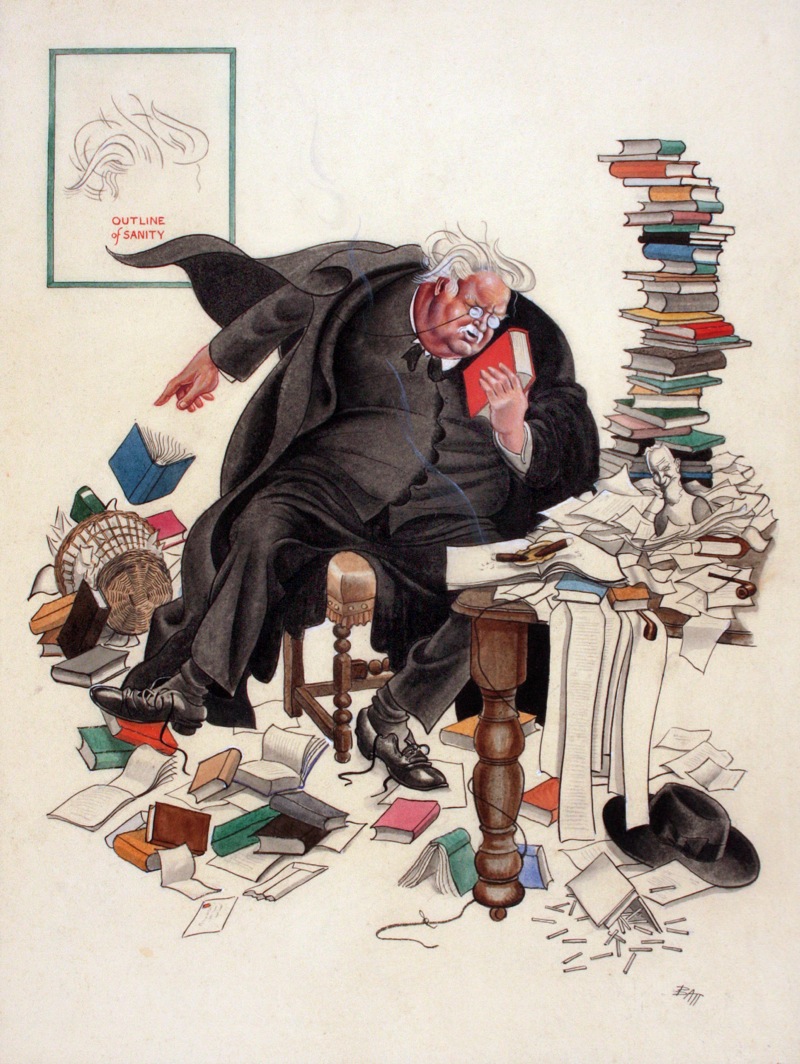
An admirable example of such was G.K. Chesterton (1874-1936). Chesterton differed from Harsanyi in that he was also a philosopher and poet, not merely a journalist. Most notably, Chesterton was also a Christian.

C.S. Lewis held Chesterton in very high regard, and included his book The Everlasting Man among the top ten titles which had influenced his professional and philosophical thought. You can download an audio copy of that text here.

There is a great essay here that explores the influence of Chesterton’s essay “Ethics of Elfland” on the Inklings.

Jerk Logic

Returning to the article with which I began, “Jerk Logic” is the title of Bersanyi’s essay. He began with a question that more people should probably ask themselves.

Am I a jerk? You may find this an odd question for a person to ask himself. But when you’re in my line of work—which, broadly speaking, is called punditry—complete strangers on social media have little compunction about pointing out all your disagreeable character traits.

I found his article interesting for several reasons. He’s candid about some of the booby traps that endanger those who dare to write about controversial subjects. He offers a confession about just how soul-scarring the past election has been for some who have followed its permutations closely.

The 2016 election, I’m afraid, has convinced me that the joke is definitely on me. But after taking meticulous inventory of my actions over the past year or so, I am forced to acknowledge that perhaps, on occasion, some of my behavior might be construed as wantonly unpleasant. Long story short, I am a jerk . . . with an explanation.

Another thing I enjoyed in the brief piece is how he turned to a personality inventory (similar to the Myers Briggs Type Indicator) to assess his potential jerk quotient.

As I learned more about my personality type, I began feeling sorry for everyone in my almost certainly beleaguered family. While we pride ourselves on “inventiveness and creativity” and “unique perspective and vigorous intellect,” Logicians can also be “insensitive,” “absent-minded,” and “condescending.”

The essay concludes with a justification for a modest amount of jerkiness when living the life of a journalist, and especially a pundit.

As a writer, it’s incumbent on me to be clinically unpleasant and prickly when focusing on self-aggrandizing do-gooders or abusers of power or those who pollute our culture with garbage. One can make arguments in good faith while still being downright disagreeable. So I make no apologies for being disliked. There’s nothing wrong with being hated by the right people.

There are, in fact, far too many journalists overly concerned about being shunned. As a young critic writing his first reviews for a wire agency, I sometimes wrestled with an existential question: “Who am I to say these horrible things about people who are far more successful and powerful than I am?” Nowadays I ask myself: “How exactly can I say more horrible things about these people who shouldn’t be more successful or powerful than any of us?”

A skeptical and contrarian disposition is not only useful if you want to be a decent pundit, but indispensable if you want to be a good journalist on any beat.

I wonder whether Chesterton would think of this as an indispensable journalistic trait. He did, after all, have an honest view of the overall profession. “Journalism largely consists in saying ‘Lord Jones is dead’ to people who never knew Lord Jones was alive.” (The Wisdom of Father Brown)

I did find a fascinating description of the press provided by Chesterton in “The Boy.” It was published in 1909 in All Things Considered . . . and echoes true a century later.

But the whole modern world, or at any rate the whole modern Press, has a perpetual and consuming terror of plain morals. Men always attempt to avoid condemning a thing upon merely moral grounds.

If I beat my grandmother to death to-morrow in the middle of Battersea Park, you may be perfectly certain that people will say everything about it except the simple and fairly obvious fact that it is wrong.

Some will call it insane; that is, will accuse it of a deficiency of intelligence. This is not necessarily true at all. You could not tell whether the act was unintelligent or not unless you knew my grandmother. Some will call it vulgar, disgusting, and the rest of it; that is, they will accuse it of a lack of manners. Perhaps it does show a lack of manners; but this is scarcely its most serious disadvantage.

Others will talk about the loathsome spectacle and the revolting scene; that is, they will accuse it of a deficiency of art, or æsthetic beauty. This again depends on the circumstances: in order to be quite certain that the appearance of the old lady has definitely deteriorated under the process of being beaten to death, it is necessary for the philosophical critic to be quite certain how ugly she was before.

Another school of thinkers will say that the action is lacking in efficiency: that it is an uneconomic waste of a good grandmother. But that could only depend on the value, which is again an individual matter.

The only real point that is worth mentioning is that the action is wicked, because your grandmother has a right not to be beaten to death. But of this simple moral explanation modern journalism has, as I say, a standing fear. It will call the action anything else—mad, bestial, vulgar, idiotic, rather than call it sinful.

Amen. Evil acts today are nearly always attributed to some shortcoming or flaw such as insanity (e.g. individual acts) or delusional indoctrination (e.g. jihadism). While these are sometimes contributing factors, Chesterton rightly assessed the base cause.

Sadly, by affirming that fact, I expect that I too will be going on some people’s “jerk” list. They may consider me contrarian, but I’m simply striving to be honest.


Fit to Print?

amazonIt’s challenging enough to conduct painstaking research. But, only to have it become immediately obsolete by virtue of it’s own publication—that is simply too much.

Flying home from a whirlwind trip from the Pacific to the Atlantic, I came across an interesting analysis of how many sheets of paper would be required to print out the entire contents of the internet.

One hundred and thirty-six billion.

Didn’t sound like all that many when I read it. Why, that’s not even a fraction of the annual deficit here in the United States.

Still, it’s quite a few sheets of paper. As the article said, stacked on one another, the pile would tower 8,300 miles high. That sounds a bit more impressive.

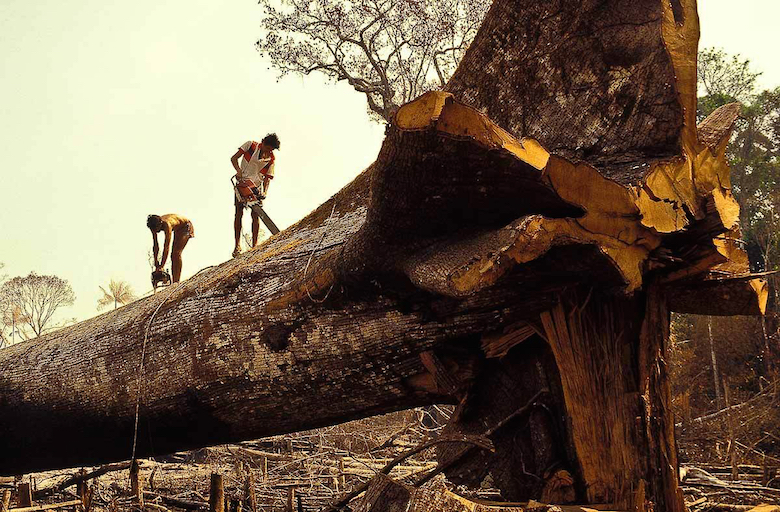
The researchers determined eight million Amazonian trees would have to be sacrificed to provide sufficient pulp. Impressive. But then they turn about and make that very number far less remarkable by declaring that this total would constitute only 0.002% of the rainforest.

The Flaw in the Research

Sadly, as diligent and mathematical as the researchers were, there was a weakness in their model. You see, they did not factor in their own research. Immediately upon it’s publication, their numbers were obsolete.

In fact, because they meddled with the internet equilibrium, there were at least 36,000,000,002 pages. (And, although I am not a scientific researcher, I suspect there were even more.) And, despite my mediocre numerical skills, even I know that when I hit post with this column, the internet page counter will advance another digit.

More ominously, especially in light of our recent reflections about the dark web, is the following:

Also, it is thought the non-explicit web is only a mere 0.2% of the total internet, the rest encompassing the Dark Web. This would mean that printing the entire internet including the Dark web would use 2% of the rainforest.

This relates to the question that entered my mind when I read the original statistic. (And I was not even thinking about the garbage that oozes throughout the internet.)

A More Important Question

As entertaining as it might be to ponder how many pages of data exist on the web, there is a far more valuable question. How many pages of the material on the internet are worth printing out?

C.S. Lewis has a delightful passage about wasted newsprint in Surprised by Joy. Although he is specifically talking about how students should not squander time or attention on newspapers, his point extends beyond that to people of all ages, and to all media including the internet.

I think those are very wrong who say that schoolboys should be encouraged to read the newspapers. Nearly all that a boy reads there in his teens will be known before he is twenty to have been false in emphasis and interpretation, if not in fact as well, and most of it will have lost all importance.

Most of what he remembers he will therefore have to unlearn; and he will probably have acquired an incurable taste for vulgarity and sensationalism and the fatal habit of fluttering from paragraph to paragraph to learn how an actress has been divorced in California, a train derailed in France, and quadruplets born in New Zealand.

If Lewis were alive today, I have no doubt he would share my opinion that most of what is written both on- and offline, is not worth printing.

Perhaps someone should undertake a study of how many trees would need to be cut to print everything worthy of being printed? If they did so, I am fairly confident we would need not worry about the future of the Amazonian rain forest.