
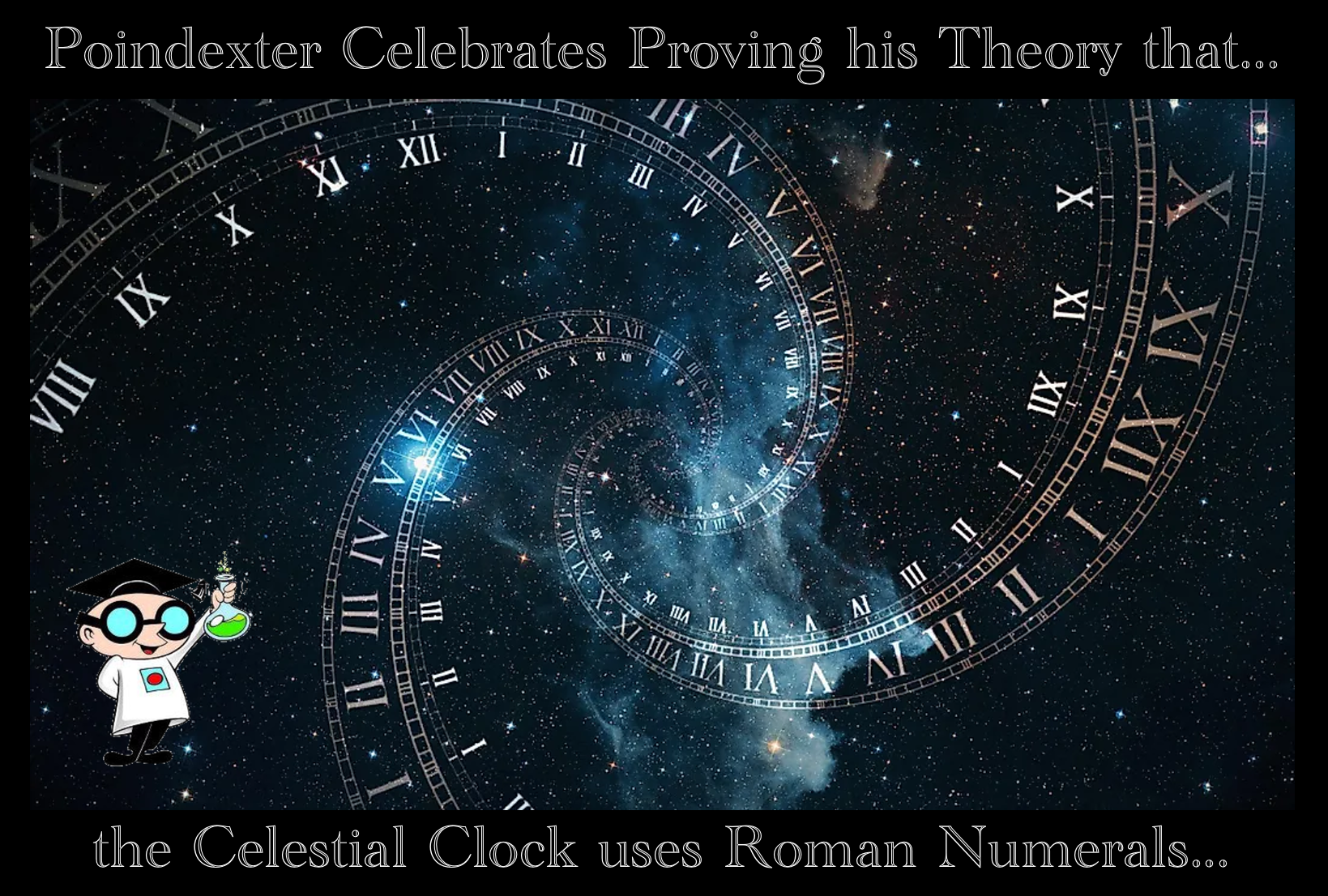
C.S. Lewis and Time’s Meaning

What is time, and why are we subject to its ofttimes harsh burdens? After his conversion from atheism, C.S. Lewis discovered some comforting truths about time, and the limits of time’s constraints.

Each year the four seasons seem to pass more rapidly. Before we know it, our parents have gown old, and we may well have children of our own. In retrospect, it all happens in the proverbial flash.

Ultimately, there will come a day when our lives reach their own “winter,” and even our most precious memories may drift away from us in time’s relentless breeze.

The C.S. Lewis Institute has an interesting article titled “The Point at which Time Touches Eternity.” They quote some wisdom from The Screwtape Letters, and end with a query which can help us live happier lives.

As you think about your own life, do you sometimes think too much about the Past or the Future, and not chiefly attend to the Present and Eternity?

Lewis answers that very question in his essay “Historicism.” He acknowledges that too often we become slaves to the regrets of our past and the dread of challenges awaiting us in the future. He reminds Christians that “God will supply every need of yours according to his riches in glory in Christ Jesus” (Philippians 4).* Therefore, Lewis encourages us to throw off the bondage of past and future, since “where, except in the present, can the Eternal be met?”

Janie Cheaney recently wrote “Eternity in Our Hearts” for World Magazine. Inspired by Saint Augustine and C.S. Lewis, it is subtitled “What if time astonishes us because we are meant to one day live outside of it.”

More of Lewis’ Thoughts about Time

In Mere Christianity, Lewis describes our universal human experience. “Our life comes to us moment by moment. One moment disappears before the next comes along: and there is room for very little in each. That is what Time is like.” He then describes just how limited our perspective is.

And of course you and I tend to take it for granted that this Time series – this arrangement of past, present, and future – is not simply the way life comes to us but the way all things really exist. We tend to assume that the whole universe and God himself are always moving on from past to future just as we do. But many learned men do not agree with that. Almost certainly God is not in Time. His life does not consist of moments following one another . . .

If you picture Time as a straight line along which we have to travel, then you must picture God as the whole page on which the line is drawn. We come to the parts of the line one by one: we have to leave A behind before we get to B, and cannot reach C until we leave B behind. God, from above or outside or all around, contains the whole line, and sees it all.

In Miracles, C.S. Lewis describes God’s transcendence over time as our Creator’s “eternal Now.”

It is probable that Nature is not really in Time and almost certain that God is not. Time is probably (like perspective) the mode of our perception. There is therefore in reality no question of God’s at one point in time (the moment of creation) adapting the material history of this universe in advance to free acts which you or I are to perform at a later point in Time.

To Him all the physical events and all the human acts are present in an eternal Now. The liberation of finite wills and the creation of the whole material history of the universe (related to the acts of those wills in all the necessary complexity) is to Him a single operation. In this sense God did not create the universe long ago but creates it at this minute – at every minute.

That is pretty deep. The sort of stuff that philosophers love to ponder and debate. Even before his conversion to Christianity, while still clinging to his formal atheism, Lewis contemplated time’s role in existence. In 1918 he wrote to his close friend Arthur Greeves about these matters. 

You see the conviction is gaining ground on me that after all Spirit does exist; and that we come in contact with the spiritual element by means of these “thrills.” I fancy that there is Something right outside time & place, which did not create matter, as the Christians say, but is matter’s great enemy: and that Beauty is the call of the spirit in that something to the spirit in us. You see how frankly I admit that my views have changed.

Sheldon Vanauken (1914-1996) was an American author who preserved in A Severe Mercy several of C.S. Lewis’ letters of consolation following the death of Sheldon’s wife. In some ways, the Vanauken story foreshadowed Lewis’ own marriage and widowhood. Pointing toward the Resurrection, Lewis wrote the following.

You say the materialist universe is “ugly.” I wonder how you discovered that! If you are really a product of a materialistic universe, how is it you don’t feel at home there? Do fish complain of the sea for being wet? Or if they did, would that fact itself not strongly suggest that they had not always been, or would not always be, purely aquatic creatures?

Notice how we are perpetually surprised at Time. (“How time flies! Fancy John being grown-up & married! I can hardly believe it!”) In heaven’s name, why? Unless, indeed, there is something in us which is not temporal.

C.S. Lewis writes much more about time, but we will conclude here with two passages that use the metaphor of author to describe God’s nature. The first comes from an essay entitled “The Seeing Eye.”

My point is that, if God does exist, He is related to the universe more as an author is related to a play than as one object in the universe is related to another. If God created the universe, He created space-time, which is to the universe as the metre is to a poem or the key is to music.

To look for Him as one item within the framework which He Himself invented is nonsensical. If God – such a God as any adult religion believes in – exists, mere movement in space will never bring you any nearer to Him or any farther from Him than you are at this very moment.

You can neither reach Him nor avoid Him by travelling to Alpha Centauri or even to other galaxies. A fish is no more, and no less, in the sea after it has swum a thousand miles than it was when it set out.

This final quotation appears in Mere Christianity. It is most certainly true, and my hope is that all who read this post will come to celebrate this joy. Both now, and for eternity.

God is not hurried along in the Time-stream of this universe any more than an author is hurried along in the imaginary time of his own novel. He has infinite attention to spare for each one of us.

He does not have to deal with us in the mass. You are as much alone with Him as if you were the only being He had ever created. When Christ died, He died for you individually just as much as if you had been the only man in the world.


* This gracious, eternal gift is available to all people.
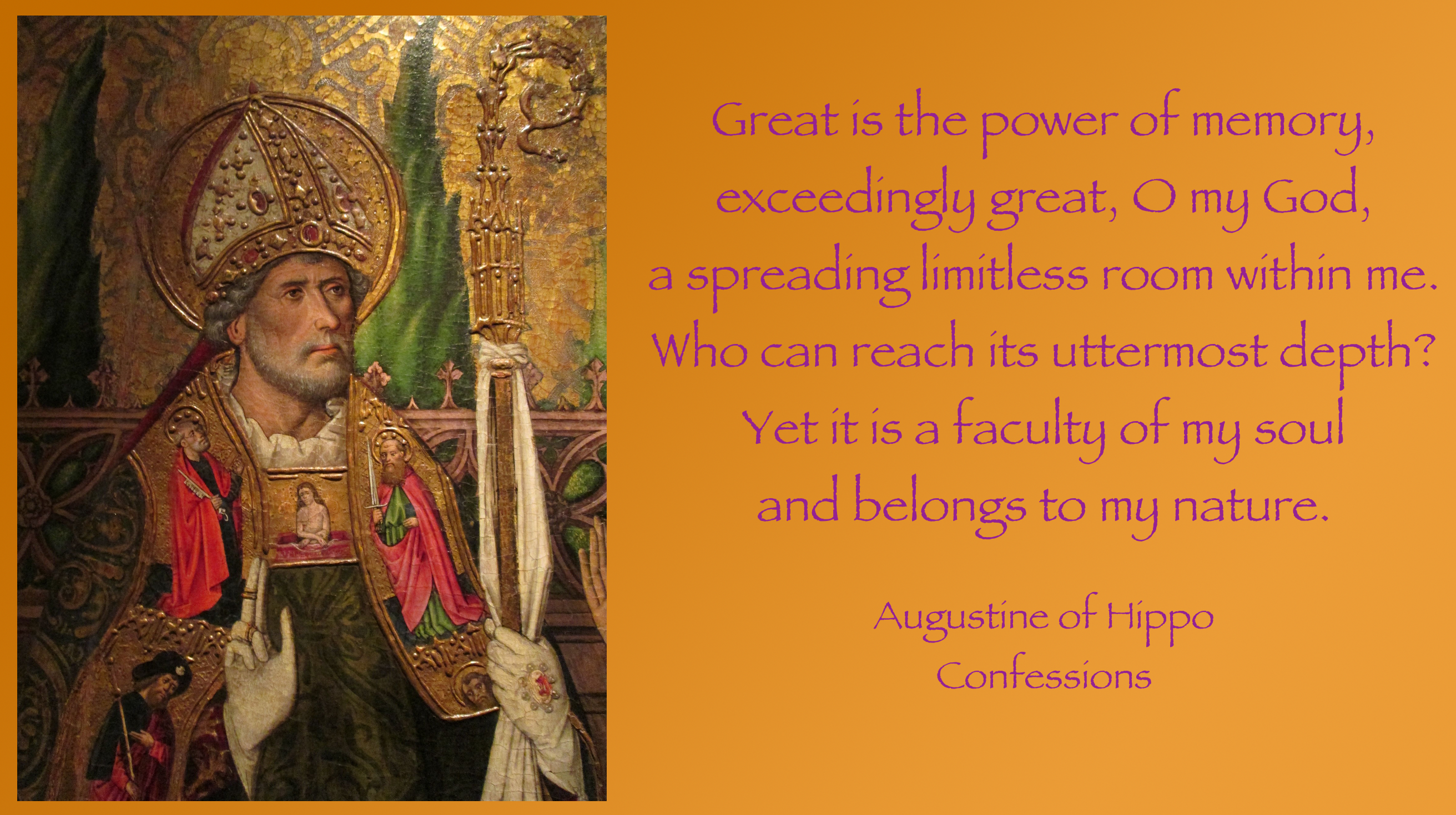
Good & Bad Memories

We humans are fascinating creatures. Our capacity to remember both the good and the ill from our past, exerts a powerful influence on the course of our future.

I’ve been reflecting on this contrast since our lectionary readings from worship this past Sunday. (I’ll note the particular passage that triggered my thoughts in a moment.)

The question I’ve pondered is whether good memories are more powerful than bad memories. By bad, I’m not referring to horrific experiences which our minds sometimes actively suppress or bury.

I’m thinking of unpleasant, disappointing memories. Things that we regret having happened, either to us, or because of us.

When I use the word “powerful” in my question, I’m referring to the ability of a given memory to continue actively impacting our lives.

In too many lives, it seems the joy and light emanating from positive recollections is often shaded or eclipsed by the clouds of painful memories.

Perhaps our lives would be happier if we consciously spent time recalling good experiences, and taught ourselves to reject – rather than dwell upon – negative thoughts when they force their way onto the stage?

C.S. Lewis provides a curious insight into the nature of memories. Their overarching essence often seem to magnify as time passes. Listen to his words, penned after a vacation in 1921, in which he describes how the joyful memories will grow ever sharper as they are recalled in the future.

I still feel that the real value of such a holiday is still to come, in the images and ideas which we have put down to mature in the cellarage of our brains, thence to come up with a continually improving bouquet.

Already the hills are getting higher, the grass greener, and the sea bluer than they really were; and thanks to the deceptive working of happy memory our poorest stopping places will become haunts of impossible pleasure and Epicurean repast.

Sadly, though, even glorious memories can sometimes fade away. This is the grimmest tragedy of many forms of dementia.

Memory in the Chronicles

C.S. Lewis does some curious things with memory in his Chronicles of Narnia. While the Pevensie children grow to adulthood reigning over Narnia, they end up forgetting about their earlier lives. Only when they stumble upon the Lamp-post, do they recall the land of their birth.

“By the Lion’s Mane, a strange device,” said King Peter, “to set a lantern here where the trees cluster so thick about it and so high above it that if it were lit it should give light to no man!”

So these Kings and Queens entered the thicket, and before they had gone a score of paces they all remembered that the thing they had seen was called a lamp-post, and before they had gone twenty more they noticed that they were making their way not through branches but through coats.

And next moment they all came tumbling out of a wardrobe door into the empty room, and they were no longer Kings and Queens in their hunting array but just Peter, Susan, Edmund and Lucy in their old clothes.

It was the same day and the same hour of the day on which they had all gone into the wardrobe to hide. Mrs. Macready and the visitors were still talking . . . (The Lion, the Witch and the Wardrobe).

In Prince Caspian, a wise advisor, Doctor Cornelius, secretly informs the heir to the Narnian throne that the old stories were not simply myths. The evil Telmarines had actively labored to erase all memory of Narnia’s true nature.

“Listen,” said the Doctor. “All you have heard about Old Narnia is true. It is not the land of Men. It is the country of Aslan, the country of the Waking Trees and Visible Naiads, of Fauns and Satyrs, of Dwarfs and Giants, of the gods and the Centaurs, of Talking Beasts. It was against these that the first Caspian fought.

It is you Telmarines who silenced the beasts and the trees and the fountains, and who killed and drove away the Dwarfs and Fauns, and are now trying to cover up even the memory of them. The King does not allow them to be spoken of.”

I find the following description of a renewed memory particularly picturesque. It takes place after the Pevensie children return to Narnia years after their initial visit.

Everyone except Lucy went to sleep at once. Lucy, being far less tired, found it hard to get comfortable. Also, she had forgotten till now that all Dwarfs snore. She knew that one of the best ways of getting to sleep is to stop trying, so she opened her eyes.

Through a gap in the bracken and branches she could just see a patch of water in the Creek and the sky above it. Then, with a thrill of memory, she saw again, after all those years, the bright Narnian stars. She had once known them better than the stars of our own world, because as a Queen in Narnia she had gone to bed much later than as a child in England.

And there they were – at least, three of the summer constellations could be seen from where she lay: the Ship, the Hammer, and the Leopard. “Dear old Leopard,” she murmured happily to herself (Prince Caspian)

Forgetting the Past

Every one of us has made mistakes. And far too often we allow those poor decisions and choices to haunt us the rest of our lives. That delights the Devil, one of whose titles is Accuser.

He wants us mired in the past, thinking there is no way we could ever earn God’s love.

The simple fact is that we don’t earn our Creator’s love. It’s a free gift. It is pure grace, and utterly unmerited.

Once we have confessed our sins, God washes them away and cleanses us from all unrighteousness.

To emphasize how God no longer holds our past sins against us, consider some of the ways he expresses his capacity to permanently forgive our confessed sins.

He does not deal with us according to our sins, nor repay us according to our iniquities… so great is his steadfast love toward those who fear him; as far as the east is from the west, so far does he remove our transgressions from us (Psalm 103).

Who is a God like you, pardoning iniquity and passing over transgression..? You will cast all our sins into the depths of the sea. (Micah 7:18-19).

And now, for the verse which inspired my thoughts. It struck me as particularly helpful for our Christian lives, given the fact that God does not keep a permanent record of our sins. Wouldn’t our lives be better if we followed the Lord’s example?

Not that I… am already perfect, but I press on to make it my own, because Christ Jesus has made me his own… one thing I do: forgetting what lies behind and straining forward to what lies ahead, I press on toward the goal for the prize of the upward call of God in Christ Jesus (Philippians 3:12-14).

“Forgetting what lies behind,” our past failings which have been forgiven, liberates us to live the life to which God calls us.

That’s seldom easy to do, but knowing how “far [God] removes our transgressions from us,” makes that possibility much more likely. Let us press on.