
Sirens Called Me Home to Mere Inkling

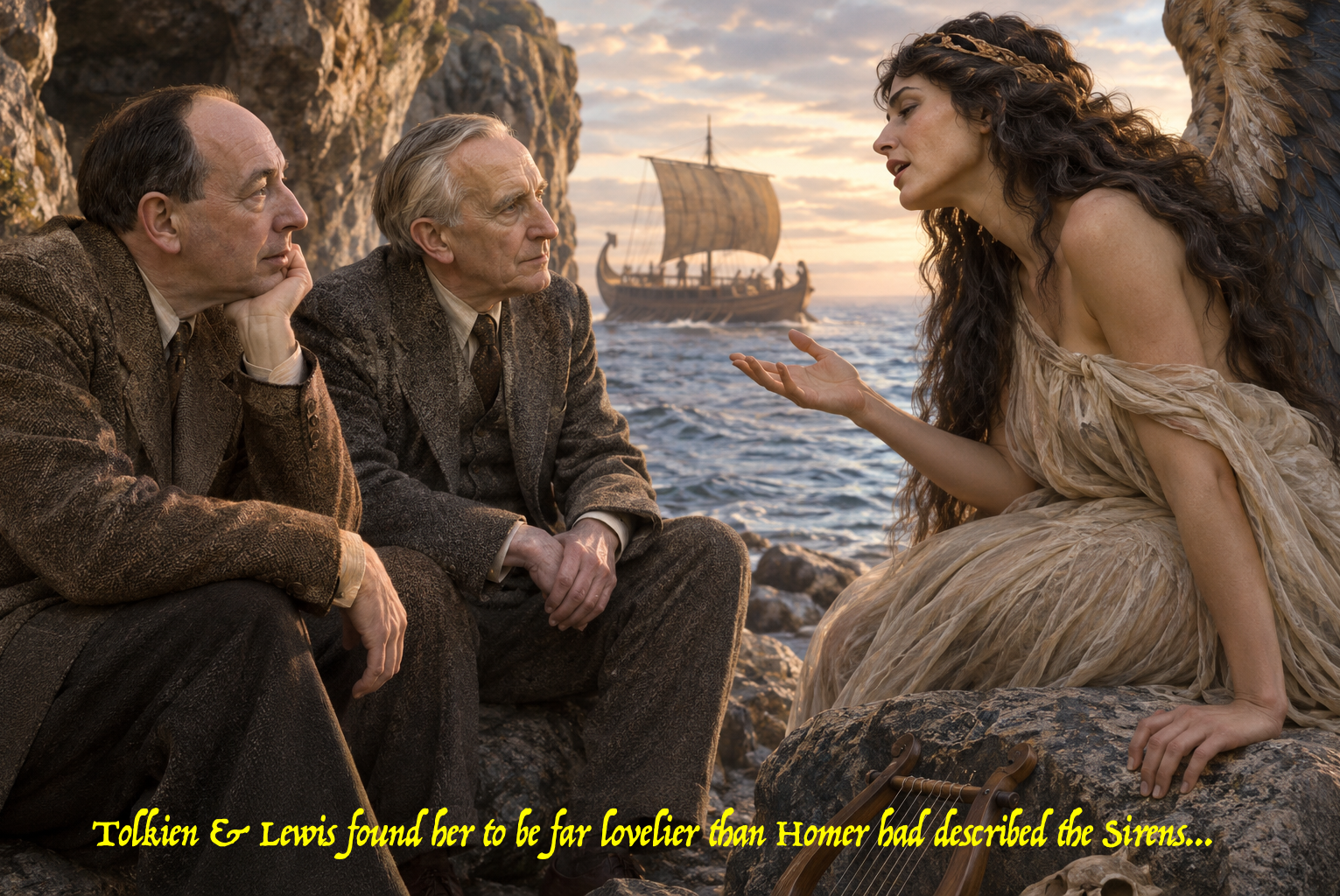
I am pleased to share that I’m prepared to resume writing regular posts for Mere Inkling. After taking a longer than anticipated hiatus, I find I can no longer resist the sirens calling me back to Narnia and Middle Earth. (These voices, of course, sing not the deceiving melodies of Homer’s Sirens. Rather, for me, they are merely an innocent metaphor.)

Saint Athanasius College† offers an excellent translation of The Odyssey in which Homer describes Circe’s warning about the danger posed by the classical Sirens.

First you will raise the island of the Sirens,
those creatures who spellbind any man alive,
whoever comes their way. Whoever draws too close,
off guard, and catches the Sirens’ voices in the air –
no sailing home for him, no wife rising to meet him,
no happy children beaming up at their father’s face.

The high, thrilling song of the Sirens will transfix him,
lolling there in their meadow, round them heaps of corpses,
rotting away, rags of skin shriveling on their bones . . .

Devilishly, the malevolent Sirens appeal to a common vanity of humanity, one which afflicts most cruelly, men: pride and reputation.

It’s fortunate for the classical Sirens that people were wooed by their voices, since their appearance was far less appealing. As Audubon magazine relates in an entertaining article, “Sirens of Greek Myth Were Bird-Women, Not Mermaids.”

C.S. Lewis & J.R.R. Tolkien were Inspired by the Siren Myth

It should come as no surprise that members of the Oxford Inklings were inspired by Homer’s masterpiece. In 1952, the Times Literary Supplement published “Vowels and Sirens” by C.S. Lewis. TLS said it possesses “a robust medieval music appropriate to Odysseus’ encounter with the Sirens, [within which] the effect is heightened by archaic inversions.”

Vowels and Sirens

Chosen to seduce you,
Those dove-like vowels,
Deuro – kudos – Odusseus.
Opening the bay, his prow
Appeared. The air rang with
Sirens’ voices.

The hero, bound, in anguish
Tried to retract his choice.
No word of solace
For a lover’s longing
They breathed. Of vanished knowledge
Was their interrupted song.

Their music resembled
Some earlier music
That men are born remembering.
What all the gods refuse –
The backward journey
To the steep river’s

High source, the great returning –
Those sirens feigned to give.
Cool voices, lying
Words abuse him,
Cooing kudos Achaiôn,
Warbling their untrue news.

Much earlier, in 1910, Lewis’ good friend J.R.R. Tolkien had written a poem called “The Sirens.” As the master philologist was wont to do, he also gave the poem another title. This one, composed in Old English: “Meremennena Symbel,” which translates as “The Sirens Feast.”

Sadly, despite its age, since it was not published until 2024, it remains under copyright and is only available in The Collected Poems of J.R.R. Tolkien. However, a single verse offered by Tolkien Gateway provides us with a teasing taste of “Meremennena Symbel.”

   Clawed by the frothy fingers of the hungry deep
That moaned in restless agony around
Stood darkly once, its cruel and unrelenting steep
Towered high, an isle by no man living found.

And, Not Only Lewis & Tolkien

Curiously, Tolkien and Lewis were not the only Inklings to contemplate sirenic themes. In the collection of Owen Barfield’s manuscripts held at Wheaton University’s Marion E. Wade Center, there is an unpublished typescript of a poem entitled “Siren Voices.”

Charles Williams, “the oddest Inkling” and C.S. Lewis’ peculiar friend, was also fascinated by the Siren archetype.‡ In The Figure of Beatrice: A Study in Dante, he explores the concept of the Siren as revealed in Dante’s Purgatory.

Rather than reducing the Siren to a symbol of lust, Williams recognizes that the corrupting nature of the creature is far broader. The decadence is illuminated by the dream’s sharp contrast with the beatific nature of Beatrice. Williams’ description of Dante’s Siren is potent.

She has been called the image of Sensual Pleasure, but this (it would seem) need not be the whole significance. She is as much – let us say – Ideal Gratification; all the sighs that lament the imperfection of a man’s actual mistress, the verses that sweetly moan over her failure to live up to his dreams (or the other way round), the self-condolences, the ‘disillusions’ – all these are the Siren’s song. She takes flesh and colour and music within the night-reveries of laziness; she is, then – what? What we want; and that is? we do not rightly know, but certainly a Siren and a song.

‘I am she who beguiles the sailors in mid-ocean, so much pleasure they have who listen to me; I turned Ulysses from his path with my song; and any who dwells with me rarely departs, so wholly do I satisfy him.’ Caesar and the God-bearer did not know her, but both Popes and Emperors have dwelled with her.

Fortunately, I have not personally shared the decadence of the aforementioned clerics and rulers. Instead, I was blessed by God this very summer to celebrate with my precious bride, our Golden wedding anniversary.

And, speaking of anniversaries, my good friend and Inkling scholar Brenton Dickieson wrote a poem for his wife on their twentieth. “Reading the Odyssey,” he writes, “I recognized that so many readers forget the sheer length of time that Odysseus was away from his beloved. Time moved on, and what heroics meant changed its meaning as Odysseus fought through his wandering curse. In that space, thinking of marriage as odyssey . . .” I encourage you to read “Magnificent Defeat.”

So, What has Kept Me Away from Mere Inkling?

Without belaboring the matter, I have been trying to focus on several long-neglected writing projects. The foremost of these has been the history of my great-grandfather’s regiment during the American Civil War. I continue to work on the project, but at the same time, it feels refreshing to also resume my labors at Mere Inkling.


† Saint Athanasius College was originally established in 1976 by the Evangelical Orthodox Church, which became canonical when it was received into the Antiochian Orthodox Church. During its early years I was blessed as I carried on a warm correspondence with it initial chancellor, the Rev. Dr. Jack Sparks.

‡ “Sirens In Art, Music, and Literature” by Annie Rose Tindall-Gibson offers a recent, accessible survey on the subject of the Siren archetype. It is available at Academia.
A Pair of Brilliant Writers

csl & chesterton

Sadly, politics are by definition nearly always polarizing. In the linguistic battleground of political warfare, we seem to more and more frequently encounter a “take no prisoners” attitude. It’s ominous.

I recently read the following words which describe, quite well I think, the positions of the two main rivals in virtually all political campaigns. (And, in this sentence, I’m referring to the military definition of “campaign.”)

“The whole modern world has divided itself into Conservatives and Progressives. The business of Progressives is to go on making mistakes. The business of the Conservatives is to prevent the mistakes from being corrected.”

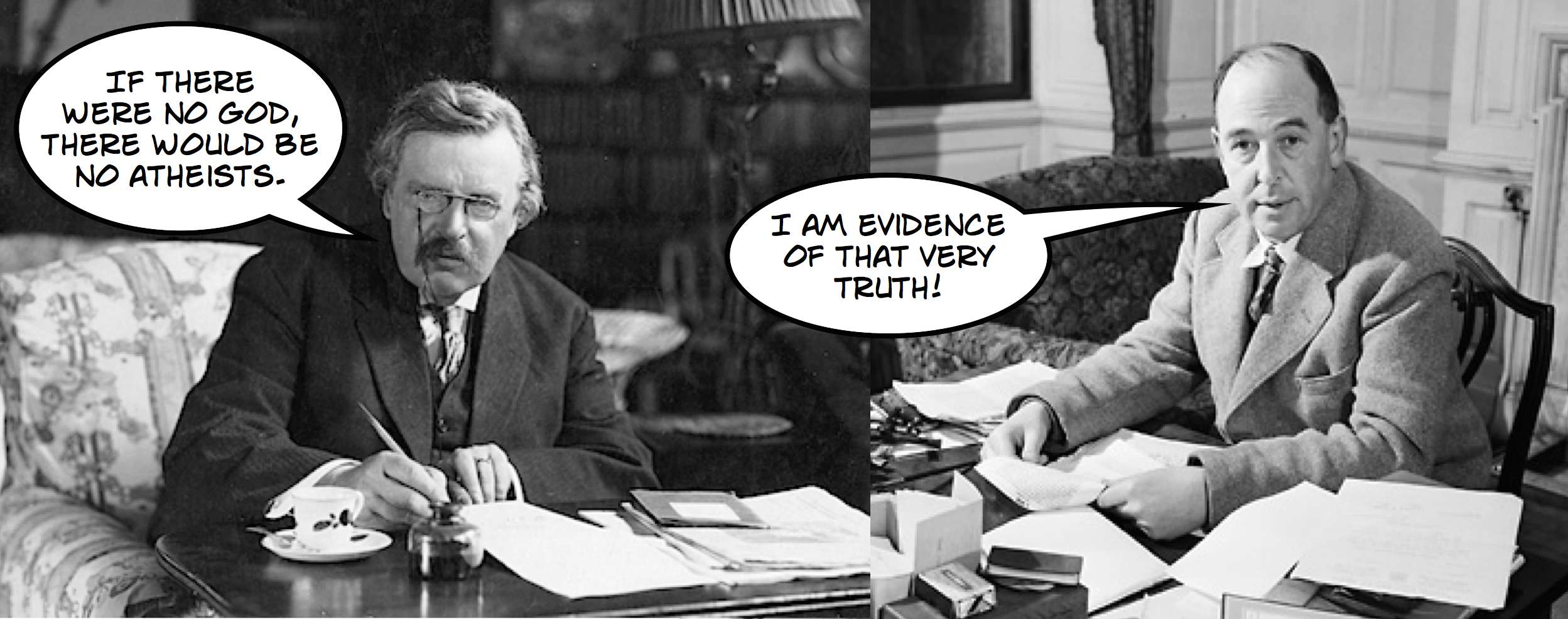
Some things never change. This cutting critique appeared nearly a century ago (in the 19 April 1924 issue of the Illustrated London News). It was penned by G.K. Chesterton, a British writer who was admired by many of his contemporaries, from a number of different perspectives. George Bernard Shaw, a Socialist, considered the conservative journalist a “man of colossal genius.”

Chesterton was one of the Christian writers whose faith made a significant impression on the unbelieving C.S. Lewis. Before encountering Jesus, the atheist Lewis resented the “intrusions” of Christian references into the writings of authors he otherwise enjoyed. He describes this conundrum delightfully in Surprised by Joy.

All the books were beginning to turn against me. Indeed, I must have been as blind as a bat not to have seen, long before, the ludicrous contradiction between my theory of life and my actual experiences as a reader. George MacDonald had done more to me than any other writer; of course it was a pity he had that bee in his bonnet about Christianity. He was good in spite of it.

Chesterton had more sense than all the other moderns put together; bating, of course, his Christianity. Johnson was one of the few authors whom I felt I could trust utterly; curiously enough, he had the same kink. Spenser and Milton by a strange coincidence had it too.

Even among ancient authors the same paradox was to be found. The most religious (Plato, Aeschylus, Virgil) were clearly those on whom I could really feed.

On the other hand, those writers who did not suffer from religion and with whom in theory my sympathy ought to have been complete—Shaw and Wells and Mill and Gibbon and Voltaire—all seemed a little thin; what as boys we called “tinny.” It wasn’t that I didn’t like them. They were all (especially Gibbon) entertaining; but hardly more. There seemed to be no depth in them. They were too simple. The roughness and density of life did not appear in their books. . . .

The upshot of it all could nearly be expressed in a perversion of Roland’s great line in the Chanson—Christians are wrong, but all the rest are bores. The natural step would have been to inquire a little more closely whether the Christians were, after all, wrong.

And C.S. Lewis, to his eternal joy, did just that. He inquired more deeply into the faith held by the writers he so respected. This included, of course, Chesterton. Echoes of Chesterton’s masterful expressions of Christian faith recur in the work of Lewis. For example, in his essay “Membership,” Lewis writes:

Equality is a quantitative term and therefore love often knows nothing of it. . . . Even in the life of the affections, much more in the body of Christ, we step outside that world which says “I am as good as you.” . . . We become, as Chesterton said, taller when we bow; we become lowlier when we instruct.

Similarly, in A Preface to Paradise Lost, Lewis describes how best to savor the historical work of writers from different eras. Although the reference to Chesterton here is given in passing, I will reproduce the larger passage in light of its insight into how best to benefit from what we read.

The things which separate one age from another are superficial. Just as, if we stripped the armour off a medieval knight or the lace off a Caroline courtier, we should find beneath them an anatomy identical with our own, so, it is held, if we strip off from Virgil his Roman imperialism, from Sidney his code of honour, from Lucretius his Epicurean philosophy, and from all who have it their religion, we shall find the Unchanging Human Heart, and on this we are to concentrate.

I held this theory myself for many years, but I have now abandoned it. I continue, of course, to admit that if you remove from people the things that make them different, what is left must be the same, and that the Human Heart will certainly appear as Unchanging if you ignore its changes. . . .

Instead of stripping the knight of his armour you can try to put his armour on yourself; instead of seeing how the courtier would look without his lace, you can try to see how you would feel with his lace; that is, with his honour, his wit, his royalism, and his gallantries out of the Grand Cyrus. I had much rather know what I should feel like if I adopted the beliefs of Lucretius than how Lucretius would have felt if he had never entertained them. The possible Lucretius in myself interests me more than the possible C.S. Lewis in Lucretius.

There is in G.K. Chesterton’s Avowals and Denials a wholly admirable essay called “On Man: Heir of All the Ages.” An heir is one who inherits and “any man who is cut off from the past . . . is a man most unjustly disinherited.” . . .

You must, so far as in you lies, become an Achaean chief while reading Homer, a medieval knight while reading Malory, and an eighteenth century Londoner while reading Johnson. Only thus will you be able to judge the work “in the same spirit that its author writ” and to avoid chimerical criticism.

G.K. Chesterton is well worth reading, and most fans of Lewis will appreciate his prodigious work. The best thing about Chesterton, is that since he entered the presence of his Lord in 1936, nearly everything he wrote is in the public domain. His essays, poetry, apologetic works—and even the tales of his fictional detective Father Brown—are readily accessible online.

For a friendly introduction to the relationship between Lewis and Chesterton, I recommend “Chesterton and Lewis, Side by Side.” In an issue devoted entirely to comparing the two pillars of Twentieth Century Christian apologetics, the St. Austin Review, we read:

In 1946, ten years after Chesterton died, Lewis wrote a short article defending Chesterton against the two charges with which he is still attacked—or dismissed—by most academicians: one, that he was popular, and two, that he was dated. Of course, Lewis is attacked for the same two reasons.

The entire article is available here. Those interested in one of the areas where Chesterton’s writing overlapped with that of Lewis and his good friend, J.R.R. Tolkien, will also enjoy “G.K. Chesterton: Fairy Tale Philosopher,” which is available here.