
Gathering Palms & Preparing for War

The Christian church has just celebrated Palm Sunday, and I recalled one of my favorite memories in preparing for the journey through Holy Week.

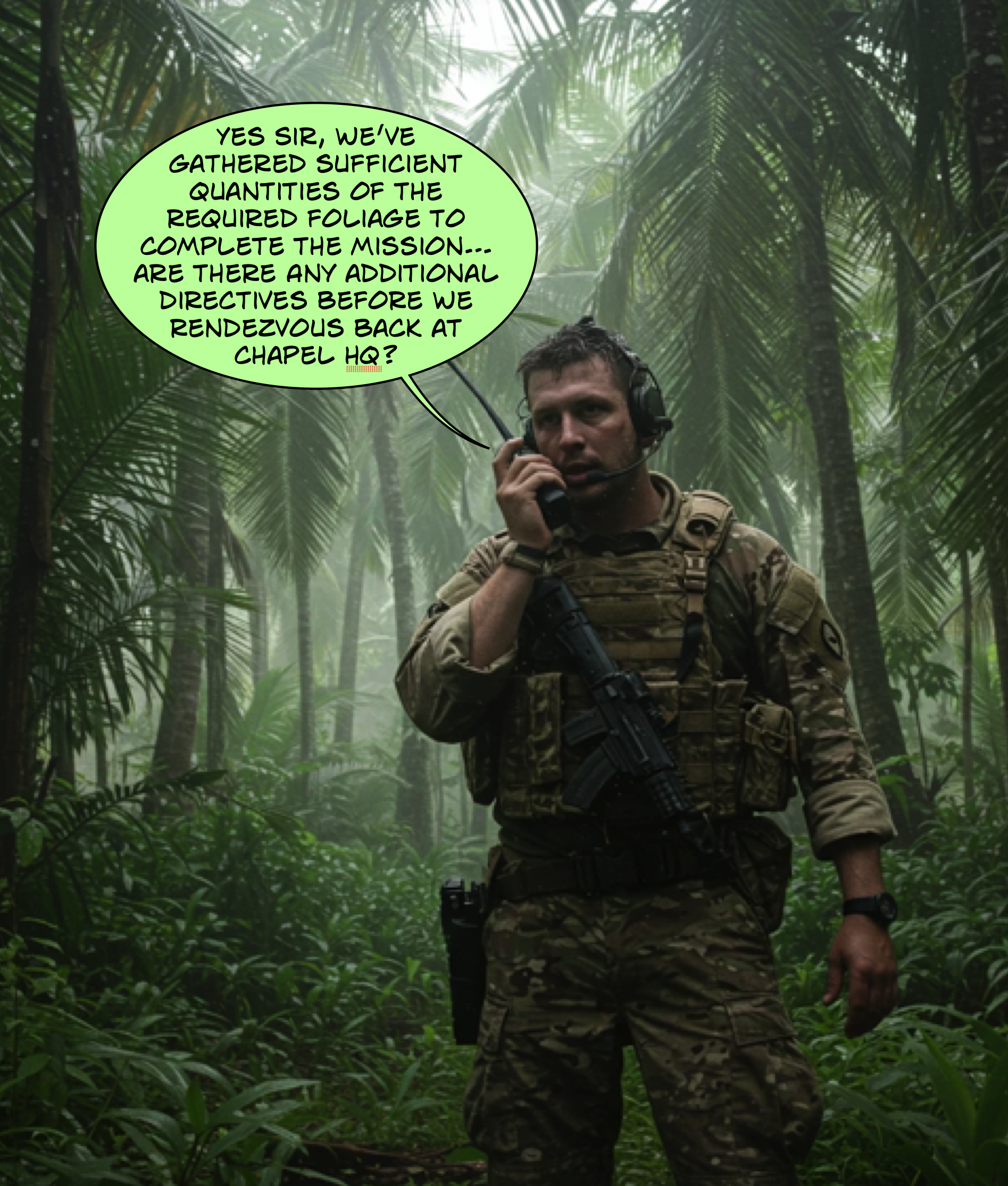
When I was stationed in Guam a few years ago (in the nineties), I enjoyed the annual tradition of gathering all of the palms to decorate the chapel and provide for worshippers in our very own jungle. Each year the chaplains and chaplain assistants, our whole team, would spend half a day gathering leaves that would put to shame any stateside palms.

Taking place in a tropical jungle, the event was sweaty, but fun. Good fellowship and even some seasonal early-Easter music. Fortunately, this didn’t take place during the typhoon season, as when the island was smashed by Super Typhoon Paka during our residency.

Jungles are fascinating places. Because the word possesses some rather ominous and even threatening overtones, a number of years ago they were rechristened “rainforests.” Even though most are tropical, there are temperate rainforests, such as in the Olympic National Forest, whose mountains I admire daily from our backyard.

C.S. Lewis alluded to the negative connotation of jungles in his study of “Vivisection,” with its repudiation of animal cruelty.

In justifying cruelty to animals we put ourselves also on the animal level. We choose the jungle and must abide by our choice.

A Modern Use for Jungles

In recent years, the jungles of Guam have been put to a military use. Unsurprisingly, soldiers and their Marine, Navy and Air Force cousins, must be prepared to do their jobs in a wide range of environments. That results in the existence of a variety of training settings, tuned to the specific needs of particular career fields.

For example, I served as the Wing Chaplain at Fairchild AFB where the USAF trains its pilots and aircrew members how to survive when they find themselves in unfriendly settings. Survival, Evasion, Resistance and Escape (SERE) training saves lives.

Anyway, not long ago the Air Force established a Jungle Agile Combat Employment (JACE) Course in, of all places, Guam.

This new course took knowledge from the U.S. Marine Corps Jungle Warfare Training Center and the Lightning Academy in Hawaii and tweaked it for non-combatant career fields to be prepared under the USAF’s Agile Combat Employment (ACE) concept.

This is part of America’s shift in focus to the threats in the Pacific theater. China has never renounced, and constantly proclaims, its intent to force the Republic of China (Taiwan) into their fascist empire. Of course, the fate of Hong Kong reveals just how unbenevolent the so-called People’s Republic is when it comes to maintaining any semblance of democratic freedoms. 

C.S. Lewis, of course, had much to say about the tragedies of fascism and war. However, that is not the focus of this reflection. Instead, the theme of this post reflects two thoughts. 

The less important idea, to which I have paradoxically devoted the most space, is the value of memories. Guam occupies a very special place in my family’s history, in part because all three of our kids were there during their teens. Lifechanging events occurred there.

And it was the wonderful people, military friends and wonderful Chamorro residents that made the most lasting impressions. Remembering the harvesting of palms, and recently learning about the jungle training course turned my thoughts back to that Micronesian paradise.

What’s Truly Vital

The infinitely more important message in this post is to acknowledge the holiest of seasons in which we find ourselves. Beginning with Palm Sunday’s celebration of the joy experienced by God’s people as they welcomed their Messiah into Jerusalem, we have the opportunity now to also join together with Jesus and our brothers and sisters in the faith as we:
~ commemorate the institution of the Lord’s Supper on Maundy Thursday,
~ contemplate the despair of the disciples as they stood at the foot of the cross as Jesus breathed his last mortal breath on Good Friday, and
~ celebrate in awe and wonder how our Savior rose from the grave and encouraged his disciples before ascending to Heaven and resuming his place at the right hand of God the Father. 

Christ’s atoning death, and his glorious resurrection, give us hope in the depths of our despair. And his promised return ensures us that there truly will come a day when we need never again prepare for war – or ever taste the pain of death.

We do well to heed C.S. Lewis’ encouragement to his friend Don Giovanni Calabria in 1948, when the priest was distraught over the troubles transpiring around the world.

Tomorrow [Easter] we shall celebrate the glorious Resurrection of Christ. I shall be remembering you in the Holy Communion. Away with tears and fears and troubles!

United in wedlock with the eternal Godhead Itself, our nature ascends into the Heaven of Heaven. So it would be impious to call ourselves “miserable.”

On the contrary, Man is a creature whom the Angels – were they capable of envy – would envy. Let us lift up our hearts! At some future time perhaps even these things it will be a joy to recall.

The Goodness of Good Friday

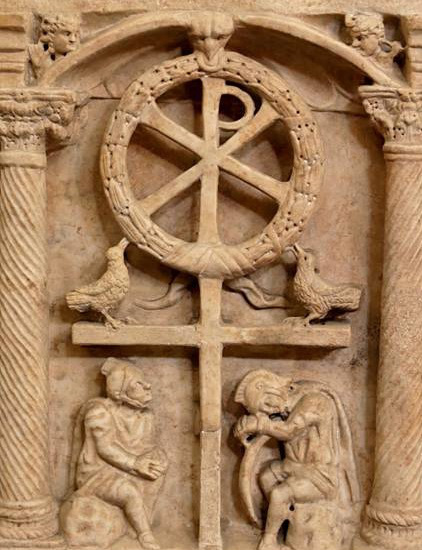
Jesus died on a cross. So why in the world would his followers choose the image of a cross to identify their faith?

The answer comes via a paradox. The cross is about two, superficially-contradictory realities. (1) Jesus bled, suffered and died on the cross. (2) On that very cross, Jesus purchased for all who call upon his name, eternal life.

This seeming paradox between simultaneous truths is sometimes referred to as a theological dialectic.

C.S. Lewis brilliantly illustrates this dynamic in his description of Death in his book Miracles.

On the one hand Death is the triumph of Satan, the punishment of the Fall, and the last enemy. Christ shed tears at the grave of Lazarus and sweated blood in Gethsemane: the Life of Lives that was in Him detested this penal obscenity not less than we do, but more.

On the other hand, only he who loses his life will save it. We are baptized into the death of Christ, and it is the remedy for the Fall. Death is, in fact, what some modern people call “ambivalent.”

It is Satan’s great weapon and also God’s great weapon: it is holy and unholy; our supreme disgrace and our only hope; the thing Christ came to conquer and the means by which He conquered (Miracles).

Thus, the grim suffering of Good Friday . . . becomes Good. It is not an accident. Nor is it a mistake. It was the necessary consequence of humanity’s fall and our costly, divine rescue. As C.S. Lewis writes in The Four Loves:

He creates the universe, already foreseeing – or should we say “seeing”? there are no tenses in God – the buzzing cloud of flies about the cross, the flayed back pressed against the uneven stake, the nails driven through the mesial nerves, the repeated torture of back and arms as it is time after time, for breath’s sake, hitched up. . . .

Herein is love. This is the diagram of Love Himself, the inventor of all loves.

Of course, this truth is only recognizable to those who have knelt before Jesus the Messiah and received his grace.

To unbelievers, “the world,” the cross makes no sense at all. Those in spiritual blindness reject it as the epitome of Christian absurdity.

Just such claims were made from the very beginning. Not long after Christ’s resurrection, these challenges were addressed by Paul, the Pharisee turned Apostle. Proclaiming the miracle of the cross, he reminds the young church in Corinth how they cannot expect the lost to comprehend its glory, its untainted goodness.

For the word of the cross is folly to those who are perishing, but to us who are being saved it is the power of God. . . .

Where is the one who is wise? Where is the scribe? Where is the debater of this age? Has not God made foolish the wisdom of the world? For since, in the wisdom of God, the world did not know God through wisdom, it pleased God through the folly of what we preach to save those who believe.

For Jews demand signs and Greeks seek wisdom, but we preach Christ crucified, a stumbling block to Jews and folly to Gentiles, but to those who are called, both Jews and Greeks, Christ the power of God and the wisdom of God. For the foolishness of God is wiser than men, and the weakness of God is stronger than men (1 Corinthians).

The crucifixion and resurrection of the only begotten Son of God are the sole means by which you and I may be cleansed, healed, and restored to the unending life for which our Lord created us.

C.S. Lewis and Times of Crisis

Dark days demand two seemingly contradictory things. Serious reflection and diversion (often in the form of entertainment).

Things are serious. The ultimate toll of the current pandemic remains unknown. Even if we regard ourselves as safe due to age, health and isolation, the simple fact is thousands are dying. Beyond our compassionate concern for those who are suffering, only a fool would fail to reflect on their own mortality during this plague.

Christians, who recently “celebrated” Good Friday are quite conscious of the fact that “we are dust and to dust we shall return” (Genesis 3:19).

Yet this awareness doesn’t leave us in despair, because Easter has come. Our Lord’s resurrection means that for those who trust in him, death does not have the final word.

I pray for those who are overcome by worry during these days. Because dwelling solely on the negative robs life of its present joys, and worsens the impact of the pandemic on individual lives.

Rather than feed your anxiety with troubling reports and thoughts, I urge you to take the opportunity to read, watch a classic program, or play a game. Distracting activities are healthy, as long as they do not displace serious awareness of our circumstances.

Seriously Assessing Our Predicament

Others have written eloquently about Lewis’ response to situations such as that in which we find ourselves today.

For example, the Gospel Coalition offers an excerpt from C.S. Lewis’ 72 year old essay about atomic weapons. They suggest we “just replace ‘atomic bomb’ with ‘coronavirus.’” Lewis’ advice holds up well in our turbulent era.

Annie Holmquist of Intellectual Takeout elaborates on Lewis’ essay. “How C.S. Lewis Would Tell Us to Handle Coronavirus” is well worth a read.

Several weeks ago, the Wade Center (which hosts the Western Hemisphere’s finest Inkling collection) struck the balance I am suggesting. They acknowledged the danger, and offered advice on spending our time well. Their blog included an excellent suggestion in “Those Who Lived to see Such Times: Suggested Readings from the Wade Authors during Times of Uncertainty.” The Wade Center provides links to a number of fine text and audio resources that will offer encouragement from authors who “witnessed both world wars, and . . . lived to see the unsettling days of nuclear weapons.”

Enjoying Life Despite the Danger

Those who are working during this time remain in need of our prayerful support. For the majority of us, however, the cancellation of most of our normal social activities has provided us with an abundance of leisure time. In addition to attacking postponed chores around the house, we should fill some of this interval by enjoying old pleasures and discovering new interests.

Take advantage of treasures such as those mentioned in the Wade Center post. Hundreds—even thousands—of free, public domain books are available online. For those whose preference is visual, there are plenty of free video options, including many vintage television shows you can view on YouTube.

If you’re craving a humorous treat, check out the great satire at The Babylon Bee and The Salty Cee.

A recent article on the former site reveals the sad tale of a boy whose childhood has been ruined by modern online games. It’s entitled, “Boy Discovers Wondrous Land Of Narnia, Leaves Negative Yelp Review.”

Lutherans (and self-confident Christians of other traditions) will enjoy the Lutheran Satire site. For people who don’t object to listening in on a demonic press conference, a fictional Easter interview on their main page is enlightening.

A bit lighter, is this rendition of Saint Patrick explaining the Trinity to the Irish pagans. It will help you sharpen your Christology.

There is a vast, unexplored world of literature out there. I recently read this illuminating post about one of George MacDonald’s fairy tales. MacDonald exerted a great influence on C.S. Lewis. With a curious twist on light and dark, the post also provides a link to a film based on MacDonald’s The Light Princess. I haven’t viewed it yet—but if you have a high tolerance for 1980s BBC productions combining animation and live action, you could be in for a treat.

Where to Begin?

Before exploring some of these links I’ve included, I encourage you to view “The Age of the Coronavirus.” The videographer has done what was suggested in one of the articles mentioned above. He has substituted the virus for the threat of nuclear war in C.S. Lewis’ abbreviated essay.

The video is good enough that you may well desire to share it with others. It can help to know the threats of our day are not unique to history. I suggest that you also include the amazing C.S. Lewis Doodle which offers an illustrated version of the entire essay.