
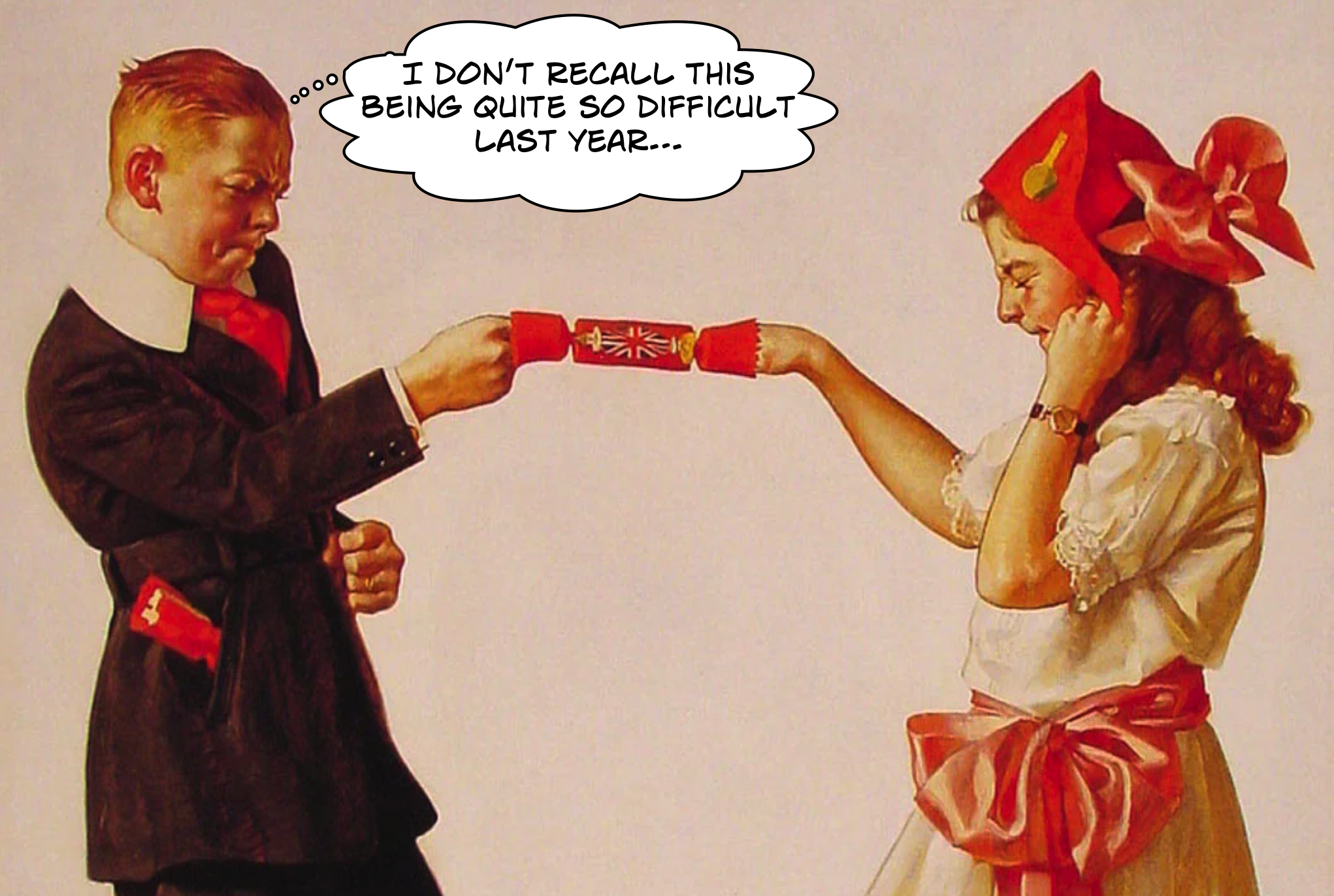
Father Christmas & Crackers

J.R.R. Tolkien wrote, for his children’s enjoyment, an entertaining little story about Father Christmas’ stash of explosives. Read on to see what a mischievous polar bear did with them.

Merry Christmas. No, I’m not late in wishing you a blessed celebration of Christ’s Nativity. The church calendar recognizes Christmas is too big to celebrate just for a single day. The Inklings knew it – Christmas is a season.

One nineteenth century invention has become a part of many families’ celebration of the season. They’re called “Christmas crackers,” and although birthed in Britain, they’ve found a home in many other countries. We adopted them as an annual tradition after living in England for several years.

Their beginning was modest. While many now lack edible treats, they were conceived as a means for selling confectionaries. Their inventor wanted to increase sales of a French treat.

For seven years he worked to develop the bon-bon into something more exciting, but it was not until he sat one evening in front of his fireplace that his great idea came to him. Watching the logs crackle, he imagined a bon-bon with a pop.

He made a coloured paper wrapper and put in it another strip of paper impregnated with chemicals which, when rubbed, created enough friction to produce a noise. He knew that bangs excited children (and were said to frighten evil spirits) – and the mottoes and poems he inserted inside the crackers amused adults (BBC).

Sadly, many of the crackers marketed today have been neutered. To improve their safety (and, no doubt, save production costs), some crackers no longer crack. They contain no “chemicals” to produce the customary bang. Seems like a misnomer to call these variants crackers, at all.

Tolkien’s Father Christmas Letters

Tolkien and his wife were blessed with four children, and they were doting parents. Each Christmas between 1920 and 1943, the famed author wrote and illustrated a pseudonymous letter to his kids. In 1976 they were posthumously published, and facsimiles of the correspondence appears in some editions of the letters.

They offer an intimate insight into the secular side of a Christian family’s celebration of the holiday (holy day). In fact, on Christmas Eve this very year, a selection from the letters was part of the Royal Carol Service, celebrated at Westminster Abbey.

The Christmas story was told in readings from Luke 2 given by The Prince of Wales and by Michael Ward. Jim Broadbent read from JRR Tolkien’s The Father Christmas Letters, and Leonie Elliot read Growing Tomorrow, a poem by Children’s Laureate Joseph Coelho commissioned specially for the service.

The following excerpt from the 1931 letter comes from the pen of Father Christmas himself. (It also features a fun notation from North Pole Bear.)

I should hardly feel it was Christmas if [the North Polar Bear] didn’t do something ridiculous. You will never guess what he did this time! I sent him down into one of my cellars – the Cracker-hole we call it – where I keep thousands of boxes of crackers (you would like to see them, rows upon rows, all with their lids off to show the kinds of colours.)

Well, I wanted 20 boxes, and was busy sorting soldiers and farm things, so I sent him; and he was so lazy he took his two Snowboys (who aren’t allowed down there) to help him. 

They started pulling crackers out of boxes, and he tried to box them (the boys’ ears I mean), and they dodged and he fell over, and let his candle fall right POOF! into my firework crackers and boxes of sparklers.

I could hear the noise, and smell the smell in the hall and when I rushed down I saw nothing but smoke and fizzing stars, and old Polar Bear was rolling over on the floor with sparks sizzling in his coat: he has quite a bare patch burnt on his back.

[NPB] It looked fine! That’s where Father Christmas spilled the gravy on my back at dinner!

The Snowboys roared with laughter and then ran away. They said it was a splendid sight – but they won’t come to my party on St. Stephen’s Day; they have had more than their share already.

The story goes on, relating the troublesome exploits of “two of the Polar Bear’s nephews” who have been visiting. However, the passage above suffices to illustrate the humor resident in the Tolkien household.

And, in light of this vignette, we just may have uncovered why modern manufacturers are forgoing the more explosive elements of Christmas crackers. No “pop,” no “poof.”

And, if you have a creative bent, consider making your own for next year!
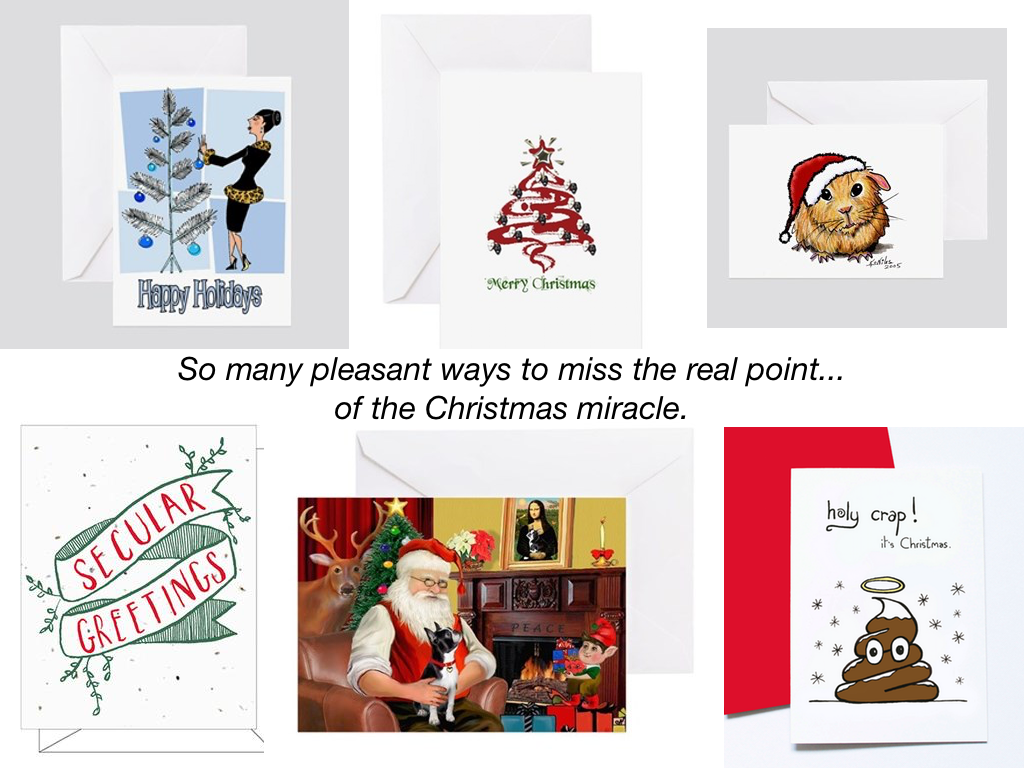
Read This Before Buying Christmas Cards

xmas cards

Fortunately, Christmas cards are not yet obsolete. Surely, many have substituted electronic alternatives, but even children of the digital age recognize that a personally scribbled note conveys a rare message—

You are worth the timeit takes me to choose a card, inscribe it, address the envelope and send it on its (dare I say, “merry”) way to you.

This pre-Christmas post is appearing so early because many of us are already addressing our Christmas greetings during the Advent season. And so it goes that Christmas cards and paraphernalia will soon usurp the place of other products in our local stores.

Whether you purchase your cards each winter, or wait until those amazing after-Christmas sales to buy them at 70% off, please keep this advice from C.S. Lewis in mind when you choose them.

Send cards that are appropriate for your recipients.

As a rule, if you are a Christian, you should send a card that celebrates the true meaningof the holy day. Naturally, this can be waived if it would cause genuine offense. However, if someone genuinely practices a different faith, why would you send them a Christmas card in the first place? A Hanukkah card, or a secular New Year’s Day or Thanksgiving seasonal missive would probably be more appropriate.

But my opinion is that for those who would not be overtly offended, a true Christ-mass card is appropriate. After all, many cards are quite gentle and inoffensive. For instance, the genre that picture a star (we recognize that celestial light as a Christian symbol during this particular season), along with words like “may you experience the joy and peace ushered in by this holy season.”

What I would encourage you to avoid sending during this time when we focus on the Incarnation miracle, is the sort of pastoral scenes with their innocuous tidings. For example, the happily sleighing family traveling in a conveyance very few of us will ever see. Send them at some other time, if you will, but they have little or nothing to do with the Nativity.

Now it’s fine if you think I’m old fashioned like the dinosaurs we recently considered.

But if you dismiss my opinion, please consider that of C.S. Lewis.

Lewis’ opinions about the commercialization of the Christmas season are well known, and we have discussed them here at Mere Inkling in the past. He, of course, abhorred the secularization of a sacred event. How sad he would be today to witness how Santa has continued to supplant Jesus.

Some will point out that Lewis himself included Father Christmas in his Chronicles of Narnia. This is true, but it is distinct from the modern secular excesses. In The Lion, the Witch and the Wardrobe, Father Christmas more closely resembles Saint Nicholas, in giving gifts and proclaiming the arrival of the King. It’s not accidental that he begins and ends his visit with the children by pointing to Aslan.

“I’ve come at last,” said he. “She has kept me out for a long time, but I have got in at last. Aslan is on the move. The Witch’s magic is weakening. . . .” Then he cried out, “Merry Christmas! Long live the true King!” and cracked his whip, and he and the reindeer and the sledge and all were out of sight before anyone realized that they had started.

C.S. Lewis was a truly devoted correspondent. He wrote back to the many fans who sought him out, and offered thoughtful responses to even the most frivolous queries. The writing was burdensome, and only the assistance of his brother Warnie for many years kept him from being forced to cease his generous practice.

Some of his correspondents were, or became, his friends. In December of 1955, he thanked one of these for the Christmas card he had sent. The friend was Peter Milward, a Jesuit priest. Lewis’ comments are still timely for Christian readers today.

Thank you for y[ou]r letter of Nov. 17. The enclosed card was one of the v[ery] few I have been pleased at getting.

Christmas cards in general and the whole vast commercial drive called ‘Xmas’ are one of my pet abominations: I wish they could die away and leave the Christian feast unentangled.

Not of course that even secular festivities are, on their own level, an evil: but the laboured and organised jollity of this—the spurious childlikeness—the half-hearted and sometimes rather profane attempts to keep up some superficial connection with the Nativity—are disgusting.

But your card is most interesting as an application of Japanese style to a Christian subject: and, me judice [in my opinion] extremely successful.

I hope you will reflect on Lewis’ thoughts on this subject. Christmas is too precious a time to be “entangled” with secular and pagan baggage.

If you send any holiday communiques—even of a digital nature—choose them wisely.


For more on C.S. Lewis and Christmas, read “A New C.S. Lewis Christmas Gift.”