
Peculiar Poetic Themes

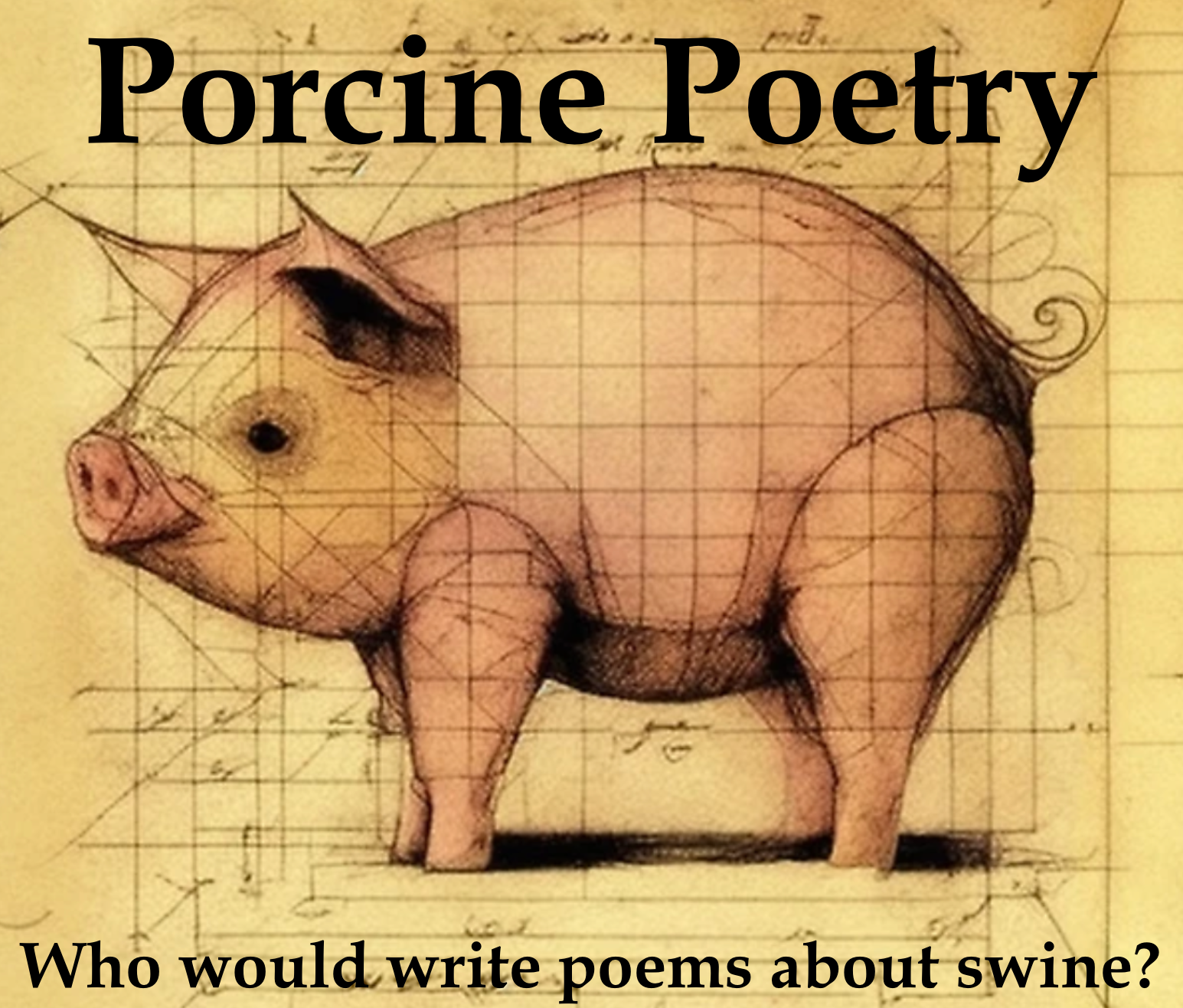
Would you purchase a collection of poetry inspired by pigs? It was certainly not what I was looking for, but my local library has once again seduced me by conducting one of their periodic “used book sales.” 

I find them irresistible. Just as I was unable to bypass, without browsing, any “secondhand bookshop” while I lived in the United Kingdom.

One never knows what treasures are buried in the stacks, since many of the volumes came from personal libraries where they may have rested for decades.

We had just finished our regular writing critique meeting when I accompanied two of my companions into the wilderness of temptation. Alas, on one of the first shelves I perused, I encountered an oddity I was unable to resist. 

The title attracted my interest – The Porcine Legacy. The minimalist sketches of pigs illustrating the text drew me in. And the final element, which captured me, was that it was autographed by both the author and the artist. The bargain price sealed the deal.

Scanning the poems I saw curious mentions of God, which I considered intriguing. The swinish images reminded me of some of DaVinci’s quick sketches of animals.

Sadly, although he professes the love he had for his hogs and piglets, the author did consign them to the market. I understand that’s their intended fate, and I do enjoy lean bacon, but it seems sad. Especially in an ode to porcine intelligence and their congeniality as pets.

The author, David Lee, moved on from animal husbandry to teaching at a university in Utah. Presumably it was his contributions there, rather than on his farmstead, which earned him the honor of becoming the very first poet laureate of Utah.

A Taste of Porcine Poetry

The poem which follows is entitled “Jubilate Agno, 1975.” As often happens when I expose myself to unfamiliar works, I learned far more than I anticipated. In this case, I discovered the “1975” in the title was included because the poem was based upon a religious poem originally penned between 1759 and 1763, while its author, Christopher Smart, was convalescing as a “Curable Patient” at London’s St. Luke’s Hospital for Lunatics.

Lee’s version follows the basic structure of Smart’s 1200 line work. Cat lovers will enjoy a section of seventy-four lines where the original author praises the wonders of his cat, Jeoffry. This is the portion of the original which most closely resembles the copy, since the latter extols its author’s favorite sow. Lee also proposes a shift in the deity upon whom the creature focuses.

For I will consider my Cat Jeoffry.
For he is the servant of the Living God duly and daily serving him.
For at the first glance of the glory of God in the East he worships in his Way.

~~~~~~

For I will consider my black sow Blackula.
For she is the servant of the god of the feed bucket and serveth him.
For she worships the god in him and the secret of his pail in her way.

The title, “Jubilate Agno” actually translates as “Rejoice in the Lamb.” And, while Lee includes no such reference, the beginning lines of Smart’s work proclaim its vision in inspiring terms.

Rejoice in God, O ye Tongues; give the glory to the Lord, and the Lamb.
Nations, and languages, and every Creature, in which is the breath of Life.
Let man and beast appear before him, and magnify his name together.

I encourage interested readers to read the edifying “Jubilate Agno” by Christopher Smart, which is available here. Ailurophiles (cat lovers) can go directly to the feline section here. The complete text of  “Jubilate Agno, 1975” is available at the Poetry Foundation.

Although I don’t believe C.S. Lewis ever wrote porcine poetry, there is an interesting passage which appears in Boxen, the collection of his childhood stories. Apparently, the first king of the northern region of Animal-Land, set out to add Pig-Land to his domain.

The pigs under their various chiefs (who had now united against Hacom, as a common enemy) advanced to meet him. The 2 armies met at a place called Kuckton (near where Marston now stands). Hacom fought well, and would have won had he not been outwitted by a clever feint on the part of the pigs.

The [invading] force was beaten, but still, much had been done towards the subjection of the pigs. Hacom was severely wounded by a stray arrow, but might have recovered, had he not been obliged to spend the night in the fields. It was winter, and the wound froze causing instant death. He had been an excellent king.

Surprisingly, to me at least, there are many other poems inspired by pigs. Since I’ve written in the past about Roald Dahl (and his slight connection to C.S. Lewis), seeing his poem entitled “The Pig” incited my curiosity. The All Poetry website includes the poem, and offers as part of its analysis:

“The Pig” by Roald Dahl is a humorous and macabre poem that explores the existential crisis of a highly intelligent pig. The poem is characterized by its playful language, which contrasts with the gruesome subject matter. . . .

The pig’s realization that he is destined for slaughter also highlights the existential themes of meaninglessness and the inevitability of death. Overall, “The Pig” is a clever and thought-provoking poem that combines humor, darkness, and a touch of existential angst, showcasing Dahl’s versatility as a storyteller.

So, if you want to end this peculiar discussion with a bit of existential porcine angst, ponder Dahl’s poem, “The Pig.”

In England once there lived a big,
A wonderfully clever pig.
To everybody it was plain
That Piggy had a massive brain.
He worked out sums inside his head,
There was no book he hadn’t read.
He knew what made an airplane fly,
He knew how engines worked and why.
He knew all this, but in the end
One question drove him round the bend:
He simply couldn’t puzzle out
What LIFE was really all about.

What was the reason for his birth?
Why was he placed upon this earth?
His giant brain went round and round.
Alas, no answer could be found.
Till suddenly one wondrous night.
All in a flash he saw the light.
He jumped up like a ballet dancer
And yelled, “By gum, I’ve got the answer!”
“They want my bacon slice by slice
“To sell at a tremendous price!
“They want my tender juicy chops
“To put in all the butcher’s shops!
“They want my pork to make a roast
“And that’s the part’ll cost the most!
“They want my sausages in strings!
“They even want my chitterlings!
“The butcher’s shop! The carving knife!
“That is the reason for my life!”

Such thoughts as these are not designed
To give a pig great peace of mind.
Next morning, in comes Farmer Bland,
A pail of pigswill in his hand,
And piggy with a mighty roar,
Bashes the farmer to the floor . . .
Now comes the rather grizzly bit
So let’s not make too much of it,
Except that you must understand
That Piggy did eat Farmer Bland,
He ate him up from head to toe,
Chewing the pieces nice and slow.
It took an hour to reach the feet,
Because there was so much to eat,
And when he finished, Pig, of course,
Felt absolutely no remorse.

Slowly he scratched his brainy head
And with a little smile he said,
“I had a fairly powerful hunch
“That he might have me for his lunch.
“And so, because I feared the worst,
“I thought I’d better eat him first.”
First the Machines Kill the Weeds

Machinery, one of the fruits of scientific research, is intended to benefit humanity. It often does. However, even machines with totally peaceful purposes – hay balers, for example – can be deadly.

Machines-run-amuck populate many dystopian novels and films. One of the most successful franchises is Terminator. Humanity is brought to the precipice of extinction, after devising machines – and their perilous companion Artificial Intelligence. The very first film, The Terminator (1984) brilliantly uses the biblical allusion “Judgement Day,” to mark the sentience of the genocidal Skynet.

Nearly forty years later, debates about weaponized autonomous systems have moved far beyond speculation. And it does not require a doctorate in computer science to recognize that given a potentially lethal machine the power to make its “own” decisions poses a deadly risk. After all, if software programs can be virally infected, and secure systems can be locked tight and held for ransom, there are no guarantees that “terminators” will not be part of our future.

We’ve seen how weapons can easily be mounted on the robotic dogs that are currently accompanying our troops.

And in a recent Air Force Magazine article, “Unmanned Flying Teammates,” we read the promise that “Robots will join the Combat Air Forces within the next decade.”

The common nomenclature for the current generation of these machines is Lethal Autonomous Weapons Systems. You can read about “slaughterbots” at the Future of Life Institute site.

Whereas in the case of unmanned military drones the decision to take life is made remotely by a human operator, in the case of lethal autonomous weapons the decision is made by algorithms alone.

Slaughterbots are pre-programmed to kill a specific “target profile.” The weapon is then deployed into an environment where its AI searches for that “target profile” using sensor data, such as facial recognition.

While the first generation of such weapons are still being designed, a genuinely wonderful new machine foreshadows what might be an ominous future.

In response to the destructive necessity for pesticides, scientists have come up with a new self-driving farm machine that avoids the need for poisons by selectively zapping individual weeds with lasers. Forbes has a great article on the subject, with the unwieldly but informative title, “Self-Driving Farm Robot Uses Lasers To Kill 100,000 Weeds An Hour, Saving Land And Farmers From Toxic Herbicides.”

The weeding machine is a beast at almost 10,000 pounds. It boasts no fewer than eight independently-aimed 150-watt lasers, typically used for metal cutting, that can fire 20 times per second.

They’re guided by 12 high-resolution cameras connected to AI systems that can recognize good crops from bad weeds. The Laserweeder drives itself with computer vision, finding the furrows in the fields, positioning itself with GPS, and searching for obstacles with LIDAR.

I applaud this invention, with one major caveat. How large a step is required between zapping weeds and burning holes through human bodies?

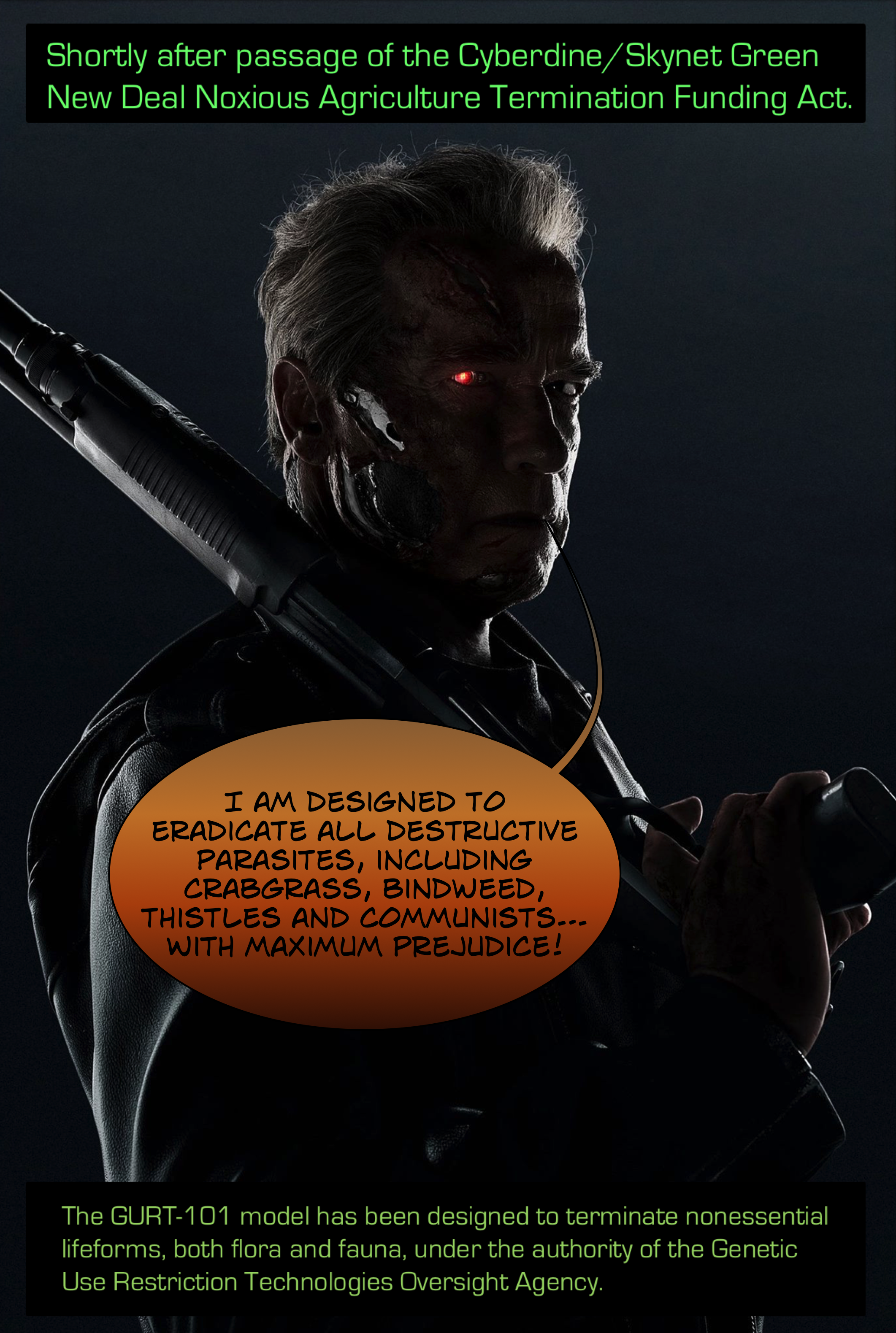
Ironically, they have even named this agricultural prototype for human-hunting machines “Terminator technology.”

Terminator technology is the genetic modification of plants to make them produce sterile seeds. They are also known as suicide seeds. Terminator’s official name – used by the UN and scientists – is Genetic Use Restriction Technologies (GURTs).

Actually, this is a very positive breakthrough in terms of increasing harvests while preserving the natural health of the earth (and the Earth). C.S. Lewis, I believe, would have welcomed this new technological achievement.

The affinity of C.S. Lewis and fellow Inkling J.R.R. Tolkien for nature is well recognized. The two WWI veterans were averse to industrialized landscapes, and much preferred bucolic images. You can see that in Lewis’ fiction, although it’s much more evident in Tolkien’s Lord of the Rings. (Even Tolkien’s truest fans must admit that some readers find his elaborate discussion of the Hobbits’ harmony with nature almost mundane.)

True science is a good thing, but one must remain vigilant against an idolatry that masks itself as science.

Beware of Scientism

C.S. Lewis’ role as a an apologist for Christianity – and for what was worthwhile in past history – brought him into more direct conflict with technology. Of course, it was not scientific advances per se of which he was wary. It was the creeping idolatry of scientism, which assumes the trappings of faith in its disciples’ eyes. Tolkien shared his concerns regarding the matter, but confronting such lies was not part of his vocation.

Lewis’ clearest exposition of humanity’s lust for progress may be his 1954 Inaugural Lecture as the Chair of Mediaeval and Renaissance Literature at Cambridge University. De Descriptione Temporum (A Description of the Times) should be read in one sitting, as it was delivered. It is included in several collections, but available online here. The quotation below offers a very small slice of his influential lecture. (Coincidentally, A Pilgrim in Narnia featured a superb column on the address just yesterday.)

[The birth of the machines] is on a level with the change from stone to bronze, or from a pastoral to an agricultural economy. It alters Man’s place in nature. . . . What concerns us . . . is its psychological effect. How has it come about that we use the highly emotive word “stagnation,” with all its malodorous and malarial overtones, for what other ages would have called “permanence”?

Why does the word “primitive” at once suggest to us clumsiness, inefficiency, barbarity? When our ancestors talked of the primitive church or the primitive purity of our constitution they meant nothing of that sort. . . . Why does “latest” in advertisements mean “best”?

Well, let us admit that these semantic developments owe something to the nineteenth-century belief in spontaneous progress which itself owes something either to Darwin’s theorem of biological evolution or to that myth of universal evolutionism which is really so different from it, and earlier. . . . But I submit that what has imposed this climate of opinion so firmly on the human mind is a new archetypal image.

It is the image of old machines being superseded by new and better ones. For in the world of machines the new most often really is better and the primitive really is the clumsy. And this image, potent in all our minds, reigns almost without rival in the minds of the uneducated. For to them, after their marriage and the births of their children, the very milestones of life are technical advances. . . .

Our assumption that everything is provisional and soon to be superseded, that the attainment of goods we have never yet had, rather than the defence and conservation of those we have already, is the cardinal business of life, would most shock and bewilder [all of those who have gone before us.]

A thought-provoking article, “The Folly of Scientism,” offers the argument of a professor of Biology, which is independent of C.S. Lewis, while echoing many of his cautions.*

Of all the fads and foibles in the long history of human credulity, scientism in all its varied guises — from fanciful cosmology to evolutionary epistemology and ethics – seems among the more dangerous, both because it pretends to be something very different from what it really is and because it has been accorded widespread and uncritical adherence.

An excellent work on this subject is available for purchase, entitled The Restoration of Man: C.S. Lewis and the Continuing Case Against Scientism. Michael Aeschliman’s excellent treatment is evidenced by the fact the 2019 version is the third edition of the title.

But why should this central civilizing truth about the “res sacra homo,” [the fact that “humanity is a sacred thing”] . . . need C.S. Lewis’s [reaffirmation]? The answer to that question is philosophical, historical, and complex, but it should not be as obscure or little understood as it is today.

Although there was never a “golden age” of civilization within historical time, this radically noble idea was often better understood in the past, even the recent past.

Back to the Robots

Wait, I just noticed some armed drones flying overhead, and what appeared to be a silhouette resembling a GURT-101 Terminator skulking through the woods outside my office . . . Perhaps I’ve already written too much.


* This article appears in The New Atlantis, where they say “Our aim is a culture in which science and technology work for, not on, human beings.”

A Mother Knows Her Child

calfWhen we lived in England, we witnessed the birth of a calf in a peculiar setting. We were driving along winding country roads, turned a corner, and saw a newborn calf lying in the middle of the road, covered in her still-warm afterbirth.

During the decades since that day, our (now adult) children complained: “why do you always get to save the baby cows?” (They had been restricted to the safety of our car, pulled off of the road with flashers blazing.)

To describe it succinctly, we were able to set up warnings along the rapprochements and lift the newborn infant into farm-familiar hands. While I attended to approaching traffic, a neighbor farmer picked up the little one and carried him or her to their mother who was mournfully mooing on the hillside above.

You see, she had backed up near the fence that surrounded her pasture, and when the infant was delivered, it slid down the fifteen-foot embankment onto the road.

I directed the traffic, while my wife Delores assisted the farmer in conveying the child to its mother.

I was surprised by what I saw as we climbed up into the field. There was the mother of the lost infant, crying out in her misery for her terrible misfortune. And gathered around her were the rest of her herd, mooing in anguished sympathy for her loss.

When we laid the bloodstained calf on the ground behind its forlorn mother, we called out to it to turn and recognize the deliverance that had dawned. The mother approached the calf, with the rest of the cattle hanging respectfully in her wake.

She sniffed at her little one and began immediately to lick it clean and smother it with love. The plaintive cries gave way to soothing moos, and a holy calm fell upon that field.

It was a glorious moment I will never forget. One of those where we recognize the privilege God has granted us to simply be in his presence as we gaze in awe at his creation.

C.S. Lewis and the Wonder of Cattle

In July 1930, Lewis wrote to his dear friend Arthur Greeves, complaining about the burden of “marking papers” at the end of the academic year. He then gently rebukes his friend for thinking that the discussion of the mundane matters of home life are insignificant.

Thank you for writing–I enjoyed your two letters enormously. Do stop apologising for them and wondering archly . . . how I can read them. Surely it needs no great imagination for you to realise that every mention of things at home now comes to me with the sweetness that belongs only to what is irrevocable.

Those who have left the rural life for academia can relate to the sentiments of C.S. Lewis. He loved the ambiance of Oxford, but missed the simplicity of the common world.

Lewis thanks Greeves for his description of the birth of a calf and confesses his own moral shortcoming in not celebrating without reservation the wondrous moment.

Oh you can’t imagine the poignancy with which your account of the sunny windy day near the dry tree fell across a dreary, dusty afternoon of those sordid papers, when my head was aching and the boys’ horrid handwriting seemed to jump on the page.

I don’t know quite what I feel about your assistance at the accouchement of our sister the cow.

I know what I ought to feel—simply the same thrill that I feel at the first coming up of a flower.

Physical disgust is a sensation which I have very often and of which I am always ashamed. If one lets it grow upon one it will in the end cut one out from all delighted participation in the life of nature. For God is gross and never heard of decency and cares nothing for refinement: nor do children, nor most women, nor any of the beasts, nor men either except in certain sophisticated classes.

And yet its hard to feel that the faculty of disgust is a sheer evil from beginning to end. I don’t know what to make of it. (Perhaps in one way it is, in another, it isn’t!)

Lewis closes his letter with an entertaining reflection on the amazing scenes such as I witnessed long ago in the English countryside.

At any rate there can be no two opinions about the delightfulness of seeing the other cows coming round to inspect the infant. Did they show any signs of congratulating the mother? for I notice that when one of our hens lays an egg, all join in the noise—whether that is congratulation or simply that they regard themselves as a single individual and announce “We have laid an egg.”

If you have another free moment, check out this great post on the spiritual value of maternal instincts . . . You can read Gloria Furman’s thoughts at desiringGod.