Deadly Gargoyles

gargoyle magdalenWhoever first considered gargoyles an attractive addition to buildings, must have had an odd personality. I have never developed an appreciation them.

What’s worse is when moonstruck (lunatic) architects deem gargoyles suitable for adorning churches.

There are too many examples out there to count. I am sure there are a number of websites devoted to them. But I don’t care enough to investigate.

It is one thing to shape a natural or fantastical creature to use as a rain spout on a building. Quite another, in my opinion, to opt for a grotesquery.

Churches should stick with symbolism that edifies the people. Admittedly, this can include some potentially gruesome subject, such as images of martyrdoms.

Our familiarity with the crucifix itself has dulled the impact of its terrible agony. We often fail to recognize the magnitude of the suffering Jesus endured.

Gargoyles were in the news this week. The reason for their appearance gave the title to this column.

A tragedy occurred in Chicago when a gargoyle broke free from a dated building and struck an innocent pedestrian. She was killed almost immediately by the crushing blow.

To make matters even more sad, the building from which the “ornament” fell was a church.

Second Presbyterian Church was built in 1874 and is a national historic landmark. Local news outlets report that it failed various inspections between 2007 and 2011, but passed them in 2012 and 2013. (The picture above is not of the gargoyle in question.)

Sarah was the name of the victim of this tragic accident. I invite your prayers on behalf of this young woman’s loved ones, especially her two children.

I think so little of church gargoyles that I included the subject in an as yet unpublished book set in the medieval period.

The nightmare gargoyle pictured on the top of the page adorns Magdalen College in Oxford. It was established in 1458, and was the school where C.S. Lewis began his teaching career.

In C.S. Lewis: An Examined Life, Bruce Edwards writes, “The college is noted for its wealth of gargoyles, grotesques, and stone portraits of notable people.”

Well, the college may be named after Mary Magdalene, but at least it isn’t a church. As for the stone “portraits,” they sound like a very agreeable adornment.

As lovely as Magdalen is considered to be, on the whole Lewis considered Cambridge University more appealing than Oxford. In a 1954 letter he wrote, “I’m afraid one must admit that, architecturally, Cambridge beats Oxford; there is so much more variety in Cambridge.”

In two other letters written the same year, Lewis revealed that there was much more to his new academic post than mere architecture that appealed to him. Oxford had taken Lewis for granted, and often belittled him because of his simplistic trust in Christ.

You know I am going as a Professor to Cambridge? My new college is Magdalene, Cambridge: a tiny little place compared with this, but a perfect gem architecturally and (I think) much more congenial socially & spiritually.

Did I tell you I’ve been made a professor at Cambridge? I take up my duties on Jan. 1st at Magdalene College, Cambridge (Eng.). Note the difference in spelling. It means rather less work for rather more pay. And I think I shall like Magdalene better than Magdalen. It’s a tiny college (a perfect cameo architecturally) and they’re so old fashioned, & pious, & gentle and conservative– unlike this leftist, atheist, cynical, hard-boiled, huge Magdalen. Perhaps from being the fogey and ‘old woman’ here I shall become the enfant terrible there.

It is not about architecture at all—or the presence or absence of grotesqueries. It is about finding a home where you know you are welcome and appreciated. A place where you do not need to remain constantly on your guard, because there are colleagues present who desire to see you humbled.

It is good to know C.S. Lewis spent the final years of his teaching life in an academic family that truly appreciated the gifted scholar in their midst.
Titles You Don’t Want


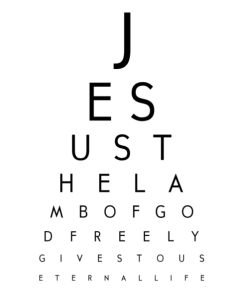
eyechartThe world’s oldest man just died—and I’m not looking forward to ever becoming one of his successors. I mean, I understand the sentiments of non-Christians who quip that any day on this side of the grass is a good one, but I would only be interested in staying around here that long if I still had a keen mind and good health.



I’m not sure most of the people who eventually earn those titles have either. This gentleman was 111, and in the picture of him receiving his Guinness certificate, he actually looks like he had already expired. I mean, no offense, just a statement of simple fact.

As for his state of mind, I’m a bit more optimistic. Apparently when asked a while ago how he had lived so long, he responded, “because I haven’t died yet.” Assuming that was tongue in cheek (I recognize that is merely an assumption), he had retained his sense of humor. A good sign.

I don’t think ultra-long longevity is all it’s cracked up to be. I remember my 92 year old grandmother (my only relative who lived to be “elderly”) telling me that she was ready to go to heaven. She was in a nursing home, but not in pain, and still witty.

She said, “Robbie, I’ll miss you and everyone who is still here, but if you live long enough, more of the people you love are already in heaven than remaining here.” She had been widowed for three decades. And, unbeknownst to us at the time, three of her four children would follow her within three years of her own passing.

I am not eager to die, of course. And, unlike Polycarp, the bishop of second-century Smyrna, I’m certainly not zealous about the possibility of someday being martyred.

Still, God-willing, when I’ve come to the end of my appointed days I will make that transition peacefully, as is appropriate for a child of God who has been blessed with a full life.

When death is seen as a dark end—a soundless void—it’s understandable that many would resist it to the “bitter” end. That theme has been common in literature and cinema.

In a comic light, a character on Parks and Recreation exhibits the desire to live as long as humanly possible. He exercises without pause and takes every vitamin that exists in horse-pill doses. Soon after Chris Traeger was introduced to the show, he shared his view of life:

I take care of my body above all else. Diet, exercise, supplements, positive thinking. Scientists believe that the first human being who will live 150 years has already been born. I believe I am that human being.

Humorous. And, a respectable goal perhaps, if not driven by deep fear.

I don’t share Traeger’s goal of being the first human to reach 150. Nor, as we considered at the outset of our discussion, do I long to gain the title of World’s Oldest Man.

And I take comfort that I find myself, once again, in the comfortable camp of C.S. Lewis. In his essay “Is Progress Possible?” Lewis wrote:

Progress means movement in a desired direction, and we do not all desire the same things for our species. In “Possible Worlds” Professor Haldane pictured a future in which Man, foreseeing that Earth would soon be uninhabitable, adapted himself for migration to Venus by drastically modifying his physiology and abandoning justice, pity and happiness.

The desire here is for mere survival. Now I care far more how humanity lives than how long. Progress, for me, means increasing goodness and happiness of individual lives. For the species, as for each man, mere longevity seems to me a contemptible ideal.

More important, we believe, is the quality than the quantity, of our lives.

Words of Death

joseyOne of the cinema’s most powerful scenes occurs in a film many might disregard due to its genre. In “The Outlaw Josey Wales,” a man trying to rebuild his war-shattered life, rides out to face a Comanche chieftain.

Josey: You be Ten Bears?

Ten Bears: I am Ten Bears.

Josey: I’m Josey Wales.

Ten Bears: I have heard. You’re the Gray Rider. You would not make peace with the Blue Coats. You may go in peace.

Josey: I reckon not. Got nowhere to go.

Ten Bears: Then you will die.

Josey: I came here to die with you. Or, live with you. Dying ain’t so hard for men like you and me, it’s living that’s hard; when all you ever cared about has been butchered or raped. Governments don’t live together, people live together. With governments you don’t always get a fair word or a fair fight. Well I’ve come here to give you either one, or get either one from you. I came here like this so you’ll know my word of death is true. And that my word of life is then true. The bear lives here, the wolf, the antelope, the Comanche. And so will we. Now, we’ll only hunt what we need to live on, same as the Comanche does. And every spring when the grass turns green and the Comanche moves north, he can rest here in peace, butcher some of our cattle and jerk beef for the journey. The sign of the Comanche, that will be on our lodge. That’s my word of life.

Ten Bears: And your word of death?

Josey: It’s here in my pistols, there in your rifles . . . I’m here for either one.

Ten Bears: These things you say we will have, we already have.

Josey: That’s true. I ain’t promising you nothing extra. I’m just giving you life and you’re giving me life. And I’m saying that men can live together without butchering one another.

Ten Bears: It’s sad that governments are chiefed by the double-tongues. There is iron in your word of death for all Comanche to see. And so there is iron in your word of life. No signed paper can hold the iron, it must come from men. The word of Ten Bears carries the same iron of life and death. It is good that warriors such as we meet in the struggle of life . . . or death. It shall be life.

This conversation has always caused me to stop and think—even as I typed it out now. It contains many profound thoughts about honesty, commitment, respect and even peace. Most captivating to my thoughts, though, is the contrast between words of death and words of life.

“There is iron in your word of death . . . And so, there is iron in your word of life.”

People say all sorts of things, often without much regard as to whether or not they are true. They often speak without thinking about the words before they leave their lips. Most daily conversation is superficial, and immediately forgotten.

That changes, when we speak of death. Sure, comedians joke about it, but when people discuss actual death—often in the wake of someone’s passing—our words become more measured, our tempo slows, and we more consciously ponder what we are saying.

I recall a conversation with a fellow chaplain who described his father’s dying. He contracted a terminal disease, which would take some time to extinguish his life, and he told his children: “As you have grown up, I’ve done my best to teach you how to live. Now I will do my best to teach you how to die.”

It doesn’t require faith in God to die with dignity, but those of us who know the resurrected Jesus, face death with a confidence that death does not have the final word.

The truly wise live all of their days in the knowledge that we all will someday (barring the parousia) experience physical death. In light of that, our words should not be careless, or even frivolous. That’s true for our life words, as well as our death words.

By this I do not mean that we should not play with language or engage in humor. After all, humor is inarguably one of God’s most precious gifts to us. Nor should we allow the cloud of death that hangs over all mortal flesh rob us of the many joys life brings.

C.S. Lewis would have understood the essence of the conversation quoted above. (The movie was made thirteen years after his own death.) When grieving the death of his wife, Lewis wrote:

You never know how much you really believe anything until its truth or falsehood becomes a matter of life and death to you. It is easy to say you believe a rope to be strong and sound as long as you are merely using it to cord a box. But suppose you had to hang by that rope over a precipice. Wouldn’t you then first discover how much you really trusted it? . . . Only a real risk tests the reality of a belief. (A Grief Observed).

What I am trying to capture is more than simply the notion that our words of life, our day to day conversations, should be just as sincere and thoughtful as our words of death. It’s more in line with what Lewis was referring to. That our words, thoughts, and hopes have been tested and proven true . . . because they are based not on the fancy of the moment, but on the final, concluding whole of the testimony of our lives.

In other words, it is precisely because one’s word of death (ultimate, naked honesty) is true, that you can trust their word of life.

That’s a message that echoes both the sound of a hammer driving nails on a Judean hill, and a heavy stone rolling away from the entrance to a sealed tomb, two days later.

A New Motorcycle Memory

sidecarI witnessed the ending of a life last night. It wasn’t stolen by disease. Nor did it gently surrender to the passage of many decades.

A healthy man, in the prime of his life, died tragically in a traffic accident. The vehicles involved did not appear to have been traveling particularly fast . . . but one was a truck, and the other a motorcycle.

I have many friends who absolutely love their bikes. That includes the fine deputy who I was riding with last night as we responded to the crash. My friends are all smart enough to wear helmets, just as the victim in this case was doing.

I have never personally longed to experience the freedom of riding a motorcycle on the open road. That doesn’t mean I think less of those who do. On the contrary, many of the people whose company I most enjoy consider riding bikes a blast.

I only hope that my grandchildren don’t.

I have no desire to rob my grandkids of any of the joy that life can offer—I’m just cautious and protective by nature.

Several of my friends have been in serous motorcycle accidents. Fortunately, all survived. And they have one more thing in common—none of the incidents was their fault.

As I looked at the bike, crushed beneath the front of the truck, I said a prayer for the rider whose family will never see him again. And as I gazed toward the driver of the truck, I prayed for him too, knowing that his own life would never be the same.

Like money, which is not the root of all evil (the love of money is) . . . so too, it is not motorcycles themselves that are intrinsically dangerous. They just happen to leave their riders so terribly vulnerable when the drivers of more massive vehicles fail to see them.

C.S. Lewis rode in motorcycles. I say “in,” because he was accustomed to riding in the sidecar of his brother Warnie’s cycle. The familiar account of his final conversion from theism to Christianity involves one such ride, to the Whipsnade Zoo. As Lewis wrote, “When we set out I did not believe that Jesus is the Son of God, and when we reached the zoo I did.”

The following diary entries from April 1924 relate to enjoying rides while on holiday. The shorthand “W” stands for his brother, Warnie. The “D” for Mrs. Jane King Moore, the mother of a close friend who died in WWI. The passage illustrates how at home Lewis was when traversing the countryside with his brother.

In the afternoon W generally read: I often went out to get something, or else read and wrote. After tea all three of us went for a most excellent ride in divine weather. We rode through Yatton and Wrington into the Mendips, passing within sight of D’s well beloved Winscombe—a steeple on a hillside seen for a moment in the heart of a beautiful long ridged wooded crooked country. After that we ran through a small gorge out on to the barer southern slope of the Mendips and down into the narrow little streets and beetling houses of Axbridge—glory! what a town and how placed!

Thence on to Cheddar by a road that skirts the hills. Here I saw many fields and trees quite white with blossom and daisies. At Cheddar we caught sight of the gorge up to our left quite unexpectedly: and then while I was still in a confused impression—the speed of a motor cycle is sometimes a great aesthetic advantage—W suddenly turned and ran up it. I lay back in the side car and watched the huge coloured cliffs pushing up further round us and closer till it seemed like going into a tunnel. I was quite unprepared for anything of the sort. It was a great moment.

We turned on our tracks and went on to Wells. Just before reaching it we turned off left at a signpost “To Wookey Hole” to find some quiet pub where we cd. eat our lunch. The lane wound on so long that we began to fear that Wookey Hole was a natural feature, a devil’s punch bowl or the like, and not a village. A village however it turned out to be, with a pub where we sat on a curiously comfortless bench and ate our sandwiches and drank cider.

We then went back and into Wells where W was charged 6d. for leaving the bike in Wells Square by the town authorities, who however “took no responsibility of any sort” for it. W was delighted with the outside of the Cathedral but less pleased with the interior. I think I agreed with him. I also agreed with his view that King’s Chapel, Cambridge, is the perfect building. We then strolled all round the Palace talking of all things that arose therefrom—Barchester, abbots, mediaeval siege tactics. Our ease and freedom and pleasant chat made this visit to Wells far better than my first when I came here on the motor tour with my father and the Hamiltons. In many ways W is the ideal person to go for a jaunt with . . .

On Saturday 26th we all came back to Oxford. It had been arranged that I shd. travel in the sidecar. It was obvious that one of us shd. do so to save fares and D, of course, refused to be that one. I therefore trained with her to Yatton and saw her into a through train to Bristol with the luggage, and W, Pat and I got aboard the bike. As we were making all snug outside Yatton station, a hamper, wh. had just been taken out of the train, was suddenly opened just beside us to release a cloud of pigeons that filled the air with an amazing noise before we knew what was forward. It was a curious experience for I had not suspected the hamper of containing anything live.

It was raining when we started but soon cleared up. We got into the main road shortly before Wrington and entered Bristol by Bedminster… From Faringdon we came along at a very good speed thro’ Bickland, Kingston Bagpuize, Fyfield, Bessels, Leigh, Cumnor and Botley to Oxford. It is a tame, well combed, cheerful country of tidy well growing woods, white gates, dark tarred roads, comfortable cottages, sometimes exceedingly beautiful, green hedges and flat blue distances. The speed, the sunlight, and the sense of coming home put me into an unusually prolonged fit of “joy.”

As Lewis says, “the speed [and] the sunlight” of a motorcycle trip can surely be exhilarating. Likewise, “the speed of a motor cycle is sometimes a great aesthetic advantage.” Clearly, C.S. Lewis enjoyed motorcycles greatly.

But I still hope my grandchildren are not seduced by motorcycles’ allures.

A Song has Ended

lyric christmasSix months of life with someone you love, is too brief. Far too brief.

Only last June I invited you to share our joy with the adoption into our family of Lyric, a border collie mix.

Tragically, last night the precious girl passed away. And our family is now dealing with the shock and grief that are such a painful (but inescapable) part of loving the pets who join our families.

After Lyric had been with us for several months, we saw evidence (excessive salivation and frantic, happy racing around the house) of a health concern. When we later witnessed a seizure that lasted just a minute or two, it was nearly as traumatic to us as it was to her. That feeling of helplessness is horrible, isn’t it?

Visits to the vet resulted in the suspicion that it may have been caused by the mushrooms that grow abundantly in the Pacific Northwest forest where we live. (This has been a particularly favorable year to all forms of fungi, and this is a fairly common cause of canine seizures.)

We took precautions to minimize her exposure to that source, but she had several more seizures, weeks apart. Our two vets said that if she experienced a “cluster” of seizures, there were some drugs we could try. However, we never saw any indications of that, so we remained in a monitoring status.

Tragically, late last night, while lying beside me as I was writing, she began what became a relentless series of attacks on her system. She briefly stabilized between each seizure, but they grew longer and more severe. Finally, her strong heart (mercifully) surrendered, and she was gone.

C.S. Lewis was writing about the death (and resurrection) of human beings in his essay “Some Thoughts,” but his words about the alien nature of death resonate with what I am feeling today.

Of all men, we hope most of death [as in, not being the end of all, but a passage to an even more real life]; yet nothing will reconcile us to—well, its unnaturalness. We know that we were not made for it; we know how it crept into our destiny as an intruder; and we know Who has defeated it.

Because Our Lord is risen we know that on one level it is an enemy already disarmed; but because we know that the natural level also is God’s creation we cannot cease to fight against the death which mars it, as against all those other blemishes upon it, against pain and poverty, barbarism and ignorance. Because we love something else more than this world we love even this world better than those who know no other.

Animals, of course, don’t share humanity’s souls. But when you gaze into those love-filled, adoring eyes of your dog, only someone spiritually blind would fail to recognize there is a precious spark within.

I have written in the past about the possibility of God restoring our pets to us in heaven. I won’t belabor that possibility here. After all, it’s merely conjecture. But, in these moments of grief, many find some small comfort in the possibility of God restoring to life these beloved, and innocent, victims of humanity’s disobedience in the Garden.

I began my first post about Lyric with these words:

Last night a new member joined our family. Her name is musical. We didn’t choose it; her previous family did. But we think it fits and she’ll live up to it.

It was for far too short a time, but Lyric definitely did live up to the beauty of her name.

Posing Like a Corpse

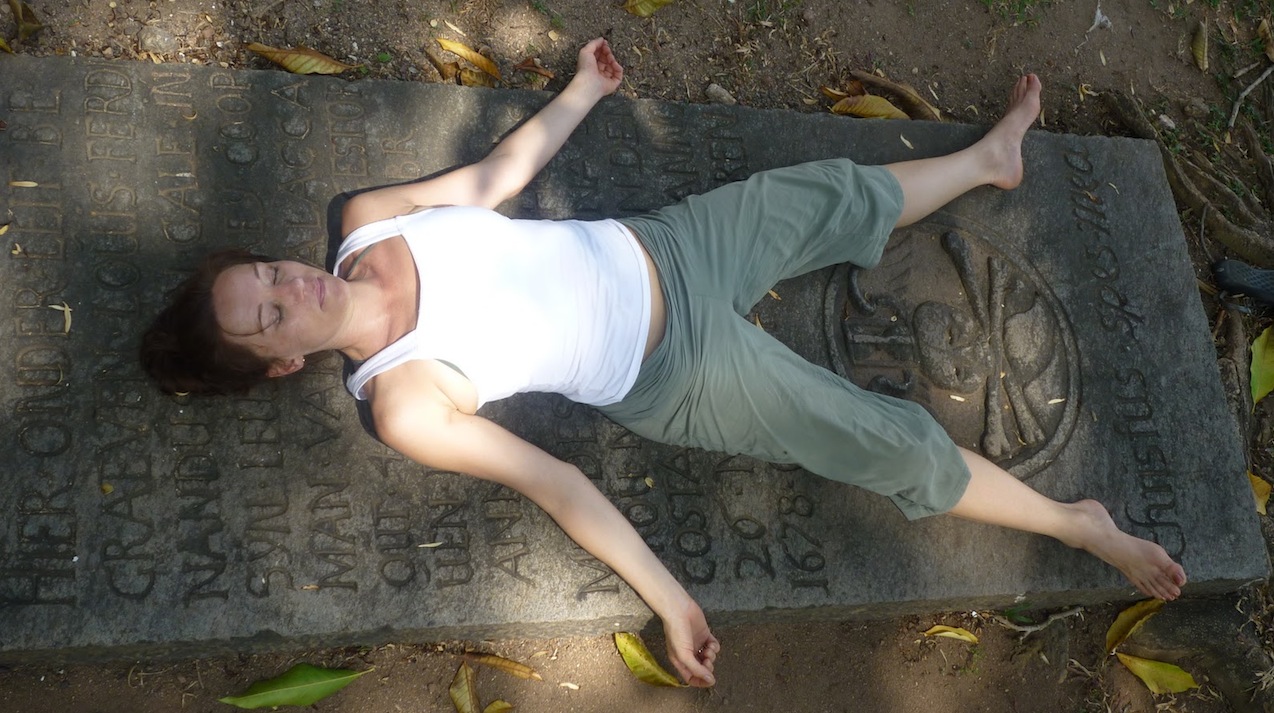
savasanaThere are some things you should never tell an elderly person to do. And, I recently came across a faux pas that certainly belongs in that number.

It may just be me, but I think one should never, ever tell a senior citizen to pose like a corpse.

Nevertheless, in a recent article in a periodical expressly written for “mature” Americans,* readers were advised to assume the “corpse pose.” My discomfort with that directive was not allayed by the description that followed.

Lie flat on your back, pillow under your head, eyes closed. Allow your feet to play to the sides. Rest your arms alongside your body, palms facing up. Then relax, surrender to the floor, and breathe deeply.

Up until being told to “breathe,” one might rightly be confused with precisely how we are emulating a corpse.

While I make no claim to understand what it means to “surrender to the floor,” I can understand how body posture has become a valued part of yoga. After all, even without the counsel of a yogi, I learned at an early age the sheer joy and peace of lying on my back with eyes closed.

I don’t wish to impugn the benefits of yoga; I wish that I were able to master my physical body half as well as many of them do. However, I would like to suggest to the yoga community that they re-label their corpse pose.

Admittedly, advocates for maintaining this verbiage can state it is clearly not intended to refer to a literal cadaver. In arguing this they are simply being human. As C.S. Lewis wrote in “Studies in Words”—“Like all philosophers, Aristotle gives words the definitions which will be most useful for his own purpose.” This approach is not, of course, the domain of philosophers alone.

The fact is that there are perfectly good words that could be substituted which do not reference a lifeless body. “Reclined,” “Reposed,” or even “Resting” or “Sleeping” come readily to mind.

Of course, I may be missing something here. Perhaps the allusion to a corpse is intentional? Perhaps the image of dissipation of energy and effort is expressly intended to be similar to a comatose state? Perhaps that is what becoming one with the floor is hinting at? Flesh to floor . . . ashes to ashes, dust to dust.

In this case, it might be clearer if we were provided with a definition of what the title of the pose actually means. I suppose that practitioners may learn this as part of their lessons, but to those on the “outside,” the label seems slightly off-putting.

As Lewis wrote in the aforementioned essay:

The fact that [writers] define it at all is itself a ground for scepticism. Unless we are writing a dictionary, or a text-book of some technical subject, we define our words only because we are in some measure departing from their real current sense. Otherwise there would be no purpose in doing so.

Thus, if “corpse” here doesn’t mean what we normally understand it to, we might benefit from a brief definition or explanation of the users’ intent.

This matter—the proper use of the precise word that will be clearly understood—is a concern for all communicators. Writers need to remain vigilant that their own vocabulary or metaphors do not confuse.

One last caveat for those who practice yoga. If you seek to master the corpse pose, be cautious in just how well you perfect it. Please stop short of emulating death so well that your resting body is discovered and a crime scene established.

_____

savasana 2* AARP the Magazine is published by the organization formerly known as the American Association of Retired People. Apparently, the sound “AARP” is considered more dignified than the original title. It remains a requirement, however, that members have survived at least a half century before applying for membership.

The Anguish of Suicide

suicideI was present at the scene of a suicide last night.

In my capacity as a volunteer chaplain with a local law enforcement agency, I was riding with a police officer. We were the initial first responders to arrive.

At the end of a rather uneventful shift, we received an urgent call to respond to a shooting. Naturally, I can’t reveal any details about the event beyond mentioning it involved a firearm. It was probably terribly similar to how you would imagine it to be.

To see a life so sadly cast aside is too sad for words. Contemplating the days ahead for those who loved the deceased is sobering. Their lives will never be the same, and that is the universal legacy bequeathed to family and friends by those who end their own lives. God have mercy on them.

C.S. Lewis understood how despair could drive a person to contemplate this irreversible choice. In a letter to a deeply grieving husband who had lost his wife, Lewis relates how suicide would never provide a genuine resolution to the pain caused by the loss.

One way or another the thing [romantic love] had to die. Perpetual springtime is not allowed. You were not cutting the wood of life according to the grain. There are various possible ways in which it could have died though both the parties went on living.

You have been treated with a severe mercy. You have been brought to see (how true & how very frequent this is!) that you were jealous of God. So from us you have been led back to us and God; it remains to go on to God and us.

She was further on than you [in Christian faith], and she can help you more where she now is than she could have done on earth.*

You must go on. That is one of the many reasons why suicide is out of the question. (Another is the absence of any ground for believing that death by that route would reunite you with her. Why should it? You might be digging an eternally unbridgeable chasm. Disobedience is not the way to get nearer to the obedient.)

There’s no other man, in such affliction as yours, to whom I’d dare write so plainly. And that, if you can believe me, is the strongest proof of my belief in you and love for you. To fools and weaklings one writes soft things. (A Severe Mercy by Sheldon Vanauken)

Vanauken, the recipient of the letter, had this response to Lewis’ challenging words: “After this severe and splendid letter, I loved Lewis like a brother. A brother and father combined.”

He continued by explaining how the letter had dispelled any consideration of suicide. “If I had been tempted at all to break my promise to Davy [his wife] about following her by [his] own act, the temptation vanished after one horrified look at Lewis’s ‘eternally unbridgeable chasm.’”

It will take some time for me to “process” my experience last evening. But, having seen death in the past, I found it less traumatic than many others would have.

And, of course, I never knew the person who chose to no longer breathe . . . or smile . . . or dream. I only became “acquainted” with them as I spoke to their spouse in the hours that followed. Sadly, because of a tragic choice, in this world they are merely a memory now.

Naturally, to those who knew and loved them, the vacuum created by their passing cannot be completely filled. Moreover, the wounds caused by the grim nature of their death by choice, will leave permanent scars.

The fact is that during the course of their lives, many people—quite possibly the majority of human beings—consider the possibility that suicide could end the pain they feel. But we must tirelessly remind them, and ourselves, that suicide is a permanent “solution” to temporary circumstances.**

_____

* Lewis is referring to the concept that the saints (i.e. all believers) currently in the presence of the Lord may have the ability to intercede on behalf of those of us who are still “living.” The best way for Protestants to understand this may be by considering this line of thought: (1) we don’t hesitate to ask our sisters and brothers in Christ to pray for us, (2) we believe that God has already given eternal life to his disciples (meaning that even the departed remain alive), thus (3) it is not illogical that children of God now in his presence would be able to intercede for us in heaven.

Traditional Protestant reticence with this understanding is based in the concept most clearly espoused in I Timothy 2:5. Lewis, of course, was a Protestant himself, but Anglicans are among the minority of Protestants who affirm this practice.

** This is not to belittle the intense agony caused by chronic emotional suffering, but I believe there is a path that leads not to death, but to healing and life. If you have suicidal feelings, I strongly encourage you to seek out a skilled Christian counselor. (Not all clergy possess the necessary training, or the faith itself, to provide an adequate lifeline in these situations.)

If you’re unable to find a pastor in your local area, you can contact me at chaplainstroud at mereinkling dot com and I will attempt to get you in touch with a compassionate minister in your local community.

Stephen King Echoes C.S. Lewis

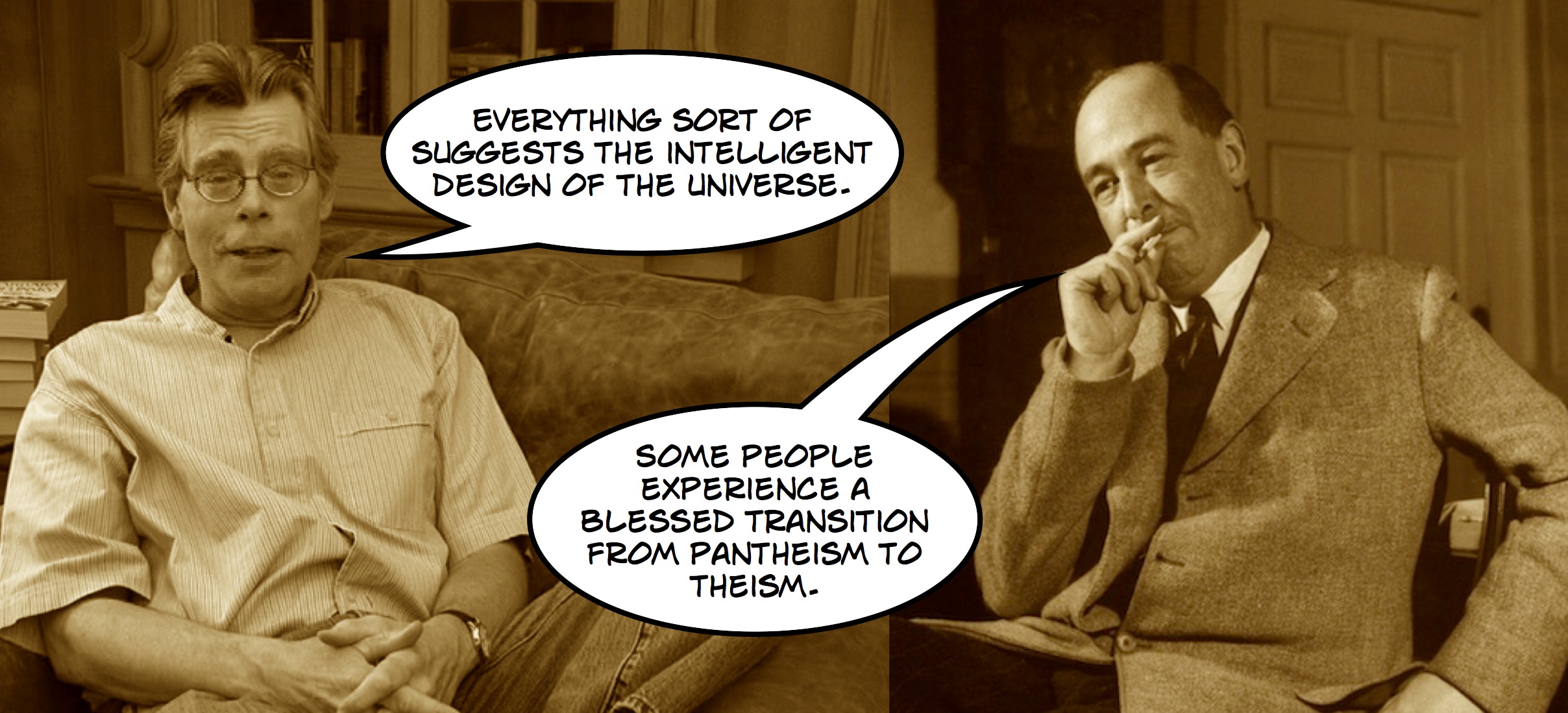
csl and kingAuthor Stephen King surprised quite a few fans during a recent PBS interview when he expressed his belief in the universe’s intelligent design. In nature and the cosmos, like theist C.S. Lewis before him, he views a creation so complex and wondrous that he thinks it makes more sense to believe in a divine power than to dismiss faith.

During the interview, King said,

I choose to believe it, yeah. I think that . . . there’s no downside to that, and the downside—if you say, well, OK, I don’t believe in God, there’s no evidence of God—then you’re missing the stars in the sky, and you’re missing the sunrises and sunsets, and you’re missing the fact that bees pollinate all these crops and keep us alive and the way that everything seems to work together at the same time.

In an essay, “Christianity and Culture,” C.S. Lewis alludes to the “Theist” phase of his own life. He points out how limiting a faith that recognizes God only abstractly, in his handiwork, can be.

There is an easy transition from Theism to Pantheism; but there is also a blessed transition in the other direction. For some souls I believe, for my own I remember, Wordsworthian contemplation can be the first and lowest form of recognition that there is something outside ourselves which demands reverence.

To return to Pantheistic errors about the nature of this something would, for a Christian, be very bad. But once again, for “the man coming up from below” the Wordsworthian experience is an advance. Even if he goes no further he has escaped the worst arrogance of materialism: if he goes on he will be converted.

King is, of course, far from what one would properly call a “person of faith.”** Still, it may be that he is presently moving in a positive direction. The following words reveal his yearning for hope, criticism of institutional religion, and his as yet unanswered questions about why God allows suffering in our world.

It’s certainly a subject that’s interested me, and I think it interests me more the older that I get. And I think we’d all like to believe that after we shuffle off this mortal coil, that there’s going to be something on the other side because for most of us, I know for me, life is so rich, so colorful and sensual and full of good things, things to read, things to eat, things to watch, places to go, new experiences, that I don’t want to think that you just go to darkness. . . .

But as far as God and church and religion and . . . that sort of thing, I kind of always felt that organized religion was just basically a theological insurance scam where they’re saying if you spend time with us, guess what, you’re going to live forever, you’re going to go to some other plain where you’re going to be so happy, you’ll just be happy all the time, which is also kind of a scary idea to me. . . .

Everything is sort of built in a way that to me suggests intelligent design. But at the same time there’s a lot of things in life where you say to yourself, well, if this is God’s plan, it’s very peculiar. And you have to wonder about that guy’s personality, the big guy’s personality. . . . What I’m saying now is I choose to believe in God, but I have serious doubts.

For many intelligent people, like C.S. Lewis and Stephen King, coming to faith cannot be severed from their reason. They desire to make sense of the world. Some, sadly, determine that human beings perish forever with their final breath. With that worldview, using King’s words, “you just go to darkness.”

Fortunately many others—brilliant and simple people alike, for God shows no partiality—possess true wisdom and heed the words of Jesus, that he is the way, the truth and the life. Both of these writers experienced an ineffective exposure to the church when they were young. Unfortunately, it served as more of an inoculation than a foundation.

Eventually C.S. Lewis followed that path from theism to Christianity. It’s not impossible that Stephen King may, as well.

_____

* A full transcript of the PBS interview is available here.

** In the interview, King “commends” the entertainment value of enthusiastic, emotionally-charged preaching, while disparaging his own mainline upbringing.

I went to a Methodist church for years as a kid, and Methodist youth fellowship on Thursday nights, and it was all pretty – you know, think of a bottle of soda with the cap off for 24 hours. There weren’t very many bubbles left in that stuff by then. It was pretty – it was Yankee religion, Terry, and there’s really not much in the world that’s any more boring than that. They tell you that you’re going to go to hell, and you’re half-asleep.

Why War?

bulletsI recently read a profound statement penned by G.K. Chesterton. Although he was not a military veteran himself, he was absolutely on target when he wrote: “The true soldier fights not because he hates what is in front of him, but because he loves what is behind him.”

Terrible things are happening today in Syria. Yesterday, over lunch, I “debated” one of my sons regarding the merits (and drawbacks) of American intervention in that Levantine cauldron.

He believes we can’t “stand by” while the world watches as a civil war rages around another of the world’s mad dictators. I argued the United States isn’t morally responsible to serve as the world’s guardian of peace. And, even if we as a single, fallible, divided people were accountable . . . what about the violence and injustice in so very many other places. Sudan, Myanmar (Burma), the Congo, and scores of other lands cry out for intervention on behalf of the oppressed.

There is an almost unlimited amount of injustice around the globe today. And, looking in the mirror, it’s evident we have problems to resolve right here.

Sending American troops to intervene in foreign civil wars is ugly business. Taking sides against dictators does not always provide a safer and more just world—we need look no further than the so-called Arab Spring to reveal that.

I was proud to serve my nation—and causes I believed in—during the liberation of Kuwait and the retaliation for the September 11 attacks on the United States a decade later.

I am now retired from active duty, and I’ve lived long enough to witness how little positive fruit seems to follow war.

Like C.S. Lewis, I remain persuaded that some evils are so malevolent (Hitler, for example, comes to mind) . . . that they must be confronted. As he wrote in “The Conditions for a Just War,”

If war is ever lawful, then peace is sometimes sinful.

At the same time, however, war is something into which we should never rush. It demands our conscious consideration of the cost and an accurate determination that the blood spilled—include that of noncombatants inevitably caught up in the horror—is a price worth paying.

It is that question which moral men and women must debate and ponder.

“Learning in War-Time” is a brilliant essay included in the collection which goes by the name of Lewis’ speech, “The Weight of Glory.” In the essay, Lewis discusses the seriousness of war. As a combat casualty during the First World War, he vividly understood its nature.

However, as a Christian, Lewis recognized that warfare is not the worst thing that can befall a human being.

What does war do to death? It certainly does not make it more frequent: 100 percent of us die, and the percentage cannot be increased. It puts several deaths earlier, but I hardly suppose that that is what we fear. Certainly when the moment comes, it will make little difference how many years we have behind us.

Does it increase our chances of painful death? I doubt it. As far as I can find out, what we call natural death is usually preceded by suffering, and a battlefield is one of the very few places where one has a reasonable prospect of dying with no pain at all.

Does it decrease our chances of dying at peace with God? I cannot believe it. If active service does not persuade a man to prepare for death, what conceivable concatenation of circumstances would? Yet war does do something to death. It forces us to remember it.

True. To die at enmity with God is a fearful thing. Still, even better than coming to faith during war (Lewis would surely agree), is recognizing God’s love and living a life of peace.

Saintly Newspaper Clippings

stfrancisMy brother, sister and I have nearly finished the somber task of going through my father’s possessions. We distributed many items to various family members, but the local charities have probably benefited most, as we cleared out the three bedroom home.

Sadly, my mother died nearly twenty years ago. My sister inherited her cedar chest, but had left it in our father’s house. As she prepared to take it home, we discovered some interesting items, including forty pictures my father had sent home during his 1967-68 tour in Vietnam.

We also found a Bible my mother had used when she attended studies. She was born in the generation which would never dare to highlight passages or scribble in the margins. Thus, the Bible bears no evidence it ever belonged to her . . . aside from some inspiring bookmarks, and a few newspaper clippings she had found meaningful.

One of the quotations that I too found particularly edifying, came from the pen of a Roman Catholic priest named Francis de Sales:

Do not look forward to what might happen tomorrow; the same everlasting Father who cares for you today will take care of you tomorrow and every day. Either He will shield you from suffering or he will give you the unfailing strength to bear it. Be at peace, then, and put aside all anxious thoughts and imaginations.

Francis was a post-Reformation Bishop of Geneva who was noted for his gentle approach toward religious divisions—in an era when such moderation was extremely rare. He is known for writings on spiritual growth (in Roman Catholic parlance, “spiritual formation”).

Although I have not read it, his book Introduction to the Devout Life comes highly recommended, and is available for free download here. I suspect even agnostics could enjoy it for its historical value.

By all accounts, Francis led a chaste and humble life, much like his namesake, Francis of Assisi. (Both men were canonized by their Church.)

Speaking of the first St. Francis, I have always wondered why no Pope ever honored his legacy by assuming his name. I suppose this is because his most prominent characteristics are not those most Popes seek to emulate. The assumption of Francis’ name by the new Pope, I believe, bodes well for his papacy. If he follows in the footsteps of Francis of Assisi, he cannot stray too far afield.

C.S. Lewis appreciated the thirteenth-century saint who began life as a self-indulged soldier and ended it living under a strict vow of poverty. Francis’ celebrated affection for animals—he is considered their “patron saint”—could not help but endear the monk to the creator of Narnia. Each year, many Christians participate in Roman Catholic and Anglican ceremonies for the blessing of animals on Saint Francis’ feast day.

In The Four Loves, Lewis discusses the nature of our physical body. He notes that there are several competing perspectives about our corporeal constitution, with the extremes either demeaning or glorifying humanity’s material nature. Lewis suggests that a metaphor created by Saint Francis provides a more biblical view.

Man has held three views of his body. First there is that of those ascetic Pagans who called it the prison or the “tomb” of the soul, and of Christians like Fisher to whom it was a “sack of dung,” food for worms, filthy, shameful, a source of nothing but temptation to bad men and humiliation to good ones. Then there are the Neo-Pagans (they seldom know Greek), the nudists and the sufferers from Dark Gods, to whom the body is glorious.

But thirdly we have the view which St. Francis expressed by calling his body “Brother Ass.” All three may be—I am not sure—defensible; but give me St. Francis for my money. Ass is exquisitely right because no one in his senses can either revere or hate a donkey. It is a useful, sturdy, lazy, obstinate, patient, lovable and infuriating beast; deserving now the stick and now a carrot; both pathetically and absurdly beautiful. So the body. There’s no living with it till we recognise that one of its functions in our lives is to play the part of buffoon.

Yes, I have to live for a while yet in this donkey of a shell, which illustrates daily the wisdom of the Apostle Paul who wrote that the spirit is willing but the flesh is weak . . . and short-sighted . . . and lazy . . . and stubborn . . .

This body, my flesh, argues that I should spend my day worrying about tomorrow. But the Holy Spirit speaks a more hopeful word. A promise. As God inspired Francis de Sales to eloquently proclaim: “Do not look forward to what might happen tomorrow; the same everlasting Father who cares for you today will take care of you tomorrow and every day.”