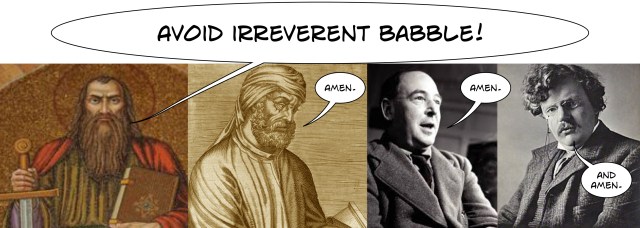
Chesterton, Tertullian and C.S. Lewis on Arguments

babble.jpg

With civil discourse in such short supply today, it may be beneficial to consider some wisdom from the past about disagreeing calmly.

If you’re a thoughtful person, and you interact with other rational people, it’s inevitable that you will sometimes disagree. These differences of opinion are not bad things, in and of themselves. They help us sharpen our thinking and occasionally result in someone (from either side) recognizing the errors in their opinions.

There are times, however, when disagreements are not handled respectfully. In such situations, they seldom result in a positive end. In cases where quarrels arise, people don’t persuade others. They do the opposite—they motivate them to entrench themselves and hide behind mental and verbal barricades that reinforce their “errors.”

You can go all the way back to the Scriptures to find the recognition that this sort of debate is destructive. Here is the counsel of the apostle Paul to his protégée Timothy, a young pastor:

Remind them of these things, and charge them before God not to quarrel about words, which does no good, but only ruins the hearers. Do your best to present yourself to God as one approved, a worker who has no need to be ashamed, rightly handling the word of truth. But avoid irreverent babble, for it will lead people into more and more ungodliness, and their talk will spread like gangrene. (2 Timothy 2:14-17)

In the second century, Tertullian, a brilliant North African Christian scholar, penned one of my favorite passages in all of patristic literature.

I might be bringing forward this objection from a want of confidence, or from a wish to enter upon the case in dispute in a different manner from the heretics, were not a reason to be found at the outset in that our Faith owes obedience to the Apostle who forbids us to enter into questionings, or to lend our ears to novel sayings, or to associate with a heretic after one admonition—he does not say after discussion.

Indeed, he forbade discussion by fixing on admonition as the reason for meeting a heretic. And he mentions this one admonition, because a heretic is not a Christian, and . . . because argumentative contests about the Scriptures profit nothing, save of course to upset the stomach or the brain.

This or that heresy rejects certain of the Scriptures, and those which it receives it perverts both by additions and excisions to agree with its own teaching. For even when it receives them it does not receive them entire, and if it does in some cases receive them entire, it none the less perverts them by fabricating heterodox interpretations.

A spurious interpretation injures the Truth quite as much as a tampered text. Baseless presumptions naturally refuse to acknowledge the means of their own refutation. They rely on passages which they have fraudulently rearranged or received because of their obscurity.

What wilt thou effect, though thou art most skilled in the Scriptures, if what thou maintainest is rejected by the other side and what thou rejectest is maintained? Thou wilt indeed lose nothing—save thy voice in the dispute; and gain nothing—save indignation at the blasphemy. (On the Prescription of Heretics, 16-17)

If you would like to read a fascinating scholarly article on this passage you can download one here. In “Accusing Philosophy of Causing Headaches: Tertullian’s Use of a Comedic Topos,” J. Albert Harrill writes:

Among the most famous passages in Tertullian’s De praescriptione haereticorum (ca. 203) is what appears to be nothing more than a throwaway line. After declaring that ‘heretics’ have no right to use Christian Scripture, he writes, ‘Besides, arguments over Scripture achieve nothing but a stomachache or a headache.’

Previous scholarship has assumed the protest to epitomize Tertullian’s fideism and general anti-intellectualism. However, I argue that the line evokes a comedic stereotype within a medical topos about ‘excessive’ mental activity causing disease in the body, going back to Plato and Aristophanes.

The passage is, therefore, not a throwaway line but an important part of Tertullian’s attempt to caricature his opponents with diseased superstitio (excessive care and ‘curiosity’).

More Recent Variations of this Theme

Those who have attempted serious, rational argument with someone who is unserious or irrational know very well what Tertullian was describing. If you are earnest and calm in your advocacy, only to have your counterpart act flippant or ignorantly obstinate, it really can make one feel nauseous.

G.K. Chesterton, who was an articulate defender of Christianity during the beginning of the twentieth century, described the frustration in a predictably entertaining manner.

If you argue with a madman, it is extremely probable that you will get the worst of it; for in many ways his mind moves all the quicker for not being delayed by things that go with good judgment.

He is not hampered by a sense of humour or by clarity, or by the dumb certainties of experience. He is the more logical for losing certain sane affections.

Indeed, the common phrase for insanity is in this respect a misleading one. The madman is not the man who has lost his reason. The madman is the man who has lost everything except his reason.” (Orthodoxy)

As Chesterton suggests, the madman has retained his ability to reason, but is no longer inhibited by reason itself. I would liken it to retaining the appearance of reasoning, bereft of its essence. It parallels what we read in 2 Timothy 3.

In the last days . . . people will be lovers of self, lovers of money, proud, arrogant, abusive, disobedient to their parents, ungrateful, unholy,  heartless, unappeasable, slanderous, without self-control, brutal, not loving good,  treacherous, reckless, swollen with conceit, lovers of pleasure rather than lovers of God, having the appearance of godliness, but denying its power. Avoid such people. (Italics added.)

C.S. Lewis also addresses the inability of many who are wrong to conduct rational conversations. Whenever they meet a reasoned argument, they are disarmed.

Unfortunately, their lack of logic does not prevent them from charging into the disputation. They assume their passion or their appeal to subjectivity (i.e. that “everyone” is right) will win the day.

Lewis grew so frustrated by the phenomenon that he coined a new word to identify it. He regrets the passing of the day when you persuade someone of their error before you could legitimately explain why your own position is correct on a given issue.

The modern method is to assume without discussion that he is wrong and then distract his attention from this (the only real issue) by busily explaining how he became so silly.

In the course of the last fifteen years I have found this vice so common that I have had to invent a name for it. I call it Bulverism.

Some day I am going to write the biography of its imaginary inventor, Ezekiel Bulver, whose destiny was determined at the age of five when he heard his mother say to his father – who had been maintaining that two sides of a triangle were together greater than the third – `Oh you say that because you are a man.’

“At that moment,” E. Bulver assures us, “there flashed across my opening mind the great truth that refutation is no necessary part of argument. Assume that your opponent is wrong, and then explain his error, and the world will be at your feet.

“Attempt to prove that he is wrong or (worse still) try to find out whether he is wrong or right, and the national dynamism of our age will thrust you to the wall.” That is how Bulver became one of the makers of the Twentieth Century.

I find the fruits of his discovery almost everywhere. Thus I see my religion dismissed on the grounds that “the comfortable able parson had every reason for assuring the nineteenth century worker that poverty would be rewarded in another world.” Well, no doubt he had. On the assumption that Christianity is an error, I can see early enough that some people would still have a motive for inculcating it.

I see it so easily that I can, of course, play the game the other way round, by saying that “the modern man has every reason for trying to convince himself that there are no eternal sanctions behind the morality he is rejecting.”

For Bulverism is a truly democratic game in the sense that all can play it all day long, and that it gives no unfair privilege to the small and offensive minority who reason. But of course it gets us not one inch nearer to deciding whether, as a matter of fact, the Christian religion is true or false. . . . I see Bulverism at work in every political argument.

Until Bulverism is crushed, reason can play no effective part in human affairs. Each side snatches it early as a weapon against the other; but between the two reason itself is discredited. (“‘Bulverism:’ Or the Foundation of Twentieth Century Thought”)

So, there we have it. We may derive some comfort from the fact that irrational arguing has frequently displaced civil discourse since the dawn of human communication.

As for me, I intend to avoid the Bulverites as much as possible. The last thing I need is a migraine or a serious case of indigestion.


How One Speaks to Royalty

bowing

How does your voice subtly alter as you are introduced to foreign royalty? When you kneel before your sovereign, if you summon the courage to speak, does your voice crack, or assume the volume of a whisper.

A recent study argues that “Non-verbal behaviours, including voice characteristics during speech, are an important way to communicate social status.”

The research involved interviews with potential employers (most likely because too few individuals with royal blood were available).

We found that vocal modulations were apparent between responses to the neutral and high-status targets, with participants . . . increasing fundamental frequency.

That means that when people talked to those they considered more powerful or prestigious than themselves, their voices got higher and squeakier. [Note: the study itself does not refer explicitly to the squeakiness quotient.]

C.S. Lewis was a gifted orator, who could well have served as the prestigious participant in a study such as this. “Lewis had a rich, deep, booming voice,” notes a recent volume.

This may be one reason that Adolf Hitler rued Lewis’ contribution to the Allied war effort.

There are a bevy of studies related to how all manner of things exert a subconscious effect on our vocal pitch. For example, you may not be aware that “Japanese women modify their pitch when reading English sentences, producing speech in a slightly lower pitch range” (Japanese Language, Gender, and Ideology).

Another fact of which you may be unaware, is that on the Supreme Court of the United States, “when male justices respond to female justices, they are more likely to raise their pitch.” What’s more, as the years pass, “female justices lower their voice pitch over time, whereas male justices raise their voice pitch over time.” What do we make of that?

In an article about how “study after study has suggested that low voices, ‘masculine’ voices, are an asset to those seeking leadership roles, in politics and beyond,” we discover how this relates to women, as well.

We perceive men with lower-pitched voices to be more attractive and physically stronger–and also more competent and more trustworthy—than their less burly-voiced peers. And we perceive women with lower-pitched voices along the same lines (though we also tend to perceive them, tellingly, as less attractive than their Betty Boop-y counterparts).

C.S. Lewis and the Idea of Voice

Accustomed as he was to an academic world constructed on the scaffolding of lecture and debate, Lewis was well acquainted with the power of “voice.” In fact, in one of his most creative essays, “Two Lectures,” Lewis describes hearing a predictable lecture on the subject of “evolution, development, the slow struggle upwards and onwards from crude and inchoate beginnings towards ever-increasing perfection . . .”

He then describes a “dream” that very night in which all of the lecturers presuppositions are reversed, raising the question of whether it might be “equally reasonable to look outside Nature for the real Originator of the natural order?”

The portion of the essay which is pertinent to the subject of the current column is the way he introduces the Dream Lecturer, but praising the “voice and figure” of its human precursor.

None of this [i.e. the evolution lecture], of course, was new to me or to anyone else in the audience. But it was put very well (much better than it appears in my reproduction) and the whole voice and figure of the lecturer were impressive. At least they must have impressed me, for otherwise I cannot account for the curious dream I had that night.

In “The Decline of Religion,” Lewis praises open and uninhibited conversations about faith. In contrast, he describes an earlier age of superficial religiosity in which Christianity, “if it had to be spoken of, it was spoken of in a hushed, medical voice.” Ah, the medical voice. We who have been around hospitals and sickbeds (for those seriously ill) are quite familiar with that somber and muted tone.

In “Meditation in a Toolshed,” Lewis illustrates the distinction between studying something and peering more deeply into it. His description of the voice of one’s beloved is quite poetic.

A young man meets a girl. The whole world looks different when he sees her. Her voice reminds him of something he has been trying to remember all his life, and ten minutes’ casual chat with her is more precious than all the favours that all other women in the world could grant. [Italics added.]

Reading these words, I am reminded of the Song of Solomon.

O my dove, in the clefts of the rock, in the crannies of the cliff, let me see your face, let me hear your voice, for your voice is sweet, and your face is lovely. (2:14)

The Voice of C.S. Lewis

Fortunately, we possess a small number of recordings of Lewis’ voice. Sadly, however, many more were lost.

During WWII, the BBC used twelve-inch metal disks coated with acetate for recordings. But because metal was in short supply, those disks were primarily reserved for field recording, so only one of Lewis’s WWII talks was preserved.

If a sufficient number of recordings had survived, an analysis of Lewis’ voice pitch might have earned a modern graduate their PhD.

It is fitting to close these thoughts with a thoroughly Lewisian quotation. Lewis was a deeply charitable man. In his writings he mentions a number of times how he strove to put the best face on the words and actions of others.

In a letter to one of his regular correspondents who is extremely “distraught” at another’s behavior, he urges patience. In doing so he mentions how we can become so prejudiced toward others that their very voice becomes a bludgeon. But read on and see how he makes his gracious point.

It is a pity he ‘gets on your nerves’ but you are, rightly, controlling your reactions. I know well how a person’s very voice, looks, and mannerisms may grate on one! I always try to remember that mine probably do the same to him—and of course I never hear or see myself.

Emphasizing Italics

italicsSermons do not make great books. Sorry, but that’s the opinion of this pastor who has to compel himself to read the sermons of preachers.

Yes, some of them sell decently (when the author has a national “pulpit”). But I suspect many copies of those books are purchased out of support of their broader ministry. I imagine most purchasers try to wade through a few of the homilies, but decide after a while they prefer listening to the sermon “preached.”

As a lifelong student of communication, I continue to be intrigued by the different ways in which aural and printed word can be used to communicate the good news. The subject promises to be a major part of my dissertation research.

Sermons are meant to be delivered orally. Transposing them to the page, without making various accommodations, is (in my personal opinion) a mistake.

C.S. Lewis apparently agreed with me on that—before he came to disagree with the effort.

Ever since the rise of the keyboard, I have celebrated the ability to use italics for emphasis. I consider the availability of italics especially important when we translate spoken messages into text.

C.S. Lewis discussed this process in his preface to Mere Christianity. His focus was on how best to transpose words prepared for oral delivery to a written medium, while still maintaining their original voice.

The contents of this book were first given on the air, and then published in three separate parts as Broadcast Talks (1942), Christian Behaviour (1943) and Beyond Personality (1944).

In the printed versions I made a few additions to what I had said at the microphone, but otherwise left the text much as it had been. A “talk” on the radio should, I think, be as like real talk as possible, and should not sound like an essay being read aloud. In my talks I had therefore used all the contractions and colloquialisms I ordinarily use in conversation.

In the printed version I reproduced this, putting don’t and we’ve for do not and we have. And wherever, in the talks, I had made the importance of a word clear by the emphasis of my voice, I printed it in italics.

I am now inclined to think that this was a mistake—an undesirable hybrid between the art of speaking and the art of writing.

A talker ought to use variations of voice for emphasis because his medium naturally lends itself to that method: but a writer ought not to use italics for the same purpose. He has his own, different, means of bringing out the key words and ought to use them.

In this edition I have expanded the contractions and replaced most of the italics by a recasting of the sentences in which they occurred: but without altering, I hope, the “popular” or “familiar” tone which I had all along intended. I have also added and deleted where I thought I understood any part of my subject better now than ten years ago or where I knew that the original version had been misunderstood by others.

When one’s mentor advises something, it demands thoughtful consideration. Lewis’ opinion that the use of italics for emphasis is not ideal forced me to seriously consider the practice, which I obviously favor.

I agree with Lewis on expanding contractions. I learned that lesson when I wrote a paper during seminary studies and the professor instructed me to make that change.

However, I disagree about the use of italics. They need to be properly applied, of course. And I recognize that the most gifted of writers may be able to consistently avoid using them. (Or “leaning on them” as an anti-italics anarchist would probably say.)

In the end, I guess it is time to ponder again Lewis’ pronouncement that writers have their “own, different, means of bringing out the key words and ought to use them.”

Until I receive a divine mandate, C.S. Lewis notwithstanding, you should continue to expect to occasionally see italics here at Mere Inkling.

_____

The cartoon at the top of the page comes from an interesting site. You can find the original source for the image here. Just for the record, I hate ALL CAPS, and I absolutely despise underlining.

Deadly Jobs

bad newsIt’s bad enough not liking your job . . . but being allergic to your chosen profession? That’s absolutely miserable.

And that’s what happened to one American journalist. Despite the myriads of new avenues for journalism, newspaper writing remains a primary context for the skill.

I actually earned my first degree in journalism. Editorial Journalism, via the University of Washington’s School of Communication. But I was never cut out to be a member of the Fourth Estate. (Ironically, I ended up belonging to the First Estate, but that’s another story.)

Journalism is a vocation important to the wellbeing of society. Good journalists are vital to society’s health. Those who spew vitriol, not so much.

Apparently a reporter for a Baltimore newspaper recently discovered—after thirty-eight years in the business, that he’s allergic to newspapers. Not their content, their composition. Specifically, he is allergic to pine resin which is used to make newsprint ink.

I assume he’s making a “quality of life” transition now to digital news sources.

Journalism is a broader field than many realize. Our first thought usually turns to newspaper “reporters.” We have often considered them to be objective relaters of events. Of course, complete objectivity is something that is beyond human grasp. Everyone approaches the “news” with their own biases and a worldview that shapes their perception of “facts.”

C.S. Lewis has a fun essay which touches on this. It’s called “Private Bates.”

We must get rid of our arrogant assumption that it is the masses who can be led by the nose. As far as I can make out, the shoe is on the other foot. The only people who are really the dupes of their favourite newspapers are the intelligentsia. It is they who read leading articles: the poor read the sporting news, which is mostly true.

I recall some debates back in my college days when others attempted to persuade me that objectivity was not only possible, it was the standard practice of reporters. That myth has long been exposed, and I try to be content with those who strive to be as fair as they can.

In a 1955 letter, C.S. Lewis is even more blunt than in the previously cited essay. He tells one of his regular correspondents, “I never read the papers. Why does anyone? They’re nearly all lies, and one has to wade thru’ such reams of verbiage and ‘write up’ to find out even what they’re saying.”

One reason journalism receives so little respect today is because people confuse reporting with editorializing. Reporting, of course, is just the facts. (Admittedly, even these are subjectively perceived.) Editorializing, on the other hand, is offering one’s unbridled opinion.

For the latter to masquerade as the former is criminal. But to accept the fact that honestly offered “opinion” is just that, is fine.

After all, one reason you’ve taken the time to read this post is because you appreciate reading gems from C.S. Lewis . . . and you don’t mind wading through the “opinionated” verbiage of this humble columnist to find it.

C.S. Lewis’ Bilingualism

csl bilingualHow many extremely intelligent and well educated people do you know . . . who can actually communicate with those of us possessing normal human intelligence?

That talent is a rarity.

And it is precisely what makes C.S. Lewis such an unusual man. He was brilliant. Yet he could communicate with the common person—even the child—just as easily as he conversed with his fellow university dons.

Lewis, of course, could comprehend a number of languages, so he was more than merely “bilingual.” But that is not exactly the sense in which I am using the word today. I mean it in the sense of my opening paragraphs. It is the ability to communicate (even with the same “language”) to distinctly different groups who would normally not be able to readily understand one another.

In an interview that appeared in Christianity Today, Detroit pastor Christopher Brooks was asked about the challenges of urban ministry.

How have you included both righteousness and justice in your setting?

I think about C.S. Lewis, who had the challenge of building the bridge between the culture of Oxford and Cambridge and the culture of the church. These cultures were worlds apart by his time, but he was bilingual, in a sense: able to speak the language of Oxford to the church and the language of the church to the intellectuals and naturalists.

One of the titles for ancient Roman priests that was adopted by their Christian successors is “pontifex.” It means “bridge-maker.” The Pontifex Maximus was, of course, referred to the greatest of these offices.

In light of Brooks’ words about Lewis as building bridges between elite academia and Christianity, I have added that dimension to my view of him. C.S. Lewis, Pontifex Maximus. (I doubt it would make him happy, so I’ll keep it under wraps . . . and probably never mention it again.) But I am genuinely happy about his skill in building these bridges of understanding.

Before signing off, a special treat. If you call someone who speaks two languages “bilingual,” and someone who speaks three “trilingual,” what do you call someone who only speaks one language? Why, an American, of course.

That joke would not be as funny if it were not so sadly true. While the rest of the world almost assumes that people know at least two languages, most Americans stumble their way through the study of a second language for two or three years and never develop a comfort level with it. But that’s a story for another day.

To Tweet or Not to Tweet

platypusI have a twitter account I’ve never used. I had attended a ministry conference where the featured speaker encouraged all of the pastors to harness the power of this cutting edge technology.

I dutifully returned home, established an account, and realized there were very few things I wanted to say in 140 characters or less. One hundred and forty words . . . now you’re talking. But a mere seven score letters . . . I don’t think so.

I know there are many positive things about brevity. In our hectic world, it’s become an absolute necessity. Still, some things—to be expressed more clearly and (dare I say it, “entertainingly”)—demand more than two and a half sentences.

I was recently reading an article entitled “Tweets Before Twitter,” and it gave me cause to reconsider the prospect of using twitter to share worthwhile ideas. It described “ingenious brevity inspired 150 years ago by telegrams. . . . when people had to pay as much as $1 per Morse-coded word to dispatch a cable overseas, only a robber baron could afford to be loquacious.”

Now, that’s a sobering thought, especially since one of the dollars of that era would likely translate into about $214.17 today (by rough estimate). With that incentive, many telegraphs employed cryptic shorthand similar to the increasingly familiar terminology of the tweetworld.

However, one example they cited was different. It did not rely on learning a new language of contemporary abbreviations. Instead, it appealed to a much older language, Latin. Here’s the example they reported.

Monotremes oviparous, ovum meroblastic.

Translation: In the 19th century one of the greatest scientific debates was whether the platypus laid eggs, a fact that zoologist William Hay Caldwell was finally able to confirm in 1884. Here he uses Latin to cable his discovery from Australia to the British Association for the Advancement of Science. Since Latin had words for high-level scientific concepts, Caldwell could condense an entire paper into one brief sentence, letting colleagues know that platypus embryos develop like birds instead of mammals.

If I could remember the Latin I studied back in high school . . . And, if the people I was tweeting could read what I was saying . . . I just might reconsider my decision not to tweet. But I regard that event highly unlikely.

For now I’ll remain more than content to post a couple of times a week to Mere Inkling, in the hopes that a few of my words prove helpful or entertaining.

Finally, although the great unknown of platypus parenting was discovered in 1884, I’ve been pondering another mystery of the Ornithorhynchus anatinus. Why was it, that C.S. Lewis failed to include these wondrous creatures in Narnia? Perhaps it was because their semi-aquatic nature meant they would be of little value in the battles that marked the events recorded in the Chronicles? I have little doubt that despite the absence of their mention, Narnia’s waters teemed with their frolicking duck bills, otter feet and beaver tails.

Vivacious Vocabularies

One reason I love reading C.S. Lewis arises from his adroit use of the English language. His vocabulary is immense. It is pleasant to run into words one seldom encounters on the drab byways of modern journalism and tangled thoroughfares of contemporary “social media.”

Consider the following example. I was exploring The Allegory of Love when I read this: “There is nothing in literature which does not, in some degree, percolate into life.”

What a delightful verb! It evokes for me recollections of my youth when my parents would refer to our coffee pot as the percolator. Simultaneously, it reminds me of more recent—less happy—usages: “I’m sorry, but inadequate soil percolation means you’ll have to install a far more expensive septic system than normally required.”

It’s discouraging when you consider the sad state of modern vocabularies. I read somewhere that people typically only use about 10% of the words they know. So a common vocabulary of 5,000 spoken words would mean they know (i.e. can recognize written or audible forms of) about 50,000 words. Shakespeare used 29,000 words in his plays and sonnets, suggesting an expansive vocabulary. Likewise, brilliant authors like C.S. Lewis would boast a praiseworthy mental dictionary.

I am sometimes curious about my own vocabulary. I consciously attempt—in conversation as well as writing—to utilize at least 15% of the words I know. After all, the English language is so rich, it’s criminal to limit ourselves to pedestrian words. It’s like having all the ingredients for a delicious feast available to us and settling for slapping together a peanut butter sandwich.

I also love the precision that comes from using the exact word that suits the occasion. For example, in a thriller it matters greatly how the hero’s nemesis inflicts injury. A skilled writer would never say “Professor Moriarty cut Holmes.” Instead, we would learn that he slashed . . . stabbed . . . sliced . . . scarred . . . carved . . . or perhaps he merely nicked the detective. Likewise, we would probably know the type of weapon he was using. It would not be a mere “knife.” It might be a saber . . . a dagger . . . a pocketknife . . . scalpel . . . carving knife . . . or perhaps even a bayonet.

Lewis addressed this richness in vocabulary in an essay on “Transposition” which appears in The Weight of Glory.

If the richer system is to be represented in the poorer at all, this can only be by giving each element in the poorer system more than one meaning. The transposition of the richer into the poorer must, so to speak, be algebraical, not arithmetical. If you are to translate from a language which has a large vocabulary into a language that has a small vocabulary, then you must be allowed to use several words in more than one sense. If you are to write a language with twenty-two vowel sounds in an alphabet with only five vowel characters than you must be allowed to give each of those five characters more than one value. If you are making a piano version of a piece originally scored for an orchestra, then the same piano notes which represent flutes in one passage must also represent violins in another.

It is wonderful to be fortunate enough to speak a language with a diverse vocabulary. English is such a tongue. Now, if we could just simplify its complexities and purge its irregularities, we would enjoy the best of all linguistic worlds.