C.S. Lewis & the Colors of Heaven

What wonders await the color blind in Heaven! That thought recently occurred to me out of the proverbial blue. 

I was sitting on my patio, tossing a ball to my border collie, when she decided to explore some of the local forest scents, as she is wont to do. As I normally do, I used that peaceful, shalom moment, to pray.

I don’t recall whether I closed my eyes, or gazed at the brilliantly white clouds dancing above me. In either case, my mind and spirit were focused on prayer. Prayer for those I love, and for strangers I have never met.

What wonders await the color blind in the presence of God. Too profound for me to take credit for thinking, but perhaps one of those serendipitous epiphanies God offers unexpectedly to his children.

In The Great Divorce, C.S. Lewis describes an excursion to the foothills of Heaven. The sheer reality of Heaven exceeds fallen humanity’s ability to comprehend it.

Before me green slopes made a wide amphitheatre, enclosing a frothy and pulsating lake into which, over many-coloured rocks, a waterfall was pouring.

Here once again I realised that something had happened to my senses so that they were now receiving impressions which would normally exceed their capacity. On Earth, such a waterfall could not have been perceived at all as a whole; it was too big. Its sound would have been a terror in the woods for twenty miles. Here, after the first shock, my sensibility ‘took’ both as a well-built ship takes a huge wave. I exulted. . . .

Near the place where the fall plunged into the lake there grew a tree. Wet with the spray, half-veiled in foam-bows, flashing with the bright, innumerable birds that flew among its branches, it rose in many shapes of billowy foliage, huge as a fen-land cloud. From every point apples of gold gleamed through the leaves.

When the Narnians sail to the “edge of the world,” they are greeted by a wonder that hints at the beauty of Heaven beyond. Barring their way into that place it rose “between them and the sky, a greenish-gray, trembling, shimmering wall.”

Then up came the sun, and at its first rising they say it through the wall and it turned into wonderful rainbow colors. Then they knew that the wall was really a long, tall wave – a wave endlessly fixed in one place . . . (Voyage of the Dawn Treader).

At the end of the Chronicles of Narnia, C.S. Lewis ushers his heroes into Heaven. They too experience the overwhelming awe inspired by their divine surroundings. 

It is as hard to explain how this sunlit land was different from the old Narnia as it would be to tell you how the fruits of that country taste. Perhaps you will get some idea of it if you think like this. You may have been in a room in which there was a window that looked out on a lovely bay of the sea or a green valley that wound away among mountains.

And in the wall of that room opposite to the window there may have been a looking-glass. And as you turned away from the window you suddenly caught sight of that sea or that valley, all over again, in the looking-glass. And the sea in the mirror, or the valley in the mirror, were in one sense just the same as the real ones: yet at the same time they were somehow different – deeper, more wonderful, more like places in a story: in a story you have never heard but very much want to know.

The difference between the old Narnia and the new Narnia was like that. The new one was a deeper country: every rock and flower and blade of grass looked as if it meant more. I can’t describe it any better than that: if you ever get there you will know what I mean (The Last Battle).

I find Lewis’ fictional visions of Heaven inspiring in their self-confessed inadequacies. Heaven, no doubt, is profoundly more glorious than any human being can imagine.

The Bible employs brilliant colors to help describe Heaven’s beauty. In John’s vision of Heaven we find these descriptions:

And he who sat [upon the throne] had the appearance of jasper and carnelian, and around the throne was a rainbow that had the appearance of an emerald. Around the throne were twenty-four thrones, and seated on the thrones were twenty-four elders, clothed in white garments, with golden crowns on their heads.

From the throne came flashes of lightning, and rumblings and peals of thunder . . . and before the throne there was as it were a sea of glass, like crystal (Revelation 4).

[An angel] showed me the holy city Jerusalem coming down out of Heaven from God, having the glory of God, its radiance like a most rare jewel, like a jasper, clear as crystal. . . .

The wall was built of jasper, while the city was pure gold, like clear glass. The foundations of the wall of the city were adorned with every kind of jewel. The first was jasper, the second sapphire, the third agate, the fourth emerald, the fifth onyx, the sixth carnelian, the seventh chrysolite, the eighth beryl, the ninth topaz, the tenth chrysoprase, the eleventh jacinth, the twelfth amethyst. And the twelve gates were twelve pearls, each of the gates made of a single pearl, and the street of the city was pure gold, like transparent glass (Revelation 21).

The Power of Color

Colors are not merely aesthetic. Their influence on human perception has been studied for many years. One key researcher, Faber Birren (1900-88), served as a respected consultant on the subject for numerous businesses and even the United States government itself. 

Shades of Meaning” relates that “in 1939, Walt Disney invited Birren to work as a color consultant. He ended up advising Disney animators on the design of BambiFantasia, and Pinocchio.” 

In Color Psychology and Color Therapy, Birren begins his discussion of the subject with the proposal that “it is perhaps a mistaken notion that man in his love of color was impelled by some aesthetic urge.” He contends that:

The greatest weight of evidence points to the fact that color was involved with the supernatural and therefore had significance that went beyond what might be thought of as mere sensuous delight. . . .

Color, being a manifestation of light, held divine meaning. Historical records of color show little interest in the physical nature of color, nor yet in its abstract beauty, but in a symbolism that attempted to resolve the strange workings of creation and give it personal and human meaning.

If this spiritual aspect of color is actual, then being colorblind carries a liability beyond simply missing out on one of life’s simple pleasures.

Color Blindness Among Humanity

You may not know anyone who is color blind. That’s not surprising, since it isn’t a common subject of conversation. Nevertheless, in the general population, approximately eight percent – or 1 in 12 – men suffer from some form of it. Meanwhile, the rate of this condition, which is most frequently genetic, for women is far lower. Only about one in two hundred.

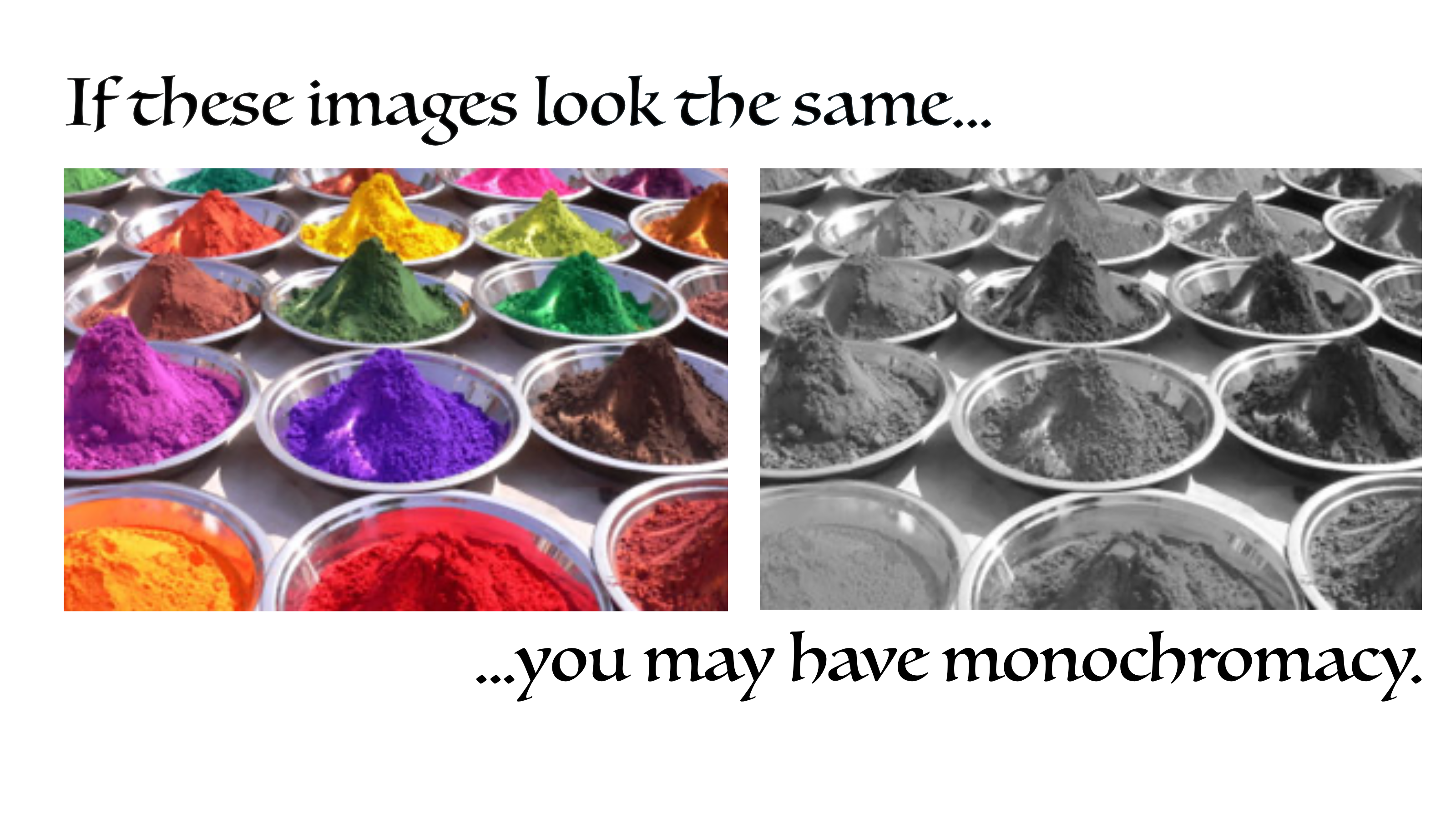
There are several varieties of color vision deficiency, with most people able to perceive some shades of certain colors. The most severe form of the problem involves a failure to see any colors. Only shades of gray distinguish between different hues. It’s called achromatopsia, and is quite rare. 

Achromatopsia is a congenital hereditary condition found in only one birth in every 33,000 to 50,000 births.  Thus less than 10,000 Americans may have achromatopsia. There are two basic forms . . . Rod Monochromatism, . . . is the most common [and] routinely occurs in both men and women. . . .

Blue Cone Monochromatism has an incidence of 1 in 50,000-100,000 births in males and could be as rare as 1 in 10 billion in females.

If you are curious about achromatopsia, you should definitely read about research on a Micronesian Island where ten percent of the people share this affliction.

Many individuals first learned of achromatopsia in 1997, when Oliver Sacks published his classic book, Island of the Color Blind.  This story beautifully chronicles Oliver Sack’s 1994 quest with Knut Nordby and Bob Wasserman to the isolated atoll of Pingelap in Micronesia, where 10% of the population have rod monochromatism. A video of the journey is available here.

Possible Visions of Heaven

Although I am quite wary of so-called near death experiences (with some being spurious, and others, spiritual deception), it is intriguing how color has entered into a number of the stories. The following examples appear in the accounts of several different individuals in Imagine Heaven: Near-Death Experiences, God’s Promises, and the Exhilarating Future that Awaits You.

The entire city was bathed in light, an opaque whiteness in which the light was intense but diffused. In that dazzling light every color imaginable seemed to exist and – what’s the right word? – played. The colors seemed to be alive, dancing in the air. I had never seen so many different colors. It was breathtaking.

Below me lay the purest, most perfect grass, precisely the right length and not a blade that was bent or even out of place. It was the most vibrant green I had ever seen. If a color can be said to be alive, the green I saw was alive, slightly transparent and emitting light and life from within each blade. The iridescent grass stretched endlessly over gently rolling hills upon which were sprinkled the most colorful wild flowers, lifting their soft-petaled beauty skyward, almost as if they were a chorus of flowers caught up in their own way of praising God.

The most gorgeous sky ever seen here on earth cannot even come close to the atmosphere in Heaven.  It is bright because of the glory of our God. . . .  The atmosphere is something you experience, not just see.  It is golden, yellow, white, and had more colors moving throughout it . . . like the Aurora Borealis lights.

The sky [and] the firmament surrounding the heavens, were a wilder and bluer yonder than you would ever believe. . . . The closest shade I can associate this otherworldly blue with is the surreal tones of the water in the Caribbean or off the coast of Hawaii at sunset. . . . That color is waiting for you and me on the other side.

The colors and lights in Heaven were simply sublime. . . . They were the deepest, richest, most gloriously lush colors I had ever seen, and some I had never seen before. Heaven is a dream-come-true for those who love all things colorful, and our home there is lit by the Father of Lights. . . . [There were] robust and bold and vigorous beams that were somehow gentle to my eyes. I simply don’t think those colors and lights exist on earth.

I saw the most dazzling colors, which was all the more surprising because I’m color-blind. I can distinguish the primary colors, but pastels all look the same to me. But suddenly I could see them, all kinds of different shades. Don’t ask me to name them because I lack the necessary experience for that.

Take a Moment to Test Your Own Color Vision

There are a number of simple, free vision tests available online. If you want to assure yourself that you can see all of the normal colors – though not necessarily all of the heavenly colors awaiting us – check out one of the following.

Color Blind Test

EnChroma Color Blind Test

X-Rite Color Challenge and Hue Test

Colorlite Collection of Tests

Final Thoughts

When I described the wonders awaiting the color blind in Heaven, I was referring to all of us. (In this life, as the Scriptures say, “For now we see in a mirror dimly . . .” (1 Corinthians 13).

All who trust in the love of Jesus Christ, and thereby enter Heaven’s environs by the unmerited grace of God’s mercy, will be overwhelmed by its beauty and wonder.

The million or more colors a person with full vision can now see, will be eclipsed by the infinite tapestry of hues in our Creator’s mind. Even those with the scientifically-presumed capability to currently perceive distinctions between up to 100 million will surely be in awe.

C.S. Lewis closes our discussion of Heaven’s colors with a fascinating thought related to the angels who worship God in that divine place. Lewis begins by noting a significant distinction between God’s angels and humanity.

But for our body one whole realm of God’s glory – all that we receive through the senses-would go unpraised. For the beasts can’t appreciate it and the angels are, I suppose, pure intelligences.

They understand colors and tastes better than our greatest scientists; but have they retinas or palates? 

I fancy the “beauties of nature” are a secret God has shared with us alone. That may be one of the reasons why we were made-and why the resurrection of the body is an important doctrine (Letters to Malcolm: Chiefly on Prayer).
C.S. Lewis & Summertime

What’s your favorite season of the year? My preference is Autumn, with Spring a close second.

In the United States, Spring comes out on top. Actually, it is the preference in forty (80%) of the states. Probably due to its northern latitude, “the most popular season in the Northeast is Summer.” Unsurprisingly, Winter is the least favorite across the board, although a few hardy souls disagree. “Alaska and Vermont are the only two states that say winter is the most wonderful time of the year.”

Some years ago, Gallup published the result of polls on the subject, which are also analyzed by the ages of respondents.

Americans aged 18 to 29 are the group least likely to prefer spring (24%), while those 65 and older are most likely to prefer it (53%). Younger Americans are much more likely to prefer summer than are those in older age groups, and, in fact, summer is the top choice among this age group. [Editor: I wonder if that has anything to do with the traditional academic calendar?]

Everyone is aware of how the seasons (through length of daylight, etc.) affect our moods. In a 1914 letter to his father in Ireland, C.S. Lewis offers a curious description of the “magnificent summer” he was enjoying in England.

My mental picture of home is disturbed to a certain extent by your mention of a fire. Here, we are in the middle of a magnificent summer: day succeeds day with the same cloudless sky and parched earth, and the nights are hot and comfortless. But on the whole, fine weather is agreeable, and has, I think, a certain effect on the spirits.

At the end of September, he wrote again about the extended summer he was experiencing. It doesn’t sound like the opinion of someone whose seasonal preference was summer. “I suppose the winter has closed in at home by this time: but we are still having quite summer weather here – which I rather resent.” Sometimes, it seems, seasons do overstay their welcome.

The following year, C.S. Lewis again lamented summer’s length. In mid-November he complained to his father.

The weather here is a perfect joke, warmer than July, bright sunshine and gentle breezes. Personally I have had quite enough summer, and should not be sorry to bid it goodbye, though Kirk persistently denounces this as a most unnatural state of mind.

A year later, in 1916, Lewis’ distaste for excessive heat is seen in an October letter to his friend Arthur Greeves. One reason for this was C.S. Lewis’ passion for hiking through the countryside.

The beastly summer is at last over here, and good old Autumn colours & smells and temperatures have come back. Thanks to this we had a most glorious walk on Saturday: it was a fine cool, windy day & we set out after lunch . . .

In a poem entitled “The Day with a White Mark,” Lewis opens with vivid imagery and the notion that mood is normally related to environment and circumstances.

All day I have been tossed and whirled in a preposterous happiness:
Was it an elf in the blood? or a bird in the brain? or even part
Of the cloudily crested, fifty-league-long, loud uplifted wave
Of a journeying angel’s transit roaring over and through my heart?
My garden’s spoiled, my holidays are cancelled, the omens harden;
The plann’d and unplann’d miseries deepen; the knots draw tight.
Reason kept telling me all day my mood was out of season.
It was, too. In the dark ahead the breakers only are white.

One website offers generalized thoughts about “what your favorite season” reveals about you. For example, it says of those who share my preference:

“Delicious autumn! My very soul is wedded to it, and if I were a bird I would fly about the earth seeking the successive autumns,” George Eliot (aka Mary Ann Evans) once wrote of her affection for the fall season.

While parts of the world tend to think of spring as the season of renewal, fall is also a very good time for a fresh start. The vibrant orange colors and cooler weather of autumn appeal to your constant desire for change. The upcoming holidays inspire many to reflect back on the year that was and make plans for the year to come.

A study in England went so far as to link birth months to the frequencies of several psychiatric conditions. If it is correct, your likelihood of suffering from recurrent depressive disorder, bipolar affective disorder and even schizophrenia varies according to your birth month.

Summer does provide a welcome time for vacations and events that would be difficult to wedge into the “busier” seasons of the year. For example, it’s not too late to register for the 2022 C.S. Lewis Summer Institute. The theme is “Surprised by Love: Cultivating Intellectual Hospitality in an Age of Uncertainty.” It is slated for 28 July – 5 August 5, 2022 in Oxford.

C.S. Lewis’ Favorite Season

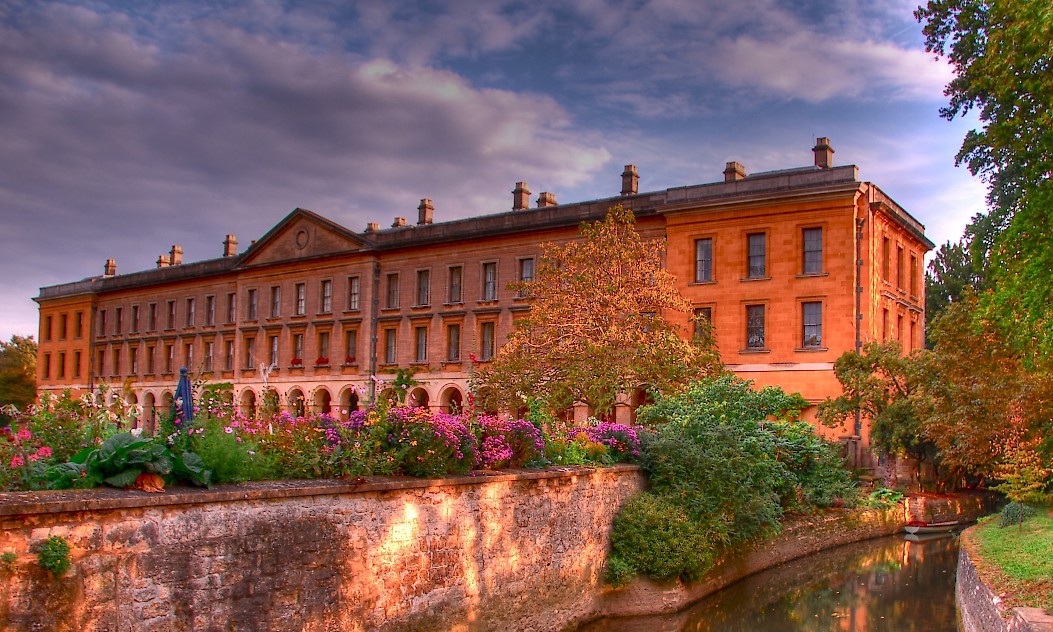
Last year, the United Kingdom’s National Trust* conducted a poll which determined summer (30%) as the favorite season for Brits. Curiously, for young adults, summer tied with the second overall favorite, autumn.

After autumn colour, Britons’ favourite things about the [autumn] season are spending time in nature – running, walking or cycling (13 per cent) and the weather – cold crisp days, Indian summer, or stormy days (12 per cent).

So what exactly was C.S. Lewis’ favorite season. At the end of his life he wrote the following. As he so often did, he used a familiar subject to make a profound comment about life.

Yes, autumn is really the best of the seasons; and I’m not sure that old age isn’t the best part of life. But of course, like autumn, it doesn’t last.

But then, isn’t it the flow of the seasons that makes each so welcome in turn? Charles Dickens offered just such an observation in a quote which offers a fitting end to our reflections today.

Nature gives to every time and season unique beauty; from morning to night, as  from the cradle to the grave, it’s just a succession of changes so soft and comfortable that we hardly notice the progress.


* The National Trust helps conserve sites of historic and natural significance in England, Wales, and Northern Ireland. Scotland has its own National Trust for Scotland, devoted to the same purposes.

Lewis’ good friend J.R.R. Tolkien also enjoyed autumn. In a post several years ago I shared a portion of a letter to his son where he says, “I have the autumn wanderlust upon me, and would fain be off with a knapsack on my back and no particular destination . . .” Sounds like something someone in Middle Earth might say – although, certainly not a hobbit!

A Lesson Taught by a Blackbird

My wife and I love birds. Perhaps we enjoy them too much.

I say that because our backyard includes four different feeders. They are different types, and appeal to a variety of species. (We also have a hummingbird feeder on the other side of the house, just outside my office window.)

Blessed as we are to live in the Puget Sound area, we see a variety of avifauna.* Nearly every day we see doves, robins, sparrows, chickadees, juncos, finches, Steller’s jays, thrushes, flickers, towhees, red-winged blackbirds and hummingbirds. Oh, and starlings too, that are the only birds our border collie chases (because of their darting taunts, I suppose).

Occasionally we have goldfinches, quail, band-tailed pigeons, woodpeckers, and various other guests I’m not quite positive about. In the sky, and on the nearby shoreline, we see many seagulls, mallards, great blue herons, Canadian geese, and—particularly during the current season—bald eagles.

As I said, we are definitely blessed to enjoy so many lovely creatures surrounding us. But this post isn’t really about birds; it concerns a particular bird who has recently joined our community. It is (I’m pretty confident) a Brewer’s blackbird.

He boasts magnificent sheen on his jet black plumage. Sadly, though, he appears to be quite unhappy.

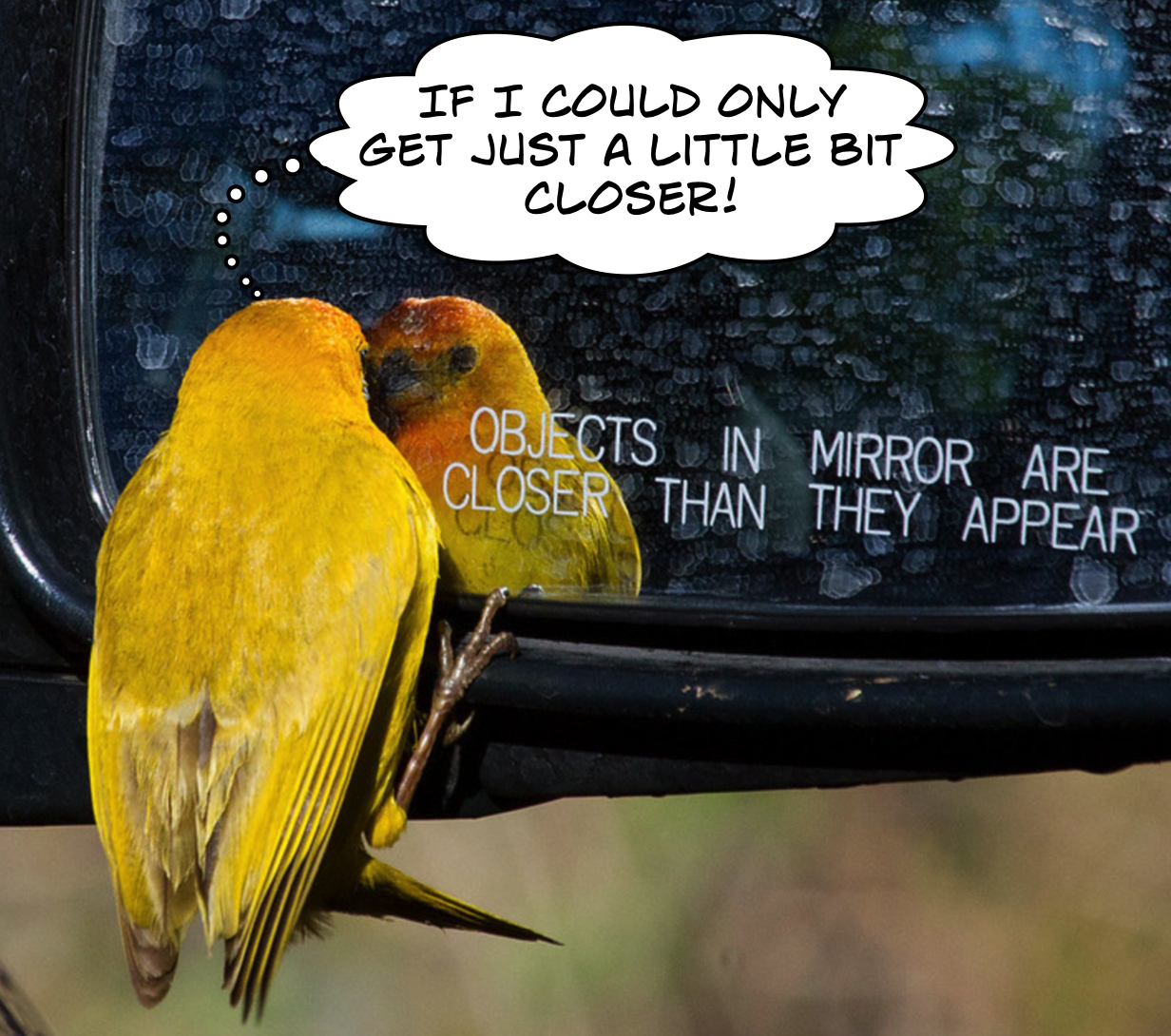
His unhappiness is due to unrequited love. A tragic condition shared by many human beings. You see, each morning he comes to a bird bath near our bedroom window where he can perch and view his own reflection on the glass.

Seeing a potential companion, he does a sort of courting dance, which the reflection presumably imitates. He bumps into the glass, often repeatedly. Despite his zealous efforts, he inevitably ends up disappointed. And yet, there he is, the next morning, delighted that his friend is willing to give him another chance.

We Are Like the Blackbird

One recent morning I awoke to his antics, and it struck my waking mind that that poor bird’s futile efforts are a metaphor of our lives.

We perceive idealized reflections of ourselves, so flawless we become enraptured. We think of ourselves as the most important thing in the world. In a sense, we begin to believe the universe revolves around us.

I remembered the Greek story of Narcissus. It is a myth offering many insights, not solely the dangers of unbridled self-love. It was because of his contempt for others that Narcissus was cursed to see in a pool a reflection of the only person he considered worthy of his attention. At first, when he fell “in love,” he did not recognize the image as being himself. The tragedy leads to his destruction.⁑

We too, I think as a I watch that small bird vainly striving to find fulfillment in an illusion, experience only disappointment and ultimate despair.

For days Narcissus knelt by the pool, hopelessly in love with the beauty of his own reflection. Before his eyes he saw the image grow pale and thin, weep tears, stretch out its arms, and look at him. Still he could not hear it, could not touch it, no matter how he implored.

While reflecting on this subject, I found a couple of articles I recommend to those desiring to ponder it further. And, next week we will consider other birds, from another perspective—their use in a Renaissance work of fiction, included by C.S. Lewis in his volume from Oxford History of English Literature.

C.S. Lewis on the Bible: Myth, Truth, Fact, and Genesis” explores C.S. Lewis’ contribution to comprehending the complexity inherent in mythology. He cites the simplistic interpretation of the story of Narcissus as a misleading reduction of the myth’s deeper message.

Understanding and Dealing with Today’s Culture of Narcissism” notes how C.S. Lewis offered a non-narcissian prescription for addressing the “hungry soul.”

Self-Centeredness Isn’t Narcissism’s Central Problem,” discusses the myth and the culture of Narcissism in which we are immersed. Author Angela Franks, a professor at St. John’s Seminary, then moves into a brilliant discussion of Till We Have Faces, which C.S. Lewis considered his finest book.

C. S. Lewis’s unjustly neglected rewriting of the myth of Cupid and Psyche, in his novel Till We Have Faces, provides a profound insight into the narcissistic spectrum. . . .

So it appears [in Lewis’ myth] that the beloved of the gods is not only the beautiful and wise Psyche, but also the tormented and ugly Orual. In the divine plan, the hideous older half-sister suffers in order to aid the beautiful maiden, but the beautiful maiden also goes through the greatest trials in order to purify Orual. The god, it appears, is willing to sacrifice his beloved in order to be united to the one who hates him. “What’s mine is yours!” Psyche and the god proclaim to Orual, but this time not in vengeance; in Lewis’s new myth, just retribution gives way to undeserved love.

To discourage our obsidian-feathered friend from squandering his brief life in pursuit of his own reflection, my wife and I just placed some decals on the window. It appears to have worked.

Would that our own echoes of Narcissus were addressed so simply.


* Don’t feel bad if this word is unfamiliar to you, don’t feel bad. I didn’t know it before I wrote this post. It means “the birds of a particular region, habitat, or geological period.”

⁑ The versions of this myth end in different ways, ranging from his divine transformation into a flower, to his despair and suicide.

The Dearest of Deer

Thank you, Lord, for allowing us to live in a home surrounded by a forest!

When I was driving home this afternoon I was stunned by the majestic flight of a dozen bald eagles as they danced in the sky above our small community of Seabeck, Washington. I pulled to the side of the road and enjoyed their ballet for some time before deciding that I would blog about eagles when I returned home.

Then I saw something even more precious. Just outside the window of my study a doe and her two (very) young fawns walked past. I grabbed my camera and snapped no fewer than fifty photos as they grazed on the nearby lawn. (I decided as they wandered on down another trail that the post on the eagles would wait.)

The fawns were so tiny I don’t think they could have been fourteen inches tall. (Sorry, we older Americans are still metric-impaired.) They stood as though they were still getting the feel of their tiny legs. It was a glorious scene.

C.S. Lewis graced the land of Narnia with a stunning array of creatures. Some are not found in this world, apart from myths. Unicorns and centaurs would be of that ilk.

I happen to find the others even more fascinating. The horses, dogs and bears that are familiar to us, but different. Different because they have been gifted with speech, and with it, the ability to know and follow their Maker.

As he wrote in his description of Narnia’s creation in The Magician’s Nephew:

And now, for the first time, the Lion [Aslan] was quite silent. He was going to and fro among the animals. And every now and then he would go up to two of them (always two at a time) and touch their noses with his. He would touch two beavers among all the beavers, two leopards among all the leopards, one stag and one deer among all the deer, and leave the rest. . . . The creatures whom he had touched came and stood in a wide circle around him. . . .

The Lion, whose eyes never blinked, stared at the animals as hard as if he was going to burn them up with his mere stare. And gradually a change came over them. The smaller ones—the rabbits, moles, and such-like—grew a good deal larger. The very big ones—you noticed it most with the elephants—grew a little smaller. Many animals sat up on their hind legs. Most put their heads on one side as if they were trying very hard to understand. The Lion opened his mouth, but no sound came from it; he was breathing out, a long, warm breath; it seemed to sway all the beasts as the wind sways a line of trees.

Far overhead from beyond the veil of blue sky which hid them the stars sang again; a pure, cold, difficult music. Then there came a swift flash like fire (but it burnt nobody) either from the sky or from the Lion itself, and every drop of blood tingled in the children’s bodies, and the deepest, wildest voice they had ever heard was saying: “Narnia, Narnia, Narnia, awake. Love. Think. Speak. Be walking trees. Be talking beasts. Be divine waters.”

The scene I was privileged to observe today reminded me of the innocence of nature, prior to humanity’s disobedience. It also reminded me of the Messianic promises that restored “nature” will enable lions to lie in harmony beside sheep.

In his book Miracles, Lewis discusses this from the perspective of redemption, as contrasted with simply understanding it as a consequence of a “new” creation.

The doctrine of a universal redemption spreading outwards from the redemption of Man, mythological as it will seem to modern minds, is in reality far more philosophical than any theory which holds that God, having once entered Nature, should leave her, and leave her substantially unchanged, or that the glorification of one creature [humanity] could be realised without the glorification of the whole system.

God never undoes anything but evil, never does good to undo it again. The union between God and Nature in the Person of Christ admits no divorce. He will not go out of Nature again and she must be glorified in all ways which this miraculous union demands. When spring comes it “leaves no corner of the land untouched;” even a pebble dropped in a pond sends circles to the margin.

I said a prayer this evening that the Lord would bless that lovely doe and her precious offspring with long, healthy, safe, peaceful, and even, happy lives.

Savoring the Weather

We awoke this morning to our first true snowfall of the year. Pretty late in winter for it to arrive, and we’ve been longing for a blanket of snow for some time. Getting a call last night about a “weather cancellation” for my wife’s classes was an added joy.

It’s utterly beautiful!

I realize, of course, there are numerous ramifications to changes in weather. The extremes (e.g. from downpours to droughts) can create hardships and hazards. But, when we have an opportunity to simply pause and savor the essence of the changing seasons, it is healing and awe-inspiring.

C.S. Lewis loved the outdoors. And, in a 1931 letter to Arthur Greeves he wrote, “That is a thing you and I have to be thankful for—the fact that we not only don’t dislike but positively enjoy almost every kind of weather.”

If you have a copy of his letters, you really should look up the December 6th correspondence. Lewis describes the wonders of several successive days of dense fog that “was enough to tax even my powers of doing without the sun . . .” He adds, “in the end I felt that it was a cheap price to pay for its beauties.”

So, today I’m doubly blessed. Not only am I enjoying the snow; I’ve learned I have one more thing in common with the great Oxford Don.