Elven Inspiration from Space

A newly captured image of a supernova remnant in our Milky Way galaxy has me curious about where J.R.R. Tolkien may have gained inspiration for the elegant style of his Elvish scripts.*

America’s NASA has gifted all of Earth’s citizens with an array of stunning, and enlightening images. Recently, the James Webb Space Telescope directed its focus to Cassiopeia A, created thousands of years ago when a star 11,000 light years away went supernova. 

It may be my imagination, or perhaps its an elevated mental talent for “core object recognition,” but for some inscrutable reason, I have recognized in the aftermath of the explosion faint echoes of Elvish script.

The light from Cassiopeia A (or Cas A, as we pseudo-astronomers refer to it) “first reached us around 340 years ago. As that was approximately 272 years before The Lord of the Rings was published, Tolkien had ample time to analyze the spectacular light source. Even factoring in the fact that the stories were composed between 1937 and 1949, the supernova’s existence had been known for a millennia and a half before LOR was written. 

I will leave it to other researchers to determine just how Tolkien was able to gain a detailed view of the explosion’s aftermath. My purpose here is to simply alert the public to the unexplainable parallel between the cosmic residue and Tolkien’s own renditions of Elvish writing as he perceived it. 

In a moment, I will allow the self-evident facts to speak for themselves.

Like his friend C.S. Lewis, Tolkien was a student of astronomy. As Professor Kristine Larsen says, “J.R.R. Tolkien based the stars and constellations of his created world of Middle-earth on ‘real world’ astronomy.” Dr. Larsen, a preeminent “Tolkienian Astronomer,” has published widely on the subject. 

Of particular interest to readers of Mere Inkling will be “Medieval Cosmology and Middle-earth: A Lewisian Walk Under Tolkienian Skies,” which can be downloaded here. In the essay, Larsen points out,

. . . as is well known in Tolkien scholarship, during and after writing The Lord of the Rings Tolkien made various attempts to more closely align his cosmology with 20th century astronomical knowledge.

Fortunately for those of us who are drawn to the mythological textures of his legendarium, Tolkien never completed this “radical transformation of the astronomical myth” (as son Christopher termed it), but it is important to understand that this tension existed within Tolkien’s mind.

Having narrowly escaped the snare of surrendering to twentieth century astronomical theories, Tolkien preserved the mythical spirit of his cosmology. Larsen’s essay considers “whether or not Tolkien’s subcreation would, in reality, pass muster as a medieval cosmology, as defined by Lewis.” Thesis established, she takes readers on a pleasing journey. “So let us take a stroll under Middle-earth skies, and observe just how well the Dome of Varda matches with Lewis’s challenge.”

Returning to Cas A

As the images below will clearly illustrate, the preservation of the medieval nature of Middle Earth’s heavens does not mean that Tolkien ignored the realities of interstellar space. As I said a moment ago, the visual proof is definitive.
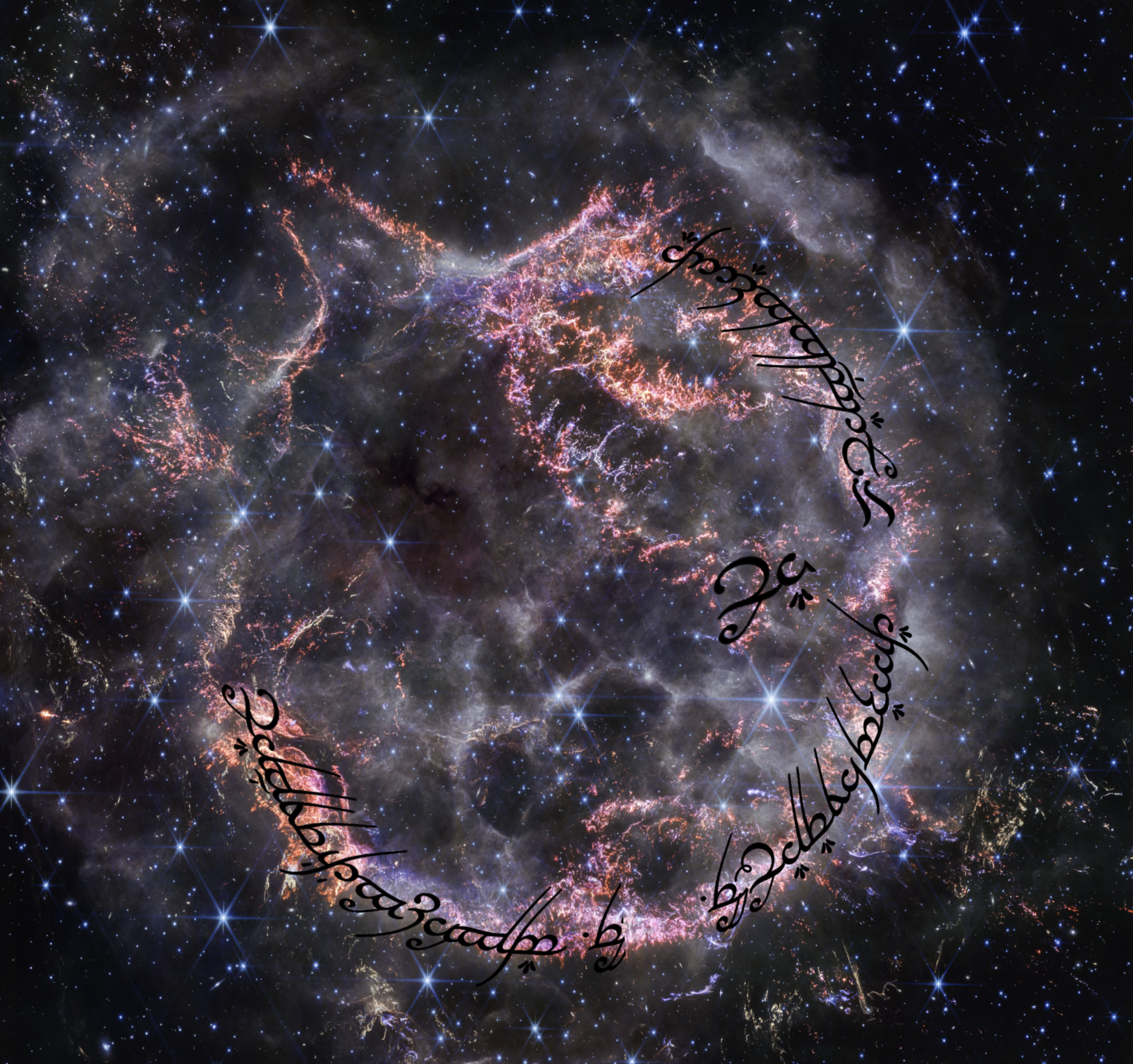
The fluid strokes of Tolkien’s Elven scripts are clearly foreshadowed in the plumes of this cosmic canvas. 
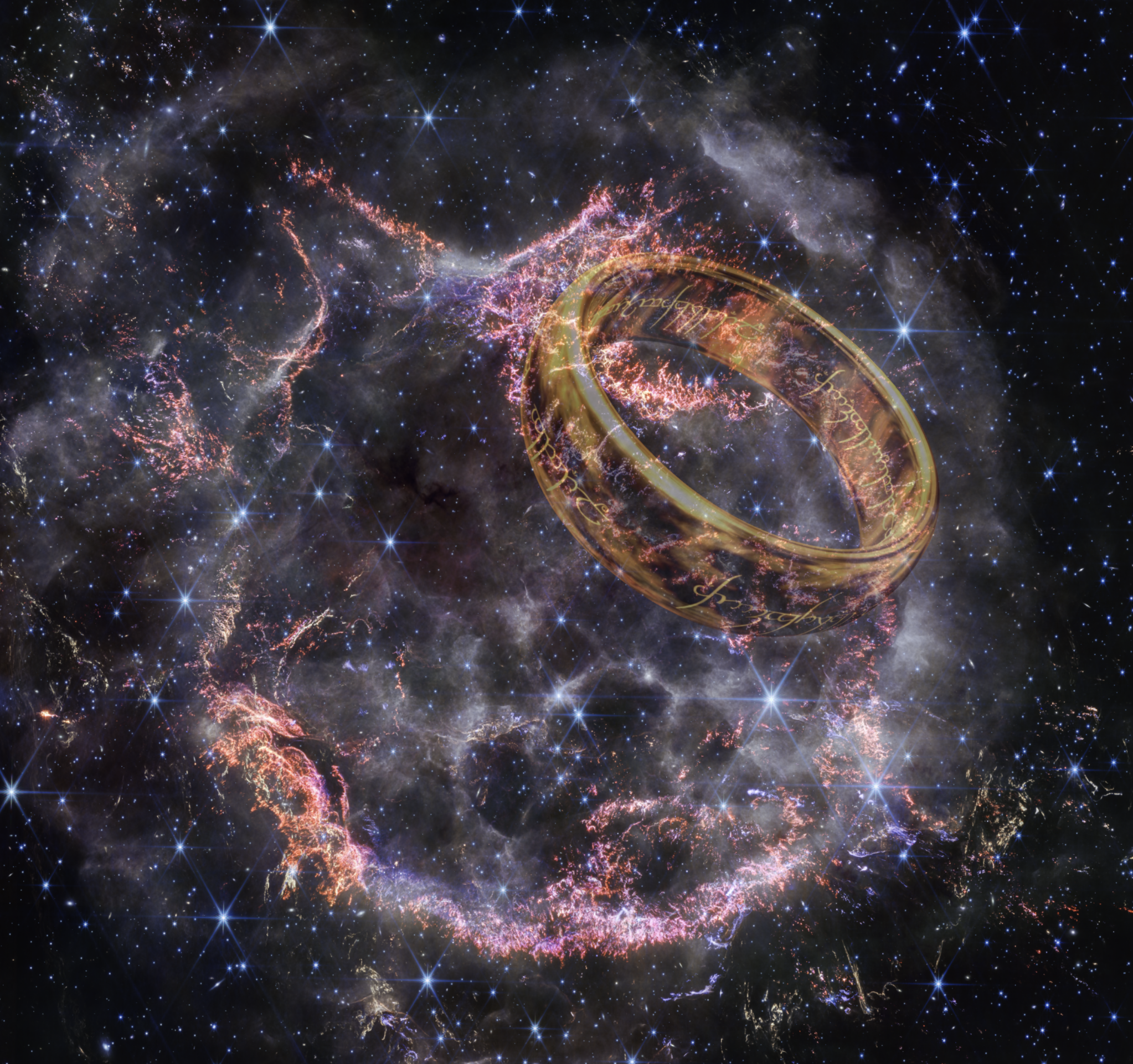
This image speaks fluently for itself.
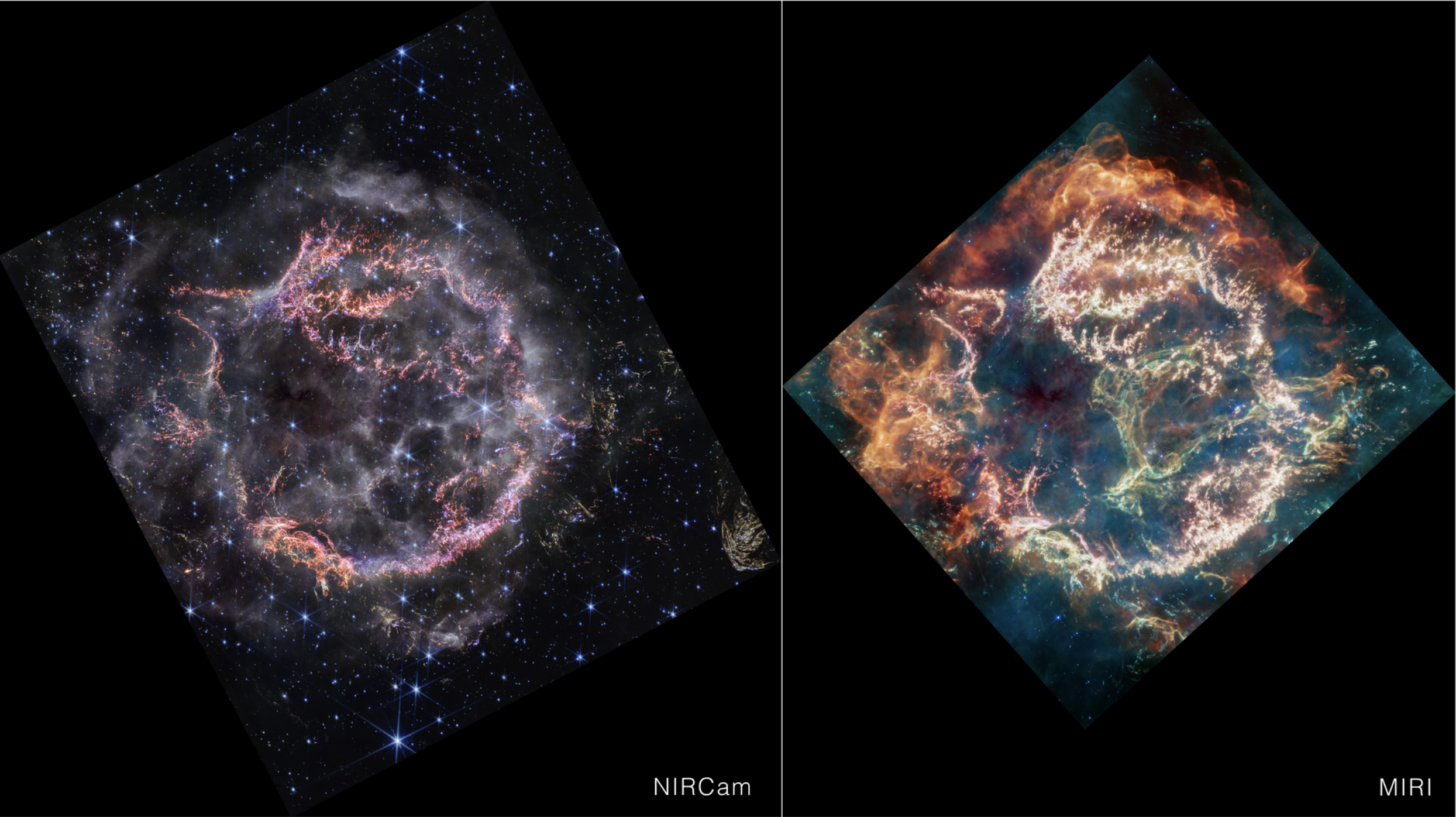
This pair of images from NASA contrasts the Near-Infrared and Mid-Infrared observations. It is quite possible the second influenced J.R.R. Tolkien’s perceptualization of Sauron’s eye. (Admit it, you see the dramatic similarities.)

We may never learn how Tolkien was able vividly see the details of Cassiopeia A with the earthbound telescopes accessible eighty years ago. Nevertheless, the evidence provided herein is irrefutable.

It seems fitting, when pondering the majesty of the stars as echoed in a masterpiece of literary subcreation, to close with an observation by Tolkien’s friend, C.S. Lewis. In an early letter to a close friend, Lewis described the wonder he experienced in reading Dante’s Paradise.

Here Lewis lyrically shares an experience of spiritual ecstasy which, this writer humbly suggests, can be shared by many, as we stand in awe of the majestic intricacy of the universe our Creator has fashioned.

[I read] Aristotle’s Ethics all morning, walk after lunch, and then Dante’s Paradiso for the rest of the day. The latter has really opened a new world to me. I don’t know whether it is really very different from the Inferno [Owen Barfield] says it’s as different as chalk from cheese – heaven from hell, would be more appropriate!) or whether I was specially receptive, but it certainly seemed to me that I had never seen at all what Dante was like before.

Unfortunately the impression is one so unlike anything else that I can hardly describe it for your benefit – a sort of mixture of intense, even crabbed, complexity in language and thought with (what seems impossible) at the very same time a feeling of spacious gliding movement, like a slow dance, or like flying. It is like the stars – endless mathematical subtility of orb, cycle, epicycle and ecliptic, unthinkable & unpicturable, & yet at the same time the freedom and liquidity of empty space and the triumphant certainty of movement.

I should describe it as feeling more important than any poetry I have ever read. . . . Its blend of complexity and beauty is very like Catholic theology – wheel within wheel, but wheels of glory, and the One radiated through the Many (The Letters of C.S. Lewis to Arthur Greeves).

Perhaps it was one of these very wheels – or rings – that Tolkien observed so many years ago in the heavens?


* For those who are interested in fonts for your computers, you can download Tolkien-inspired typefaces here.
Martian Tribute to C.S. Lewis

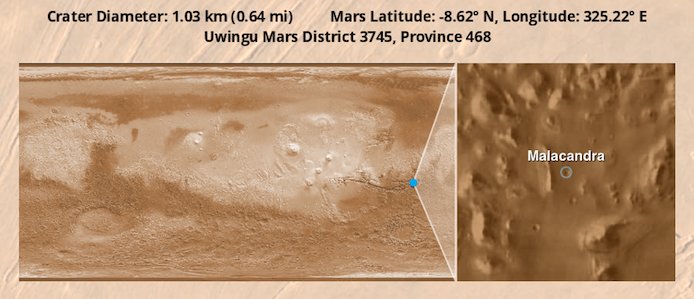
Malacandra CraterMere Inkling recently named a crater on Mars, in honor of C.S. Lewis. The crater’s name is Malacandra, which was the name for the red planet in the first volume of Lewis’ Space Trilogy, Out of the Silent Planet.

The naming of Malacandra Crater was done through an organization preparing the map which will be used by the Mars One Mission. Mars One is the optimistic international effort to establish a permanent human settlement on the red planet, beginning in 2024.

The über-adventurous (or foolhardy) are able to apply today for consideration to become an astronaut.

The crater naming project is not sponsored by the International Astronomical Union (IAU). Instead, it is coordinated by Uwingu, a for profit company that has a goal of raising $10,000,000 for grants to scientists and educators promoting space exploration.

Due to its limited* budget, Mere Inkling was only able to name a small crater. However, it’s not the expense, it’s the thought that counts.

In addition to Malacandra Crater, I named the impact mark directly to its south in honor of my grandchildren. The process allows one to include a dedication for each named crater. For theirs, I wrote:

Stroud Crater is named in honor of the brilliant grandchildren of Rob & Delores Stroud. Andrew, Ariana, Dominic, Arabelle, Rachel, Rebecca, Kaelyn & Asher. Whether they grow up to be astrophysicists, veterinarians or educators, we know they will all make this world a better place. Soli Deo Gloria.

The tiny basins named above lie in Aurorae Chaos. It’s a rugged neighborhood, but there are surprisingly few craters in the immediate vicinity. I’m always seeking opportunities to encourage my grandchildren to study science, and I hope this will pique their interests, both now and in the years to come.

C.S. Lewis is not primarily known today as a writer of science fiction, but his series (also known as the Cosmic Trilogy, or the Ransom Trilogy, after its protagonist) is quite good. In fact, it was the very first of Lewis’ works I ever read. I was introduced to them by a Christian friend during my college years.

Several influences converged to move Lewis to venture into science fiction. In 1938, he thanked a friend for his praise of Out of the Silent Planet, and wrote:

You are obviously much better informed than I about this type of literature and the only one I can add to your list is Voyage to Arcturus by David Lyndsay (Methuen) which is out of print but a good bookseller will probably get you a copy for about 5 to 6 shillings. It is entirely on the imaginative and not at all on the scientific wing.

What immediately spurred me to write was Olaf Stapledon’s Last and First Men and an essay in J. B. S. Haldane’s Possible Worlds both of which seemed to take the idea of such travel seriously and to have the desperately immoral outlook which I try to pillory in Weston.

I like the whole interplanetary idea as a mythology and simply wished to conquer for my own (Christian) point of view what has always hitherto been used by the opposite side. I think Wells’ 1st Men in the Moon the best of the sort I have read.**

Lewis then appends a comment referring to the other planets in our solar system, but intriguing in light of the recent discovery of numerous planets throughout the galaxy. “The more astronomy we know the less likely it seems that other planets are inhabited: even Mars has practically no oxygen.”

One of Lewis often overlooked science fiction short stories, “Ministering Angels,” is set on Mars. It begins in the following way.

The Monk, as they called him, settled himself on the camp chair beside his bunk and stared through the window at the harsh sand and black-blue sky of Mars. He did not mean to begin his ‘work’ for ten minutes yet. Not, of course, the work he had been brought there to do. He was the meteorologist of the party, and his work in that capacity was largely done; he had found out whatever could be found out.

There was nothing more, within the limited radius he could investigate, to be observed for at least twenty-five days. And meteorology had not been his real motive. He had chosen three years on Mars as the nearest modern equivalent to a hermitage in the desert.

He had come there to meditate: to continue the slow, perpetual rebuilding of that inner structure which, in his view, it was the main purpose of life to rebuild. And now his ten minutes’ rest was over. He began with his well-used formula. ‘Gentle and patient Master, teach me to need men less and to love thee more.’ Then to it. There was no time to waste.

There were barely six months of this lifeless, sinless, unsuffering wilderness ahead of him. Three years were short . . . but when the shout came he rose out of his chair with the practised alertness of a sailor.

The Botanist in the next cabin responded to the same shout with a curse. His eye had been at the microscope when it came. It was maddening. Constant interruption. A man might as well try to work in the middle of Piccadilly as in this infernal camp. And his work was already a race against time. Six months more . . . and he had hardly begun.

The flora of Mars, these tiny, miraculously hardy organisms, the ingenuity of their contrivances to live under all but impossible conditions—it was a feast for a lifetime. He would ignore the shout. But then came the bell. All hands to the main room.
(“Ministering Angels,” Of Other Worlds: Essays and Stories).

Malacandra Crater may be a small feature on a vast and curious planet, but it is a tribute to an author of immense and lasting talent.

_____

* i.e. nonexistent

** The following titles mentioned by Lewis are available for free digital download:

Voyage to Arcturus

Last and First Men

The First Men in the Moon

Interplanetary Life

death valley stars

How many galaxies exist out there? How many stars? How many planets? Billions upon billions, apparently.

Of all of those myriad worlds, how many boast life?

C.S. Lewis pondered that subject in an essay entitled “Religion and Rocketry.” He said that either result—an absence of life, or an abundance of living creatures throughout the cosmos—can be used by atheists to deny the existence of our Creator.

In my time I have heard two quite different arguments against my religion put forward in the name of science. When I was a youngster, people used to say that the universe was not only not friendly to life but positively hostile to it.

Life had appeared on this planet by a millionth chance, as if at one point there had been a breakdown of the elaborate defenses generally enforced against it. We should be rash to assume that such a leak had occurred more than once. Probably life was a purely terrestrial abnormality. We were alone in an infinite desert. Which just showed the absurdity of the Christian idea that there was a Creator who was interested in living creatures.

But then came Professor F.B. Hoyle, the Cambridge cosmologist, and in a fortnight or so everyone I met seemed to have decided that the universe was probably quite well provided with habitable globes and with livestock to inhabit them. Which just showed (equally well) the absurdity of Christianity with its parochial idea that Man could be important to God.

Lewis, brilliant and honest, then predicts the future. Believers and cynics alike, he says, will seek to interpret all new data in a fashion that proves their own, preexisting beliefs.

This is a warning of what we may expect if we ever do discover animal life (vegetable does not matter) on another planet. Each new discovery, even every new theory, is held at first to have the most wide-reaching theological and philosophical consequences.

It is seized by unbelievers as the basis for a new attack on Christianity; it is often, and more embarrassingly, seized by injudicious believers as the basis for a new defence.

Fascinating as these comments are, they merely represent Lewis’ introduction to the subject. The heart of his concern is this—what would it mean if we should one day encounter alien beings created by God on a distant world?

In a moment I’ll share with you one of the most provocative thoughts Lewis expresses in this essay, but first take a moment to watch this amazing reminder of the vastness of our universe and the power of its Creator.

A video presentation like this can leave us feeling rather small, lost in the abyss of an immeasurable vastness. Or, it can inspire us. It can baptize us with an increased appreciation for the majesty of the One who loved each of us so profoundly that he sent his only begotten Son into the world to redeem us from destruction. I hope your reaction is the latter.

I promised another fascinating observation from Lewis, and here it is. He poses the question of precisely what might transpire if humanity encounters another sentient race. His Christian interpretation may shock some readers, but I believe he is right.

It sets one dreaming—to interchange thoughts with beings whose thinking had an organic background wholly different from ours (other senses, other appetites), to be unenviously humbled by intellects possibly superior to our own yet able for that very reason to descend to our level, to descend lovingly ourselves if we met innocent and childlike creatures who could never be as strong or as clever as we, to exchange with the inhabitants of other worlds that especially keen and rich affection which exists between unlikes; it is a glorious dream.

But make no mistake. It is a dream. We are fallen. We know what our race does to strangers. Man destroys or enslaves every species he can. Civilized man murders, enslaves, cheats, and corrupts savage man. Even inanimate nature he turns into dust bowls and slag-heaps. There are individuals who don’t. But they are not the sort who are likely to be our pioneers in space.

Our ambassador to new worlds will be the needy and greedy adventurer or the ruthless technical expert. They will do as their kind has always done. What that will be if they meet things weaker than themselves, the black man and the red man can tell. If they meet things stronger, they will be, very properly, destroyed.

Lewis continues, addressing related themes in this amazing work that seems more prescient each year. He next compares our encounters with fallen, and unfallen races. I highly commend the essay, which appears in The World’s Last Night and Other Essays.

If you prefer a fictional consideration of these same topics, I encourage you to read C.S. Lewis’ Cosmic Trilogy (Out of the Silent Planet, Perelandra, and That Hideous Strength).

_____

Appreciation goes to a retired USAF chaplain colleague of mine, Chuck McGathy, for bringing this Hubble video to my attention.