Screwtape Letters Anniversary

I was recently reminded that February 2012 marks the seventieth anniversary of C.S. Lewis’ masterpiece, The Screwtape Letters. Other bloggers have remarked on the anniversary, for example here and here.

Lewis dedicated the book to his dear friend and fellow Inkling, J.R.R. Tolkien.

If you’re unfamiliar with the letters, you really should rectify that gap in your knowledge. The letters are penned by Screwtape, a senior Devil, to Wormword, a less experienced tempter. They illuminate Satan’s demonic tactics and provide keen insight into our fallen human nature, replete with its countless vulnerabilities.

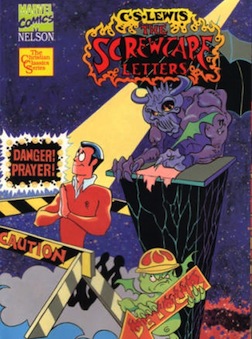
There’s even a graphic novel version of the collection which was published in 1994 by Thomas Nelson in partnership with Marvel Comics.

While the anniversary of the Letters in and of itself is certainly significant enough to merit a blog announcement . . . this post includes something quite rare. The fact is we’ve come into possession of one of Screwtape’s instructional emails, written to another subordinate demon.

For the benefit of those who would arm themselves against the snares of the Enemy, we reproduce it in full below.

(Oh, and as a reminder, when Screwtape refers to his Enemy, he is actually talking about the Creator of heaven and earth. Also, you can’t actually trust anything he writes since he’s a Liar, just like the archangel he followed so long ago. For example, note his incorrect reference to his own “immortality.”)

My Dear Esculentus,*

Another decade has passed since that puppet of the Enemy released to the world a portion of my correspondence with Wormwood. Of course, the lamentable Wormwood has had ample time to regret his carelessness in that matter, as I often remind you.

A decade’s but a snippet to immortals such as us, of course, but to the mortals it marks a significant portion of their brief lives. Why the Enemy loves those pitiable insects so much goes beyond logic!

Still, another halfscore has flown past and that damaging treatise remains in print. In fact, if anything, it continues to grow in popularity.

We simply cannot have our “patients” made aware of our treatment regimen for them. If they come to realize that our most successful deception is untrue, the relentless work of centuries will be undone.

We have labored tirelessly up to the present day to persuade humanity that all truth is subjective! Fortunately, the vast majority of the population in what are ironically labeled “enlightened nations,” has accepted our suggestion. This allows them to eagerly swallow the comforting lie that “all roads lead to god.” If they realize that all roads do indeed lead to a ‘god,’ they might abandon one of the many paths that lead to our Master who is ever-eager to “swallow” them in turn.

Better by far that those entrusted to our misleading, nourish our infernal Father than that you and I sate his appetite. (As you know, I say that figuratively, since our Father’s hunger for power can never be truly satiated. His all consuming hunger is one of his infinite qualities, which we rightly extol.)

But, back to your primary concern my appetizing friend, your patient. By all means keep him from reading The Screwtape Letters. In fact, the farther you keep him from anything written by Clive Staples Lewis, the better!

Keep him in the company of liberal companions who have embraced the myth of there being no objective truth. That way, we can prevent him from ever meeting the Enemy who proclaims himself to be—yes, disgusting isn’t it—the Way, the Truth and the Life.

Never pass up an opportunity to impress upon your patient that such a claim is politically incorrect to the utmost. Remind him he will be shunned by society if he argued there was a single truth. Indeed, make him think the very suggestion that anyone sincerely following another path might be lost, is repugnant.

Many of your fellow tempters have experienced great success in motivating the humans they treat to replace in their world views the virtue of Truth with the sentimentality of Sincerity. This you must do as well.

Persuade him that the eternal destiny of all who believe in something, is secure. Convince him that it is by their sincerity that they are saved. Oh how sweet it is when they accept this dark epiphany!

And it has never been easier to win humans over to this view than it is today. If you wish to embellish the doctrine with vague language about “God being love” and all that, so be it. Just see to it that they never open the Enemy’s book to recognize how grossly they have edited and distorted that concept!

Oh, and in closing, allow me to once again remind you of how I began this digital epistle. (We both know that it frequently takes a dozen or more reminders to make a firm impression on your dull mind.)

Do whatever it takes to ensure that your patient never reads the Letters! And, be wise to guard our own correspondence, lest you end up in the agonizing company of the afore-censured Wormwood.

Your affectionate adoptive Uncle,

Screwtape

*Esculentus translates from the Latin as either “delicious” or “succulent,” and if you have read The Screwtape Letters you know what that suggests about Screwtape’s interest in his protégé.


Pets in Heaven?

One of my favorite features in the Wittenburg Door of the 1980s was a running account of “Dogs Who Know the Lord.” Having witnessed more Christlike traits in some pets than I’ve seen in many human lives, I considered the tongue in cheek title a definite possibility.

This week we bid farewell to a gentle and loving border collie who had been part of our family for more than a decade. She lived a long and full life, and like her our previous border collie, she enjoyed her family and the outdoors (both gifts of God) right up until the end. (Both had been “rescued” by us.) Then, when Tanner and Lady were each over 15 years old, simply remained on their blankets when the day arrived that they knew they had not the strength to rise.

There are two kinds of people. Pet lovers, and those whose hearts are desensitized to their affections. The latter group has already stopped reading this post. But pet lovers, yes you, can empathize with my family’s current grief. You understand our loss because you’ve suffered the same pain. And, some of you may even pause to say a short prayer for us.

As a pastor, I’ve had numerous conversations with people about the question of whether or not we’ll see our pets in heaven. It’s a provocative subject, and the fact that such questions persist is a tribute to the significance of these animals in our lives.

Contrary to what some would allege, posing questions about this matter does not trivialize faith; it reveals how our restored relationship with our Creator affects every dimension of our existence.

We cannot know, of course, the answer to the question. That’s something that those who respond with a snide “of course not!” should take care to realize.

Over the years my own views on this have broadened, and far from seeing the deliverance (i.e. not “salvation”) of animals as something unlikely . . . I now consider it likely that we will be greeted by our beloved pets in the new creation. Here are some reasons I consider this a definite possibility:

  1. First, it is true that Jesus died to redeem (save) human beings (not animals).
  2. Animals are “innocent” sufferers of humanity’s disobedience and fall.
  3. Some animals are uniquely precious and beloved by God’s children.
  4. Their presence in heaven would enhance our joy.
  5. The same God who created them would have no difficulty re-creating or restoring them.
  6. If the lion and the lamb will lie together in harmony, why should there not be room for our much-loved pets to frolic alongside them?

And, lest you consider the words above merely the sentimental ramblings of a grieving man, I take comfort in the fact that C.S. Lewis too regarded this as a possibility. In a 1962 letter, he wrote:

. . . in The Problem of Pain I ventured the supposal—it could be nothing more—that as we are raised in Christ, so at least some animals are raised in us. Who knows, indeed, but that a great deal even of the inanimate creation is raised in the redeemed souls who have, during this life, taken its beauty into themselves? That may be the way in which the “new heaven and the new earth” are formed. Of course we can only guess and wonder. But these particular guesses arise in me, I trust, from taking seriously the resurrection of the body.

The Satisfaction of Writing

Many people who don’t write live a bit in awe of those who do. Even in this POD age, an almost mystical aura surrounds those who “successfully” write. This is especially true for those who are published, but not restricted to them.

Over the years, many friends and family members have asked why I “like to write.” Some years ago, the vague responses I once offered assumed clarity. It was, in a sense, due to a personal epiphany. I now answer such queries with the words, “it’s not that I enjoy writing itself . . . but I find the satisfaction of having written to be deeply rewarding.” (Well, that’s not a verbatim quote of how I respond, but you get the idea.)

One of my driving desires when I retired from the Air Force was to spend more time pursuing my lifelong avocation. Toward that end, I’ve devoted a serious amount of time to publishing a free online journal about the military chaplaincy. It is semi-annual, and even at that, it’s currently behind its publication schedule. (Mea culpa.)

I’m happy to share that the latest issue of the journal is now ready for free download. You can find it here. In fact, all four issues of the journal are available for download in PDF.

Curtana features new articles, editorials, poetry and reviews. In addition, since a major purpose of the journal is to gather chaplaincy history from disparate sources, we also compile biographical notes and other material.

As Curtana’s editor, I’m proud of the international scope of the journal. We’ve received contributions from Australia, Bangladesh, Canada, Great Britain, Haiti, Ireland, and even the United States. Most articles have been written by chaplains, but that’s not a requirement. Skim the contents of the issues and you’ll note the breadth and depth that characterize Curtana.

C.S. Lewis recognized the value of thoughtful literary works. Good literature might be fiction or nonfiction, but it bears the mark of genuine reflection.

Literature adds to reality, it does not simply describe it. It enriches the necessary competencies that daily life requires and provides; and in this respect, it irrigates the deserts that our lives have already become.

I hope that in some small way Curtana: Sword of Mercy helps irrigate the arid minds of modern men and women. Please share news of its existence with your acquaintances who may be interested in ministry within the armed forces.

Literary Dementia & Hope

When we’re young we look forward to growing up. However, once we reach adulthood, the “benefits” of aging begin to pay diminishing returns. Ultimately, aging becomes an unwelcome corollary to being human. When our bodies—and our minds—begin to fail us, we long for the days of our youth.

In 1942, C.S. Lewis wrote to a friend about their similar ailments.

I have had neuralgia to-day but am otherwise alright—except for rheumatism which has prevented me from sleeping on my right side for nearly a year now. (What a series of rediscoveries life is. All the things which one used to regard as simply the nonsense grown-ups talk have one by one come true—draughts, rheumatism, Christianity. The best one of all remains to be verified.)

A recent study of aging writers considered a new technique for assessing dementia, specifially Alzheimer’s. Agatha Christie, a talented and prolific author who wrote over a lengthy period of time, provided the prime candidate for the study. You can read more about it here.

They analyzed how her final two volumes (penned when she was in her eighties) compared to her earlier work, in terms of “vocabulary size and richness.” The decline was significant. They also noted an increase in repeated phrases and the use of indefinite words such as “anything.”

In a sense, this result is not surprising. It is illogical to assume our writing skills would not decline as we reach our senior years. Fewer brain cells means, after all, fewer brain cells. One potential value of this study is to provide a means for identifying illness while it is treatable. The investigation continues.

In a later letter to another of his correspondents, C.S. Lewis wrote again about aging.

We must both, I’m afraid, recognise that, as we grow older, we become like old cars—more repairs and replacements are necessary. We must just look forward to the fine new machines (latest Resurrection model) which are waiting for us, we hope, in the Divine garage!

Replacing Exonyms

Scott Stantis has illustrated once again how educational some current comic strips can be. His current story arc takes place in Guam. (Guam’s a lovely United States Territory where my family and I lived for two wonderful years in the nineties.)

The story line involves a presidential candidate who has taken refuge there and was asked his opinion about formally changing the island’s name. (There is a movement seeking to replace “Guam” with “Guahon,” the island’s name in the Chamorro language.) You can follow the entire series at Prickly City.

As the panel shows, the (rabbit) senator is unaware that “Guam” is actually an exonym. As such, there is a valid reason to consider its replacement.

Kids today are growing up knowing prominent international cities by names that still seem “foreign” to many of us adults. Beijing has been around just long enough to sound right. But it will always be remembered as Peking to some. Mumbai, as a more recent adjustment, rings alien in the ears of those who still think of the most populous city in India as Bombay.

Still, it makes sense to attempt to refer to cities and nations as the residents of those locales do. For one thing, it is a sign of respect.

And this kind of transition is not an example of thoughtless or random “verbicide” which C.S. Lewis described in “Studies in Words.” There he wrote:

Verbicide, the murder of a word, happens in many ways. Inflation is one of the commonest; those who taught us to say awfully for “very,” tremendous for “great,” sadism for “cruelty,” and unthinkable for “undesirable,” were verbicides.

Replacing exonyms is meaningful to those it directly affects. And it is little more than an inconvenience to the rest of us. So, I’m in favor of it.

Just as I’m always in favor of comic strips that educate as well as entertain!

Savoring the Weather

We awoke this morning to our first true snowfall of the year. Pretty late in winter for it to arrive, and we’ve been longing for a blanket of snow for some time. Getting a call last night about a “weather cancellation” for my wife’s classes was an added joy.

It’s utterly beautiful!

I realize, of course, there are numerous ramifications to changes in weather. The extremes (e.g. from downpours to droughts) can create hardships and hazards. But, when we have an opportunity to simply pause and savor the essence of the changing seasons, it is healing and awe-inspiring.

C.S. Lewis loved the outdoors. And, in a 1931 letter to Arthur Greeves he wrote, “That is a thing you and I have to be thankful for—the fact that we not only don’t dislike but positively enjoy almost every kind of weather.”

If you have a copy of his letters, you really should look up the December 6th correspondence. Lewis describes the wonders of several successive days of dense fog that “was enough to tax even my powers of doing without the sun . . .” He adds, “in the end I felt that it was a cheap price to pay for its beauties.”

So, today I’m doubly blessed. Not only am I enjoying the snow; I’ve learned I have one more thing in common with the great Oxford Don.

Military Helmets

War is deadly business. And, if a kingdom or nation hopes to emerge victorious, they are wise to equip their soldiers properly. That’s why this fact, included in today’s Ripley’s Believe It or Not comic, is so shocking.

It’s inconceivable that as the world marched to war in 1914, not a single one of the world powers equipped their troops with steel helmets. Elegant helms that looked superb on the parade ground . . . yes. Elaborate crests that exaggerated height to intimidate the foe . . . of course. Comfortable fabrics that kept the scorching sun off of the scalp . . . certainly.

But steel helmets that might actually spare men from bullet and shrapnel wounds . . . not those.

It’s not like the danger of ballistic wounds caught the Europeans off guard. Muskets had given way to deadly rifles long before. Artillery had advanced to the point where the Germans actually built not one, but two unique weapons: (1) Big Bertha, a huge howitzer that lobbed an eighteen hundred pound shell nearly eight miles, and (2) the Paris Gun, a siege cannon able to fire its shell eighty miles!

As soldiers like C.S. Lewis and J.R.R. Tolkien rallied to the flag and fought the Huns, they would eventually be issued more protective equipment. But it didn’t exist at the war’s outset. And even with it, Lewis was severely wounded in combat. in 1939 he wrote, “My memories of the last war haunted my dreams for years.”

The irony about metal helmets is that even ancient peoples recognized the importance of protecting the skulls of their warriors with the strongest materials available. In my office I have a replica Roman legionary helmet. Trust me, it was capable of saving lives.

Today’s combat helmets are highly advanced, and great effort is made to protect military members from head trauma. Sending them into battle with anything less than the best equipment available should be a crime.

DC’s Absurd Educational Policies

Most Americans are sadly disappointed with the deplorable state of our current federal government. (Many of us feel the same about our state governments, but that’s another matter.)

When we talk about (Washington) DC, we are almost always referring to the foibles of our national government . . .  but we often ignore the bizarre machinations of the “municipal” government which oversees the city itself.

Some of the city’s foolishness makes the federal government appear wise in comparison.

Case in point. DC public schools are in shambles. Rather than improve the schools themselves, lawmakers have come up with an innovative solution: Require all of the students to apply for higher education!

Yes, that’s what Kwame Brown and his fellow bureaucrats have proposed.

Forcing students unable to complete high school requirements to apply for college. Right. One brilliant solution to a failed educational system.

Since it’s doubtful that diverting time and energy from actual studies to this questionable exercise will solve the underlying problems, we can hope that the proposed legislation dies an swift death.

In 1868 Samuel Clemens (Mark Twain) judged Washington, D.C. with his razor-bladed pen:

This everlasting compelling of honesty, morality, justice and the law to bend the knee to policy, is the rottenest thing in a republican form of government. It is cowardly, degraded and mischievous; and in its own good time it will bring destruction upon this broad-shouldered fabric of ours. I believe the Prince of Darkness could start a branch hell in the District of Columbia (if he has not already done it), and carry it on unimpeached by the Congress of the United States, even though the Constitution were bristling with articles forbidding hells in this country. And if there were moneyed offices in it, Congress would take stock in the concern, too . . .

God, spare us from the whims of those in political authority over us!

The brilliant C.S. Lewis identified one aspect of the faulty thinking exemplified by this proposed statute. He placed on the lips of the devil Screwtape this sure way to cripple a nation.

The basic principal of the new education is to be that dunces and idlers must not be made to feel inferior to intelligent and industrious pupils. That would be “undemocratic.”

Powerful Words

Wow. Today I “enjoyed” the sensation that comes from seeing an archaic word we haven’t encountered for ages. This was a word my sainted mother used when my siblings and I were mere rugrats. No, that’s not the word. “Rugrats” remains in my unsainted father’s vocabulary to this very day. Today he uses it in reference to his great-grandchildren. Besides, it’s only been seven years since the eponymous television series aired its final episode.

The modest word which inspired this post is “rigmarole.” My child-recollection adds an extra syllable, an “a.” Ri-ga-ma-role . . . now there’s a word to evoke memories from many years ago. Ah, and a further internet search reveals my mom wasn’t mispronouncing the word, she was simply using a variant.

She used the word in its primary context. Elaborate or lengthy procedures. Actually, it is through the second meaning of the word that I encountered it this morning. It is also defined as “confused, incoherent, foolish or meaningless talk.”

It’s in this context—referring to useless jargon—that C.S. Lewis describes the crippling effect of rigamarole. He writes:

“Stone walls cannot a prison make

Half so secure as rigmarole.”

Thus concludes one of C.S. Lewis’ delightful poems, entitled “The Prudent Jailer.” When I trace the quotation back to its source I encounter a wonderful poem I had never before read. And, ironically, the poem begins with a reference to “nostalgia,” the very sensation Lewis’ word choice evoked in me.

“Always the old nostalgia? Yes

We still remember times before

We had learned to wear the prison dress

Or steel rings rubbed our ankles sore.”

The master Inkling has once again impressed upon me the immense power of words. Rightly chosen words. Well woven together, their symbiosis can be awe-inspiring.

Wielded by the anointed, words can be powerful enough to tear down the stone walls our Jailer uses to imprison us . . . dark walls designed to bar us from the radiant freedom God has created us to enjoy.

Educational Headaches

Doing a bit of research about Chinese poetry, I came across a fascinating sentiment that has been reverberated across the centuries since it was first penned by Du Fu in the eighth century.

Du Fu was a prominent poet and a dedicated civil servant who believed in making his kingdom a better place for all. He lived during a tumultuous era and survived several major revolts. (Such turmoil is often said to provide fertile fodder for the poet’s heart.)

At one point he earned the displeasure of the emperor and was demoted to a position as Commissioner of Education. He served diligently but found the duties onerous. Foremost among his complaints was the timeless curse of administrators and teachers:

I am about to scream madly in the office.

Especially when they bring more papers to pile higher on my desk.

It’s true that most of us get buried under greater mounds of paperwork as we advance in our careers . . . but it is a particular shame when teachers (people who are there in the trenches because they love kids) suffocate under stifling piles of trivial record-keeping debris.

If you’re interested in reading a couple of verses composed by Du Fu, you can find them on the internet. Or, you could wait a couple weeks for the release of Curtana 2.2 (the free journal I edit), and read them there.

The Inklings (especially C.S. Lewis and J.R.R. Tolkien) are exemplars of the tradition of dedicated patriots and poets who devoted their energies to improving our world. And, I doubt you’d need to search very hard to find in their writings an echo of this disaffection for the piles of meaningless work each of them had to wade through during their prolific lives.