It’s Tough being a Colony

During the early 1990s I was stationed at RAF Greenham Common and RAF Alconbury in the United Kingdom. Our family loved our three brief years in that inspiring land. One of the quaint things I recall was the relatively frequent question I was asked when meeting someone new. They would inquire as to “how things were going in the colonies.” It was actually a pleasant ice-breaker, and never said maliciously.

The comment offered no cause for offense. It’s been too long since the United States was a British colony for it to be more than a historical comment. The heated issues that once led to bloodshed have become historical trivia. There are, of course, many “younger” nations in our world that are still struggling to discover their post-colonial identities. This has been notoriously difficult where occidental powers established arbitrary boundaries that failed to recognize ethnic, religious or cultural considerations.

So, why is today’s post pondering the concept of colonialism? It just so happens that today is the anniversary of the imposition of the Stamp Act (tax) on her colonies by the British. It became law in 1765, a full decade before the War of Independence, but it was one of the alienating actions that laid the foundation for the upcoming rebellion.

Apparently, our paternalistic government in Europe regarded North America as a sort of bank from which they could make continuous withdrawals without ever repaying the funds. (“No taxation without representation” was a common battle cry.) The Stamp Act directly taxed all commercially published colonial materials, including newspapers and pamphlets. The Stamp Act would have been burdensome enough by itself, but the colonies were still reeling from three other onerous taxes that had recently been levied:

Sugar Act (1764)

…which covered textiles, wines, and coffee, in addition to sugar.

Currency Act (1764)

…which undermined colonial mercantilism and freedom.

Quartering Act (1765)

…which transformed every American home into a free bed & breakfast for British soldiers.

You get the idea. Georgia, Pennsylvania, Maryland and their like were merely colonies, so why should their concerns be factored into the equation? Extremely shortsighted. Not to mention, quite selfish.

C.S. Lewis addressed this subject in his major historical work.

The best European minds were ashamed of Europe’s exploits in America. Montaigne passionately asks why so noble a discovery could not have fallen to the Ancients who might have spread civility where we have spread only corruption. (English Literature in the Sixteenth Century).

We recognize that Montaigne’s notion is just a tad idealistic. If the Romans had colonized the Americas, for example, the indigenous people would hardly have been treated any differently. And the introduction of gladiatorial arenas would have presented an arguable civic improvement.

Still, Lewis’ point is completely valid. Whenever humans conquer or “colonize” their fellows, the colonies always get the proverbial “short end of the stick.” Thus, we recognize that it’s tough being a colony.

So, where does that leave us? Historically informed, perhaps we can make better decisions in the future. Weaker nations and peoples should never be exploited. It’s not just a matter of justice. Ethics aside, history teaches that sowing seeds of alienation and discontent invariably reap an unwelcome harvest.

One word of hope that we see in this historical snippet is that despite a combative history, lands (and people) can lay aside their animosity and become sincere allies. Which brings me back to the place where I began this column . . . living in an era when these nations that fought not one, but two wars, are steadfast friends.
The Ides of March

I was introduced to ancient Rome as a young reader. Rosemary Sutcliff (1920-1992) wrote such fine historical fiction that it appeals to young readers and adults alike. A film version of The Eagle of the Ninth was made just last year. And I’m a sucker for a good Roman movie (wherein “good” excludes all of the so-called spaghetti gladiator films made in the fifties and sixties).

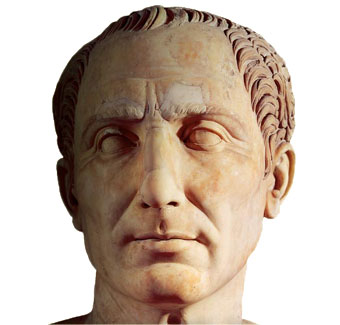
As a student of Rome, I find it worth noting today’s date. Even those who know “nothing” about Rome should understand its significance. You don’t need to have studied Latin or the classics to understand the warning “Beware the Ides of March.” The Ides is the fifteenth day of the month. And it was on this day that Julius Caesar was murdered by members of the Roman Senate.

It was left to his adopted son, Caesar Augustus, to transform the Republic into an autocratic Empire. It was this Caesar who ruled Rome at the time of Jesus’ birth, and he bequeathed the title of “Caesar” to his heirs. When Jesus requested that the Pharisees and Herodians “show him the coin for the tax,” we do not know whether Augustus or Caesar Tiberius adorned it. It matters not, since the image of Caesar was tantamount to representing Rome itself.

Jesus taught his disciples to be discerning in the loyalties we offer. We are to be responsible citizens. But we are also required to remember our true citizenship rests in the New Jerusalem.

C.S. Lewis astutely illustrated this truth. He lived during two global conflicts, and served in combat defending his homeland. Yet Lewis recognized the dangers of placing our trust (faith) in even the “noble” things of this world.

A man may have to die for our country: but no man must, in any exclusive sense, live for his country. He who surrenders himself without reservation to the temporal claims of a nation, or a party, or a class is rendering to Caesar that which, of all things, most emphatically belongs to God: himself. (“Learning in War-Time” – a sermon preached in Oxford in 1939).

So, on this day when Julius’ dreams of glory bled out in Rome . . . may you and I find refuge, hope, peace and meaning in the One who bled and died for each of us on Calvary.

Beware Your Personal Dragon

Readers of C.S. Lewis possess differing opinions on the film adaptations of the Chronicles of Narnia. One element from the latest film that is presented quite faithfully, is Eustace’s transformation into a dragon.

“He had turned into a dragon while he was asleep. Sleeping on a dragon’s hoard with greedy, dragonish thoughts in his heart, he had become a dragon himself.” (Voyage of the Dawn Treader).

With his brilliant insight and typical mirth, Lewis reveals for us a powerful dynamic of human existence. Two, in fact.

First, what we are inside—our genuine essence or spirit—will ultimately be revealed. This is true for most of us during this life. And, it will be experienced by all humanity as we stand before our Creator.

Second, what we desire—the longings upon which we focus our hearts and energies—shape that very essence. In a sense, Lewis is saying, we become what we covet!

What a wonderful lesson for us. It resounds with echoes of the Scriptures.

The title of this column suggests that we beware of the dragons to which we are particularly vulnerable. They vary from person to person, of course. And, they frequently shift, dependent on our biological age circumstances.

Martin Luther alludes to this in his broader comments about temptation and spiritual maturity:

To feel temptation is therefore a far different thing from consenting or yielding to it. We must all feel it, although not all in the same manner, but some in a greater degree and more severely than others; as, the young suffer especially from the flesh, afterwards, they that attain to middle life and old age, from the world, but others who are occupied with spiritual matters, that is, strong Christians, from the devil. But such feeling, as long as it is against our will and we would rather be rid of it, can harm no one. For if we did not feel it, it could not be called a temptation. But to consent thereto is when we give it the reins and do not resist or pray against it. (Luther’s Large Catechism).

Lewis reveals vividly what becomes of us when we surrender to our dragons. It’s not a pretty sight. And, sometimes it’s terminal. It would have been so, in Eustace’s own case, had not Aslan come to him with his healing grace

And so it is with us. No matter how dragonish you and I have grown, we can be healed of the affliction by the same Aslan, who is known in our world by a different name . . . Yeshua (Jesus).

Exercising Your Creativity

If you work in an “institutional” or office setting, you may be acquainted with the ubiquitous motivational posters that adorn offices from sea to shining sea. (I can’t speak for other countries, but here in the United States, these encouraging slogans can be found in government and private businesses across the land.)

They are so common, in fact, that they have been parodied by a company that offers “The Demotivator’s Collection.” They sell entertaining posters such as:

1. [Image of a sinking ship]

MISTAKES

It could be that the purpose of your life is only to serve as a warning to others.

2. [Image of a salmon leaping up a raging river directly into the mouth of a waiting bear]

AMBITION

The journey of a thousand miles sometimes ends very, very badly.

3. [Image of a fast food carton of french fries]

POTENTIAL

Not everyone gets to be an astronaut when they grow up.

Humor is powerful. I image that many of these demotivational posters adorn the walls of companies that recognize this fact. (You know, the ones with young, dynamic, iconoclastic leaders.)

Here’s one I might even have tempted to hang up in a couple offices where I used to work:

4. [Image of five hands linked together.]

COMMITTEES

Just like teamwork. Only without the work.

I agree with C.S. Lewis about the vital role humor plays in the lives of healthy people. As he wrote in Reflections on the Psalms: “A little comic relief in a discussion does no harm, however serious the topic may be. (In my own experience the funniest things have occurred in the gravest and most sincere conversations.)”

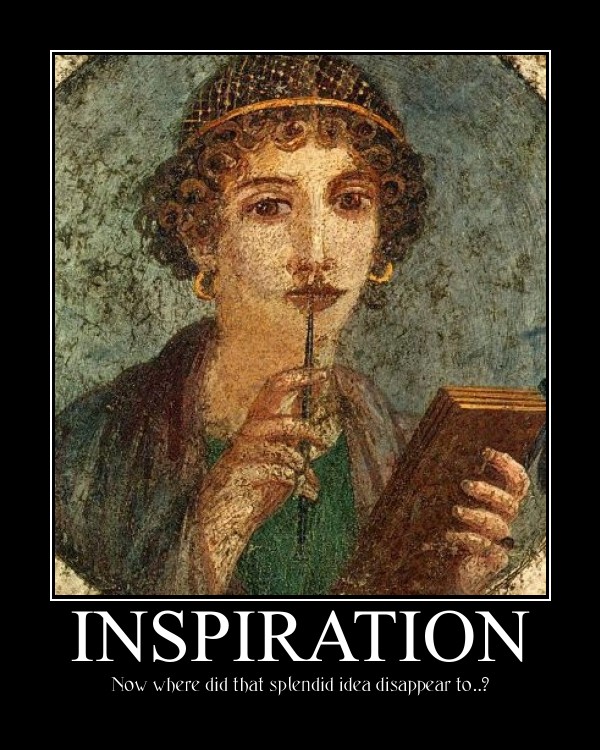
If you feel inspired by the concept of creating thoughtful—or witty—phrases to elaborate on a specific word or brief phrase, you can manufacture these graphics online yourself. Using this free application, you can craft your own (de)motivational posters—just as I did the one displayed above. Yes, that’s my handiwork.

The images you make are yours to download for free. The company needs to turn a profit though, so they offer high quality digital files or posters, for a price. (The free versions are only suitable for smaller applications, like blogs or other websites.)

How’s that for a great way to express your creativity? And it only requires a couple of minutes!

Oh, and if you’re wondering whether my poster about INSPIRATION is a motivator or a demotivator . . . well, I guess that’s in the eye of the beholder.

The Church Militant (Or Not)

I was surfing wordpress sites the other day and came across one that linked to a fascinating collection of distinctive church buildings. I’ll include the link at the end of this column (so you don’t get too distracted, and fail to finish reading my impressions).

Many of the edifices are intriguing. Most are unique. A handful are truly inspiring.

One of the “unique” designs is found in the architecture of Saint Joseph Ukrainian Catholic Church in Chicago. For some viewers, the structure suggests minarets. Others see it as a contemporary version of Moscow’s Cathedral of Saint Basil. For me, it evokes a rather more martial memory.

In the early 1990s I was stationed at RAF Greenham Common where we were part of the nuclear deterrence mission. We supported the GLCM (ground launched cruise). We actually accomplished our national goal, in persuading the Soviet Union to mutually disarm through the Intermediate-Range Nuclear Forces Treaty. That was a significant accomplishment.

As part of the process, NATO and the Soviets dispatched Verification Teams to ensure that each was following through with the reduction and ultimate elimination of the missiles. After all of ours had been removed, I was privileged to serve as a Soviet Escort Officer during one such visit. It was interesting to watch how the highlight for the Soviets was their visit to our base exchange. (They were shocked by the diverse offerings of everyday capitalism and suspected that we depleted other stores to stock this one in a manner that would impress them.)

While they were visiting, they conducted pro forma inspections of all the locations where a missile could be hidden, including under regular manhole covers, as I recall.

Perhaps by now you understand why the Saint Joseph building reminds me of that tour of duty?

I am probably the only person whose first thought upon viewing this building is: what an amazing disguise for missile silos! Of course, one factor for my reaction is the clearly Russian/Ukrainian shape of the entire structure. A peculiar response to the picture, right? And yet . . . without inspecting the tubes, who can say with certainty whether or not my first reaction may have been accurate?

Here’s the link to the 50 Most Extraordinary Churches.

Happy Leap Day Birthday!

When our daughter-in-law was given a due date for her third child around the end of February, she decided to have her daughter on February 29, Leap Day. This was not a “scheduled” delivery with an inducement of labor. Katie simply chose to give birth to her baby on that day. And, she did.

After we sang “Happy Birthday” to that precious angel today, she immediately volunteered “I’m four!” It’s so nice that she’s not confused by the fact her actual birthday has only appeared on the calendar twice during her brief life.

Age is an interesting subject. We understand its relative applications (e.g. being old enough to begin formal schooling or drive an automobile), but what is its ultimate significance?

In his novel That Hideous Strength, C.S. Lewis says “Youth and age touch only the surface of our lives.” Quite an insight.

Like this body of ours, which we inhabit only for a limited time, in the scope of eternity our age means less than we typically think. Jesus, for example, encouraged his adult followers to receive God’s message with the simple faith “of a child.” I’ve learned firsthand that what passes for “maturity” is sometimes merely a calcification of our hearts and minds.

Our relationship with our Creator is intended to be a dynamic, living, growing thing. And, I suspect that when we’ve been in the Lord’s presence for a thousand eons it will still pulse with the vigor of youth and newness.

As Lewis wrote in The Silver Chair, “People have no particular ages in Aslan’s country.” Ages are something meant for here, for this transitory world.

Thus it’s fitting that we celebrate such transitions for those who mark birthday milestones of four, forty or fourscore. May God bless each and every child until we enter that Place where we no longer care to keep track of such concerns.

Human Transformation

Some of us aren’t really happy with the person we are. We’d like to be better than the man or woman who squanders their life in the pursuit of the trivial . . . while we neglect what is truly important.

Fortunately, when we look to God as he has revealed himself in his only, begotten Son, we are transformed. As we place our trust—our faith—in Jesus the Messiah, what was dying is reborn. Instead of aligning our eternal fate with a decaying world, we are embraced by the Giver of eternal life.

By the grace of God, through the work of his Holy Spirit, we are transformed. This is a lifelong process that doesn’t experience its culmination until we stand in the presence of our Lord. In the meantime, however, we are engaged in the process of “sanctification,” becoming holy (like our God is holy!).

Not only is this a lifelong process, it’s a daily, ongoing progression. C.S. Lewis provides an excellent illustration of the daily aspect of our spiritual growth:

The real problem of the Christian life comes where people do not usually look for it. It comes the very moment you wake up each morning. All your wishes and hopes for the day rush at you like wild animals. And the first job each morning consists simply in shoving them all back; in listening to that other voice, taking that other point of view, letting that other larger, stronger, quieter life come flowing in. And so on, all day. Standing back from all your natural fussings and frettings; coming in out of the wind. We can only do it for moments at first. But from those moments the new sort of life will be spreading through our system: because now we are letting Him work at the right part of us. It is the difference between paint, which is merely laid on the surface, and a dye or stain which soaks right through. (C.S. Lewis, Mere Christianity).

What a wonderful adventure we are on!

May the grace, mercy, peace and glory of God seep deep into your heart, mind and spirit.

Jesus & Gandalf

Today Christians celebrated our Lord’s Transfiguration. (If you attend a church that doesn’t follow the historic “Church Year,” ask your pastor about it. It can be a healthy and educational spiritual discipline.)

The Transfiguration took place on a mountaintop where God the Father brought Moses and Elijah to speak with Jesus. During this encounter, Jesus and his garments shined with a pure, clear light that dazzled the eyes.

It was quite likely the Transfiguration that inspired J.R.R. Tolkien to include one powerful image in his Lord of the Rings tale. (The Lord of the Rings is often referred to as a trilogy, although it is actually a single intricate novel which consists of six “books” plus appendices.)

In the Middle Earth myth, the heroic Gandalf dies in battle with a champion of evil . . . only to be resurrected with even greater power and focus. In this point, the two events differ, since Jesus’ nature never changed. He was incarnate and born as both God and human being. The Transfiguration merely revealed momentarily a portion of his divine identity which was masked, in a sense, by his human flesh.

The aspect in which the accounts are similar comes in the appearance of the glorified Savior and the resurrected Wizard . . . they exude a holy radiance so powerful it even affects their garb.

Thus, Tolkien’s beloved Gandalf the Grey is transformed into the triumphant Gandalf the White.

The Transfiguration of Jesus was one small piece of evidence that he was who he claimed to be. It wasn’t given to the disciples to persuade them of his divinity; in fact, those who witnessed it were enjoined not to share the miracle with others until much later.

Ultimately, what one believes about Jesus does not come down to adding up his miracles and weighing them against the claims of other faiths. Jesus claimed to be the Son of God, the promised Messiah, and humanity’s Savior. If he wasn’t exactly that, he should be condemned and his memory forgotten. As the brilliant C.S. Lewis wrote:

Christians believe that Jesus Christ is the Son of God because He said so. The other evidence about Him has convinced them that He was neither a lunatic nor a quack. (C.S. Lewis, “The Language of Religion”)

Those familiar with Lewis’ writings may recognize how this quotation echoes others where he discusses his divine trilemma.

The world is full of hypocrites who want to force Jesus into their warped pantheons as a “prophet” or “teacher.” Jesus doesn’t allow himself to be embraced as anything other than who he is—God’s Son. Since he made that claim so clearly, he is either precisely that, or he is a liar. Or, it’s possible as Lewis points out, that he may have been insane. In which case he also falls short of being someone who should be followed.

For those who do not presently know Christ, simply pray in humility that God would open your eyes in a personal epiphany. God desires that no one would remain separated from him. And then, one day we can all look forward to seeing our Lord in the fullness of his glory.

Christian Marriage

Not all people should marry. But those who are led to marry—if they establish their marriage on the cornerstone of Christ—are in for a most glorious adventure. Yet, even with faith, marriages still require effort (i.e. proper choices) to bloom.

Sadly, it is possible for a marriage to end, even when one of the members is unreservedly devoted to “making it work.” Still, when wife and husband focus their eyes heavenward . . . when they recognize their marriage is, in a sense, a figure of the Trinity, including God as well as themselves . . . it can weather any storm the world throws at it. That’s one consequence of possessing that earnest love which “covers a multitude of sins” (I Peter 4:8).

And, never doubt it, the world and the lord of this world, love few things more than destroying a marriage. All of that holy promise, crushed. The joy and peace that come from living in lifelong intimacy, devastated. The miracle of two becoming one, forfeited.

One of the things that often surprises young Christian converts as they enter the Church, is the longevity of the marriages there. In some congregations, the thirty-five years my wife and I have been married still qualify us as “newlyweds.”

In light of these thoughts on this Valentine’s Day, the following quotation from C.S. Lewis is extremely apropos.

The Christian idea of marriage is based on Christ’s words that a man and wife are to be regarded as a single organism . . . The male and female were made to be combined together in pairs, not simply on the sexual level, but totally combined. The monstrosity of sexual intercourse outside marriage is that those who indulge in it are trying to isolate one kind of union (the sexual) from all the other kinds of union which were intended to go along with it and make up the total union. The Christian attitude does not mean that there is anything wrong about sexual pleasure, any more than about the pleasure of eating. It means that you must not isolate that pleasure and try to get it by itself, any more than you ought to try to get the pleasures of taste without swallowing and digesting, by chewing things and spitting them out.

As a consequence, Christianity teaches that marriage is for life.