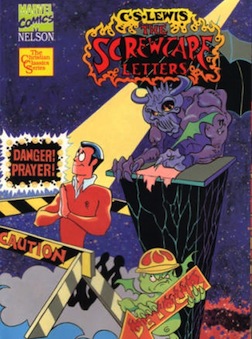
Screwtape Letters Anniversary

I was recently reminded that February 2012 marks the seventieth anniversary of C.S. Lewis’ masterpiece, The Screwtape Letters. Other bloggers have remarked on the anniversary, for example here and here.

Lewis dedicated the book to his dear friend and fellow Inkling, J.R.R. Tolkien.

If you’re unfamiliar with the letters, you really should rectify that gap in your knowledge. The letters are penned by Screwtape, a senior Devil, to Wormword, a less experienced tempter. They illuminate Satan’s demonic tactics and provide keen insight into our fallen human nature, replete with its countless vulnerabilities.

There’s even a graphic novel version of the collection which was published in 1994 by Thomas Nelson in partnership with Marvel Comics.

While the anniversary of the Letters in and of itself is certainly significant enough to merit a blog announcement . . . this post includes something quite rare. The fact is we’ve come into possession of one of Screwtape’s instructional emails, written to another subordinate demon.

For the benefit of those who would arm themselves against the snares of the Enemy, we reproduce it in full below.

(Oh, and as a reminder, when Screwtape refers to his Enemy, he is actually talking about the Creator of heaven and earth. Also, you can’t actually trust anything he writes since he’s a Liar, just like the archangel he followed so long ago. For example, note his incorrect reference to his own “immortality.”)

My Dear Esculentus,*

Another decade has passed since that puppet of the Enemy released to the world a portion of my correspondence with Wormwood. Of course, the lamentable Wormwood has had ample time to regret his carelessness in that matter, as I often remind you.

A decade’s but a snippet to immortals such as us, of course, but to the mortals it marks a significant portion of their brief lives. Why the Enemy loves those pitiable insects so much goes beyond logic!

Still, another halfscore has flown past and that damaging treatise remains in print. In fact, if anything, it continues to grow in popularity.

We simply cannot have our “patients” made aware of our treatment regimen for them. If they come to realize that our most successful deception is untrue, the relentless work of centuries will be undone.

We have labored tirelessly up to the present day to persuade humanity that all truth is subjective! Fortunately, the vast majority of the population in what are ironically labeled “enlightened nations,” has accepted our suggestion. This allows them to eagerly swallow the comforting lie that “all roads lead to god.” If they realize that all roads do indeed lead to a ‘god,’ they might abandon one of the many paths that lead to our Master who is ever-eager to “swallow” them in turn.

Better by far that those entrusted to our misleading, nourish our infernal Father than that you and I sate his appetite. (As you know, I say that figuratively, since our Father’s hunger for power can never be truly satiated. His all consuming hunger is one of his infinite qualities, which we rightly extol.)

But, back to your primary concern my appetizing friend, your patient. By all means keep him from reading The Screwtape Letters. In fact, the farther you keep him from anything written by Clive Staples Lewis, the better!

Keep him in the company of liberal companions who have embraced the myth of there being no objective truth. That way, we can prevent him from ever meeting the Enemy who proclaims himself to be—yes, disgusting isn’t it—the Way, the Truth and the Life.

Never pass up an opportunity to impress upon your patient that such a claim is politically incorrect to the utmost. Remind him he will be shunned by society if he argued there was a single truth. Indeed, make him think the very suggestion that anyone sincerely following another path might be lost, is repugnant.

Many of your fellow tempters have experienced great success in motivating the humans they treat to replace in their world views the virtue of Truth with the sentimentality of Sincerity. This you must do as well.

Persuade him that the eternal destiny of all who believe in something, is secure. Convince him that it is by their sincerity that they are saved. Oh how sweet it is when they accept this dark epiphany!

And it has never been easier to win humans over to this view than it is today. If you wish to embellish the doctrine with vague language about “God being love” and all that, so be it. Just see to it that they never open the Enemy’s book to recognize how grossly they have edited and distorted that concept!

Oh, and in closing, allow me to once again remind you of how I began this digital epistle. (We both know that it frequently takes a dozen or more reminders to make a firm impression on your dull mind.)

Do whatever it takes to ensure that your patient never reads the Letters! And, be wise to guard our own correspondence, lest you end up in the agonizing company of the afore-censured Wormwood.

Your affectionate adoptive Uncle,

Screwtape

*Esculentus translates from the Latin as either “delicious” or “succulent,” and if you have read The Screwtape Letters you know what that suggests about Screwtape’s interest in his protégé.

The Satisfaction of Writing

Many people who don’t write live a bit in awe of those who do. Even in this POD age, an almost mystical aura surrounds those who “successfully” write. This is especially true for those who are published, but not restricted to them.

Over the years, many friends and family members have asked why I “like to write.” Some years ago, the vague responses I once offered assumed clarity. It was, in a sense, due to a personal epiphany. I now answer such queries with the words, “it’s not that I enjoy writing itself . . . but I find the satisfaction of having written to be deeply rewarding.” (Well, that’s not a verbatim quote of how I respond, but you get the idea.)

One of my driving desires when I retired from the Air Force was to spend more time pursuing my lifelong avocation. Toward that end, I’ve devoted a serious amount of time to publishing a free online journal about the military chaplaincy. It is semi-annual, and even at that, it’s currently behind its publication schedule. (Mea culpa.)

I’m happy to share that the latest issue of the journal is now ready for free download. You can find it here. In fact, all four issues of the journal are available for download in PDF.

Curtana features new articles, editorials, poetry and reviews. In addition, since a major purpose of the journal is to gather chaplaincy history from disparate sources, we also compile biographical notes and other material.

As Curtana’s editor, I’m proud of the international scope of the journal. We’ve received contributions from Australia, Bangladesh, Canada, Great Britain, Haiti, Ireland, and even the United States. Most articles have been written by chaplains, but that’s not a requirement. Skim the contents of the issues and you’ll note the breadth and depth that characterize Curtana.

C.S. Lewis recognized the value of thoughtful literary works. Good literature might be fiction or nonfiction, but it bears the mark of genuine reflection.

Literature adds to reality, it does not simply describe it. It enriches the necessary competencies that daily life requires and provides; and in this respect, it irrigates the deserts that our lives have already become.

I hope that in some small way Curtana: Sword of Mercy helps irrigate the arid minds of modern men and women. Please share news of its existence with your acquaintances who may be interested in ministry within the armed forces.

Literary Dementia & Hope

When we’re young we look forward to growing up. However, once we reach adulthood, the “benefits” of aging begin to pay diminishing returns. Ultimately, aging becomes an unwelcome corollary to being human. When our bodies—and our minds—begin to fail us, we long for the days of our youth.

In 1942, C.S. Lewis wrote to a friend about their similar ailments.

I have had neuralgia to-day but am otherwise alright—except for rheumatism which has prevented me from sleeping on my right side for nearly a year now. (What a series of rediscoveries life is. All the things which one used to regard as simply the nonsense grown-ups talk have one by one come true—draughts, rheumatism, Christianity. The best one of all remains to be verified.)

A recent study of aging writers considered a new technique for assessing dementia, specifially Alzheimer’s. Agatha Christie, a talented and prolific author who wrote over a lengthy period of time, provided the prime candidate for the study. You can read more about it here.

They analyzed how her final two volumes (penned when she was in her eighties) compared to her earlier work, in terms of “vocabulary size and richness.” The decline was significant. They also noted an increase in repeated phrases and the use of indefinite words such as “anything.”

In a sense, this result is not surprising. It is illogical to assume our writing skills would not decline as we reach our senior years. Fewer brain cells means, after all, fewer brain cells. One potential value of this study is to provide a means for identifying illness while it is treatable. The investigation continues.

In a later letter to another of his correspondents, C.S. Lewis wrote again about aging.

We must both, I’m afraid, recognise that, as we grow older, we become like old cars—more repairs and replacements are necessary. We must just look forward to the fine new machines (latest Resurrection model) which are waiting for us, we hope, in the Divine garage!

Replacing Exonyms

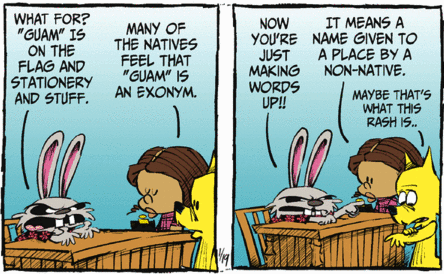
Scott Stantis has illustrated once again how educational some current comic strips can be. His current story arc takes place in Guam. (Guam’s a lovely United States Territory where my family and I lived for two wonderful years in the nineties.)

The story line involves a presidential candidate who has taken refuge there and was asked his opinion about formally changing the island’s name. (There is a movement seeking to replace “Guam” with “Guahon,” the island’s name in the Chamorro language.) You can follow the entire series at Prickly City.

As the panel shows, the (rabbit) senator is unaware that “Guam” is actually an exonym. As such, there is a valid reason to consider its replacement.

Kids today are growing up knowing prominent international cities by names that still seem “foreign” to many of us adults. Beijing has been around just long enough to sound right. But it will always be remembered as Peking to some. Mumbai, as a more recent adjustment, rings alien in the ears of those who still think of the most populous city in India as Bombay.

Still, it makes sense to attempt to refer to cities and nations as the residents of those locales do. For one thing, it is a sign of respect.

And this kind of transition is not an example of thoughtless or random “verbicide” which C.S. Lewis described in “Studies in Words.” There he wrote:

Verbicide, the murder of a word, happens in many ways. Inflation is one of the commonest; those who taught us to say awfully for “very,” tremendous for “great,” sadism for “cruelty,” and unthinkable for “undesirable,” were verbicides.

Replacing exonyms is meaningful to those it directly affects. And it is little more than an inconvenience to the rest of us. So, I’m in favor of it.

Just as I’m always in favor of comic strips that educate as well as entertain!

Powerful Words

Wow. Today I “enjoyed” the sensation that comes from seeing an archaic word we haven’t encountered for ages. This was a word my sainted mother used when my siblings and I were mere rugrats. No, that’s not the word. “Rugrats” remains in my unsainted father’s vocabulary to this very day. Today he uses it in reference to his great-grandchildren. Besides, it’s only been seven years since the eponymous television series aired its final episode.

The modest word which inspired this post is “rigmarole.” My child-recollection adds an extra syllable, an “a.” Ri-ga-ma-role . . . now there’s a word to evoke memories from many years ago. Ah, and a further internet search reveals my mom wasn’t mispronouncing the word, she was simply using a variant.

She used the word in its primary context. Elaborate or lengthy procedures. Actually, it is through the second meaning of the word that I encountered it this morning. It is also defined as “confused, incoherent, foolish or meaningless talk.”

It’s in this context—referring to useless jargon—that C.S. Lewis describes the crippling effect of rigamarole. He writes:

“Stone walls cannot a prison make

Half so secure as rigmarole.”

Thus concludes one of C.S. Lewis’ delightful poems, entitled “The Prudent Jailer.” When I trace the quotation back to its source I encounter a wonderful poem I had never before read. And, ironically, the poem begins with a reference to “nostalgia,” the very sensation Lewis’ word choice evoked in me.

“Always the old nostalgia? Yes

We still remember times before

We had learned to wear the prison dress

Or steel rings rubbed our ankles sore.”

The master Inkling has once again impressed upon me the immense power of words. Rightly chosen words. Well woven together, their symbiosis can be awe-inspiring.

Wielded by the anointed, words can be powerful enough to tear down the stone walls our Jailer uses to imprison us . . . dark walls designed to bar us from the radiant freedom God has created us to enjoy.

Uninhibited Fonts

Tonight as we prepared to begin our monthly Christian Writers meeting, our leader mentioned one of his favorite subjects for scribbling. As an unreformed doodler myself, the conversation immediately seized my wandering attention.

He said something to the effect that he “likes to see how complex or ornate he can draw letters while still maintaining their legibility.” It reminded me of some of the flowery medieval versions of fonts where it is determining precisely what a given letter is, becomes a mystery. (I made the challenge simple above, by bracketing the “I” and “J” with adjacent letters . . . but without the “H” and “K” their identities may have been quite difficult to ascertain.)

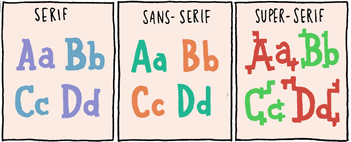
The image to the left comes from a witty strip called “Incidental Comics.” It is penned by Grant Snider, whose cartoons are quite often as entertaining as they are absurd. In this small element from his broader treatment entitled “Design Like Nobody’s Watching,” he expands on the two styles traditionally identified for letter forms.

I’ve written earlier about font lovers, who will especially enjoy the humor here. But all word lovers can appreciate the importance of the letter styles which clothe the words we read and write.

It’s good to be reminded. The fonts we use truly do make a difference.

UAVs and Manuscripts

Iran’s capture of an extremely sophisticated (and classified) drone is a huge disaster. Now the enemies of democracy will be able to duplicate our technology without having to spend a penny on research. As too often happens (usually through espionage), our fascist enemies have stolen advances that make them much greater threats. (I use the plural here, because there’s no doubt Iran will share/sell much of what they learn with mainland China, North Korea and various other dangerous regimes.)

Unmanned Aerial Vehicles (UAVs) are particularly cutting edge. Some voices in the Department of Defense already advocate creating an entirely unmanned Air Force. What used to be science fiction sometimes becomes science fact.

Nearly a decade ago, on the first anniversary of the September 11 attacks, I found myself serving as a chaplain in one of the “-stans” on the other side of the globe. It was during the early days of Operation Enduring Freedom, and there was an intense commitment to the mission. A price was being paid in Coalition lives, but virtually everyone there believed the steep cost would be worth it, as the world became a safer place.

One of the major activities at our air base involved supporting the Predator mission. It was novel. It was exciting. One can only imagine how advanced these platforms have become during the intervening decade. Well, you don’t need to merely “imagine;” many of the innovations are public knowledge. And yet, wisdom suggests that the most amazing advancements are not publicly acknowledged. Most civilians can’t understand just how serious a setback it is for this surveillance and/or weapon system to be captured by extremists.

Turning from the world of current affairs to a subject far less threatening . . . how might this relate to writing? We’re told to “write about what you know,” so our past experiences provide a rich resource for both our factual and fictional efforts. Unless we are simply allowing our thoughts to flow as they may, we find that research remains an essential part of writing even about that which we know.

Case in point. I have served with Predator drones. Watched them being launched and then gracefully land. I’ve touched them. Even though I’m retired from active duty, I belong to several military professional organizations and I subscribe to a variety of military publications. I’ve read a lot about UAVs over the years—but before I would ever attempt to compose a story featuring one, I’d plan to do a significant amount of research.

And that may be one of the few things I have in common with truly good writers. They pay attention to the details, and they get them right. It’s dangerous to assume that we are ever familiar enough with a subject to write off the proverbial “cuff.” Nothing destroys a story’s (or author’s) credibility than surely than getting facts wrong. And that’s certainly one fact worth being reminded of.

A Font for All Seasons

There are a variety of ailments that disproportionately affect writers. Mundane disorders such as Repetitive Stress Injury, Computer Eyestrain and assorted carbuncles arise as no surprise. But there is another, psychological malady that can cripple an author’s creativity and savage his time schedule.

A fascination with fonts is a logical curiosity among people who love words. You can find stylized fonts reflecting for almost any special interest. In fact, just four months ago the total number of fonts surpassed the population of the planet. An affection for different fonts is one thing . . . but an obsession is quite another. Addicts are commonly referred to as “fontaholics.”

There truly are fonts for all seasons . . . too many versions to number. As an example of a unique font, you can check out Narnia BLL.

This lovely lettering is inspired by the recent films about the land of C.S. Lewis’ anointed Chronicles.

And It’s Not Just about Aesthetics

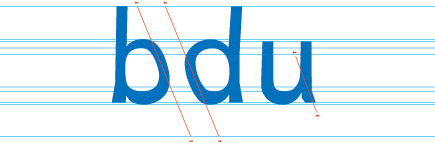
Recently a Dutch scholar devised a nefont specifically for people suffering from dyslexia.

Their approach, based on “weighting” the various letters and symbols, has been shown to improve readability for dyslexics. (Truth is, it would probably make reading easier for anyone.) Some see this new font as reinforcing prior studies which show serif fonts to be more legible than sans serif versions.

Whether you consider yourself immune to the lure of fonts, or are a self-confessed fontaholic, it’s a field about which every writer should understand the basics.

The Bane of Blogging

In today’s “Pearls Before Swine” comic strip, Rat says, “Hey, Goat. In an effort to improve the readership of your blog, I’ve been studying the google analytics for it.”

“What are those?” asks Goat, who is seated at his computer, presumably typing his latest post.

“A comprehensive series of stats about page views, unique visitors and how viewers find your blog. Anyways, from all that, I think I’ve ascertained the problem.”

“You’re boring.”

The final panel reveals Goat’s reaction to that painful assertion.

Truth be told, many individual blog posts are boring. And, not a few blogs in toto are tedious as well.

Boredom, though, lies in the perception of the reader. What weighs down the eyelids of one drowsy reader may be precisely the message that invigorates another. So, I don’t worry too much about the natural ebb and flow of responses to various things I write.

Many years of preaching has doubtless influenced me. The sermon one person regards as “okay,” may be used by God to create a genuine epiphany in the life of another.

Of course, the overall flavor or voice of an author is something a reader recognizes only after sampling a fair amount of their work. Taking just a bite here or a nibble there doesn’t allow a reader to adequately assess whether someone’s work is truly nourishing.

Sadly, our busy age doesn’t allow for terribly thorough examinations . . . and with millions of blogs to be sampled, we’re lucky to have a reader stumble upon even one of our posts. Then, in the briefest of moments, an assessment is made and a judgment passed.

Is this column boring . . . or is it informative and perhaps even entertaining? It’s not enough to hint at the promise of gratification. Bloggers must deliver. And they must deliver every time they post. Of course, that’s not humanly possible. Striving for an unattainable goal can be quite disheartening. And we all have “rats” out there ever ready to discourage us.

If you write, I encourage you to take genuine comfort in the fact that some readers will be pleased by what you write. Some will even be blessed. Not all of them. But remember that even the prophets and poets of the Scriptures did not delight all of the members of their audiences.

Do your best to write something worthy of being read. And rest in the knowledge that some of those who see your words will be refreshed and encouraged by them.

Pornography Pays . . . and Costs

See No Evil

Some years ago I was a member of an “online” fiction critique group. It was secular, and few members worked with religious themes. I recall how one of the other writers bemoaned the fact that she had become “trapped” in a cycle of needing to write pornography. She said, “I can’t stop because it’s so easy to write and the market pays so well.” Now, I can’t attest to either of those statements . . . but her next sentence sure rang true.

“It simple to write and profitable . . . but writing this stuff makes me feel dirty.”

This impressed me. Even the theologically unenlightened mind (spirit/soul) recognizes the corrupting influence of immersing oneself in filth. God has written his (natural) law on the conscience of all those created in his image.

An article in today’s news brought this story to my mind. It appears a Roman Catholic publishing house has been found to include pornography in its frontlist. My first reaction is that this had to be a mistake, but the evidence seems quite significant.

The facts are simple. The press is in Germany and called Weltbild, and it’s second only to Amazon in book sales there. It publishes material most would deem pornographic. (The legal but vile industry calls itself “erotic” literature, but it’s eros-defiled.) While it’s sad enough that such material even exists, that’s not all. The more depressing issue is that Weltbild is owned in whole by the dioceses of the Roman Catholic Church in Germany.

Now, if you’re like me, you’ll want to give the church the benefit of the doubt. After all, you think, some unknown editor probably slipped a single title into their immense publishing list. I’m sure the senior people were never even aware of the mistake.

If you’re like me, you’d be mistaken. Turns out over 2,000 titles are found in their online store under the category of erotica. And, back in 2008 a group of concerned Catholics brought this matter to the attention to the attention of the bishops. In a seventy-page document.

What a tragedy.

But there is a lesson here. Those of us who call ourselves “Christian” should strive to maintain the highest possible standards. Associating ourselves with ugly things reflects poorly not only on us, but also on our Lord. This story is shameful, and I pray the leaders involved will repent of their error, no matter what the financial consequences may be. On the other hand, I too need to avoid shameful actions. And, whenever I do fall short of the Christian ideals which are my goal—I need to be swift to acknowledge my sin and seek to restore what has been lost.

Addendum:

Very true. Paul’s counsel to the church in Philippi remains timely. “Whatever is true, whatever is honorable, whatever is just, whatever is pure, whatever is lovely, whatever is commendable, if there is any excellence, if there is anything worthy of praise, think about these things.”