Defeating Procrastination

procrastination beast

Procrastination is rearing its head around here, and it’s as ugly as ever.

At times like this, I often remind myself of the wisdom of J.R.R. Tolkien placed on the lips of Samwise Gamgee: “It’s the job that’s never started that takes the longest to finish.”

Sadly, that shrewd insight seldom solves my problem. You see, the breed of procrastibeast that typically plagues me isn’t the one that prevents a person from beginning.

The species that lurks in the shadows of my office is the variety that derails “jobs” that are already well begun.

My problem—and you may share it—is that I’m juggling too many projects simultaneously. A detailed book proposal, a literary contest entry, Mere Inkling, a half dozen articles in various stages, and a technical PTSD article I just agreed to review for a professional journal . . . all of these beckon to me and continue to grow more and more urgent in their pleas.

Sometimes I envy the people who tell me they find it challenging to come up with ideas. That’s never been my difficulty. I normally have a surfeit of topics that juice my creativity.

It has only recently dawned on me that this too easily transforms into procrastination.

Unable or unwilling to see works through to conclusion, I constantly initiate new projects. I often struggle with the need to push my writing through to conclusion.

In my own case it seems to boils down to discipline. I have to focus and consciously strive to revisit manuscripts near their deadlines, even when I’m “inspired” to be working on one of the other projects. Too often, I’m resigned to believe, my Muse is simply out of synch with reality.

C.S. Lewis was highly disciplined. An excellent example of this is found in his devotion to responding to the mountains of correspondence he received. In this burdensome activity he was assisted by his brother Warnie, who absence during his drinking binges created an extreme hardship. At the end of his life, Lewis was appreciative to have gained the assistance of Walter Hooper

Fixing the Problem

We who struggle with procrastination do not need to despair. According to psychologists, “This is a learned behavior and therefore can be unlearned.”

Procrastinators are made and not born. That’s both the good news and the bad news. Good because it’s a learned response, and what’s learned can be unlearned. The bad news is that while it’s possible to change, it takes a lot of psychic energy and you don’t necessarily feel transformed internally.

You should know that some people who think of themselves as procrastinators really aren’t. In a world of unending deadlines, they just put too many things on their “To Do” list. They’re not avoiding tasks, the mark of a bona fide procrastinator; they’re getting things done, just not as many as they would like.

In my own case, I would alter that final sentence to: “they’re getting things done, just not in the order that they would like.”

The article quoted here includes some suggestions for defeating procrastination. The one I like best is “Promise yourself a reward.”

Unfortunately, my most effective rewards seem to be food-based, with items of the chocolate tier in the hierarchy pyramid being the most effective.

I have, however, come upon a tentative substitute. I thought of it while writing this very column.

I have accumulated some writings by and about C.S. Lewis during the past few years that I have yet to read. Too busy. Well, I’ve decided that when I finished some of the most pressing projects that are strangling me, I will treat myself to simply reading some Lewis.

I doubt it will be as effective as chocolate . . . but it is best substitute I can imagine.

_____

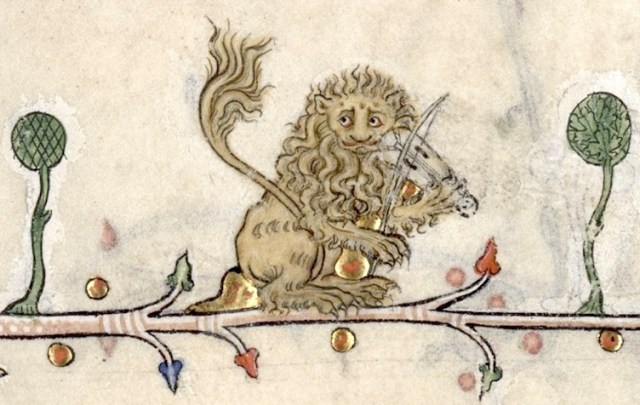
The medieval illumination above may represent one version of the procrastination beast which afflicts Christians… since it did manage to deter at least one monk from carrying on with his proper duties.

Typing is Not Writing

chimp

How is this for an absurd waste of time? A foolish man wanted “to feel what it was like to write like F. Scott Fitzgerald.” So, what did he do? Take writing classes? No, he had a better idea. He sat down at the keyboard and proceeded to type out a verbatim copy of The Great Gatsby.

Some of you may have heard this story, from the life of Hunter S. Thompson. He founded the “gonzo journalism” movement which dispenses with the pretense of objectivity. Sarcasm, humor and even profanity abound in this type of writing.

Thompson was apparently well suited to gonzoism, summarizing his life philosophy in this way: “I hate to advocate drugs, alcohol, violence, or insanity to anyone, but they’ve always worked for me.” Which is, presumably, a personal endorsement, rather than advocacy.

Apparently, typing the same words as literary icons also “worked” for Thompson. He also retyped Hemingway’s A Farewell to Arms to learn how to emulate his style.

I wonder what C.S. Lewis and his fellow Inklings would think of this approach to learning how to write. Lewis, of course, treasured good writing and recognized wide reading as a valuable inspiration for successful writing.

Nevertheless, if Lewis and Tolkien heard about Thompson’s exercise, I imagine they would enjoy a good laugh.

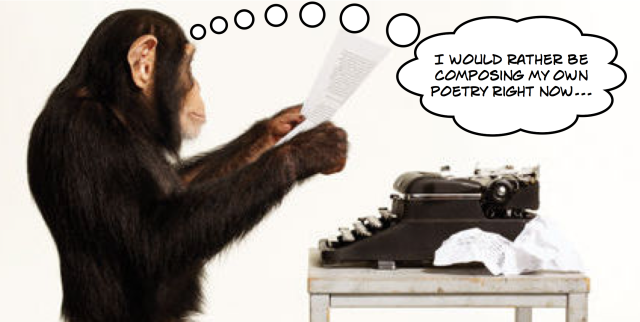
Reproducing typed facsimilies cannot be considered writing. Even an utterly illiterate person (or probably even a chimpanzee) could be trained to reproduce an original, key stroke by key stroke. (The monkey would probably benefit from a keyboard tailored to its particularly physiology.)

Emulating is Writing

When a lesser writer seeks to imitate the style of a renowned author, using their own creative skills and not plagiarizing, they are composing something original. There are several considerations to keep in mind.

Copyright restrictions may bar the work from publication. For example, it’s not yet legal for people to publish new Narnia stories.

Trademarks can also limit options for such works. Speaking of which, you don’t need to register a trademark to use TM in the United States, as we at MereInkling(TM) recently learned.

If registered with the USPTO, use the ® symbol after your mark.  If not yet registered, you may use TM for goods or SM for services, to indicate that you have adopted this as a “common law” trademark or service mark.

Works written as an homage—without any compensation or profit—is typically allowed. Thus we see innumerable variations on the Screwtape Letters. I have contributed to that mountain myself.

Basing a piece on the themes or voice of a masterpiece is altogether different from plagiarism.

There is one more critical point to make about a legitimate literary “tribute.” It can be based on the most anointed writing of the most impressive author . . . and still not be worth reading at all.

Which returns us to the typescripts reproduced by Thompson. Assuming he reproduced them faithfully, he is immune at least to the charge that the product of his typewriter is inferior to the original text.

That said, I find the two minutes I just invested in writing the following modest haiku more beneficial to my creativity than the hundreds of hours I might have spent literally copying a book I prize.

Retyping fixed words

Rather than shaping one’s own

Is a game for fools.

Beavers Beware

russian-typoA mere 375,000 rubles buys a fair amount of publicity in Russia; just be sure to proofread the product.

This Christmas season one Russian charity hoped to encourage readers to live good lives, but instead they published a brochure that encouraged beaver genocide.

Beavers are particularly vulnerable rodents. They are quite gentle, and even Talking Beavers are poorly equipped to defend themselves.

The lovely scene on the leaflet featured an innocent girl gazing into a snow globe. Emblazoned above it was supposed to read “Do Good.” Instead, the Russian words spelled out “Exterminate Beavers!”

It just bears out the maxim, “proofread before you publish.” In this case, one could easily add: “if the work is translated, make sure the proofreader understands both languages.”

Some errors are especially heinous.

C.S. Lewis recognized the importance of proofreading.

He was sometimes the victim of inadequate editorial review. So it comes as no surprise that he preferred to see galleys (the uncorrected typeset proofs) of his work before actual publication.

The following reference from a letter in which Lewis attributes the need for such as due to his own poor penmanship, rather than the carelessness of others. This is typical of his generosity, since part of the duties of editors (and pharmacists, for that matter) is to be able to decipher the scribblings of authors (and physicians). Mark Twain did not share Lewis’ grace in this matter.

When his friend Dorothy Sayers died in 1958, Lewis was unable to attend the funeral in London. He was, however, honored to write a panegyric for the service, which was read by one of the bishops in attendance. Following the event, Sayer’s son, Anthony Fleming thanked Lewis and asked if he might include the eulogy in possible collection.

Dear Mr. Fleming

Thank you for your most kind letter. I am relieved to find that the little speech has pleased those whose approval at such a time matters most—it is so easy to go wrong in a thing of that kind and so to give offence.

I am perfectly willing that it should be printed, but please ask whoever sees to it to be sure and let me see a proof. Even if printers made no mistakes, my villainous writing nearly always leads to some.

Lewis, of course, was referring to a literal manuscript, a document written by hand. One assumes that the Russian publisher was given a typescript, so they could not use “villainous writing” as an excuse for their error.

Still, I suspect they were given the text in one language, English perhaps, and asked to translate it for publication. In that case, who actually is responsible for the mistake?

I choose not to worry about attributing liability in this matter. I’m content to use this winter mistake to remind me of the importance of proofreading.

Oh, and on behalf of all of the beavers in Russia, I am relieved to know they will not be distributing these murderous words.

C.S. Lewis was Not a Dramatist

shakespeare-and-lewisC.S. Lewis’ prolific, genre-crossing success teaches us two things. First, that a very good writer can fruitfully write in a variety of fields. Second, that even the most gifted of authors cannot write with equal talent in all genres.

Students of C.S. Lewis are well acquainted with the fact that one of the great disappointments of his life was failing to succeed as a poet. Although he did write a reasonable amount of poetry, it failed to elicit the response for which he hoped.

Lewis did, of course, receive well-deserved kudos for his literary fiction and children’s stories. His fiction and nonfiction are extraordinary, and over the years I have appreciated the value of his many essays to be among the most precious of his works.

Finally, as a correspondent, Lewis stood in the first ranks. He regarded the responsibility of personally responding to the letters he received as something not to be shirked.

Fortunately, the excellent collections of his letters offer us many insights into Lewis’ life and career. For his Christian fans, they reveal insights into how a disciple of Jesus can gracefully navigate life.

The following letter was written in 1959, to a man who was apparently the editor of a small newspaper. He had requested an article from the exceedingly busy professor. Lewis’ response is quite interesting.

Dear Mr. Aylard,

Yes! my handwriting is awful. It used to be nice but my muscles have stiffened up and the strokes no longer come out as I intend. I give ‘this generation’ all I can in the way of books and articles. Particular articles by request are not usually the good ones: and, you know, I should reach more readers through other organs than your paper. I hope this doesn’t sound stand-offish or conceited, for it is not meant to be. It is really common sense to speak where one can be most widely heard.

I agree that drama is a good medium for our purpose. In this country Dorothy Sayers’ broadcast set of plays on the life and death of Our Lord (The Man Born to be King) did a great deal of good. I don’t attempt this form myself because any talent I may have is narrative, not dramatic. With all good wishes.

I draw several observations from reading this letter.

  • Lewis took the time to personally pen many of his letters, despite the fact that this presented an uncomfortable challenge to him.
  • Lewis preferred to address subjects as he felt moved by the Holy Spirit to do so, rather than on demand.
  • He did not have the time to dress it up in gentle fluff, but candidly expressed the fact that if he had sufficient time and energy to write, it would not be the wisest stewardship to send the piece to a publication with a limited distribution.
  • Even though he did not intend for that remark to be curt or “conceited,” Lewis still felt compelled to offer his “I hope this doesn’t sound…” apology.
  • Lewis appreciated drama, and recognized Sayers’ work as quite noteworthy.
  • He recognized that drama would not be his forte, and wisely preferred to stick with the type of writing wherein he was most accomplished.

Even this final thought is offered with C.S. Lewis’ characteristic—and genuine—humility.

I don’t attempt this form myself because any talent I may have is narrative, not dramatic.

As a writer myself, I find this sentence quite comforting. And not simply because my own extremely modest talents also lie in the narrative realm. Even if I were a poet or a dramatist I would recognize how liberating it is to acknowledge that one cannot be fairly expected to excel at more than one genre.

And “excel” is not really the best word to use here. Perhaps it’s sufficient that writers think of themselves like children of Lake Wobegon, where Garrison Keillor tells us “all the women are strong, all the men are good-looking, and all the children are above average.”

Ultimately, whether we consider ourselves to be adequate or exceptional writers, it is necessary to understand where our skills reside, and to transgress those boundaries only with the greatest trepidation.

Devastated by Criticism

calvin-criticismHow do you feel when others criticize something you’ve written? Do you just want to tear your work up and start all over again? If you do, you have something in common with J.R.R. Tolkien, creator of Lord of the Rings. And he is not the only great writer with whom you share this hypersensitive trait.

Tolkien’s inability to accept constructive criticism is no secret; it is frequently noted in biographies.

Few people enjoy receiving criticism, and we are often suspicious of the mental health of those who do. Yet many writers actively seek out constructive criticism in order to sharpen their skills and improve their work.

That is a major reason for the existence of writers’ groups which pop up in varying expressions wherever serious writers live. While another benefit of such communities is the simple encouragement that comes from gathering with others who share your passion, it is the critical examination of each other’s manuscripts which provides the clearest concrete benefit. It’s no accident many such literary meetings are actually called critique groups.

Tolkien was a member of one of the most famous such fellowships that ever existed, the Inklings. It was in that setting where he first shared the stories of hobbits and elves who would make such a profound impact on Western literature. He said it was primarily through the encouragement of the Inklings—specifically his good friend, C.S. Lewis—that these amazing stories were ever published.

You see, Tolkien had a terrible and frequently fatal flaw . . . When his writing was criticized, he felt compelled to toss it aside and begin anew. Many other writers have been afflicted with this curse, and not all of them had a C.S. Lewis to rescue their words from the dust bin.

I have shared in the past Lewis’ description of his friend’s handicap.

No one ever influenced Tolkien—you might as well try to influence a bander-snatch. We listened to his work, but could affect it only by encouragement. He has only two reactions to criticism; either he begins the whole work over again from the beginning or else takes no notice at all.

Criticism of the Constructive Variety

As I said a moment ago, no one really craves criticism, and yet most serious writers actively solicit it. As I write this very column, it is with the intention of sharing it tomorrow with my friends in my own writing circles.

When you read it, it will likely have changed, probably in subtle, enriching ways. You can gauge the benefit of mutual critiquing by the amount and the quality of the criticism which is shared. And, should you feel violated, rebuke defensiveness and remind yourself that even the greats, like Tolkien and Lewis, gained from the comments and suggestions of their friends.

I recently learned of another individual who struggled with receiving criticism. It was John Calvin, the father of Reformed theology. Belonging to the Lutheran branch of the church universal, my readings in Reformed history have been limited. However, I’m currently reading two similarly titled books* and I discovered something that may be commonly known to Reformed clergy but was news to me.

He often tended to express his disappointment in extravagant terms. When he encountered an obstacle, his reaction was stark: he would burn his manuscript, never write again, never publish anything again. His decision to write was motivated by external factors: a request by his circle of friends and colleagues, or as the result of his emotional reaction to an event or a work that he read. . . . (John Calvin and the Printed Book)

The good news though is Calvin did not allow these obstacles to have the final say. Instead, he turned to those he trusted and sought their counsel.

Indeed, his extreme sensitivity meant that he needed to have the emotional support of close friends. As a Reformer and specifically as an author, Calvin never worked in isolation even though he was the dominant figure in his setting. While he was confident of the quality of his writings, Calvin still had no hesitation in submitting them to his colleagues before publication. (Ibid.)

Not that Calvin always welcomed suggestions. There was one particular Reformer to whom he sent some of his work whose “commend from Zurich were too numerous and detailed. Hence Calvin stopped sending his manuscripts to Bullinger prior to printing, although he maintained cordial relations with the Zurich Reformer.” I can almost read Calvin’s mind at the time: I asked for your suggestions, not a complete rewrite of the manuscript.

So, it appears those of us who feel discomfort at the sting of criticism—even when we request it—stand in good company. So don’t ever let that temporary pain discourage you from continuing to write.

____

* A 2005 volume is called John Calvin and the Printed Book, while a 2015 collection of essays is called Calvin and the Book.

C.S. Lewis and Metaphors

hobbit-quoteLearn how to effectively wield metaphors, and you will be powerful indeed. They are one of the most creative and intrinsically rewarding tools used by communicators.

Metaphors are not simply ornamental. Nor are they limited to abstracts subjects. The following description comes from C.S. Lewis’ book, Miracles.

It is a serious mistake to think that metaphor is an optional thing which poets and orators may put into their work as a decoration and plain speakers can do without. The truth is that if we are going to talk at all about things which are not perceived by the senses, we are forced to use language metaphorically.

Books on psychology or economics or politics are as continuously metaphorical as books of poetry or devotion. There is no other way of talking, as every philologist is aware. . . . All speech about supersensibles is, and must be, metaphorical in the highest degree.

To effectively communicate—especially about deep or profound subjects—metaphors need to be part of a readers’ or speakers’ core vocabulary. That’s what Lewis meant by saying “we are forced to use language metaphorically” when speaking about things that transcend our senses.

Former Time editor James Geary has echoed Lewis’ description of the universality of metaphors.

Metaphor is not just confined to art and literature but is at work in all fields of human endeavor, from economics and advertising, to politics and business, to science and psychology. . . .

There is no aspect of our experience not molded in some way by metaphor’s almost imperceptible touch. (I Is an Other: The Secret Life of Metaphor and How It Shapes the Way We See the World)

Without being conscious of it, we all use metaphors more frequently than we realize it. Geary claims “We utter about one metaphor for every ten to twenty-five words, or about six metaphors a minute.” Granted, most of these are routine like the four appearing in this sentence he quotes from an economic report.

“Britain’s recovery from the worst recession in decades is gaining traction but confused economic data and the high risk of a hung parliament could yet snuff out its momentum.”

Metaphors Versus Similes

Envisioning fresh metaphors may seem challenging, but it is a skill which can be practiced. One need not feel embarrassed if they find the subject of metaphors confusing. In their simplest form, they are like especially meaningful similes.

In a simile we compare two distinctly different things and declare that they are similar. For example, someone might say about the sleek new stealth destroyer, “the USS Zumwalt is like a Porsche.” This simile suggests a number of attributes and the statement contains the familiar phrase “is like.”

By contrast, a metaphor is not merely “like” something else. Using a metaphor implies that the two different things share, in a true sense, some common nature or element. So, a person might write, “the current election season is a nightmare.” Certainly, a less confident writer might weaken the power of this sentence, by diluting it into a simile, it’s “like” a nightmare.

But the bold speaker or writer recognizes how much more sharply the metaphor communicates their message. They want to state that the experience is not just nightmarish. It is a nightmare. It is (to many) horrific, frightening, and something from which we wish we could awaken to resume our lives in a world that still makes sense.

Like any rhetorical or literary tool, metaphors can be misused. They can be stretched so far that they don’t make sense, or they only appeal to individuals who share some narrow interpretation of existence.

While metaphors can be used in an ostentatious or overdone way, that simply weakens their effect. The judicious application of metaphors is a skill well worth practicing.

The Scriptures as a Treasure Trove

The subtitle above can itself be viewed as a similar or a metaphor. But that’s beside the point, since it simply introduces our discussion of the fact that the Bible is filled to overflowing with metaphors.

This is unsurprising, since almost the entire text deals with the story of an infinite Creator’s love for his fallen creation.

Put another way, our God, whose nature is utterly incomprehensible to the beings he fashioned from the earth (adamah), longs to communicate his love for we whose lives in this world are so very brief. How could the Lord accomplish this without metaphors? Thus he describes himself in this fashion:

“I am the alpha and the omega.”

“I am the bread of life.”

“I am the light of the world.”

“I am the vine; you are the branches.”

“I am the resurrection and the life.”

Metaphors are not reserved for God in the Scriptures. On the contrary, they abound, like radiant dandelions in the early days of summer.

“The teaching of the wise is a fountain of life . . .”

“The Lord is my shepherd . . .”

“O Lord . . . we are the clay, and you are our potter . . .”

“If anyone is in Christ, he is a new creation.”

All of us, “new creations” in particular, have much to learn from C.S. Lewis about metaphors. A good place to start is the brief essay “C.S. Lewis and the Apt Metaphor.”

After reflection, you may want to try your hand at creating a novel metaphor. After all, a thought-provoking metaphor is a refreshing breath in any conversation.

_____

I’ve written about metaphors in the past posts, including this one. I also wrote a a column which includes George Orwell’s advice for writers: “Never use a metaphor, simile, or other figure of speech which you are used to seeing in print.”

Enlarging C.S. Lewis’ Vocabulary

csl sayersCan you imagine receiving a compliment like this from C.S. Lewis? Your work “even enlarged my vocabulary.”

Shocking . . . but another writer did receive that rare praise.

In 1954, Lewis wrote a lengthy letter to his friend Dorothy Sayers, praising her recent publication of Introductory Papers on Dante. Lewis’ opening sentence reveals his delight. “Your Introductory Papers have given me a regular feast.”

Lewis specifically comments on a number of insights he found particularly worthwhile. And remember, Lewis was an expert on Dante in his own right.

One evidence that Lewis’ praise is sincere, and not mere flattery, comes in his comment that “every essay and nearly every page enriched me.” Not every page, mind you, but very nearly every one of them.

Offering Gentle Criticism

Consistent with the nature of friendly literary criticism (like one receives in a healthy writers group), Lewis does offer some specific advice on how to strengthen a specific point that he regards as overemphasized. In this case it relates to a classical Latin phrase.

At one point Lewis expresses awe about a portion of the book, and then immediately proceeds to make an enjoyable comment about the limitations of the English language.

P. 52 is a blaze of (just) splendour. (Drat our homophones: by just I don’t mean ‘nothing but,’ I mean ‘justified,’ ‘veracious.’)

Toward the close of his letter, Lewis raises a profound notion about our perception of humor. He cautions Sayers, in her interpretation of Dante’s Comedy, not to read it directly through the lens of our own day. “I’ve a feeling that in handling particular passages you are too certain that whatever is comic to us was, and was meant to be, comic at the time.” He continues:

Because, as any one can see even from the old Punches,* nothing changes so quickly as the sense of humour: so that in reading any old book there is nothing we are less sure of than which places wd. welcome a smile. And oughtn’t we to start by a recognition that our generation (yours & mine) was quite abnormally ‘tickle o’ the sere’** (already the young people are less so).

A Poetic Postscript

Lewis ends his letter to Sayers with some advice for her subsequent work with Dante. He courteously writes, “Don’t give me the next set, I’ll buy it.”

Then he makes a suggestion to protect her from the spurious criticisms of ignorant literary critics. (Note that he doesn’t use the choice descriptive in a vulgar sense common today, but in more classical sense of extreme foolishness.)

And do put in an essay on D. as ‘poet’ in the old, narrowest sense—his sheer poeticalness. Otherwise we shall have some ass saying that because you like so many other qualities, you are oblivious to that.

_____

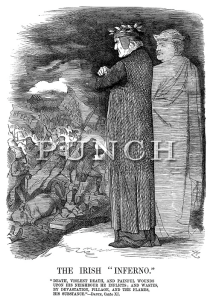
* Punch Magazine was published in England until 1992. The 1881 image below is inspired by Dante’s Inferno, and applied to the violence in Ireland.

** Easily made to laugh. From Hamlet: “The clown shall makes those laugh whose lungs are tickle o’ the sere.” The seare, or sere, was part of the trigger of old matchlock guns, so arranged that the slightest movement would make the gun discharge. Lungs, then, “tickle o’ the sere,” are those easily moved to laughter.

punch dante

Hunting Facts

librariansI’m having a serious problem. One that was shared by C.S. Lewis.

Unfortunately, it has reached its greatest intensity as I am striving to meet the deadline for my doctoral dissertation.

The problem is one that should be simple to remedy, yet I’m crippled by it. The solution is so simple that it is almost embarrassing to admit what it is.

But, confession is good for the soul. (That’s not a biblical verse, by the way, in case you were wondering. Nevertheless, it’s quite true.)

So, here’s my confession. I love to conduct research.

The internet is tailor made for a lifelong student like me; I can follow any avenue that piques my interest from one corner of the world wide web to the other.

And, I do.

That’s the problem, of course. I always over-research the things that I write. And this dissertation is no different. I have so much research—good stuff—to cram into it that I’m dreading hearing back from my advisor . . . who now has the first three chapters in hand.

So, how does this plight resonate with the life of C.S. Lewis? Well, not in the sense of my possessing his brilliant intellect and memory. Lewis had no need of the internet to sort out all of the material he had studied.

Still, the two of us do share one important character trait. He too, was an inveterate collector of information.

In his anthology of George MacDonald’s writings, Lewis confesses his pleasure at conducting research. He says it in this fashion:

“I am a don, and “source-hunting” (Quellen-forschung) is perhaps in my marrow.”

Alas, my marrow is filled with the same unquenchable hunger.

Considering Your Own Writing

It may be that some Mere Inkling readers share this passion for pursuing knowledge for its own sake.

It can certainly be argued that it is an important facet of writing. But there are other aspects of writing, and it is quite natural for different elements of the process to appeal to different individuals.

Perhaps you prefer the initial brainstorming, daydreaming or idea phase of a writing project.

Or, as we have discussed, researching information may be the high point of your writing efforts.

This typically leads to outlining, in various shades of detail. Some writers prefer to proceed without any structure in mind. (This is usually not a good idea when writing nonfiction.) I like outlining. I find establishing a logical structure satisfying work, probably because I’m NTJ.

There are, of course those who honestly love the writing itself, especially when they are in the zone and the creativity is really flowing. Frankly, for me the writing is work. (That doesn’t mean I don’t enjoy the feeling that flashes when you come upon the perfect word or phrase.)

And, although I’m a brutal editor of my own work, and find sharpening an article rewarding work, I must admit I am a little surprised when I encounter a writer who enjoys this phase of the process the most of all.

Then there is sharing or submitting a manuscript for publication. Most writers are a little nervous about this, but some find it exhilarating.

Once someone has published a book, it is now normal for the bulk of responsibility for its promotion to rest upon their own shoulders, as the author. I’m still waiting to meet someone who claims that this is their favorite phase of the writing cycle.

Back Again to the Oxford Don

Lewis’ writing is so enjoyable that I want to close with a longer excerpt from the introduction.

C.S. Lewis’ high regard for MacDonald is well known. This anthology of his work was a tribute to him, in the hopes of introducing many more readers to his work. This book is insightful into the hearts of both men. After all, the editor’s choice of quotations cannot help but reveal much about them too.

In making this collection I was discharging a debt of justice. I have never concealed the fact that I regarded him as my master; indeed I fancy I have never written a book in which I did not quote from him. But it has not seemed to me that those who have received my books kindly take even now sufficient notice of the affiliation.

Honesty drives me to emphasize it. And even if honesty did not— well, I am a don, and “source-hunting” (Quellen-forschung) is perhaps in my marrow. It must be more than thirty years ago that I bought— almost unwillingly, for I had looked at the volume on that bookstall and rejected it on a dozen previous occasions— the Everyman edition of Phantastes. A few hours later I knew that I had crossed a great frontier.

_____

There is no authoritative step-by-step list of the writing process. Some sources call the idea stage “prewriting.” Others break writing down into two parts: “drafting” and “revising.” Some consider editing primarily to be “proofreading,” while you can see from post that I merge the revising and proofreading into what I call “editing.” There are various other structures that are used to describe the writing process. My suggestion is to go with what works for you.

MacDonald’s works are now in the public domain. You can download a free copy of Phantastes here. There is a LibriVox (audio) recording available at the same site.

Choose Your Adjectives Carefully

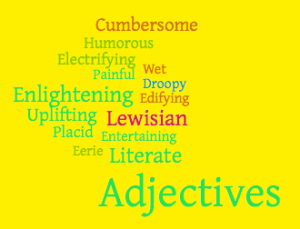
adjectivesMark Twain was a fount of wit and wisdom.* I recently encountered this astute maxim attributed to him.

A man’s character may be learned from the adjectives which he habitually uses in conversation.

While the statement rings true, it turns out that Mark Twain is not the person who coined it.

That honor belongs to Henry Theodore Tuckerman (1813-71). The confusion is apparently due to the fact that Twain’s future bride, Olivia Langdon, began compiling a commonplace book while a teenager, in which she included this paraphrase of one of Tuckerman’s observations.

The actual quotation comes from an 1850 volume in which he wrote:

It is amusing to detect character in the vocabulary of each person. The adjectives habitually used, like the inscriptions on a thermometer, indicate the temperament. (The Optimist, “Conversation”)**

C.S. Lewis was not a fan of the excessive use of adjectives, as I have written about in the past.

Don’t use adjectives which merely tell us how you want us to feel about the things you are describing. I mean, instead of telling us a thing was “terrible,” describe it so that we’ll be terrified. Don’t say it was “delightful;” make us say “delightful” when we’ve read the description. You see, all those words (horrifying, wonderful, hideous, exquisite) are only like saying to your readers, “Please, will you do my job for me?”

Despite Lewis’ warning, I have to confess that I love adjectives. When they are creatively chosen, I find them illuminating, provocative and welcome. In fact, the ideal adjective accomplishes Lewis’ goal of conveying an emotion, not simply describing it.

And, as we have been reminded today, adjectives have the additional benefit of giving us glimpses into the personality of the authors themselves. “It is amusing to detect character in the vocabulary of each person. The adjectives habitually used, like the inscriptions on a thermometer, indicate the temperament.”

Meeting a New Author

Researching this subject I encountered an interesting quote from a popular Chilean-American writer, Isabel Allende.

I want to have an epic life. I want to tell my life with big adjectives. I want to forget all the grays in between, and remember the highlights and the dark moments.

While I can understand her desire to live an epic life, and applaud the accompany image of living one’s life with “big adjectives,” I have to say I am a bit disappointed in her choice of adjective itself. “Big” adjectives? “Vast,” “immense,” “deep,” and “complex” are just a handful of the substitutes that might convey different aspects of the concept “big.”

Perhaps she originally penned this in Spanish, and chose just such a “bigger” word? But then again, I assume she would do all of her own translation work. So it could be she was striving for irony? Not having read her work, I cannot say with any confidence.

Still, if I do expose myself to a greater quantity of her “adjectives habitually used” . . . I have no doubt I can gain some insight into her literary temperament.

_____

* If you are curious as to whether Twain was a “fount” or a “font,” check this out.

** You can find more of his wisdom by downloading a free copy of Selections from the Writings of Henry Theodore Tuckerman.

Great Grandparent or Great-Grandparent?

ggfI have never been more glad to have a birthday than I was this year. After all, at a mere sixty, I would have been far too young to become a great-grandfather. Now, at sixty-one, I feel adequately prepared for the momentous event which transpired just under an hour ago.

Tobin (meaning “God is Good”) is the child of my grandson and his wife, who currently reside in Texas where dad handles munitions for B-1 bombers.

Age and offspring do not always line up the way that we ourselves would plan. Yet every precious child is a miraculous gift from God.

Our grandson was born to our precious daughter-in-law while she was in high school. We didn’t get to meet him until he was ten, but we’ve done our best to make up for lost time. Our grandson, early on began calling us his “great grandparents.” That didn’t make us feel old, just special.

When my wife worked in a residential care facility for severely handicapped children, one of the aides arrived one morning with joyous news. “I’m a great-grandmother!”

Because the woman seemed too young, Delores responded, “Congratulations, you look so young for being a grandmother.”

The lady laughed and said, “No, a great-grandmother!” It turns out she was not yet forty . . . having been 13 when she had a daughter who was 13 when she had her own daughter who now had birthed her own baby. (I don’t recall the gender of the child.)

As I wrote this, it dawned on me that this all took place thirty-seven years ago, so it’s quite possible there are now several more generations in that particular family tree.

Some people will scoff at the thought of celebrating such early and assumedly unintended pregnancies. But, that caregiver knew the truth—every young life is a gift from God.

As an imperfect parent and grandparent, I recognize all too well that I won’t be the great-grandfather Tobin should have. I do pray, though, that God would grant that my mistakes with him would be few, and the memories forged during this life will help this little one grow into the finest man that he can become.

Most importantly, I pray that he will see Christ in my life and recognize the value of faith. Only the Lord knows what the future will bring, and I will not be here to share too many decades of life with my grandchildren and great-grandchildren. But my hope is that the time we do have will leave a lasting legacy of encouragement, faith, and compassion.

The letters of C.S. Lewis provide insights into the influence of his grandparents on his young life.

In a 1905 letter to his brother Warnie, he describes family festivities on Halloween. They even persuaded his grandfather to join in.

On Halow-een we had great fun and had fireworks; rockets, and Catherine wheels, squbes, and a kind of thing that you lit and twirled and then they made stars. We hung up an apple and bit at it. We got [his paternal] Grandfather down to watch and he tried to bite.

In a 1916 letter to his father, he refers to his grandmother’s declining health. (She died two weeks after he wrote.) Lewis refers to the common sentiment that we should have tried harder to spend time with family while they were with us. “I am sorry to hear what you say about [Lewis’ maternal] Grandmother: I feel that we ought to have seen more of her, but it was not easy.”

I should dearly love to get away for a bit, but, as you say, for so short a time, the expense and the interruption of work is hardly worth it. The Colonel must have had an unpleasant journey: I wish he would keep a diary which we could compare with that of Grandfather Hamilton in the same waters. Two generations of sub-tropical Atlantic and Hamilton temperament would be worth studying!

The diaries left by C.S. Lewis’ grandfather, and by his brother Warnie, provide a reminder to us that a written legacy will outlast our voices. If we have something important to say to our descendants, perhaps that is something we should keep in mind.