Your Writing Style

Each of us writes in a unique manner.

You can study writing patterns in various ways, by considering vocabulary, changes in sentence lengths, repeated phrases, and various other measurable elements.

Then there are more subjective aspects of our writing, but these too are recognizable. They would include tone and more abstract things like pacing.

When you add them all together, you arrive at an amorphous quality called the writer’s “voice.” And, as I said above, each of our “voices” are different.

It may be that we dabble in a variety of forms and genres. For example, in addition to these casual blog posts, I also write about theology and military ministry from a much more “professional” perspective. And, shockingly (to my own writing identity) I’ve recently received encouragement related to poetry with which I’ve been experimenting.

Even when we write in various literary forms, and they clearly differ from one another in their voice, the truth is that for each of these documents we develop a personal, inimitable voice.

Now, after emphasizing our literary uniqueness, I want to switch perspectives and consider that our various styles and voice resemble those of others. Occasionally, when reading someone’s work it strikes you as familiar. You may even recall the author that the work reminds you of. (I’m not referring to plagiarism, of course, although the internet has apparently made that particular plague even more common now than in the past.)

It would be vanity to claim that our own writing voice resembles that of no one else. Yes, some voices are so peculiar that they are clearly “rarities,” but others have shared even those odd personalities in the past. I suspect that’s even true for the senseless ramblings with which some self-styled “artists” assail the public. (Even insanities can resemble one another.)

In any case, if you ponder this subject it’s natural to wonder: who do I write like?

Today, through the amazing processing abilities of the computer, you may be able to get an answer to that very question. It’s not a definitive answer, because as I said above, our writing voice possesses both material (words and syntax) and spiritual (ephemeral and aesthetic) dimensions. And, while a computer may be without peer in comparing the former, I believe it to be quite deficient in discerning the latter.

Nevertheless, a rudimentary program is available online to compare your writing with that of a number of writers of varying reputation. The program has a number of limitations, but I think there may be something to it. It requires an extensive section of your writing (several paragraphs, at least). I assume more would be better, in terms of promoting accuracy.

As I just mentioned, it includes a limited number of authors currently entered into the database, and I suspect that the gifted C.S. Lewis is not among them. (I say this not because I expected to be aligned with him, but because of some of the included authors I am aware of. In addition, the program’s creator is actually Russian, so I would be curious to learn how the represented English authors were selected.)

It would limit the program’s value, for example, if I only input data on three writers and you were matched with the one you resembled most closely. Would you prefer, for example, to be told you write like Edward Bulwer-Lytton, Georgette Heyer, or Fabius Planciades Fulgentius?

Even with a significant number of writers included, the program’s accuracy will be affected by the quantity (and specific choice) of what is included to represent each. For example, the programmer properly included Stephen King. How valuable would that be, however, if he had only used King’s poetry and excluded his prose works? (Yes, the horror master has also penned poetry—now, that’s a scary thought!)

Well, despite the limitations of the “I Write Like” program, it is fun to try out. And it sounds impressive, in that it relies upon a naive Bayesian classifier. (Well, the “naive” part doesn’t sound especially remarkable, but the formula looks pretty imposing to someone who never took calculus.

You can use take the “test” at this site.

Make sure you include lengthy selections from your work. Also, testing the program with different genres (assuming you write in different styles) will actually give you new matches. (That is, of course, as it should be.)

If you do decide to experiment with it, a comment below about your results would be interesting for others. And now, for the moment that you have been awaiting . . . with whose writing did the program match mine?

I tried a number of times (no—not fishing for results I wanted, but using a variety of types of my writing) and here were the repeated results:

For my blog posts: H.P. Lovecraft or J.R.R. Tolkien

For my more formal essays: J.R.R. Tolkien or Jonathan Swift

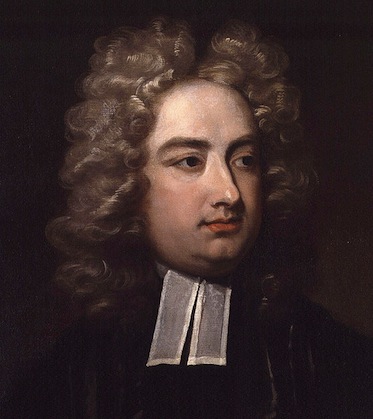
(It’s Swift’s picture, you’ll note, that begins this post.) Actually, the majority of the results linked to Swift, whose work I don’t recall ever reading in full, not even Gulliver’s Travels. However, our shared emphasis on wit, advocacy and satire account for what I deem a genuinely accurate assessment. And it does not hurt that Swift was Anglo-Irish, like my favorite author!

So, until Dmitry Chestnykh adds C.S. Lewis to the writers included in the “classifier,” I’m quite content to rest on my matches. Because even if I don’t share Lovecraft’s worldview, I can still respect his literary skill. And being identified with the other gentlemen, is a grand compliment.

[Special thanks to Julie Catherine who introduced me to the site via her post on the subject.]

Mastering the Anacoluthon

Allow me to once again display my grammatical ignorance. I was reading an online book review and the author used lots of multisyllabic words. (That’s something I actually enjoy.) But then he went and threw in one of those words I had to rush to dictionary.com to define. (That’s another thing I love—learning new words.)

Naturally, I could partially decipher the definition from the context. However, whenever I have a dictionary within reach, that shortcut doesn’t satisfy me.

In this case, the word was anacolutha, the plural form of anacoluthon. It is defined as “a construction involving a break in grammatical sequence, as ‘It makes me so—I just get angry.’” Well, we can all agree that is not a good sentence; it’s a fine example of what a writer should avoid.

Not all grammar rules make sense. Take for example the notion that one cannot end a sentence with a preposition. Some of us literally had our knuckles rapped for scribbling such grammatical “obscenities.” While it’s true that you can avoid using prepositions in this manner, it’s not the great sin we were taught it was. In his Letters to an American Lady, C.S. Lewis writes:

[Regarding] a sentence ending with a preposition. The silly “rule” against it was invented by Dryden. I think he disliked it only because you can’t do it in either French or Latin which he thought more “polite” languages than English.

Well, isn’t that an interesting historical note to become aware of?

But, back to anacolutha . . . let’s see if it’s difficult for a trained pen to sever the ties of logic, and compose this sort of literary construction.

Reepicheep was a great swordsman who, “a tail is the honor and glory of a Mouse” was his creed.

Frodo pondered his options while—the Nazgûl loathed bathing more than once each fortnight.

Wow, that’s a lot harder than it looks. If you can think of better examples (not difficult, I’m sure), feel free to share them in a comment! But only write them here, and don’t allow any anacolutha to slip into your real writing!

Screwtape Goes to War

I edit a free online journal for military chaplains. Articles have been contributed by clergy from most of the world’s continents, sharing their experiences and opinions. Much of the material will be of interest to anyone interested in the nature of ministry within the armed forces.

The current issue was “published” at the end of June, and includes one article that may be of particular interest to the readers of Mere Inkling.

On page fifty-seven you’ll find the preface to a series of six letters. They are collected under the same title as this post, “Screwtape Goes to War.” It is available via this link: Curtana: Sword of Mercy.

Those familiar with C.S. Lewis’ masterpiece of diabolical correspondence will require no introduction. Here’s an excerpt from one of the six epistles gathered in this modest collection. Remember, it is from the pen of a senior demon advising a junior Tempter on how to corrupt his “patient” (in this case a chaplain).

While preaching can in theory be used by the Enemy to draw his servants closer to himself, it’s equally possible to use the pulpit to drive a wedge between the Enemy and those ordained to serve him. In fact, there is something uniquely satisfying about using a chaplain’s own preaching to immunize him to the disgusting message of hope and forgiveness.

There are so many tactics to undermining the effectiveness of your chaplain’s sermons . . . where to begin? I have found the following methods to be most useful.

1. Encourage him to subscribe to all sorts of periodicals and keep him as far away from the Enemy’s book as possible. Tell him that by this means he “will remain in touch with the culture” to which he is preaching. We do not want him opening the Scriptures. It’s not too challenging persuading many clergy today that they’ll bore and alienate their audience by citing passages from that archaic text. Let him explore all sorts of publications so he discovers ones he honestly enjoys. That will make the choice easier when he looks on his desk at a tempting contemporary publication lying next to that black book.

Not all journals are created equal, of course. Some actually contribute to the knowledge and comprehension of the Enemy’s book. Avoid these. Secular publications are usually safe, the more so when they celebrate selfishness, man’s favorite religion. The most precious, however, are those published by “religious” presses. You know those to which I refer. The ones penned by our allies who where wear the garb of the Enemy but live with either themselves or some other idol on the throne of their souls. Those who may praise him with their lips but deny him access to their hearts. Mind you, these documents need to be chosen with great care. But if you can find some which appeal to him, it will aid you immeasurably in bringing about his demise. . . .

Curtana discusses both historical matters and contemporary issues. It is interfaith and international in scope. The website includes a “subscription” form for those who wish to be notified whenever a new issue of the journal is published.

Don’t be confused when you see the date on the current issue. Like many minimally-staffed, free publications, we’ve fallen slightly “behind schedule.” Thus, the current issue is dated Fall & Winter 2011. (I promise this is due not merely to procrastination, but also to the editor’s chronic propensity for terribly over-extending himself.) At any rate, Curtana 3.1 is indeed the issue which includes the afore-described article.

C.S. Lewis the Poet

Many of us desire to write. And yet, we often consider ourselves “failed” writers because the novel buried within us is never published. Print on Demand technology has addressed this to a degree . . . but the fact remains that few of us are destined to receive accolades for our work.

And that, simply, is life. We cannot all be “successful,” especially as the world defines the concept.

It is good to have family and friends who remind us of what does truly make us precious, especially if we are enslaved by our passion to write, and discouraged by the meager fruits of our efforts.

In the writers group in which I participate, we enjoy that sort of supportive “family.” While we encourage everyone to refine their skills, expand their horizons and pursue their dreams . . . we are also realistic in our expectations. One of the most important things we can do for novice writers, in my humble opinion, is to help them discover the particular fields in which their literary labors will be most effective.

For example, many writers compose memoirs that prove invaluable to family members. When these stories capture the flavor of a bypast locale, their value extends to others who are interested in that beloved community. Likewise, I’ve known people whose gift for writing was most radiant in terms of letters. Their personal correspondence was glorious. Like radiant gems carved to perfection for each of the individual persons to whom they were addressed. In past eras, such correspondence was highly esteemed. Gifted writers such as these owe no apology for not writing best-selling fiction.

Still, we often judge ourselves by our failures, rather than our successes.

C.S. Lewis was no different. He was quite successful as a writer, and was certainly in high demand as a professor and adviser at Oxford and Cambridge. He received international praise for his work, and yet he was despondent about at least one aspect of his writing.

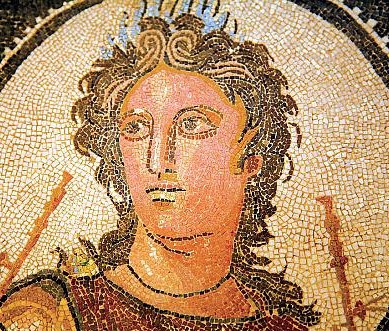
Lewis had longed from his adolescence to become a respected poet. This was partly due to the age in which he was reared. Poetry was viewed as the most cultured and elegant form of writing. Much more so than is true today. (Although I assume today’s poets still regard Euterpe, pictured above, as the most wondrous of Greece’s Muses. Her domain was Music and Poetry.)

Lewis’ poetry did not receive much critical praise. We’ll consider the subject more in the future, but for now suffice it to say that this fact caused him much grief. Walter Hooper, Lewis’ secretary writes in his C.S. Lewis: Companion & Guide: “The most noticeable effect of Lewis’ conversion [to Christianity] was the death of his old ambition as a poet and the emergence of a man never thereafter at a loss for the right words.”

Lewis still wrote poetry, of course, but he no longer sought his identity in it. The following love poem, inspired by his deep affection for his wife Joy, is quite powerful. As they faced her illnesses and death, I believe his words reach heights rarely attained by many a poet laureate.

As the Ruin Falls by C. S. Lewis

All this is flashy rhetoric about loving you.

I never had a selfless thought since I was born.

I am mercenary and self-seeking through and through:

I want God, you, all friends, merely to serve my turn.

Peace, re-assurance, pleasure, are the goals I seek,

I cannot crawl one inch outside my proper skin:

I talk of love—a scholar’s parrot may talk Greek—

But, self-imprisoned, always end where I begin.

Only that now you have taught me (but how late) my lack.

I see the chasm. And everything you are was making

My heart into a bridge by which I might get back

From exile, and grow man. And now the bridge is breaking.

For this I bless you as the ruin falls. The pains

You give me are more precious than all other gains.

If you find this poem moving, it is well worth taking a moment to listen to Phil Keaggy’s musical treatment of Lewis’ lyrics.

Mastering the Contranym

English is a fascinating language. Certainly not the simplest to learn, but extremely versatile. You might say that among the circus of languages, English is the contortionist. (That analogy might make German the strong man and Romani the fortune teller.  As for the bearded lady . . . I’ll leave that to your personal conjecture.)

I’ve formally studied several other languages, yet I consider myself a master of none. Nevertheless, when it comes to English, I do take some pride in my skills, and would be willing to claim for myself the status of journeyman. Among other credentials I have my “verbal” score on the Graduate Record Exam, which placed me in the 97th percentile.

It goes without saying that C.S. Lewis (along with most of his fellow Inklings) was a Master of English. One of his many insights warned of language’s occasional tendency to confuse rather than illuminate.

Language exists to communicate whatever it can communicate. Some things it communicates so badly that we never attempt to communicate them by words if any other medium is available. (C.S. Lewis, Studies in Words).

As much as I discover about English, I find there is still more to learn. This week I enjoyed thinking about contranyms. It’s uncommon enough a word that you know your spell checker won’t recognize it. One of those words only an English major is expected to know.

We all know, of course, what synonyms and antonyms are. Useful little tools for playful manipulation of language. A contranym is a word that possesses two “contradictory” meanings. For example a “citation” which can be awarded for either good or issued for bad behavior. Or, consider “literally,” which has its literal meaning as well as its recently developed and contradictory definition of “figuratively.” For lovers of words that’s a particularly discomforting contranym, and it literally makes my head explode. (No, seriously, please don’t ever write or say something like that unless it is in the form of dialog you’re composing for a semi-literate character.)

There are many more examples.

“They left for London, without a thought as to the luggage they left at the station.”

“He was certainly bound for jail if they discovered the Internal Revenue agent he had left bound in his basement.”

“He buckled his belt a mere moment before his legs buckled beneath him as he was struck by the errant meteorite.”

“Apparently there are many thoughtless oversights when programs are left to governmental oversight.”

Homophonic contranyms are not spelled alike, but they are pronounced similarly. “My aural test is scheduled tomorrow, immediately before the oral defense of my dissertation.”

There are actually a couple of alternative names for contranyms. They can be called antagonyms or autoantonyms, which only serves to make the hazy water that much murkier.

Our next lesson will feature that amazing category of words that are “polysemy.” (Not really, I think this has been enough linguistic thinking to cover us for at least a week.)

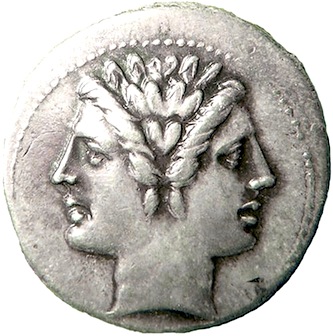
Oh, one final note, for those who were curious about the choice of the image above for this column. Contranyms are also referred to as “Janus words,” in honor of the Roman deity who constantly gazes in two directions. Very fitting.

Generalizations (& Those Who Criticize Them)

“That’s the worst of girls,” said Edmund to Peter and the Dwarf. “They never can carry a map in their heads.”

“That’s because our heads have something inside them,” said Lucy. (C.S. Lewis, Prince Caspian).

It seems that if an author wishes to alienate vast swaths of readers today, they need do no more than “generalize.” Thus, C.S. Lewis has received unjust criticism due to some passages such as this.

To make a judgment such as Edmund’s leaves unmentioned the implied fact that there are, indeed, many useful things that are manifestly present in the heads of girls. But this example of difficulty in reading maps refers to a common perception . . . and if you’ve never heard it voiced before you read it here, you have led a shockingly sheltered life.

No one believes that there are no women capable of defeating even well-trained men in rigorous navigational competitions. Likewise, I have no doubt there are many gifted female cartographers. But please reseal the tar barrel and restuff the pillows; Lewis’ use of this dialog is not intended to be offensive!

I long for the days when a reader gave the writer the proverbial “benefit of the doubt.” A time when our assumption was that they meant something other than the meaning which offended us . . . or, at least, that they intended no malice.

I can’t speak for the rest of the world, but in most of the United States, such days of literary curtesy are long behind us. Today we often read things with an eye to finding the “problem” (ignorance, prejudice, or political viewpoint foreign to our own).

My wife and I attempted to raise our children with critical minds. (Critical in the best sense of the word.) We taught them that there are absolute truths. We informed them that, while people are entitled to hold to all sorts of notions and beliefs, that fact does not make the contending concepts “true.”

At the same time, we did our best to teach our children to respect others. To recognize that all human beings are created in the image of God. To understand that not even the basest man or woman is beyond redemption and restoration.

One practical element of this education in basic virtues took the shape of an adage we taught our kids. I’m sure others have advised this throughout history, and that many have voiced it far more eloquently, but we simply said: Judge everyone and everything by their best cases, rather than their worst.

In practice, this would mean that when a teenager compliments his dad on his wisdom, the dad does not immediately assume his prodigy is attempting to manipulate him. Now, further conversation and “investigation” may certainly prove that manipulation is indeed the goal, but it should not be the very first suspicion of the father.

As a pastor, one of your greatest challenges (and joys) comes in the pulpit. One major difficulty is discussing some extremely complex subjects in a relatively brief period of time. Pastors sometimes lapse into a sort of theological shorthand—which can be confusing or troubling to those unfamiliar with the underlying presuppositions. Taken out of context, individual statements may sound strange, or even heterodox.

I have always encouraged the members of my congregations and (especially) visitors to specifically ask me about what was meant by any statement or phrase that left them uneasy. It is no exaggeration to say that 98% of the time, that has cleared the air in and of itself, as I’ve had an opportunity to elaborate and clarify. (Of course, the other 2% of the occasions constitute a second pastoral “joy.”)

It saddens me when I hear people berate C.S. Lewis for a handful of passages that critics deem to be misogynistic or racist. They fail to extend toward him the goodwill he strove to offer to others. Most of these very few passages can simply be explained by the age in which he lived. It is disingenuous to judge by today’s standards someone who died a half century ago.

Like Lewis’ peers (and, in fact, all human beings), on occasion Lewis himself generalized. Let those who have never done the same cast the first stone. I confess that I’m guilty of it. In fact, returning to the quotation with which we began, I could most definitely echo Edmund’s words in reference to my wife. Ironically, they would be utterly inaccurate in reference to my daughter. For many years she was my “official navigator” as our family often drove across country (relying upon those seven foot by seven foot paper maps that are nearly impossible to refold.)

So, in my own nuclear family I’m batting .500 in terms of the accuracy of this generalization. The next generation may decide. Four of my six grandchildren are girls, and since the oldest girl just turned five, it’s about time to set them out in the woods with a map and a compass to see how they do!

Writing Awards

It’s good to be appreciated. For a lesson I’m teaching later this week I’ll be using a profound song entitled “Legacy,” which was written and recorded by Nichole Nordeman. I’ll place a link for it at the end of the blog. (Wouldn’t want you to get distracted and not return to this page!)

Nordeman’s anointed words remind us to treasure what is truly important, and to consciously ponder the legacy we desire to leave when we’ve breathed our last. She acknowledges that it’s nice to receive praise, but suggests there is so much more to life. What follows is only a portion of her inspiring ballad.

I don’t mind if you’ve got something nice to say about me

And I enjoy an accolade like the rest

You could take my picture and hang it in a gallery

Of all who’s who and so-n-so’s that used to be the best

At such’n’such . . . it wouldn’t matter much

I won’t lie, it feels alright to see your name in lights

We all need an ‘’Atta boy’ or ‘’Atta girl’

But in the end I’d like to hang my hat on more besides

The temporary trappings of this world

I want to leave a legacy

How will they remember me?

Did I choose to love?

Did I point to You enough

To make a mark on things?

I want to leave an offering

A child of mercy and grace

   who
 blessed your name unapologetically

And leave that kind of legacy

It’s in this context that I mention I’ve been nominated for the Versatile Blogger Award. It’s nice that someone wanted to pat me on the back this way, and I like the title of the award, so I decided to accept it. I guess the confirmation of your acceptance (and the actual awarding of the accolade) happens automatically (but presumably not supernaturally) when you post seven points that illustrate your personal versatility. I’ll do that, momentarily.

The gifted C.S. Lewis was noted for his own versatility. Few other people have excelled in such diverse literary fields. Very few. Lewis was a brilliant author of fiction and nonfiction. He was a preeminent literary historian and critic. Much of his poetry was inspiring, although it never attained the measure he desired for it. He is also one of the most highly regarded Christian apologists of the twentieth century. He had few literary equals. Very few.

While Lewis was the recipient of various awards, and accepted them gracefully, he remained quite modest. (One of his most noteworthy honors came in the Carnegie Award, the United Kingdom’s highest honour for children’s literature.) The desire for accolades didn’t sway Lewis from his course.

Likewise, I’ll remain on my course, and not pursue awards or praise. That said, I am pleased to see so many people enjoying this modest blog. (Thank you all!)

Seven quick things about me:

1. I was Thespian of the Year my senior year in high school.

2. While stationed in the Republic of Korea during the 1988 Olympics I watched the United States fall before the Soviet Union in soccer.

3. Although I never played a musical instrument in high school, I joined the University of Washington Husky Marching Band while in college.

4. First car was a 1961 MGA sports car. I’m not quite as old as that sounds; it was already a classic when I got it. (Sure wish I still had it today.)

5. I wrote a Master’s Thesis on the Odes of Solomon, the first Christian hymnal.

6. I once served on a Christian conference committee with Jim Otto, the greatest center ever to play in the NFL.

7. Speaking of awards, in addition to Air Force and Joint medals, during my military career I also received medals from the United States Army and the United States Navy.

P.S. – I promised a link to a Nichole Nordeman’s ballad “Legacy.” Here it is: Legacy by Nichole Nordeman.

Roman Realism

There are many things about ancient Rome that fascinate me. My love for the era finds its roots in the wonderful books of Rosemary Sutcliff and the spectacular cinematic epics like “Ben Hur” that were released during my childhood.

Over the years I’ve studied the Roman world in great depth. I shifted my numismatic interested to coins of the Constantinian era. (You can still purchase the genuine articles relatively inexpensively. Thanks to the tragic individuals who buried their hoards during troubled times and never returned to recover them.)

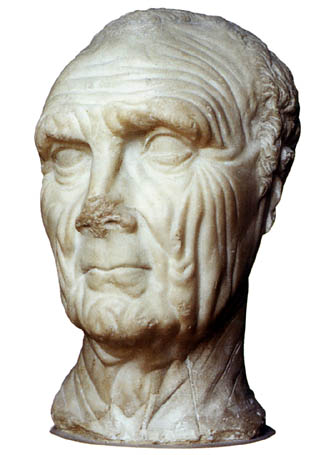
One of my favorite things about the Romans was their realism which manifested itself even in the busts they carved. Unlike the Greeks who strove to idealize everything, the Romans were pragmatic. If the honoree’s face lacked character (or suffered from an excess of the same), then the artist was expected to reflect that fact.

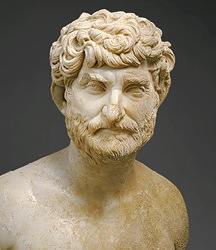
Just look at all the character in the face of the unknown Roman portrayed above. Or, how about this one. So vivid. Imagine just how difficult life must have been for this thirty-two year citizen.* Yes, they did an impressively faithful job portraying the subjects of their artistic studies.

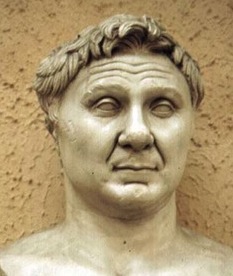
I’m not naïve enough to think that the emperors’ likenesses weren’t “airbrushed” just a tad. But take a look at the image to the left. It was made of an extremely important person, Pompey the Great, and it’s obviously intended to be a true likeness. This image always reminds me of a troubled chaplain assistant who served with me during my isolated tour in Korea. That sergeant’s tussled coiffure witnessed to a nasty hangover. I cannot attribute Pompey’s unruly mane to the same cause.

C.S. Lewis said the first requirement of art is to engage, to connect in some fashion with the interests of the viewer. He wrote this in his essay “Hamlet: The Prince or the Poem,” which he wrote in 1942.

To interest is the first duty of art; no other excellence will even begin to compensate for failure in this, and very serious faults will be covered by this, as by charity.

If I lined up a dozen beautiful and stylized Grecian busts against one wall and the same number of Roman examples against another, I have no doubt which would merit and receive the greatest attention. Idealized portraiture can be appreciated. But realistic likenesses, that celebrate the uniqueness of each human being, these are truly engaging.

Oh, and in closing let me say that I’m just vain enough—should anyone undertake to create a bust of me—to want it crafted in the Greek style, rather than the Roman . . .

* True age unknown . . . but you already knew that, right?

Literary Words

I must confess that I like words. In fact, it’s not excessive to say that I delight in brilliantly witty “turns of phrase” and elegantly painted landscapes that allow me to clearly see what the author is painting with his or her words.

I’ve grown convinced that loving words is a handicap to becoming an excellent writer. Yes, scribblers like me can become adequate or even appreciated writers . . . but to stand in the highest ranks a writer must be willing to ruthlessly slash and slay excess words that impede their perfect vision.

Self-editing is a discipline. It’s something that can be learned and refined through practice. That it forever remains a bit painful for some of us is clear evidence we are overly attached to the words we have put to paper.

C.S. Lewis addressed this general subject in a 1932 letter to his good friend Arthur Greeves. While he was not a slave to the number of words required, he aimed for simplicity and clarity. Lewis wrote:

I think I see, from your criticisms, that you like a much more correct, classical, and elaborate manner than I. I aim chiefly at being idiomatic and racy, basing myself on Malory, Bunyan, and Morris, tho’ without archaisms: and would usually prefer to use ten words, provided they are honest native words and idiomatically ordered, than one “literary word.” To put the thing in a nutshell you want “The man of whom I told you,” and I want “The man I told you of.”

I smiled as I typed Lewis’ remark about “ten words.” He used that to illustrate his willingness to use excessive verbiage to communicate clearly. Brevity was, however, an admirable goal. And brevity is a virtue I’ve seldom been accused of possessing.

In the military, comrades and associates are frequently presenting plaques and remembrances to those who are “rotating” to new assignments. Having served in a dozen different “permanent” assignments, I have boxes full of such memorabilia.

Two of the few I display are genuinely precious. The first is an icon of Saint Athanasius, presented to me by the best “boss” I ever had, an Orthodox priest by the name of John Stefero. The reasons for the personal gift were theological and I accepted it with genuine appreciation and humility.

The second prized gift is a gracefully curved etched glass keepsake featuring the seal of the United States Air Force Chaplain School where I served for three wonderful years. The commandant was speechless as he presented the plaque to me, reading for the first time the inscription that my closest companions had composed for me.

He says in a book what others say in a sentence.

The commandant (later our Chief of Chaplains) was stunned. I was delighted. I led the gathering’s laughter and bellowed, “Yes, and it’s a book well worth reading!”

Jack Lewis may have chided me a bit for the underlying reason for the accolade, but I am confident he would have delighted in the affectionate friendship and esprit de corps with which it was presented.

So much for my shortcomings. For all other writers (including, perhaps, you?) . . . I would recommend following the master’s example, rather than my own.