Promoting Our Writing

blog promoOne of the common frustrations online writers face is the question: “is anyone out there reading what I write?”

I suspect that’s been the plaintive lament of all authors, since the dawn of written languages. Just as a conversation can’t occur when one of the parties ignores the other, no “communication” takes place when something is written, but never read.

Blogs provide an excellent framework for exploring this phenomenon. Bloggers don’t write merely for themselves. (If they wanted to do that, they’d simply “journal.”) Bloggers long to have others read their words. And the commonest disappointment of new online writers is just how few people actually visit their sites.

Fortunately, communities such as wordpress include features that allow us to track statistics in an accurate manner. Even when visitors fail to comment or formally “like” a post, they still leave digital footprints. I’ve written before about how enjoyable it is to see how frequently your page has been visited by people from all around the world.

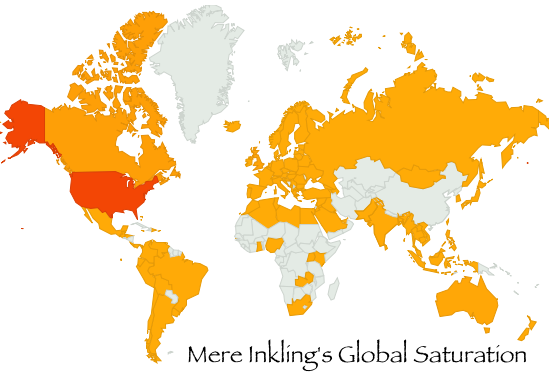
At that time I shared my statistical world map, (directly below). Today I follow it with my current status . . . which reveals that I have finally penetrated the Great Wall and accessed the vast population of the People’s Republic of China! (Of course, I have long suspected the Chinese military of spying on my column, in an effort to glean military secrets about the Inklings’ military service during WWI.)

countries

countries 2

Methods of Increasing Visits to Our Sites

There are a number of concrete ways to expose others to our words. A few appear below. Still, it’s good to remain realistic in our expectations.

I recently read that it’s worthwhile being listed in the Technorati blog directories. As part of the verification process for inclusion there, I need to include in one of my blogs the code RFQE8T2R48RG. (I just hope their verification search engine isn’t confused by the numerous occasions when I’ve used that very same code in my previous blogs.)

As promised, here are a handful of nearly universal recommendations for increasing the number of visitors to our websites.

  • Write on subjects we feel passionate about.
  • Write well.
  • Be as unique as possible (in our personal publishing niche).
  • Encourage people to leave comments.
  • Dialog with the readers who do.
  • Create intriguing titles for our posts.
  • Write regularly (at least weekly, but not hourly).
  • Offer RSS and email subscription options.
  • Visit other blogs & offer encouraging comments.
  • Tell everyone you know to read Mere Inkling.

Truly sorry about that last plug. I’m simply trying extra hard to ensure my words don’t drop into the obsidian darkness of digital anonymity. Blessings in your own efforts to ensure the same!

A Literary Phobia

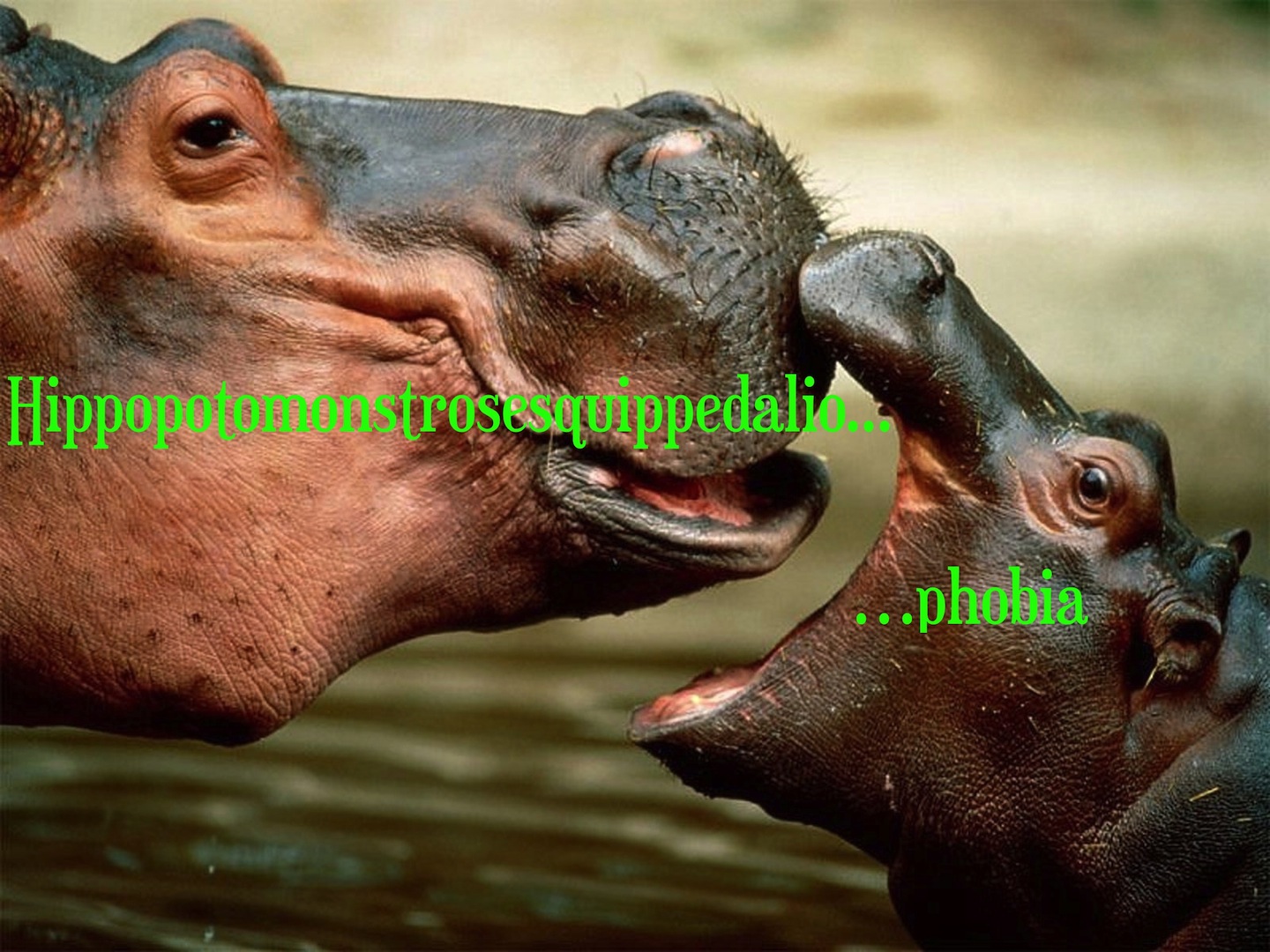
hipposWhat in the world does this protracted word mean?

Hippopotomonstrosesquippedaliophobia

From the suffix, we can assume that it refers to some sort of “fear.” But fear of what? Hippopotami?

No, this lengthy word doesn’t refer to the African “river horses” from which it derives its beginning. This peculiar construction describes nothing other than a fear of long words!

I know people who find long words daunting . . . but none who have admitted to be in fear of them. I myself am a bit intimidated by unfamiliar words that I have to pronounce in front of others. (I recently visited a writing group that caught me off guard with their practice of reading one another’s work out loud. Not only was I the first person expected to begin reading the first article critiqued that morning—it included a number of words from French cuisine with which I was unfamiliar.)

I don’t mind encountering unfamiliar words in a text (that I’m reading privately), especially when the meaning is evident from the context. In fact, I often enjoy the introduction, since it expands my own vocabulary.

The fact his, however, that many very gifted writers warn their readers to avoid lengthy or complicated words.

Just last week I contrasted George Orwell’s writing advice with that of C.S. Lewis. Orwell said,

“Never use a long word when a short one will do.”

C.S. Lewis, included in his short list of advice the encouragement to,

“Always prefer the plain, direct word to the long, vague one.”

While these suggestions may “sound” identical, they are not. Orwell is concerned here with simplicity (rather than brevity, per se). Lewis, though, is advocating clarity.

Lewis does not object at all to using a multisyllabic word. He merely argues that the choice needs to be one that helps communicate rather than confuse. Allow me to share a simple example. Following Lewis’ counsel, one of these sentences would be problematic, while the other would be okay.

Life is all about love.

Experiencing contentment and joy relates directly to one’s ability to offer, and receive, affection from other human beings.

Obviously one sentence is far more complex than the other. However, it’s meaning is quite clear. The simpler, five word sentence is so vague as to allow for any number of interpretations. For example, in addition to the alternative above, it might mean (to its writer):

Without a foundation of self-love, we cannot experience life to its fullest.

     or . . .

At the Final Judgment, it is only our acts of love that will pass intact through the “purifying fire.”

     or . . .

The more people with whom you can “sow your wild oats,” the happier you will be.

The Government Intervenes

Amazing as it may seem, the United States government actually has a website devoted to promoting simple language: plainlanguage.com. It exists to help implement the Plain Writing Act of 2010.

While the effectiveness of the statute is debatable, it’s intention is praiseworthy.

On one page it directs agencies to avoid complex words. Instead of “endeavoring to assist,” writers are told to use “told to help.” While that is absolutely commendable in governmental documents, I prefer a bit more flavor when I’m reading for pleasure.

I strongly encourage anyone suffering from hippopotomonstrosesquippedaliophobia to seek professional help. This is especially true for those who desire to express themselves clearly. We need never fear a lengthy word—as long as we are using the right word!

Hip-Hop Literary Lessons

flocabDo you ever have trouble remembering the key elements of a story? Well, you may not now, since you’ve become an accomplished writer. However, there was once a time when you were just learning about such matters. And that learning might have been far easier than it was if some of today’s teaching resources existed then.

This week I stumbled across a very unusual approach to teaching the fundamental building blocks of stories. You might want to bookmark the page, in case you ever experience difficulty remembering those five pesky elements required for your short fiction, or want to teach a young learner. You need look no further than Flocabulary’s innovative lesson “Five Things.”

The song is less than four minutes long, so go ahead and watch it now, before reading on. (Barring a small typo, it’s quite educational, and their website includes testimonials from teachers affirming how well it connects with young people.) Despite the fact that it’s got a hip-hop beat—not my favorite musical genre—it’s actually quite entertaining . . . and it’s easy to see how well it would connect with today’s younger students.

[Warning: If you watch the following video, you may well be singing along with the chorus before it ends.] Story Elements

Plot, Character, Conflict, Theme,
Setting, yes these are the 5 things
That you’re going to be needing
When you’re reading or writing
A short story that’s mad exciting.

Music is a powerful medium, and when it is harnessed for educational purposes, it can accomplish wonderful things.

Music can be enjoyed for itself . . . its own inherent loveliness.

Music can also be used to communicate holy things. I believe this is the very reason it exists. Divine grace and our response to our Creator’s love are too majestic to be restricted to simple words.

The brilliant African Bishop Augustine of the city of Hippo is cited as saying “he who sings, prays twice.” Many have echoed these words. I have no doubt Augustine believed this, but the more accurate quotation is: “he who sings well prays twice” (bis orat qui bene cantat). Lest those of us with less than professional vocal chords be dismayed, I am confident the “well” here refers here to worshiping God in spirit and truth (John 4:23).

I have no doubt which of these two pleases God more. The most wondrous voice ever created (a gift itself from our Creator) flawlessly navigating three octaves and singing of the cares of this world—or the feeble, cracking, off-key strains of a tone deaf beggar who is praising the Lord for the gift of his daily bread.

C.S. Lewis famously expressed his disaffection for most church hymnody in a 1950 letter where he wrote:

I naturally loathe nearly all hymns; the face and life of the charwoman in the next pew who revels in them, teach me that good taste in poetry or music are not necessary to salvation.

We must forgive Lewis his condescending comment here, which was only meant for a private communication. And, if read in context it can be interpreted almost as a sort of confession. While he disliked the quality of contemporary Anglican hymns, he was acutely aware of how insignificant the matter was in light of the vital importance of  knowing Christ. (His description of the glorification of the modest Sarah Smith in The Great Divorce reveals how well he recognized that the charwoman beside him, despite her musical preferences, could easily dwarf him in holiness and religious courage.)

In a letter written in 1916, Lewis alluded to the wonder of music, and it’s relationship to particular words. “Isn’t it funny the way some combinations of words can give you—almost apart from their meaning—a thrill like music?”

Toward the end of his life, Lewis invested much time in a literary study of Edmund Spenser’s The Faerie Queene. (It was actually published after his death, based upon his notes, as Spenser’s Images of Life. It includes a sparkling description of the book as a musical masterpiece.

A story of this kind is in a way more like a symphony than a novel. Corresponding to the themes of the musical form, the literary form has images, which may be delicious or threatening or cryptic or grotesque, but which are always richly expressive of mood.

The images are in every possible relation of contrast, mutual support, development, variation, half-echo, and the like, just as the musical themes are. But the ostensible connection between them all—what keeps the meddling intellect quiet—is here provided by the fact that they are all happening to someone.

They are all worked into the experience or the world of the characters “whose” story it is. That, no more and no less, is the raison d’étre of characters in the characterless story.

I have no doubt Lewis would have found the video above jarring. Yet, I suspect he would have approved of the fact that the music was creating a bridge to some for whom traditional learning is incomprehensible. He was a traditionalist. In many ways, a medievalist. But he was, above all, a redeemed child of God. And, because of that, he desired the best for his neighbor, his nation, and our world.

That said, I don’t want to hear that any readers of Mere Inkling got it into their heads to put any of C.S. Lewis’ words into hip-hop melodies. Ever!

_____

If you are interested in checking out the official website for Flocabulary, you can view their lesson “Wordplay” (on figurative language). I understand, however, that some of their lessons with political dimensions have been considered superficial.

Orwellian Advice

cls orwellThe title of this post is slightly misleading. In truth, it does contains advice from Eric Arthur Blair (1903-1950) whose pen name was George Orwell. However, because of the impact of his two dystopian classics, Nineteen Eighty-Four and Animal Farm, the author’s name has actually become a true English adjective . . . one that might suggest I’m alluding to futuristic or totalitarian matters.

Or·well·i·an [awr-wel-ee-uhn] means something that resembles his literary work, especially as described in the aforementioned novel and novella. (Within the Christian literary community, “Lewisian” is common shorthand for referring to C.S. Lewis . . . but that word is unlikely to ever find its way into standard dictionaries.)

Despite the enormous (and eternal) differences between Orwell and Lewis, they did have something significant in common. More about that in a moment.

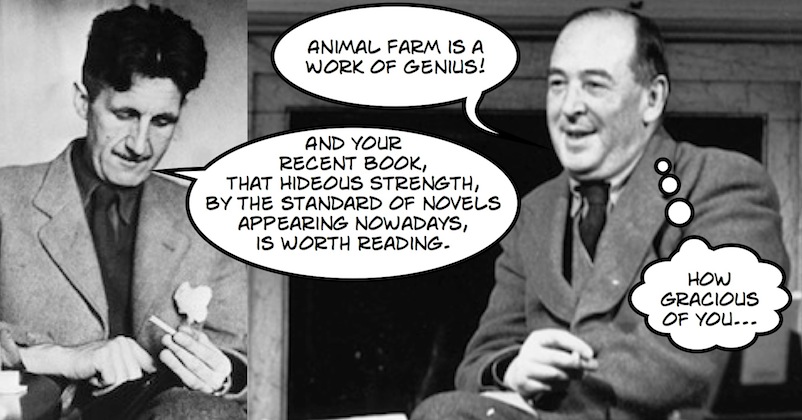
As the graphic I created above reveals (from actual quotations), Lewis had a better opinion of Orwell’s work than vice versa. Orwell disliked Lewis and resented the fact that he was popular among many common people. He particularly disliked Lewis’ traditional (evangelical) Christianity. In his review of That Hideous Strength, Orwell dismissed the biblically based supernatural as a version of “magic.”

Much is made of the fact that the scientists are actually in touch with evil spirits, although this fact is known only to the inmost circle. Mr. Lewis appears to believe in the existence of such spirits, and of benevolent ones as well. He is entitled to his beliefs, but they weaken his story . . .

Orwell was one of those “professing” Christians who is accurately labeled a hypocrite. He was a communing member of the Church of England, and advocated a Judeo-Christian moral code, but did not believe in an afterlife. The following letter, written to Eleanor Jaques in 1932, reveals his hypocrisy.

It seems rather mean to go to HC [Holy Communion] when one doesn’t believe, but I have passed myself off for pious & there is nothing for it but to keep up with the deception.

In a comment to my last post, a good friend of Mere Inkling, Brenton Dickieson at A Pilgrim in Narnia, reminded me of a thought-provoking essay on English written by Orwell. His essay, “Politics and the English Language,” addresses a number of problems with the language. He considers dying metaphors, verbal false limbs, pretentious diction, and meaningless words.

A Similarity in the Two Writers’ Advice

Orwell’s goal is “the scrapping of every word or idiom which has outworn its usefulness. It has nothing to do with correct grammar and syntax, which are of no importance so long as one makes one’s meaning clear, or with the avoidance of Americanisms, or with having what is called a ‘good prose style.’”  [As irritating as I imagine most Europeans find Americanisms!] Writers of fiction will enjoy the way Orwell explains the challenge of “showing, not telling.”

What is above all needed is to let the meaning choose the word, and not the other way around. In prose, the worst thing one can do with words is surrender to them. When you think of a concrete object, you think wordlessly, and then, if you want to describe the thing you have been visualizing you probably hunt about until you find the exact words that seem to fit it.

When you think of something abstract you are more inclined to use words from the start, and unless you make a conscious effort to prevent it, the existing dialect will come rushing in and do the job for you, at the expense of blurring or even changing your meaning. Probably it is better to put off using words as long as possible and get one’s meaning as clear as one can through pictures and sensations. Afterward one can choose—not simply accept—the phrases that will best cover the meaning, and then switch round and decide what impressions one’s words are likely to make on another person.

This last effort of the mind cuts out all stale or mixed images, all prefabricated phrases, needless repetitions, and humbug and vagueness generally. But one can often be in doubt about the effect of a word or a phrase, and one needs rules that one can rely on when instinct fails. I think the following rules will cover most cases:

1. Never use a metaphor, simile, or other figure of speech which you are used to seeing in print.

2. Never use a long word where a short one will do.

3. If it is possible to cut a word out, always cut it out.

4. Never use the passive where you can use the active.

5. Never use a foreign phrase, a scientific word, or a jargon word if you can think of an everyday English equivalent.

6. Break any of these rules sooner than say anything outright barbarous.

These rules sound elementary, and so they are, but they demand a deep change of attitude in anyone who has grown used to writing in the style now fashionable.

Students of Lewis will note in the final passage the parallel with advice he provided to a correspondent in 1956. Although the context is different—Orwell’s is a formal essay and Lewis’ a casual correspondence written to a child, the similarities are significant. Lewis would have been familiar with Orwell’s essay, composed a decade before his letter, but the resemblance between their words is better attributed to shared literary philosophies and the self-evident nature of the principles. Lewis identified five important considerations when writing.

1. Always try to use language so as to make quite clear what you mean and make sure [your] sentence couldn’t mean anything else.

2. Always prefer the plain, direct word to the long, vague one. Don’t implement promises, but keep them.

3. Never use abstract nouns when concrete ones will do. If you mean “More people died” don’t say “Mortality rose.”

4. Don’t use adjectives which merely tell us how you want us to feel about the things you are describing. I mean, instead of telling us a thing was “terrible,” describe it so that we’ll be terrified. Don’t say it was “delightful;” make us say “delightful” when we’ve read the description. You see, all those words (horrifying, wonderful, hideous, exquisite) are only like saying to your readers, “Please, will you do my job for me?”

5. Don’t use words too big for the subject. Don’t say “infinitely” when you mean “very;” otherwise you’ll have no word left when you want to talk about something really infinite.

Whatever the two authors thought about the other, they certainly shared some similar views on the subject of effective writing. And, I think we can assume with confidence that Lewis would concur with Orwell’s final rule. Under no circumstances should we resort to barbarity! For, as Lewis wrote in The Four Loves, “Who does not prefer civility to barbarism?”

____

If you are interested in reading Orwell’s “Politics and the English Language” in its entirety, you can find it here.

Avoid them Like the Plague

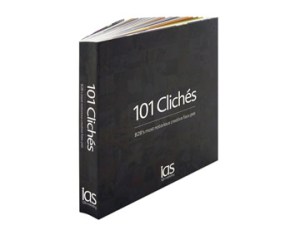
cliche bookAvoiding clichés in one’s writing is such oft-repeated advice it’s nearly become a cliché itself.

Many do not make much sense to people approaching a language from a literal perspective. For example, those new to American English may require a bit of explanation to understand that “hit the books” refers to studying rather than literary pugilism.

Some clichés are easily deciphered, especially when read in context. As an admonition to stop obstructing a view, we can understand why someone would say, “You make a better door than a window.”

“Don’t rain on my parade” adequately warns the hearer to avoid dampening the speaker’s special plans or activities.

Folksy adages are common where clichés are concerned. Take “The acorn doesn’t fall far from the tree.” We all know it references a child who shares numerous traits with a parent.

And we have interchangeable versions of the same notion, in case a lazy writer wishes to alternate your redundancies. He/she is a “chip off the old block” means essentially the same thing. And there’s always the classic “like father, like son,” and its corollary “like mother, like daughter.”

“As snug as a bug in a rug” used to be a favorite of my mother, ever applicable as she tucked little ones into their beds. Today, however, with bedbugs plaguing humanity in epidemic proportions, that cuddly image may have lost a touch of its appeal.

Some clichés have clearly outlived any usefulness they may once have possessed. “Too many chiefs, and not enough Indians,” clearly refers to a situation in which everyone is in charge and there no one is able or willing to actually carry out the project. However, few writers would tempt incurring the wrath of readers by using such a dated and rather prejudiced saying.

A cliché, of course, is a typically trite phrase that has lost its element of ingenuity due to overuse. It is something serious writers strive to avoid at all costs. But the final phrase in my previous sentence reveals how difficult it can be to purge these worn out words from our writing. Whenever used, they should be included consciously; writers might utilize them to establish, for example, a comic tone.

Even the gifted C.S. Lewis recognized the threat of clichés worming their way into one’s work. In a 1922 entry in his diary he wrote:

Tried to work at Dymer [his narrative poem] and covered some paper: but I am very dispirited about my work at present—especially as I find it impossible to invent a new opening for the Wild Hunt. The old one is full of clichés and will never do. I have learned too much on the idea of being able to write poetry and if this is a frost I shall be rather stranded . . .

The word cliché itself originated in France, where it was a printing plate or stereotype cast from an original composed of movable type. (The casting freed the movable type for new projects while maintaining the lettering for possible future printings.) The word came to be applied to ready-made phrases. However, the casting of printing plates is one thing. Recycling exhausted phrases ad nauseum is quite another.

Clichés are generally limited to a particular country or culture. Some are restricted to given regions. When outsiders hear or read these phrases, they often make little sense.

Some gain international esteem. More than a century ago Lord Acton described a universal truth of politics that resonates across boundaries. We have all witnessed the truth that “absolute power corrupts absolutely,” but those wise words are not something we should typically parrot in our own writings.

Not knowing the original source of a cliché is common. It is rather tragic, though, when it comes to texts that should be familiar to writers. For example:

“All’s well that ends well” is one of Shakespeare’s best loved maxims. If most Americans were asked whether it came from the pen of the Bard or Benjamin Franklin, we might be sadly disappointed with the results.

“The writing is on the wall” infers the outcome is already determined. But too few recognize this as a reference to a miracle recorded in the Book of Daniel. (If you’re not familiar with it, you can read the story here.)

Some clichés that relate to the art of writing would include the following [with my modest illustrations attached]:

“You can’t judge a book by its cover.”

     Appearances may be misleading.

Someone who appears wonderful when you first meet them may be just like an ebook with a professionally designed cover that contains a poorly scanned reprint replete with typos.

“It’s nothing to write home about.”

     Something that’s boring and not worth retelling.

While the freedom of POD technology has created democracy within the publishing industry, it’s also led to millions of meandering “books” that should “never have seen the light of day.”

A person is “an open book.”

     Someone who readily reveals their personality through word and action.

The type of character skilled authors will wish to introduce in limited quantities, especially if they are writing mysteries.

“Throw the book at him.”

     Give him the maximum possible judicial punishment.

The well-deserved fate of best-selling authors who rest on their laurels and start “phoning in” their sequels.

We turn now to a non-literary but colorful example of an American colloquialism that has spread far from its origins in the swine-breeding communities where it undoubtedly originated. It’s one of my favorite clichés, and it just may have a few good uses left in it, so feel free to include it in your next column or book . . . and no need to cite me as your source:

“You can’t make a silk purse out of a sow’s ear.”

     A task is impossible, given what you have to work with.

The echoing refrain of editors whose clients expect them to transform a few dusty lumps of coal into diamonds.

Possible Valid Uses for Clichés

While it’s safest for writers to avoid them altogether, there are a handful of occasions where they are not utterly inappropriate.

One suitable place for “chesnuts” like these to appear is in dialogue—especially when it’s written for a character a writer desires to portray as rather shallow-thinking.

It’s incorrect to suggest good writers never use clichés in conversation or composition. They do. The difference is that when they do include such tired phrases in their normally witty banter, they do it with a sense of irony.

C.S. Lewis, master of wordplay that he was, illustrated how we can creatively re-imagine or reword a cliché to reinvigorate it. Only the very best minds are up to this task. Yet, when it’s successfully accomplished, it can prove quite entertaining. The following comes from an informal conversation that was recorded before his retirement, preserved in the collection On Stories. Lewis refers in passing to an overly detailed passage in literature that nearly obscured the storyline.

The only trouble is that Golding writes so well. In one of his other novels, The Inheritors, the detail of every sensuous impression, the light on the leaves and so on, was so good that you couldn’t find out what was happening. I’d say it was almost too well done. All these little details you only notice in real life if you’ve got a high temperature. You couldn’t see the wood for the leaves.


International Blogging

countries

Who reads blogs? Well, initially, we find just two sources of readers.

  1. Family & Close Friends who we can coerce into reading it, and put on the spot by publicly asking questions related to our recent columns to tighten the screws just a smidge.
  2. Fellow bloggers who search for interesting reads with the ulterior hope that the writers of posts they “like” will make a reciprocal journey to their site.

Expanding beyond those two categories is the challenge. I suspect that most bloggers are resigned to only reaching a relatively small audience. And that’s not necessarily a bad thing. After all, junk mail reaches the boxes of millions, but it is tossed into recycling without a second thought. On the other hand, a blog may only be read by a handful of people, but one or two of them may be wonderfully touched or encouraged through that brief encounter. Junk mail is deleted with a groan. Our posts, in sharp contrast, may elicit a smile, a laugh, or perhaps even an appropriate tear.

I can settle for that.

One of the nice things about being part of the WordPress community is the way writers can monitor their site statistics. One fascinating feature is “Views by Country,” which tracks the national origin of visitors to a blog. (Well, not necessarily their ethnic origin, but the country from which they established their online connection with the website.)

Checking out this resource is fantastic for several reasons. First, it’s pleasant as we note visits from locales with which we have a special bond. Republic of Korea, spent a busy year there ministering to those guarding democracy, but still managed to visit many beautiful sites and established many friendships. United Kingdom, got to live there with my family, and visited amazing historic locations too numerous to list. (But, shouldn’t the UK count as three or four countries?) Guam, we got to live there too and enjoy the scenic ocean vistas. (Of course, it’s not a separate country either, being a Territory of the United States.) So what if the word “country” is applied a bit loosely, the sheer breadth of the program’s coverage is impressive.

A second value of the list is that it is educational. You can learn about the existence and/or location of many exotic lands. I’ve had visitors from the Mongolian steppes of the Khans, WWI catalyst Montenegro, freedom-seeking Syria, and the Viking-haunted Faroe Islands.

The third major benefit of visiting the statistics tool is that it can actually reinforce a writer’s sense that someone out there in the vast global unknown is actually interested in their words. I’m amazed, and a mite humbled, to have had visitors to MereInkling from 129 “countries.” Pretty amazing. When I revisit the list every two or three months I see one or two newly reached populations. Yet, as I look at the map, I see many nations remain to be reached. For example, most of the “-stans” and many countries in Africa have yet to feel the warm and liberating glimmer of light MereInkling attempts to deliver.

The Remaining Mystery

I am still plagued by one unanswered question though.

I readily understand why the People’s [misnamed] “Republic” of China has barred MereInkling from internet availability for their billions of prisoners residents.

What perplexes me is why the Kingdom of Denmark has barred access to MereInkling for the subjugated country of Greenland?!? One would think that, in light of their 5 day summer and 360 winter that they would be eager to read something as entertaining as MereInkling. Why has an internet wall been erected to prevent them from doing so? What, we must wonder, is going on behind that impenetrable Ice Curtain?

Yes, for those who think they’ve noted a flaw in my conspiracy theory, I am fully aware that the Faroe Islands are also technically part of the Danish empire. So, why would citizens of Denmark proper and the occupied Faroes be allowed to visit MereInkling while the Greenlanders are left to find enjoyment in measuring the advance and retreat of massive glaciers? The mystery deepens.

As C.S. Lewis wrote in “The Efficacy of Prayer,” in a passage I’ve wrenched completely out of context: “There is a mystery here which, even if I had the power, I might not have the courage to explore.”

Skillful Turns of Phrase

frank burnsEveryone loves an exquisite turn of phrase. Those of us who dabble in writing are particularly susceptible to their numinous power.

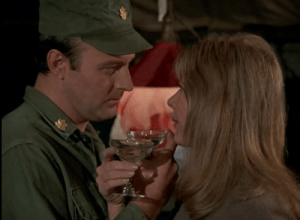
I’ve been doing some research on the Father Mulcahy character from M*A*S*H. William Christopher transformed the fictional character from a caricature of military chaplaincy, into a compassionate and respected representative of the Holy. During my research, I’ve been reviewing episodes of the series in which he was featured.

In “Alcoholics Unanimous,” which originally aired in 1974, Mulcahy has been tasked with delivering a lecture on temperance. In an interesting twist he wears full clerical garb and prepares what is essentially a sermon. Since the lecture is a “mandatory formation,” the mess tent (which doubles as the chapel) is filled to capacity.

Sitting in the front row are the hypocritical Majors Burns and Houlihan. (For those unfamiliar with the show, they constantly call for the most rigid of military standards, even as they are all the while breaking the military’s Uniform Code that prohibits adultery.) Major Houlihan’s nickname, in fact, is “Hotlips.”

In the aforementioned episode they have a delightful little exchange that illustrates through its witty banter the skill of the Hollywood writers at their best. As the hospital’s temporary commander, Burns has banned all alcohol and mandated attendance at the lecture. The tent is filled to its limits as Houlihan turns adoring towards her paramour and says:

Houlihan: Frank, what a turnout!

Burns: Lemmings must be directed to the sea.

Houlihan: You’re magic with a phrase!

It requires skill to create a well-crafted turn of phrase. Well, even a fool like Frank Burns can stumble across a clever phrase, but only a master can repeatedly coax them from their ethereal realms.

C.S. Lewis was just such a master. His works abound with profound and captivating language. And he recognized it in the works of others. In “Dante’s Similes,” in Studies in Medieval and Renaissance Literature, he wrote:

[Dante] is the most translatable of the poets—not, probably, that he entrusts less wealth than others to the music of the words and the nuance of the phrase but that he entrusts more than others to the “plain sense.”

In The Four Loves, Lewis reveals just how impoverished much of our language is . . . even when it relates to the most inspiring of matters. Describing the difference between carnal “love” and genuine love, he shows that even impoverished phrases can begin to grasp the truth behind the dynamics of affection and commitment.

We must do the works of Eros when Eros is not present. This all good lovers know, though those who are not reflective or articulate must be able to express it only in a few conventional phrases about “taking the rough along with the smooth,” not “expecting too much,” having “a little common sense,” and the like. And all good Christian lovers know that this programme, modest as it sounds, will not be carried out except by humility, charity and divine grace; that it is indeed the whole Christian life seen from one particular angle.

Surely those who are more articulate can more expressively communicate our love for our spouse. Yet, even in so-called matters of the heart, we frequently utter phrases that are utterly mundane.

The History of the Phrase “Turn of Phrase”

One online dictionary uses these definitions:

a turn of phrase

1. a way of saying something “Significant other,” meaning “partner,” now that’s an interesting turn of phrase.

2. the ability to express yourself well She has a nice turn of phrase which should serve her well in journalism.

The Phrase Finder website provides excellent information about numerous phrases. And, in discussing this idiomatic phrase about phrases, they do not disappoint.

So, a phrase was a style of speaking or writing, and style meant beauty of expression. We can now interpret a fine “turn of phrase” as analogous to a skillfully crafted piece of wood turned on a lathe. John Dryden referred to the “turning” of words in this sense in The Satires of Decimus Junius Juvenalis, 1693: “Had I time, I cou’d enlarge on the Beautiful Turns of Words and Thoughts; which are as requisite in this, as in Heroique Poetry.”

Check out their entire article about turns of phrase at the link above. And, may your own writing be filled with impressive verbal ballets, replete with inspiring leaps and unforgettable pirouettes.

Avoiding Fantasy Clichés

We’re all familiar with that classic paradigm of suspenseful introductions: “It was a dark and stormy night.” While this is not intrinsically poor writing, it has been parroted and ridiculed for so long as a lightweight cliché, that the author’s name has become a byword for writing “purple prose.”

In the same way, there are certain plotlines or story devices that are overused, particularly in genre literature. For example, J.R.R. Tolkien’s genius in creating Middle Earth cannot be exaggerated. Yet, since his epic, dwarves, elves and orcs innumerable have been written about in chronicles ad nauseum by lesser poets. Many of Tolkien’s inventions seem rather tired when repeated by contemporary writers for the hundredth time. (Hundred thousandth time, if you count fan fiction.)

This literary dilemma has led to the creation of “The Fantasy Novelist’s Exam,” designed to be taken by aspiring authors before submitting their manuscripts for publication. (The link for the exam will be found below.)

The purpose of the test is to determine how derivative your storytelling is. If you use too many of the listed elements, you are in danger of composing a parody rather than a masterpiece. Some of the questions posed in the exam are astute, many are glib, and most are humorous. Here’s a sampling, with my responses (speculative, of course, since I haven’t written any fantasy proper).

Is your main character the heir to the throne but doesn’t know it?

How about an anonymous member of minor nobility?

Do inns in your book exist solely so your main characters can have brawl?

I never visit bars, but isn’t hosting altercations a primary purpose of all drinking establishments?

Do you think you know how feudalism worked but really don’t?

Ah, a conundrum. If I know I don’t really know . . .

Do any of your female characters exist solely to be captured and rescued?

You mean they have another role they can perform? (Wait, I’m just joking!)

Do you think that “mead” is just a fancy name for “beer?”

My Viking ancestors would never forgive me if I did!

Do you think horses can gallop all day long without rest?

I wasn’t raised on a ranch, but I’m not that stupid.

Is this the first book in a planned trilogy?

Whoops.

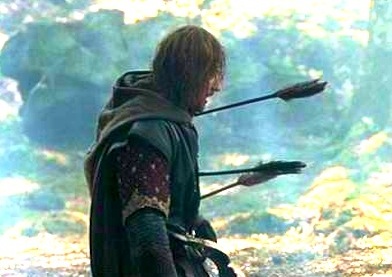
As you see, the questions are fun to read, but there’s one that bothered me a bit. Well, not the question itself. It’s innocent enough. But it alludes to a particular scene in The Lord of the Rings films which I find stunning—in the original sense of the word. It strikes me viscerally, almost leaving me breathless.

Do you really think it frequently takes more than one arrow in the chest to kill a man?

Generally, no . . . but if that hero is Boromir, most certainly!

The Death of Boromir

One of the most moving scenes in The Lord of the Rings involves the death of Boromir as he sacrifices his life in a futile battle to allow the hobbits time to escape the Uruk-hai. It’s impact is magnified by the fact that it immediately follows Boromir’s near-betrayal, under the corrupting influence of the Ring.

The irony is that this spectacular scene is not described in detail in Tolkien’s book. It is a tribute to director Peter Jackson’s cinematic brilliance. This is the original telling:

Even as [Aragorn] gazed his quick ears caught sounds in the woodlands below, on the west side of the River. He stiffened. There were cries, and among them, to his horror, he could distinguish the harsh voices of Orcs. Then suddenly with a deep-throated call a great horn blew, and the blasts of it smote the hills and echoed in the hollows, rising in a mighty shout above the roaring of the falls.

“The horn of Boromir!” he cried. “He is in need!” He sprang down the steps and away, leaping down the path. “Alas! An ill fate is on me this day, and all that I do goes amiss. Where is Sam?”

As he ran the cries came louder, but fainter now and desperately the horn was blowing. Fierce and shrill rose the yells of the Orcs, and suddenly the horn-calls ceased. Aragorn raced down the last slope, but before he could reach the hill’s foot, the sounds died away; and as he turned to the left and ran towards them they retreated, until at last he could hear them no more. Drawing his bright sword and crying Elendil! Elendil! he crashed through the trees.

A mile, maybe, from Parth Galen in a little glade not far from the lake he found Boromir. He was sitting with his back to a great tree, as if he was resting. But Aragorn saw that he was pierced with many black-feathered arrows; his sword was still in his hand, but it was broken near the hilt; his horn cloven in two was at his side. Many Orcs lay slain, piled all about him and at his feet.

Aragorn knelt beside him. Boromir opened his eyes and strove to speak. At last slow words came. “I tried to take the Ring from Frodo” he said. “I am sorry. I have paid.” His glance strayed to his fallen enemies; twenty at least lay there. “They have gone: the Halflings: the Orcs have taken them. I think they are not dead. Orcs bound them.” He paused and his eyes closed wearily. After a moment he spoke again. “Farewell, Aragorn! Go to Minas Tirith and save my people! I have failed.”

“No!” said Aragorn, taking his hand and kissing his brow. “You have conquered. Few have gained such a victory. Be at peace! Minas Tirith shall not fall!” Boromir smiled.

“Which way did they go? Was Frodo there?” said Aragorn.

But Boromir did not speak again.

“Alas!” said Aragorn. “Thus passes the heir of Denethor, Lord of the Tower of Guard! This is a bitter end. Now the Company is all in ruin. It is I that have failed. Vain was Gandalf’s trust in me. What shall I do now? Boromir has laid it on me to go to Minas Tirith, and my heart desires it; but where are the Ring and the Bearer? How shall I find them and save the Quest from disaster?”

He knelt for a while, bent with weeping, still clasping Boromir’s hand. So it was that Legolas and Gimli found him. (Lord of the Rings, Book III Chapter 1).

So, we understand that while a single arrow might slay a common warrior, it could well take a quiver full to lay low a champion such as this.

___

If you would like to review “The Fantasy Novelist’s Exam,” simply follow this link.

Vivacious Vocabularies

One reason I love reading C.S. Lewis arises from his adroit use of the English language. His vocabulary is immense. It is pleasant to run into words one seldom encounters on the drab byways of modern journalism and tangled thoroughfares of contemporary “social media.”

Consider the following example. I was exploring The Allegory of Love when I read this: “There is nothing in literature which does not, in some degree, percolate into life.”

What a delightful verb! It evokes for me recollections of my youth when my parents would refer to our coffee pot as the percolator. Simultaneously, it reminds me of more recent—less happy—usages: “I’m sorry, but inadequate soil percolation means you’ll have to install a far more expensive septic system than normally required.”

It’s discouraging when you consider the sad state of modern vocabularies. I read somewhere that people typically only use about 10% of the words they know. So a common vocabulary of 5,000 spoken words would mean they know (i.e. can recognize written or audible forms of) about 50,000 words. Shakespeare used 29,000 words in his plays and sonnets, suggesting an expansive vocabulary. Likewise, brilliant authors like C.S. Lewis would boast a praiseworthy mental dictionary.

I am sometimes curious about my own vocabulary. I consciously attempt—in conversation as well as writing—to utilize at least 15% of the words I know. After all, the English language is so rich, it’s criminal to limit ourselves to pedestrian words. It’s like having all the ingredients for a delicious feast available to us and settling for slapping together a peanut butter sandwich.

I also love the precision that comes from using the exact word that suits the occasion. For example, in a thriller it matters greatly how the hero’s nemesis inflicts injury. A skilled writer would never say “Professor Moriarty cut Holmes.” Instead, we would learn that he slashed . . . stabbed . . . sliced . . . scarred . . . carved . . . or perhaps he merely nicked the detective. Likewise, we would probably know the type of weapon he was using. It would not be a mere “knife.” It might be a saber . . . a dagger . . . a pocketknife . . . scalpel . . . carving knife . . . or perhaps even a bayonet.

Lewis addressed this richness in vocabulary in an essay on “Transposition” which appears in The Weight of Glory.

If the richer system is to be represented in the poorer at all, this can only be by giving each element in the poorer system more than one meaning. The transposition of the richer into the poorer must, so to speak, be algebraical, not arithmetical. If you are to translate from a language which has a large vocabulary into a language that has a small vocabulary, then you must be allowed to use several words in more than one sense. If you are to write a language with twenty-two vowel sounds in an alphabet with only five vowel characters than you must be allowed to give each of those five characters more than one value. If you are making a piano version of a piece originally scored for an orchestra, then the same piano notes which represent flutes in one passage must also represent violins in another.

It is wonderful to be fortunate enough to speak a language with a diverse vocabulary. English is such a tongue. Now, if we could just simplify its complexities and purge its irregularities, we would enjoy the best of all linguistic worlds.

Treasuring Books

Most of us love and respect books, don’t we? We take care of our literary treasures, and the more deeply we are attached to a particular volume, the better we treat it.

Many of us are reluctant to loan out the books which line our shelves like so many gems, resting in a jeweler’s pristine cases. When we do agree to share them, we’re afraid they may never find their way home. And, when they eventually return to our welcoming grasp, they sometimes bear the scars of their sojourn in the paws of others who do not esteem them as they ought to. Page corners may be scored. Coffee or tea stains may have “embellished” the text. Bindings may have been carelessly mistreated. And, unbelievably, the borrowers are likely to be unaware of how they have abused the tome’s dignity and disfigured its beauty.

Speaking honestly, my own bookshelves are in constant disarray, and too many of my books still remain unpacked after our move into our retirement home. But I am absolutely serious about how painful I find it to witness the mistreatment of books by those ignorant of their value.

C.S. Lewis loved books. He recognized their power. He embraced their wonder. And—most wonderfully for us—he penned a number of classics that will continue to inspire readers for generations.

Yet, as much as Lewis treasured books, he took his own creations for granted. This changed in December of 1954, when he received a precious package from his publisher. Among his Christmas gifts that year were specially bound copies of Surprised by Joy and Mere Christianity. Receipt of the thoughtful present opened his eyes to an interesting notion. On the twenty-second day of the month, he wrote:

I never had a handsomer present. . . . Perhaps these two charming volumes will teach me at last to have for the bodies of my own books the same reverence I have for the bodies of all other books. For it is a curious fact that I never can regard them as being really books; the boards and print, in however mint a condition, remain a mere pretense behind which one sees the scratchy, inky old manuscript.

I daresay that those writers among us can relate to Lewis’ mindset. Even with the pride that accompanies having books or articles in print, our work somehow seems “different” than the other published materials we invariably respect. This is due in large part, I believe, to their familiarity. Writers, better than most, understand what familiarity breeds. We know these works that flowed from our own consciousness and sweat . . . we know them intimately. And we are keenly aware that if given another opportunity, there are parts of them we would even now edit to be clearer, sharper, and more eloquent.

I never cease to be surprised by the humility of new writers who almost whisper their accomplishments to others. It’s as though they are embarrassed . . . that they assume their friends would consider them braggarts if they spoke with the pride they genuinely feel about their work. Some of us hold onto our rejection letters. (I do.) How much better though, to print out high quality copies of articles or devotions we’ve written and place them in a prominent binder or display located near our keyboard.

Who knows, I may actually follow my own advice and do something like that. Sadly, I don’t have a grateful publisher eager to prepare special editions for me. Nevertheless, I’m glad Lewis did. I learned from his insight that whenever we release our literary progeny to the world, they merit the same degree of respect and affection that we book-lovers bestow so generously on the works of others.

___

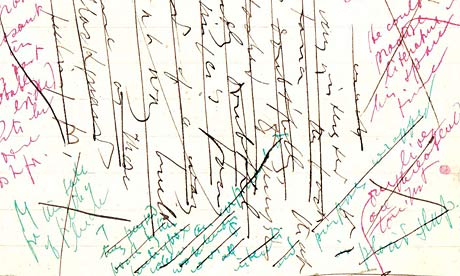
Postscript: The image above is an actual manuscript page from James Joyce’s Ulysses. (It makes me feel much more confident about my own initial scribblings.)