Theological Training

I’m proud I graduated from a well-respected seminary. And I’m proud of following that Master of Divinity degree with an advanced Master of Theology degree in Patristics. And that’s precisely the problem . . . I’m proud.

As a Christian, I recognize that pride is one of the most destructive and insidious sins. As a pastor and chaplain, I have seen all too frequently how pride expressly targets members of the clergy. Our vulnerability to the temptation to be proud is one of the common chinks in the armor of the ordained.

C.S. Lewis recognized this fact. In A Severe Mercy, he wrote:

I think there is a great deal to be said for having one’s deepest spiritual interest distinct from one’s ordinary duty as a student or professional man. St. Paul’s job was tent-making. When the two coincide I shd. have thought there was a danger lest the natural interest in one’s job and the pleasures of gratified ambition might be mistaken for spiritual progress and spiritual consolation; and I think clergymen sometimes fall into this trap. . . .

In fact, the change [to a Christian ministry] might do good or harm. I’ve always been glad myself that Theology is not the thing I earn my living by. On the whole, I’d advise you to get on with your tent-making. The performance of a duty will probably teach you quite as much about God as academic Theology wd. do. Mind, I’m not certain: but that is the view I incline to.

Lewis understood that “advancement” in ecclesiastical contexts can mask the inner heart and be mistaken as a form of holiness when it is in actuality vanity. I was reminded of this weakness in clerical armor recently, when I read a tribute to a Chinese Christian whose name is little known beyond his homeland. Dr. Sun Yi-yin, known in America as “Freddie Sun,” died in August at the age of 76. A professor of Geology, he lost his faculty position for failing to deny Christ.

Like thousands of other Christians living under the atheist regime, he was imprisoned for his work in establishing churches and Bible schools. He raised the funds to start no fewer than 154 of these training centers, and was key to the equipping of approximately 60,000 underground pastors and teachers. The “underground” Church in China is distinguished from the government-controlled “Three-Self Patriotic Movement.”

For his labors, Sun endured a decade in a Chinese labor camp. (His wife, Dorothy Chang, was also imprisoned. Rather than reducing his faith, during his sojourn in the harshest of conditions, Sun experienced a personal revival and his zeal increased.

His story is amazing, but here is the aspect that hit the mark in the center of my conscience. In his autobiography, The Man in the Fiery Furnace, Sun described his imprisonment as his “seminary” experience: “Instead of learning homiletics, hermeneutics, Greek, and Hebrew, I was being taught the greater lessons of obedience, submission, forgiveness, love, endurance, and patience.”

Now, I am grateful that God has preserved me from the “fiery furnace,” but I do long to experience the fruit of the spirit that Sun so richly harvested in prison. While not dismissing the importance of the classical subjects of homiletics and hermeneutics, as the Apostle says, “If I speak in the tongues of men and of angels, but have not love, I am a noisy gong or a clanging cymbal. And if I have prophetic powers, and understand all mysteries and all knowledge, and if I have all faith, so as to remove mountains, but have not love, I am nothing. If I give away all I have, and if I deliver up my body to be burned, but have not love, I gain nothing.” (I Corinthians 13:1-3, ESV).

In The Problem of Pain, Lewis’ treatise on suffering, he addresses how God can redeem terrible things such as unjust punishments. For those desiring to understand how an omnipotent God can allow evil to occur, Lewis’ presentation is quite helpful. And, the life example of Dr. Sun provides a superb example of its validity.

I advance six propositions necessary to complete our account of human suffering which do not arise out of one another and must therefore be given in an arbitrary order. 1. There is a paradox about tribulation in Christianity. Blessed are the poor, but by ‘judgement’ (i.e., social justice) and alms we are to remove poverty wherever possible. Blessed are we when persecuted, but we may avoid persecution by flying from city to city, and may pray to be spared it, as Our Lord prayed in Gethsemane.

But if suffering is good, ought it not to be pursued rather than avoided? I answer that suffering is not good in itself. What is good in any painful experience is, for the sufferer, his submission to the will of God, and, for the spectators, the compassion aroused and the acts of mercy to which it leads. In the fallen and partially redeemed universe we may distinguish (1) the simple good descending from God, (2) the simple evil produced by rebellious creatures, and (3) the exploitation of that evil by God for His redemptive purpose, which produces (4) the complex good to which accepted suffering and repented sin contribute.

Now the fact that God can make complex good out of simple evil does not excuse—though by mercy it may save—those who do the simple evil. And this distinction is central. Offences must come, but woe to those by whom they come; sins do cause grace to abound, but we must not make that an excuse for continuing to sin. The crucifixion itself is the best, as well as the worst, of all historical events, but the role of Judas remains simply evil.

I thank God for the life and testimony of Sun. I pray God will reap an abundance of believers in China, and elsewhere, due to his faithfulness. And I thank God for using Sun’s words to cause me to stop in the midst of my busy activities and take the time to examine my own heart and motives.


Wasp Wars

This fall I’ve entered into combat with some of fallen nature’s most ferocious and merciless creatures. Thus far, they are winning the war.

A couple months ago my castle (i.e. home) was invaded by a ruthless tribe of wasps or hornets (the latter is a subset of the species, as are yellow jackets, so they are all members of a single horrific animal family).

They found a small, un-caulked opening into our attic . . . strategically placed just above our front door. I’m sure they had thousands of alternative bastions in the forest that surrounds our house but, being wasps, they knew this was the precise location from which they could wreak the most violent havoc.

The initial fray was brief. I sprayed copious amounts of wasp insecticide into the crevice, in the hope of encouraging them to nest elsewhere. It appeared to act as an attractant. After it failed and added more recruits to their number, I donned armor and climbed a ladder after dusk when they had settled in for the night, and noiselessly attempted to close the space with insect-proof sealant.

Alas, their sentinels were vigilant. They swarmed me, and pushed me off of the ladder causing me to land on my back and crash my head on the ground. Unfortunately, my long sleeved armor did not include a concussion proof helmet. Like a craven coward I lifted my bruised body from the rocky ground (nope, we haven’t planted a lawn yet) . . . and I ran for my life. All the while I was thanking God that I was only standing on the third rung.

Aside from my bruises, they had only inflicted a single piercing wound—on my index finger. Of course, being predators, wasps carry a very nasty venom, and for the next week it failed to heal as the poison festered, despite diligent attention from my corpsman-wife.

I’m waiting patiently for winter now, when they are partially dormant and “hibernating.” When the queen wakes up in the spring, she’ll find herself sealed in a crypt. (At least, that’s what I’m hoping.)

Wasps in Narnia

C.S. Lewis, being a lover of the outdoors, was well acquainted with the hazard posed by wasps. In The Chronicles of Narnia,

When the Pevensie children are drawn back to Narnia for a second time, it is a jarring and initially frightening experience. As we read in Prince Caspian:

It was an empty, sleepy, country station and there was hardly anyone on the platform except themselves. Suddenly Lucy gave a sharp little cry, like someone who has been stung by a wasp. “What’s up, Lu?” said Edmund—and then suddenly broke off and made a noise like “Ow!”

“What on earth—” began Peter, and then he too suddenly changed what he had been going to say. Instead, he said, “Susan, let go! What are you doing? Where are you dragging me to?”

“I’m not touching you,” said Susan. “Someone is pulling me. Oh—oh—oh—stop it!” Everyone noticed that all the others’ faces had gone very white.

“I felt just the same,” said Edmund in a breathless voice. “As if I were being dragged along. A most frightful pulling—ugh! It’s beginning again.”

“Me too,” said Lucy. “Oh, I can’t bear it.”

“Look sharp!” shouted Edmund. “All catch hands and keep together. This is magic—I can tell by the feeling. Quick!”

“Yes,” said Susan. “Hold hands. Oh, I do wish it would stop—oh!” Next moment the luggage, the seat, the platform, and the station had completely vanished.

The four children, holding hands and panting, found themselves standing in a woody place—such a woody place that branches were sticking into them and there was hardly room to move. They all rubbed their eyes and took a deep breath. “Oh, Peter!” exclaimed Lucy. “Do you think we can possibly have got back to Narnia?”

Later, Edmund offers some wise advice in The Voyage of the Dawn Treader. He alludes to the deceptive natural and inherent ninja skills possessed by the killers.

“We must all show great constancy,” Caspian was saying. “A dragon has just flown over the tree-tops and lighted on the beach. Yes, I am afraid it is between us and the ship. And arrows are no use against dragons. And they’re not at all afraid of fire.”

“With your Majesty’s leave—” began Reepicheep.

“No, Reepicheep,” said the King very firmly, “you are not to attempt a single combat with it. And unless you promise to obey me in this matter I’ll have you tied up. We must just keep close watch and, as soon as it is light, go down to the beach and give it battle. . . .”

“Perhaps it will go away,” said Lucy.

“It’ll be worse if it does,” said Edmund, “because then we shan’t know where it is. If there’s a wasp in the room I like to be able to see it.”

Back to My Own Campaign

Just as I became resigned to my strategy with the vicious intruders, I became aware of a second army of insect brigands. This multitude had invaded the crawlspace under my home, through some weakness in the screens guarding my ventilation openings.

Noting that I would not require a ladder to engage them in combat I foolishly thought, oh how you will rue the day you trespassed in my domain!

I purchased a new screen to cover the entire opening, but their guards remained vigilant even during the night and before I could even begin the project, they swarmed and had me fleeing across our back lawn (yes, we do have some grass). Running recklessly in the dark I naturally stumbled and still bear some significant bruises. These would be bad enough, but two of the villains stabbed me with their poisonous stingers before I secured myself in the house.

With the aid of my faithful border collie, I discovered an infiltrator who insidiously snuck into the castle proper clinging to my pants. I immediately dropped my leggings and proceeded to stomp on them for several minutes. I was thorough, walking repeatedly over every part of the crumpled clothing. Naturally, he survived. I did manage to rewrap him in the trousers and see to his demise.

I am reconsidering my strategy now, and leaning towards placing commercial wasp traps directly outside the vent when the vermin reawaken in the spring. I’m also contemplating periodically banging a hammer near their hidden nest to disturb their rest during their hibernation. I haven’t determined yet whether this would be effective, as it is when interrogating terrorists, or whether it would simply be sadistic.

Trying to learn their weaknesses (they don’t have any) I did learn one reason why wasps are so aggressive and merciless. They are almost all female! While queens alone reproduce, and they keep a few males handy for their sole role of mating and dying, the rest of the army consists of “asexual female workers.” These perform community duties such as building the hive, gathering food, feeding the young, and protecting the colony!

Now, lest I be unfairly accused of misogyny, let me make clear that it is not their “feminine” nature that makes them violent. Rather, it is a corruption of their natural maternal instincts which cause them to guard their nest so belligerently that all rationally minded people desire their utter annihilation.

And, Once Again, to Narnia

The final book in the Chronicles has been my favorite ever since I first read the series forty years ago. I gained an even greater appreciation for The Last Battle when I read this description of the heavenly Narnia into which all of Aslan’s faithful were ushered.

Tirian had thought—or he would have thought if he had time to think at all—that they were inside a little thatched stable, about twelve feet long and six feet wide. In reality they stood on grass, the deep blue sky was overhead, and the air which blew gently on their faces was that of a day in early summer. Not far away from them rose a grove of trees, thickly leaved, but under every leaf there peeped out the gold or faint yellow or purple or glowing red of fruits such as no one has seen in our world. The fruit made Tirian feel that it must be autumn but there was something in the feel of the air that told him it could not be later than June.

They all moved toward the trees. Everyone raised his hand to pick the fruit he best liked the look of, and then everyone paused for a second. This fruit was so beautiful that each felt “It can’t be meant for me . . . surely we’re not allowed to pluck it.”

“It’s all right,” said Peter. “I know what we’re all thinking. But I’m sure, quite sure, we needn’t. I’ve a feeling we’ve got to the country where everything is allowed.”

“Here goes, then!” said Eustace. And they all began to eat. What was the fruit like? Unfortunately no one can describe a taste. All I can say is that, compared with those fruits, the freshest grapefruit you’ve ever eaten was dull, and the juiciest orange was dry, and the most melting pear was hard and woody, and the sweetest wild strawberry was sour. And there were no seeds or stones, and no wasps.

Despite our repeated failings, the victory will ultimately be won by our divine Champion!

Screwtape Goes to War

I edit a free online journal for military chaplains. Articles have been contributed by clergy from most of the world’s continents, sharing their experiences and opinions. Much of the material will be of interest to anyone interested in the nature of ministry within the armed forces.

The current issue was “published” at the end of June, and includes one article that may be of particular interest to the readers of Mere Inkling.

On page fifty-seven you’ll find the preface to a series of six letters. They are collected under the same title as this post, “Screwtape Goes to War.” It is available via this link: Curtana: Sword of Mercy.

Those familiar with C.S. Lewis’ masterpiece of diabolical correspondence will require no introduction. Here’s an excerpt from one of the six epistles gathered in this modest collection. Remember, it is from the pen of a senior demon advising a junior Tempter on how to corrupt his “patient” (in this case a chaplain).

While preaching can in theory be used by the Enemy to draw his servants closer to himself, it’s equally possible to use the pulpit to drive a wedge between the Enemy and those ordained to serve him. In fact, there is something uniquely satisfying about using a chaplain’s own preaching to immunize him to the disgusting message of hope and forgiveness.

There are so many tactics to undermining the effectiveness of your chaplain’s sermons . . . where to begin? I have found the following methods to be most useful.

1. Encourage him to subscribe to all sorts of periodicals and keep him as far away from the Enemy’s book as possible. Tell him that by this means he “will remain in touch with the culture” to which he is preaching. We do not want him opening the Scriptures. It’s not too challenging persuading many clergy today that they’ll bore and alienate their audience by citing passages from that archaic text. Let him explore all sorts of publications so he discovers ones he honestly enjoys. That will make the choice easier when he looks on his desk at a tempting contemporary publication lying next to that black book.

Not all journals are created equal, of course. Some actually contribute to the knowledge and comprehension of the Enemy’s book. Avoid these. Secular publications are usually safe, the more so when they celebrate selfishness, man’s favorite religion. The most precious, however, are those published by “religious” presses. You know those to which I refer. The ones penned by our allies who where wear the garb of the Enemy but live with either themselves or some other idol on the throne of their souls. Those who may praise him with their lips but deny him access to their hearts. Mind you, these documents need to be chosen with great care. But if you can find some which appeal to him, it will aid you immeasurably in bringing about his demise. . . .

Curtana discusses both historical matters and contemporary issues. It is interfaith and international in scope. The website includes a “subscription” form for those who wish to be notified whenever a new issue of the journal is published.

Don’t be confused when you see the date on the current issue. Like many minimally-staffed, free publications, we’ve fallen slightly “behind schedule.” Thus, the current issue is dated Fall & Winter 2011. (I promise this is due not merely to procrastination, but also to the editor’s chronic propensity for terribly over-extending himself.) At any rate, Curtana 3.1 is indeed the issue which includes the afore-described article.

Life With Few Friends

Human beings were not created to live solitary lives. From the very outset, God recognized “it is not good that [Adam] is alone,” and he created for him the perfect companion, Eve. She was, of course, his bride, but more than that, she was his intimate friend.

The power and joy derived from true friendship are awe inspiring. And, the absence of friendship strips life of those same blessings. We are weaker, when we stand alone—the strength of our friends empowers us to live courageously. We know more sorrow when we are alone—the pleasant company of friends dispels many discouragements and we all know the comfort that comes from a warm shoulder to cry on.

As a “military brat,” moving every year or two, I experienced the challenge of constantly needing to make new friends. When I raised my own children in that same context, I was acutely aware of the hardship this presents to kids (especially during their teens).

C.S. Lewis, in describing just how precious friendship is, emphasizes the value of proximity to those who support and encourage you. In a 1935 letter to Arthur Greeves he writes:

Friendship is the greatest of worldly goods. Certainly to me it is the chief happiness of life. If I had to give a piece of advice to a young man about a place to live, I think I should say, “sacrifice almost everything to live where you can be near your friends.” I know I am very fortunate in that respect.

Over the years I talked with many other military parents about the price paid by our family members as we serve. Certainly there are benefits as well. After all, most military families see parts of the world that their peers can only dream of. But, they do make great sacrifices. The careers of military spouses, for example, are often severely disrupted by family moves. There are other costs, but the one we’re considering here is the price paid in friendships.

Some of my friends have argued that frequent moves taught their children to quickly make many new friends. I disagree with that. This contention is frequently voiced, it seems to me, as a subconscious means of expiating the veteran for the hardships their children suffered. Giving them the benefit of the doubt, I prefer to attribute the statement to a very shallow understanding of what friendship truly is. This definition is terribly distant from Lewis’ “greatest of worldly goods.”

My response to these claims is that frequent military moves have a detrimental effect on friendships but they do indeed train our children to be adaptable. The lesson most of them learn is how to quickly establish interpersonal relationships. These “friendships,” I argue, are more accurately described as acquaintances.

Their lack of depth is seldom a conscious choice. Imminent moves mean the relationships lack the time necessary to mature. Sort of like a vintner pulling the cork out of a bottle of grape juice that was pressed only a week before, and expecting it to already be wine. If the vintage of a relationship is a mere three months, it’s rare for it to have “fermented” into a profound friendship.

There are certainly exceptions, of course, as in the case of my sister. She and one of her girlfriends from junior high school still visit each other each year, as they have for four decades. But such bonds are as rare as they are precious.

While I’m sharply attuned to the circumstances of military families, I’ve been thinking recently about the lack of roots experienced by many people living in contemporary Western society. Modern families move much more frequently than their parents did. So it dawns on me that this instability has probably exerted a detrimental effect on many more individuals than I had previously considered.

All it takes is the pain from the abrupt termination of a few budding friendships, to teach many children it’s not worth the effort to make real friends. We long for friendship, we truly do, but most relationships don’t survive geographic separations for very long. And the natural grace of God, friendship, becomes distorted as we begin to withhold ourselves, because we know that we’ll be moving away soon anyway.

Friendships deceased. Friendships aborted. Friendships deferred. Deceased as we move apart and they wither. Aborted as we bid farewell before they’ve been fully born. And deferred as we consciously wait until we imagine we’ll be somewhere long enough to make the effort worth it.

It strikes me that the itinerancy of this age is fostering an explosion of acquaintances (for example, the hordes of Facebook “friends” it’s so easy to accumulate) . . . with a corresponding decrease in the number of people we genuinely trust to care about our wellbeing.

Lewis described this shift in an academic context. In The Weight of Glory he described the exchange of numbers for depth.

When I first went to Oxford the typical undergraduate society consisted of a dozen men, who knew one another intimately, hearing a paper by one of their own number in a small sitting-room and hammering out their problem till one or two in the morning. Before the war the typical undergraduate society had come to be a mixed audience of one or two hundred students assembled in a public hall to hear a lecture from some visiting celebrity. Even on those rare occasions when a modern undergraduate is not attending some such society he is seldom engaged in those solitary walks, or walks with a single companion, which built the minds of the previous generations. He lives in a crowd; caucus has replaced friendship.

The benefits of having numerous acquaintances is real. We rightly appreciate them. But we cannot forego our innate need for friends and still maintain our humanity. We need others who know the true “us,” as contrasted with our public masks, and still care about us.

I’ve read that we only know several truly intimate friends during the course of our entire life. And many of those who marry are blessed to genuinely know their spouse is the best friend (even though it usually sounds trite when they say it). Still, I doubt that there’s a living human being who would not benefit from having another genuine friend. And that, my “friends,” is my hope and prayer for each of you—that even though we all live within a crowd, you may be able to single out those wonderful few who can become and remain your lifelong friends.

Literary Words

I must confess that I like words. In fact, it’s not excessive to say that I delight in brilliantly witty “turns of phrase” and elegantly painted landscapes that allow me to clearly see what the author is painting with his or her words.

I’ve grown convinced that loving words is a handicap to becoming an excellent writer. Yes, scribblers like me can become adequate or even appreciated writers . . . but to stand in the highest ranks a writer must be willing to ruthlessly slash and slay excess words that impede their perfect vision.

Self-editing is a discipline. It’s something that can be learned and refined through practice. That it forever remains a bit painful for some of us is clear evidence we are overly attached to the words we have put to paper.

C.S. Lewis addressed this general subject in a 1932 letter to his good friend Arthur Greeves. While he was not a slave to the number of words required, he aimed for simplicity and clarity. Lewis wrote:

I think I see, from your criticisms, that you like a much more correct, classical, and elaborate manner than I. I aim chiefly at being idiomatic and racy, basing myself on Malory, Bunyan, and Morris, tho’ without archaisms: and would usually prefer to use ten words, provided they are honest native words and idiomatically ordered, than one “literary word.” To put the thing in a nutshell you want “The man of whom I told you,” and I want “The man I told you of.”

I smiled as I typed Lewis’ remark about “ten words.” He used that to illustrate his willingness to use excessive verbiage to communicate clearly. Brevity was, however, an admirable goal. And brevity is a virtue I’ve seldom been accused of possessing.

In the military, comrades and associates are frequently presenting plaques and remembrances to those who are “rotating” to new assignments. Having served in a dozen different “permanent” assignments, I have boxes full of such memorabilia.

Two of the few I display are genuinely precious. The first is an icon of Saint Athanasius, presented to me by the best “boss” I ever had, an Orthodox priest by the name of John Stefero. The reasons for the personal gift were theological and I accepted it with genuine appreciation and humility.

The second prized gift is a gracefully curved etched glass keepsake featuring the seal of the United States Air Force Chaplain School where I served for three wonderful years. The commandant was speechless as he presented the plaque to me, reading for the first time the inscription that my closest companions had composed for me.

He says in a book what others say in a sentence.

The commandant (later our Chief of Chaplains) was stunned. I was delighted. I led the gathering’s laughter and bellowed, “Yes, and it’s a book well worth reading!”

Jack Lewis may have chided me a bit for the underlying reason for the accolade, but I am confident he would have delighted in the affectionate friendship and esprit de corps with which it was presented.

So much for my shortcomings. For all other writers (including, perhaps, you?) . . . I would recommend following the master’s example, rather than my own.

Compassion Fatigue

Jesus at GethsemaneI just returned from a weeklong gathering with a group of armed forces chaplains. They represented all the branches—Army, Navy & Air Force. (The Navy provides the chaplains for the Marine Corps and the Coast Guard in the United States.)

I retired four years ago, after nearly a quarter century as a chaplain in the Air Force. I miss the people, the esprit de corps, and the awareness of doing something truly important.

On the other hand, I miss neither the innumerable meetings nor the rank consciousness of some chaplains. (Sadly, to some chaplains their rank insignia is more important than the religious symbol they bear.)

I’ve been privileged, in my semi-retirement, to serve my denomination on our national Ministry to the Armed Forces committee. We determine which of our pastors should be allowed to serve as military chaplains. It was in that capacity I attended our annual conference for “our” chaplains.

As always, we offered a first-class program. This one was conducted by Doxology and our speakers were a veteran pastor and a gifted psychologist. They covered a lot of ground during the week, but one of the subjects they began with was helping us assess our own degrees of “compassion fatigue.”

Compassion fatigue is experienced by many people in the so-called helping professions. Medical personnel, first responders and (especially) those in the ministry give so much of themselves without adequate replenishment, that they often end up spiritually exhausted.

It’s easy for critics to judge someone who is genuinely fatigued, because they can become impatient and irritable. People may accuse them of trying to do everything “in their own strength,” rather than relying on God’s grace and anointing.

In his famous prayer, Francis of Assisi asked, “Lord, make me an instrument of your peace . . .” This is precisely how most clergy view themselves. But, to more precisely focus the petition, we might pray, “Lord, make me a conduit of your grace.”

If you understand the distinction . . . you can see how even regarding ourselves as God’s instruments or hands or voice in the world, can compel those in the ministry to serve until they drop. So much for the Puritan work ethic. Few of us pause adequately for the rest and renewal we require.

C.S. Lewis described just how costly this love for others can be.

To love at all is to be vulnerable. Love anything, and your heart will certainly be wrung and possibly be broken. If you want to make sure of keeping it intact, you must give your heart to no one. . . . It will not be broken; it will become unbreakable, impenetrable, irredeemable. The alternative to tragedy, or at least the risk of tragedy, is damnation. The only place outside Heaven where you can be perfectly safe from all the dangers and perturbations of love is Hell. (The Four Loves.)

You may well be on the verge of compassion fatigue yourself, assuming you care deeply about the suffering of others. If you are, I encourage you to join me in identifying times and places to pause and rest in the presence of God. Scheduling opportunities to meditate on his word and listen for his still small voice as we communicate with him in prayer, will refresh and strengthen each of us.

These precious moments won’t occur accidentally. We need to be intentional in carving them out of our too-busy schedules. But, when we do so, we are spared the pain and numbness of compassion fatigue. We can continue to love others, despite the vulnerability, and still remain healthy and whole.

It’s Tough being a Colony

During the early 1990s I was stationed at RAF Greenham Common and RAF Alconbury in the United Kingdom. Our family loved our three brief years in that inspiring land. One of the quaint things I recall was the relatively frequent question I was asked when meeting someone new. They would inquire as to “how things were going in the colonies.” It was actually a pleasant ice-breaker, and never said maliciously.

The comment offered no cause for offense. It’s been too long since the United States was a British colony for it to be more than a historical comment. The heated issues that once led to bloodshed have become historical trivia. There are, of course, many “younger” nations in our world that are still struggling to discover their post-colonial identities. This has been notoriously difficult where occidental powers established arbitrary boundaries that failed to recognize ethnic, religious or cultural considerations.

So, why is today’s post pondering the concept of colonialism? It just so happens that today is the anniversary of the imposition of the Stamp Act (tax) on her colonies by the British. It became law in 1765, a full decade before the War of Independence, but it was one of the alienating actions that laid the foundation for the upcoming rebellion.

Apparently, our paternalistic government in Europe regarded North America as a sort of bank from which they could make continuous withdrawals without ever repaying the funds. (“No taxation without representation” was a common battle cry.) The Stamp Act directly taxed all commercially published colonial materials, including newspapers and pamphlets. The Stamp Act would have been burdensome enough by itself, but the colonies were still reeling from three other onerous taxes that had recently been levied:

Sugar Act (1764)

…which covered textiles, wines, and coffee, in addition to sugar.

Currency Act (1764)

…which undermined colonial mercantilism and freedom.

Quartering Act (1765)

…which transformed every American home into a free bed & breakfast for British soldiers.

You get the idea. Georgia, Pennsylvania, Maryland and their like were merely colonies, so why should their concerns be factored into the equation? Extremely shortsighted. Not to mention, quite selfish.

C.S. Lewis addressed this subject in his major historical work.

The best European minds were ashamed of Europe’s exploits in America. Montaigne passionately asks why so noble a discovery could not have fallen to the Ancients who might have spread civility where we have spread only corruption. (English Literature in the Sixteenth Century).

We recognize that Montaigne’s notion is just a tad idealistic. If the Romans had colonized the Americas, for example, the indigenous people would hardly have been treated any differently. And the introduction of gladiatorial arenas would have presented an arguable civic improvement.

Still, Lewis’ point is completely valid. Whenever humans conquer or “colonize” their fellows, the colonies always get the proverbial “short end of the stick.” Thus, we recognize that it’s tough being a colony.

So, where does that leave us? Historically informed, perhaps we can make better decisions in the future. Weaker nations and peoples should never be exploited. It’s not just a matter of justice. Ethics aside, history teaches that sowing seeds of alienation and discontent invariably reap an unwelcome harvest.

One word of hope that we see in this historical snippet is that despite a combative history, lands (and people) can lay aside their animosity and become sincere allies. Which brings me back to the place where I began this column . . . living in an era when these nations that fought not one, but two wars, are steadfast friends.

The Ides of March

I was introduced to ancient Rome as a young reader. Rosemary Sutcliff (1920-1992) wrote such fine historical fiction that it appeals to young readers and adults alike. A film version of The Eagle of the Ninth was made just last year. And I’m a sucker for a good Roman movie (wherein “good” excludes all of the so-called spaghetti gladiator films made in the fifties and sixties).

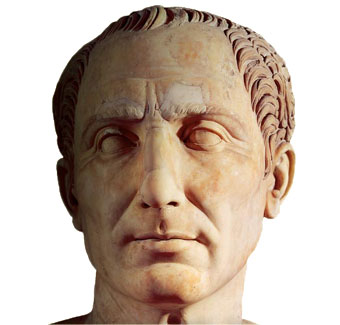
As a student of Rome, I find it worth noting today’s date. Even those who know “nothing” about Rome should understand its significance. You don’t need to have studied Latin or the classics to understand the warning “Beware the Ides of March.” The Ides is the fifteenth day of the month. And it was on this day that Julius Caesar was murdered by members of the Roman Senate.

It was left to his adopted son, Caesar Augustus, to transform the Republic into an autocratic Empire. It was this Caesar who ruled Rome at the time of Jesus’ birth, and he bequeathed the title of “Caesar” to his heirs. When Jesus requested that the Pharisees and Herodians “show him the coin for the tax,” we do not know whether Augustus or Caesar Tiberius adorned it. It matters not, since the image of Caesar was tantamount to representing Rome itself.

Jesus taught his disciples to be discerning in the loyalties we offer. We are to be responsible citizens. But we are also required to remember our true citizenship rests in the New Jerusalem.

C.S. Lewis astutely illustrated this truth. He lived during two global conflicts, and served in combat defending his homeland. Yet Lewis recognized the dangers of placing our trust (faith) in even the “noble” things of this world.

A man may have to die for our country: but no man must, in any exclusive sense, live for his country. He who surrenders himself without reservation to the temporal claims of a nation, or a party, or a class is rendering to Caesar that which, of all things, most emphatically belongs to God: himself. (“Learning in War-Time” – a sermon preached in Oxford in 1939).

So, on this day when Julius’ dreams of glory bled out in Rome . . . may you and I find refuge, hope, peace and meaning in the One who bled and died for each of us on Calvary.

The Church Militant (Or Not)

I was surfing wordpress sites the other day and came across one that linked to a fascinating collection of distinctive church buildings. I’ll include the link at the end of this column (so you don’t get too distracted, and fail to finish reading my impressions).

Many of the edifices are intriguing. Most are unique. A handful are truly inspiring.

One of the “unique” designs is found in the architecture of Saint Joseph Ukrainian Catholic Church in Chicago. For some viewers, the structure suggests minarets. Others see it as a contemporary version of Moscow’s Cathedral of Saint Basil. For me, it evokes a rather more martial memory.

In the early 1990s I was stationed at RAF Greenham Common where we were part of the nuclear deterrence mission. We supported the GLCM (ground launched cruise). We actually accomplished our national goal, in persuading the Soviet Union to mutually disarm through the Intermediate-Range Nuclear Forces Treaty. That was a significant accomplishment.

As part of the process, NATO and the Soviets dispatched Verification Teams to ensure that each was following through with the reduction and ultimate elimination of the missiles. After all of ours had been removed, I was privileged to serve as a Soviet Escort Officer during one such visit. It was interesting to watch how the highlight for the Soviets was their visit to our base exchange. (They were shocked by the diverse offerings of everyday capitalism and suspected that we depleted other stores to stock this one in a manner that would impress them.)

While they were visiting, they conducted pro forma inspections of all the locations where a missile could be hidden, including under regular manhole covers, as I recall.

Perhaps by now you understand why the Saint Joseph building reminds me of that tour of duty?

I am probably the only person whose first thought upon viewing this building is: what an amazing disguise for missile silos! Of course, one factor for my reaction is the clearly Russian/Ukrainian shape of the entire structure. A peculiar response to the picture, right? And yet . . . without inspecting the tubes, who can say with certainty whether or not my first reaction may have been accurate?

Here’s the link to the 50 Most Extraordinary Churches.

The Satisfaction of Writing

Many people who don’t write live a bit in awe of those who do. Even in this POD age, an almost mystical aura surrounds those who “successfully” write. This is especially true for those who are published, but not restricted to them.

Over the years, many friends and family members have asked why I “like to write.” Some years ago, the vague responses I once offered assumed clarity. It was, in a sense, due to a personal epiphany. I now answer such queries with the words, “it’s not that I enjoy writing itself . . . but I find the satisfaction of having written to be deeply rewarding.” (Well, that’s not a verbatim quote of how I respond, but you get the idea.)

One of my driving desires when I retired from the Air Force was to spend more time pursuing my lifelong avocation. Toward that end, I’ve devoted a serious amount of time to publishing a free online journal about the military chaplaincy. It is semi-annual, and even at that, it’s currently behind its publication schedule. (Mea culpa.)

I’m happy to share that the latest issue of the journal is now ready for free download. You can find it here. In fact, all four issues of the journal are available for download in PDF.

Curtana features new articles, editorials, poetry and reviews. In addition, since a major purpose of the journal is to gather chaplaincy history from disparate sources, we also compile biographical notes and other material.

As Curtana’s editor, I’m proud of the international scope of the journal. We’ve received contributions from Australia, Bangladesh, Canada, Great Britain, Haiti, Ireland, and even the United States. Most articles have been written by chaplains, but that’s not a requirement. Skim the contents of the issues and you’ll note the breadth and depth that characterize Curtana.

C.S. Lewis recognized the value of thoughtful literary works. Good literature might be fiction or nonfiction, but it bears the mark of genuine reflection.

Literature adds to reality, it does not simply describe it. It enriches the necessary competencies that daily life requires and provides; and in this respect, it irrigates the deserts that our lives have already become.

I hope that in some small way Curtana: Sword of Mercy helps irrigate the arid minds of modern men and women. Please share news of its existence with your acquaintances who may be interested in ministry within the armed forces.