The Road Taken

They are both important. Where we are going, and how we get there.

It’s quite common for analogies about our lives to assume the form of journeys. The journey, in fact, is a fitting metaphor for all human life.

Aging is a journey. Maturing is a journey that should run parallel to aging (though it seldom seems to do so). Learning is a journey. And the image of the “lifelong learner” is something that appeals to most readers and to all who hunger for daily intellectual growth.

Our spiritual lives are journeys of a sort. They follow “paths,” with branches that invite us to travel in myriad directions. Yet all roads are not “equal.” David, the anointed Psalmist prayed, “Make me to know your ways, O Lord;
 teach me your paths” (Psalm 25:4, ESV).

Even secular poets have recognized the power of this concept. One of the most memorable lines ever penned in English is: “Two roads diverged in a wood and I . . . I took the one less traveled by, and that has made all the difference” (“The Road Not Taken,” Robert Frost).

The Inklings expertly used the metaphor of journey to frame their works. Tolkien’s The Hobbit and Lord of the Rings are both propelled, in fact, by vivid journeys. Likewise, Narnia’s Chronicles contain a number of momentous journeys, which ultimately culminate in the final journey which just begins with the close of The Last Battle.

These journeys are, of course, literal trips. Physical traveling from one place to another. Of course, these physical passages occur simultaneously with far more meaningful changes.

The typical contemporary journey of life may take us to varying locales—but it’s possible to savor a rich life journey without ever traveling far from the home of our youth. Indeed, one could be bedridden from birth, and travel the world in terms of experiencing Life. Thanks to God’s gifts of imagination, dream, wonder and faith.

C.S. Lewis also employs this journeying metaphor in his nonfiction works. In The Problem of Pain, he paints a fascinating panorama of our life in this world. He reveals that suffering is actually a blessing, in that it prevents us from growing too attached to this world. Although God graces us with pleasing moments in this life, they are interrupted by moments of insecurity . . . lest we mistakenly believe this finite world is our true home.

Christian doctrine of suffering explains, I believe, a very curious fact about the world we live in. The settled happiness and security which we all desire, God withholds from us by the very nature of the world: but joy, pleasure, and merriment, He has scattered broadcast. We are never safe, but we have plenty of fun, and some ecstasy. It is not hard to see why. The security we crave would teach us to rest our hearts in this world and pose an obstacle to our return to God: a few moments of happy love, a landscape, a symphony, a merry meeting with our friends, a bathe or a football match, have no such tendency. Our Father refreshes us on the journey with some pleasant inns, but will not encourage us to mistake them for home.

May the roads we choose to follow bring us safely to the wonderful home our heavenly Father has prepared for each of us.

___

The beautiful, copyrighted photograph above appears compliments of Craig Sterken Photography at craigsterken.com. Check out his exceptional gallery!


Generalizations (& Those Who Criticize Them)

“That’s the worst of girls,” said Edmund to Peter and the Dwarf. “They never can carry a map in their heads.”

“That’s because our heads have something inside them,” said Lucy. (C.S. Lewis, Prince Caspian).

It seems that if an author wishes to alienate vast swaths of readers today, they need do no more than “generalize.” Thus, C.S. Lewis has received unjust criticism due to some passages such as this.

To make a judgment such as Edmund’s leaves unmentioned the implied fact that there are, indeed, many useful things that are manifestly present in the heads of girls. But this example of difficulty in reading maps refers to a common perception . . . and if you’ve never heard it voiced before you read it here, you have led a shockingly sheltered life.

No one believes that there are no women capable of defeating even well-trained men in rigorous navigational competitions. Likewise, I have no doubt there are many gifted female cartographers. But please reseal the tar barrel and restuff the pillows; Lewis’ use of this dialog is not intended to be offensive!

I long for the days when a reader gave the writer the proverbial “benefit of the doubt.” A time when our assumption was that they meant something other than the meaning which offended us . . . or, at least, that they intended no malice.

I can’t speak for the rest of the world, but in most of the United States, such days of literary curtesy are long behind us. Today we often read things with an eye to finding the “problem” (ignorance, prejudice, or political viewpoint foreign to our own).

My wife and I attempted to raise our children with critical minds. (Critical in the best sense of the word.) We taught them that there are absolute truths. We informed them that, while people are entitled to hold to all sorts of notions and beliefs, that fact does not make the contending concepts “true.”

At the same time, we did our best to teach our children to respect others. To recognize that all human beings are created in the image of God. To understand that not even the basest man or woman is beyond redemption and restoration.

One practical element of this education in basic virtues took the shape of an adage we taught our kids. I’m sure others have advised this throughout history, and that many have voiced it far more eloquently, but we simply said: Judge everyone and everything by their best cases, rather than their worst.

In practice, this would mean that when a teenager compliments his dad on his wisdom, the dad does not immediately assume his prodigy is attempting to manipulate him. Now, further conversation and “investigation” may certainly prove that manipulation is indeed the goal, but it should not be the very first suspicion of the father.

As a pastor, one of your greatest challenges (and joys) comes in the pulpit. One major difficulty is discussing some extremely complex subjects in a relatively brief period of time. Pastors sometimes lapse into a sort of theological shorthand—which can be confusing or troubling to those unfamiliar with the underlying presuppositions. Taken out of context, individual statements may sound strange, or even heterodox.

I have always encouraged the members of my congregations and (especially) visitors to specifically ask me about what was meant by any statement or phrase that left them uneasy. It is no exaggeration to say that 98% of the time, that has cleared the air in and of itself, as I’ve had an opportunity to elaborate and clarify. (Of course, the other 2% of the occasions constitute a second pastoral “joy.”)

It saddens me when I hear people berate C.S. Lewis for a handful of passages that critics deem to be misogynistic or racist. They fail to extend toward him the goodwill he strove to offer to others. Most of these very few passages can simply be explained by the age in which he lived. It is disingenuous to judge by today’s standards someone who died a half century ago.

Like Lewis’ peers (and, in fact, all human beings), on occasion Lewis himself generalized. Let those who have never done the same cast the first stone. I confess that I’m guilty of it. In fact, returning to the quotation with which we began, I could most definitely echo Edmund’s words in reference to my wife. Ironically, they would be utterly inaccurate in reference to my daughter. For many years she was my “official navigator” as our family often drove across country (relying upon those seven foot by seven foot paper maps that are nearly impossible to refold.)

So, in my own nuclear family I’m batting .500 in terms of the accuracy of this generalization. The next generation may decide. Four of my six grandchildren are girls, and since the oldest girl just turned five, it’s about time to set them out in the woods with a map and a compass to see how they do!

The Satisfaction of Writing

Many people who don’t write live a bit in awe of those who do. Even in this POD age, an almost mystical aura surrounds those who “successfully” write. This is especially true for those who are published, but not restricted to them.

Over the years, many friends and family members have asked why I “like to write.” Some years ago, the vague responses I once offered assumed clarity. It was, in a sense, due to a personal epiphany. I now answer such queries with the words, “it’s not that I enjoy writing itself . . . but I find the satisfaction of having written to be deeply rewarding.” (Well, that’s not a verbatim quote of how I respond, but you get the idea.)

One of my driving desires when I retired from the Air Force was to spend more time pursuing my lifelong avocation. Toward that end, I’ve devoted a serious amount of time to publishing a free online journal about the military chaplaincy. It is semi-annual, and even at that, it’s currently behind its publication schedule. (Mea culpa.)

I’m happy to share that the latest issue of the journal is now ready for free download. You can find it here. In fact, all four issues of the journal are available for download in PDF.

Curtana features new articles, editorials, poetry and reviews. In addition, since a major purpose of the journal is to gather chaplaincy history from disparate sources, we also compile biographical notes and other material.

As Curtana’s editor, I’m proud of the international scope of the journal. We’ve received contributions from Australia, Bangladesh, Canada, Great Britain, Haiti, Ireland, and even the United States. Most articles have been written by chaplains, but that’s not a requirement. Skim the contents of the issues and you’ll note the breadth and depth that characterize Curtana.

C.S. Lewis recognized the value of thoughtful literary works. Good literature might be fiction or nonfiction, but it bears the mark of genuine reflection.

Literature adds to reality, it does not simply describe it. It enriches the necessary competencies that daily life requires and provides; and in this respect, it irrigates the deserts that our lives have already become.

I hope that in some small way Curtana: Sword of Mercy helps irrigate the arid minds of modern men and women. Please share news of its existence with your acquaintances who may be interested in ministry within the armed forces.

Literary Dementia & Hope

When we’re young we look forward to growing up. However, once we reach adulthood, the “benefits” of aging begin to pay diminishing returns. Ultimately, aging becomes an unwelcome corollary to being human. When our bodies—and our minds—begin to fail us, we long for the days of our youth.

In 1942, C.S. Lewis wrote to a friend about their similar ailments.

I have had neuralgia to-day but am otherwise alright—except for rheumatism which has prevented me from sleeping on my right side for nearly a year now. (What a series of rediscoveries life is. All the things which one used to regard as simply the nonsense grown-ups talk have one by one come true—draughts, rheumatism, Christianity. The best one of all remains to be verified.)

A recent study of aging writers considered a new technique for assessing dementia, specifially Alzheimer’s. Agatha Christie, a talented and prolific author who wrote over a lengthy period of time, provided the prime candidate for the study. You can read more about it here.

They analyzed how her final two volumes (penned when she was in her eighties) compared to her earlier work, in terms of “vocabulary size and richness.” The decline was significant. They also noted an increase in repeated phrases and the use of indefinite words such as “anything.”

In a sense, this result is not surprising. It is illogical to assume our writing skills would not decline as we reach our senior years. Fewer brain cells means, after all, fewer brain cells. One potential value of this study is to provide a means for identifying illness while it is treatable. The investigation continues.

In a later letter to another of his correspondents, C.S. Lewis wrote again about aging.

We must both, I’m afraid, recognise that, as we grow older, we become like old cars—more repairs and replacements are necessary. We must just look forward to the fine new machines (latest Resurrection model) which are waiting for us, we hope, in the Divine garage!

Powerful Words

Wow. Today I “enjoyed” the sensation that comes from seeing an archaic word we haven’t encountered for ages. This was a word my sainted mother used when my siblings and I were mere rugrats. No, that’s not the word. “Rugrats” remains in my unsainted father’s vocabulary to this very day. Today he uses it in reference to his great-grandchildren. Besides, it’s only been seven years since the eponymous television series aired its final episode.

The modest word which inspired this post is “rigmarole.” My child-recollection adds an extra syllable, an “a.” Ri-ga-ma-role . . . now there’s a word to evoke memories from many years ago. Ah, and a further internet search reveals my mom wasn’t mispronouncing the word, she was simply using a variant.

She used the word in its primary context. Elaborate or lengthy procedures. Actually, it is through the second meaning of the word that I encountered it this morning. It is also defined as “confused, incoherent, foolish or meaningless talk.”

It’s in this context—referring to useless jargon—that C.S. Lewis describes the crippling effect of rigamarole. He writes:

“Stone walls cannot a prison make

Half so secure as rigmarole.”

Thus concludes one of C.S. Lewis’ delightful poems, entitled “The Prudent Jailer.” When I trace the quotation back to its source I encounter a wonderful poem I had never before read. And, ironically, the poem begins with a reference to “nostalgia,” the very sensation Lewis’ word choice evoked in me.

“Always the old nostalgia? Yes

We still remember times before

We had learned to wear the prison dress

Or steel rings rubbed our ankles sore.”

The master Inkling has once again impressed upon me the immense power of words. Rightly chosen words. Well woven together, their symbiosis can be awe-inspiring.

Wielded by the anointed, words can be powerful enough to tear down the stone walls our Jailer uses to imprison us . . . dark walls designed to bar us from the radiant freedom God has created us to enjoy.

Educational Headaches

Doing a bit of research about Chinese poetry, I came across a fascinating sentiment that has been reverberated across the centuries since it was first penned by Du Fu in the eighth century.

Du Fu was a prominent poet and a dedicated civil servant who believed in making his kingdom a better place for all. He lived during a tumultuous era and survived several major revolts. (Such turmoil is often said to provide fertile fodder for the poet’s heart.)

At one point he earned the displeasure of the emperor and was demoted to a position as Commissioner of Education. He served diligently but found the duties onerous. Foremost among his complaints was the timeless curse of administrators and teachers:

I am about to scream madly in the office.

Especially when they bring more papers to pile higher on my desk.

It’s true that most of us get buried under greater mounds of paperwork as we advance in our careers . . . but it is a particular shame when teachers (people who are there in the trenches because they love kids) suffocate under stifling piles of trivial record-keeping debris.

If you’re interested in reading a couple of verses composed by Du Fu, you can find them on the internet. Or, you could wait a couple weeks for the release of Curtana 2.2 (the free journal I edit), and read them there.

The Inklings (especially C.S. Lewis and J.R.R. Tolkien) are exemplars of the tradition of dedicated patriots and poets who devoted their energies to improving our world. And, I doubt you’d need to search very hard to find in their writings an echo of this disaffection for the piles of meaningless work each of them had to wade through during their prolific lives.

C.S. Lewis’ Lion

The Chronicles of Narnia rank among the finest children’s literature ever written. And the introduction of the noble Aslan in The Lion, the Witch and the Wardrobe is a wondrous highlight of the series.

In 1951, Lewis wrote a letter to some fans of his “new” book. He said:

I am glad you all liked The Lion. A number of mothers, and still more, schoolmistresses, have decided that it is likely to frighten children, so it is not selling very well. But the real children like it, and I am astonished how some very young ones seem to understand it. I think it frightens some adults, but very few children.

As usual, the Oxford don was astute. There are those who have considered some of the themes in The Chronicles to be overly mature for some children. But that is a more insidious reason for some objections leveled against the books. More on that momentarily.

The stories are admired by many secular readers, and they are beloved by Christian readers of all ages. Some liberal readers object to what they consider to be “dated” (i.e. traditional) attitudes in the books. Honest literary critics recognize that literature written more than a half century ago would reflect the mores of their era and provenance. Lewis’ skepticism about “public” schools (i.e. in American parlance, “private” academies) is one such example.

But behind some objections to Lewis’ children’s books lies a more sinister agenda. Some secularists believe that only their own agnostic faith should be promoted, and they object to any expression of Christianity in the public forum. Some such activists have even advocated that The Chronicles barred from schools because they recognize that Aslan has a “different name” in our world.

Fortunately, The Chronicles of Narnia overflow with so much intrinsic merit that only the most cynical object to them. They are popular today, and that is likely to remain true in the foreseeable future. They have translated well to digital, audio and cinematic formats. But, for most of us, the soft caress of the printed page remains the medium of choice . . . when we cross through the wardrobe door into this land of awe.

The Bane of Blogging

In today’s “Pearls Before Swine” comic strip, Rat says, “Hey, Goat. In an effort to improve the readership of your blog, I’ve been studying the google analytics for it.”

“What are those?” asks Goat, who is seated at his computer, presumably typing his latest post.

“A comprehensive series of stats about page views, unique visitors and how viewers find your blog. Anyways, from all that, I think I’ve ascertained the problem.”

“You’re boring.”

The final panel reveals Goat’s reaction to that painful assertion.

Truth be told, many individual blog posts are boring. And, not a few blogs in toto are tedious as well.

Boredom, though, lies in the perception of the reader. What weighs down the eyelids of one drowsy reader may be precisely the message that invigorates another. So, I don’t worry too much about the natural ebb and flow of responses to various things I write.

Many years of preaching has doubtless influenced me. The sermon one person regards as “okay,” may be used by God to create a genuine epiphany in the life of another.

Of course, the overall flavor or voice of an author is something a reader recognizes only after sampling a fair amount of their work. Taking just a bite here or a nibble there doesn’t allow a reader to adequately assess whether someone’s work is truly nourishing.

Sadly, our busy age doesn’t allow for terribly thorough examinations . . . and with millions of blogs to be sampled, we’re lucky to have a reader stumble upon even one of our posts. Then, in the briefest of moments, an assessment is made and a judgment passed.

Is this column boring . . . or is it informative and perhaps even entertaining? It’s not enough to hint at the promise of gratification. Bloggers must deliver. And they must deliver every time they post. Of course, that’s not humanly possible. Striving for an unattainable goal can be quite disheartening. And we all have “rats” out there ever ready to discourage us.

If you write, I encourage you to take genuine comfort in the fact that some readers will be pleased by what you write. Some will even be blessed. Not all of them. But remember that even the prophets and poets of the Scriptures did not delight all of the members of their audiences.

Do your best to write something worthy of being read. And rest in the knowledge that some of those who see your words will be refreshed and encouraged by them.

Journalism that Respects God

“I believe that the journalism which succeeds best—and best deserves success—fears God and honors Man.” (from “The Journalist’s Creed”)

These words were written more than a century ago by Walter Williams, founder of one of the world’s best-respected schools of journalism. How times have changed! Today the majority of journalists are not only ignorant of matters related to faith . . . they are hostile towards it.

Thirty-five years ago, when I earned a degree in the field, there was more of an apathy towards religion at my secular university. (Sadly, I hear about a similar listless mood on some Christian campuses today.)

Ironically, while Williams might anticipate the danger of a subjective sympathy for Christianity in the West, he would be surprised. Many journalists seem to despise Christianity even more strongly than they question other faiths. And they wear their derision on their proverbial sleeves.

The simple fact is that everyone possesses a worldview. And, strive as a person might, they cannot attain the abstract precipice of utter objectivity. Most, of course, don’t strive at all. They surrender to their disdain for God and all religious institutions. And it is evident in their writing.

If writers today followed this element of the Journalist’s Creed more conscientiously, we would enjoy a far more civil and informed dialog in our society.

Addendum: 

Don’t forget that as disciples of Jesus, we too need to remain civil and respectful. Never forget that God chose to make humanity in his own holy image.

Biblical Illiteracy

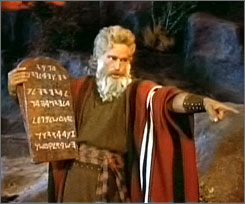
A person does not have to be religious to recognize the importance of the Ten Commandments on western civilization, literature and life. Even when one disregards their intrinsic merit, their literary significance remains. That said, it is important that those who consider themselves well educated should be acquainted with the message of this foundational document.

The statistics reveal a rather surprising picture. It turns out sixty percent of Americans cannot identify even half of the commandments. What I find stunning about that is the fact that since they are mostly prohibitions of destructive behavior, even the illiterate should be able to guess half of them. “Okay . . . we shouldn’t commit murder . . . steal from others . . . or lie about and slander others.” Pretty common sense, and we’re already over halfway there.

“Let’s see . . . the commandments are about God, so there’s probably one that says ‘worship the real God.’” Simple logic, and we’ve nearly arrived. Four out of the five and it wasn’t all that challenging. But how do we arrive at a fifth commandment? Here are two possible paths:

“Oh, doesn’t ‘religion’ believe that it’s sinful to cheat on your spouse . . . that’s probably on the list.”

or

“What’s that weird word the Bible uses about wanting stuff that belongs to others . . . oh yeah, ‘coverting’ or something like that . . . we’re not supposed to desire the possessions of others.”

Since our world has programmed us all with insatiable materialistic desires, it’s probably unlikely that someone would “guess” that coveting our neighbor’s property is wrong, so let’s substitute a more likely alternative.

“Christians get so worked up about swearing, especially when people curse using ‘God’ or ‘Jesus’ . . . so there’s probably something about that in the Ten Commandments.”

Congratulations, we’ve reached our goal of five.

As for the enumeration of the commandments—which varies among Jewish, Roman Catholic and Protestant communions—that’s a subject for another day.

Addendum:

Don’t forget the observance of this commandment which would transform our world: “Honor your father and mother” (this is the first commandment with a promise), “that it may go well with you and that you may live long in the land.”