Humor & Health

I had to have blood drawn today for an upcoming physical exam. It’s not one of my favorite things to do, but I consciously try not to allow my feelings to negatively affect the caregivers who provide these essential procedures for our wellbeing. (Trust me, dentists especially are sorely in need of our appreciation.) I often try to add a little smile to their day employing a touch of light humor.

Today, for example, I was repeating a blood test I had already accomplished earlier this week. When the corpsman (Naval hospital) asked which arm I said, “you better take it out of my left arm . . . they weren’t happy with the numbers in the sample they got from my right.”

Now, a modest joke like that won’t make it into any comedians’ monologues, but it did inspire a chuckle from the four of us in the lab at that moment.

It reminded me of getting my flu shot last year and having my choice of four different corpsmen to administer it. Each had a waiting line. I could only imagine what it was like to be puncturing one anonymous arm after another for eight hours. Most “victims” silent, but many grimacing and some feeling compelled to describe to you just how much they hate shots.

Three of the corpsmen were normal sized human beings. But the fourth was a behemoth. The seams of his uniform were near to bursting due to his extraordinary musculature. I doubt he was on steroids, but his massive figure could have fit into the offensive line of any team in the NFL. And, for some mysterious reason, his waiting line was the shortest.

When I approached him to receive my vaccination, I ventured (in a voice loud enough for his companions to hear): “I chose you because you look like you’re gentle.” Everyone got a laugh out of that, and I felt pleased at having momentarily brightened their day.

My kids are always wary when I make comments like this. They recognize that every time we open our mouths, it’s a gamble. We can achieve our goal, and elicit someone’s precious smile . . . or we can make a fool of ourselves.

As a grandfather, I have the added “protection” of not having too much expected of me, in the wittiness department. By the grace of God, I’m still in possession of the bulk of my mental capacities. I imagine that, should I live long enough, most of my attempts at humor may grow rather lame. But, if there remains any cultural respect for our elders, even these attempts will be recognized for what they are—goodwill. And, as such, there are those from whom they will still elicit a smile.

We should not be afraid of humor, especially in its most humble and intimate forms. Woven amidst the threads of our daily conversations, it enriches life.

C.S. Lewis recognized this quite well. In The Magician’s Nephew, which recounts the creation of Narnia, Aslan says to the newly anointed animals: “Laugh and fear not, creatures. Now that you are no longer dumb and witless, you need not always be grave. For jokes as well as justice come in with speech.”

Lewis notes something in Reflections on the Psalms that I too have found to be true. “A little comic relief in a discussion does no harm, however serious the topic may be. (In my own experience the funniest things have occurred in the gravest and most sincere conversations.)”

Because of this, it’s not uncommon when we sit with those who have lost a loved one, to find that the conversation often drifts towards those happy and humorous moments that were shared with the departed. I’ve heard much healing laughter in the still sorrowing presence of the grieving. And, whether the words or thoughts evoke bold laughter or simple smiles, I tend to consider them a good thing indeed.

Mastering the Anacoluthon

Allow me to once again display my grammatical ignorance. I was reading an online book review and the author used lots of multisyllabic words. (That’s something I actually enjoy.) But then he went and threw in one of those words I had to rush to dictionary.com to define. (That’s another thing I love—learning new words.)

Naturally, I could partially decipher the definition from the context. However, whenever I have a dictionary within reach, that shortcut doesn’t satisfy me.

In this case, the word was anacolutha, the plural form of anacoluthon. It is defined as “a construction involving a break in grammatical sequence, as ‘It makes me so—I just get angry.’” Well, we can all agree that is not a good sentence; it’s a fine example of what a writer should avoid.

Not all grammar rules make sense. Take for example the notion that one cannot end a sentence with a preposition. Some of us literally had our knuckles rapped for scribbling such grammatical “obscenities.” While it’s true that you can avoid using prepositions in this manner, it’s not the great sin we were taught it was. In his Letters to an American Lady, C.S. Lewis writes:

[Regarding] a sentence ending with a preposition. The silly “rule” against it was invented by Dryden. I think he disliked it only because you can’t do it in either French or Latin which he thought more “polite” languages than English.

Well, isn’t that an interesting historical note to become aware of?

But, back to anacolutha . . . let’s see if it’s difficult for a trained pen to sever the ties of logic, and compose this sort of literary construction.

Reepicheep was a great swordsman who, “a tail is the honor and glory of a Mouse” was his creed.

Frodo pondered his options while—the Nazgûl loathed bathing more than once each fortnight.

Wow, that’s a lot harder than it looks. If you can think of better examples (not difficult, I’m sure), feel free to share them in a comment! But only write them here, and don’t allow any anacolutha to slip into your real writing!

Exercising Your Creativity

If you work in an “institutional” or office setting, you may be acquainted with the ubiquitous motivational posters that adorn offices from sea to shining sea. (I can’t speak for other countries, but here in the United States, these encouraging slogans can be found in government and private businesses across the land.)

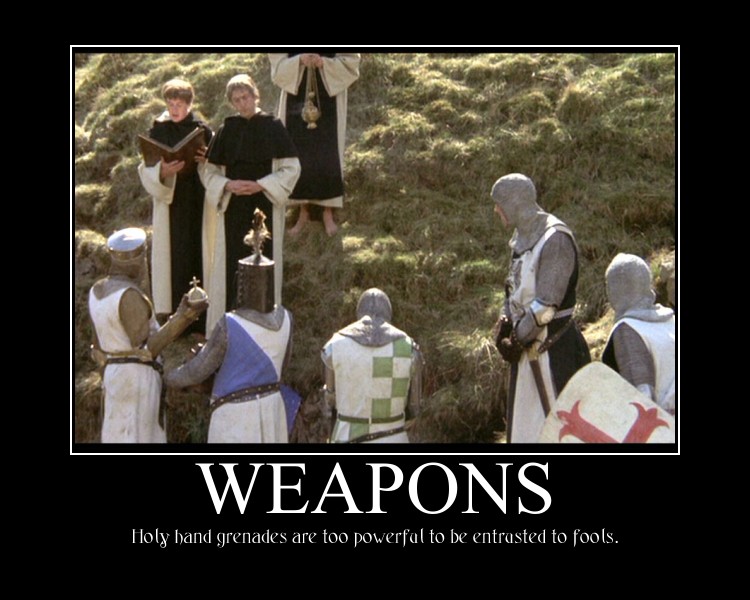
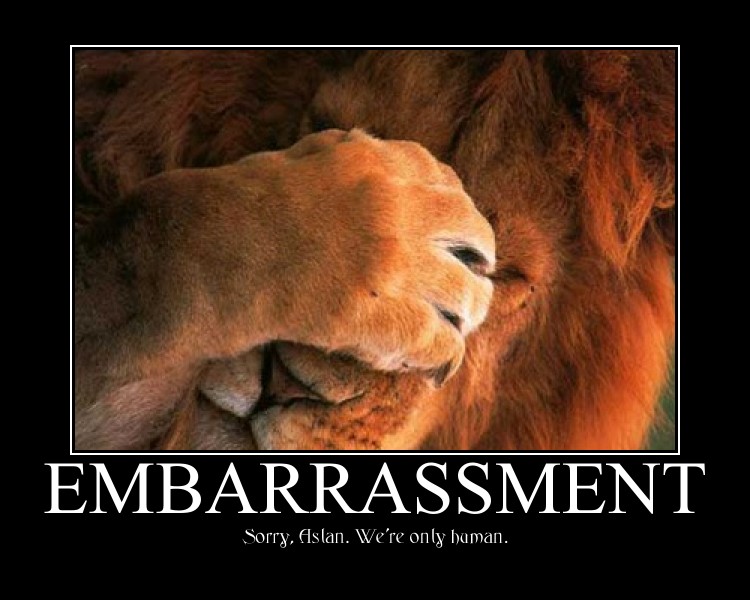
They are so common, in fact, that they have been parodied by a company that offers “The Demotivator’s Collection.” They sell entertaining posters such as:

1. [Image of a sinking ship]

MISTAKES

It could be that the purpose of your life is only to serve as a warning to others.

2. [Image of a salmon leaping up a raging river directly into the mouth of a waiting bear]

AMBITION

The journey of a thousand miles sometimes ends very, very badly.

3. [Image of a fast food carton of french fries]

POTENTIAL

Not everyone gets to be an astronaut when they grow up.

Humor is powerful. I image that many of these demotivational posters adorn the walls of companies that recognize this fact. (You know, the ones with young, dynamic, iconoclastic leaders.)

Here’s one I might even have tempted to hang up in a couple offices where I used to work:

4. [Image of five hands linked together.]

COMMITTEES

Just like teamwork. Only without the work.

I agree with C.S. Lewis about the vital role humor plays in the lives of healthy people. As he wrote in Reflections on the Psalms: “A little comic relief in a discussion does no harm, however serious the topic may be. (In my own experience the funniest things have occurred in the gravest and most sincere conversations.)”

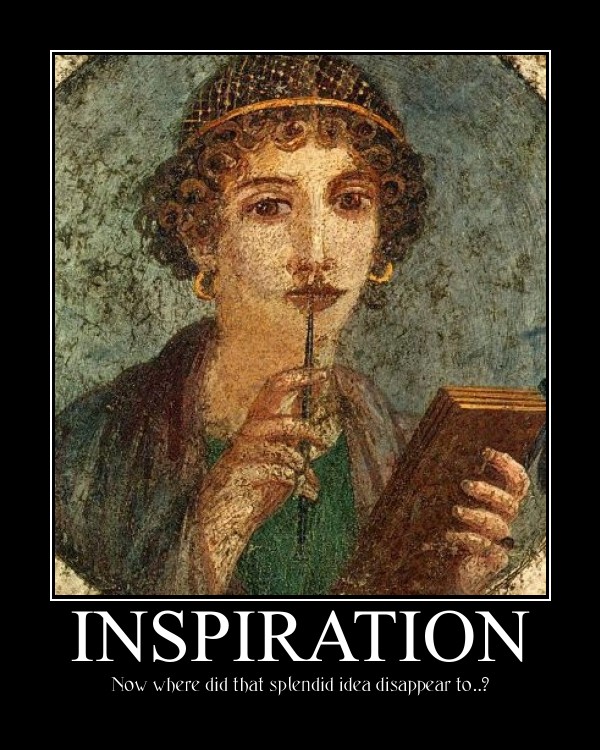
If you feel inspired by the concept of creating thoughtful—or witty—phrases to elaborate on a specific word or brief phrase, you can manufacture these graphics online yourself. Using this free application, you can craft your own (de)motivational posters—just as I did the one displayed above. Yes, that’s my handiwork.

The images you make are yours to download for free. The company needs to turn a profit though, so they offer high quality digital files or posters, for a price. (The free versions are only suitable for smaller applications, like blogs or other websites.)

How’s that for a great way to express your creativity? And it only requires a couple of minutes!

Oh, and if you’re wondering whether my poster about INSPIRATION is a motivator or a demotivator . . . well, I guess that’s in the eye of the beholder.

Pets in Heaven?

One of my favorite features in the Wittenburg Door of the 1980s was a running account of “Dogs Who Know the Lord.” Having witnessed more Christlike traits in some pets than I’ve seen in many human lives, I considered the tongue in cheek title a definite possibility.

This week we bid farewell to a gentle and loving border collie who had been part of our family for more than a decade. She lived a long and full life, and like her our previous border collie, she enjoyed her family and the outdoors (both gifts of God) right up until the end. (Both had been “rescued” by us.) Then, when Tanner and Lady were each over 15 years old, simply remained on their blankets when the day arrived that they knew they had not the strength to rise.

There are two kinds of people. Pet lovers, and those whose hearts are desensitized to their affections. The latter group has already stopped reading this post. But pet lovers, yes you, can empathize with my family’s current grief. You understand our loss because you’ve suffered the same pain. And, some of you may even pause to say a short prayer for us.

As a pastor, I’ve had numerous conversations with people about the question of whether or not we’ll see our pets in heaven. It’s a provocative subject, and the fact that such questions persist is a tribute to the significance of these animals in our lives.

Contrary to what some would allege, posing questions about this matter does not trivialize faith; it reveals how our restored relationship with our Creator affects every dimension of our existence.

We cannot know, of course, the answer to the question. That’s something that those who respond with a snide “of course not!” should take care to realize.

Over the years my own views on this have broadened, and far from seeing the deliverance (i.e. not “salvation”) of animals as something unlikely . . . I now consider it likely that we will be greeted by our beloved pets in the new creation. Here are some reasons I consider this a definite possibility:

  1. First, it is true that Jesus died to redeem (save) human beings (not animals).
  2. Animals are “innocent” sufferers of humanity’s disobedience and fall.
  3. Some animals are uniquely precious and beloved by God’s children.
  4. Their presence in heaven would enhance our joy.
  5. The same God who created them would have no difficulty re-creating or restoring them.
  6. If the lion and the lamb will lie together in harmony, why should there not be room for our much-loved pets to frolic alongside them?

And, lest you consider the words above merely the sentimental ramblings of a grieving man, I take comfort in the fact that C.S. Lewis too regarded this as a possibility. In a 1962 letter, he wrote:

. . . in The Problem of Pain I ventured the supposal—it could be nothing more—that as we are raised in Christ, so at least some animals are raised in us. Who knows, indeed, but that a great deal even of the inanimate creation is raised in the redeemed souls who have, during this life, taken its beauty into themselves? That may be the way in which the “new heaven and the new earth” are formed. Of course we can only guess and wonder. But these particular guesses arise in me, I trust, from taking seriously the resurrection of the body.

Replacing Exonyms

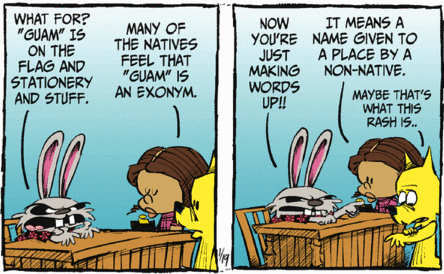
Scott Stantis has illustrated once again how educational some current comic strips can be. His current story arc takes place in Guam. (Guam’s a lovely United States Territory where my family and I lived for two wonderful years in the nineties.)

The story line involves a presidential candidate who has taken refuge there and was asked his opinion about formally changing the island’s name. (There is a movement seeking to replace “Guam” with “Guahon,” the island’s name in the Chamorro language.) You can follow the entire series at Prickly City.

As the panel shows, the (rabbit) senator is unaware that “Guam” is actually an exonym. As such, there is a valid reason to consider its replacement.

Kids today are growing up knowing prominent international cities by names that still seem “foreign” to many of us adults. Beijing has been around just long enough to sound right. But it will always be remembered as Peking to some. Mumbai, as a more recent adjustment, rings alien in the ears of those who still think of the most populous city in India as Bombay.

Still, it makes sense to attempt to refer to cities and nations as the residents of those locales do. For one thing, it is a sign of respect.

And this kind of transition is not an example of thoughtless or random “verbicide” which C.S. Lewis described in “Studies in Words.” There he wrote:

Verbicide, the murder of a word, happens in many ways. Inflation is one of the commonest; those who taught us to say awfully for “very,” tremendous for “great,” sadism for “cruelty,” and unthinkable for “undesirable,” were verbicides.

Replacing exonyms is meaningful to those it directly affects. And it is little more than an inconvenience to the rest of us. So, I’m in favor of it.

Just as I’m always in favor of comic strips that educate as well as entertain!

Military Helmets

War is deadly business. And, if a kingdom or nation hopes to emerge victorious, they are wise to equip their soldiers properly. That’s why this fact, included in today’s Ripley’s Believe It or Not comic, is so shocking.

It’s inconceivable that as the world marched to war in 1914, not a single one of the world powers equipped their troops with steel helmets. Elegant helms that looked superb on the parade ground . . . yes. Elaborate crests that exaggerated height to intimidate the foe . . . of course. Comfortable fabrics that kept the scorching sun off of the scalp . . . certainly.

But steel helmets that might actually spare men from bullet and shrapnel wounds . . . not those.

It’s not like the danger of ballistic wounds caught the Europeans off guard. Muskets had given way to deadly rifles long before. Artillery had advanced to the point where the Germans actually built not one, but two unique weapons: (1) Big Bertha, a huge howitzer that lobbed an eighteen hundred pound shell nearly eight miles, and (2) the Paris Gun, a siege cannon able to fire its shell eighty miles!

As soldiers like C.S. Lewis and J.R.R. Tolkien rallied to the flag and fought the Huns, they would eventually be issued more protective equipment. But it didn’t exist at the war’s outset. And even with it, Lewis was severely wounded in combat. in 1939 he wrote, “My memories of the last war haunted my dreams for years.”

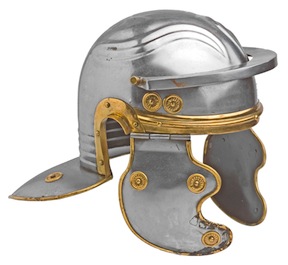
The irony about metal helmets is that even ancient peoples recognized the importance of protecting the skulls of their warriors with the strongest materials available. In my office I have a replica Roman legionary helmet. Trust me, it was capable of saving lives.

Today’s combat helmets are highly advanced, and great effort is made to protect military members from head trauma. Sending them into battle with anything less than the best equipment available should be a crime.

Powerful Words

Wow. Today I “enjoyed” the sensation that comes from seeing an archaic word we haven’t encountered for ages. This was a word my sainted mother used when my siblings and I were mere rugrats. No, that’s not the word. “Rugrats” remains in my unsainted father’s vocabulary to this very day. Today he uses it in reference to his great-grandchildren. Besides, it’s only been seven years since the eponymous television series aired its final episode.

The modest word which inspired this post is “rigmarole.” My child-recollection adds an extra syllable, an “a.” Ri-ga-ma-role . . . now there’s a word to evoke memories from many years ago. Ah, and a further internet search reveals my mom wasn’t mispronouncing the word, she was simply using a variant.

She used the word in its primary context. Elaborate or lengthy procedures. Actually, it is through the second meaning of the word that I encountered it this morning. It is also defined as “confused, incoherent, foolish or meaningless talk.”

It’s in this context—referring to useless jargon—that C.S. Lewis describes the crippling effect of rigamarole. He writes:

“Stone walls cannot a prison make

Half so secure as rigmarole.”

Thus concludes one of C.S. Lewis’ delightful poems, entitled “The Prudent Jailer.” When I trace the quotation back to its source I encounter a wonderful poem I had never before read. And, ironically, the poem begins with a reference to “nostalgia,” the very sensation Lewis’ word choice evoked in me.

“Always the old nostalgia? Yes

We still remember times before

We had learned to wear the prison dress

Or steel rings rubbed our ankles sore.”

The master Inkling has once again impressed upon me the immense power of words. Rightly chosen words. Well woven together, their symbiosis can be awe-inspiring.

Wielded by the anointed, words can be powerful enough to tear down the stone walls our Jailer uses to imprison us . . . dark walls designed to bar us from the radiant freedom God has created us to enjoy.

Uninhibited Fonts

Tonight as we prepared to begin our monthly Christian Writers meeting, our leader mentioned one of his favorite subjects for scribbling. As an unreformed doodler myself, the conversation immediately seized my wandering attention.

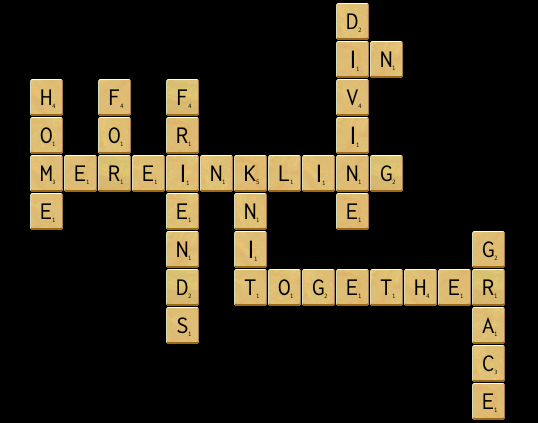
He said something to the effect that he “likes to see how complex or ornate he can draw letters while still maintaining their legibility.” It reminded me of some of the flowery medieval versions of fonts where it is determining precisely what a given letter is, becomes a mystery. (I made the challenge simple above, by bracketing the “I” and “J” with adjacent letters . . . but without the “H” and “K” their identities may have been quite difficult to ascertain.)

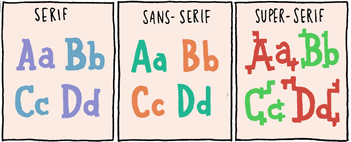
The image to the left comes from a witty strip called “Incidental Comics.” It is penned by Grant Snider, whose cartoons are quite often as entertaining as they are absurd. In this small element from his broader treatment entitled “Design Like Nobody’s Watching,” he expands on the two styles traditionally identified for letter forms.

I’ve written earlier about font lovers, who will especially enjoy the humor here. But all word lovers can appreciate the importance of the letter styles which clothe the words we read and write.

It’s good to be reminded. The fonts we use truly do make a difference.

The Bane of Blogging

In today’s “Pearls Before Swine” comic strip, Rat says, “Hey, Goat. In an effort to improve the readership of your blog, I’ve been studying the google analytics for it.”

“What are those?” asks Goat, who is seated at his computer, presumably typing his latest post.

“A comprehensive series of stats about page views, unique visitors and how viewers find your blog. Anyways, from all that, I think I’ve ascertained the problem.”

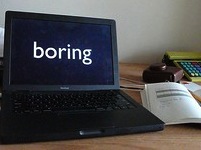
“You’re boring.”

The final panel reveals Goat’s reaction to that painful assertion.

Truth be told, many individual blog posts are boring. And, not a few blogs in toto are tedious as well.

Boredom, though, lies in the perception of the reader. What weighs down the eyelids of one drowsy reader may be precisely the message that invigorates another. So, I don’t worry too much about the natural ebb and flow of responses to various things I write.

Many years of preaching has doubtless influenced me. The sermon one person regards as “okay,” may be used by God to create a genuine epiphany in the life of another.

Of course, the overall flavor or voice of an author is something a reader recognizes only after sampling a fair amount of their work. Taking just a bite here or a nibble there doesn’t allow a reader to adequately assess whether someone’s work is truly nourishing.

Sadly, our busy age doesn’t allow for terribly thorough examinations . . . and with millions of blogs to be sampled, we’re lucky to have a reader stumble upon even one of our posts. Then, in the briefest of moments, an assessment is made and a judgment passed.

Is this column boring . . . or is it informative and perhaps even entertaining? It’s not enough to hint at the promise of gratification. Bloggers must deliver. And they must deliver every time they post. Of course, that’s not humanly possible. Striving for an unattainable goal can be quite disheartening. And we all have “rats” out there ever ready to discourage us.

If you write, I encourage you to take genuine comfort in the fact that some readers will be pleased by what you write. Some will even be blessed. Not all of them. But remember that even the prophets and poets of the Scriptures did not delight all of the members of their audiences.

Do your best to write something worthy of being read. And rest in the knowledge that some of those who see your words will be refreshed and encouraged by them.