Theological Training

I’m proud I graduated from a well-respected seminary. And I’m proud of following that Master of Divinity degree with an advanced Master of Theology degree in Patristics. And that’s precisely the problem . . . I’m proud.

As a Christian, I recognize that pride is one of the most destructive and insidious sins. As a pastor and chaplain, I have seen all too frequently how pride expressly targets members of the clergy. Our vulnerability to the temptation to be proud is one of the common chinks in the armor of the ordained.

C.S. Lewis recognized this fact. In A Severe Mercy, he wrote:

I think there is a great deal to be said for having one’s deepest spiritual interest distinct from one’s ordinary duty as a student or professional man. St. Paul’s job was tent-making. When the two coincide I shd. have thought there was a danger lest the natural interest in one’s job and the pleasures of gratified ambition might be mistaken for spiritual progress and spiritual consolation; and I think clergymen sometimes fall into this trap. . . .

In fact, the change [to a Christian ministry] might do good or harm. I’ve always been glad myself that Theology is not the thing I earn my living by. On the whole, I’d advise you to get on with your tent-making. The performance of a duty will probably teach you quite as much about God as academic Theology wd. do. Mind, I’m not certain: but that is the view I incline to.

Lewis understood that “advancement” in ecclesiastical contexts can mask the inner heart and be mistaken as a form of holiness when it is in actuality vanity. I was reminded of this weakness in clerical armor recently, when I read a tribute to a Chinese Christian whose name is little known beyond his homeland. Dr. Sun Yi-yin, known in America as “Freddie Sun,” died in August at the age of 76. A professor of Geology, he lost his faculty position for failing to deny Christ.

Like thousands of other Christians living under the atheist regime, he was imprisoned for his work in establishing churches and Bible schools. He raised the funds to start no fewer than 154 of these training centers, and was key to the equipping of approximately 60,000 underground pastors and teachers. The “underground” Church in China is distinguished from the government-controlled “Three-Self Patriotic Movement.”

For his labors, Sun endured a decade in a Chinese labor camp. (His wife, Dorothy Chang, was also imprisoned. Rather than reducing his faith, during his sojourn in the harshest of conditions, Sun experienced a personal revival and his zeal increased.

His story is amazing, but here is the aspect that hit the mark in the center of my conscience. In his autobiography, The Man in the Fiery Furnace, Sun described his imprisonment as his “seminary” experience: “Instead of learning homiletics, hermeneutics, Greek, and Hebrew, I was being taught the greater lessons of obedience, submission, forgiveness, love, endurance, and patience.”

Now, I am grateful that God has preserved me from the “fiery furnace,” but I do long to experience the fruit of the spirit that Sun so richly harvested in prison. While not dismissing the importance of the classical subjects of homiletics and hermeneutics, as the Apostle says, “If I speak in the tongues of men and of angels, but have not love, I am a noisy gong or a clanging cymbal. And if I have prophetic powers, and understand all mysteries and all knowledge, and if I have all faith, so as to remove mountains, but have not love, I am nothing. If I give away all I have, and if I deliver up my body to be burned, but have not love, I gain nothing.” (I Corinthians 13:1-3, ESV).

In The Problem of Pain, Lewis’ treatise on suffering, he addresses how God can redeem terrible things such as unjust punishments. For those desiring to understand how an omnipotent God can allow evil to occur, Lewis’ presentation is quite helpful. And, the life example of Dr. Sun provides a superb example of its validity.

I advance six propositions necessary to complete our account of human suffering which do not arise out of one another and must therefore be given in an arbitrary order. 1. There is a paradox about tribulation in Christianity. Blessed are the poor, but by ‘judgement’ (i.e., social justice) and alms we are to remove poverty wherever possible. Blessed are we when persecuted, but we may avoid persecution by flying from city to city, and may pray to be spared it, as Our Lord prayed in Gethsemane.

But if suffering is good, ought it not to be pursued rather than avoided? I answer that suffering is not good in itself. What is good in any painful experience is, for the sufferer, his submission to the will of God, and, for the spectators, the compassion aroused and the acts of mercy to which it leads. In the fallen and partially redeemed universe we may distinguish (1) the simple good descending from God, (2) the simple evil produced by rebellious creatures, and (3) the exploitation of that evil by God for His redemptive purpose, which produces (4) the complex good to which accepted suffering and repented sin contribute.

Now the fact that God can make complex good out of simple evil does not excuse—though by mercy it may save—those who do the simple evil. And this distinction is central. Offences must come, but woe to those by whom they come; sins do cause grace to abound, but we must not make that an excuse for continuing to sin. The crucifixion itself is the best, as well as the worst, of all historical events, but the role of Judas remains simply evil.

I thank God for the life and testimony of Sun. I pray God will reap an abundance of believers in China, and elsewhere, due to his faithfulness. And I thank God for using Sun’s words to cause me to stop in the midst of my busy activities and take the time to examine my own heart and motives.

Vivacious Vocabularies

One reason I love reading C.S. Lewis arises from his adroit use of the English language. His vocabulary is immense. It is pleasant to run into words one seldom encounters on the drab byways of modern journalism and tangled thoroughfares of contemporary “social media.”

Consider the following example. I was exploring The Allegory of Love when I read this: “There is nothing in literature which does not, in some degree, percolate into life.”

What a delightful verb! It evokes for me recollections of my youth when my parents would refer to our coffee pot as the percolator. Simultaneously, it reminds me of more recent—less happy—usages: “I’m sorry, but inadequate soil percolation means you’ll have to install a far more expensive septic system than normally required.”

It’s discouraging when you consider the sad state of modern vocabularies. I read somewhere that people typically only use about 10% of the words they know. So a common vocabulary of 5,000 spoken words would mean they know (i.e. can recognize written or audible forms of) about 50,000 words. Shakespeare used 29,000 words in his plays and sonnets, suggesting an expansive vocabulary. Likewise, brilliant authors like C.S. Lewis would boast a praiseworthy mental dictionary.

I am sometimes curious about my own vocabulary. I consciously attempt—in conversation as well as writing—to utilize at least 15% of the words I know. After all, the English language is so rich, it’s criminal to limit ourselves to pedestrian words. It’s like having all the ingredients for a delicious feast available to us and settling for slapping together a peanut butter sandwich.

I also love the precision that comes from using the exact word that suits the occasion. For example, in a thriller it matters greatly how the hero’s nemesis inflicts injury. A skilled writer would never say “Professor Moriarty cut Holmes.” Instead, we would learn that he slashed . . . stabbed . . . sliced . . . scarred . . . carved . . . or perhaps he merely nicked the detective. Likewise, we would probably know the type of weapon he was using. It would not be a mere “knife.” It might be a saber . . . a dagger . . . a pocketknife . . . scalpel . . . carving knife . . . or perhaps even a bayonet.

Lewis addressed this richness in vocabulary in an essay on “Transposition” which appears in The Weight of Glory.

If the richer system is to be represented in the poorer at all, this can only be by giving each element in the poorer system more than one meaning. The transposition of the richer into the poorer must, so to speak, be algebraical, not arithmetical. If you are to translate from a language which has a large vocabulary into a language that has a small vocabulary, then you must be allowed to use several words in more than one sense. If you are to write a language with twenty-two vowel sounds in an alphabet with only five vowel characters than you must be allowed to give each of those five characters more than one value. If you are making a piano version of a piece originally scored for an orchestra, then the same piano notes which represent flutes in one passage must also represent violins in another.

It is wonderful to be fortunate enough to speak a language with a diverse vocabulary. English is such a tongue. Now, if we could just simplify its complexities and purge its irregularities, we would enjoy the best of all linguistic worlds.

Wasp Wars

This fall I’ve entered into combat with some of fallen nature’s most ferocious and merciless creatures. Thus far, they are winning the war.

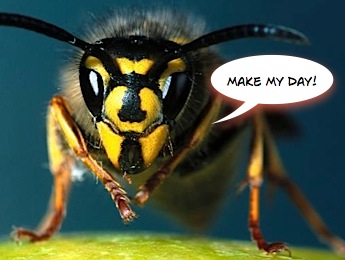
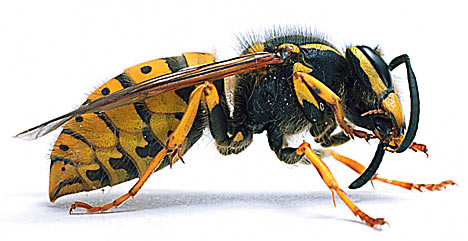
A couple months ago my castle (i.e. home) was invaded by a ruthless tribe of wasps or hornets (the latter is a subset of the species, as are yellow jackets, so they are all members of a single horrific animal family).

They found a small, un-caulked opening into our attic . . . strategically placed just above our front door. I’m sure they had thousands of alternative bastions in the forest that surrounds our house but, being wasps, they knew this was the precise location from which they could wreak the most violent havoc.

The initial fray was brief. I sprayed copious amounts of wasp insecticide into the crevice, in the hope of encouraging them to nest elsewhere. It appeared to act as an attractant. After it failed and added more recruits to their number, I donned armor and climbed a ladder after dusk when they had settled in for the night, and noiselessly attempted to close the space with insect-proof sealant.

Alas, their sentinels were vigilant. They swarmed me, and pushed me off of the ladder causing me to land on my back and crash my head on the ground. Unfortunately, my long sleeved armor did not include a concussion proof helmet. Like a craven coward I lifted my bruised body from the rocky ground (nope, we haven’t planted a lawn yet) . . . and I ran for my life. All the while I was thanking God that I was only standing on the third rung.

Aside from my bruises, they had only inflicted a single piercing wound—on my index finger. Of course, being predators, wasps carry a very nasty venom, and for the next week it failed to heal as the poison festered, despite diligent attention from my corpsman-wife.

I’m waiting patiently for winter now, when they are partially dormant and “hibernating.” When the queen wakes up in the spring, she’ll find herself sealed in a crypt. (At least, that’s what I’m hoping.)

Wasps in Narnia

C.S. Lewis, being a lover of the outdoors, was well acquainted with the hazard posed by wasps. In The Chronicles of Narnia,

When the Pevensie children are drawn back to Narnia for a second time, it is a jarring and initially frightening experience. As we read in Prince Caspian:

It was an empty, sleepy, country station and there was hardly anyone on the platform except themselves. Suddenly Lucy gave a sharp little cry, like someone who has been stung by a wasp. “What’s up, Lu?” said Edmund—and then suddenly broke off and made a noise like “Ow!”

“What on earth—” began Peter, and then he too suddenly changed what he had been going to say. Instead, he said, “Susan, let go! What are you doing? Where are you dragging me to?”

“I’m not touching you,” said Susan. “Someone is pulling me. Oh—oh—oh—stop it!” Everyone noticed that all the others’ faces had gone very white.

“I felt just the same,” said Edmund in a breathless voice. “As if I were being dragged along. A most frightful pulling—ugh! It’s beginning again.”

“Me too,” said Lucy. “Oh, I can’t bear it.”

“Look sharp!” shouted Edmund. “All catch hands and keep together. This is magic—I can tell by the feeling. Quick!”

“Yes,” said Susan. “Hold hands. Oh, I do wish it would stop—oh!” Next moment the luggage, the seat, the platform, and the station had completely vanished.

The four children, holding hands and panting, found themselves standing in a woody place—such a woody place that branches were sticking into them and there was hardly room to move. They all rubbed their eyes and took a deep breath. “Oh, Peter!” exclaimed Lucy. “Do you think we can possibly have got back to Narnia?”

Later, Edmund offers some wise advice in The Voyage of the Dawn Treader. He alludes to the deceptive natural and inherent ninja skills possessed by the killers.

“We must all show great constancy,” Caspian was saying. “A dragon has just flown over the tree-tops and lighted on the beach. Yes, I am afraid it is between us and the ship. And arrows are no use against dragons. And they’re not at all afraid of fire.”

“With your Majesty’s leave—” began Reepicheep.

“No, Reepicheep,” said the King very firmly, “you are not to attempt a single combat with it. And unless you promise to obey me in this matter I’ll have you tied up. We must just keep close watch and, as soon as it is light, go down to the beach and give it battle. . . .”

“Perhaps it will go away,” said Lucy.

“It’ll be worse if it does,” said Edmund, “because then we shan’t know where it is. If there’s a wasp in the room I like to be able to see it.”

Back to My Own Campaign

Just as I became resigned to my strategy with the vicious intruders, I became aware of a second army of insect brigands. This multitude had invaded the crawlspace under my home, through some weakness in the screens guarding my ventilation openings.

Noting that I would not require a ladder to engage them in combat I foolishly thought, oh how you will rue the day you trespassed in my domain!

I purchased a new screen to cover the entire opening, but their guards remained vigilant even during the night and before I could even begin the project, they swarmed and had me fleeing across our back lawn (yes, we do have some grass). Running recklessly in the dark I naturally stumbled and still bear some significant bruises. These would be bad enough, but two of the villains stabbed me with their poisonous stingers before I secured myself in the house.

With the aid of my faithful border collie, I discovered an infiltrator who insidiously snuck into the castle proper clinging to my pants. I immediately dropped my leggings and proceeded to stomp on them for several minutes. I was thorough, walking repeatedly over every part of the crumpled clothing. Naturally, he survived. I did manage to rewrap him in the trousers and see to his demise.

I am reconsidering my strategy now, and leaning towards placing commercial wasp traps directly outside the vent when the vermin reawaken in the spring. I’m also contemplating periodically banging a hammer near their hidden nest to disturb their rest during their hibernation. I haven’t determined yet whether this would be effective, as it is when interrogating terrorists, or whether it would simply be sadistic.

Trying to learn their weaknesses (they don’t have any) I did learn one reason why wasps are so aggressive and merciless. They are almost all female! While queens alone reproduce, and they keep a few males handy for their sole role of mating and dying, the rest of the army consists of “asexual female workers.” These perform community duties such as building the hive, gathering food, feeding the young, and protecting the colony!

Now, lest I be unfairly accused of misogyny, let me make clear that it is not their “feminine” nature that makes them violent. Rather, it is a corruption of their natural maternal instincts which cause them to guard their nest so belligerently that all rationally minded people desire their utter annihilation.

And, Once Again, to Narnia

The final book in the Chronicles has been my favorite ever since I first read the series forty years ago. I gained an even greater appreciation for The Last Battle when I read this description of the heavenly Narnia into which all of Aslan’s faithful were ushered.

Tirian had thought—or he would have thought if he had time to think at all—that they were inside a little thatched stable, about twelve feet long and six feet wide. In reality they stood on grass, the deep blue sky was overhead, and the air which blew gently on their faces was that of a day in early summer. Not far away from them rose a grove of trees, thickly leaved, but under every leaf there peeped out the gold or faint yellow or purple or glowing red of fruits such as no one has seen in our world. The fruit made Tirian feel that it must be autumn but there was something in the feel of the air that told him it could not be later than June.

They all moved toward the trees. Everyone raised his hand to pick the fruit he best liked the look of, and then everyone paused for a second. This fruit was so beautiful that each felt “It can’t be meant for me . . . surely we’re not allowed to pluck it.”

“It’s all right,” said Peter. “I know what we’re all thinking. But I’m sure, quite sure, we needn’t. I’ve a feeling we’ve got to the country where everything is allowed.”

“Here goes, then!” said Eustace. And they all began to eat. What was the fruit like? Unfortunately no one can describe a taste. All I can say is that, compared with those fruits, the freshest grapefruit you’ve ever eaten was dull, and the juiciest orange was dry, and the most melting pear was hard and woody, and the sweetest wild strawberry was sour. And there were no seeds or stones, and no wasps.

Despite our repeated failings, the victory will ultimately be won by our divine Champion!

Treasuring Books

Most of us love and respect books, don’t we? We take care of our literary treasures, and the more deeply we are attached to a particular volume, the better we treat it.

Many of us are reluctant to loan out the books which line our shelves like so many gems, resting in a jeweler’s pristine cases. When we do agree to share them, we’re afraid they may never find their way home. And, when they eventually return to our welcoming grasp, they sometimes bear the scars of their sojourn in the paws of others who do not esteem them as they ought to. Page corners may be scored. Coffee or tea stains may have “embellished” the text. Bindings may have been carelessly mistreated. And, unbelievably, the borrowers are likely to be unaware of how they have abused the tome’s dignity and disfigured its beauty.

Speaking honestly, my own bookshelves are in constant disarray, and too many of my books still remain unpacked after our move into our retirement home. But I am absolutely serious about how painful I find it to witness the mistreatment of books by those ignorant of their value.

C.S. Lewis loved books. He recognized their power. He embraced their wonder. And—most wonderfully for us—he penned a number of classics that will continue to inspire readers for generations.

Yet, as much as Lewis treasured books, he took his own creations for granted. This changed in December of 1954, when he received a precious package from his publisher. Among his Christmas gifts that year were specially bound copies of Surprised by Joy and Mere Christianity. Receipt of the thoughtful present opened his eyes to an interesting notion. On the twenty-second day of the month, he wrote:

I never had a handsomer present. . . . Perhaps these two charming volumes will teach me at last to have for the bodies of my own books the same reverence I have for the bodies of all other books. For it is a curious fact that I never can regard them as being really books; the boards and print, in however mint a condition, remain a mere pretense behind which one sees the scratchy, inky old manuscript.

I daresay that those writers among us can relate to Lewis’ mindset. Even with the pride that accompanies having books or articles in print, our work somehow seems “different” than the other published materials we invariably respect. This is due in large part, I believe, to their familiarity. Writers, better than most, understand what familiarity breeds. We know these works that flowed from our own consciousness and sweat . . . we know them intimately. And we are keenly aware that if given another opportunity, there are parts of them we would even now edit to be clearer, sharper, and more eloquent.

I never cease to be surprised by the humility of new writers who almost whisper their accomplishments to others. It’s as though they are embarrassed . . . that they assume their friends would consider them braggarts if they spoke with the pride they genuinely feel about their work. Some of us hold onto our rejection letters. (I do.) How much better though, to print out high quality copies of articles or devotions we’ve written and place them in a prominent binder or display located near our keyboard.

Who knows, I may actually follow my own advice and do something like that. Sadly, I don’t have a grateful publisher eager to prepare special editions for me. Nevertheless, I’m glad Lewis did. I learned from his insight that whenever we release our literary progeny to the world, they merit the same degree of respect and affection that we book-lovers bestow so generously on the works of others.

___

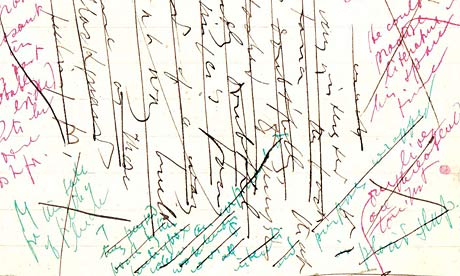
Postscript: The image above is an actual manuscript page from James Joyce’s Ulysses. (It makes me feel much more confident about my own initial scribblings.)

The Glory of Storge (Love)

Storge, noun: Parental affection; the instinctive affection which animals have for their young.

Some of you will recall when I wrote about attending my wife as her nurse while she recuperated from surgery this past summer. Well, I just completed a remotely similar familial duty with my daughter and her husband the past two weeks.

We’ve all been anticipating the arrival of their fourth child and Grandpa is the on call childcare provider of choice. Well, Grandma is actually first choice . . . but since she’s a teacher, that’s not feasible. (She’ll be down here for a week to help out soon, while her husband is home recuperating from two exhausting but wonderful weeks with our inexhaustible grandchildren!)

A few days ago, our newest granddaughter breathed her first breath. I contemplated writing “entered the world,” but far less accurate. She’s beautiful, of course. And we’ll continue to pray that her inner and spiritual beauty, rather than her external appearance, will define her life.

This has gotten me thinking about C.S. Lewis’ wonderful book, The Four Loves. The following passage describes humanity’s natural love for family.

I begin with the humblest and most widely diffused of loves, the love in which our experience seems to differ least from that of the animals. Let me add at once that I do not on that account give it a lower value. Nothing in Man is either worse or better for being shared with the beasts. When we blame a man for being ‘a mere animal’, we mean not that he displays animal characteristics (we all do) but that he displays these, and only these, on occasions where the specifically human was demanded. (When we call him ‘brutal’ we usually mean that he commits cruelties impossible to most real brutes; they’re not clever enough.)

The Greeks called this love storge (two syllables and the g is ‘hard’). I shall here call it simply Affection. My Greek Lexicon defines storge as ‘affection, especially of parents to offspring’; but also of offspring to parents. And that, I have no doubt, is the original form of the thing as well as the central meaning of the word. The image we must start with is that of a mother nursing a baby, a [dog] or a cat with a basketful of puppies or kittens; all in a squeaking, nuzzling heap together; purrings, lickings, baby-talk, milk, warmth, the smell of young life.

The importance of this image is that it presents us at the very outset with a certain paradox. The Need and Need-love of the young is obvious; so is the Gift-love of the mother. She gives birth, gives suck, gives protection. On the other hand, she must give birth or die. She must give suck or suffer. That way, her Affection too is a Need-love. There is the paradox. It is a Need-love but what it needs is to give. It is a Gift-love but it needs to be needed.

As Lewis says, this storge love is a natural affection, instilled within the entire animal kingdom. That is what makes reports of people’s crimes against their own children so terribly shocking. These barbaric acts go against natural law itself. They are inhuman in the absolute sense. And witnessing them among humanity and various animal species reminds us of just how far we have fallen.

By God’s grace, such outrageous acts are the rare exception. Storge is so deeply engrained in nature’s order that we see it in nearly every direction we look. No family is perfect, but most of us are blessed with parents, siblings or other relatives who love us by virtue of our innate bonds.

However, if you are one of the unfortunates who were not loved by your father or mother . . . if you were rejected by your family, I am praying for you. Praying that you will come to know storge in its wonderful fullness through surrogate parents and siblings. After all, it’s not blood that forges these bonds—it is love. Storge is something we readily share with our spouses and our intimate friends. It is a sort of “kinship by choice.”

As I thank God for the most recent addition to our family’s number, I encourage you to thank the Lord as well for the storge love he allows you to give, and receive.

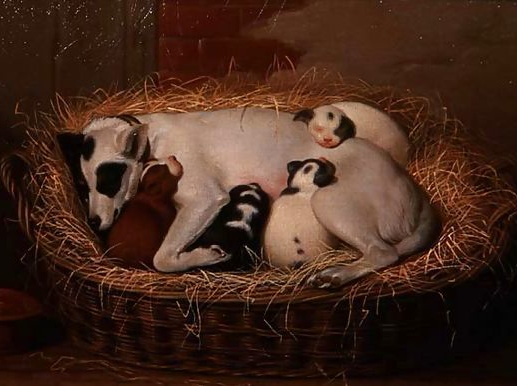
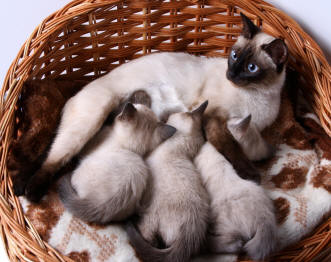
The painting above was created by Samuel De Wilde (1751-1832). And for you cat lovers who were disappointed by my selection of an image of puppies, enjoy this fine portrait of feline storge.

Discovering Your Elvish Name

Most readers of Mere Inkling are either fans of C.S. Lewis and his fellow Inklings, or writers interested in similar topics such as adventure, virtue, imagination, and spirituality. In light of that, and the fact that the finale of the trilogy won Oscar for Best Film, I assume the vast majority have seen “The Lord of the Rings.”

When you watched the films, with whom did you most identify? Ladies had options from warriors, to counselors, to royalty. Likewise for the men. Then there were the different races of Middle Earth . . . did you cast yourself as human, elf or dwarf? Or perhaps, as a modest, earthy hobbit? (I hope there weren’t too many who identified with the orcs, and if you did, I’d suggest an appointment with your local therapist.)

If the notion of living a long, peaceful life, studying the arts and enjoying God’s creation inspires you, then it may be you possess a kinship with the Elvish soul. And if you do (or even if you’re merely curious) there is a wonderful website where you can learn not only how to speak your name in the Elf tongue, but also to write it in the Elf script.

J.R.R. Tolkien, C.S. Lewis’ treasured friend, was at heart a philologist. Few people have ever lived who shared the intensity of his love for language. Not everyone knows though, that the matchless realm of Middle Earth with its timeless sagas grew neither from a vision for the heroic story nor out of the visualization of any of its vibrant inhabitants. No, the seeds of the most renowned fantasy realm ever envisioned, were planted and watered by Tolkien’s love of language.

It was primarily linguistic in inspiration and was begun in order to provide the necessary background of ‘history’ for Elvish tongues. (J.R.R. Tolkien, Forward to the Second Edition of The Lord of the Rings).

Tolkien’s passion for the languages of Middle Earth is legend. Today, other linguists continue to study, document and teach the sophisticated system. Tolkien’s creation was so complex that it resulted in the creation (and evolution) of several languages—distinguished by both history and geography. In the same way, Tolkien was not content to settle for a single version of text with which to pen these musical dialects. He created no fewer than three styles, with Tengwar being most familiar. (You can download these and related fonts here.)

So, how exactly do you discover your Elvish name?

There have long been “random generators” for Middle Earth-sounding names. The generator at one site renders my Elvish name as Eöl Séregon, which does sound fairly distinguished. (Who knows whether or not it means anything?) These programs may satisfy the curiosity of the passing surfer seeking random oddities. However, for those who respect the love Tolkien invested in his linguistic progeny, this will never suffice.

Fortunately, there is an amazing website, overseen by a bona fide lover of languages. Moreover, his site is devoted to maintaining the integrity of Tolkien’s Elvish tongues. (And many of us who are writers are similarly enamored with language itself, making this a worthwhile domain to visit.)

The host of Quenya101 embraced the tongue so completely that in college he even took lecture notes in the language! Today he teaches Quenya through his website and other means. Although there’s a long waiting list (that can be circumvented, I believe, by donating to the site) he will actually translate names into Quenya. Note that I said “translate.” This is no mere transposing of letters.

He does not waste his time with transliterations. He actually applies the etymology of your given name to rendering the very same meaning in the Elvish language. For good measure, he provides a Tengwar rendition of your Elvish name. (It may be that he has already translated your name and has it posted at the site.)

Here’s how it works, as illustrated by my own name. Fortunately, my father’s name has also been translated, so I am seeking the Quenya for “Robert (son of) Charles.”

Robert

From: Germanic name Hrodebert.

Meaning: Bright fame, derived from the Germanic elements

     hrod ”fame” and beraht “bright”.

Quenya: Calialcaro

     (calima+alcar+[o] = bright+splendour, glory+[masculine names suffix])

Charles

From: Germanic name Karl, which was derived from the same Germanic word. However, an alternative theory states that it is derived from the common Germanic element hari

Meaning: Karl means “man” & hari means “army, warrior”

Quenya: Nér (nér = man) or Ohtatyaro (ohtatyaro = warrior)

So, henceforth you may address me as Calialcaro Ohtatyaro!

It is encouraging to see people keeping alive the vision and wonder of Middle Earth. The same is true for Narnia, of course, though you cannot really compare the purpose. These magical realms were both created by geniuses. It is a divine coincidence that these men, with major differences in their temperaments and imaginations, were lifelong friends.

Discovering your unique Elvish name can establish a dramatic connection with an imaginary, but at the same time gloriously real, realm.

Searching for Water

Have you ever been truly, deeply thirsty? Parched all the way from your lips to your loins . . . scorched like a desiccated crustacean who didn’t quite scurry back to the retreating tides quickly enough.

If you have, you know how savory—how gloriously life giving—a simple drink of water can be. In fact, when you experience thirst like this and take that first quenching swallow, there is nothing else like it in the world.

In those rare moments of dire yearning and satisfaction, we understand how water is utterly vital to life. All the treasures and honors of this world would be meaningless, if they were intended to substitute for that most basic human necessity.

I was pondering the importance of water as I examined the photograph above. The Mars rover Curiosity took it. NASA considers the outcrop here to be the edge “of an ancient streambed.” Rounded rocks, which would presumably have been shaped as they tumbled along “vigorous” creeks or rivers, support that notion. The quest transpiring across our solar system this very hour is nothing less than a search for evidence of life on that arid planet

Water, of course, is necessary to life “as we know it.” Thus the vast significance of the discovery.

Jesus of Nazareth was talking one day with a woman of Samaria. He brashly said of the water she was drawing from a well that dated back to the days of the Patriarch Jacob: “Everyone who drinks of this water will be thirsty again, but whoever drinks of the water that I will give him will never be thirsty again. The water that I will give him will become in him a spring of water welling up to eternal life.”

Because we are inescapably bound to water, it carries tremendous power as a simile or metaphor. C.S. Lewis used it quite effectively in the following passage. In it, he is discussing the true value of performing religious exercises, even when they do not bring us joy or a conscious sense of renewal. As usual, Lewis uses vivid imagery to communicate profound truth.

When we carry out our “religious duties” we are like
people digging channels in a waterless land, in order that when at last the water comes, it may find them ready. . . . There are happy moments, even now, when a trickle creeps along the dry beds; and happy souls to whom this happens often. (C.S. Lewis, Reflections on the Psalms).

I’m saddened by the number of people (especially those with a family legacy of faith) who succumb to the secular philosophies of our materialistic world. They surrender to the world’s hedonistic proclamation that personal happiness is the greatest good! They are ultimately destined to find their souls withered and wasted by the waterless doctrines they embrace.

The worst part of it all is that the water is right in front of us all, offered freely to each of us. We don’t need to commission any expensive interplanetary projects to seek it out. We don’t need to try to be “good enough” to deserve it. All we need do is accept the gift, priceless though it is.

Creation Story Similarities

I love being welcomed into other cultures by individuals who are proud of their heritage and eager to share it. Yesterday I attended a gathering of pastors at a church in Neah Bay, Washington, which lies in the far northwest corner of the “Lower Forty-Eight” United States.

Neah Bay is the largest community on the Makah Indian Reservation. A visit to the outstanding Makah Museum taught me many things. The unfortunate burial of the Makah village of Ozette preserved numerous artifacts that teach us about “pre-contact” Native American tribal life. A 1750 mudslide covered ten long houses and that tragedy has been redeemed in a small way by providing the modern Makah nation with a wealth of knowledge about its ancestors.

As a dog lover, I was fascinated by the fact that the Makah bred a special type of dog that was sheered for its “wool.” This, of course, was due to the absence of sheep, goats, llamas and the like. These particular canines were kept on an island to prevent their interbreeding with camp dogs. Unfortunately, their breed is no longer known, although I am curious as to whether it could be established from studying remains, assuming the tribe still knows which island was used as their refuge.

The news that intrigued me most was that, in Makah mythology, at the time of their creation, all of the animals could speak. Now, it will not surprise any readers to know this reminded me of another creation tale. My thoughts immediately leapt to the story of Narnia’s creation, which C.S. Lewis describes in The Magician’s Nephew.

[Aslan] was going to and fro among the animals. And every now and then he would go up to two of them (always two at a time) and touch their noses with his. He would touch two beavers among all the beavers, two leopards among all the leopards, one stag and one deer among all the deer, and leave the rest. . . . the creatures whom he had touched came and stood in a wide circle around him. . . . The Lion, whose eyes never blinked, stared at the animals as hard as if he was going to burn them up with his mere stare. And gradually a change came over them. The smaller ones—the rabbits, moles, and such-like—grew a good deal larger. The very big ones—you noticed it most with the elephants—grew a little smaller. Many animals sat up on their hind legs. Most put their heads on one side as if they were trying very hard to understand.

The Lion opened his mouth, but no sound came from it; he was breathing out, a long, warm breath; it seemed to sway all the beasts as the wind sways a line of trees. Far overhead from beyond the veil of blue sky which hid them the stars sang again; a pure, cold, difficult music. Then there came a swift flash like fire (but it burnt nobody) either from the sky or from the Lion itself, and every drop of blood tingled in the children’s bodies, and the deepest, wildest voice they had ever heard was saying: “Narnia, Narnia, awake. Love. Think. Speak. Be walking trees. Be talking beasts. Be divine waters.”

In the Makah creation story, the two brothers of the sun and moon changed preexisting material into the people and creatures we know today. Here is the brief account of their labors. It is interesting to note that both accounts impute personhood to the trees, as well as the animals.

When the world was very young, there were no people on the earth. There were no birds or animals, either. There was nothing but grass and sand and creatures that were neither animals nor people but had some of the traits of people and some of the traits of animals.

Then the two brothers of the Sun and the Moon came to the earth. Their names were Ho-ho-e-ap-bess, which means “the Two-Men-Who-Changed-Things.” They came to make the earth ready for a new race of people, the Indians. The Two-Men-Who-Changed-Things called all the creatures to them. Some they changed to animals and birds. Some they changed to trees and smaller plants.

Among them was a bad thief. He was always stealing food from creatures who were fishermen and hunters. The Two-Men-Who- Changed-Things transformed him into Seal. They shortened his arms and tied his legs so that only his feet could move. Then they threw Seal into the Ocean and said to him, “Now you will have to catch your own fish if you are to have anything to eat.”

One of the creatures was a great fisherman. He was always on the rocks or was wading with his long fishing spear. He kept it ready to thrust into some fish. He always wore a little cape, round and white over his shoulders. The Two-Men-Who-Changed-Things transformed him into Great Blue Heron. The cape became the white feathers around the neck of Great Blue Heron. The long fishing spear became his sharp pointed bill.

Another creature was both a fisherman and a thief. He had stolen a necklace of shells. The Two-Men-Who-Changed-Things transformed him into Kingfisher. The necklace of shells was turned into a ring of feathers around Kingfisher’s neck. He is still a fisherman. He watches the water, and when he sees a fish, he dives headfirst with a splash into the water.

Two creatures had huge appetites. They devoured everything they could find. The Two-Men-Who-Changed-Things transformed one of them into Raven. They transformed his wife into Crow. Both Raven and Crow were given strong beaks so that they could tear their food. Raven croaks “Cr-r-ruck!” and Crow answers with a loud “Cah! Cah!”

The Two-Men-Who-Changed-Things called Bluejay’s son to them and asked, “Which do you wish to be—a bird or a fish?”

“I don’t want to be either,” he answered.

“Then we will transform you into Mink. You will live on land. You will eat the fish you can catch from the water or can pick up on the shore.”

Then the Two-Men-Who-Changed-Things remembered that the new people would need wood for many things.

They called one of the creatures to them and said “The Indians will want tough wood to make bows with. They will want tough wood to make wedges with, so that they can split logs. You are tough and strong. We will change you into the yew tree.”

They called some little creatures to them. “The new people will need many slender, straight shoots for arrows. You will be the arrowwood. You will be white with many blossoms in early summer.”

They called a big, fat creature to them. “The Indians will need big trunks with soft wood so that they can make canoes. You will be the cedar trees. The Indians will make many things from your bark and from your roots.”

The Two-Men-Who-Changed-Things knew that the Indians would need wood for fuel. So they called an old creature to them. “You are old, and your heart is dry. You will make good kindling, for your grease has turned hard and will make pitch. You will be the spruce tree. When you grow old, you will always make dry wood that will be good for fires.”

To another creature they said, “You shall be the hemlock. Your bark will be good for tanning hides. Your branches will be used in the sweat lodges.”

A creature with a cross temper they changed into a crab apple tree, saying, “You shall always bear sour fruit.”

Another creature they changed into the wild cherry tree, so that the new people would have fruit and could use the cherry bark for medicine.

A thin, tough creature they changed into the alder tree, so that the new people would have hard wood for their canoe paddles.

Thus the Two-Men-Who-Changed-Things got the world ready for the new people who were to come. They made the world as it was when the Indians lived in it.

Travel Weary

I enjoy traveling. Cross country car trips are exciting adventures that have created some of my fondest memories. Flying to other countries has been the equivalent of stepping through a looking-glass; one moment you’re surrounded by the familiar and only a “few moments” after, you are immersed in utterly foreign environs.

Admittedly, traveling by air is a bit less enjoyable now, given the necessary security precautions. And, my 75 inch frame has never savored being wedged into the standard airline seat. Still, being able to cross to the opposite slide of the planet within a day borders on the amazing. I would have used the word “unbelievable,” but for the fact that imminent breakthroughs in low orbit travel will likely make today’s flight durations seem protracted.

While travel is often invigorating, there is an annual journey that I do not look forward to. Each year I travel to Saint Louis—a lovely city in America’s heartland—as a member of my church’s commission for military ministry. The problem arises from the fact that we fly in on a Thursday, begin with an informal gathering around dinner, and then rise early for business meetings that last into the late afternoon. Then, we fly home on an early evening flight that gets us home (in my case) about midnight.

While the clock says midnight, that is on a day when we got up in a different time zone, which means we’ve been on the run for twenty hours . . . and a ninety minute drive home from the airport is still ahead. It becomes a bit of a safety concern when you haven’t napped at all. Why not, you might wonder? Well, the truth is that I am one of the many people with sleep apnea, and the decibel level of my snoring could constitute assault. My exhaustion is an inevitable consequence of my consideration of others.

I know I’m not alone in having to take trips like this. What I’m describing is probably familiar to many of you. It’s just that spending nearly twenty-four hours over two days traveling to and from approximately eight hours of meetings leaves me exhausted.

Then there is the consideration that we don’t always make the best decisions when we are tired. There’s an intriguing passage in Prince Caspian where C.S. Lewis describes a decision facing the Narnian heroes. Young Lucy, pure of heart, has informed the group that Aslan would have them follow a particular route. However, in a wonderful portrayal of religious democracy, the band decides to put the matter to a vote! And, just as in church bodies today, we learn that not all ballots result in divinely inspired decisions.

There’s nothing for it but a vote,” said Edmund.

“All right,” replied Peter. “You’re the eldest, D.L.F. What do you vote for? Up or down?”

“Down,” said the Dwarf. “I know nothing about Aslan. But I do know that if we turn left and follow the gorge up, it might lead us all day before we found a place where we could cross it. Whereas if we turn right and go down, we’re bound to reach the Great River in about a couple of hours. And if there are any real lions about, we want to go away from them, not toward them.”

“What do you say, Susan?”

“Don’t be angry, Lu,” said Susan, “but I do think we should go down. I’m dead tired. Do let’s get out of this wretched wood into the open as quick as we can. And none of us except you saw anything.”

“Edmund?” said Peter.

“Well, there’s just this,” said Edmund, speaking quickly and turning a little red. “When we first discovered Narnia a year ago—or a thousand years ago, whichever it is—it was Lucy who discovered it first and none of us would believe her. I was the worst of the lot, I know. Yet she was right after all. Wouldn’t it be fair to believe her this time? I vote for going up.”

“Oh, Ed!” said Lucy and seized his hand.

“And now it’s your turn, Peter,” said Susan, “and I do hope—”

“Oh, shut up, shut up and let a chap think,” interrupted Peter. “I’d much rather not have to vote.”

“You’re the High King,” said Trumpkin sternly. “Down,” said Peter after a long pause. “I know Lucy may be right after all, but I can’t help it. We must do one or the other.”

At many times in our life journeys we may find ourselves “dead tired” like Susan. But we need to keep our wits about us so we don’t make decisions that lead us down paths destined to bring even more suffering and fatigue.

The following passage from Lewis’ Mere Christianity illustrates how we often justify our poor decisions and inconsiderate actions with our tiredness. I certainly do. Perhaps you’ll see a little of yourself in the following words.

I hope you will not misunderstand what I am going to say. I am not preaching, and Heaven knows I do not pretend to be better than anyone else. I am only trying to call attention to a fact; the fact that this year, or this month, or, more likely, this very day, we have failed to practise ourselves the kind of behaviour we expect from other people. There may be all sorts of excuses for us. That time you were so unfair to the children was when you were very tired. That slightly shady business about the money—the one you have almost forgotten—came when you were very hard-up. And what you promised to do for old So-and-so and have never done—well, you never would have promised if you had known how frightfully busy you were going to be. And as for your behaviour to your wife (or husband) or sister (or brother) if I knew how irritating they could be, I would not wonder at it—and who the dickens am I, anyway? I am just the same.

That is to say, I do not succeed in keeping the Law of Nature very well, and the moment anyone tells me I am not keeping it, there starts up in my mind a string of excuses as long as your arm. The question at the moment is not whether they are good excuses. The point is that they are one more proof of how deeply, whether we like it or not, we believe in the Law of Nature. If we do not believe in decent behaviour, why should we be so anxious to make excuses for not having behaved decently? The truth is, we believe in decency so much—we feel the Rule of Law pressing on us so—that we cannot bear to face the fact that we are breaking it, and consequently we try to shift the responsibility. For you notice that it is only for our bad behaviour that we find all these explanations. It is only our
temper that we put down to being tired or worried or hungry; we put our good temper down to ourselves.

Well, I’m too tired to write any more on this subject now, so those of you who have remained with me to this point, can count yourselves blessed!

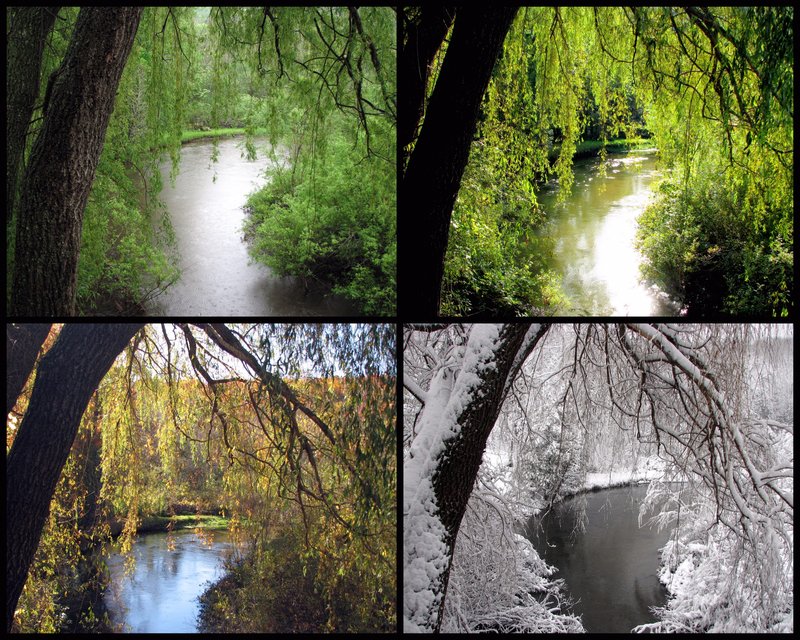
Recycling Seasons

Fall has arrived, and with it (in many nations) a new “school year.” The traditional academic year has been modified in various locales, but for most the end of summer and beginning of fall herald the beginning of the latest season of learning.

The irony is, of course, that even those long “graduated” from any personal learning goals remain subject to this academic cycle. The “back to school” advertising is pervasive, and simultaneous “commencements” such as football and new television programming also reinforce that sensation that something familiar is returning for a fresh beginning.

Families with children in traditional schools are anchored in this academic cycle. It is so intimately an aspect of life that the world would be disorienting without it. Fall, winter, spring and summer—each with their unique traits and holidays—create an ongoing cycle that is as comfortingly familiar as it is renewed and invigorating.

This is particularly true in families such as my own where my wife and son teach in public and private schools, respectively. We also have children embracing the challenges and potential rewards of homeschooling. Yet, even after my immediate family retires from teaching and our youngest grandchild (due to be born in less than a month) has received her college diploma . . . the academic cycle will still be part our lives.

As Christians, the significance of this annual cycle is reinforced by the celebration of the Church Year. It begins in the winter, on the first Sunday of December, with the season of Advent. Then we are carried delightfully through the momentous “white water” events in the life of Jesus Christ until the current slows and we drift serenely through the long season of Pentecost which spans the summer months.

As I wrote above, this cycle is wonderfully familiar and remarkably new. It is a gift of God. And, like all divine beneficences, the Adversary desires to corrupt its meaning and destroy its value. C.S. Lewis addresses this expertly in The Screwtape Letters, where the tempter is advising a fellow devil to make his “patient” bored with the recurring nature of this pattern. In the passage which follows, Screwtape is complaining how God (whom he refers to as “the Enemy”) has so skillfully balanced creation to meet the needs of his children.

The horror of the Same Old Thing is one of the most valuable passions we have produced in the human heart—an endless source of heresies in religion, folly in counsel, infidelity in marriage, and inconstancy in friendship. The humans live in time, and experience reality successively. To experience much of it, therefore, they must experience many different things; in other words, they must experience change. And since they need change, the Enemy (being a hedonist at heart) has made change pleasurable to them, just as He has made eating pleasurable.

But since He does not wish them to make change, any more than eating, an end in itself, He has balanced the love of change in them by a love of permanence. He has contrived to gratify both tastes together in the very world He has made, by that union of change and permanence which we call Rhythm. He gives them the seasons, each season different yet every year the same, so that spring is always felt as a novelty yet always as the recurrence of an immemorial theme. He gives them in His Church a spiritual year; they change from a fast to a feast, but it is the same feast as before. . . . We pick out this natural pleasantness of change and twist it into a demand for absolute novelty.

“Absolute novelty,” can never satisfy the human heart. Ultimately, if each moment is new and possesses no connection with the past, we would be living in chaos. Sadly, some people do choose that path. But, as for me and my household (as Joshua once alluded), we choose to bask in the rich cycle of life that God has designed for us. And, if your own life has been short on predictability, stability and joy, I commend this choice to you as well.