
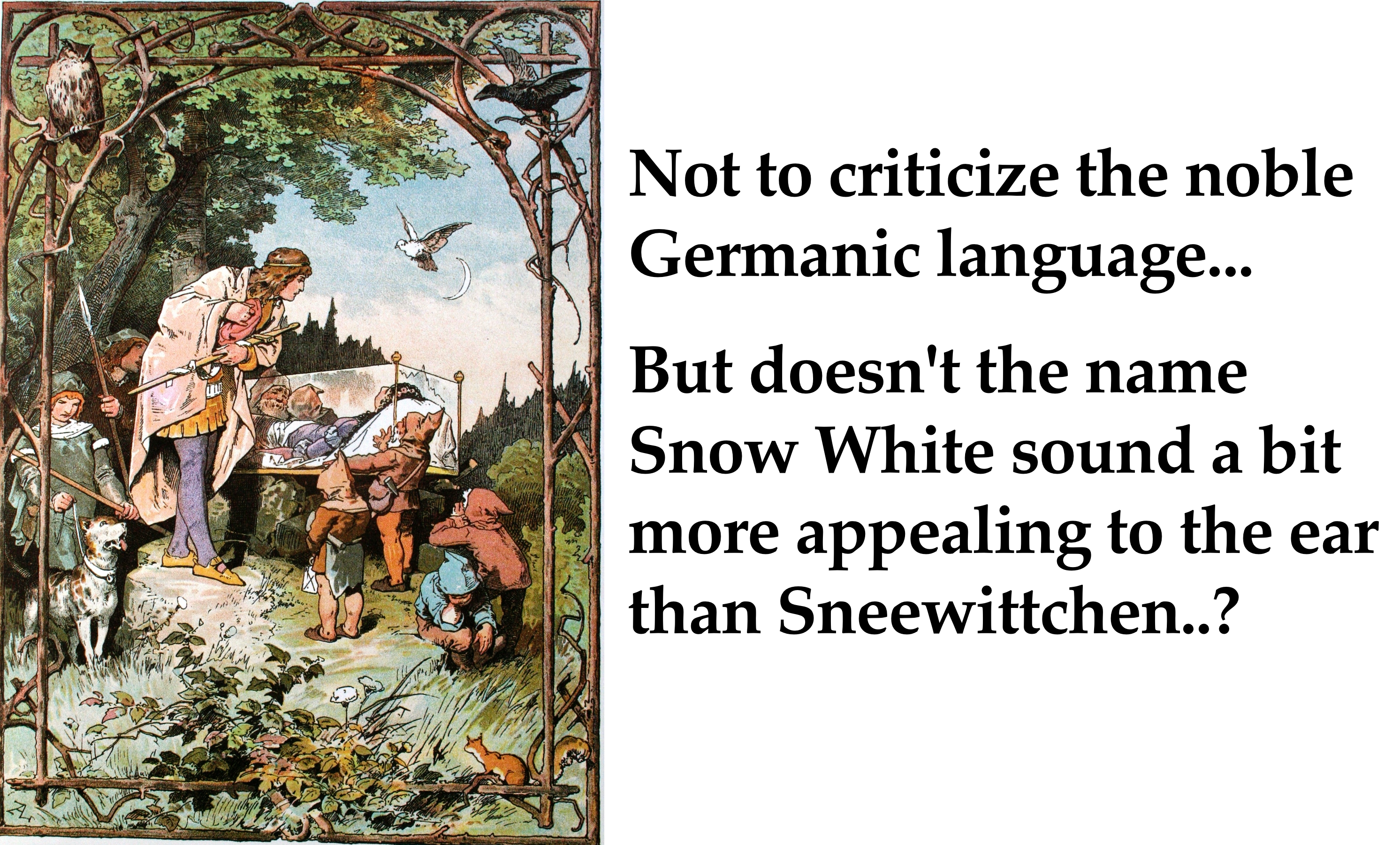
You may blame the recent cinematic debacle that is Snow White on a declining Film Studio or the Brothers Grimm, but C.S. Lewis is innocent.
That’s not to say the Grimms didn’t have an influence on the great Oxbridge professor, a subject we’ll explore momentarily. But it was the German folk tales published by academics Jacob and Wilhelm Grimm who published the classic fairy tales that Walt Disney mined so effectively.
They also popularized Cinderella, Hansel and Gretel, Little Red Riding Hood, The Princess and the Frog, and Rapunzel. Disney began the transformation of these tales into visual treasures as early as 1921 when he founded Laugh-O-Gram Studio in Kansas City, Missouri.
In addition to films, over the years Walt gleaned memorable Grimm stories for a multitude of cartoon shorts, including The Brave Little Tailor and The Four Musicians of Bremen.
Obviously, Walt Disney himself respected the source material for the stories and wielded his editorial prerogative in an appropriate manner. Tragically, the same cannot be said for his corporate heirs. Likewise, the Brothers Grimm bear no culpability in this area.
C.S. Lewis, J.R.R. Tolkien & Snow White
The truth is, although Lewis and Tolkien appreciated literary fairy tales, neither of the preeminent Inklings were enamored with Disney’s animated treatment of the stories. Curiously, the two distinguished dons actually attended the theater together to view the trailblazing novelty that was Snow White.
They were particularly disappointed with the dwarves, seeing just how different they were from the genuine legends about them. Lewis even wrote “Dwarfs ought to be ugly of course, but not in that way.” Atlas Obscura has an entertaining article about their “movie date” and notes some of the elements they also enjoyed in the feature.
In his lectures published as A preface to Paradise lost, C.S. Lewis elaborates on his response to the Disney version of the tale.
That strange blend of genius and vulgarity, the film of Snow-White, will illustrate the point. There was good unorginality in the drawing of the Queen. She was the very archetype of all beautiful, cruel queens: the thing one expected to see, save that it was truer to type than one dared to hope for.
There was bad originality in the bloated, drunken, low-comedy faces of the dwarfs. Neither the earthiness, the avarice, nor the wisdom of true dwarfs was there, but an imbecility of arbitrary invention.
But in the scene where Snow-White wakes in the woods both the right originality and the right unoriginality were used together. The good unoriginality lay in the use of small, delicate animals as comforters, in the true Märchen [fairy tale] style. The good originality lay in letting us at first mistake their eyes for the eyes of monsters.
If you want to read more about the subject, you can do no better than read Joe Christopher’s article on the subject.
For an interesting argument that fellow Brit G.K. Chesterton would have loved Snow White for the very reason that moved the Inklings to criticize it, see “Tolkien and Lewis disliked Snow White. You know who wouldn’t have?”
C.S. Lewis & Grimm’s Fairy Tales
Like his friend, J.R.R. Tolkien, C.S. Lewis was a champion of classical fairy tales. Neither was apologetic for it, although Lewis admitted to being shy about it when he was young. In an essay titled “On Three Ways of Writing For Children,” he wrote,
When I was ten, I read fairy tales in secret and would have been ashamed if I had been found doing so. Now that I am fifty I read them openly. When I became a man I put away childish things, including the fear of childishness and the desire to be very grown up.
In a great post called “Old Enough For Fairy Tales: C.S. Lewis’ “The Chronicles of Narnia” the writer describes this distinction to which Lewis alludes.
The Chronicles of Narnia are not children’s stories. They are fairy tales—but that is precisely why they are not children’s stories. If you can’t understand, you haven’t been listening. Go back and read the quote from Lewis’ essay again. Children are not the only audience for fairy tales.
In 1954, C.S. Lewis apologized to a German professor for being unable to understand the nuances of his volume on philosophy. In doing so, he referred to his youthful reading of the Brothers Grimm in their original German (available at Internet Archive).
I look forward to reading the book (when the translation arrives! My German is wretched, and what there is of it belongs chiefly to the libretto of the Ring and Grimm’s Märchen – works whose style and vocabulary you very possibly do not closely follow).
If you are in the mood for reading Grimm’s Fairy tales today, and your German is sadly lacking, Project Gutenberg has just the translation for you . . . as long as you can read English.
Addendum [added 10 April 2025]
The Brothers Grimm were far more than simply folklorists. They were respected professors at the University of Göttingen. They were devout Christians and worked with other prominent Germans.
Goethe assisted them at a crucial moment in collecting their tales, and the philosopher Friedrich Schleiermacher provided copyediting assistance. Jacob’s work on German mythology had a pronounced influence on the composer Richard Wagner (World Magazine).
They also began compiling the Deutsches Wörterbuch (Germany dictionary) in 1838, with the first volumes published in 1854. It was the first dictionary to include historical usages of each word, preceding the Oxford English Dictionary, which was initiated in 1857 with its first edition published in 1884.
Bonus Trivia: The dwarves were unnamed until their debut on Broadway in 1912. And on that day they were christened Blick, Flick, Glick, Plick, Snick, Whick and Quee.
 Mere Inkling Press
I saw the original Snow White when I was very little with my grandmother. The music and the artistic animation stay with me. I agree with Lewis that the Chronicles were not children’s books, except both my children and I read them all, and lapped them up as children. We love Lewis and Narnia to this day. My 6 yo grandsons are reading abridged versions of The Chronicles supplied to them by Nana, preparing them to be 8, and read the originals. We also all read the trilogy of The Rings as children. So did my brother, who made the local newspaper, when his summer camp counselor confiscated, ‘The Return of the King,’ as it was, “inappropriate reading for children.” My son has the greatest enduring love of the trilogy of us all. Children really are much smarter than adults. Tolkien and Lewis were magically smart and knew this.
Ah, childhood memories. Precious ones, especially with grandparents. (As the son of a Marine, I never enjoyed enough time with my grandparents, and the handful of memories I have are very precious to me.)
Yes, introducing our kids to Narnia and Middle Earth is one of the greatest gifts we can give them!
As for your brother’s copy of The Return of the King being confiscated… unbelievable. Makes me wonder whatever became of that camp counselor…
Thanks for your comment, Cindy. (And yes, I did notice you tastefully avoided making any comments about the new live action version of the story.)
Many thanks for this article.
Insightful, engaging, and rich with literary depth and context.
Glad you enjoyed it. May your academic work in Qatar continue to prosper.
I agree that Narnia isn’t just for kids. And fairy tales have much insight into human nature and good vs. evil.
Great to hear from you Beryl. Being able to distinguish between good and evil — from our childhood on — has never been more important than it is in our increasingly subjective culture.
I am captivated by the artistry of animation, but have loved fairy tales for a more profound reason. They capture the accumulated wisdom of centuries, and often address troubling subjects and deep seated fears in symbolic terms. As a girl, I devoured Lang’s Fairy Books of Many Colors without being able to articulate the need they filled. Multiple psychologists have though explored the significance of fairy tales.
Thank you for sharing this important insight, Anna. We can be thankful to people like the Grimms who preserve these treasures.
Readers: The entire collection of Lang’s Fairy Books to which Dr. Waldherr refers, can be downloaded for free from Project Gutenberg at this link.