C.S. Lewis & Iran’s Nuclear Program

Connecting C.S. Lewis to the pursuit of nuclear weapons by Iran’s mullahs admittedly sounds like a protracted stretch. Yet the current conflict between Iran and Israel does have one astonishing element that does link the great Oxbridge professor with the conflict.

If you’re familiar with Lewis’ writings, you might logically assume the connection relates to his writing on nuclear weapons. After all, in 1948 he wrote an essay entitled “On Living in an Atomic Age.” The matter is even more acute since we moved from the era of relatively minuscule A-bombs into a time when humanity’s H-bombs, employing fusion rather than mere fission, are thousands of times more deadly.

Lewis discusses some interesting philosophical (and theological) questions in his article. He begins by placing the question within the context of our inherent physical mortality. He writes, “do not let us begin by exaggerating the novelty of our situation.”

Believe me, dear sir or madam, you and all whom you love were already sentenced to death before the atomic bomb was invented: and quite a high percentage of us were going to die in unpleasant ways. . . .

It is perfectly ridiculous to go about whimpering and drawing long faces because the scientists have added one more chance of painful and premature death to a world which already bristled with such chances and in which death itself was not a chance at all, but a certainty.

Don’t let the stoic beginning of his thoughts deter you from reading the essay itself, because C.S. Lewis does not leave us despairing. On the contrary, he offers hope and practical advice for maximizing the meaning of our lives. 

Although C.S. Lewis lived into the beginning of the MAD (Mutually Assured Destruction) era, he chose not to inject himself into political subjects, lest it detract from his advocacy for the simple Gospel.

Nevertheless, the brief note “C.S. Lewis and Nuclear Weapons,”penned forty years ago by a “peace activist” pastor, conjectures on what the author’s opinion may have been. It is thought-provoking, especially in mentioning a possible link between nuclear destruction and the “deplorable word” referred to in The Chronicles of Narnia. 

In The Magician’s Nephew, Lewis’ child protagonists encounter a witch queen on the devasted world of Charn. Queen Jadis, when denied the power to rule over the planet, chose to invoke a curse that destroyed every living thing other than herself. “Then I spoke the Deplorable Word. A moment later I was the only living thing beneath the sun.”

While Lewis does not elaborate on the nature of the destructive nature of this most deplorable of powers, Aslan does offer the following caution near the end of the novel.

It is not certain that some wicked one of your race will not find out a secret as evil as the Deplorable Word and use it to destroy all living things. And soon, very soon, before you are an old man and an old woman, great nations in your world will be ruled by tyrants who care no more for joy and justice and mercy than the Empress Jadis. Let your world beware.

So, what does this have to do with Iran & Israel?

Frankly, I find the connection to be especially odd. As you may know, military entities have a propensity to apply nicknames or euphemisms to various things, such as their weapon systems.

This is true for military campaigns or discrete operations. For example, the United States has employed labels like Operation Linebacker (in Vietnam) and Operation Crossroads (for 1946 nuclear weapons tests).

Sadly, Operation Enduring Freedom (in which I personally took part) did not live up to its name. Under the Taliban, Afghanistan has degenerated once again into a primitive morass which abuses its women and children.

A number of distinct operations have taken place during the current war between Iran (and its proxies) and Israel. Operation Rising Lion is Israel’s nomenclature for the various elements of their direct attack on Iran. One independent Jewish news site points out how Benjamin Netanyahu foreshadowed the campaign in May when he said, “the verse in the Tanach that most fits with an existential war? That’s our war – a war of existence . . . A people that rises like a lion, leaps up like the king of beasts.”

Every Israeli military operation has a name, and the Iran attack is now called Am K’lavi, or “a people like a lion” – the exact wording Netanyahu used six weeks ago. English-language publications now refer to the operation as “Rising Lion.”

While this is quite interesting, it is the name assigned to one of the subsidiary operations encompassed by Rising Lion which possesses a genuinely shocking designation.

One initial focus of Israel’s campaign was to eliminate the leading scientists leading Iran’s efforts to pursue a nuclear arsenal. They named this particular facet Operation Narnia.

When I first saw that, I immediately thought I must have misread the title. But no, they actually chose Narnia as the name for the assassinations. At that point I thought they might be referring to some other Narnia. Alas, it doesn’t appear they were alluding to the medieval Italian city whose name inspired C.S. Lewis.

The reason for choosing Narnia as the operation’s title was apparently an intentional reference to the amazing world where so many of us met the awesome and compassionate Aslan. In “‘Operation Narnia:’ How Israeli Intelligence Targeted Key Iranian Nuclear Scientists,” we read:

Israel kicked off Operation “Rising Lion” last Friday, launching a sweeping military assault that dealt a major blow to Iran’s leadership and nuclear infrastructure. . . .

In a surprising detail, the Jerusalem Post reports, the component of the mission aimed at Iran’s nuclear scientists was codenamed “Narnia” by Israeli forces – a reference to the fantasy realm, underscoring how bold and unlikely such a strike might have seemed before it was executed.

Another intriguing rationale for entitling the Operation after C.S. Lewis’ creation is even more provocative. The Substack blog Wardrobe Door proposes a supernatural consideration for the choice of “Narnia.”

The [Jerusalem] Post says the name “reflects the operation’s improbable nature, like something out of a fantasy tale rather than a real-world event.” One could also imagine it involved deep espionage tactics that may have had soldiers sneaking in areas as if through a magical wardrobe.

Whatever tactics may have been used in Operation Narnia, it is intriguing to consider how the power of C.S. Lewis’ vision has spread across national boundaries. May all people heed Lewis’ witness to humanity’s Savior, for surely,

God cannot give us a happiness and peace apart from Himself, because it is not there. There is no such thing (Mere Christianity).


A More Peaceful Time

It seems like a dream, when I recall a college course I took where Jews and Muslims peacefully discussed the turbulent history of the Middle East. And how we discussed that sad story in a cordial, and even sympathetic, manner.

The contrast between that day and 2023 – when people cannot even agree that tiny infants should not suffer for the sins of their parents – is mind-bending.

We assume that all people desire peace. Would that it were so. In his essay “First and Second Things,” C.S. Lewis offers a timely insight.

As far as peace (which is one ingredient in our idea of civilization) is concerned, I think many would now agree that a foreign policy dominated by desire for peace is one of the many roads that lead to war.

I was an undergrad at the University of Washington in the mid-1970s, when I saw a graduate level course with a fascinating title: “Wars that have Shaped the History of the Middle East.” My high school friend and I “begged” the professor to allow us into the class. He cautioned us that he would have the same requirements for us as he did for everyone else; there would be no mercy extended if we failed to meet the syllabus’ demands.

“No problem,” we said . . . although, being young procrastinators, at the end of the quarter we foolishly required a couple of all-nighters to complete our comprehensive term papers.

We, both Christians, were the only undergraduates in the small class. Our professor was Jewish, as were two of the students. One of these, was Israeli. He was, in fact, a veteran of the recent Yom Kippur War, during which he had served as the commander of a tank. I don’t recall which front on which he fought, but when you look at a map of Israel, it’s clear that every part of that small nation is a potential combat zone.

The remaining members of the class consisted of three Muslim students. One was American and a second was Iranian (back when the Shah was still in power). The third Islamic member of the class taught at a Seattle community college. He was Palestinian. And not merely Palestinian – his family was displaced during the 1948 Arab-Israeli War, which is referred to by the Israelis as the War of Independence.

You can imagine that with a group like that, opinions were deeply entrenched. Yet, although the preexisting opinions were indeed fixed, the individuals were not obstinate. Conversations were civil. Disagreements were conducted with reason rather than emotion. And, most surprisingly of all, we were able to socialize together at the end of the course.

It was a different world, apparently. It’s challenging to conceive of partisans today being capable of treating others with such respect. The last half century has marked a steep decline in the humanity of humanity.

Anti-Semitism is a Curse

It is strange to ponder how we’ve come to define antisemitism, confining it to anti-Jewish sentiment. After all, the word Semite refers to all people who speak a Semitic language, including Arabs.

Etymologically, Semite “comes via Latin from Greek Sēm ‘Shem,’ son of Noah in the Bible, from whom these people were traditionally supposed to be descended.”

If you are interested in an excellent article titled “C.S. Lewis’s Anti-Anti-Semitism in The Great Divorce,” simply follow the link embedded here.

Israel’s Wars

There has been no shortage of blood shed on the land the Romans called Judea and Arabia Petraea. And the history of the past seventy-five years have been violent indeed. For a description of all of the wars and military operations involving Israel, see this website.

We students each had to select one of the Middle Eastern regional wars to research in depth. We also had to make a detailed presentation and lead the discussion based on general readings completed by everyone.

As soon as I saw that requirement in the syllabus, my mind was mired in confusion over which of Israel’s wars would be the least controversial. Fortunately, as I read further I discovered that the purview of the course did not begin with the end of the Palestine Mandate, which was administered by Britain. Due to the influence of the Ottoman Empire, which had overshadowed the region until the end of the First World War, the professor elected to begin the course with the relatively nonconfrontational consideration of the Crimean War. I was the first student to raise my hand and voice my preference.

During the Palestine Mandate, C.S. Lewis had a number of former students serving in the Levant. In a 1940 letter to his brother Warnie, he describes a pleasant visit from one of these who went on to serve in a political capacity throughout the region for several more decades. This statesman refers to a fellow student who would go on to teach at East Anglia University.

I had a visit one night last week from Pirie-Gordon back from leave from Palestine, where (and in Egypt and Turkey) he says everything is “as good as gold.” The last riot was quelled by the cavalry regiment in which Rivière serves . . . In fact as P.G. said “I raised the riot and Rivière quelled it.”

I wonder how the members of the class would relate to one another if we were reunited for a discussion of what has transpired since 1975. With members of the American government at each other’s throats on our nation’s response to Hamas’ war, I doubt our discussions would be as respectful as they were back in the twentieth century. Still, conversations – even painful ones – need to happen if people are ever to get along with one another. That’s true not only for nations, but also for neighbors, and families.

I recommend two things to move us in the right direction. Honest communication, where we do a lot of listening. And prayer. The fact we do so poorly with the first, makes the second all that more essential.

Can We Ignore Modern Slavery?

I can’t answer this question for you, but I know how I want to be able to answer when I stand before our Creator. 

Many Christians include corporate confession and absolution (forgiveness) as part of their regular worship. We often ask forgiveness our sins of commission and omission – the wrongs we do, and the wrongs we are responsible for when we fail to do what we should.

God forbid that any of us would actively support slavery, but . . . how little most of us do to reduce it or free people from its deadly grasp.

In Britain, the National Society for the Prevention of Cruelty to Children, founded in 1884, recognizes modern slavery as one of the world’s greatest challenges. As they say: “Any child is at risk of child trafficking.”

Save the Children states that “children account for 27% of all the human trafficking victims worldwide, and two out of every three child victims are girls.”

Sometimes sold by a family member or an acquaintance, sometimes lured by false promises of education and a “better” life – the reality is that these trafficked and exploited children are held in slave-like conditions without enough food, shelter or clothing, and are often severely abused and cut off from all contact with their families.

The children’s condition is not “slave-like;” these precious victims literally are slaves, in every cruel sense of the word. While no unenslaved person would be so ignorant as to presume they understand slavery, C.S. Lewis mentioned in a 1939 letter several torments it inflicts. At the break of the Second World War, he was reflecting on his experiences in the First.

My memories of the last war haunted my dreams for years. Military service, to be plain, includes the threat of every temporal evil; pain and death which is what we fear from sickness; isolation from those we love which is what we fear from exile: toil under arbitrary masters, injustice, humiliation, which is what we fear from slavery: hunger, thirst and exposure which is what we fear from poverty.

The most shocking part of this description from Save the Children, is the acknowledgment that the children are “sometimes sold by a family member . . .” I discussed this grim truth in my 2014 post, “Loving Prostitutes.”

In that article I express a sentiment I hope you share: “I love prostitutes because God has granted me the vision to see them as he does.”

What You & I Can Do Today

Obviously, if this subject is new to you, you can become informed. The links I’ve provided offer a good starting point.

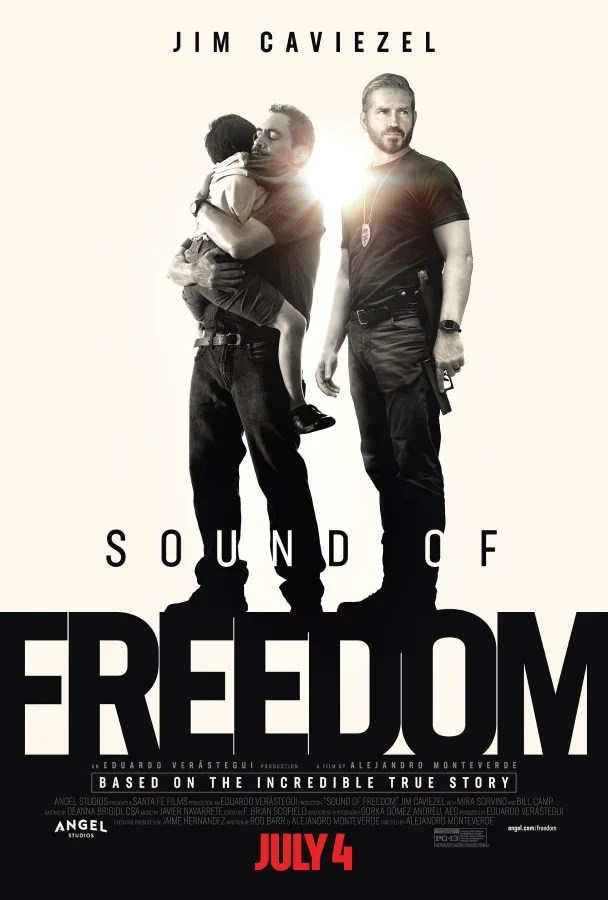
At the present moment we have a truly unique opportunity to make a contribution toward addressing this massive horror. We can support a superb, first-class film that is currently showing in hundreds of cinemas. 

Sound of Freedom is a true story with a superb cast and excellent cinematography. Despite its serious subject, the film is well worth viewing while it is still in theaters. Simply by attending, and even more by encouraging family and friends to join you, we can raise the awareness of this tragedy.

Together, you and I truly can help rescue people from this fate, and promoting this message of hope and deliverance is a small step in that journey. 

When faced with ugly things, the timid response is to turn away and pretend it doesn’t exist. In cases like this, particularly involving children, a cowardly response in ignoring the evil constitutes nothing less than a sin of omission. 

Check with your local theaters today, and reserve a seat at a showing of Sound of Freedom. (And, for those who see this suggestion months or years after the film’s 2023 release, check it out soon on a streaming service.)

Postscript & Resources:

While I was still on active duty, the United States Department of Defense initiated a long-overdue program. In recognition that military members are literally on the “front lines” of encountering modern slavery, Combating Trafficking in Persons is an official program established to confront the crime.

The program includes provisions requiring training for all DoD personnel, civilian as well as uniformed. This site describes the various levels of training required. To actually “take” the training and testing requires login privileges. However, various resources – including some very informative videos – are available to the public.

Similarly, agencies such as INTERPOL restrict their courses to members. Nevertheless, they offer a variety of educational resources and updates on current efforts to battle this crime around the globe.

While I haven’t personally vetted the following, a number of public and governmental organizations offer free training for interested individuals. Among them are: 

the U.S. Department of Homeland Security, and the Office for Victims of Crime. The U.S. Institute Against Human Trafficking lists six free classes, several of which offer certificates of completion.

The Home Office in the United Kingdom hosts a site with a number of related resources. One is “A typology of modern slavery offences in the UK” which breaks “down the broad categories of modern slavery into 17 distinct types of offences identified in the UK.” No doubt, most other enlightened nations promote similar materials.

In a 1943 essay entitled “Equality,” C.S. Lewis discusses the subject of the nature of Democracy, as a form of government. His argument includes the clearest possible reason why slavery never has been, and never could be a good, or morally neutral, thing.

I am a democrat because I believe in the Fall of Man. I think most people are democrats for the opposite reason. A great deal of democratic enthusiasm descends from the ideas of people like Rousseau, who believed in democracy because they thought mankind so wise and good that everyone deserved a share in the government.

The danger of defending democracy on those grounds is that they’re not true. . . . I find that they’re not true without looking further than myself. I don’t deserve a share in governing a hen-roost, much less a nation. . . .

The real reason for democracy is . . . Mankind is so fallen that no man can be trusted with unchecked power over his fellows. Aristotle said that some people were only fit to be slaves. I do not contradict him. But I reject slavery because I see no men fit to be masters.

I know that C.S. Lewis would add his “amen” to my challenge today that each of us might look for ways to help eradicate this plague of slavery, which has cursed humanity for millennia.

Chocolate Fuels Armies

“An army marches on its stomach.”* Military leaders have long recognized that it is difficult to arouse soldiers weakened by deprivation. Sadly, though, even a king of Israel could be foolish enough to ignore that and order his soldiers to fast before a battle.

While logisticians rarely receive the accolades of their peers who serve directly in combat, they have always been vital members of successful military ventures.

While they are concerned with securing and transporting all requirements, such as ammunition and medical supplies, there is a single necessary requirement for all campaigns. Without sustenance, soldiers will desert the flag and even the most steadfast will fall.

Nutritional value is the first priority. Palatability has historically been a distant afterthought. This has given rise to innumerable jokes made by veterans about the “combat rations” provided to them. While these “menus” have vastly improved in recent years, they remain fodder for much humor.

And even the most delicious food choices become monotonous when they are limited to a small range. In 2002, I visited a remote military detachment supplied with adequate pallets of Meals Ready to Eat, but begging for variety. They had hundreds of meals available, but only two or three different meal options! Civilians, in contrast, can readily purchase a far wider range of entrees.

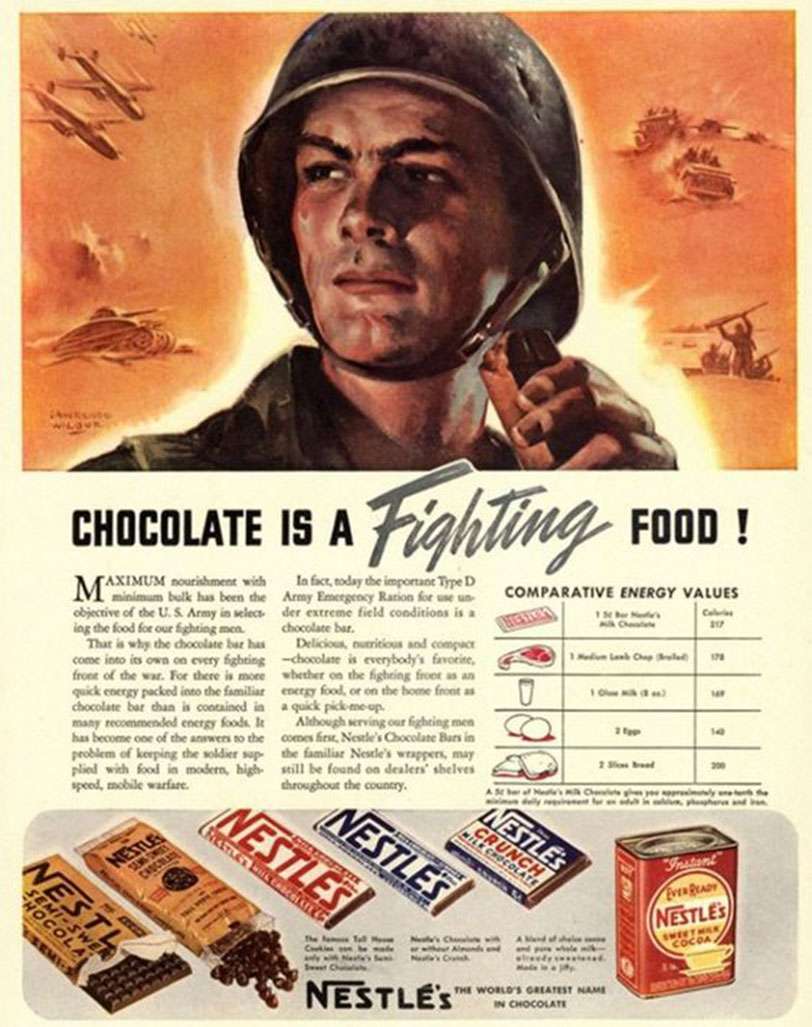
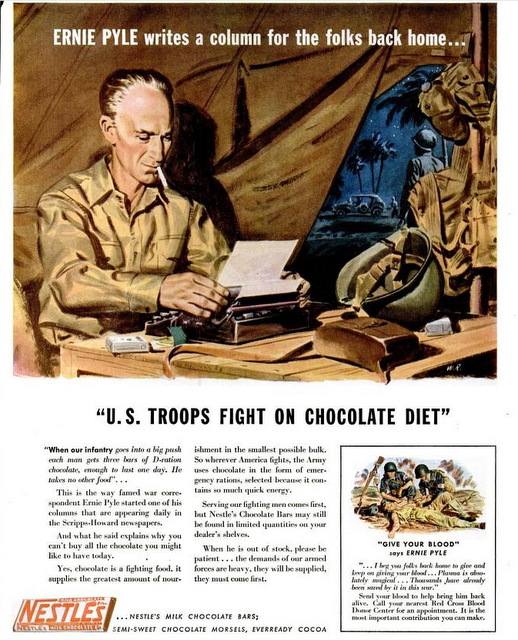
During the Second World War, the United States invested major efforts in making the combat meals more appealing. Various candies found their way into K-rations, in addition to necessities like toilet paper and cigarettes. In a comprehensive overview of the history of rations, the U.S. Army Quartermaster Foundation points to the main reason for complaint during WWII.

Like other unpopular items, misuse was a contributing factor to the waning popularity of the K ration. Although designed to be used for a period of two or three days only, the ration occasionally subsisted troops for weeks on end. . . . Continued use reduced the acceptability and diminished the value of the ration.

Adding confectionaries to rations made the meals more welcome. Chocolate was always a favorite, but the initial American versions left much to be desired.

My research was, in fact, prompted by a recent post on “Chocolate in WWII” in Pacific Paratrooper. (It is one of the very best military blogs on the internet.) They describe how the military approached a major American confectioner with a simple list of requirements (the last one is best appreciated by older veterans).

The Hershey Chocolate company was approached back in 1937 about creating a specially designed bar just for U.S. Army emergency rations. According to Hershey’s chief chemist, Sam Hinkle, the U.S. government had just four requests about their new chocolate bars: (1) they had to weigh 4 ounces; (2) be high in energy; (3) withstand high temperatures; (4) “taste a little better than a boiled potato.”

Sadly, many “who tried it said they would rather have eaten the boiled potato.” Well, it was the thought that counted, right?

There is a legend that during the war a German officer was confronted with American desserts and determined that the abundant resources of the United States signaled doom for the Nazi cause. The story likely has a fictional origin.

In the 1965 film Battle of the Bulge, Wehrmacht Colonel Hessler, shows his commanding general a treasure confiscated from American soldiers.

Hessler: “General, before you go, may I show you something?”

General: “What is it?”

Hessler: “A chocolate cake.”

Kohler: “Well?”

Hessler: “It was taken from a captured American private. It’s still fresh. If you will look at the wrapping, general, you will see it comes from Boston.”

Kohler: “And?”

Hessler: “General, do you realize what this means? It means that the Americans have fuel and planes to fly cake across the Atlantic Ocean. They have no conception of defeat.”

C.S. Lewis & Rations

Military rations during the First World War were more primitive than those provided twenty years later. One difference for the British is that they were granted a half gill of rum (or a pint of porter) each day.

This alcohol distribution was at the discretion of the commanding general, which meant that it was not available in the trenches. This was in the spirit of the American “General Order Number 1,” which typically applies to alcohol, and sometimes prohibits its presence throughout an entire theater. (I can personally attest to the ability of some elements, such as Special Ops, to circumvent such restrictions.)

C.S. Lewis wrote with some frequency about the rationing endured by the British public, during and after the world wars.⁑

Unfortunately, I’ve only uncovered one Lewisian reference to his own experience with military cuisine. In a 1917 letter to his father, he reveals that meals were not always appealing, even during training, prior to deploying to the war zone.

First of all came the week at Warwick, which was a nightmare. I was billeted with five others in the house of an undertaker and memorial sculptor. We had three beds between six of us, there was of course no bath, and the feeding was execrable.

The little back yard full of tomb stones, which we christened ‘the quadrangle,’ was infinitely preferable to the tiny dining room with its horse hair sofa and family photos.

When all six of us sat down to meals there together, there was scarcely room to eat, let alone swing the traditional cat round. Altogether it was a memorable experience.

A Hobbit, a Wardrobe, and a Great War describes how WWI affected C.S. Lewis and J.R.R. Tolkien. After relating a passage following Miraz’s defeat of Caspian’s force, when the momentarily defeated were “a gloomy company that huddled under the dripping trees to eat their scanty supper,” the author observes:

The military blunders, the fruitless acts of bravery, the bone-chilling rain, the meager rations: there were many days and nights just like these along the Western Front. Imaginary beasts aside, such scenes could have been lifted from the journal of any front-line soldier.

Like Tolkien, though, Lewis includes these images not for their own sake, but to provide the matrix for the moral and spiritual development of his characters . . .

Rations in Ukraine

Although the eyes of the world are riveted today on the war in Ukraine, there are currently 110 armed conflicts being monitored by the Geneva Academy. However, since Ukraine is in the news daily, it is worth noting both modern armies are employing military rations.

Apparently, Ukrainian troops have great Meals Ready to Eat (MREs). “Most importantly, when making, eating, or even talking about the food, the men seem to be genuinely happy.” The MRE link in this paragraph contains the details, including the note that “among the contents, you’ll find a small packet of dried apricots and a dark chocolate bar.”

There is also a vendor on ebay who sells what are purported to be captured Russian supplies, including a confiscated chocolate bar. The candy appears to be conventionally purchased, but could be part of an illicit chocolate conspiracy finding its way to the Russians from Latvia. “The Russian confectionery company ‘Pobeda’ ПОБЕДА has been producing chocolates, truffles, waffles and other types of sweets for more than six years in Ventspils, via a Latvian subsidiary.”

A month ago in Russia, “Pobeda” received thanks from an organization called the “Battle Brotherhood” for the fact that since the beginning of the Ukrainian war, the company has sent at least 15 tonnes of its products to Russian soldiers.

Chocolate does indeed appear to fuel armies. For a fascinating article on how chocolate can also be used to promote propaganda, check out this Ukrainian site.

Russian propaganda continues to dehumanize Ukrainians with the help of outright fakes.

Another “proof” of our apparent bloodthirstiness was the image of a chocolate bar with a remarkable name “Death of Alyoshka.” A portrait of a boy in a helmet with a mourning ribbon is placed on the wrapper of the confectionery. Propagandists claim that Ukrainians wish Russian children dead.

Become an MRE Connoisseur

If you are curious about the contents of various international MREs that are available for purchase by civilians, visit MREmountain, which began “in 2017 when people discovered the hobby of trying army rations.”

Most veterans, I suspect, would find the “hobby” of eating military rations rather peculiar. But then again, you can check out the French options, which the site labels “The best MRE in the world.” Only there, I imagine, could one discover “meals not found in any other MRE like Kebob Meatballs, Duck Confit, Deer Pate, Wild Boar.”

And, of course, France’s 24-hour ration also includes chocolat müesli, chocolate biscuits, five snack bars (at least one of which is pure chocolate), and a hot cacao packet. Yummy. It appears that les Français also consider chocolate to be a staple of modern soldiers.


* This quotation has been attributed to Napoleon and Frederick the Great. Whatever its modern origin, it is obvious starvation and its frequent companion, disease, have crippled as many armies as blade and shot.

⁑ “Mock Goose and Other Dishes of the War-Rations Diet” offers some interesting thoughts on this subject.

C.S. Lewis & a Horse Named Fledge

C.S. Lewis was not alone in recognizing horses are magnificent creatures. Many of us share his appreciation for the more than 300 breeds that comprise the equine family.

Horses hold a prominent place in Lewis’ zoologically rich fantasies. In the Chronicles of Narnia, we encounter many Talking Horses. Among them are Bree, the titular hero of The Horse and His Boy, and Hwin, the heroine who teaches Bree what it means to be a Narnian.

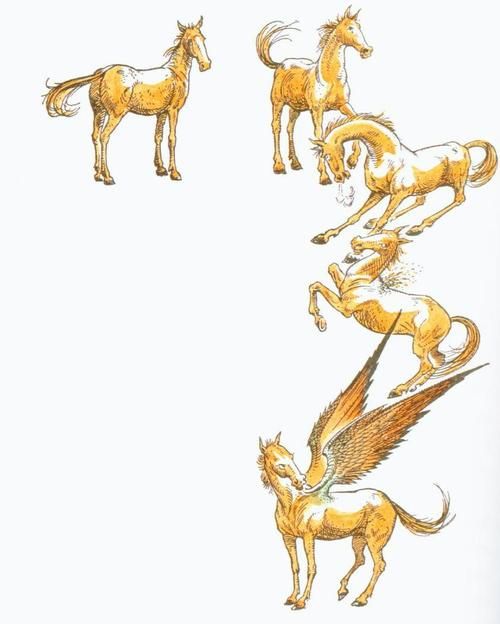
But before Bree and Hwin galloped across the fields and plains of Narnia, a horse from Earth was transported to that Land at the hour of its very creation.* And there, Aslan anointed this modest draft horse⁑ to become the progenitor of a race of pegasi. Fledge’s story is quite inspiring.

Fledge was once named Strawberry, and pulled a Hansom cab in London. But after journeying to Narnia, Aslan chose him to be one of the very first Talking Animals, and granted him wings.

Would You Like Wings?” offers an illuminating meditation on this transformation.

So Strawberry, in this first stage, goes from beast to person. From a dream to wakefulness. From slavery to freedom. From silence to speech, from witless to intelligent.

From C.S. Lewis’ account of the “miraculous” event:

He then turned to the Horse who had been standing quietly beside them all this time, swishing his tail to keep the flies off, and listening with his head on one side as if the conversation were a little difficult to understand. “My dear,” said Aslan to the Horse, “would you like to be a winged horse?”

You should have seen how the Horse shook its mane and how its nostrils widened, and the little tap it gave the ground with one back hoof. Clearly it would very much like to be a winged horse. But it only said: “If you wish, Aslan – if you really mean – I don’t know why it should be me – I’m not a very clever horse.”

“Be winged. Be the father of all flying horses,” roared Aslan in a voice that shook the ground. “Your name is Fledge.” The horse shied . . . It strained its neck back as if there were a fly biting its shoulders and it wanted to scratch them. And then, just as the beasts had burst out of the earth, there burst out from the shoulders of Fledge wings that spread and grew, larger than eagles’, larger than swans’, larger than angels’ wings in church windows. . . .

“Is it good, Fledge?” said Aslan.

“It is very good, Aslan,” said Fledge.

When Aslan sends Polly and Digory on a quest with Fledge, they camp for the night and enjoy a delightful human~animal conversation (much like I would anticipate having with the deer that visit our yard daily, should they be graced with speech).

“And my wings are beginning to ache,” said Fledge. “There’s no sign of the valley with a Lake in it, like what Aslan said. What about coming down and looking out for a decent spot to spend the night in? We shan’t reach that place tonight.”

“Yes, and surely it’s about time for supper?” said Digory. So Fledge came lower and lower. As they came down nearer to the earth and among the hills, the air grew warmer and after traveling so many hours with nothing to listen to but the beat of Fledge’s wings . . .

A warm, good smell of sun-baked earth and grass and flowers came up to them. . . . “I am hungry,” said Digory.

“Well, tuck in,” said Fledge, taking a big mouthful of grass. Then he raised his head, still chewing and with bits of grass sticking out on each side of his mouth like whiskers, and said, “Come on, you two. Don’t be shy. There’s plenty for us all.”

“But we can’t eat grass,” said Digory.

“H’m, h’m,” said Fledge, speaking with his mouth full. “Well—h’m—don’t know quite what you’ll do then. Very good grass too.”

Polly and Digory stared at one another in dismay. “Well, I do think someone might have arranged about our meals,” said Digory.

“I’m sure Aslan would have, if you’d asked him,” said Fledge. “Wouldn’t he know without being asked?” said Polly. “I’ve no doubt he would,” said the Horse (still with his mouth full). “But I’ve a sort of idea he likes to be asked.”

“But what on earth are we to do?” asked Digory.

“I’m sure I don’t know,” said Fledge. “Unless you try the grass. You might like it better than you think.” (The Magician’s Nephew).⁂

In C.S. Lewis’ first story about Narnia, The Lion, the Witch and the Wardrobe, we read about the “statues” that surround the castle of the White Witch. Edmund has been corrupted by the Witch, and told that Aslan is dangerous.

The Witch has the power to turn living creatures to stone. When Edmund discovers a lion in her garden, he is delighted. But the lion is not alone.

The relief which Edmund felt was so great that in spite of the cold he suddenly got warm all over right down to his toes, and at the same time there came into his head what seemed a perfectly lovely idea. “Probably,” he thought, “this is the great Lion Aslan that they were all talking about. She’s caught him already and turned him into stone. So that’s the end of all their fine ideas about him! Pooh! Who’s afraid of Aslan?”

And he stood there gloating over the stone lion, and presently he did something very silly and childish. He took a stump of lead pencil out of his pocket and scribbled a mustache on the lion’s upper lip and then a pair of spectacles on its eyes. Then he said, “Yah! Silly old Aslan! How do you like being a stone? You thought yourself mighty fine, didn’t you?”

But in spite of the scribbles on it the face of the great stone beast still looked so terrible, and sad, and noble, staring up in the moonlight, that Edmund didn’t really get any fun out of jeering at it. He turned away and began to cross the courtyard.

As he got into the middle of it he saw that there were dozens of statues all about – standing here and there rather as the pieces stand on a chessboard when it is halfway through the game. There were stone satyrs, and stone wolves, and bears and foxes and cat-a-mountains of stone. . . . a winged horse and a long lithe creature that Edmund took to be a dragon (The Lion, the Witch and the Wardrobe).

I find the description of the lion quite provocative. “. . . so terrible, and sad, and noble.” That is exactly what I experienced when I saw the model for a “war horse” memorial in Romsey, England. The artists have done a brilliant job. The sorrow overflows from it eyes.

True, my impression is influenced by the outstanding 2011 film titled War Horse. If you’ve never seen this Spielberg gem, I encourage you to watch it and challenge you to do so without shedding a tear.

Horses have long been used in war. That is not what God created them for, but fallen humanity has often harnessed their power for combat. Some of their names are remembered today, including Bucephalus, Copenhagen, Cincinnati, and Traveler.

Returning to Fledge, we find a horse not only experiencing the fullness of his equine nature, but receiving blessings unimagined.


* C.S. Lewis did not compose the seven volumes of the Chronicles of Narnia chronologically. This has led to different opinions on the order in which the books should be read.

⁑ Draught horse, to you Brits.

⁂ While I typed this, a doe and her two fawns were peacefully grazing on our clover-seeded lawn, just a few feet away, outside my office window. [I’m sure they would have happily shared with me.]

Keeping the Peace, Finn Style

The war in Ukraine trudges on, but the world has become safer with the imminent expansion of the North Atlantic Treaty Organization (NATO).

Recognizing the expansionist aspirations of Dictator Putin’s Russia, Sweden and Finland have decided to request formal admission to the peacekeeping alliance. Their reception has tentatively been approved, although just today another dictator, Recep Tayyip Erdogan of Turkey is threatening to “freeze” them out if they don’t support his efforts to suppress Kurdish independence.

I have my own experiences with NATO. Foremost among them was the small part I played in helping bring about the Intermediate-Range Nuclear Forces Treaty. (I even served as one of the “escort officers” for a Soviet verification team when it visited RAF Greenham Common.)

I mentioned the treaty on Mere Inkling and lauded its success.

The great thing about NATO’s cruise missiles is that they were deployed to bring the Soviet Union to the negotiating table, where the Intermediate Nuclear Forces Treaty led to the elimination of all such munitions from Europe!

Alas, this monumental treaty has expired.

It is a casualty of Russian Federation dreams to restore the Soviet Union’s former borders in Europe. Combined with the “defection” of the former Warsaw Pact nations, it is easy to understand why a suspicious Russia postures so aggressively.

Which, of course, encourages the democratic nations to draw closer in mutual defense.

How are the Finns Celebrating

Finns are different.

Not quite what you would expect. Many people – certainly most Americans, the ones who are not totally geographically ignorant – mistakenly think Finland is a Scandinavian country. Not quite. True, they are a Nordic nation, but Nordic Perspective offers an insightful discussion, replete with great maps, on the subject.

Being a Nordic people, it comes as no surprise many Finns are welcoming their entry into NATO with a beer. In fact, a brewing company named “Olaf” has opted to use the French acronym for NATO – OTAN – as a play on words. “The beer’s name is a play on the Finnish expression ‘Otan olutta,’ which means ‘I’ll have a beer…’”

Good for them. (So long as they remember to drink in moderation.)

Now, this OTAN-business raises a question in my mind. Is it merely a coincidence, or might the French have a passive aggression purpose in mind with this heteropalindrome?

After all, the headquarters of NATO had to be moved from Paris to Belgium when Charles de Gaulle withdrew from the military alliance.

Wondering about French subliminal messages got me thinking about C.S. Lewis’ thoughts on the subject. Lewis loved all people, but was no one’s fool. He understood many of the influences exerted upon culture are destructive. Decadent societies (e.g. pre-war Berlin) sow seeds that ultimately bear tragic fruit.

As the Second World War was just beginning, and Lewis’ brother Warnie had safely returned home after the Dunkirk evacuation, Lewis mentioned France in one of his 1940 letters to his veteran brother. It is quite entertaining, as long one is not an über-Francophile.

I am also working on a book sent me to review, Le Mystere de la Poesie*by a professor at Dijon, of which my feeling is “If this is typical of modern France, nothing that has happened in the last three months surprises me” – such a mess of Dadaists, Surrealists, nonsense, blasphemy and decadence, as I could hardly have conceived possible.

But one ought to have known for, now that I come to think of it, all the beastliest traits of our intelligentsia have come to them from France.

Well, that’s enough of that. It’s time to pop the tab on an OTAN and toast the NATO, and its expanding protection of world democracies.


* Volume two of The Collected Letters of C.S. Lewis has a footnote reading “This work cannot be traced.” I believe the likely object of Lewis’ disdain may have been written by André Vovard and published in 1951 in Paris and Montreal by Fides.

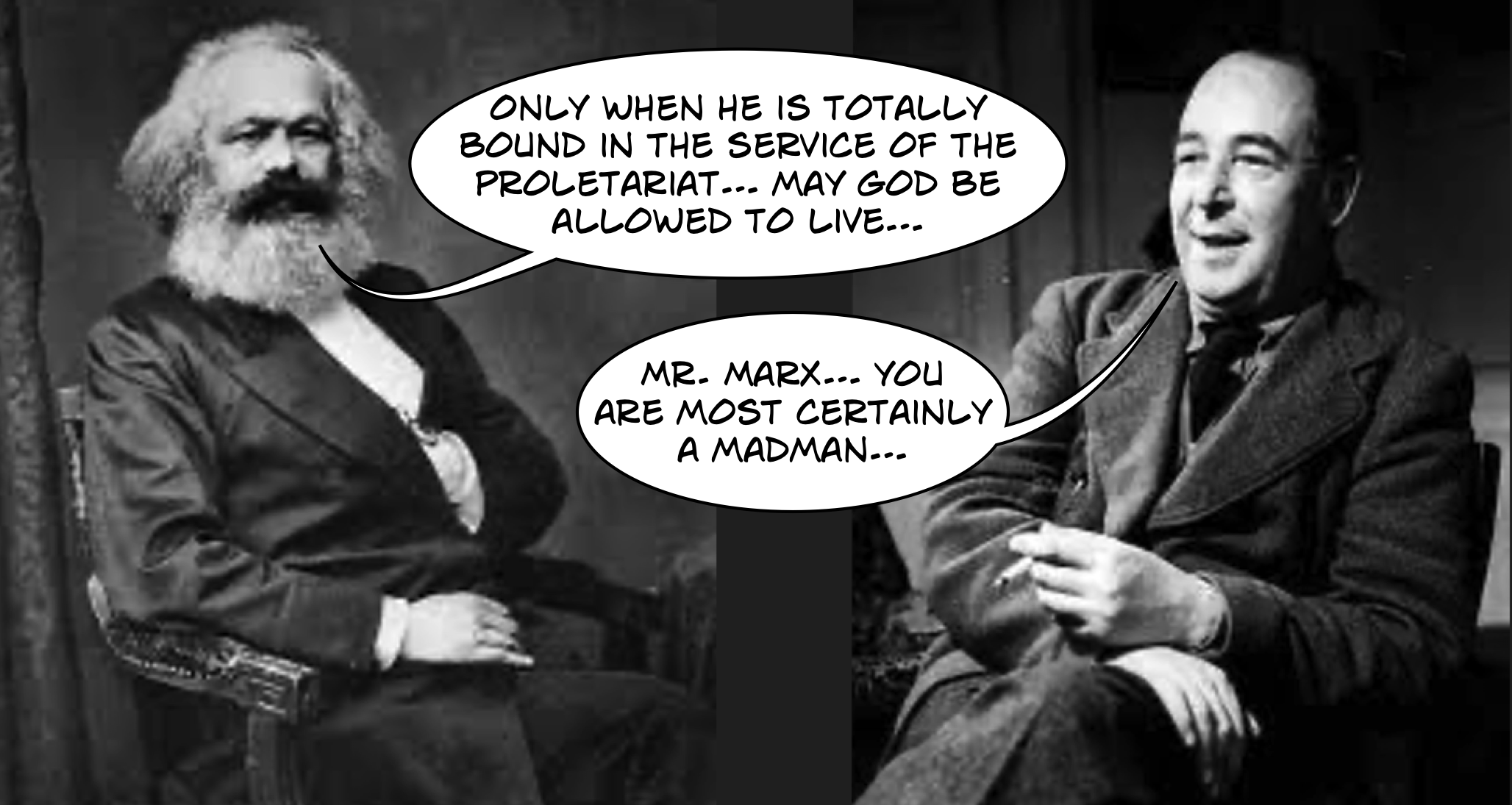
C.S. Lewis & Karl Marx

C.S. Lewis recognized quite early how Karl Marx’s philosophy, a “potent evil,” would justify terrible crimes.

The greatest threats to humanity’s future are the two major Communist powers. We see Russia’s brazen criminal ambitions currently on display in Ukraine.

Communist China’s malevolent intentions are more insidious and far more dangerous.

Aside from its nuclear arsenal, we now recognize how vastly overrated Russia’s military has been. China, by contrast, possesses an army and navy that grow deadlier each day.

C.S. Lewis understood the evil at the core of Marxism. Communists and, to a lesser degree, Socialists, seek to strip away individual rights for the illusory betterment of the whole.

But, because human beings are sinful and self-centered, even true Marxist idealists invariably end up devolving into fascist totalitarians. That’s why every one of these so-called “people’s republics” reflect nothing of republican or democratic values.

They invariably become corrupt oligarchies, typically led by ironfisted dictators. In addition to the aforementioned regimes, consider Cuba and Venezuela. When was the last time any of these four beacons of Socialism held free elections?

Karl Marx was a very troubled man. This essay in a recent publication addresses not only his insane economic theories, but his extensive personal failures as well.

The sufferings of the Marx family, and especially of poor faithful Jenny, are difficult to describe. Though they did have a housekeeper and though Friedrich Engels spent in the course of the years at least 4000 Pounds on Karl Marx, they lived in abject misery.

The death of one child, a boy, is directly attributable to poverty and neglect. Family life must have been absolutely terrible, but Marx could not be moved – neither by entreaties, nor by tears, nor by cries of despair. . . .

Yet it would be a mistake to think that Marx suffered silently and proudly. By no means! In his letters and in his conversations he never failed to complain and to lament. He had a colossal amount not only of self-hatred, but also of self-pity, but no human feelings for others, least of all for his wife whose health he had ruined completely.

In a 1946 essay entitled “Modern Man and His Categories of Thought,” C.S. Lewis discussed the atheistic core of Communism. He noted that its advocates can use “religion” as a puppet to bolster their power. Read here about the official position of the Russian Orthodox Church, and the sad fact that “Patriarch Kirill is a staunch ally of Mr. Putin.”

Such is the fruit of the Marxist mind. Here is C.S. Lewis’ description.

Proletarianism, in its various forms ranging from strict Marxism to vague “democracy” . . . [is] self-satisfied to a degree perhaps beyond the self-satisfaction of any recorded aristocracy.

They are convinced that whatever may be wrong with the world it cannot be themselves. Someone else must be to blame for every evil.

Hence, when the existence of God is discussed, they by no means think of Him as their Judge. On the contrary, they are His judges. If He puts up a reasonable defence they will consider it and perhaps acquit Him. They have no feelings of fear, guilt, or awe.

They think, from the very outset, of God’s duties to them, not their duties to Him. And God’s duties to them are conceived not in terms of salvation but in purely secular terms – social security, prevention of war, a higher standard of life. “Religion” is judged exclusively by its contribution to these ends (“Modern Man and His Categories of Thought”).

As destructive as Marxism is wearing its true, secular garb, it becomes far more calamitous when it infiltrates the Christian Church. As C.S. Lewis observed, Marxism can use and abuse the Church, but that is done from an external position.

When actual members of the Church are deceived to the degree they adopt this error, it is beyond tragic. In 1940 Lewis warned of this danger in a letter to a Roman Catholic priest with whom he corresponded.

Fascism and Communism, like all other evils, are potent because of the good they contain or imitate. Diabolus simius Dei.* And, of course, their occasion is the failure of those who left humanity starved of that particular good.

This does not for me alter the conviction that they are very bad indeed. One of the things we must guard against is the penetration of both into Christianity-availing themselves of that very truth you have suggested and I have admitted.

Mark my words: you will presently see both a Leftist and a Rightist pseudo-theology developing – the abomination will stand where it ought not.

C.S. Lewis was an honest man, who was capable of acknowledging his own shortcomings. Thirteen years after the previous letter, he wrote to another priest in the wake of massive suppression of Christianity in China.

After lamenting the persecution, he acknowledges the failure of the Church to live according to its calling. To this failure he attributes the rise of “other evils” such as Communism.

At last, dearest Father, there has come to hand that copy of . . . your article on that Chinese disaster. I used myself to entertain many hopes for that nation, since the missionaries have served there for many years not unsuccessfully: now it is clear, as you write, that all is on the ebb.

Many have reported to me too, in letters on this subject, many atrocities, nor was this misery absent from our thoughts and prayers.

But it did not happen, however, without sins on our part: for that justice and that care for the poor which (most mendaciously) the Communists advertise, we in reality ought to have brought about ages ago. But far from it: we Westerners preached Christ with our lips, with our actions we brought the slavery of Mammon.

We are more guilty than the infidels: for to those that know the will of God and do it not, the greater the punishment. Now the only refuge lies in contrition and prayer. Long have we erred.

In reading the history of Europe, its destructive succession of wars, of avarice, of fratricidal persecutions of Christians by Christians, of luxury, of gluttony, of pride, who could detect any but the rarest traces of the Holy Spirit?

Christians, I encourage you to join me in repenting of our failures. We must still challenge the lies, such as those of Karl Marx. But, we should never do so without remaining conscious of our own failures which too often provide fertile soil for such deceptions.


* Diabolus simius Dei means “the Devil is the ape of God.” This refers to Satan’s attempts to imitate or counterfeit divine actions and principles. The observation was first made by Tertullian, and echoed by Augustine and others.

Anachronistic Military Imagery

Peace is almost universally valued. Ironically, it cannot be achieved without holding militaristic forces at bay. And preventing them from crushing the weak, requires that a more “benevolent” be strong enough to stand up to the international bullies.

If there is no champion for those unable to defend themselves, the wolves tear their prey apart and the only limits placed on their appetites are the threats posed by other predators. The fate of the small ranges from domination by ruthless powers to domination by less ruthless overlords.

If there is no benevolent “superpower,” or if it is viewed as feeble and indecisive, the Third Reichs of the world will reign.

Historically, imperialistic agendas have been checked by other empires or alliances. Some alliances are small, such as the North American Aerospace Defense Command (NORAD) which includes only Canada and the U.S. Others are intercontinental, such as the North Atlantic Treaty Organization (NATO), with its thirty members. Further growth of this alliance is at the heart of global tensions as this post is published.

The alliances I have mentioned are established for mutual defense. NATO has not secreted away a covert plan for world domination.

My thoughts turn to the possibility of war because (in view of many) the power of the United States is waning. Wolves are licking their proverbial chops, eager to expand their spheres of influence.

Even as we pray that God would preserve Europe from conflict around Ukraine, remember that there are nations where civil wars have raged for generations. God have mercy.

War & Peace

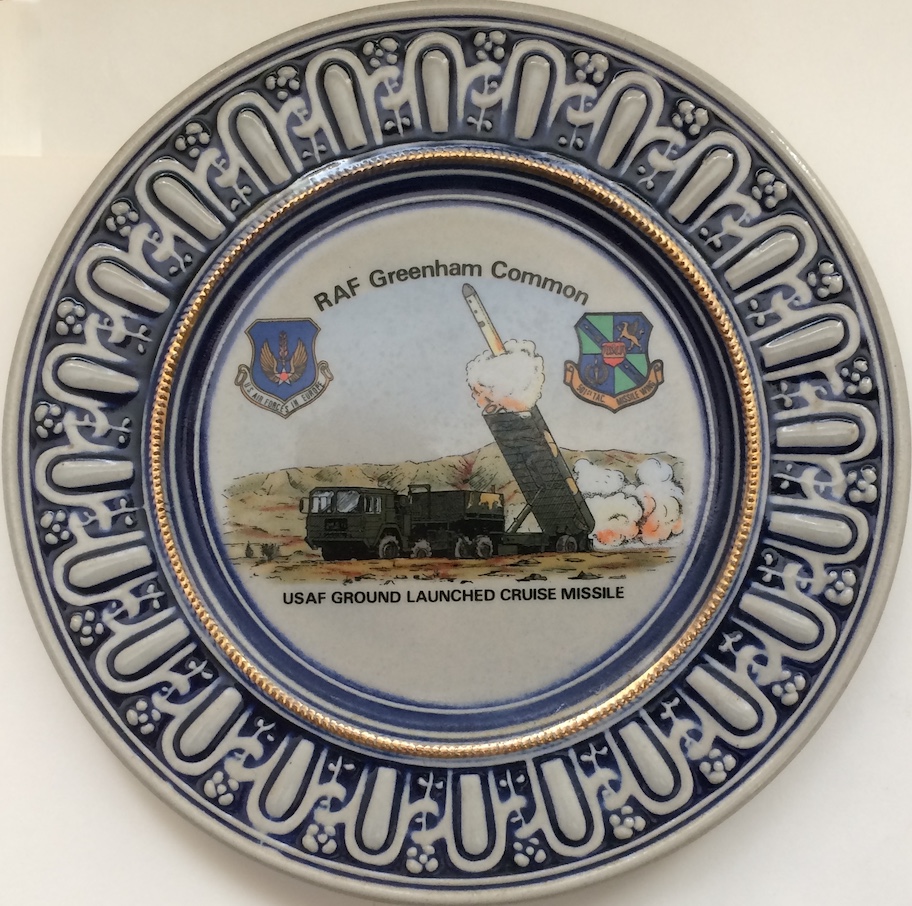
The “collectable plate” pictured at the top of this post was purchased by my mother when she visited our family in the U.K. in 1990. A decade after my retirement from the USAF, I am still unpacking some of the boxes I accumulated during decades, and after my mom’s passing, this souvenir joined the archives.

It really is beautifully ornate. Such an attractive setting for an awesomely combative image.

Lest they be misperceived as “conventional” weapons, it should be noted that Ground Launched Cruise Missiles were expressly devised to deliver intermediate range nuclear explosives. Deadly.

The great thing about NATO’s cruise missiles is that they were deployed to bring the Soviet Union to the negotiating table, where the Intermediate Nuclear Forces Treaty led to the elimination of all such munitions from Europe!

Combining military and peace imagery has a long tradition. I wrote about “Powerful Names” and how Iran chose the classic name “Peacekeeper” for one of its deadly missiles. But you can find in my post many other, stranger labels. (I’m still confused why the Brits named of their 1950s missiles “Green Cheese.”)

My assignment at Royal Air Force Greenham Common was a joy. And it was a genuine privilege to be part of a mission that literally made the world a safer place.

I hope all people who desire lasting peace will join me in supporting the allied nations of democratic countries as they counterbalance the world’s totalitarians. And if they can combine the power of necessary arms with artistry that celebrates the pastimes of peace, all the better.

C.S. Lewis worked his own magic combining frightening images with peaceful pursuits. Included in the ranks of Aslan’s army, after all, we see not only cute badgers and prickly hedgehogs. Fierce (even beastly) satyrs are found in the ranks of Good. (Think super-gross, goat-faced fauns . . . with axes). Still, when they are aligned in the ranks beside Narnia, they appear noble. I can even imagine them, during seasons of peace, tilling the soil and tending the orchards.

We will close with a piece of trivia about Narnian warriors. In the books, the Minotaurs (nasty creatures these), are all portrayed in a negative light. They are among the troops of the White Witch celebrating Aslan’s death. However, in the films they have been redeemed and some fight beside Aslan and Narnia’s kings. C.S. Lewis’ son, Doug Gresham, explained the change in an interview:

There are several reasons for that. Firstly, we felt that we needed to show that in Narnia as here, old foes can be forgiven and can reconcile and work together, given the will to do so. Secondly, that in Narnia as also it is here, a common adversary will bring even the worst of enemies together and unite them.

Also, that the shapes and colours of a species’ body do not necessarily denote their character, that just because someone is a Minotaur does not have to mean that they are all bad. Finally, we kind of like Minotaurs.

First the Machines Kill the Weeds

Machinery, one of the fruits of scientific research, is intended to benefit humanity. It often does. However, even machines with totally peaceful purposes – hay balers, for example – can be deadly.

Machines-run-amuck populate many dystopian novels and films. One of the most successful franchises is Terminator. Humanity is brought to the precipice of extinction, after devising machines – and their perilous companion Artificial Intelligence. The very first film, The Terminator (1984) brilliantly uses the biblical allusion “Judgement Day,” to mark the sentience of the genocidal Skynet.

Nearly forty years later, debates about weaponized autonomous systems have moved far beyond speculation. And it does not require a doctorate in computer science to recognize that given a potentially lethal machine the power to make its “own” decisions poses a deadly risk. After all, if software programs can be virally infected, and secure systems can be locked tight and held for ransom, there are no guarantees that “terminators” will not be part of our future.

We’ve seen how weapons can easily be mounted on the robotic dogs that are currently accompanying our troops.

And in a recent Air Force Magazine article, “Unmanned Flying Teammates,” we read the promise that “Robots will join the Combat Air Forces within the next decade.”

The common nomenclature for the current generation of these machines is Lethal Autonomous Weapons Systems. You can read about “slaughterbots” at the Future of Life Institute site.

Whereas in the case of unmanned military drones the decision to take life is made remotely by a human operator, in the case of lethal autonomous weapons the decision is made by algorithms alone.

Slaughterbots are pre-programmed to kill a specific “target profile.” The weapon is then deployed into an environment where its AI searches for that “target profile” using sensor data, such as facial recognition.

While the first generation of such weapons are still being designed, a genuinely wonderful new machine foreshadows what might be an ominous future.

In response to the destructive necessity for pesticides, scientists have come up with a new self-driving farm machine that avoids the need for poisons by selectively zapping individual weeds with lasers. Forbes has a great article on the subject, with the unwieldly but informative title, “Self-Driving Farm Robot Uses Lasers To Kill 100,000 Weeds An Hour, Saving Land And Farmers From Toxic Herbicides.”

The weeding machine is a beast at almost 10,000 pounds. It boasts no fewer than eight independently-aimed 150-watt lasers, typically used for metal cutting, that can fire 20 times per second.

They’re guided by 12 high-resolution cameras connected to AI systems that can recognize good crops from bad weeds. The Laserweeder drives itself with computer vision, finding the furrows in the fields, positioning itself with GPS, and searching for obstacles with LIDAR.

I applaud this invention, with one major caveat. How large a step is required between zapping weeds and burning holes through human bodies?

Ironically, they have even named this agricultural prototype for human-hunting machines “Terminator technology.”

Terminator technology is the genetic modification of plants to make them produce sterile seeds. They are also known as suicide seeds. Terminator’s official name – used by the UN and scientists – is Genetic Use Restriction Technologies (GURTs).

Actually, this is a very positive breakthrough in terms of increasing harvests while preserving the natural health of the earth (and the Earth). C.S. Lewis, I believe, would have welcomed this new technological achievement.

The affinity of C.S. Lewis and fellow Inkling J.R.R. Tolkien for nature is well recognized. The two WWI veterans were averse to industrialized landscapes, and much preferred bucolic images. You can see that in Lewis’ fiction, although it’s much more evident in Tolkien’s Lord of the Rings. (Even Tolkien’s truest fans must admit that some readers find his elaborate discussion of the Hobbits’ harmony with nature almost mundane.)

True science is a good thing, but one must remain vigilant against an idolatry that masks itself as science.

Beware of Scientism

C.S. Lewis’ role as a an apologist for Christianity – and for what was worthwhile in past history – brought him into more direct conflict with technology. Of course, it was not scientific advances per se of which he was wary. It was the creeping idolatry of scientism, which assumes the trappings of faith in its disciples’ eyes. Tolkien shared his concerns regarding the matter, but confronting such lies was not part of his vocation.

Lewis’ clearest exposition of humanity’s lust for progress may be his 1954 Inaugural Lecture as the Chair of Mediaeval and Renaissance Literature at Cambridge University. De Descriptione Temporum (A Description of the Times) should be read in one sitting, as it was delivered. It is included in several collections, but available online here. The quotation below offers a very small slice of his influential lecture. (Coincidentally, A Pilgrim in Narnia featured a superb column on the address just yesterday.)

[The birth of the machines] is on a level with the change from stone to bronze, or from a pastoral to an agricultural economy. It alters Man’s place in nature. . . . What concerns us . . . is its psychological effect. How has it come about that we use the highly emotive word “stagnation,” with all its malodorous and malarial overtones, for what other ages would have called “permanence”?

Why does the word “primitive” at once suggest to us clumsiness, inefficiency, barbarity? When our ancestors talked of the primitive church or the primitive purity of our constitution they meant nothing of that sort. . . . Why does “latest” in advertisements mean “best”?

Well, let us admit that these semantic developments owe something to the nineteenth-century belief in spontaneous progress which itself owes something either to Darwin’s theorem of biological evolution or to that myth of universal evolutionism which is really so different from it, and earlier. . . . But I submit that what has imposed this climate of opinion so firmly on the human mind is a new archetypal image.

It is the image of old machines being superseded by new and better ones. For in the world of machines the new most often really is better and the primitive really is the clumsy. And this image, potent in all our minds, reigns almost without rival in the minds of the uneducated. For to them, after their marriage and the births of their children, the very milestones of life are technical advances. . . .

Our assumption that everything is provisional and soon to be superseded, that the attainment of goods we have never yet had, rather than the defence and conservation of those we have already, is the cardinal business of life, would most shock and bewilder [all of those who have gone before us.]

A thought-provoking article, “The Folly of Scientism,” offers the argument of a professor of Biology, which is independent of C.S. Lewis, while echoing many of his cautions.*

Of all the fads and foibles in the long history of human credulity, scientism in all its varied guises — from fanciful cosmology to evolutionary epistemology and ethics – seems among the more dangerous, both because it pretends to be something very different from what it really is and because it has been accorded widespread and uncritical adherence.

An excellent work on this subject is available for purchase, entitled The Restoration of Man: C.S. Lewis and the Continuing Case Against Scientism. Michael Aeschliman’s excellent treatment is evidenced by the fact the 2019 version is the third edition of the title.

But why should this central civilizing truth about the “res sacra homo,” [the fact that “humanity is a sacred thing”] . . . need C.S. Lewis’s [reaffirmation]? The answer to that question is philosophical, historical, and complex, but it should not be as obscure or little understood as it is today.

Although there was never a “golden age” of civilization within historical time, this radically noble idea was often better understood in the past, even the recent past.

Back to the Robots

Wait, I just noticed some armed drones flying overhead, and what appeared to be a silhouette resembling a GURT-101 Terminator skulking through the woods outside my office . . . Perhaps I’ve already written too much.


* This article appears in The New Atlantis, where they say “Our aim is a culture in which science and technology work for, not on, human beings.”

C.S. Lewis and the Horrors of War

The world is weeping today for the bloody collapse of a nascent democracy in Asia.

But not only are tears falling; prayers are rising. And history has shown us repeatedly that out of the ashes of suffering, God can raise a phoenix.*

Afghanistan is today a land of terror. Yet, even as the Taliban tightens its merciless grip on a population that for much of a generation has enjoyed a taste of freedom, it is not as if the darkness will ultimately triumph. War is not eternal. And for those who look to God for deliverance, even death does not have the final word.

Some familiar words in the Book of Ecclesiastes remind us of the fact wars ultimately end.

For everything there is a season, and a time for every matter under heaven:
a time to be born, and a time to die . . .
a time to weep, and a time to laugh;
a time to mourn, and a time to dance . . .
a time for war, and a time for peace (Ecclesiastes 3).

While these words are of little or no comfort to those in the midst of the terror. And these innocent people are the ones we must do everything possible to help—especially the children, in which group I most certainly include the young girls forced into sexual slavery through involuntary marriages to the victorious terrorists.

“For everything there is a season, and a time for every matter under heaven . . . a time for war, and a time for peace.” Let us all pray that the season of peace comes soon.

Surviving War’s Cauldron and Discovering New Life

C.S. Lewis entered the trenches of World War One as a confirmed agnostic. His childhood faith had been extinguished before he embarked for the battlefield.

Seriously wounded in the conflict, Lewis emerged from the carnage with a conviction there was no God.

As we all continue to pray for the people of Afghanistan, I found an encouraging article that may offer some hope that God can—ultimately—rebuild something out of broken rubble. Even as we continue to intercede now for the suffering, and seek God’s protection of those who are in acute danger, I encourage you to read this story.

Jeremiah Braudrick was similar in some ways to C.S. Lewis. His story is available in a brief Guideposts article linked here. Allow me to share the article’s beginning, in the hope that you will read his story.

For much of my life, I have assumed that I was a spiritual failure. . . .

Wind back the clock 12 years. I was transitioning to civilian life after eight years of military service, including combat duty in Afghanistan. My marriage was falling apart. I’d pretty much abandoned my faith during my time in the service. I suffered from depression. I was convinced God saw me as a worthless failure, and I agreed.

You know what pulled me out of all that? A quote I saw on Facebook. It was one of those random inspirational quotes people post. It read: “I have found (to my regret) that the degrees of shame and disgust which I actually feel at my own sins do not at all correspond to what my reason tells me about their comparative gravity.”

The language was complicated and formal, like something an Oxford don would write. I heard a simple message: Maybe my feelings of spiritual worthlessness weren’t the final word about me. Maybe I wasn’t the best judge of God’s attitude. Maybe I had a chance after all.

The author’s name? C. S. Lewis. Was that the same C. S. Lewis who wrote the Chronicles of Narnia books I’d read as a child . . ? It was like he knew exactly what I felt and exactly what I needed to hear.

Braudrick’s story of redemption and hope continues today. I encourage you to visit his website after reading his Guideposts story.

There you will find his post entitled “C.S. Lewis Goes to War: Some Silver-Linings in Chaos and Unrest,” which was written nearly a year ago. He describes how Lewis’ wartime experiences transformed him.

His pessimism did not plague his life for long however, as his atheistic façade began to encounter cracks . . . After suffering his wounds, Lewis found himself breathing in the English countryside on a train ride to London where he was sent to heal. Staring out of the window, in both physical and mental recovery, he recognized a slight spiritual opening.

“I think I never enjoyed anything so much as that scenery – all the white in the hedges, and the fields so full of buttercups that in the distance that seemed to be of solid gold,” he wrote a friend. “You see the conviction is gaining ground on me that after all Spirit does exist. I fancy that there is something right outside time and place . .  You see how frankly I admit that my views have changed.”

The wounded and strident atheist, after surviving humankind’s bloodiest war, saw beauty and was receptive to the spiritual, perhaps, for the first time as a young adult.

Lewis was not yet a Christian, theism being a waystation in his conversion, but he had encountered Light in the midst of the darkness. Sadly, that was not the experience of all (as “Wilfred Owen, C.S. Lewis, and the ‘Great War’” illustrates).

Let it be our prayer that those suffering today might follow the same path to the One who is the Light, the Way, the Truth and the Life.


* Yes, I realize the phoenix was a pre-Christian myth, but the early church sometimes used it as a symbol of the resurrection. You can see that in Lactantius, and Clement of Rome.