Meandering Words

Sometimes we read for business. Other times we read for pleasure. Few people are so fortunate as to have these two purposes overlap.

When the goal is the former – the necessity of reading a particular document, our desire is usually to simply “get it done.” We want to arrive quickly at the point, so we can move on to some other project. In this context, digressions are definitely something to be avoided.

This is how military writers are taught to do their job. Deliver the goods immediately, with zero interest in the prose. (Well, apart from proper grammar and spelling.) This principle is frequently described with the acronym BLUF – bottom line up front. This approach makes sense, when lives can literally be on the line and the need to make sound decisions swiftly is urgent.

The Harvard Business Review puts it bluntly: “In the military, a poorly formatted email may be the difference between mission accomplished and mission failure.” Being the HBR, they naturally translate this concept for application in the business world.

If you are curious, you can freely download some of the military writing manuals available online. Warning: these manuals tend to include lots of tedious details that ironically appear to violate the BLUF principle itself!

Army Regulation 25–50 Preparing and Managing Correspondence

DOD Manual 5110.04, Correspondence Management

Canadian Armed Forces Junior Officer Development Programme

Similar to the military approach, we have the civilian version, which remains common in traditional journalism. (Even though printed newspapers continue to vanish, this approach is still found in many digital outlets.) This technique is referred to as the Inverted Pyramid Structure. Here is one concise definition:

The inverted pyramid is the model for news writing. It simply means that the heaviest or most important information should be at the top – the beginning – of your story, and the least important information should go at the bottom. And as you move from top to bottom, the information presented should gradually become less important.

The benefit of this strategy is that readers immediately learn the primary “news.” Only when they desire to supplement that information do they need to continue reading. Presumably the material follows in descending significance until they either finish the piece or it descends into minutiae of no interest to that particular reader.

The previously linked article notes one extremely important aspect of the inverted pyramid [emphasis added].

The inverted pyramid format turns traditional storytelling on its head. In a short story or novel, the most important moment – the climax – typically comes about two-thirds of the way through, closer to the end. But in news writing, the most important moment is right at the start of the lede.

And it is this traditional sort of storytelling to which we most often turn when we read for pleasure rather than as an obligation.

Reading for Enjoyment

Pleasurable reading is not, by definition, expeditious. It takes its time to tell a story, rather than rushing into a rapid information dump. In fact, when the narrative is savaged by unloading too much background or too many facts, it becomes hard to enjoy even when we want to like it.

Literature, even brief poetry, takes us on a journey. We go somewhere. We are transformed, albeit usually in an unmeasurable way. While the change may be small, it is quite distinct from the difference made by simply learning new facts.

While the journey itself may appear straightforward, in most cases there are often subtle alterations in its course. You might say a story intentionally tends to meander, which is why I titled this post as I have. Meander itself is a curious word.

Like so many words, meander has a literal and a figurative application. In a moment we will see each of these meanings entertainingly illustrated in C.S. Lewis’ correspondence.

I began thinking about this intriguing word when I recently read about its source. It begins with an ancient kingdom in Asia Minor (modern day Türkiye). Lydia was independent for half a millennia before its king, Croesus, was defeated by Cyrus of Persia. One of Lydia’s lasting contributions to civilization came in the form of the minting of coinage.

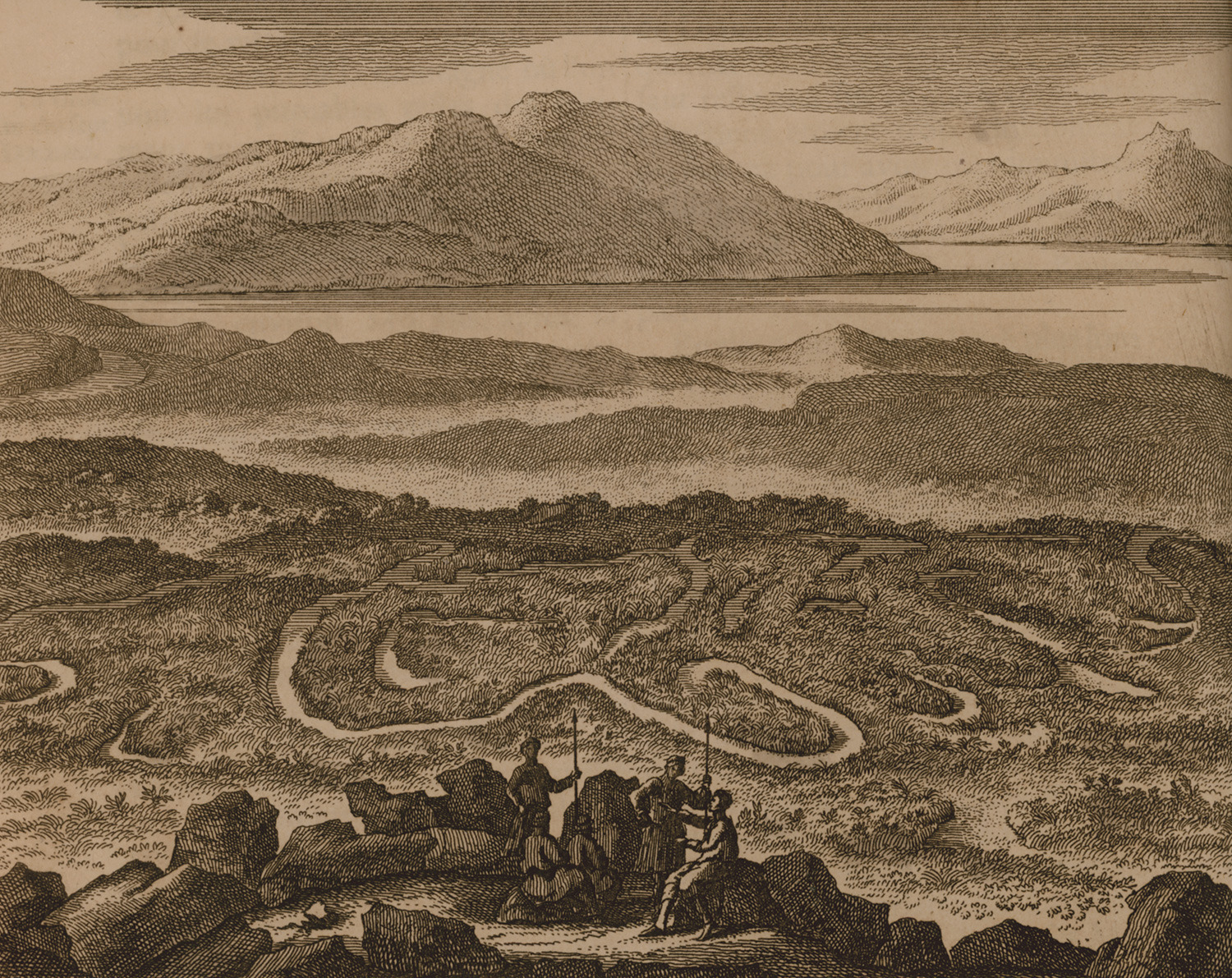
Herodotus tells us they were the first to do so. This is, of course, a captivating story in its own right.One of the images used on one of their early coins was of the Maeander River, which meandered through their kingdom. The picture above, View of Maeander Valley, was published by Flemish artist Cornelis de Bruyn in 1714.

Did C.S. Lewis Meander?

Searching through Lewis’ writings, I did not find any examples of his use of this winding word. (Let me know if you’re aware of one.)

However, here are two enjoyable examples of his informal use of “meander” in his correspondence. The first, in a 1920 letter to his father, uses the word in its figurative sense.

I have two tutors now that I am doing ‘Greats,’ one for history and one for philosophy. . . . We go to the philosophy one in pairs: then one of us reads an essay and all three discuss it. . . . it is very amusing.

Luckily I find that my previous dabbling in the subject stands me in good stead and for some time I shall have only to go over more carefully ground through which I have already meandered on my own.

In the second occurrence, we find C.S. Lewis writing to his Brother Warnie in 1932. He describes, at some humorous length, the condition of the pond on their property. You can visit this same setting today in the C.S. Lewis Nature Reserve.

I have included the full discussion below. Suburbanites (and even more so, city-dwellers) may not be able to appreciate this story the way that people who have lived in the country can. Still, those with a minute to read the entire passage will likely enjoy the way Lewis meanders through his description of events. Oh, and lest you suffer unnecessary shock, be forewarned that Lewis uses the word “bathe” here not to refer to a “bath,” but to a plunge in the pond.

You will gather from this that summer has arrived: in fact last Sunday (it is Tuesday to day) I had my first bathe. You will be displeased to hear that in spite of my constant warnings the draining of the swamp has not been carried out without a fall in the level of the pond.

I repeatedly told both [the workmen] that the depth of water in the pond was sacrosanct: that nothing which might have even the remotest tendency to interfere with that must be attempted: that I would rather have the swamp as swampy as ever than lose an inch of pond.

But of course I might have known that it is quite vain ever to get anything you want carried out: and the pond is lower. However, don’t be too alarmed. I don’t think it can get any lower than it is now.

I don’t know how much of the draining operations Minto [Janie Moore] has described to you nor whether you understood them. In fact, remembering what a mechanical process described by Minto is like I may assume that the more she has said the less you know about it.

The scheme was a series of deep holes filled with rubble and covered over with earth. Into each of these a number of trenches drain: and from each of these pipes lead into the main pipe now occupying the old ditch between the garden and the swamp, which in its turn, by pipes under the lawn, drains into the ditch beside the avenue.

It was however useless to do all this as long as the overflow outlet from the pond (you know – the tiny runnel with the tiny bridge over near the Philips end of the pond) was meandering – as it did – over all the lower parts of the swampy bit. Nor was it possible to stop this up and deny the pond any outlet, as it would then have been stagnant and stinking in summer, and overflowing in winter.

It was therefore decided to substitute a pipe outlet for the mere channel outlet – which pipe could carry the overflow from the pond, through the swampy bit without wetting it, to the rest of the drainage system. When they first laid this pipe I said that its mouth (i.e. at the pond end) was too low and that it would therefore carry off more water than the old channel and so lower the pond.

The workmen shortly denied this but I stuck to my point and actually made them raise it. Even after they had raised it I was still not sure that it wasn’t taking off more water than the old channel did: so I have now had a stopper made which is in the mouth of the pipe at this moment. I have also given the spring-tap up beyond the small pond a night turned on, and I trust that by thus controlling in-flow and outflow of water I can soon nurse the pond back to its old level.

At any rate I don’t see how it can sink as long as its escape is bunged up. As to the degree of loss at present, as there are no perpendicular banks anywhere it is hard to gauge. I should think that the most pessimistic episode could hardly be more than ¾ of a foot: i.e. a difference one is unconscious of in bathing. Still I grudge every inch.

By the way, it has just occurred to me that the sinking may not be due to the draining at all: for the old ‘channel’ escape, when I looked at it just before the operations began, had certainly widened itself extremely from what I first remembered, and must have been letting out more than it ought. In that case the new pipe may have arrested rather than created a wastage.

One criticism some short-attention-span readers levy against Tolkien’s masterpiece, Lord of the Rings, is that too much time is spent traveling. Such critics overlook the reasons the author presented his saga in the manner he did. Well, for those desiring to simply jump from battle to battle, we now have graphic novels. All of the journeying in LOR has a purpose; it is far from mere “meandering.”

Tolkien detailed the travails of the Fellowship during their quest, and his maps allow students of the mythos to discern “Frodo and Sam traveled over a thousand miles from the Shire to Mount Doom in the Lord of the Rings trilogy, over multiple landscapes and terrains.” One of the colorful words created by Tolkien, that rolls off the tongue like a babbling brook, is the name of a river that crosses the Old Forest: Withywindle. (A withy is an Old English word for a willow, or slender twigs or branches.) Its course may not have been especially winding, but it definitely sounds like it should have been.

No one can deny the influence of J.R.R. Tolkien on fantasy literature. But the aforementioned shortening attention spans do deter some readers. Make no mistake about it, however, the traveling in the writings of the Inklings is not without purpose. Nor does it disrupt the story. Still, the less skilled among us should be cautious about mimicking their techniques. One author describes this hazard in the following way.

Ultimately, when you write, your goal should be to make sure that everything you write doesn’t meander, or in other words, moves in some way towards the conclusion of your story. Be that taking care of a subplot, a character arc . . . whatever, it needs to hit a step, or move towards it, on the path to the ultimate ending of your story.

Remember both pacing and the up and down of rising and falling tension. A meandering story stretches out a low point and breaks the pacing. You always want to keep your plot on a straight line to the ending. The characters, they can wander, as long as the plot doesn’t.

Thanks for meandering with Mere Inkling today. Isn’t it wonderful that God allows us these carefree moments, and life isn’t all about “getting things done?”
Theological Humor

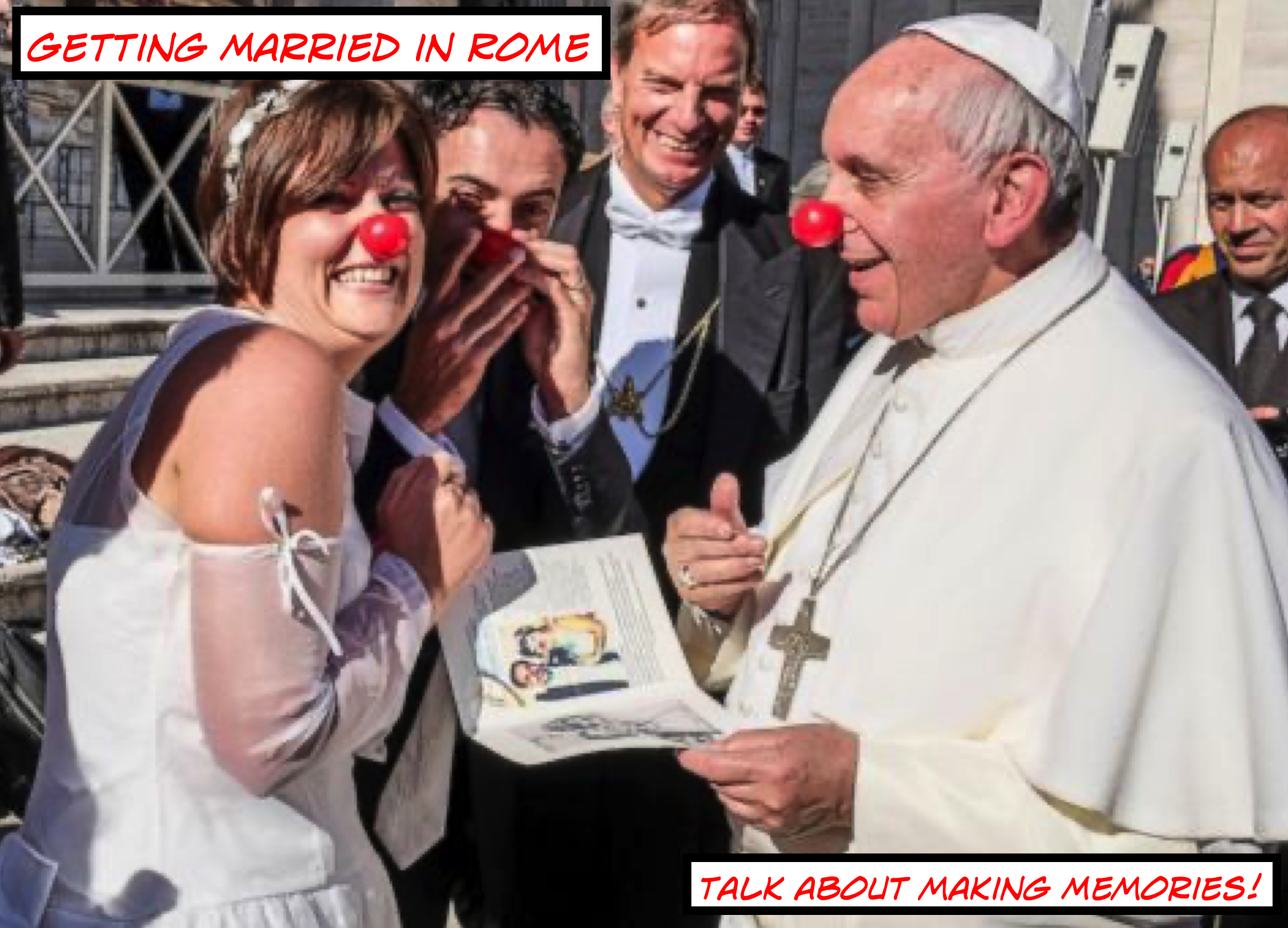
Pope Francis jokes with a newlywed couple in Rome.

Don’t be surprised, but many clergy possess keen senses of humor. Sure, there are staid, grimacing ministers who consider acting dour to be a virtue. (They’re often legalistic.) But most of the pastors and military chaplains I’ve worked beside, love to laugh. I think I’ve written enough about humor to verify that.

C.S. Lewis maintained strong bonds with a number of clergy, from a variety of denominations, and that would hardly have been true if they had lacked a sense of humor. Humor, to Lewis, is an essential part of life. He proclaims this truth from the lips of Aslan himself, as the newly created Talking Animals hear the first (accidental) joke.

“Laugh and fear not, creatures. Now that you are no longer dumb and witless, you need not always be grave. For jokes as well as justice come in with speech.” (The Magician’s Nephew)

I recently read about a fascinating incident one historian described as “perhaps the only really satisfactory practical joke in the whole history of theology.” Allow me to set the scene.

The Byzantine Empire lasted for a thousand years, before being defeated and desecrated* by Islamic armies. During the centuries surrounding its apex, it suffered from the political intrigue and competition with which we are all too familiar.

Photios I was a Byzantine scholar who was twice the Patriarch of Constantinople during the ninth century. Twice is unusual, but it was due to the machinations of emperors and empresses who meddled in the affairs of the church.

He had a troubled relationship with another priest named Ignatius, who also served two times as Patriarch. The good news is that the men were eventually reconciled and both are regarded by Orthodox Christians as saints.

The anecdote comes from the period of their rivalry. Photios, whose brilliance was widely acknowledged, and presumably envied by Ignatius, decided to pull an embarrassing public prank on his nemesis.

Photios devised a bizarre theory that human beings have two souls. His goal was to trick Ignatius into taking it seriously, whereupon Photius withdrew the thesis and admitted he had not been serious. Apparently, everyone unsatisfied with Ignatius’ leadership found it quite entertaining.

Fortunately, among clergy the humiliation of others is rarely the object of humor. Yet, sadly, I have seen it attempted. I personally repent of ever having done so myself, and regard it as sharing, along with vulgarity and blasphemy, the lowest level of “humor.” 

The Wisdom of Lewis

In Reflections on the Psalms, C.S. Lewis relates something I know to be true from my own experience.

A little comic relief in a discussion does no harm, however serious the topic may be. (In my own experience the funniest things have occurred in the gravest and most sincere conversations.) 

Clergy deal with serious topics, like death, quite frequently. Perhaps that is one reason a well-developed sense of humor is common among their ranks.


Skip this footnote if you want to end on a “happy” note.

* “Desecration” may sound like a harsh word to our interfaith-sensitive ears, but it is accurate here. Islam is rarely a gentle master for Christians, and it has been common to see churches and holy places seized and converted to foreign religious uses. For example, in the capital Constantinople (now called Istanbul), Orthodox Christianity’s most magnificent church, Hagia Sophia, saw much of its glorious and historic iconography destroyed when it was converted to a mosque. Many years later, in 1934, an enlightened Turkish government ended the insult, and chose to treat the holy place as a museum. Sadly, the current regressive government under Recep Tayyip Erdoğan, reversed that decision, and in 2020 the Church of Holy Wisdom was returned to its usage as a mosque.

Keeping the Peace, Finn Style

The war in Ukraine trudges on, but the world has become safer with the imminent expansion of the North Atlantic Treaty Organization (NATO).

Recognizing the expansionist aspirations of Dictator Putin’s Russia, Sweden and Finland have decided to request formal admission to the peacekeeping alliance. Their reception has tentatively been approved, although just today another dictator, Recep Tayyip Erdogan of Turkey is threatening to “freeze” them out if they don’t support his efforts to suppress Kurdish independence.

I have my own experiences with NATO. Foremost among them was the small part I played in helping bring about the Intermediate-Range Nuclear Forces Treaty. (I even served as one of the “escort officers” for a Soviet verification team when it visited RAF Greenham Common.)

I mentioned the treaty on Mere Inkling and lauded its success.

The great thing about NATO’s cruise missiles is that they were deployed to bring the Soviet Union to the negotiating table, where the Intermediate Nuclear Forces Treaty led to the elimination of all such munitions from Europe!

Alas, this monumental treaty has expired.

It is a casualty of Russian Federation dreams to restore the Soviet Union’s former borders in Europe. Combined with the “defection” of the former Warsaw Pact nations, it is easy to understand why a suspicious Russia postures so aggressively.

Which, of course, encourages the democratic nations to draw closer in mutual defense.

How are the Finns Celebrating

Finns are different.

Not quite what you would expect. Many people – certainly most Americans, the ones who are not totally geographically ignorant – mistakenly think Finland is a Scandinavian country. Not quite. True, they are a Nordic nation, but Nordic Perspective offers an insightful discussion, replete with great maps, on the subject.

Being a Nordic people, it comes as no surprise many Finns are welcoming their entry into NATO with a beer. In fact, a brewing company named “Olaf” has opted to use the French acronym for NATO – OTAN – as a play on words. “The beer’s name is a play on the Finnish expression ‘Otan olutta,’ which means ‘I’ll have a beer…’”

Good for them. (So long as they remember to drink in moderation.)

Now, this OTAN-business raises a question in my mind. Is it merely a coincidence, or might the French have a passive aggression purpose in mind with this heteropalindrome?

After all, the headquarters of NATO had to be moved from Paris to Belgium when Charles de Gaulle withdrew from the military alliance.

Wondering about French subliminal messages got me thinking about C.S. Lewis’ thoughts on the subject. Lewis loved all people, but was no one’s fool. He understood many of the influences exerted upon culture are destructive. Decadent societies (e.g. pre-war Berlin) sow seeds that ultimately bear tragic fruit.

As the Second World War was just beginning, and Lewis’ brother Warnie had safely returned home after the Dunkirk evacuation, Lewis mentioned France in one of his 1940 letters to his veteran brother. It is quite entertaining, as long one is not an über-Francophile.

I am also working on a book sent me to review, Le Mystere de la Poesie*by a professor at Dijon, of which my feeling is “If this is typical of modern France, nothing that has happened in the last three months surprises me” – such a mess of Dadaists, Surrealists, nonsense, blasphemy and decadence, as I could hardly have conceived possible.

But one ought to have known for, now that I come to think of it, all the beastliest traits of our intelligentsia have come to them from France.

Well, that’s enough of that. It’s time to pop the tab on an OTAN and toast the NATO, and its expanding protection of world democracies.


* Volume two of The Collected Letters of C.S. Lewis has a footnote reading “This work cannot be traced.” I believe the likely object of Lewis’ disdain may have been written by André Vovard and published in 1951 in Paris and Montreal by Fides.

Sharia Law Versus Democracy

chaldean

“Liberal and democratic principles are worth nothing here [in Iraq]. Islam does not say that all men are equal.” (Amal Nona). You cannot state the truth more concisely than that.

Nona is a Chaldean Catholic archbishop who “doesn’t have a diocese anymore. He doesn’t have a church. ISIS destroyed all that, and his people are scattered. But he’s not afraid to speak forthrightly, even when ISIS was at his doorstep.” (“Happy Warriors”)

The Chaldean Catholic Church is no stranger to persecution. They are descendants of the Assyrians who maintained the faith through the Muslim conquest up until today. They are a courageous people, but that is not the subject I wish to address here.

As the archbishop alludes, the reason that Western nations have been utterly unsuccessful in transplanting democracy to countries with Islamic majority populations is that democracy is alien to their worldview.

To the literalist Muslim (i.e. those who accept the words of the Quran at face value), it’s ludicrous to claim that Christians are equal to followers of Islam. Even without appealing to detailed Sharia law, the simple notion that infidels should possess the same rights as the followers of Allah is foolish, or worse. They are dhimmi—second class citizens, at best and actively persecuted and martyred, at worse.

This is the default setting for Islamic nations. Just look at Turkey and Egypt, two nations with actual democratic governments. The terrorist Muslim Brotherhood continues to exert destructive influences in both, and Turkey’s president, Recep Tayyip Erdoğan has used the excuse of the recent coup attempt to further destroy the vestiges of democracy (e.g. free speech) which he has long been undermining. Egypt is currently enjoying a respite after removing Mohamed Morsi, a man with a similar, anti-democratic agenda.

Retired military analyst Ralph Peters recently penned a frightening (and I believe accurate) appraisal of where Erdoğan will take his nation.

The ragtag ISIS caliphate is merely the forerunner of the more ambitious caliphate to come. It’s coming in Turkey.

The immense and destructive crackdown underway in Turkey now, with at least 10,000 Turks taken into custody and as many as 100,000 others dismissed from their positions—not only soldiers, but judges, civil servants, police and academics—isn’t an end-game. It’s a beginning. . . .

Erdoğan didn’t need a reason for this pre-planned purge. He had his reasons and his lists of names. He needed an excuse. The failed coup was a gift.

Now we’re witnesses to the destruction of Turkey’s secular society and the forced-march reversion to religious regimentation and obscurantism, to intolerance and oppressive fundamentalism. This is the triumph of mosque over modernity, not of the rule of law, but of its supersession.

Professors have been forbidden to leave the country. The government demanded the resignation of all the deans of higher-level schools and universities. Book-banning is on the way, and book-burning wouldn’t surprise me in the least.

To those of us in the West, including numerous Muslim immigrants who have recognized the universal benefits of freedom of conscience and equal rights, the historic interpretations of government based on the Quran seem disconcerting. Part of the reason they seem unfathomable, is because we do not take the time to study them. Nor do we listen to the voices of minority populations who have been long subjugated and deprived of what we deem basic human rights.

Archbishop Nona, and others like him, need to be heeded. His warning about the challenge of translating democratic principles, points to the proper beginning place: education. It is no accident that the Muslim countries with the highest educations and most moderate (i.e. non-fundamentalist) adherents replicate democratic freedoms most consistently.

I consider the best course for promoting peace to be educating all people, and encouraging freedom of conscience, especially when it comes to religion and speech. And I recognize that the statement with which we began remains a vital fact that must be recognized at the outset of that effort. The following observation appeared in an article last year.

The lust for power corrupts religion, just as the quest for piety is vulnerable to hubris. As Cengiz Erdoğan, a CHP [minority political party] member who runs a car repair workshop, put it to me: “He’s power-hungry and he’s dedicated to the Islamist way.” Or, as C.S. Lewis once warned: “Of all bad men, religious bad men are the worst.”

The principles guiding Democracies and Republics arose in the Western world. There they found fertile soil. Yet even here in the West, we see on a daily basis that democracy is fragile. Tolkien and Lewis scholar, Joseph Laconte, wrote an “optimistic” essay about the 2015 elections in Turkey. Erdoğan had been prevented from achieving an absolute majority.

The danger, at least for the moment, has been averted. . . . [Some Turks fear] Erdoğan’s early reformist talk was a mere façade for his hardcore Islamism.

That may be reason enough to cheer Turkey’s election results: they offer the hope that corrupted religion will find it harder to derail the nation’s experiment in democratic self-government. More than hope, of course, will be needed. For if secular authoritarianism has left the stage in Turkey, its religious counterpart is waiting hungrily in the wings.

Unfortunately, what political minorities in Turkey feared, is now coming to fruition, with a vengeance.

A Positive Postscript from the Chaldeans

Christianity rejects the notion that any person possesses greater worth than another. In the Christian world there are no castes . . . there are no dhimmi.

Each and every life is precious. In fact, the Good Shepherd is not content to keep the faithful ninety-nine under his protection, he leaves them to go out in search of the one—the individual one—that has strayed.

Chaldean Christians have some of the most ancient roots in Christian history. Despite the fact that most the Assyrian Christians have been driven from their ancestral homes, and are unlikely to ever be allowed to return, they have retained their hope. That is because they do not place their faith in humanity or their own strength. The following description of Archbishop Nona comes from another article.

I’d even go so far as to say that before me is a happy man. Indeed, he tells me: “We were always a minority. We always knew it was not important what we have but what we do. The Lord shows us how it is important to be happy in all situations.”

He emphasizes that the Christian has no other identity than as a Christian. The Gospel is what you want to conform your life to, he says. “For us, we want to practice our identity. We are not another identity. Our identity is to live like Jesus Christ.”

There is no other life, he says, for a Christian. Christ becomes everything, and so there is no life without Christ. “I think all our problems lie in this point: that in our life, sometimes we forget to live like Jesus. It’s not theology, it’s reality.”

It is not difficult to hear echoes of C.S. Lewis in his words. And these come not from a mutual acquaintance between the two . . . rather from a common acquaintance with the Messiah.

In the end, it’s not about theology, philosophies or human political institutions. It’s about a Redeemer.

_____

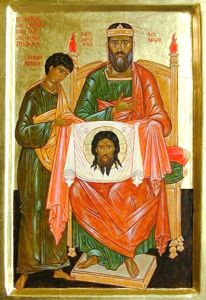
The icon above is of Saint Addai (Thaddeus of Edessa). He was a missionary to Mesopotamia, and contributed to the Divine Liturgy used by much of the Eastern Church. The image portrays Addai presenting the Mandylion to King Abgar of Edessa.