Introducing Anatole France

papeThere’s always a new author to meet. Some are more worth meeting than others.

I was introduced to Anatole France (1844-1924) when I saw him listed on the “must read” list of F. Scott Fitzgerald.

I’m not a big Fitzgerald fan, but as an amateur literary historian, I was curious about how this particular list was recovered. Apparently, he had dictated it to one of his nurses, several years before his death. However, the list only turned up last year, having lain unnoticed in the nurse’s effects.

The France title that Fitzgerald deemed essential was The Revolt of the Angels. Its importance to him is highlighted by the fact that this relatively short list only included twenty-two titles. And one of that mere score of selections was The Revolt of the Angels.

The angelic dimension of the work is what intrigued me. Angels, of course, are real beings. They’re distinct from people (contrary to the pervasive contemporary notion that when people die they “become” angels).

There actually was an angelic revolt, and there are several references to it in the Scriptures. “How you are fallen from heaven,
O Day Star, son of Dawn!” (Isaiah 14:12).

I was curious whether France was writing about this ancient event. I was also intrigued by Fitzgerald’s interest in the volume, given its subject.

I was disappointed.

It turns out that, like Mark Twain, France was sympathetic to the Devil. I’m sure he thought himself quite the wit when he wrote, in reference to the Bible, “We have never heard the devil’s side of the story, God wrote the whole book.”

I don’t have time to read texts like this—when there is more than enough good literature to keep me occupied for several lifetimes. However, it appears to be based on Gnostic concepts with God (the Creator of this world) viewed as an imperfect demiurge. His incompetence, it seems, justifies the heavenly revolt.

Suffice it to say, the book is commended for reading by the Freedom From Religion Foundation. That sort of endorsement speaks volumes.

Here, however, is a random paragraph. It may be illustrative of the tone of the work, even though pulled from its context. The speaker is, I believe, one of the positive characters in the book. While France himself was an atheist, his sympathetic character summarizes a pagan cosmology quite elegantly.

Young Maurice’s guardian angel [said] “I argue, like you, in the language of human beings. And what is human language but the cry of the beasts of the forests or the mountains, complicated and corrupted by arrogant anthropoids. How then . . . can one be expected to argue well with a collection of angry or plaintive sounds like that?

Angels do not reason at all; men, being superior to the angels, reason imperfectly. I will not mention the professors who think to define the absolute with the aid of cries that they have inherited from the pithecanthropoid monkeys, marsupials, and reptiles, their ancestors! It is a colossal joke! How it would amuse the demiurge, if he had any brains!”

That is actually a rather provocative quote, and I’m sure it may lead some to explore the text even further. I certainly don’t object to that, and would be curious to hear back from anyone familiar with the book. I would especially like to see the reaction of Christians to The Revolt of the Angels.

If you are interested in a more creative fictional treatment of fallen angels, be sure to read C.S. Lewis’ The Screwtape Letters. While the presentation is truly groundbreaking, Lewis’ take on the motives and nature of these defeated beings is actually based on reality. Cast from the heavens they are consumed with rage and hatred of God.

A positive note about Anatole France

Whatever I think about the writer’s theology, I did read several wise quotations attributed to him. I’d like to close with these, as they may be more edifying than our discussion of Gnostic cosmology.

“Nine tenths of education is encouragement.”

“Some succeed because they are destined to; most succeed because they are determined to.”

“If 50 million people say a foolish thing, it is still a foolish thing.”

“When a thing has been said and well said, have no scruple; take it and copy it.”

And my favorite:

“Until one has loved an animal, a part of one’s soul remains unawakened.”

_____

The illustration above is the work of Frank C. Papé (1874-1972) an English book illustrator. It comes from another of France’s “religious” works.

One Person’s Joy, Another’s Curse

Dislike emoticonEmoticons. Some people love them. Others find them irritating. I’m in the latter camp. That’s why I enjoyed a comic in the paper this week.* A fifty-something husband and wife are talking as she’s typing on her desktop.

Jeannie: I wish I was a little more computer-literate.

Charlie: I don’t really care for that term.

Jeannie: Why not?

Charlie: I don’t like ascribing literacy to people who think emoticons are a part of speech.

I am forced to respond with a wholehearted “ditto!”

I find the evolution of alphabets fascinating. Primitive pictographs amaze me. Emoticons, not so much.

I have to admit that I occasionally use the primitive :) to indicate that something is intended to be humorous, rather than serious. It has served as useful shorthand for written speech, conveying what would be evident in the intonations of oral communication.

However, this nouveau-punctuation has mutated into an abomination. Today there are innumerable graphic variations of that once modest “smile.” And some of them are truly bizarre.

Emoticons run amuck are an evidence of humanity’s demand for novelty. In The Screwtape Letters, C.S. Lewis shows how an incessant demand for something new saps the joy out of the present moment. As the senior demonic tempter declares:

Now just as we pick out and exaggerate the pleasure of eating to produce gluttony, so we pick out this natural pleasantness of change and twist it into a demand for absolute novelty. This demand is entirely our workmanship. If we neglect our duty, men will be not only contented but transported by the mixed novelty and familiarity of snowdrops this January, sunrise this morning, plum pudding this Christmas. . . . Only by our incessant efforts is the demand for infinite, or unrhythmical, change kept up. This demand is valuable in various ways. In the first place it diminishes pleasure while increasing desire.

I realize it’s a bit of a stretch to apply this passage to the subject at hand, but the principle remains the same. When is enough enough? When it comes to emoticons, apparently, that level has yet to be reached. 

I am not seriously suggesting that there is a conspiracy going on here, but one never knows.

Please forgive me if I have offended any Mere Inkling readers who may suffer from emoticonaddiction or some other disorder. It is not my desire to upset you. Feel free to continue your unbridled (ab)use of these tiny monstrosities.

Simply include me (and C.S. Lewis) alongside Charlie in saying, “I don’t like ascribing literacy to people who think emoticons are a part of speech.”

Postscript: I must confess to finding one set of emoticons rather amusing. If you are familiar with Spock from Star Trek, you too may enjoy these Vulcan emoticons that exhibit the full range of Vulcan expression.

vulcan

_____

* You can see the strip I am referring to here.


Settling for Less

ammunitionMy wife and I are thrifty people. (Well, in all honesty, she wouldn’t exactly use that word to describe me.) Still, we try to save for the future and spend money sensibly.

We always try to purchase generic products unless we find their quality inferior to the “name brands.” Once I learned that most generics were manufactured in the same plants that produce the more expensive products, that made sense.

Nevertheless, as the illustration suggests, there are some places where it just doesn’t pay to settle for potentially inferior goods. Take, for instance, medical care and your children’s educations. We all want the best we can get. And there’s nothing wrong with that.

No, the “wrong” enters in when we begin to envy those who possess something we think we would like to have. It might be a nicer home, a newer car, or a larger television screen.

Envy is a deceptive thing. It lies to us. It beckons to us, saying, “if only you possessed that one thing . . . then you’d truly be happy.” Envy usually whispers, but it makes up for its lack of volume with its persistence. Once we open the door to our heart and mind, envy suggests—over and over—that if we don’t secure the object we desire, that happiness will elude us.

Envy does more than nag us. It distracts us from all of God’s blessings. With eyes focused on our presumed “needs,” we forfeit the joy that would otherwise flow naturally from contentment with our genuine needs. “Give us this day our daily bread” is not, after all, a request for more of this world’s “treasures.”

Another quality of envy is that it promises what it cannot—due to its very nature—deliver. Envy has a relentless appetite; it is incapable of being appeased. As C.S. Lewis wrote, “Envy is insatiable. The more you concede to it the more it will demand.” (“Democratic Education”).

Envy is so ravenous that it is used by Lewis to illustrate part of the torment of Hell. The following comes from his Preface to The Screwtape Letters.

We must picture Hell as a state where everyone is perpetually concerned about his own dignity and advancement, where everyone has a grievance, and where everyone lives the deadly serious passions of envy, self-importance, and resentment.

It’s probably no accident God included repeated prohibitions against coveting in the Ten Commandments.

In light of the demands levied by envy, I choose to reject it whenever I recognize its whisper. I opt instead for giving thanks for the innumerable blessings I’ve received. And, I ponder the responsibility that comes with God’s generosity . . . not least of which is the duty to remain thrifty, so that I have more of those blessings available to share with others.

Screwtape Goes to War

I edit a free online journal for military chaplains. Articles have been contributed by clergy from most of the world’s continents, sharing their experiences and opinions. Much of the material will be of interest to anyone interested in the nature of ministry within the armed forces.

The current issue was “published” at the end of June, and includes one article that may be of particular interest to the readers of Mere Inkling.

On page fifty-seven you’ll find the preface to a series of six letters. They are collected under the same title as this post, “Screwtape Goes to War.” It is available via this link: Curtana: Sword of Mercy.

Those familiar with C.S. Lewis’ masterpiece of diabolical correspondence will require no introduction. Here’s an excerpt from one of the six epistles gathered in this modest collection. Remember, it is from the pen of a senior demon advising a junior Tempter on how to corrupt his “patient” (in this case a chaplain).

While preaching can in theory be used by the Enemy to draw his servants closer to himself, it’s equally possible to use the pulpit to drive a wedge between the Enemy and those ordained to serve him. In fact, there is something uniquely satisfying about using a chaplain’s own preaching to immunize him to the disgusting message of hope and forgiveness.

There are so many tactics to undermining the effectiveness of your chaplain’s sermons . . . where to begin? I have found the following methods to be most useful.

1. Encourage him to subscribe to all sorts of periodicals and keep him as far away from the Enemy’s book as possible. Tell him that by this means he “will remain in touch with the culture” to which he is preaching. We do not want him opening the Scriptures. It’s not too challenging persuading many clergy today that they’ll bore and alienate their audience by citing passages from that archaic text. Let him explore all sorts of publications so he discovers ones he honestly enjoys. That will make the choice easier when he looks on his desk at a tempting contemporary publication lying next to that black book.

Not all journals are created equal, of course. Some actually contribute to the knowledge and comprehension of the Enemy’s book. Avoid these. Secular publications are usually safe, the more so when they celebrate selfishness, man’s favorite religion. The most precious, however, are those published by “religious” presses. You know those to which I refer. The ones penned by our allies who where wear the garb of the Enemy but live with either themselves or some other idol on the throne of their souls. Those who may praise him with their lips but deny him access to their hearts. Mind you, these documents need to be chosen with great care. But if you can find some which appeal to him, it will aid you immeasurably in bringing about his demise. . . .

Curtana discusses both historical matters and contemporary issues. It is interfaith and international in scope. The website includes a “subscription” form for those who wish to be notified whenever a new issue of the journal is published.

Don’t be confused when you see the date on the current issue. Like many minimally-staffed, free publications, we’ve fallen slightly “behind schedule.” Thus, the current issue is dated Fall & Winter 2011. (I promise this is due not merely to procrastination, but also to the editor’s chronic propensity for terribly over-extending himself.) At any rate, Curtana 3.1 is indeed the issue which includes the afore-described article.

Screwtape Letters Anniversary

I was recently reminded that February 2012 marks the seventieth anniversary of C.S. Lewis’ masterpiece, The Screwtape Letters. Other bloggers have remarked on the anniversary, for example here and here.

Lewis dedicated the book to his dear friend and fellow Inkling, J.R.R. Tolkien.

If you’re unfamiliar with the letters, you really should rectify that gap in your knowledge. The letters are penned by Screwtape, a senior Devil, to Wormword, a less experienced tempter. They illuminate Satan’s demonic tactics and provide keen insight into our fallen human nature, replete with its countless vulnerabilities.

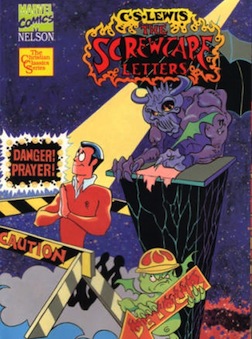
There’s even a graphic novel version of the collection which was published in 1994 by Thomas Nelson in partnership with Marvel Comics.

While the anniversary of the Letters in and of itself is certainly significant enough to merit a blog announcement . . . this post includes something quite rare. The fact is we’ve come into possession of one of Screwtape’s instructional emails, written to another subordinate demon.

For the benefit of those who would arm themselves against the snares of the Enemy, we reproduce it in full below.

(Oh, and as a reminder, when Screwtape refers to his Enemy, he is actually talking about the Creator of heaven and earth. Also, you can’t actually trust anything he writes since he’s a Liar, just like the archangel he followed so long ago. For example, note his incorrect reference to his own “immortality.”)

My Dear Esculentus,*

Another decade has passed since that puppet of the Enemy released to the world a portion of my correspondence with Wormwood. Of course, the lamentable Wormwood has had ample time to regret his carelessness in that matter, as I often remind you.

A decade’s but a snippet to immortals such as us, of course, but to the mortals it marks a significant portion of their brief lives. Why the Enemy loves those pitiable insects so much goes beyond logic!

Still, another halfscore has flown past and that damaging treatise remains in print. In fact, if anything, it continues to grow in popularity.

We simply cannot have our “patients” made aware of our treatment regimen for them. If they come to realize that our most successful deception is untrue, the relentless work of centuries will be undone.

We have labored tirelessly up to the present day to persuade humanity that all truth is subjective! Fortunately, the vast majority of the population in what are ironically labeled “enlightened nations,” has accepted our suggestion. This allows them to eagerly swallow the comforting lie that “all roads lead to god.” If they realize that all roads do indeed lead to a ‘god,’ they might abandon one of the many paths that lead to our Master who is ever-eager to “swallow” them in turn.

Better by far that those entrusted to our misleading, nourish our infernal Father than that you and I sate his appetite. (As you know, I say that figuratively, since our Father’s hunger for power can never be truly satiated. His all consuming hunger is one of his infinite qualities, which we rightly extol.)

But, back to your primary concern my appetizing friend, your patient. By all means keep him from reading The Screwtape Letters. In fact, the farther you keep him from anything written by Clive Staples Lewis, the better!

Keep him in the company of liberal companions who have embraced the myth of there being no objective truth. That way, we can prevent him from ever meeting the Enemy who proclaims himself to be—yes, disgusting isn’t it—the Way, the Truth and the Life.

Never pass up an opportunity to impress upon your patient that such a claim is politically incorrect to the utmost. Remind him he will be shunned by society if he argued there was a single truth. Indeed, make him think the very suggestion that anyone sincerely following another path might be lost, is repugnant.

Many of your fellow tempters have experienced great success in motivating the humans they treat to replace in their world views the virtue of Truth with the sentimentality of Sincerity. This you must do as well.

Persuade him that the eternal destiny of all who believe in something, is secure. Convince him that it is by their sincerity that they are saved. Oh how sweet it is when they accept this dark epiphany!

And it has never been easier to win humans over to this view than it is today. If you wish to embellish the doctrine with vague language about “God being love” and all that, so be it. Just see to it that they never open the Enemy’s book to recognize how grossly they have edited and distorted that concept!

Oh, and in closing, allow me to once again remind you of how I began this digital epistle. (We both know that it frequently takes a dozen or more reminders to make a firm impression on your dull mind.)

Do whatever it takes to ensure that your patient never reads the Letters! And, be wise to guard our own correspondence, lest you end up in the agonizing company of the afore-censured Wormwood.

Your affectionate adoptive Uncle,

Screwtape

*Esculentus translates from the Latin as either “delicious” or “succulent,” and if you have read The Screwtape Letters you know what that suggests about Screwtape’s interest in his protégé.

DC’s Absurd Educational Policies

Most Americans are sadly disappointed with the deplorable state of our current federal government. (Many of us feel the same about our state governments, but that’s another matter.)

When we talk about (Washington) DC, we are almost always referring to the foibles of our national government . . .  but we often ignore the bizarre machinations of the “municipal” government which oversees the city itself.

Some of the city’s foolishness makes the federal government appear wise in comparison.

Case in point. DC public schools are in shambles. Rather than improve the schools themselves, lawmakers have come up with an innovative solution: Require all of the students to apply for higher education!

Yes, that’s what Kwame Brown and his fellow bureaucrats have proposed.

Forcing students unable to complete high school requirements to apply for college. Right. One brilliant solution to a failed educational system.

Since it’s doubtful that diverting time and energy from actual studies to this questionable exercise will solve the underlying problems, we can hope that the proposed legislation dies an swift death.

In 1868 Samuel Clemens (Mark Twain) judged Washington, D.C. with his razor-bladed pen:

This everlasting compelling of honesty, morality, justice and the law to bend the knee to policy, is the rottenest thing in a republican form of government. It is cowardly, degraded and mischievous; and in its own good time it will bring destruction upon this broad-shouldered fabric of ours. I believe the Prince of Darkness could start a branch hell in the District of Columbia (if he has not already done it), and carry it on unimpeached by the Congress of the United States, even though the Constitution were bristling with articles forbidding hells in this country. And if there were moneyed offices in it, Congress would take stock in the concern, too . . .

God, spare us from the whims of those in political authority over us!

The brilliant C.S. Lewis identified one aspect of the faulty thinking exemplified by this proposed statute. He placed on the lips of the devil Screwtape this sure way to cripple a nation.

The basic principal of the new education is to be that dunces and idlers must not be made to feel inferior to intelligent and industrious pupils. That would be “undemocratic.”