
Discerning Your Personality

How has your personality been changing through the years? Over the years I’ve noticed some gentle shifts in my own personality, particularly as it relates to my attitudes toward interacting with others.

C.S. Lewis records an intriguing comment about personalities in his early diary, published now as All My Road Before Me. After WWI, he fulfilled his promise to a friend who perished in the conflict, by providing for the soldier’s mother and young sister. Lewis’ relationship with Janie Moore has been debated, but he referred to her as “his mother,” his birth mother having died when he was young. 

Lewis refers to Mrs. Moore as “D” in the diary, and Maureen, her daughter, would have been a teenager at the time (January of 1923).

At supper the subject of personality arose – I said that it made one giddy to think that oneself might not have been.

Maureen said, “Yes – I was wishing the other day that you had married someone else (to D) and then I thought, Oh, it wouldn’t make any difference to me, I shouldn’t have been there.” This shows me that she thinks more than I had hoped.

The three people seated at that dinner experienced personality changes during the following years. Many of these attitudes and behaviors have been recorded for posterity. 

Some change is natural. Healthy change should be considered “growth.” People who remain rigidly static are the exception. Nevertheless, normal temperament modifications are usually quite gradual. Major alterations usually precipitated by significant emotional events. And, it’s important to recognize these SEMs can be positive – such as the birth of a child – despite our human tendency to focus on those which are traumatic.

So, how does one asess their personality? There are a variety of accessible personality inventories. One of the most accessible identifies sixteen basic personality types, as popularized by Katherine Cook Briggs and Isabel Briggs Myers in the Myers Briggs Type Indicator. Using questionnaires of various length and detail, individuals discover their core personality attributes. 

It is quite common for people using one of these MBTI-based inventories to be truly surprised at the accuracy of the instrument. Many choose to embark on a quest to learn more about themselves – and others. There are resources for using these insights to improve interaction with people of other types, and even to find a compatible type of career.

I recently stumbled across a simple-to-use website that I offer for your consideration. Sixteen Personalities not only aids you in identifying your “type,” it offers a number of additional types of supplemental data – many of them for free. One clearly outlines the strengths and weaknesses of people with your personality. 

Readers will notice I’m careful to refer to the tools used as assessments or inventories, not tests. That’s because the word “test” implies that there are right and wrong answers. The fact is that there are no invalid personality types.

Each combination possesses its own strengths, and its inevitable weaknesses. Often they are two sides of the same coin. For example, the 16 Personalities site includes ten such traits for the Protagonist (ENFJ). Here are two of the examples.

A Strength – Reliable – Few things bother Protagonists more than the prospect of letting down a person or cause that they believe in. People with this personality type can be counted on to see their promises and responsibilities through – even when it’s difficult to do so.

A Weakness – Overly Empathetic – Compassion is among this personality type’s greatest strengths. But Protagonists have a tendency to take on other people’s problems as their own – a habit that can leave them emotionally and physically exhausted.

The Reality of Personality Drift

It isn’t uncommon that over a period of years, personality type (as identified by these sixteen options) can change. This is particularly true when we are near equilibrium between two competing attributes. For example, as a young pastor, I was slightly Extravert. Today, I am modestly Introverted. Some of this is due to being “worn out” by excessive interpersonal interactions. Some, I suspect, is because I’m assessing my preferences more honestly. I really do draw more positive energy from small groups, than crowds.

But pastors, of course, are expected to be people people. So many of us do consciously push ourselves to become more of an Extravert than we truly are. (And many people would be quite surprised to learn how many of the pastors they’ve admired for their personability are actually Introverts.)

In my own situation I have a pair of weak preferences – Introvert over Extravert and Thinking over Feeling – and two quite strong preferences – iNtuitive over Sensing and Judging over Perceiving. Due to the balanced aspect of two characteristics, I possess a sort of blend of four different personalities. And, I could be fairly perceived by others as any of them.
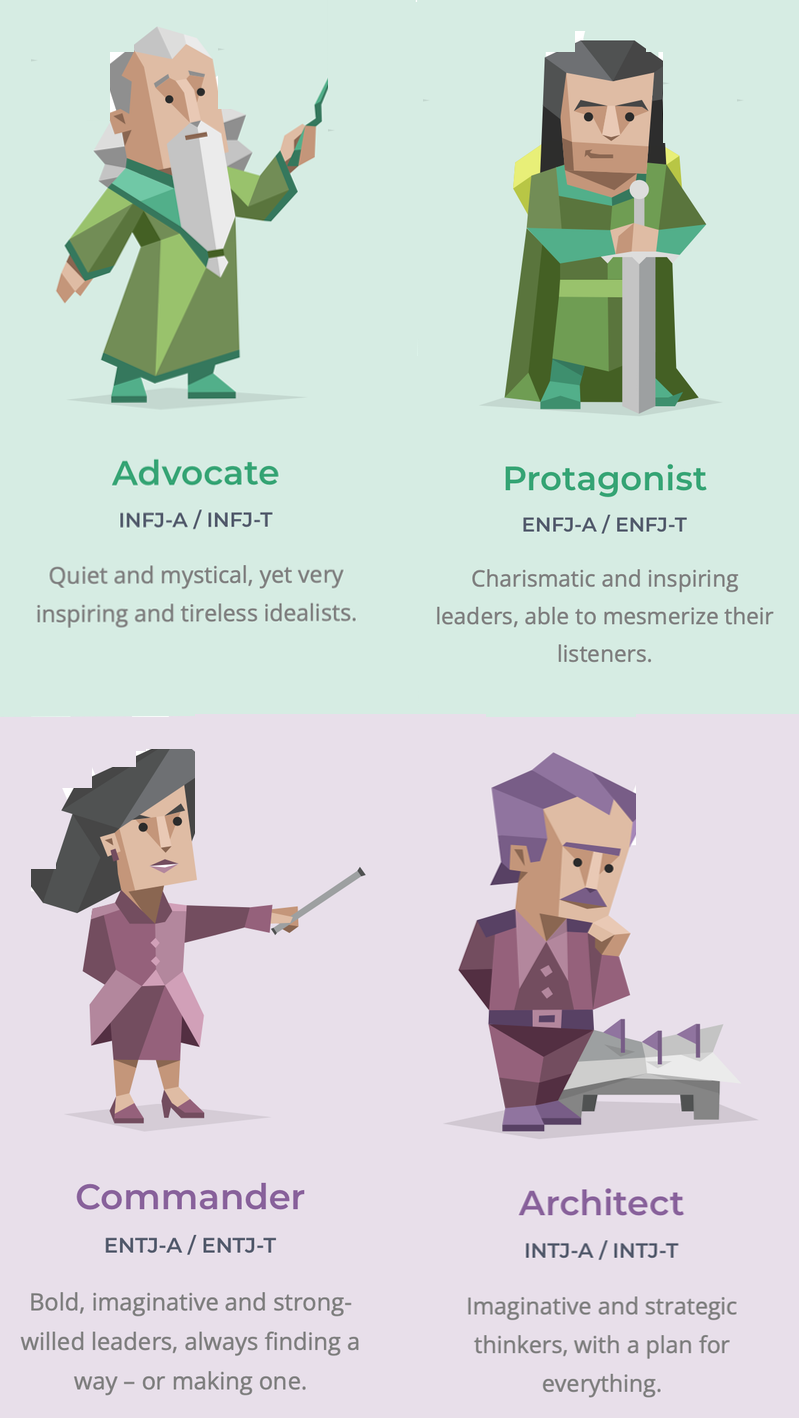
One last element of the 16 Personalities version of the MBTI, is that it includes a measurement of one’s Assertive versus Turbulent nature.

Assertive and turbulent refer to opposing personality traits sometimes added to the Myers-Briggs Type Indicator (MBTI), a personality inventory. An assertive person is more calm, confident, and laid-back, while a turbulent person is more anxious, self-conscious, and perfectionist.

The labels, when used, are appended to the standard four-letter MBTI codes to lend further nuance to the psychological types. 

No one who knows me would be surprised to learn that I peg out as Assertive. One clear evidence is that no one has ever accused me of being a Perfectionist.

Was C.S. Lewis an ESFP?

Seven years ago I wrote about this subject, and I researched the question of which personality C.S. Lewis possessed.

The consensus seemed to be that he was an INTJ. One current discussion concurs with that assessment, although it also makes the subject a bit more complex by including the “Harold Grant cognitive function stack,” something I’ve never studied.

Lewis’ identity as an INTF remains most reasonable to me. Feel free to share your thoughts on the matter.

Remember, a personality inventory is not intended to put you in some sort of restrictive box. If the tool is not helpful to you, just ignore it. And, if you are wary of how such revelations might be used “against” you, share those concerns with any authorities (e.g. educators or employers) who want you to participate in a group process.

[You might dismiss such a concern, but I can personally attest to a situation where a senior military chaplain attempted to twist the MBTI results of a Roman Catholic chaplain to suggest he had “issues.” Suffice it to say it was really the colonel who had psychological problems, not the captain.]

That sad episode was, fortunately, unique in my experience. In any case, it should not prevent someone from personally discovering their personality type. It’s free, only takes a few minutes, and the dividends could well surprise you.

And, if you are curious about what type characterizes a particular breed of dog or cat . . . I think this site was right on in labeling our border collie an ENFJ.

C.S. Lewis and Punditry

chesterton-sanity

Odds are that you, kind reader of Mere Inkling, are a pundit. While the overpaid professionals who overpopulate the media would like for us to think being a pundit requires possessing special knowledge or expertise, that’s simply not true.

Any of us who make comments or pass judgments in an authoritative manner can rightly be deemed a pundit. If you are simply a commonplace critic, you probably qualify for the title. All the more so if you publish your thoughts.

If the recent elections proved anything, they revealed there may well be more pundits per cubic acre in the modern world, than there are bees.

Recently I came across a peculiar essay, written by a writer with whom I’m totally unfamiliar. David Harsanyi is a senior editor of The Federalist, although this article appeared in National Review. Presumably he is a conservative, but of the atheist variety. (No wonder I haven’t read any of his work.)

At any rate, he’s a journalist who describes his “line of work” as “punditry.” Punditry as we have noted, has become all the rage in our modern era. I’m debating though whether adding it to one’s resume would be beneficial. It appears that receiving the validation of a punditry paycheck is the best gauge for making that determination.

As soon as people had the leisure time to develop their senses of humor, the seeds of punditry were planted, and many a silver tongued cynic has reaped the harvest. The past has known people who offered social criticism with a dash of wit (typically of the sarcastic variety).

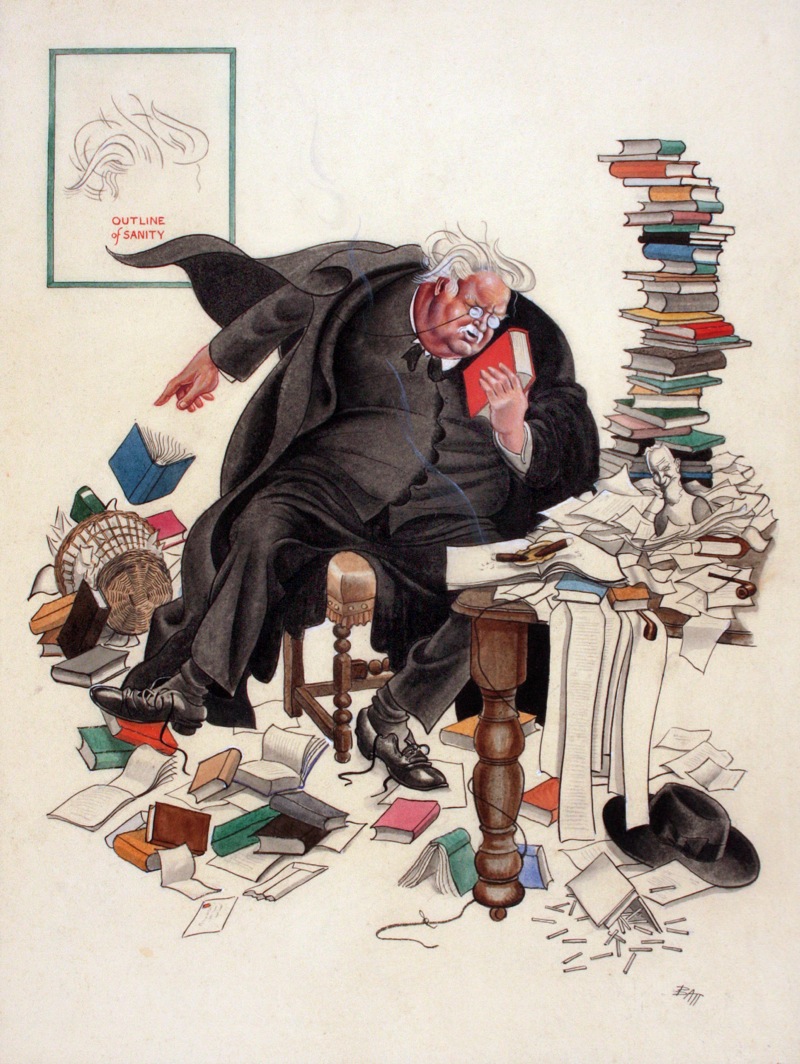
An admirable example of such was G.K. Chesterton (1874-1936). Chesterton differed from Harsanyi in that he was also a philosopher and poet, not merely a journalist. Most notably, Chesterton was also a Christian.

C.S. Lewis held Chesterton in very high regard, and included his book The Everlasting Man among the top ten titles which had influenced his professional and philosophical thought. You can download an audio copy of that text here.

There is a great essay here that explores the influence of Chesterton’s essay “Ethics of Elfland” on the Inklings.

Jerk Logic

Returning to the article with which I began, “Jerk Logic” is the title of Bersanyi’s essay. He began with a question that more people should probably ask themselves.

Am I a jerk? You may find this an odd question for a person to ask himself. But when you’re in my line of work—which, broadly speaking, is called punditry—complete strangers on social media have little compunction about pointing out all your disagreeable character traits.

I found his article interesting for several reasons. He’s candid about some of the booby traps that endanger those who dare to write about controversial subjects. He offers a confession about just how soul-scarring the past election has been for some who have followed its permutations closely.

The 2016 election, I’m afraid, has convinced me that the joke is definitely on me. But after taking meticulous inventory of my actions over the past year or so, I am forced to acknowledge that perhaps, on occasion, some of my behavior might be construed as wantonly unpleasant. Long story short, I am a jerk . . . with an explanation.

Another thing I enjoyed in the brief piece is how he turned to a personality inventory (similar to the Myers Briggs Type Indicator) to assess his potential jerk quotient.

As I learned more about my personality type, I began feeling sorry for everyone in my almost certainly beleaguered family. While we pride ourselves on “inventiveness and creativity” and “unique perspective and vigorous intellect,” Logicians can also be “insensitive,” “absent-minded,” and “condescending.”

The essay concludes with a justification for a modest amount of jerkiness when living the life of a journalist, and especially a pundit.

As a writer, it’s incumbent on me to be clinically unpleasant and prickly when focusing on self-aggrandizing do-gooders or abusers of power or those who pollute our culture with garbage. One can make arguments in good faith while still being downright disagreeable. So I make no apologies for being disliked. There’s nothing wrong with being hated by the right people.

There are, in fact, far too many journalists overly concerned about being shunned. As a young critic writing his first reviews for a wire agency, I sometimes wrestled with an existential question: “Who am I to say these horrible things about people who are far more successful and powerful than I am?” Nowadays I ask myself: “How exactly can I say more horrible things about these people who shouldn’t be more successful or powerful than any of us?”

A skeptical and contrarian disposition is not only useful if you want to be a decent pundit, but indispensable if you want to be a good journalist on any beat.

I wonder whether Chesterton would think of this as an indispensable journalistic trait. He did, after all, have an honest view of the overall profession. “Journalism largely consists in saying ‘Lord Jones is dead’ to people who never knew Lord Jones was alive.” (The Wisdom of Father Brown)

I did find a fascinating description of the press provided by Chesterton in “The Boy.” It was published in 1909 in All Things Considered . . . and echoes true a century later.

But the whole modern world, or at any rate the whole modern Press, has a perpetual and consuming terror of plain morals. Men always attempt to avoid condemning a thing upon merely moral grounds.

If I beat my grandmother to death to-morrow in the middle of Battersea Park, you may be perfectly certain that people will say everything about it except the simple and fairly obvious fact that it is wrong.

Some will call it insane; that is, will accuse it of a deficiency of intelligence. This is not necessarily true at all. You could not tell whether the act was unintelligent or not unless you knew my grandmother. Some will call it vulgar, disgusting, and the rest of it; that is, they will accuse it of a lack of manners. Perhaps it does show a lack of manners; but this is scarcely its most serious disadvantage.

Others will talk about the loathsome spectacle and the revolting scene; that is, they will accuse it of a deficiency of art, or æsthetic beauty. This again depends on the circumstances: in order to be quite certain that the appearance of the old lady has definitely deteriorated under the process of being beaten to death, it is necessary for the philosophical critic to be quite certain how ugly she was before.

Another school of thinkers will say that the action is lacking in efficiency: that it is an uneconomic waste of a good grandmother. But that could only depend on the value, which is again an individual matter.

The only real point that is worth mentioning is that the action is wicked, because your grandmother has a right not to be beaten to death. But of this simple moral explanation modern journalism has, as I say, a standing fear. It will call the action anything else—mad, bestial, vulgar, idiotic, rather than call it sinful.

Amen. Evil acts today are nearly always attributed to some shortcoming or flaw such as insanity (e.g. individual acts) or delusional indoctrination (e.g. jihadism). While these are sometimes contributing factors, Chesterton rightly assessed the base cause.

Sadly, by affirming that fact, I expect that I too will be going on some people’s “jerk” list. They may consider me contrarian, but I’m simply striving to be honest.