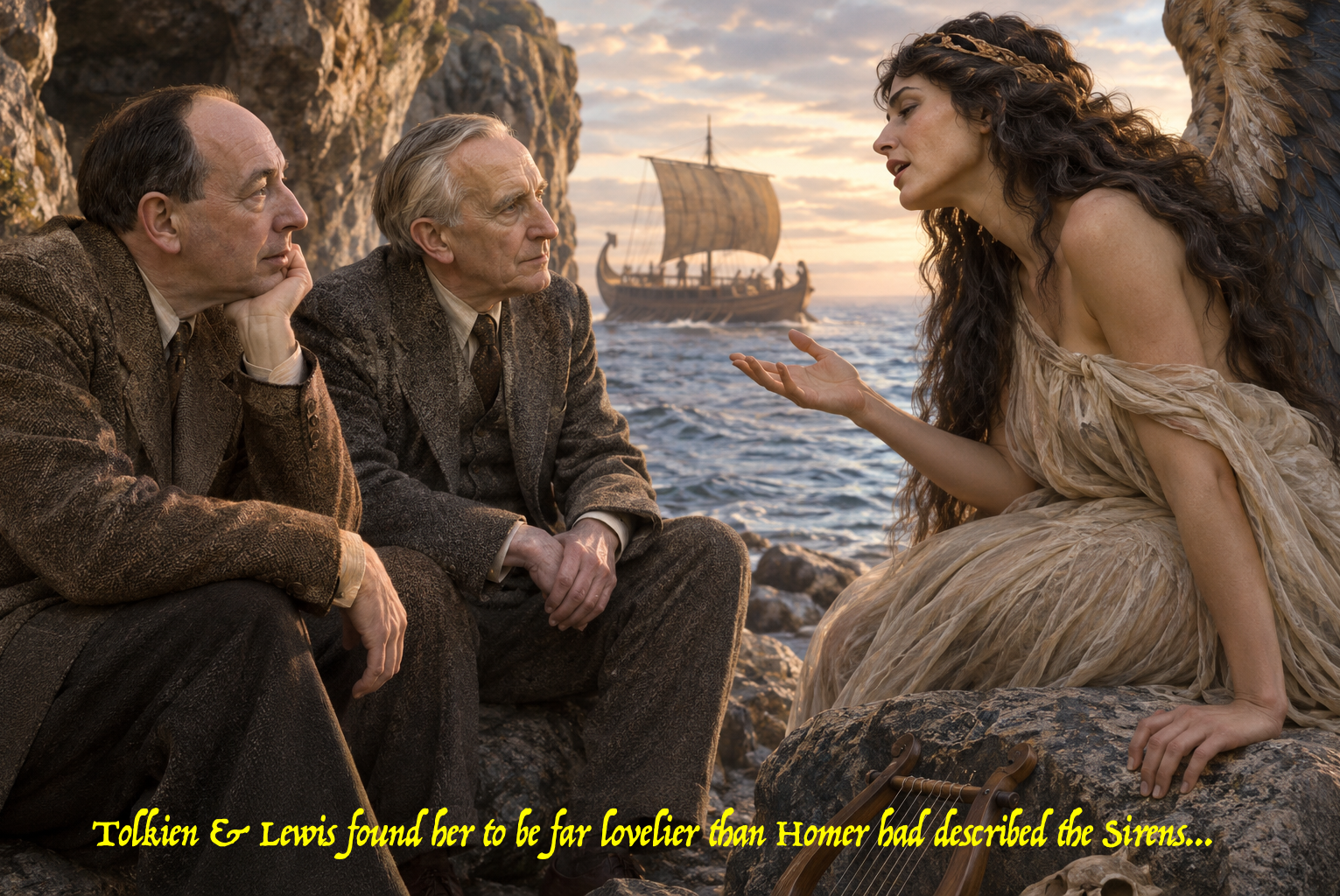
I am pleased to share that I’m prepared to resume writing regular posts for Mere Inkling. After taking a longer than anticipated hiatus, I find I can no longer resist the sirens calling me back to Narnia and Middle Earth. (These voices, of course, sing not the deceiving melodies of Homer’s Sirens. Rather, for me, they are merely an innocent metaphor.)
Saint Athanasius College† offers an excellent translation of The Odyssey in which Homer describes Circe’s warning about the danger posed by the classical Sirens.
First you will raise the island of the Sirens,
those creatures who spellbind any man alive,
whoever comes their way. Whoever draws too close,
off guard, and catches the Sirens’ voices in the air –
no sailing home for him, no wife rising to meet him,
no happy children beaming up at their father’s face.
The high, thrilling song of the Sirens will transfix him,
lolling there in their meadow, round them heaps of corpses,
rotting away, rags of skin shriveling on their bones . . .
Devilishly, the malevolent Sirens appeal to a common vanity of humanity, one which afflicts most cruelly, men: pride and reputation.
It’s fortunate for the classical Sirens that people were wooed by their voices, since their appearance was far less appealing. As Audubon magazine relates in an entertaining article, “Sirens of Greek Myth Were Bird-Women, Not Mermaids.”
C.S. Lewis & J.R.R. Tolkien were Inspired by the Siren Myth
It should come as no surprise that members of the Oxford Inklings were inspired by Homer’s masterpiece. In 1952, the Times Literary Supplement published “Vowels and Sirens” by C.S. Lewis. TLS said it possesses “a robust medieval music appropriate to Odysseus’ encounter with the Sirens, [within which] the effect is heightened by archaic inversions.”
Vowels and Sirens

   Chosen to seduce you,
       Those dove-like vowels,
   Deuro – kudos – Odusseus.
       Opening the bay, his prow
   Appeared. The air rang with
       Sirens’ voices.

   The hero, bound, in anguish
       Tried to retract his choice.
   No word of solace
       For a lover’s longing
   They breathed. Of vanished knowledge
       Was their interrupted song.

   Their music resembled
       Some earlier music
   That men are born remembering.
       What all the gods refuse –
   The backward journey
       To the steep river’s

   High source, the great returning –
       Those sirens feigned to give.
   Cool voices, lying
       Words abuse him,
   Cooing kudos Achaiôn,
       Warbling their untrue news.
Much earlier, in 1910, Lewis’ good friend J.R.R. Tolkien had written a poem called “The Sirens.” As the master philologist was wont to do, he also gave the poem another title. This one, composed in Old English: “Meremennena Symbel,” which translates as “The Sirens Feast.”
Sadly, despite its age, since it was not published until 2024, it remains under copyright and is only available in The Collected Poems of J.R.R. Tolkien. However, a single verse offered by Tolkien Gateway provides us with a teasing taste of “Meremennena Symbel.”
   Clawed by the frothy fingers of the hungry deep
       That moaned in restless agony around
   Stood darkly once, its cruel and unrelenting steep
       Towered high, an isle by no man living found.
And, Not Only Lewis & Tolkien
Curiously, Tolkien and Lewis were not the only Inklings to contemplate sirenic themes. In the collection of Owen Barfield’s manuscripts held at Wheaton University’s Marion E. Wade Center, there is an unpublished typescript of a poem entitled “Siren Voices.”
Charles Williams, “the oddest Inkling” and C.S. Lewis’ peculiar friend, was also fascinated by the Siren archetype.‡ In The Figure of Beatrice: A Study in Dante, he explores the concept of the Siren as revealed in Dante’s Purgatory.
Rather than reducing the Siren to a symbol of lust, Williams recognizes that the corrupting nature of the creature is far broader. The decadence is illuminated by the dream’s sharp contrast with the beatific nature of Beatrice. Williams’ description of Dante’s Siren is potent.
She has been called the image of Sensual Pleasure, but this (it would seem) need not be the whole significance. She is as much – let us say – Ideal Gratification; all the sighs that lament the imperfection of a man’s actual mistress, the verses that sweetly moan over her failure to live up to his dreams (or the other way round), the self-condolences, the ‘disillusions’ – all these are the Siren’s song. She takes flesh and colour and music within the night-reveries of laziness; she is, then – what? What we want; and that is? we do not rightly know, but certainly a Siren and a song.
‘I am she who beguiles the sailors in mid-ocean, so much pleasure they have who listen to me; I turned Ulysses from his path with my song; and any who dwells with me rarely departs, so wholly do I satisfy him.’ Caesar and the God-bearer did not know her, but both Popes and Emperors have dwelled with her.
Fortunately, I have not personally shared the decadence of the aforementioned clerics and rulers. Instead, I was blessed by God this very summer to celebrate with my precious bride, our Golden wedding anniversary.
And, speaking of anniversaries, my good friend and Inkling scholar Brenton Dickieson wrote a poem for his wife on their twentieth. “Reading the Odyssey,” he writes, “I recognized that so many readers forget the sheer length of time that Odysseus was away from his beloved. Time moved on, and what heroics meant changed its meaning as Odysseus fought through his wandering curse. In that space, thinking of marriage as odyssey . . .” I encourage you to read “Magnificent Defeat.”
So, What has Kept Me Away from Mere Inkling?
Without belaboring the matter, I have been trying to focus on several long-neglected writing projects. The foremost of these has been the history of my great-grandfather’s regiment during the American Civil War. I continue to work on the project, but at the same time, it feels refreshing to also resume my labors at Mere Inkling.

† Saint Athanasius College was originally established in 1976 by the Evangelical Orthodox Church, which became canonical when it was received into the Antiochian Orthodox Church. During its early years I was blessed as I carried on a warm correspondence with it initial chancellor, the Rev. Dr. Jack Sparks.
‡ “Sirens In Art, Music, and Literature” by Annie Rose Tindall-Gibson offers a recent, accessible survey on the subject of the Siren archetype. It is available at Academia.

