Government & Baboons

I recently read an interesting article about battling terrorism from an international base in Djibouti. Many African nations have joined those from Europe and North America in trying to protect vulnerable villages from the ravages of violent extremism.

However, as readers of Mere Inkling know, we don’t deal with political matters here. Everyday life, yes. Writing and self-expression, of course. Faith, definitely. Imagination, most certainly. Current events are also on the table for consideration, insofar as they relate to the aforementioned subjects.

Politics though, as a subject in and of itself, is not on the Mere Inkling menu.

With that in mind, I want to share a passage from the Air Force magazine article. In a description of “a recent personnel recovery mission in Ethiopia,” it says,

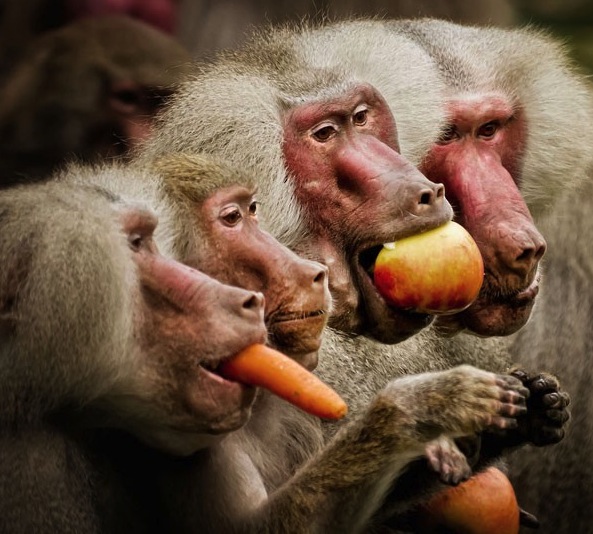
The HC-130s landed at night on a pitch-black airstrip, but first had to make a “clearing pass” to scare a congress of baboons and a pod of hippopotamuses off the runway.

Quite a picture. However, the image itself only made part of the impression left on me by this sentence. More lasting was the reminder of what a group of baboons is called.

C.S. Lewis wrote a fascinating essay about government entitled “Democratic Education.” One of many of its many kernels of wisdom is this: “Democracy demands that little men should not take big ones too seriously; it dies when it is full of little men who think they are big themselves.”

Returning to the subject of animals, the second chapter of Genesis tells us,

Now out of the ground the Lord God had formed[f] every beast of the field and every bird of the heavens and brought them to the man to see what he would call them. And whatever the man called every living creature, that was its name. The man gave names to all livestock and to the birds of the heavens and to every beast of the field.

So, Adam named the animals, and I imagine that after her creation, Eve helped her husband refine some of those appellations. What I don’t know is this—exactly who decided how we label groups of the same species?

I would point out how apropos baboons being referred to as a “congress” is . . . except for two considerations. (1) The connection would be lost on many readers whose governments have parliaments, and (2) It turns out this is actually an error. The actual word for baboon bands is a “troop.” So much for their unfortunate association with an organization that has lost the confidence of nine out of ten Americans.

Here are a few of the familiar and unfamiliar collective nouns for a variety of animals, with some brief comments and questions.

Lions | Pride – Aptly named!

Prairie Dogs | Coterie – I never considered prairie dogs snobbish.

Kittens | Intrigue – I should have learned that from simple observation.

Finches | Charm – They really do, don’t they?

Wombats | Wisdom – Wisdom to Aussies, a mystery to me.

Pekingese | Pomp – Well, perhaps just slightly elitist.

Cobras | Quiver – Logical, given the prospect of meeting a group of vipers.

Peacocks | Ostentation – Much nicer than the “pride” option.

Barracudas | Battery – Same as electric eels, I suppose.

Crows | Murder – A term familiar to most literary folk.

Bullfinches | Bellowing – Huh? Sounds more hippopotamusish.

Cows | Kine – Have to thank the medieval English for this one.

Seabirds | Wreck – Beware when they fly overhead.

Bacteria | Culture – And what kind of civilization have they ever built?

Deer | Gang – Must be the teenagers, before they become a herd.

Cockroaches | Intrusion – Accurate, repulsive and ominous.

Guillemots | Bazaar – What’s a guillemot, and what is it selling?

Cormorants | Gulp – Didn’t their momma’s teach them to chew?

Cheetahs | Coalition – Wouldn’t “a ‘sprint’ of cheetahs” sound better?

Woodpeckers | Descent – Am I missing something here?

Clams | Bed – Not much else to do in the clam-world.

Turtledoves | Pitying – Meaning they take pity on us, not vice versa.

Bobolinks | Chain – Cute, but lost on Americans where they’re known as reedbirds or ricebirds.

Snails | Walk – Someone’s lacking a bit in creativity here.

Ravens | Unkindness – Speaking of unkind, who labeled them this?

Flamingoes | Stand – Come on now, isn’t that a bit obvious?

Giraffe | Tower – I guess the flamingoes aren’t the only ones.

Lice | Flock – That is way too nice a word for those vermin!

Alligators | Congregation – As a pastor, I simply don’t want to go there.

This is way too much fun, but I’d better stop now so I can revisit this theme in a year or so. Until then, if you learn who gave that unkind name to groups of ravens, let me know.
Nature’s Hazards

tumbleweedsNo matter where in the world you live, you are vulnerable to dangers uniquely associated with that locale. Some of us have moved around and weathered a variety of these threats.

My own family has survived earthquakes in our home state of Washington, ice storms in Oklahoma, nearby tornadoes in Texas, record-setting freezes in Minnesota, both droughts and failed levees in two different California cities along with a Super Typhoon in Guam. (Sometimes we’ve even been assailed by disasters that had no place occurring where they did, like a hurricane that knocked out our power for a full month in England, of all places!)

It’s quite possible that you too have experienced near misses when it comes to suffering Nature’s wrath. (I’d much rather attribute these things to fallen Nature than refer to them as “acts of God.”)

C.S. Lewis offers a wonderful description of Nature in Miracles.

You must have tasted, however briefly, the pure water from beyond the world before you can be distinctly conscious of the hot, salty tang of Nature’s current. To treat her as God, or as Everything, is to lose the whole pith and pleasure of her. Come out, look back, and then you will see . . . this astonishing cataract of bears, babies, and bananas: this immoderate deluge of atoms, orchids, oranges, cancers, canaries, fleas, gases, tornadoes and toads. How could you ever have thought that this was the ultimate reality? How could you ever have thought that it was merely a stage-set for the moral drama of men and women? She is herself.

Offer her neither worship nor contempt. Meet her and know her. If we are immortal, and if she is doomed (as the scientists tell us) to run down and die, we shall miss this half-shy and half-flamboyant creature, this ogress, this hoyden, this incorrigible fairy, this dumb witch. But the theologians tell us that she, like ourselves, is to be redeemed. The “vanity” to which she was subjected was her disease, not her essence. She will be cured, but cured in character: not tamed (Heaven forbid) nor sterilised. We shall still be able to recognise our old enemy, friend, play-fellow and foster-mother, so perfected as to be not less, but more, herself. And that will be a merry meeting.

But, until that glorious day when Nature has been reborn in the culmination of the event that took place on Calvary . . . until that day, Nature remains a capricious neighbor. It’s best to know what she is likely to throw at you based on where you reside—and be prepared. Disaster preparedness is something that the wise will concern themselves before catastrophe strikes.

There are some dangers, however, for which one cannot adequately prepare. The prospects of mega-tsunamis terrify me (and I don’t even live by the sea). Then there are zombie outbreaks, which are apparently taking place on a frequent basis, if the plethora of media on that ghoulish subject is any indication.

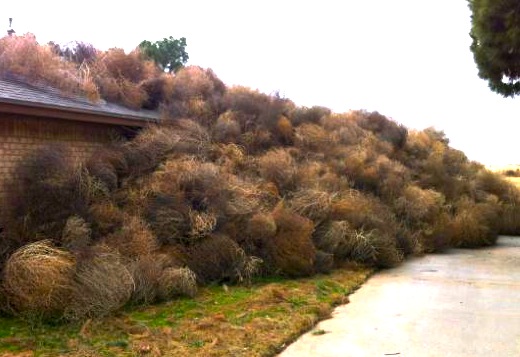
The photograph at the top of this page reveals a grim threat to life on the American plains. There may be a few other places where these merciless creatures wreak havoc (the arid portions of Australia, perhaps), but I hope most of those reading this have been spared the visage of plagues of tumbleweeds racing across the horizon in search of victims to overrun, scar, and bury. As the picture shows, sometimes it is not even safe to shelter in a home during a particularly virulent attack.

I’ve seen many a wayward tumbleweed, while I’ve driven across barren desert terrains. Occasionally you’ll see them alone, scouting ahead of the mass for weak prey. If you see an entire horde, well . . . it’s probably already to late to flee.

This picture makes me shiver. It’s one reason I’m so happy to have moved home to Puget Sound, where the incessant rain* keeps everything green. I can put up with an occasional tectonic jiggle, if it means I don’t have to worry about being buried alive beneath a mountain of desiccated thorns.

_____

* The rainfall in western Washington is highly exaggerated. It’s true that for half of the year it receives more rain than the national average, but the other six months it receives less than average of the rest of the nation.

Also, I don’t believe it is an accident that one of the most commonly encountered tumbleweeds in the United States is Salsola tragus, an utterly humorless thistle that invaded from Russia at the end of the nineteenth century. Despite occasional eruptions, it seems to be lying in wait, for the most part, growing in strength for the final conflagration between humanity and noxious weeds and their allies, the triffids.

Beware of Beavers

beaverIt’s rather ironic that after my last post on the peaceful harmony of wildlife I would choose to post on the subject of increasing violence among once peaceful forest mammals.

Beavers—of all the unlikely creatures—have apparently been growing more aggressive.

That’s a far cry from the gentle domestic rodents C.S. Lewis introduced us to in The Lion, the Witch and the Wardrobe. Just consider the politeness of Mr. and Mrs. Beaver when the Pevensie children are meeting Aslan for the first time:

“Go on,” whispered Mr. Beaver.

“No,” whispered Peter, “you first.”

“No, Sons of Adam before animals,” whispered Mr. Beaver back again.

As if we needed another reminder that we’re not in Narnia, reports out of Belarus indicate that beaver attacks are on the rise. In the most serious attack, a sixty year old man was actually slain by one of the web-footed amphibians. Accounts said a major artery in his leg was sliced by its “razor-sharp teeth.”

A frightening picture indeed.

Well, worrisome certainly . . . until we hear the rest of the story.

It turns out the fisherman was assaulting the poor little animal. While we must remain considerate of the grief of the sportsman’s family, it appears he was driving past the beaver—which was presumably minding its own woodland business—when he decided it would be fun to grab it and force it to pose for a picture with him.

Apparently—make note of this lest you inadvertently arouse a beaver’s ire—since they are predominantly nocturnal, beavers become disoriented and irritable when forced to pose for portraits during the daytime.

It’s one thing to enjoy nature’s wildness from a distance. Quite another to interpose ourselves and expect undomesticated beasts to behave with good manners. After all, as we learned when Aslan created Narnia, he didn’t civilize all of the furry beavers:

He was going to and fro among the animals. And every now and then he would go up to two of them (always two at a time) and touch their noses with his. He would touch two beavers among all the beavers, two leopards among all the leopards, one stag and one deer among all the deer, and leave the rest. (The Magician’s Nephew).

New Beauty Each Day

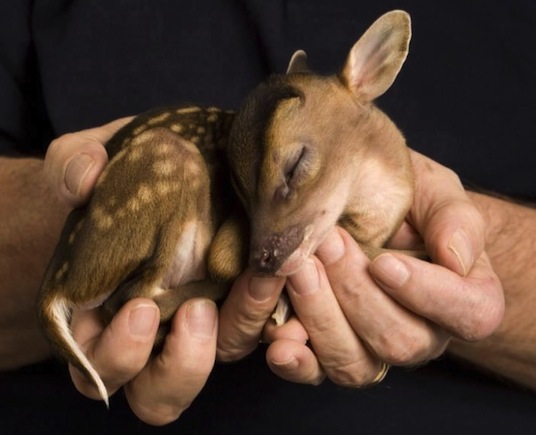
fawnI woke this morning to a scene from Disney.

Looking out the window, with my coffee perking in the background, God blessed me with fabulous scene. A pregnant doe, lying on the ground to rest her weary legs, was peacefully grazing on our lawn. (Echoes of gentle Faline.)

As if that vision were not spectacular enough, a few yards to her side a small bunny hopped about, nibbling on the same grass. (We seeded our lawn with clover to provide a welcoming meal for just such visitors.) The rabbit was alone, although we watched it frolic with its siblings just the other day. (Might they be the children of carefree Thumper?)

Completing the scene were a bevy robins and sparrows. They hopped around the pair, in a wonderful display of original nature’s harmony, which will one day be restored.

The wolf shall dwell with the lamb,

   and the leopard shall lie down with the young goat,

and the calf and the lion and the fattened calf together;

   and a little child shall lead them.

The cow and the bear shall graze;

   their young shall lie down together;

   and the lion shall eat straw like the ox.

                     Isaiah 11:6-7, ESV

The Creator of Narnia understood the essence of this peace as well as anyone. C.S. Lewis revealed that just as nature was created at peace, so too the new creation would mark a restoration of that purity. As Lewis writes in Miracles, Nature “is to be redeemed. The ‘vanity’ to
which she was subjected was her disease, not her essence. She will be cured, but cured in character: not tamed (Heaven forbid) . . .”

For the present time, however, we must be content to appreciate brief glimpses of that promise . . . just as I am now, as I write. (Yes, the doe is still resting mere feet from my window.)

Precious moments like this are something to be savored. A sweet foretaste of the feast to come.

_____

The full context of Lewis’ words from Miracles follows. In this passage he warns us not to worship what is created, but only its Creator.

You must have tasted, however briefly, the pure water from beyond the world before you can be distinctly conscious of the hot, salty tang of Nature’s current. To treat her as God, or as Everything, is to lose the whole pith and pleasure of her. Come out, look back, and then you will see . . . this astonishing cataract of bears, babies, and bananas: this immoderate deluge of atoms, orchids, oranges, cancers, canaries, fleas, gases, tornadoes and toads.

How could you ever have thought that this was the ultimate reality? How could you ever have thought that it was merely a stage-set for the moral drama of men and women? She is herself. Offer her neither worship nor contempt. Meet her and know her. If we are immortal, and if she is doomed (as the scientists tell us) to run down and die, we shall miss this half-shy and half-flamboyant creature, this ogress, this hoyden, this incorrigible fairy, this dumb witch.

But the theologians tell us that she, like ourselves, is to be redeemed. The “vanity” to which she was subjected was her disease, not her essence. She will be cured, but cured in character: not tamed (Heaven forbid) nor sterilised. We shall still be able to recognise our old enemy, friend, play-fellow and foster-mother, so perfected as to be not less, but more, herself. And that will be a merry meeting.

Not to be Missed

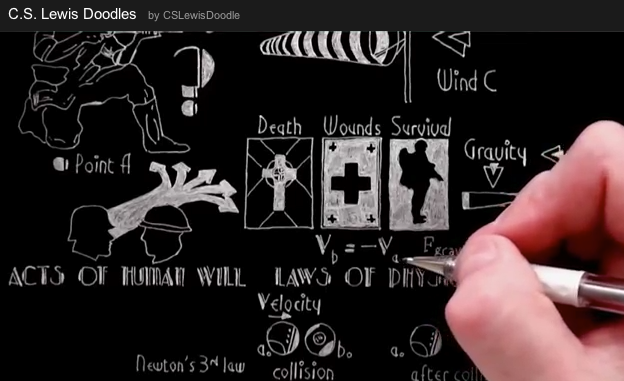
csl doodlesA recent post at the wonderful C.S. Lewis Minute blog introduced me to an amazing new way to experience the brilliance of the great author. I want to pass on the information so that you too can enjoy it.

The site is called “C.S. Lewis Doodles,” and it is the creation of a Kiwi (New Zealander) named Kalman Kingsley.

Kingsley uses a skillful artistic presentation of the clearly read original essays, to give Lewis’ words a particularly engaging and comprehensible air. It is, in a sense, C.S. Lewis “updated” to contemporary media.

Lewis himself alluded to the value of different types of media in communicating. In “Studies in Words” he says, “Language exists to communicate . . . Some things it communicates so badly that we never attempt to communicate them by words if any other medium is available.” Of course, in this case Lewis’ words are profound—in and of themselves. However, the addition of the illustrations serves to highlight and amplify his message.

Lewis, after all, passed away nearly sixty years ago, when most homes still owned black and white televisions. Technology has advanced light years since then, and transposing Lewis’ timeless wisdom to new formats such as this is an important work worthy of the talents of innovative men and women.

C.S. Lewis Doodles is available here, but don’t head there until you finish reading this Mere Inkling post.

The YouTube “Channel” offers three essays:

“The Grand Miracle” (from a sermon about the Incarnation preached in 1945)

“The Laws of Nature” (a 1945 consideration of the interplay between Nature and prayer)

“On ‘Sexual’ Morality” (a 1963 essay entitled “We have No ‘Right to Happiness’”)

All three of these essays are found in the collection published as God in the Dock. (For Americans the last word in that title refers not to a marina, but to a courtroom.)

Because each presentation covers an entire essay, they range in length from eight to ten minutes. Nevertheless, they are so well presented that they will certainly hold your interest.

I believe Lewis would have enjoyed this presentation of his work. Had he been an artist and had access to this technology, he may have experimented with it himself. As he wrote to Arthur Greeves in 1933, his book Pilgrim’s Regress is “going to be decorated by a map on the end leaf which I had great fun in drawing the sketch for.”

You can hear (and view) Lewis’ thoughts on “the Laws of Nature,” by clicking on the image below.

_____

C.S. Lewis Minute is a website every true Lewis fan should be following. You can read the column I referred to—and subscribe to the blog—here.

New Life Continues to Blossom

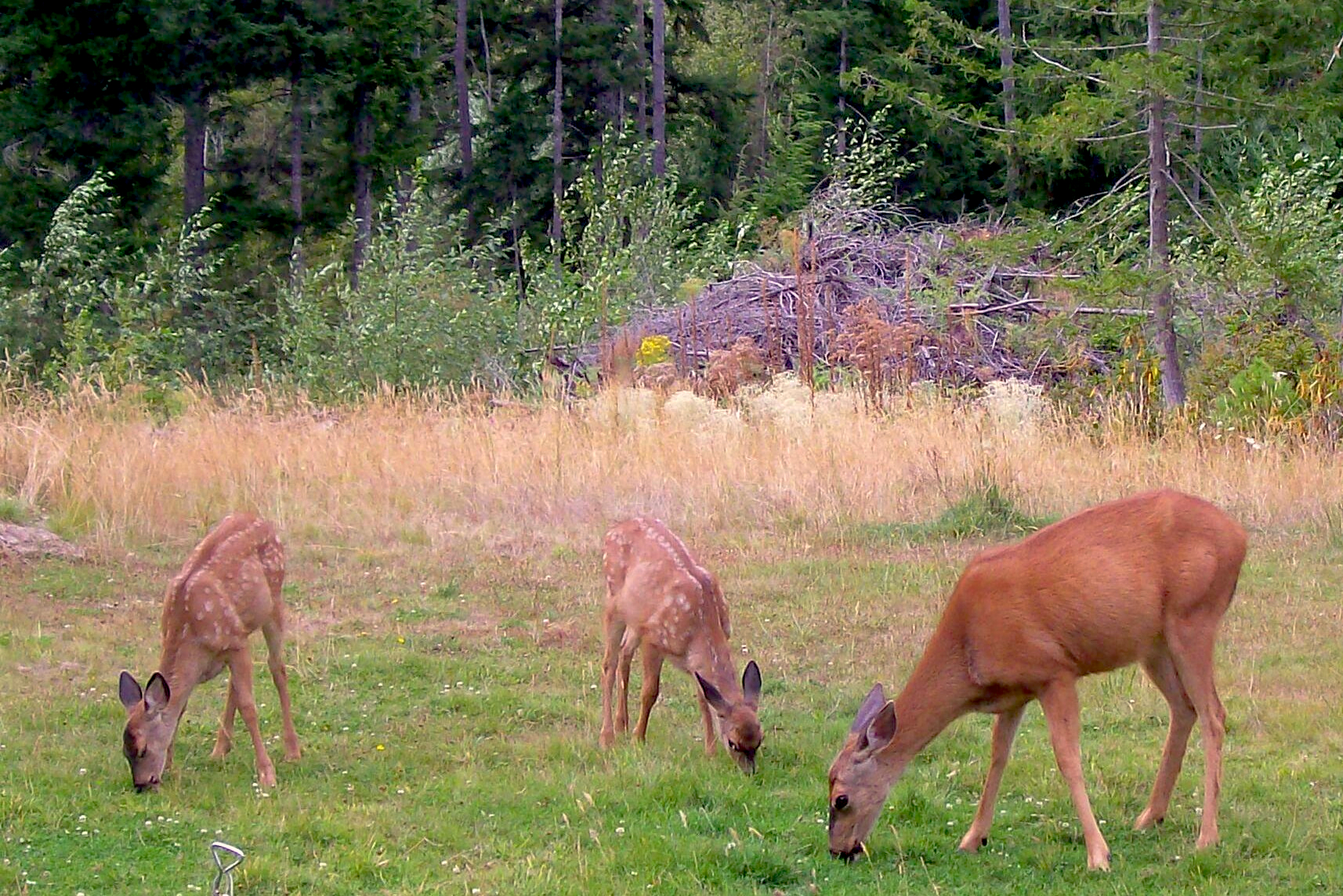
After the seriousness of my last couple of posts, I hoped to come up with an “uplifting” theme for my latest reflection. And, lo and behold, God provided a perfect picture.

My photograph (through a glass door) doesn’t do justice to his living portrait of peace. Still, I thought some of you who recalled my initial post on the brand new fawns that pranced past my office months ago would enjoy seeing how they have grown.

Mom has them munching on the overgrown grass and clover in our back yard. (My wife says we can alternate mowing the yard, one-half each week. I argue that the deer may want to bring along friends and we wouldn’t want them disappointed by a mower-stunted banquet.)

When I see such peaceful creatures, I long for the new heaven and earth when the lion shall like down with the lamb. To see the harmony God originally designed—to touch and to taste it—is one of the reasons that Narnia resonates to strongly with many of our souls.

C.S. Lewis was a lover of nature. Nature walks were a fundamental part of his life’s regimen. And, Lewis recognized there is a danger in looking to Nature herself for life’s meaning. In The Four Loves he wrote “Nature cannot satisfy the desires she arouses nor answer theological questions nor sanctify us.”

In the same essay he elaborates on how the bliss communicated by Nature is only fully experienced by those who look beyond it, to its divine Source.

Say your prayers in a garden early, ignoring steadfastly the dew, the birds and the flowers, and you will come away overwhelmed by its freshness and joy; go there in order to be overwhelmed and, after a certain age, nine times out of ten nothing will happen to you. (The Four Loves).

I looked out the window today, grateful to God for the majesty of the mountains that grace the horizon. With that prayerful, thankful and receptive heart, I found my expectations in that moment far exceeded . . . swept aside as a trifle in a maelstrom . . . as I gazed upon the purity and peace of our three precious visitors.

Nature’s Melodies

Recently we were walking our five year old granddaughter home after a visit to our house, and she said something remarkable. (Our son’s family lives on a forested parcel adjacent to our own near Puget Sound.)

This precious little girl gazed to the top of the tall pine and fir lining the path and said, “I love the music the woods make.” She went on to describe various elements of nature’s orchestra, including the whistling wind in the treetops, the croaking of innumerable frogs drumming down by the pond, and, of course, the varied melodies of the birds who also call this glorious place “home.”

It was a wonderful moment.

When we pause to appreciate nature, it reminds us of the beneficent God who created it. Nature, especially when it is pristine and untouched by human hand, is truly wondrous. There are, I recognize, some “natural” settings that might actually be improved by human intervention . . . but these are few.

Unspoiled nature is beautiful. And that is a crucial distinction to make—because nature too has been corrupted by humanity’s fall from grace. Its capricious temperament is manifested in storms and other disasters.

So we, as Sons of Adam and Daughters of Eve must be content to savor this blurred image of God’s original creation. For, even this corrupted world, is surely magnificent.

C.S. Lewis appreciated this truth. He and his close friends enjoyed many a long walk across the English countryside.

Nature is an awe-inspiring thing, but she is incapable of communicating ultimate joy. To find that, we must look beyond the forest to see who wrote the music it so eloquently sings.

In The Four Loves, Lewis emphasizes this truth:

Nature cannot satisfy the desires she arouses nor answer theological questions nor sanctify us. Our real journey to God involves constantly turning our backs on her; passing from the dawn-lit fields into some pokey little church, or (it might be) going to work in an East End parish. But the love of her has been a valuable and, for some people, indispensable initiation.

May our Creator grant us the opportunity to enjoy his unfathomable creation—even as we recognize that it is only by his boundless grace we are capable of doing so.

The Dearest of Deer

Thank you, Lord, for allowing us to live in a home surrounded by a forest!

When I was driving home this afternoon I was stunned by the majestic flight of a dozen bald eagles as they danced in the sky above our small community of Seabeck, Washington. I pulled to the side of the road and enjoyed their ballet for some time before deciding that I would blog about eagles when I returned home.

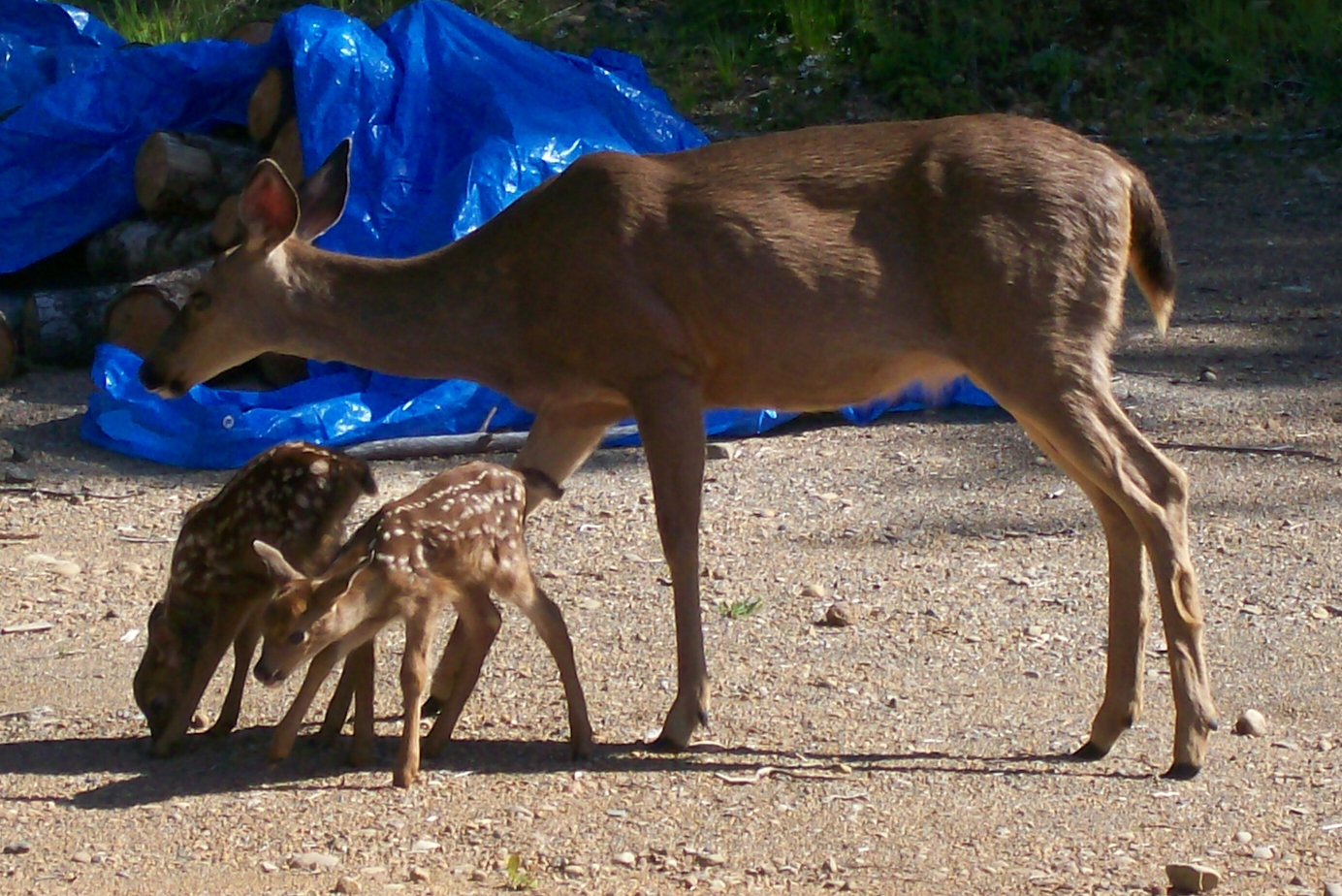
Then I saw something even more precious. Just outside the window of my study a doe and her two (very) young fawns walked past. I grabbed my camera and snapped no fewer than fifty photos as they grazed on the nearby lawn. (I decided as they wandered on down another trail that the post on the eagles would wait.)

The fawns were so tiny I don’t think they could have been fourteen inches tall. (Sorry, we older Americans are still metric-impaired.) They stood as though they were still getting the feel of their tiny legs. It was a glorious scene.

C.S. Lewis graced the land of Narnia with a stunning array of creatures. Some are not found in this world, apart from myths. Unicorns and centaurs would be of that ilk.

I happen to find the others even more fascinating. The horses, dogs and bears that are familiar to us, but different. Different because they have been gifted with speech, and with it, the ability to know and follow their Maker.

As he wrote in his description of Narnia’s creation in The Magician’s Nephew:

And now, for the first time, the Lion [Aslan] was quite silent. He was going to and fro among the animals. And every now and then he would go up to two of them (always two at a time) and touch their noses with his. He would touch two beavers among all the beavers, two leopards among all the leopards, one stag and one deer among all the deer, and leave the rest. . . . The creatures whom he had touched came and stood in a wide circle around him. . . .

The Lion, whose eyes never blinked, stared at the animals as hard as if he was going to burn them up with his mere stare. And gradually a change came over them. The smaller ones—the rabbits, moles, and such-like—grew a good deal larger. The very big ones—you noticed it most with the elephants—grew a little smaller. Many animals sat up on their hind legs. Most put their heads on one side as if they were trying very hard to understand. The Lion opened his mouth, but no sound came from it; he was breathing out, a long, warm breath; it seemed to sway all the beasts as the wind sways a line of trees.

Far overhead from beyond the veil of blue sky which hid them the stars sang again; a pure, cold, difficult music. Then there came a swift flash like fire (but it burnt nobody) either from the sky or from the Lion itself, and every drop of blood tingled in the children’s bodies, and the deepest, wildest voice they had ever heard was saying: “Narnia, Narnia, Narnia, awake. Love. Think. Speak. Be walking trees. Be talking beasts. Be divine waters.”

The scene I was privileged to observe today reminded me of the innocence of nature, prior to humanity’s disobedience. It also reminded me of the Messianic promises that restored “nature” will enable lions to lie in harmony beside sheep.

In his book Miracles, Lewis discusses this from the perspective of redemption, as contrasted with simply understanding it as a consequence of a “new” creation.

The doctrine of a universal redemption spreading outwards from the redemption of Man, mythological as it will seem to modern minds, is in reality far more philosophical than any theory which holds that God, having once entered Nature, should leave her, and leave her substantially unchanged, or that the glorification of one creature [humanity] could be realised without the glorification of the whole system.

God never undoes anything but evil, never does good to undo it again. The union between God and Nature in the Person of Christ admits no divorce. He will not go out of Nature again and she must be glorified in all ways which this miraculous union demands. When spring comes it “leaves no corner of the land untouched;” even a pebble dropped in a pond sends circles to the margin.

I said a prayer this evening that the Lord would bless that lovely doe and her precious offspring with long, healthy, safe, peaceful, and even, happy lives.

Savoring the Weather

We awoke this morning to our first true snowfall of the year. Pretty late in winter for it to arrive, and we’ve been longing for a blanket of snow for some time. Getting a call last night about a “weather cancellation” for my wife’s classes was an added joy.

It’s utterly beautiful!

I realize, of course, there are numerous ramifications to changes in weather. The extremes (e.g. from downpours to droughts) can create hardships and hazards. But, when we have an opportunity to simply pause and savor the essence of the changing seasons, it is healing and awe-inspiring.

C.S. Lewis loved the outdoors. And, in a 1931 letter to Arthur Greeves he wrote, “That is a thing you and I have to be thankful for—the fact that we not only don’t dislike but positively enjoy almost every kind of weather.”

If you have a copy of his letters, you really should look up the December 6th correspondence. Lewis describes the wonders of several successive days of dense fog that “was enough to tax even my powers of doing without the sun . . .” He adds, “in the end I felt that it was a cheap price to pay for its beauties.”

So, today I’m doubly blessed. Not only am I enjoying the snow; I’ve learned I have one more thing in common with the great Oxford Don.