C.S. Lewis & Gluttony

Gluttony. If you were guilty of committing this sin, would you admit it? How, in fact, can we determine whether we (much less someone else) is a glutton? 

And, even if we do fit the description of a glutton, is it all that bad? I mean, it’s not like it is nearly as bad as any of the other so-called “seven deadly sins,” right?

Perhaps C.S. Lewis can offer some illumination on this subject? Our investigation could lead us to a curious, yet edifying, discovery. Just as it enlightened the author of “Ok Google, Who’s Fatter, Me or C.S. Lewis?

Like many of us, in his prime C.S. Lewis did not consider himself beset with the problem of gluttony. Historically, people have been more physically active when they are young – at least that was true before “addiction” to screens, keyboards and game controls became endemic.

Even a quarter century ago this trend was being seriously studied, as in “Computer Use and Physical Inactivity in Young Adults: Public Health Perils and Potentials of New Information Technologies,” which appeared in the Annals of Behavioral Medicine.

As the capacities of the new information technologies for delivering targeted, tailored health behavior change programs are developed, the issues for physical activity promotion will become particularly salient.

The emerging paradox is that this new behavior setting for physical activity program delivery is also a setting that strongly promotes long periods of sedentariness.

C.S. Lewis, obviously, lived prior to the ravages of this plague. Yet, he was not immune to the temptations of the Seven Eight Deadly Sins, as identified by the Desert Father Evagrius Ponticus.

As already mentioned, C.S. Lewis did not consider himself particularly vulnerable to gluttony. This is illustrated by a witty (and fascinating) postscript to a letter written to his lifelong friend Arthur Greeves in 1930.

P.S. When I said that your besetting sin was Indolence and mine Pride I was thinking of the old classification of the seven deadly sins: They are Gula (Gluttony), Luxuria (Unchastity), Accidia (Indolence), Ira (Anger), Superbia (Pride), Invidia (Envy), Avaricia (Avarice).

Accidia, which is sometimes called Tristicia (despondence) is the kind of indolence which comes from indifference to the good – the mood in which though it tries to play on us we have no string to respond.

Pride, on the other hand, is the mother of all sins, and the original sin of Lucifer – so you are rather better off than I am. You at your worst are an instrument unstrung: I am an instrument strung but preferring to play itself because it thinks it knows the tune better than the Musician.

GULA – J.A.G.
LUXURIA – J.A.G., C.S.L.
ACCIDIA – J.A.G.
IRA – C.S.L.
SUPERBIA – C.S.L.
INVIDIA – C.S.L.
AVARICIA – (neither, I hope)

Two decades later, C.S. Lewis would make a related observation in a letter to his friend Don Giovanni Calabria. Apologizing for the delay of his correspondence, Lewis wrote:

Nothing else was responsible for it except the perpetual labour of writing and (lest I should seem to exonerate myself too much) a certain Accidia [sloth], an evil disease and, I believe, of the Seven Deadly Sins that one which in me is the strongest – though few believe this of me.

Gluttony is Not Synonymous with Being Overweight

I meet few people who do not wish that they weighed a few pounds less than they do. That would include the elder C.S. Lewis. Listen to his self-description in a letter to a young admirer in 1954.

Self-effacing, as always, he said he was nothing special to behold: “I’m tall, fat, rather bald, red-faced, double-chinned, black-haired, have a deep voice, and wear glasses for reading . . .” (I hope this is not the only dimension of Lewis that I come to resemble more as the years pass by.)

The United Kingdom and Ireland have an historically odd manner of assessing a person’s weight. I suspect there is a bit of intentional obfuscation involved when they use the archaic measurement of “stone” rather than pounds or kilograms. 

As Britannica says, “the stone is still commonly used in Britain to designate the weights of people and large animals.” Ironically, babies are not weighed this way, presumably because few of them weigh a full stone – fourteen pounds – at birth.

In the military it was important to remain below your maximum allowable weight. This becomes a problem for a fair number of folks (a dilemma with which I’m personally familiar).

Due to the aforementioned problem with sedentary activities, meeting these height and weight guidelines has become a serious issue for many young recruits.

Still, gluttony is not synonymous with weighing more than is healthy for us. Not so, according to a great column at Intellectual Takeout.

It’s typical to associate gluttony with overconsumption, or, an excess of food or drink. But according to C.S. Lewis, that’s only one form the vice takes. The broader definition of gluttony is any inordinate desire related to food or drink. That includes overconsumption, but it also includes overselectivity regarding the type or quality of food and drink.

Derek Rishmawy discusses this Lewisian distinction as well. 

I have to admit that I struggle with gluttony. Yet those who know me probably wouldn’t suspect it. Indeed, I’m tempted to deny it myself because I don’t tend to have a weight issue . . . All the same, this is a sin I’m beginning to realize I need to be increasingly watchful against.

Of course, that confession only makes sense when you understand that there’s more than one way of being a glutton. I’ll let C.S. Lewis explain what I mean.

He cites Screwtape’s letter to his demonic protégé reveling in one of the seldom noticed “victories” of humanity’s Enemy.

One of the great achievements of the last hundred years has been to deaden the human conscience on that subject, so that by now you will hardly find a sermon preached or a conscience troubled about it in the whole length and breadth of Europe.

This has largely been effected by concentrating all our efforts on gluttony of Delicacy, not gluttony of Excess. Your patient’s mother . . . She would be astonished . . . to learn that her whole life is enslaved to this kind of sensuality, which is quite concealed from her by the fact that the quantities involved are small.

But what do quantities matter, provided we can use a human belly and palate to produce querulousness, impatience, uncharitableness, and self-concern? (The Screwtape Letters)

Now, there is something for us to examine in our own lives.

As for those troubled by their physical weight (be it higher or lower than they would like), I discovered an entertaining site where you can find out how much you would weigh on any of the other planets in our solar system.

Exploratorium lifted my spirits by informing me that on Mars I would weigh a mere 96.1 pounds! And best of all, that’s less than seven stone!


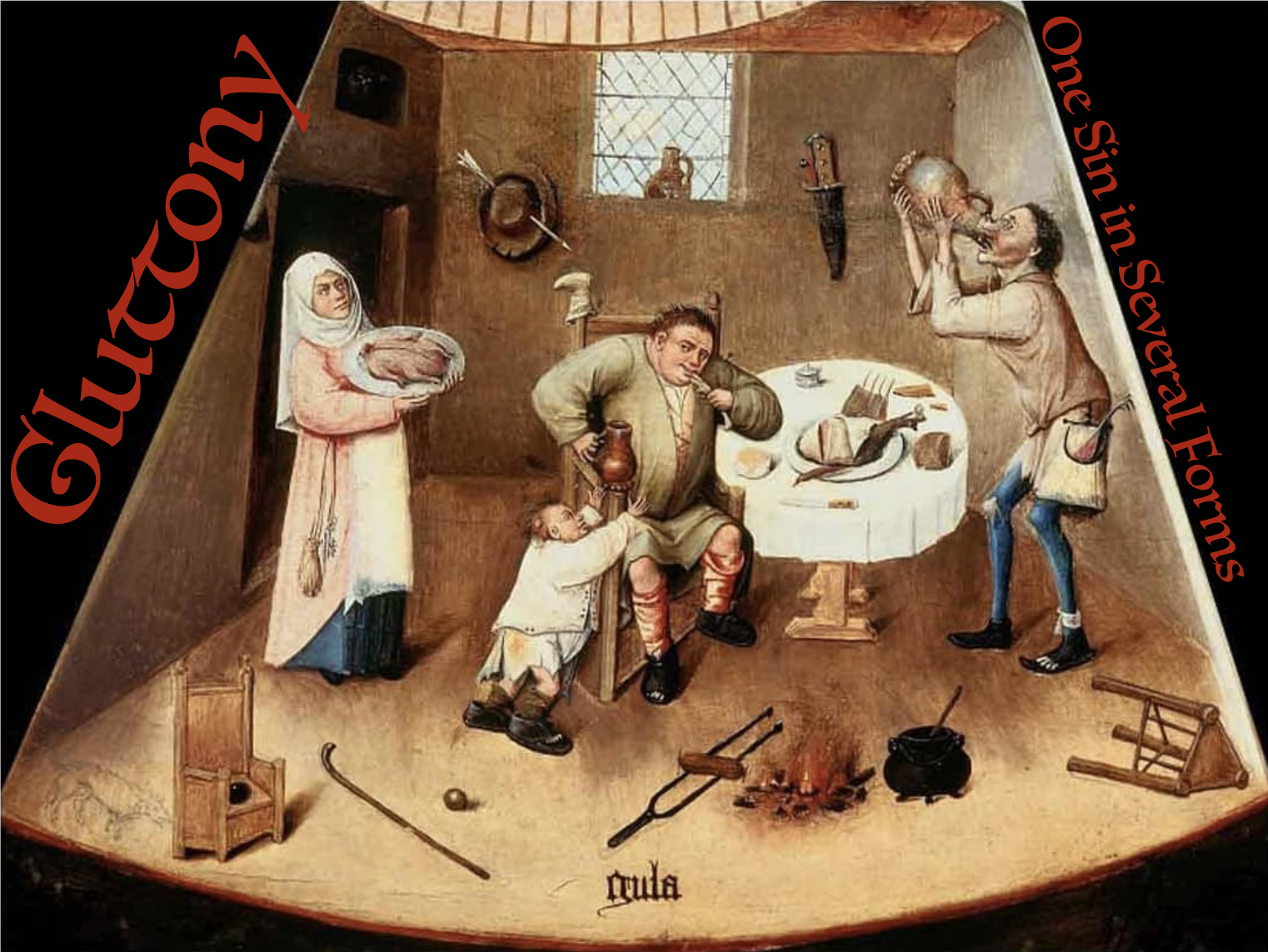
The illustration above is based on a detail from The Seven Deadly Sins and the Four Last Things painted c. 1500 by Hieronymus Bosch.
Following C.S. Lewis’ Military Example

Like his friend J.R.R. Tolkien, and many of the British men of their generation, C.S. Lewis served in the grim battlefields of the First World War. (However, since Lewis was actually Irish, he could not be drafted, and instead volunteered to serve.)

In recent years a number of books have appeared related to the military service of the Inklings. In A Hobbit, a Wardrobe, and a Great War, the author introduces his discussion with a succinct summary.

For a generation of men and women, [WWI] brought the end of innocence – and the end of faith. Yet for two extraordinary authors and friends, J.R.R. Tolkien and C.S. Lewis, the Great War deepened their spiritual quest. Both men served as soldiers on the Western Front, survived the trenches, and used the experience of that conflict to shape their Christian imagination. . . .

By the time of the Armistice, more than nine million soldiers lay dead and roughly thirty-seven million wounded. On average, there were about 6,046 men killed every day of the war, a war that lasted 1,566 days. In Great Britain, almost six million men—a quarter of Britain’s adult male population – passed through the ranks of the army. About one in eight perished. Tolkien and Lewis might easily have been among their number.

In 1939, a correspondent inquired if Lewis was going to reassume his commission in the army for the new conflict, and he responded with sentiments I have heard voiced by a number of other combat veterans.

No, I haven’t joined the Territorials. I am too old. It would be hypocrisy to say that I regret this. My memories of the last war haunted my dreams for years.

C.S. Lewis proceeded to graphically explain the cost of serving under such pressure. 

Military service, to be plain, includes the threat of every temporal evil: pain and death which is what we fear from sickness: isolation from those we love which is what we fear from exile: toil under arbitrary masters, injustice and humiliation, which is what we fear from slavery: hunger, thirst, cold and exposure which is what we fear from poverty.

I’m not a pacifist. If it’s got to be, it’s got to be. But the flesh is weak and selfish and I think death would be much better than to live through another war.

A new announcement from the United States’ Department of Defense brought Lewis’ situation to mind. It appears that due to a number of factors – not least of which the emphasis on Diversity, Equity and Inclusion,* which (imo) has discouraged veterans from encouraging their children to serve in the armed forces – some services are repeatedly falling short of their recruiting goals. 

In light of the fact that the world is inarguably growing more dangerous – the Doomsday Clock is set at “90 seconds to midnight” – it is alarming that we are unable to fully staff our shrunken military.

Just today my sixteen year old grandson expressed concerns about the resumption of a draft. I could not muster a persuasive argument that it won’t happen. Ironically, the last time the U.S. involuntarily conscripted troops was 1972, the year I turned eighteen. Oh, in the process of including a link to the Selective Service Sytem, I was surprised to learn that a “Medical Draft is in Standby Mode.” 

It is designed to be implemented in connection with a national mobilization in an emergency, and then only if Congress and the President approve the plan and pass and sign legislation to enact it. . . .

[The plan will] provide a fair and equitable draft of doctors, nurses, medical technicians and those with certain other health care skills if, in some future emergency, the military’s existing medical capability proved insufficient and there is a shortage of volunteers. . . .

[If implemented, the plan will] begin a mass registration of male and female health care workers between the ages of 20 and 45. . . . HCPDS [the innocuously named Health Care Personnel Delivery System] would provide medical personnel from a pool of 3.4 million doctors, nurses, specialists and allied health professionals in more than 60 fields of medicine.

No Draft Yet

Since we are not currently at war, the specter of a draft remains ephemeral. Still, the shortage of volunteers has led to a variety of initiatives, such as lowering service qualification standards. These efforts have proven inadequate, resulting in the aforementioned announcement.

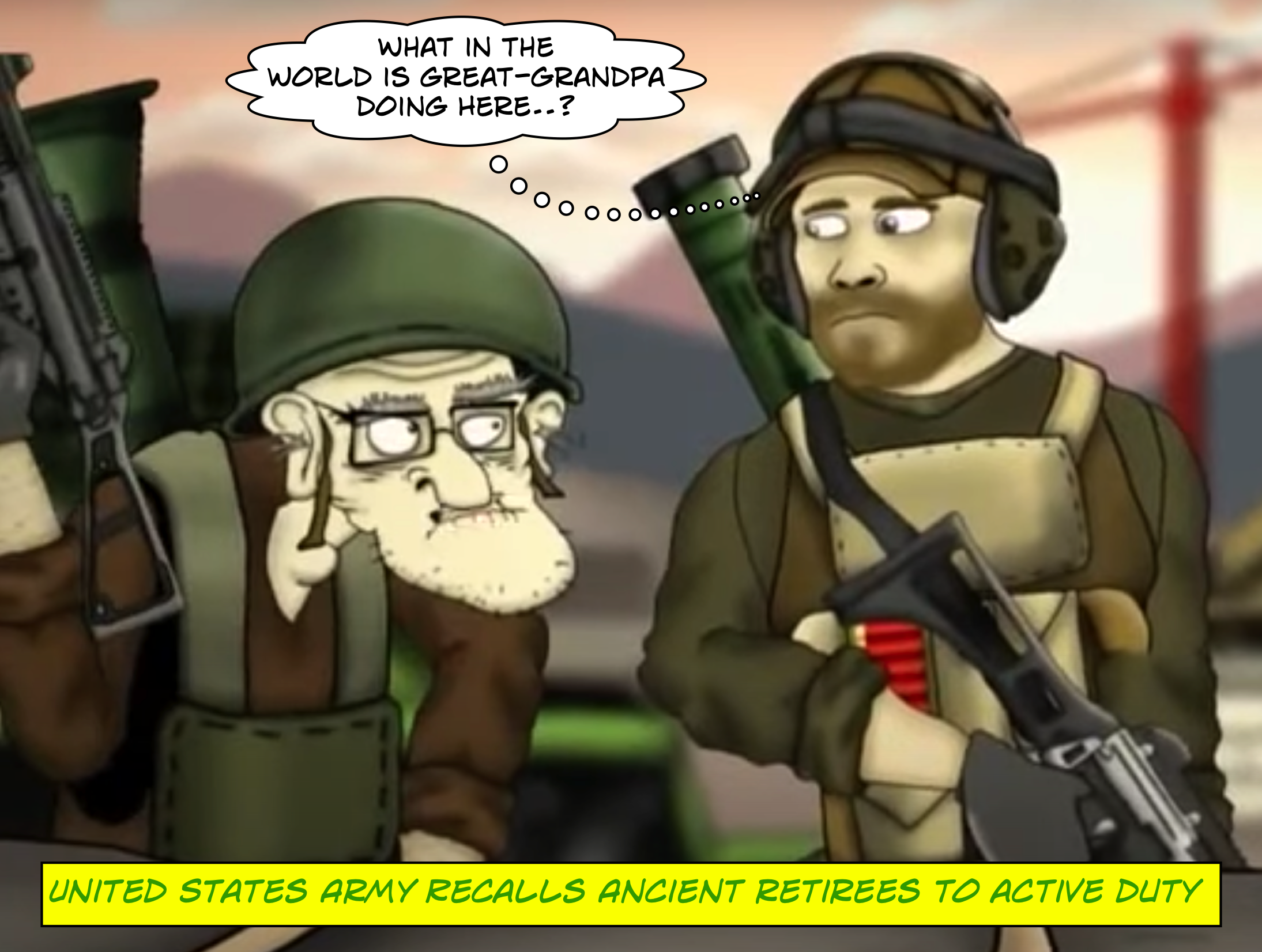
Both the Army and the Air Force have begun Retiree Recalls. Yes, that is just what it sounds like. People who have actually retired from the armed forces, normally after 20+ years of active duty, are being recalled to serve again. 

When I heard this news I was stunned. It is legally possible for the military to recall former members via a tiered process, but the first thing that came to my mind was my favorite high school teacher. He had served in Viet Nam as a draftee and finished his enlistment. He once told me that he felt safe, having survived, because now he was in the same call-up status as a “pregnant nun.” (Rather hyperbolic, but comforting to him.)

Fortunately, the current recalls are all voluntary. Only retirees whose personal circumstances make the offer appealing, will respond. As the Air Force Times reports, “Regret retiring? Here’s your shot at a second chance in the Air Force.”

I suspect that even vets who enjoyed their military service will be inclined to consider redonning the uniform as “too much of a good thing.” And if they witnessed the bloody horrors of war, as seen by C.S. Lewis, returning to the ranks would be even less tempting.

Since I, myself, have no desire to resume the demands of military life, I haven’t researched the age requirements for the Air Force recall program. Like Lewis, “I am too old.” 

But amazingly, depending on individual factors, the Army is willing to recall retired volunteers up to the age of seventy. That’s not a typo. As someone reaching that very milestone this summer, I can’t imagine returning to work side-by-side with troops half a century younger than me. 

Now, I pray for peace, knowing that being prepared for war is one way to increase that likelihood. So, I hope the military can throw off some of its political shackles and return to its necessary focus.

Furthermore, like C.S. Lewis, I have a pragmatic view of the effects of war. In “Learning in War-Time,” Lewis summarized the effects of military service during a war. As always, his insights are profound.

What does war do to death? It certainly does not make it more frequent: 100 per cent of us die, and the percentage cannot be increased. . . . Does it increase our chances of painful death? I doubt it. . . .

Does it decrease our chances of dying at peace with God? I cannot believe it. If active service does not persuade a man to prepare for death, what conceivable concatenation of circumstances would?


* This reference is to the convoluted and inequitable DEI philosophy and program(s) being mandated today. In truth, most people value diversity, and all people of goodwill believe in the importance of equity and inclusion. Along with Martin Luther King, Jr., they long for a day when people are not “judged by the color of their skin, but by the content of their character.”

Can We Ignore Modern Slavery?

I can’t answer this question for you, but I know how I want to be able to answer when I stand before our Creator. 

Many Christians include corporate confession and absolution (forgiveness) as part of their regular worship. We often ask forgiveness our sins of commission and omission – the wrongs we do, and the wrongs we are responsible for when we fail to do what we should.

God forbid that any of us would actively support slavery, but . . . how little most of us do to reduce it or free people from its deadly grasp.

In Britain, the National Society for the Prevention of Cruelty to Children, founded in 1884, recognizes modern slavery as one of the world’s greatest challenges. As they say: “Any child is at risk of child trafficking.”

Save the Children states that “children account for 27% of all the human trafficking victims worldwide, and two out of every three child victims are girls.”

Sometimes sold by a family member or an acquaintance, sometimes lured by false promises of education and a “better” life – the reality is that these trafficked and exploited children are held in slave-like conditions without enough food, shelter or clothing, and are often severely abused and cut off from all contact with their families.

The children’s condition is not “slave-like;” these precious victims literally are slaves, in every cruel sense of the word. While no unenslaved person would be so ignorant as to presume they understand slavery, C.S. Lewis mentioned in a 1939 letter several torments it inflicts. At the break of the Second World War, he was reflecting on his experiences in the First.

My memories of the last war haunted my dreams for years. Military service, to be plain, includes the threat of every temporal evil; pain and death which is what we fear from sickness; isolation from those we love which is what we fear from exile: toil under arbitrary masters, injustice, humiliation, which is what we fear from slavery: hunger, thirst and exposure which is what we fear from poverty.

The most shocking part of this description from Save the Children, is the acknowledgment that the children are “sometimes sold by a family member . . .” I discussed this grim truth in my 2014 post, “Loving Prostitutes.”

In that article I express a sentiment I hope you share: “I love prostitutes because God has granted me the vision to see them as he does.”

What You & I Can Do Today

Obviously, if this subject is new to you, you can become informed. The links I’ve provided offer a good starting point.

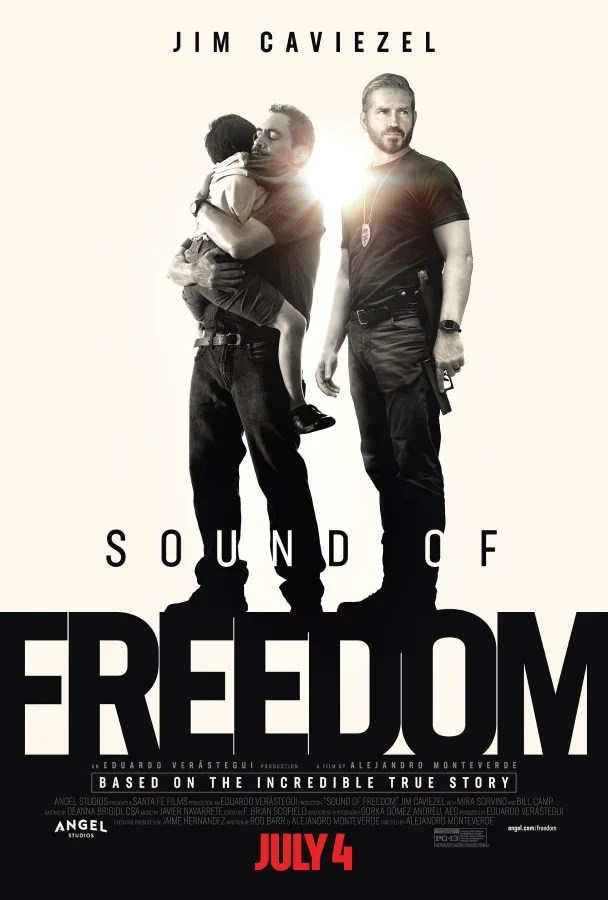
At the present moment we have a truly unique opportunity to make a contribution toward addressing this massive horror. We can support a superb, first-class film that is currently showing in hundreds of cinemas. 

Sound of Freedom is a true story with a superb cast and excellent cinematography. Despite its serious subject, the film is well worth viewing while it is still in theaters. Simply by attending, and even more by encouraging family and friends to join you, we can raise the awareness of this tragedy.

Together, you and I truly can help rescue people from this fate, and promoting this message of hope and deliverance is a small step in that journey. 

When faced with ugly things, the timid response is to turn away and pretend it doesn’t exist. In cases like this, particularly involving children, a cowardly response in ignoring the evil constitutes nothing less than a sin of omission. 

Check with your local theaters today, and reserve a seat at a showing of Sound of Freedom. (And, for those who see this suggestion months or years after the film’s 2023 release, check it out soon on a streaming service.)

Postscript & Resources:

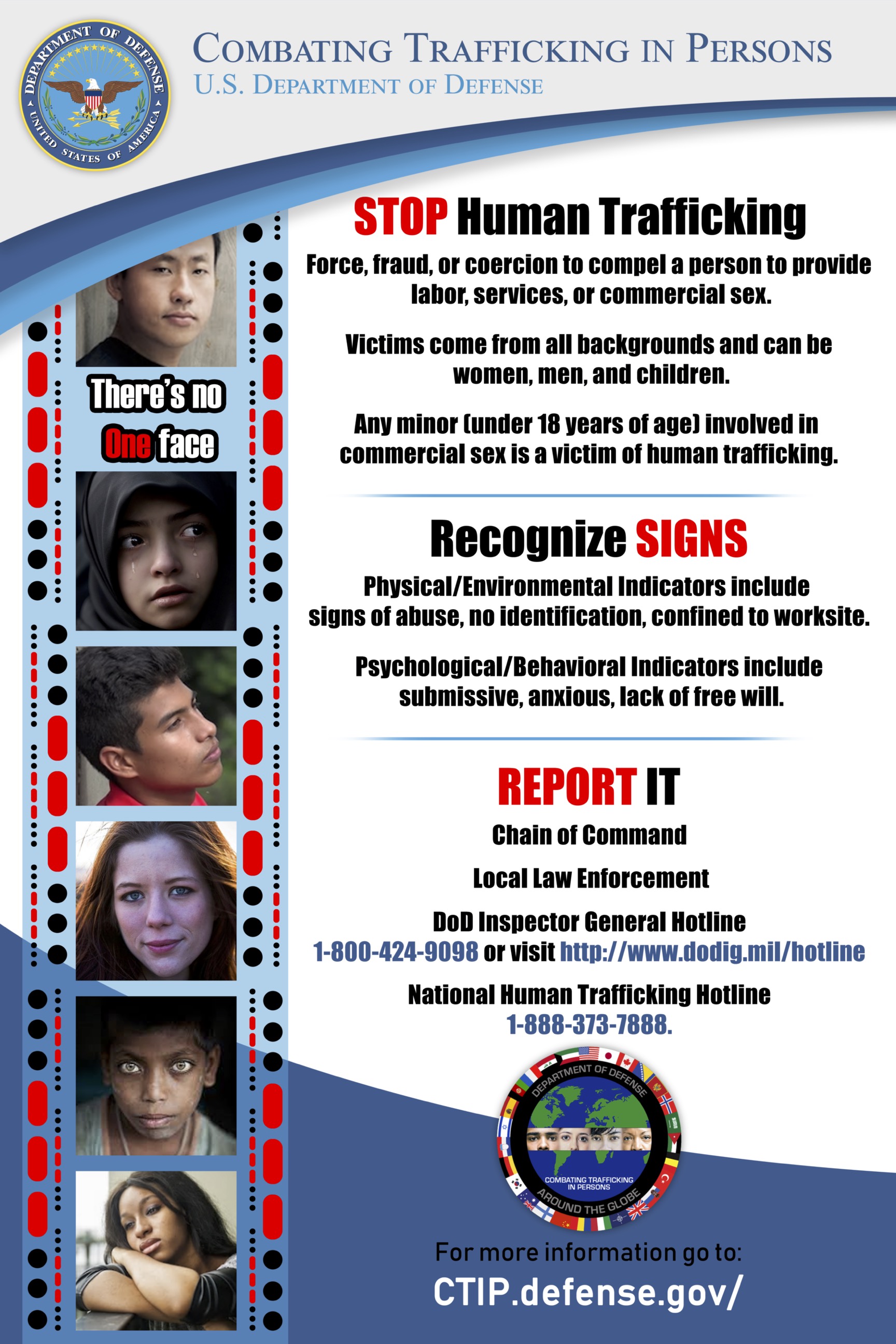
While I was still on active duty, the United States Department of Defense initiated a long-overdue program. In recognition that military members are literally on the “front lines” of encountering modern slavery, Combating Trafficking in Persons is an official program established to confront the crime.

The program includes provisions requiring training for all DoD personnel, civilian as well as uniformed. This site describes the various levels of training required. To actually “take” the training and testing requires login privileges. However, various resources – including some very informative videos – are available to the public.

Similarly, agencies such as INTERPOL restrict their courses to members. Nevertheless, they offer a variety of educational resources and updates on current efforts to battle this crime around the globe.

While I haven’t personally vetted the following, a number of public and governmental organizations offer free training for interested individuals. Among them are: 

the U.S. Department of Homeland Security, and the Office for Victims of Crime. The U.S. Institute Against Human Trafficking lists six free classes, several of which offer certificates of completion.

The Home Office in the United Kingdom hosts a site with a number of related resources. One is “A typology of modern slavery offences in the UK” which breaks “down the broad categories of modern slavery into 17 distinct types of offences identified in the UK.” No doubt, most other enlightened nations promote similar materials.

In a 1943 essay entitled “Equality,” C.S. Lewis discusses the subject of the nature of Democracy, as a form of government. His argument includes the clearest possible reason why slavery never has been, and never could be a good, or morally neutral, thing.

I am a democrat because I believe in the Fall of Man. I think most people are democrats for the opposite reason. A great deal of democratic enthusiasm descends from the ideas of people like Rousseau, who believed in democracy because they thought mankind so wise and good that everyone deserved a share in the government.

The danger of defending democracy on those grounds is that they’re not true. . . . I find that they’re not true without looking further than myself. I don’t deserve a share in governing a hen-roost, much less a nation. . . .

The real reason for democracy is . . . Mankind is so fallen that no man can be trusted with unchecked power over his fellows. Aristotle said that some people were only fit to be slaves. I do not contradict him. But I reject slavery because I see no men fit to be masters.

I know that C.S. Lewis would add his “amen” to my challenge today that each of us might look for ways to help eradicate this plague of slavery, which has cursed humanity for millennia.

C.S. Lewis on Stupidity

Just because someone did something extraordinarily stupid does not mean that another fool should repeat the act. And C.S. Lewis would agree.

This summer a (likely unemployed) Coloradan decided to push a peanut to the top of Pikes Peak – a 14,115 foot American landmark – using his nose. Talk about stupid. His ambition was to be the first person in the twenty-first century to accomplish this pseudo-impressive goal.

That’s right, “in the twenty-first century.” Oddly, he is the fourth man (women are too intelligent, IMHO) to waste time in this pursuit, but the others proved their mettle in the twentieth century.

Simple stupidity is not the oddest motivator of irrational actions. Some people feel compelled to pursue death-defying activities. Those of us who would prefer to avoid danger whenever possible, are confused by others who embrace it.

Quite recently, “the body of an American mountaineer whose daring achievements brought her acclaim among some of the world’s most elite climbers was found . . . on a peak in Nepal.” Apparently, she climbed the “world’s eighth-highest peak” so she could ski down from its peak.

Hilaree Nelson, 49, and her romantic and climbing partner, Jim Morrison, were trying to ski down Manaslu . . . An avalanche apparently blew her off a cliff onto the south face of the mountain, opposite of their intended route of descent.

Tragic, most would agree. Foolish, many would add.

Doing something silly falls lower on the FDS (foolishness disorder spectrum) than does taking arbitrary and utterly unnecessary risks.

C.S. Lewis offers some interesting counsel to a woman who shared concern about the marital frustrations of someone close to her. (Yes, people actively sought his advice.) He ranks ignorance very low on the scale of relationship problems.

It is a great joy to be able to ‘feel’ God’s love as a reality, and one must give thanks for it and use it. But you must be prepared for the feeling dying away again, for feelings are by nature impermanent.

The great thing is to continue to believe when the feeling is absent: & these periods do quite as much for one as those when the feeling is present. It sounds to me as if Genia had a pretty good husband on the whole.

So much matrimonial misery comes to me in my mail that I feel those whose partner has no worse fault than being stupider than themselves may be said to have drawn a prize! It hardly amounts to a Problem. (Correspondence, 1953).

So it is, that while obviously undesirable, stupidity is not a bad thing in itself. In “The World’s Last Night,” Lewis includes the trait in a curious list. And the passage suggests to me the dangers implicit in allowing one‘s ignorance to jeopardize their wellbeing.

Perfect love, we know, casteth out fear. But so do several other things – ignorance, alcohol, passion, presumption, and stupidity.

It is very desirable that we should all advance to that perfection of love in which we shall fear no longer; but it is very undesirable, until we have reached that stage, that we should allow any inferior agent to cast out our fear.

It is precisely when what I would identify as stupidity inspires dangerous activities, that C.S. Lewis would rule it to be detrimental. And this brings us to the question of why some few people do what the majority of us “saner” people would avoid.

Why Do People Pursue Risky Activities

For our discussion here, I am not including people who face danger due to their vocations. Doubtless some “first responders” and military members relish brushes with death, but they are in the minority. Most are not eager to court death.

It has been debated as to why some people are drawn to the most hazardous of so-called “extreme sports.” The uncharitable might attribute a vulnerability to the siren call of danger to mere stupidity, but there are other factors at work.

However, some people are conditioned by their upbringing to participate in unsafe behaviors (e.g. base jumping, smoking or alligator wrestling). And, in recent years, we have been hearing more about genetic dispositions to such activities. It appears there is some merit to the notion of there being a “risk taking gene.”

A major 2019 study reported in in Nature Genetics “identified . . . 99 [genetic] loci associated with general risk tolerance.” An accessible discussion of the study says, “the genetic variants identified in the study open a new avenue of research on the biological mechanisms that influence a person’s willingness to take risks.”

In any case, DNA is only one, limited factor. Researchers confirmed “non-genetic factors matter more for risk tolerance than genetic factors. The study shows evidence of shared genetic influences across both an overall measure of risk tolerance and many specific risky behaviors.”

Lacking the fear gene is not quite the same thing as being courageous. As noted above, a person may face danger because of a valid reason. Thus “first responders” and most military members I served as a chaplain were not foolhardy. They didn’t take unnecessary risks. But most were willing to place themselves between very real threats and those they were protecting.

If you personally are of an adventurous nature, I encourage you to take sensible precautions. Avoiding rafting on Class VI rapids and cave diving – anywhere – would be a good place to start..

And for the less daring among us, perhaps we can avoid foolish pursuits that are merely a waste of time. It seems apparent to me that time spent serving others in a food bank, or mowing the lawn of a disabled neighbor, constitute a far better use of our time.

Books on the Battlefield

war book.png

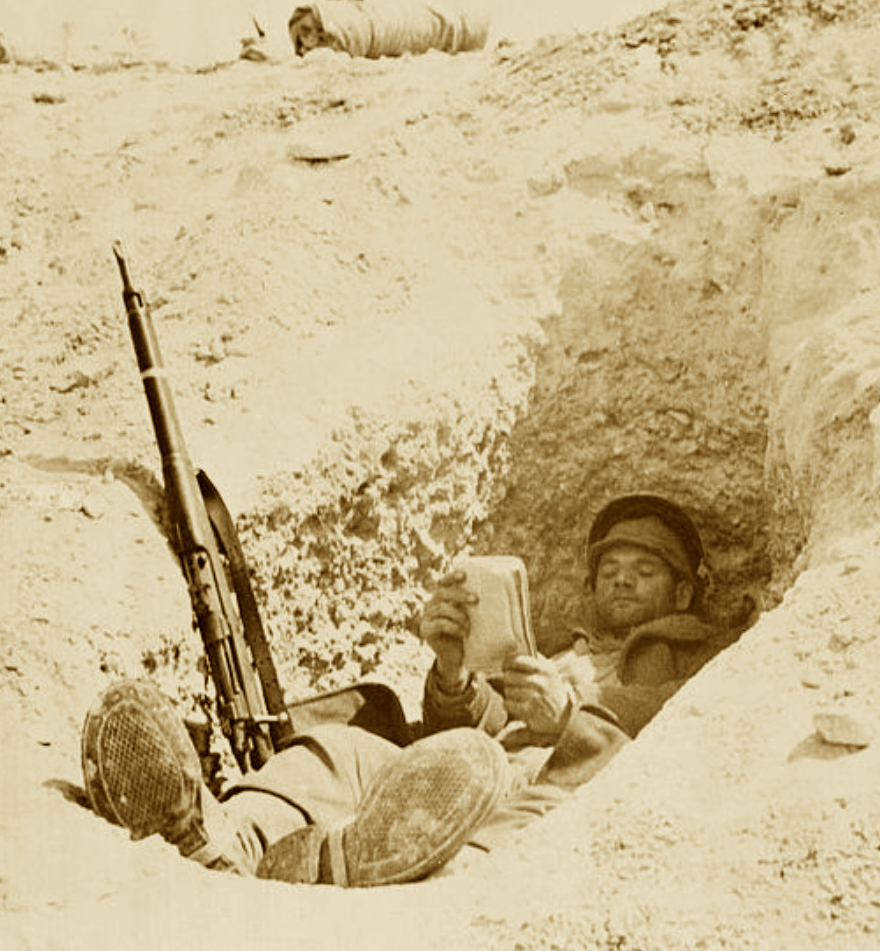
Some would say “only a fool would bring a book to a gunfight.” That might be true if the person carried the book in lieu of a firearm, but the fact is many varieties of literature accompany soldiers to war.

When Edward Bulwer-Lytton wrote “the pen is mightier than the sword,” he offered a powerful insight into how ultimate victory hinges more on knowledge and ideas than on direct violence. Of course, he didn’t mean that in a personal conflict between two combatants a quill could best a saber.

Even those who’ve never been to war realize warriors need to have their bodies, minds and spirits renewed in order to be at their best when their lives hang in the balance. Bodies are taken care of by providing healthy sustenance, swift medical attention, and opportunities to remain fit.

Minds and spirits overlap somewhat, but for the latter, most of the world’s militaries send chaplains to accompany the men and women “in harm’s way.” Spiritual encouragement often comes even more readily from their fellow military members.

Wartime is, surprising no one, an optimal time for people to consider their spiritual wellbeing and contemplate their eternal destiny. Still, that does not make true the adage “there are no atheists in foxholes.”

That said, war zones are places where the fields are literally “white unto harvest” (Luke 4).

It is no accident copies of the Bible have accompanied Christians to war since the first printed copies were available.

During the American Civil War, personal Bibles and religious tracts were widely distributed. It was not uncommon for a soldier to send a particularly meaningful tract home to his family. In addition to chaplains, numerous ministries today work to ensure no service member who desires a Bible is without one.

Reading for the Mind

It would be wrong to think religious works dominate the literature available to military members dispatched to war. Most locations offer access to numerous publications, and even the internet. The Department of Defense even provides access to the nonpartisan Stars and Stripes, which offers some of its headline articles here.

And then there are books. Books of all genres, though perhaps, tilted towards thrillers and sports subjects. Soldiers pass their books around, and for many lucky enough to serve in a garrison type of setting, there is often a library.

Yes, a real library—except that the books are typically all available for free. This is due in large part to the generosity of publishers. During the Second World War, the Council on Books in Wartime, founded by publishers and others, provided over 120 million paperbacks in their Armed Services Editions. (The classic titles sold for an average of six cents.) The Council’s slogan was, “books are weapons in the war of ideas.”

So, military folks read lots of books overseas. In fact, here is a photo of yours truly reading one of my favorite authors (David Drake) while I was on a flight between Pakistan and Afghanistan back in 2002.

I was delighted recently when rereading C.S. Lewis’ autobiography to see that I was following in his footsteps. Lewis is discussing how actual books, and not merely periodicals, can accompany us on our journeys. He refers briefly to his war experiences.

Soon too we gave up the magazines; we made the discovery (some people never make it) that real books can be taken on a journey and that hours of golden reading can so be added to its other delights.

(It is important to acquire early in life the power of reading sense wherever you happen to be. I first read Tamburlaine while traveling from Larne to Belfast in a thunderstorm, and first read Browning’s Paracelsus by a candle which went out and had to be relit whenever a big battery fired in a pit below me, which I think it did every four minutes all that night.) (Surprised by Joy)

I would not equate our two situations. After all, a comfortable C-130 (even when making “combat” landings and take-offs) can hardly be compared to a muddy WWI trench.

But, like nearly all of Mere Inkling’s audience, I do share C.S. Lewis’ joy at knowing books need never be far from our hand. Whether it be on holiday, in the hospital, or even in prison (God forbid), we can always find some pleasure and peace in reading.


Postscript:

During Desert Storm, I helped ship thousands of donated books to troops on the front lines. Unfortunately, there was a problem with the clothing worn by most of the women on the covers. We learned the Saudis were destroying some of the books, deeming them pornography.

As a result, our book processors began tearing the cover off of every book featuring a woman. As a compromise, I offered to become an informal “Saudi censor.” With a large black marker, I was able to suitably cover up elements of the female anatomy that would have presumably offended our Middle East allies.

Despite my misgivings about “defacing” the covers, I felt it was less destructive than removing the entire cover. I’ll leave it to you to be the judge.

Do Titles Matter?

cbeThere are many sorts of titles one may accumulate, and some people pursue them with great passion. There are familial titles like “Grandmother,” military titles such as “Ensign,” academic titles like “Associate Professor,” and ecclesiastical titles as in “Archimandrite.”

And that’s only the tip of the titular iceberg. Titles are prominent in many fields, such as medicine, politics and the judiciary. And appellations such as “Coach,” are precious to multi-millionaire athletic leaders and folks working with preschoolers in the gym or on the field alike.

The best way to tell how important a person’s titles are to them, is to witness how they respond to the “misuse” of one. My wife and I have a joke when I show my identification card when we enter a military installation. If the guard courteously says, “have a good day, colonel,” after I roll up the window and proceed, I will sometimes say (for Delores’ benefit) “that’s lieutenant colonel!”

If you’re unfamiliar with the armed forces, there’s a good chance you miss the joke. A lieutenant colonel is junior in grade to a “full” colonel, although addressing one simply as “colonel” is allowed. In fact, in a sense it’s an added courtesy or sign of respect. (I should mention that it’s not uncommon for some of the civilian guards to follow up such a greeting with a glance towards my wife and the words, “and a good day to you, general.”)

I have mixed feelings about titles, a trait I believe I share with C.S. Lewis.

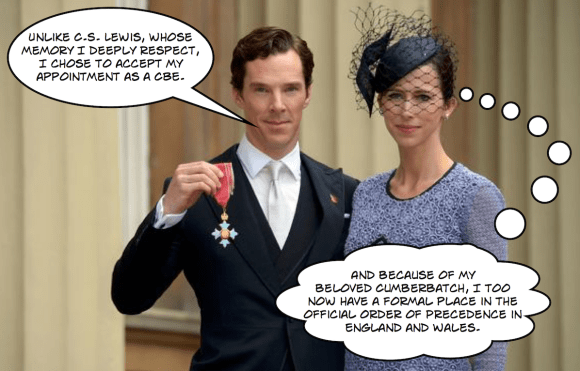
In 1952, Lewis declined appointment as a Commander (CBE) in the Order of the British Empire. He did so to avoid entangling his Christian witness with political considerations. But by declining he forsook the opportunity to be known as “Sir Lewis,” although, I doubt he lost sleep over his decision. (In fact, in his humility, Lewis never revealed the matter for public scrutiny.)

A 1959 letter to Lance Sieveking, the BBC producer who wrote the radio script for The Lion, the Witch and the Wardrobe, offers an interesting insight into Lewis’ attitude about titles. He begins with this greeting:

Dear Sieveking

(Why do you ‘Dr.’ me? Had we not dropped the honorifics?)

Volume three of Lewis’ letters reveals this was representative of his thinking. Once he had established a rapport with some correspondents, he requested that they drop the use of titles. A typical example reads, “We may both drop the honorific now, mayn’t we?.” In one case he writes in the imperative, “Dear Hooton (Do drop the honorifics!).”

So, Do Titles Matter?

My grandchildren surprised me the other day by addressing me as “Doctor Grandpa.” They proudly shared in my joy (read “relief”) at having completed my Doctor of Ministry degree.

I responded to their adulation with “actually, kids, it’s ‘Reverend Doctor Grandpa.’” This led to a fun discussion about titles during which I was able to explain to them how my pastoral title was of greater significance to me than the doctoral honorific. After which I reminded them the matter was moot because all I want them to call me is grandpa. I explained how only eight people in the entire world can call me that, and it made that title extremely precious to me.

Ultimately, the most valuable title any human being could have is to be addressed as son or daughter, by God. As Jesus’ disciple John wrote:

See what kind of love the Father has given to us, that we should be called children of God; and so we are. (1 John 3:1).

On this, I have no doubt C.S. Lewis would agree.

Despite this, there are cases where titles are critical. The military, with its “chain of command” sometimes being a life or death matter, is a prime example.

In other settings, the honorifics are less significant. I addressed all my instructors in college as “Professor,” regardless of whether they were full/associate/assistant/whatever.

I doubt that many of Lewis’ very fortunate students thought less of his lectures because of Oxford’s politics which withheld from him the full “professorship” he had certainly earned. (It would be left to the wiser University of Cambridge to rectify this oversight.)

This suggests to me that titles mean less to most people than the way others think of them. If people respect you as someone with integrity . . . if they call you “friend . . .” how much more fortunate could you be?

The Urgent Need for Chivalry

chivalryWith all the nations of the world engaged in power struggles—or cowering behind the protection of their more courageous allies—C.S. Lewis’ essay on “The Necessity of Chivalry” demands our attention.

Yes, the very word “chivalry” reeks of a bygone era that has been superseded and relegated to history books. But those who consider the concept outdated impoverish their lives and quite possibly contribute to the violent spirit of our age.

Warfare is not an abstract concept to the millions—yes, millions—of people who are surrounded by vicious threats every hour. Britain itself was in this position when Lewis penned these words during the Battle of Britain.

As he wrote, three days before Winston Churchill’s most famous speech, Lewis commended those same few to whom so many owed so much. It was 1940, and Germany’s advance had yet to be halted. Ultimate victory in the world conflagration would remain uncertain for years.

It is in this milieu, but not only for this context, that Lewis challenges us to combine the chivalrous values of meekness and ferocity.

Lewis argues that in the chivalrous “knight,” true humility and the capacity for great (but moral) violence are merged. The result is not a schizophrenic warrior, but a noble defender of what is good.

Indeed, even apart from wartime, it is vital that society has heroes to protect sheep from wolves. In a moment I will share with you a brief video featuring an amazing artistic rendering of this essay on chivalry.*

In the essay, Lewis’ examples span Western history. He uses Launcelot as the archetype of the chivalrous man. And he offers the hope and evidence that chivalry is not extinct. A veteran of the previous war, he wrote at the outset of the Second World War:

Launcelot is not yet irrecoverable. To some of us this war brought a glorious surprise in the discovery that after twenty years of cynicism and cocktails the heroic virtues were still unimpaired in the younger generation and ready for exercise the moment they were called upon. Yet with this “sternness” there is much “meekness;” from all I hear, the young pilots in the R.A.F. (to whom we owe our life from hour to hour) are not less, but more, urbane and modest than the 1915 model. (“The Necessity of Chivalry”)

And accordingly, in our own day there are many serving in uniform who exemplify the same virtues. Would, though, that all who bear arms could be described thusly.

Some who are reading these words may regard chivalry as a “sexist” concept. It is not. Certainly no more than courage, strength and virtue could be deemed such. The fact that Lewis’ historical examples of society’s defenders are men simply reflects history.

In the seventy-five years since he wrote, it has become evident that women too can easily embody both meekness and unyielding courage. One need look no further than the ranks of the military and law enforcement to see this borne out.

Chivalry for the Civilian

It would be a tragic mistake to think that chivalry is only required during war. It is a vital, daily necessity of all social life. And the increasing incivility of the world suggests its erosion. (Many attribute this in part to the anonymity of the internet, which allows bullies to savage others anonymously and without mercy.)

This is what Lewis was saying when he described Launcelot as being “not a compromise or happy mean between ferocity and meekness; he is fierce to the nth and meek to the nth.”

After all, it is not the bland or “lukewarm” person who makes this world a better place. It is upon chivalrous men and women that the majority of the vulnerable must ever rely.

Each of us needs to be willing to examine our own lives for the union of these two traits: courage that does not surrender to what is wrong, and meekness that is gentle, calm and patient with others.

These are the values that we need to promote in our communities, media and schools. Because what we instill in receptive minds is precisely that which will take root. To use more contemporary terms, the “programming” these young minds are subject to will directly influence the behaviors that they “output.”

Let us do all we are capable of, to be, and to raise up, what is chivalrous. After all, despite all of the utopian promises of those who believe humanity is capable of purifying itself, the evidence shows otherwise. As Lewis said,

There was, to be sure, a rumour in the last century that wolves would gradually become extinct by some natural process; but this seems to have been an exaggeration.

Enjoy this fine presentation of  “The Necessity of Chivalry.”

_____

* This video is a creation of CSLewisDoodle, about which I have written before. (Their name may sound quaint, but the expertise with which they visualize Lewis’ words is astounding.)

Priceless Letters

letterHow precious is a single letter?

If it is eagerly anticipated correspondence from a close friend or loved one, it may be invaluable.

Telephones and email have diminished the impact offered by the contents of an individual message, yet even now we value the touch of the written word shared by our soul mates across the miles.

Prior to the invention of the internet, and before the cost of international calls grew reasonable, I spent a year in the Republic of Korea, far from my wife and three young children. Naturally, like all military members serving far from home—even during times of peace—I missed them terribly.

While many wonderful things happened during the course of that year, and lifelong friendships were born, the highlight of each day was a visit to the installation post office. And, due to the faithfulness of my mother, sister and wife, I was greeted nearly every day by one or more handwritten messages of love and encouragement.

So important were these bonds that, prior to my departure, Delores and I covenanted to write one another every single day. A promise we both kept. In addition, I promised to write each of my three children their own letter each week. One evidence of the impact of those letters was the seamless reunion our family experienced when I returned after a year away.

In the even more distant past, this means of communication was even more vital. As little as a century ago, when individuals and families emigrated from their homelands they recognized the sad truth that they would probably never see their loved ones again.

Think about that for a moment. Saying “goodbye” usually meant “I will never see you again in this life.” How precious those missives must have been when they found their way between intimate companions!

Eighty-five years ago, C.S. Lewis was carrying on an active correspondence with the dearest friend from his youth, Arthur Greeves.

In the 1930s, the two men were corresponding on a weekly basis. Lewis opened one of his letters with the following paragraph to gently reprimand Greeves for allowing other responsibilities to delay his writing.

July 8th 1930

My dear Arthur,

Your letters get later and later every week. If you write on Monday the first week, on Tuesday the second week, and so on, then in seven weeks you will be writing on Monday again: but you will have written one letter less than you should.

In a year you will have written eight letters less, that is thirty six pages. Assuming that we both live thirty years more you will in that time have cheated me out of one thousand and eighty pages. Why, oh why, do you do these things?

As I said, the “reprimand” is gentle, even humorous, but it is sincere. It reveals just how meaningful each piece of his friend’s correspondence was to Lewis.

Many of us can relate to Lewis’ experience. We know firsthand how a smile comes to our lips and our pulse quickens when we find a message from a close companion.

I wanted to share this thought with each of you today for two reasons. First, I thought it might remind you of those whose words have encouraged and supported you in the past.

My second motivation is more important. I would like to suggest that you pause to consider just how important your letters are to others.

There are thousands of reasons for not scheduling (and guarding) time to write letters. Life is busy. The distractions vying for our attention are certainly more numerous, and loud, than they were in decades past.

Still, reminded of the value of the gift we offer when we write, perhaps it is time to shuffle our priorities.

Pacifism as an Enemy of Peace 

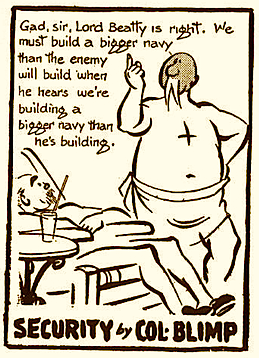
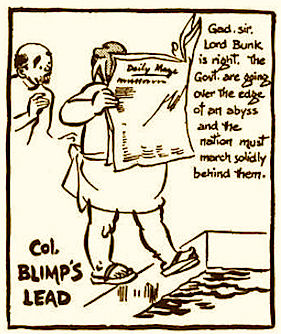
blimp 01The literary careers of C.S. Lewis and George Orwell overlapped in some interesting ways.* Today we will consider a rather odd British personality mentioned by each of them in wartime essays, Colonel Blimp.

Colonel Blimp was a cartoon figure, inspired by a conversation between two military officers who were arguing that “cavalry” officers should continue to wear spurs even when they migrated into tanks.**

At one time the cartoon was so popular that Lewis wrote:

It may well be that the future historian, asked to point to the most characteristic expression of the English temper in the period between the two wars, will reply without hesitation, “Colonel Blimp.” (“Blimpophobia”).

The good colonel echoes similar foolish notions as he blusters about in a caricature of pompous military commanders. Blimp is retired, but harangues all within earshot about the wisest course for the nation.

Orwell wrote derisively of the military and imperialistic middle class, that he called “the Blimps.” He drew the label from the “colonel with his bull neck and diminutive brain, like a dinosaur.” (“The Lion and the Unicorn”).***

blimp 02The cartoon above illustrates how Colonel Blimp is certain he has the solution to winning the arms race. The frame to the right shows that he believes his wisdom extends beyond the military to politics in general.

Timely Advice from C.S. Lewis

In “Blimpophobia,” Lewis offers advice which proves apropos for our modern age. Today, as fanatical barbarians seek to destroy civilization, enlightened nations and individuals must be vigilant.

One dimension of that vigilance involves walking the fine line between unbridled nationalism and self-absorbed pacifism. When he wrote, Lewis was worried about the anti-war sentiment that threatened to undermine Britain’s response to the Nazis.

Lewis, a wounded combat veteran of the Great War, recognized the truth of the Colonel Blimp caricature. He said something veterans recognize even more clearly than civilians. There is an overabundance of preening and stupidity in the military.

The infection of a whole people with Blimpophobia would have been impossible but for one fact—the fact that seven out of every ten men who served in the last war, emerged from it hating the regular army much more than they hated the Germans. How mild and intermittent was our dislike of “Jerry” compared with our settled detestation of the Brass Hat, the Adjutant, the Sergeant-Major, the regular Sister, and the hospital Matron!

Now that I know more (both about hatred and about the army) I look back with horror on my own state of mind at the moment when I was demobilized. I am afraid I regarded a Brass Hat and a Military Policeman as creatures quite outside the human family.

Still, he said we cannot allow that sad truth to cause us to deny the requirement to maintain a strong defense. “A nation convulsed with Blimpophobia will refuse to take necessary precautions and will therefore encourage her enemies to attack her.”

C.S. Lewis warned his countrymen of the dangers military-phobia during the Second World War. And—among the war-weary nations of the free world battling jihadism—we are wise to heed his wise words today.

The future of civilization depends on the answer to the question, “Can a democracy be persuaded to remain armed in peacetime?” If the answer to that question is No, then democracy will be destroyed in the end. But “to remain armed” here means “to remain effectively armed”. A strong navy, a strong air force, and a reasonable army are the essentials. If they cannot be had without conscription, then conscription must be endured. (C.S. Lewis, “Blimpophobia”).

_____

* In “A Literary Phobia,” I compared some advice they offered to writers. The counsel in question sounds similar on the surface, but actually differs. In “Orwellian Advice,” I contrast the two authors in much greater detail.

** Blimp’s creator, David Low, resided in London but was actually a New Zealander.

*** You can read Orwell’s 1941 essay, “The Lion and the Unicorn,” here.

Inkling Chivalry

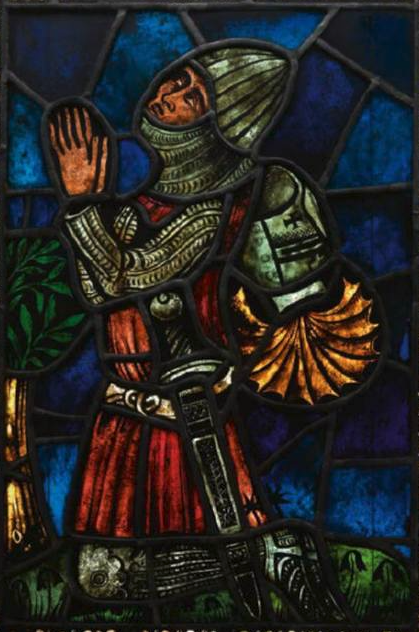
praying knightJ.R.R. Tolkien and C.S. Lewis practiced what they preached.

While most people are content to sit back while others battle for just causes. Sadly, cowardice appears to outweigh bravery in our modern age. We have, Lewis says, “having grown up among the ruins of the chivalrous tradition . . .” (“The Necessity of Chivalry”).

Lewis and Tolkien, by contrast, were genuine heroes. Peaceful academics by nature, each of them responded to their nation’s call to defend their homeland against the Huns.

In the world of the modern university—inhospitable to those who would defend the veracity of the Scriptures—each man counted the cost, and willingly bore the ridicule of skeptics and secularists.

Not only were these two Inklings paragons of courage, they engaged in their battles with a code of chivalry. Neither desired the destruction of their foes. Instead, they sought the preservation of truth, justice, peace and mercy.

Chivalry is a concept alien to the modern era. In an age when there is so little mercy and forgiveness, it seems a more and more archaic notion each day.

Yet, chivalry is not dead.

Both of these men not only modeled the virtue, they imbued their works with its spirit. The heroes of Middle Earth and Narnia are chivalrous almost to a fault. And the spiritual heirs of both fictional domains, still yearn to be chivalrous in their own lives.

So, precisely what is it? As Lewis begins his essay on the subject, he writes, “The word chivalry has meant at different times a good many different things—from heavy cavalry to giving a woman a seat in a train.”

Lewis considers the “double demand it makes on human nature” through an exploration of the Middle Ages.

The knight is a man of blood and iron, a man familiar with the sight of smashed faces and the ragged stumps of lopped-off limbs; he is also a demure, almost a maidenlike, guest in hall, a gentle, modest, unobtrusive man. He is not a compromise or happy mean between ferocity and meekness; he is fierce to the nth and meek to the nth.

Gentle toward the innocent and vulnerable. Relentless versus evil.

What, you may ask, is the relevance of this ideal to the modern world? It is terribly relevant. It may or may not be practicable—the Middle Ages notoriously failed to obey it—but it is certainly practical; practical as the fact that men in a desert must find water or die.

We live in a violent world, and the beheading of even children suggest things are growing worse. So, more than ever, Lewis tells us, we need chivalrous people like Lancelot, who combined these conflicting qualities. We need gentle men, like Lewis and Tolkien, who are willing to lay aside their books to face the specter of war on the front lines.

Lewis forcefully describes the three divisions of humanity bereft of chivalry.

If we cannot produce Launcelots, humanity falls into two sections—those who can deal in blood and iron but cannot be “meek in hall”, and those who are “meek in hall” but useless in battle—for the third class, who are both brutal in peace and cowardly in war, need not here be discussed. When this dissociation of the two halves of Launcelot occurs, history becomes a horribly simple affair.

Lewis wrote the essay during the Second World War. He and others among the Inklings had stood in the gap during the “war to end all wars.” Now he was observing a glimmer of hope in the witness of a successive generation doing its part.

Launcelot is not yet irrecoverable. To some of us this war brought a glorious surprise in the discovery that after twenty years of cynicism and cocktails the heroic virtues were still unimpaired in the younger generation and ready for exercise the moment they were called upon.

In the face of the contemporary ferocity of global terrorism, we see many young men and women following their example. Surely, they are a minority among the population, but we are all deeply fortunate they exist.

Our prayers should accompany those of all nationalities who are courageous enough to face the blade of modern barbarians. And our prayer should be that they are not merely brave, but also meek.