Gathering Palms & Preparing for War

The Christian church has just celebrated Palm Sunday, and I recalled one of my favorite memories in preparing for the journey through Holy Week.

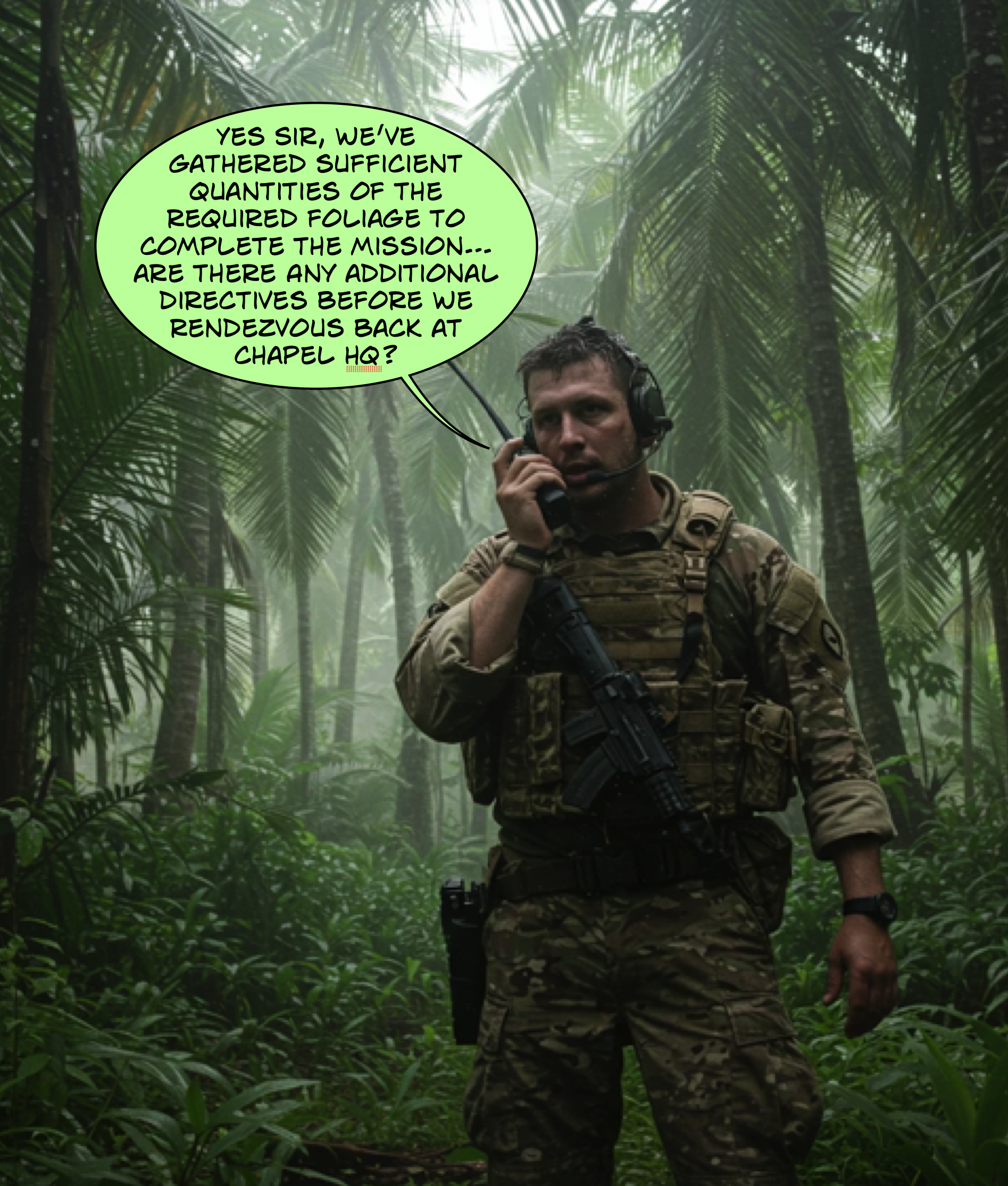
When I was stationed in Guam a few years ago (in the nineties), I enjoyed the annual tradition of gathering all of the palms to decorate the chapel and provide for worshippers in our very own jungle. Each year the chaplains and chaplain assistants, our whole team, would spend half a day gathering leaves that would put to shame any stateside palms.

Taking place in a tropical jungle, the event was sweaty, but fun. Good fellowship and even some seasonal early-Easter music. Fortunately, this didn’t take place during the typhoon season, as when the island was smashed by Super Typhoon Paka during our residency.

Jungles are fascinating places. Because the word possesses some rather ominous and even threatening overtones, a number of years ago they were rechristened “rainforests.” Even though most are tropical, there are temperate rainforests, such as in the Olympic National Forest, whose mountains I admire daily from our backyard.

C.S. Lewis alluded to the negative connotation of jungles in his study of “Vivisection,” with its repudiation of animal cruelty.

In justifying cruelty to animals we put ourselves also on the animal level. We choose the jungle and must abide by our choice.

A Modern Use for Jungles

In recent years, the jungles of Guam have been put to a military use. Unsurprisingly, soldiers and their Marine, Navy and Air Force cousins, must be prepared to do their jobs in a wide range of environments. That results in the existence of a variety of training settings, tuned to the specific needs of particular career fields.

For example, I served as the Wing Chaplain at Fairchild AFB where the USAF trains its pilots and aircrew members how to survive when they find themselves in unfriendly settings. Survival, Evasion, Resistance and Escape (SERE) training saves lives.

Anyway, not long ago the Air Force established a Jungle Agile Combat Employment (JACE) Course in, of all places, Guam.

This new course took knowledge from the U.S. Marine Corps Jungle Warfare Training Center and the Lightning Academy in Hawaii and tweaked it for non-combatant career fields to be prepared under the USAF’s Agile Combat Employment (ACE) concept.

This is part of America’s shift in focus to the threats in the Pacific theater. China has never renounced, and constantly proclaims, its intent to force the Republic of China (Taiwan) into their fascist empire. Of course, the fate of Hong Kong reveals just how unbenevolent the so-called People’s Republic is when it comes to maintaining any semblance of democratic freedoms. 

C.S. Lewis, of course, had much to say about the tragedies of fascism and war. However, that is not the focus of this reflection. Instead, the theme of this post reflects two thoughts. 

The less important idea, to which I have paradoxically devoted the most space, is the value of memories. Guam occupies a very special place in my family’s history, in part because all three of our kids were there during their teens. Lifechanging events occurred there.

And it was the wonderful people, military friends and wonderful Chamorro residents that made the most lasting impressions. Remembering the harvesting of palms, and recently learning about the jungle training course turned my thoughts back to that Micronesian paradise.

What’s Truly Vital

The infinitely more important message in this post is to acknowledge the holiest of seasons in which we find ourselves. Beginning with Palm Sunday’s celebration of the joy experienced by God’s people as they welcomed their Messiah into Jerusalem, we have the opportunity now to also join together with Jesus and our brothers and sisters in the faith as we:
~ commemorate the institution of the Lord’s Supper on Maundy Thursday,
~ contemplate the despair of the disciples as they stood at the foot of the cross as Jesus breathed his last mortal breath on Good Friday, and
~ celebrate in awe and wonder how our Savior rose from the grave and encouraged his disciples before ascending to Heaven and resuming his place at the right hand of God the Father. 

Christ’s atoning death, and his glorious resurrection, give us hope in the depths of our despair. And his promised return ensures us that there truly will come a day when we need never again prepare for war – or ever taste the pain of death.

We do well to heed C.S. Lewis’ encouragement to his friend Don Giovanni Calabria in 1948, when the priest was distraught over the troubles transpiring around the world.

Tomorrow [Easter] we shall celebrate the glorious Resurrection of Christ. I shall be remembering you in the Holy Communion. Away with tears and fears and troubles!

United in wedlock with the eternal Godhead Itself, our nature ascends into the Heaven of Heaven. So it would be impious to call ourselves “miserable.”

On the contrary, Man is a creature whom the Angels – were they capable of envy – would envy. Let us lift up our hearts! At some future time perhaps even these things it will be a joy to recall.
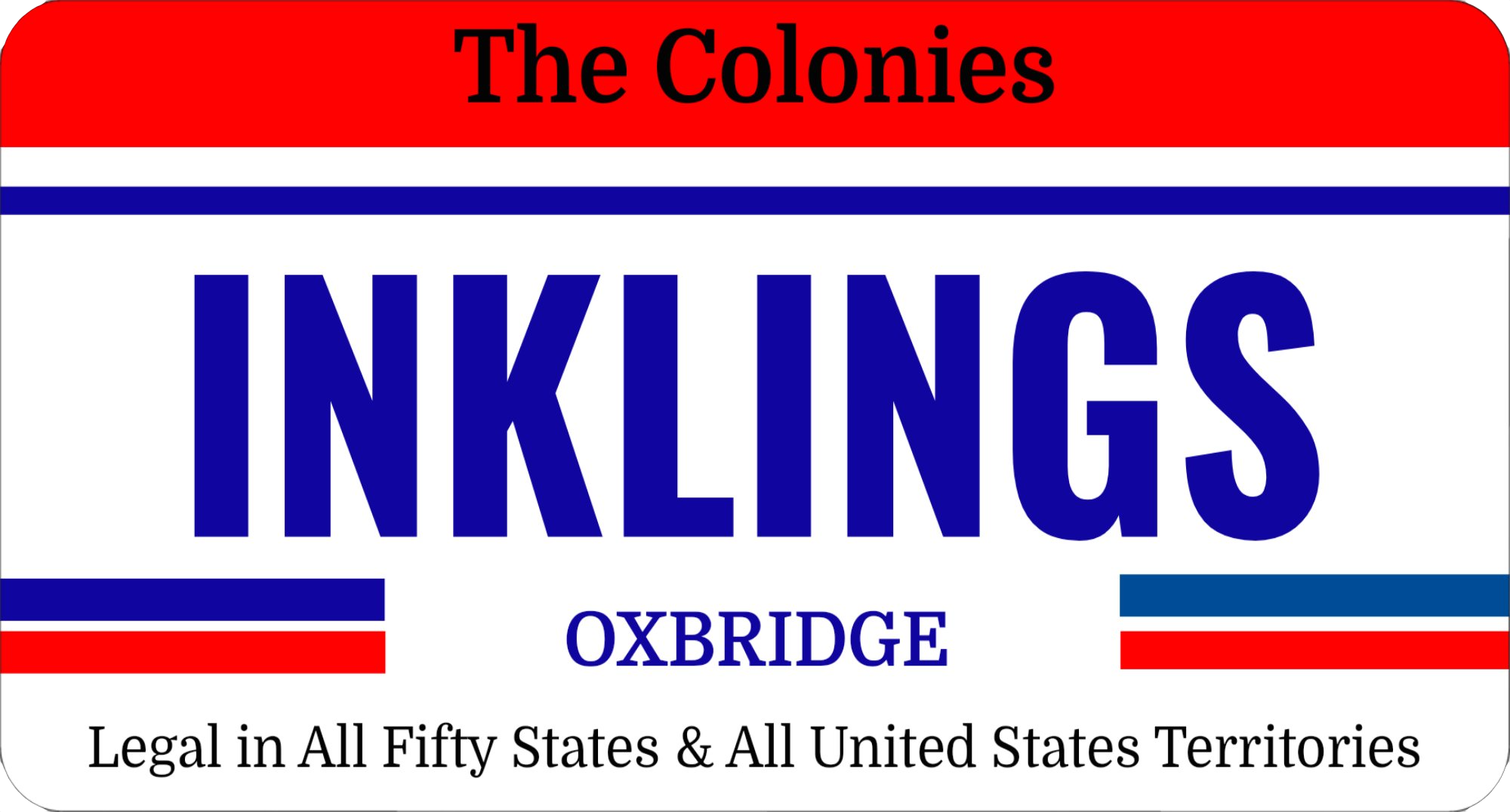

Individualism, License Plates & C.S. Lewis

One of the peculiar things about the United States is the extreme degree to which people are driven to stand out from the crowd. We are able to do this with our automobiles, for example, in a rather odd way.

C.S. Lewis was immune to the temptation discussed here, since he was never a fan of cars, as I discussed in “C.S. Lewis & Automobiles.”

In his autobiography, Lewis declared “I number it among my blessings that my father had no car, while yet most of my friends had, and sometimes took me for a drive.” Those who are curious about Lewis’ dichotomy concerning vehicles, should refer to that post.

I don’t know how many other countries do this, but in most of the United States states, people have the option of getting random numbers and letters on their license plates – or opting for so-called vanity plates.

These individually emblazoned metallic placards perform a sort of Third Estate heraldic device. They often include variations on surnames or words significant to the bearer.

Obviously, offensive words are prohibited, but they are frequently quite creative. Here are a few examples: SO 4CHN8 and its opposite, EN-V ~  GONA B L8 which is probably an insufficient excuse to the cop who pulls you over ~ IBMEUBU with its live and let live philosophy versus URAMESS ~ UH AS IF from California, of course ~ IOU DAD from a grateful child ~ BWAHAHA and the clearer message from Vermont, BBRRRR ~ TWOCUTE can either refer to attractive twins, or to an illiterate narcissist ~ BBQ=LUV celebrates a common American favorite ~ and, this provocative phrase ITS A SIN. Hundreds more examples are online if you’re curious.

It’s fascinating that Americans will pay often exorbitant surcharges to individuate their auto plates. Especially in light of the fact that we already have different plates for each of the 50 states and a Federal District (for our national capital), as well as others for Territories and Protectorates. Prepare yourself. Seriously, prepare for a shock.

All of the 8,331 License Plates in America

States now offer a vast menu of personalized plate options for a dizzying array of organizations, professions, sports teams, causes and other groups.

Such plates typically include a surcharge to support the theme identified on each choice, as for Maryland’s Beekeepers, Barbershop Quartet Singers, or the Baltimore Bicycling Club. And we mustn’t forget their plate promoting the museum of the B&O Railroad (of Monopoly fame).

How can we arrive at that unbelievable number? Well, consider Illinois, for example. They boast no fewer than forty different options related to military alone. Hawaii has the fewest overall varieties at fourteen. Maryland, likely desperate for revenue, actually has nine hundred and eighty-nine. I am curious why they bothered to stop short of an even thousand.

Add to that the fact that nineteen states do not require a license on the front of the car, which invites the substitution of an individualized alternative. Consequently, there are statutes ensuring “most states also require that you do not mount your plate upside down.” In many of these, you would be legally allowed to mount decorative or business plates, but not alternative license plates, misleadingly different from your true registration.

Individuality run amok. The chaos sadly seems strikingly American.

Which brings me to the reason I was thinking about this unusual topic. Heading to church on Sunday I saw a plate with a curious message. It was one of my state’s options for Fire Fighters. The message it bore consisted of just three letters: UGH.

What does that convey to you? Since it appeared on a vocational emblem, my thought is that it reflects the feelings of someone who has grown tired of their profession. The best construction I can imagine is someone frustrated by the fact that after every fire they suppress there will come another. Resulting in a sense of futility or ennui. If you interpret it differently, please let me know.

I mean, we’ve all had ugh-days. But to feel ugh enough about life to indelibly express it this way . . . well, all I could do was hope it was an unconventional joke, and offer a quick prayer for the driver, in case it wasn’t.

C.S. Lewis offered many insights about our God-given individuality and uniqueness. Individualism, as a driving force, however, is something different. I recently read a wonderful article about how Lewis assessed individualism’ interplay with collectivism – two relentless forces in many Western cultures. “C.S. Lewis on Individualism, Equality and the Church” focuses on a World War Two speech delivered at Oxford and published as “Membership.”

Our personal uniqueness is not accidental. As C.S. Lewis wrote in The Problem of Pain,”

[God] makes each soul unique. If He had no use for all these differences, I do not see why He should have created more souls than one. Be sure that the ins and outs of your individuality are no mystery to Him; and one day they will no longer be a mystery to you.

In contrast, hyper-individualism is normally deleterious. Yet, the fact that God regards us as precious, irreplaceable beings, and calls each of us by our personal name, is wondrous news. It can accomplish two things related to the discussion above: (1) it puts personalized license plates in their proper perspective, and (2) it reminds us that even though we occasionally feel frustrated or despondent, our overall life attitude should never be summed up with an ugh.


Editor’s Note: In the interest of journalistic transparency, yours truly, while experiencing many moves, has participated in the automotive bacchanalia described above. Twice I secured military-related plates, Alabama’s Desert Shield/Desert Storm veterans and Illinois’ POW/MIA remembrance commemorations. In addition, while stationed in Guam, I secured plates with my surname.

I have asked my children to have me hospitalized for dementia should I ever decide to order our Washington State J.P. Patches Pal license plate. The reasons for that decision are obvious.

Chocolate Mushrooms

mushroomThat’s right, chocolate mushrooms. And it gets worse.

Some flavors are not intended to ever be combined. Years ago, some friends who knew I loved chocolate and despised mushrooms found the perfect gift for me. Chocolates shaped like mushrooms.

There was only one small problem. The chocolates were actually mushroom-flavored. Imagine a chocolate bar melted into a can of cream of mushroom soup, and you get the idea.

Even people like my wife who love both distinct tastes, couldn’t stomach the blend.

Well, a new product has entered the market and it immediately reminded me of that unsavory fiasco.

A company in Hawaii has capitalized on merging two very flavors that are popular in many locales but just sound a wee bit incompatible. They have taken the delectable taste and gentle crunch of macadamia nuts and accented them with the aromatic zest of spam.

That’s right. Spam-flavored macadamia nuts. They sound irresistible, don’t they?

Probably not. But then, most readers of Mere Inkling aren’t in the target audience of Hamakua Macadamia Nut Company. The fact is—and those of us who’ve experienced the joy of living in the Pacific and Micronesia know this well—there are vast numbers of people who absolutely love spam.

I actually don’t have an objection to either of these products . . . individually. Spam casserole was a staple in the home of my youth, and I can eat it with pleasure today. Macadamias still seem a bit exotic and shipping costs make them a bit pricier than most of their competition, but they taste great.

Two wonderful flavors. Logic tells us that if they are both good alone, they’ll be even better together!

But some things were never meant to be combined.

Then again, some different qualities are magnificent when they are brought together. This is especially true when it comes to the art of writing.

Evelyn Underhill, a gifted author in her own right, composed a letter to C.S. Lewis in 1938 praising him for his recently released Out of the Silent Planet.

It is so seldom that one comes across a writer of sufficient imaginative power to give one a new slant on reality: & this is just what you seem to me to have achieved. And what is more, you have not done it in a solemn & oppressive way but with a delightful combination of beauty, humour & deep seriousness. I enjoyed every bit of it, in spite of starting with a decided prejudice against “voyages to Mars.”

“Beauty, humor, and deep seriousness . . .” Traits those of us who love Lewis’ work have come to expect. In great quantity. And we are not disappointed.

Good writing can excel in a single dimension. Great writing, it seems to me, earns that appellation by weaving together a variety of strong “flavors.”

It’s like comparing a superb violin solo to a flawless symphony. Part of the wonder of the latter is the skill with which each disparate element combines into a glorious whole.

Or, returning to the culinary realm with which we began, powerful writing properly combines distinct flavors that complement one another . . . such as chocolate and peanut butter, or spam and . . . Well, I trust I’ve made my point.

Nature’s Hazards

tumbleweedsNo matter where in the world you live, you are vulnerable to dangers uniquely associated with that locale. Some of us have moved around and weathered a variety of these threats.

My own family has survived earthquakes in our home state of Washington, ice storms in Oklahoma, nearby tornadoes in Texas, record-setting freezes in Minnesota, both droughts and failed levees in two different California cities along with a Super Typhoon in Guam. (Sometimes we’ve even been assailed by disasters that had no place occurring where they did, like a hurricane that knocked out our power for a full month in England, of all places!)

It’s quite possible that you too have experienced near misses when it comes to suffering Nature’s wrath. (I’d much rather attribute these things to fallen Nature than refer to them as “acts of God.”)

C.S. Lewis offers a wonderful description of Nature in Miracles.

You must have tasted, however briefly, the pure water from beyond the world before you can be distinctly conscious of the hot, salty tang of Nature’s current. To treat her as God, or as Everything, is to lose the whole pith and pleasure of her. Come out, look back, and then you will see . . . this astonishing cataract of bears, babies, and bananas: this immoderate deluge of atoms, orchids, oranges, cancers, canaries, fleas, gases, tornadoes and toads. How could you ever have thought that this was the ultimate reality? How could you ever have thought that it was merely a stage-set for the moral drama of men and women? She is herself.

Offer her neither worship nor contempt. Meet her and know her. If we are immortal, and if she is doomed (as the scientists tell us) to run down and die, we shall miss this half-shy and half-flamboyant creature, this ogress, this hoyden, this incorrigible fairy, this dumb witch. But the theologians tell us that she, like ourselves, is to be redeemed. The “vanity” to which she was subjected was her disease, not her essence. She will be cured, but cured in character: not tamed (Heaven forbid) nor sterilised. We shall still be able to recognise our old enemy, friend, play-fellow and foster-mother, so perfected as to be not less, but more, herself. And that will be a merry meeting.

But, until that glorious day when Nature has been reborn in the culmination of the event that took place on Calvary . . . until that day, Nature remains a capricious neighbor. It’s best to know what she is likely to throw at you based on where you reside—and be prepared. Disaster preparedness is something that the wise will concern themselves before catastrophe strikes.

There are some dangers, however, for which one cannot adequately prepare. The prospects of mega-tsunamis terrify me (and I don’t even live by the sea). Then there are zombie outbreaks, which are apparently taking place on a frequent basis, if the plethora of media on that ghoulish subject is any indication.

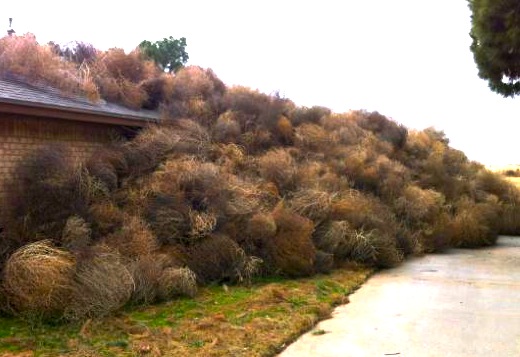
The photograph at the top of this page reveals a grim threat to life on the American plains. There may be a few other places where these merciless creatures wreak havoc (the arid portions of Australia, perhaps), but I hope most of those reading this have been spared the visage of plagues of tumbleweeds racing across the horizon in search of victims to overrun, scar, and bury. As the picture shows, sometimes it is not even safe to shelter in a home during a particularly virulent attack.

I’ve seen many a wayward tumbleweed, while I’ve driven across barren desert terrains. Occasionally you’ll see them alone, scouting ahead of the mass for weak prey. If you see an entire horde, well . . . it’s probably already to late to flee.

This picture makes me shiver. It’s one reason I’m so happy to have moved home to Puget Sound, where the incessant rain* keeps everything green. I can put up with an occasional tectonic jiggle, if it means I don’t have to worry about being buried alive beneath a mountain of desiccated thorns.

_____

* The rainfall in western Washington is highly exaggerated. It’s true that for half of the year it receives more rain than the national average, but the other six months it receives less than average of the rest of the nation.

Also, I don’t believe it is an accident that one of the most commonly encountered tumbleweeds in the United States is Salsola tragus, an utterly humorless thistle that invaded from Russia at the end of the nineteenth century. Despite occasional eruptions, it seems to be lying in wait, for the most part, growing in strength for the final conflagration between humanity and noxious weeds and their allies, the triffids.

International Blogging

countries

Who reads blogs? Well, initially, we find just two sources of readers.

  1. Family & Close Friends who we can coerce into reading it, and put on the spot by publicly asking questions related to our recent columns to tighten the screws just a smidge.
  2. Fellow bloggers who search for interesting reads with the ulterior hope that the writers of posts they “like” will make a reciprocal journey to their site.

Expanding beyond those two categories is the challenge. I suspect that most bloggers are resigned to only reaching a relatively small audience. And that’s not necessarily a bad thing. After all, junk mail reaches the boxes of millions, but it is tossed into recycling without a second thought. On the other hand, a blog may only be read by a handful of people, but one or two of them may be wonderfully touched or encouraged through that brief encounter. Junk mail is deleted with a groan. Our posts, in sharp contrast, may elicit a smile, a laugh, or perhaps even an appropriate tear.

I can settle for that.

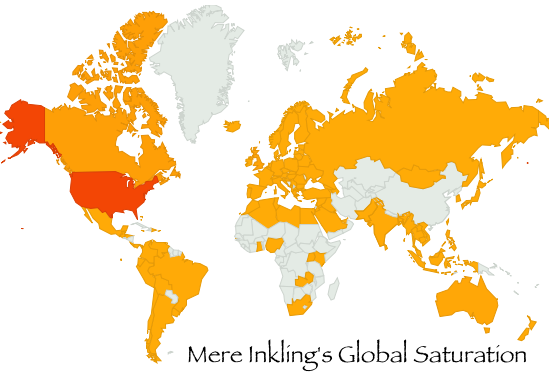
One of the nice things about being part of the WordPress community is the way writers can monitor their site statistics. One fascinating feature is “Views by Country,” which tracks the national origin of visitors to a blog. (Well, not necessarily their ethnic origin, but the country from which they established their online connection with the website.)

Checking out this resource is fantastic for several reasons. First, it’s pleasant as we note visits from locales with which we have a special bond. Republic of Korea, spent a busy year there ministering to those guarding democracy, but still managed to visit many beautiful sites and established many friendships. United Kingdom, got to live there with my family, and visited amazing historic locations too numerous to list. (But, shouldn’t the UK count as three or four countries?) Guam, we got to live there too and enjoy the scenic ocean vistas. (Of course, it’s not a separate country either, being a Territory of the United States.) So what if the word “country” is applied a bit loosely, the sheer breadth of the program’s coverage is impressive.

A second value of the list is that it is educational. You can learn about the existence and/or location of many exotic lands. I’ve had visitors from the Mongolian steppes of the Khans, WWI catalyst Montenegro, freedom-seeking Syria, and the Viking-haunted Faroe Islands.

The third major benefit of visiting the statistics tool is that it can actually reinforce a writer’s sense that someone out there in the vast global unknown is actually interested in their words. I’m amazed, and a mite humbled, to have had visitors to MereInkling from 129 “countries.” Pretty amazing. When I revisit the list every two or three months I see one or two newly reached populations. Yet, as I look at the map, I see many nations remain to be reached. For example, most of the “-stans” and many countries in Africa have yet to feel the warm and liberating glimmer of light MereInkling attempts to deliver.

The Remaining Mystery

I am still plagued by one unanswered question though.

I readily understand why the People’s [misnamed] “Republic” of China has barred MereInkling from internet availability for their billions of prisoners residents.

What perplexes me is why the Kingdom of Denmark has barred access to MereInkling for the subjugated country of Greenland?!? One would think that, in light of their 5 day summer and 360 winter that they would be eager to read something as entertaining as MereInkling. Why has an internet wall been erected to prevent them from doing so? What, we must wonder, is going on behind that impenetrable Ice Curtain?

Yes, for those who think they’ve noted a flaw in my conspiracy theory, I am fully aware that the Faroe Islands are also technically part of the Danish empire. So, why would citizens of Denmark proper and the occupied Faroes be allowed to visit MereInkling while the Greenlanders are left to find enjoyment in measuring the advance and retreat of massive glaciers? The mystery deepens.

As C.S. Lewis wrote in “The Efficacy of Prayer,” in a passage I’ve wrenched completely out of context: “There is a mystery here which, even if I had the power, I might not have the courage to explore.”

Replacing Exonyms

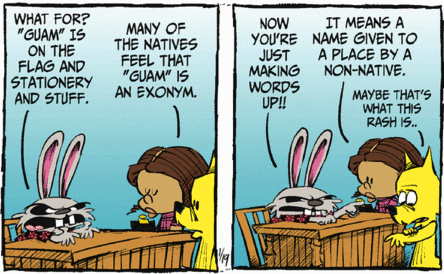
Scott Stantis has illustrated once again how educational some current comic strips can be. His current story arc takes place in Guam. (Guam’s a lovely United States Territory where my family and I lived for two wonderful years in the nineties.)

The story line involves a presidential candidate who has taken refuge there and was asked his opinion about formally changing the island’s name. (There is a movement seeking to replace “Guam” with “Guahon,” the island’s name in the Chamorro language.) You can follow the entire series at Prickly City.

As the panel shows, the (rabbit) senator is unaware that “Guam” is actually an exonym. As such, there is a valid reason to consider its replacement.

Kids today are growing up knowing prominent international cities by names that still seem “foreign” to many of us adults. Beijing has been around just long enough to sound right. But it will always be remembered as Peking to some. Mumbai, as a more recent adjustment, rings alien in the ears of those who still think of the most populous city in India as Bombay.

Still, it makes sense to attempt to refer to cities and nations as the residents of those locales do. For one thing, it is a sign of respect.

And this kind of transition is not an example of thoughtless or random “verbicide” which C.S. Lewis described in “Studies in Words.” There he wrote:

Verbicide, the murder of a word, happens in many ways. Inflation is one of the commonest; those who taught us to say awfully for “very,” tremendous for “great,” sadism for “cruelty,” and unthinkable for “undesirable,” were verbicides.

Replacing exonyms is meaningful to those it directly affects. And it is little more than an inconvenience to the rest of us. So, I’m in favor of it.

Just as I’m always in favor of comic strips that educate as well as entertain!