Following Your Heart

trust your heartI read a lot. That’s no surprise, and it’s true of most readers of Mere Inkling. We read a lot.

It is not easy to resist the temptation to pass on many more of the profound insights I encounter on my literary meanderings. I am encouraged there are so many brilliant people in the world who understand what it means live life with integrity and influence in this new millennium.

I want to share a comment taken from a recent interview with Steven James.* He has authored more than thirty books, and won a number of awards. Since most of my reading is nonfiction, I confess I’m not familiar with his writings, but based on the interview I am quite intrigued about his work.

James was asked: “Are non-Christian books and movies more often either manic or depressant?”

That’s a nicely provocative question. There are certainly many examples that could justify either response. In his response, James identifies one of the lies that has come to dominate Western thinking—that there is no ultimate, objective truth.

Building upon that underlying premise, we see the inevitable consequence. Today’s governing philosophy has become one of personal freedom and choice. Nothing (certainly not a nonexistent agreement on right and wrong) can stem the resultant  moral and ethical chaos.

“To thine own self be true,” reads one of Shakespeare’s best recalled lines. Its power arises from the fact it resonates with our deepest desires. Don’t impose your standards on me, our flesh cries out, I will be the master of my own destiny. Of course we wouldn’t want to be untrue to our own conscience. The part that is so often left out here, is the need to pursue truth (Truth).

The Book of Proverbs includes the following maxim: “Every way of a man is right in his own eyes . . .” (We prefer to dispense with the second part of the wisdom saying: “. . . but the Lord weighs the heart.”)

What, you may be wondering, was James’ response to the interview question. Trust me, it was worth the wait.

Some movies and books say life is just terrible now: Slit your wrists. Disney on the other hand is: Follow your dreams and everything will be wonderful in the end. This whole idea of follow your heart—that’s not Christian either. Rapists follow their hearts. Pedophiles are true to themselves.

Nazis pursued their dreams. The Bible says that the heart’s deceitful above all things. Why would you want to follow something deceitful? We believe you should follow something greater than your heart, that you need Someone else to inform your dreams. We turn to God.

Point made. Nihilistic films aside, even the sentimental, idealistic, “positive” types of entertainment are fundamentally flawed. Neither reflects reality. And, while the poisoned fruit of the former may be more apparent in its corruption than the latter, the produce of unrealistic optimism is also tainted.

C.S. Lewis describes the untrustworthiness of personal desires, consciences and hearts.

“If our heart condemn us, God is greater than our heart.” And equally, if our heart flatter us, God is greater than our heart.

I sometimes pray not for self-knowledge in general but for just so much self-knowledge at the moment as I can bear and use at the moment; the little daily dose. Have we any reason to suppose that total self-knowledge, if it were given us, would be for our good?

Children and fools, we are told, should never look at half-done work; and we are not yet, I trust, even half-done. You and I wouldn’t at all stages, think it wise to tell a pupil exactly what we thought of his quality. It is much more important that he should know what to do next. . . . The unfinished picture would so like to jump off the easel and have a look at itself! (Letters to Malcolm).

This isn’t all bad news, of course. As Lewis says, we are freed from depending on our hearts—the emotions of the moment—for our understanding. We no longer need to be “tossed about by the waves” of circumstance.

In the scriptural passage Lewis cites, we are reminded that “God is greater than our hearts.” He alone deserves to be the “Someone else” who “informs our dreams” and reveals to us reality. And, the wonderful result is that when we listen to God, we learn just how deeply he loves us.

_____

* The interview was entitled “Truth Teller,” and appears in the 14 December 2013 issue of World magazine.

Having Our Writing Criticized

roeShould literary critics look down on authors whose work proves popular with “common” people? Is it appropriate for the literary elite to smirk dismissively whenever the prose of a writer outside their circle resonates with the masses?

These, my friends, are rhetorical questions. The answer to both is “no,” and if you believe otherwise, you probably won’t find yourself too comfortable with the opinions shared here at Mere Inkling.

I believe each piece of literature, regardless of its source, should be judged on its own merits. Not all genres appeal to all people. And not all writers compose their works with equal skill. Nevertheless, it is possible for even a poor miner to strike gold.

Likewise, an accomplished writer is not infallible. Even a master wildcatter can sink a dry well.

I’ve been writing an article about Civil War chaplain who became one of America’s most popular writers during the nineteenth century. In fact, many years his novels outsold the works of Samuel Clemens himself.

And yet, despite his success—or possibly, because average people enjoyed his stories—he received an extraordinary amount of criticism from the literary establishment.

I’m going to share his insights about writing in a moment, but  before doing so, I want to draw a parallel with one of the twentieth century’s most gifts authors. C.S. Lewis was loved by common women and men of Britain and other English-speaking countries. And yet, this very popularity undermined his standing in the world of academia and, I daresay, literary snobbery.

Lewis describes this condescending mindset in a 1939 essay entitled, “High Brows and Low Brows.”

The great authors of the past wrote to entertain the leisure of their adult contemporaries, and a man who cared for literature needed no spur and expected no good conduct marks for sitting down to the food provided for him.

Boys at school were taught to read Latin and Greek poetry by the birch, and discovered the English poets as accidentally and naturally as they now discover the local cinema. Most of my own generation, and many, I hope, of yours, tumbled into literature in that fashion.

Of each of us some great poet made a rape when we still wore Eton collars. Shall we be thought immodest if we claim that most of the books we loved from the first were good books and our earliest loves are still unrepented? If so, that very fact bears witness to the novelty of the modern situation; to us, the claim that we have always liked Keats is no prouder than the claim that we have always liked bacon and eggs. For there are changes afoot.

I foresee the growth of a new race of readers and critics to whom, from the very outset, good literature will be an accomplishment rather than a delight, and who will always feel, beneath the acquired taste, the backward tug of something else which they feel merit in resisting.

Such people will not be content to say that some books are bad or not very good; they will make a special class of “lowbrow” art which is to be vilified, mocked, quarantined, and sometimes (when they are sick or tired) enjoyed. They will be sure that what is popular must always be bad, thus assuming that human taste is naturally wrong, that it needs not only improvement and development but veritable conversion.

For them a good critic will be, as the theologians say, essentially a “twice-born” critic, one who is regenerate and washed from his Original Taste. They will have no conception, because they have had no experience, of spontaneous delight in excellence.

I confess I’ve sometimes felt slightly embarrassed when in the presence of a group of people singing the praises of authors of fiction popular among the well-educated. Sometimes I don’t even recognize their names, much less have an idea of what they have written.

Part of my “handicap” rises from the fact that I’m by and large a non-fiction sort of guy. As seminary I was less enraptured by abstract “systematic theology” than the time-proven lessons learned during the Church’s two millennia history. Likewise, I found “practical theology” far more beneficial. After all, I was being equipped not to be a theologian per se, but to become a shepherd entrusted with the cura animarum (the cure of souls).

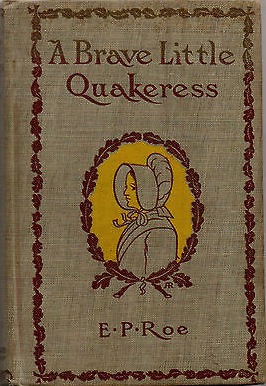
In that spirit, valuing history and lessons I could put into practice as a pastor and writer, I have been researching the legacy of Edward Payson Roe (1838-1888). He was a Presbyterian pastor who served as a chaplain in the Union cavalry, and later as a military hospital chaplain.

After the war, Roe served a congregation, and eventually turned his energies to writing wholesome fiction. He played a key role in helping many suspicious Protestants realize that, like manna, fiction was neither good nor bad. It’s effects depended on the use to which it was put. Roe proved quite popular with readers. Less so with the literary establishment.

The following account comes from an essay about his life solicited by one of the prominent magazines of his day. It is well worth reading, touching as it does on a broad range of subjects, including international copyrights and the vagaries of publishing in the late 1800s. Most precious, though, are the echoes of Roe’s humility and his realistic understanding of the vocation of writing.

“While writing my first story, I rarely thought of the public, the characters and their experiences absorbing me wholly. When my narrative was actually in print, there was wakened a very deep interest as to its reception. I had none of the confidence resulting from the gradual testing of one’s power or from association with literary people, and I also was aware that, when published, a book was far away from the still waters of which one’s friends are the protecting headlands.

“That I knew my work to be exceedingly faulty goes without saying; that it was utterly bad, I was scarcely ready to believe. Dr. Field, noted for his pure English diction and taste, would not publish an irredeemable story, and the constituency of the New York ‘Evangelist’ is well known to be one of the most intelligent in the country.

“Friendly opinions from serial readers were reassuring as far as they went, but of course the great majority of those who followed the story were silent. A writer cannot, like a speaker, look into the eyes of his audience and observe its mental attitude toward his thought. If my memory serves me, Mr. R.R. Bowker was the earliest critic to write some friendly words in the ‘Evening Mail;’ but at first my venture was very generally ignored.

Then some unknown friend marked an influential journal published in the interior of the State and mailed it so timely that it reached me on Christmas eve. I doubt if a book was ever more unsparingly condemned than mine in that review, whose final words were, ‘The story is absolutely nauseating.’ In this instance and in my salad days I took pains to find out who the writer was, for if his view was correct I certainly should not engage in further efforts to make the public ill.

“I discovered the reviewer to be a gentleman for whom I have ever had the highest respect as an editor, legislator, and honest thinker. My story made upon him just the impression he expressed, and it would be very stupid on my part to blink the fact. Meantime, the book was rapidly making for itself friends and passing into frequent new editions. Even the editor who condemned the work would not assert that those who bought it were an aggregation of asses. People cannot be found by thousands who will pay a dollar and seventy-five cents for a dime novel or a religious tract.

“I wished to learn the actual truth more sincerely than any critic to write it, and at last I ventured to take a copy to Mr. George Ripley, of the New York ‘Tribune.’ ‘Here is a man,’ I thought, ‘whose fame and position as a critic are recognized by all. If he deigns to notice the book, he will not only say what he thinks, but I shall have much reason to think as he does.’ Mr. Ripley met the diffident author kindly, asked a few questions, and took the volume. A few weeks later, to my great surprise, he gave over a column to a review of the story. Although not blind to its many faults, he wrote words far more friendly and inspiring than I ever hoped to see; it would seem that the public had sanctioned his verdict

“From that day to this these two instances have been types of my experience with many critics, one condemning, another commending. There is ever a third class who prove their superiority by sneering at or ignoring what is closely related to the people. Much thought over my experience led to a conclusion which the passing years confirm: the only thing for a writer is to be himself and take the consequences. Even those who regard me as a literary offender of the blackest dye have never named imitation among my sins.

“As successive books appeared, I began to recognize more and more clearly another phase of an author’s experience. A writer gradually forms a constituency, certain qualities in his book appealing to certain classes of minds. In my own case, I do not mean classes of people looked at from the social point of view. A writer who takes any hold on popular attention inevitably learns the character of his constituency. He appeals, and minds and temperaments in sympathy respond. Those he cannot touch go on their way indifferently; those he offends may often strike back. This is the natural result of any strong assertion of individuality.

“Certainly, if I had my choice, I would rather write a book interesting to the young and to the common people, whom Lincoln said ‘God must love, since He made so many of them.’ The former are open to influence; the latter can be quickened and prepared for something better. As a matter of fact, I find that there are those in all classes whom my books attract, others who are repelled, as I have said.

“It is perhaps one of the pleasantest experiences of an author’s life to learn from letters and in other ways that he is forming a circle of friends, none the less friendly because personally unknown. Their loyalty is both a safeguard and an inspiration. On one hand, the writer shrinks from abusing such regard by careless work; on the other, he is stimulated and encouraged by the feeling that there is a group in waiting who will appreciate his best endeavor.

“While I clearly recognize my limitations, and have no wish to emulate the frog in the fable, I can truthfully say that I take increasing pains with each story, aiming to verify every point by experience—my own or that of others. Not long since, a critic asserted that changes in one of my characters, resulting from total loss of memory, were preposterously impossible. If the critic had consulted Ribot’s ‘Diseases of Memory,’ or some experienced physician, he might have written more justly.

“I do not feel myself competent to form a valuable opinion as to good art in writing, and I cannot help observing that the art doctors disagree woefully among themselves. Truth to nature and the realities, and not the following of any school or fashion, has ever seemed the safest guide. I sometimes venture to think I know a little about human nature. My active life brought me in close contact with all kinds of people; there was no man in my regiment who hesitated to come to my tent or to talk confidentially by the campfire, while scores of dying men laid bare to me their hearts. I at least know the nature that exists in the human breast.

“It may be inartistic, or my use of it all wrong. That is a question which time will decide, and I shall accept the verdict. Over twelve years ago, certain oracles, with the voice of fate, predicted my speedy eclipse and disappearance. Are they right in their adverse judgment? I can truthfully say that now, as at the first, I wish to know the facts in the case. The moment an author is conceited about his work, he becomes absurd and is passing into a hopeless condition. If worthy to write at all, he knows that he falls far short of his ideals; if honest, he wishes to be estimated at his true worth, and to cast behind him the mean little Satan of vanity. If he walks under a conscious sense of greatness, he is a ridiculous figure, for beholders remember the literary giants of other days and of his own time, and smile at the airs of the comparatively little man. On the other hand, no self-respecting writer should ape the false deprecating ‘’umbleness’ of Uriah Heep. In short, he wishes to pass, like a coin, for just what he is worth.

“Mr. Matthew Arnold was ludicrously unjust to the West when he wrote, ‘The Western States are at this moment being nourished and formed, we hear, on the novels of a native author called Roe.’ Why could not Mr. Arnold have taken a few moments to look into the bookstores of the great cities of the West, in order to observe for himself how the demand of one of the largest and most intelligent reading publics in the world is supplied? He would have found that the works of Scott and Dickens were more liberally purchased and generally read than in his own land of ‘distinction.’ He should have discovered when in this country that American statesmen (?) are so solicitous about the intelligence of their constituents that they give publishers so disposed every opportunity to steal novels describing the nobility and English persons of distinction; that tons of such novels have been sold annually in the West, a thousand to one of the ‘author called Roe.’

“The simple truth in the case is that in spite of this immense and cheap competition, my novels have made their way and are being read among multitudes of others. No one buys or reads a book under compulsion; and if any one thinks that the poorer the book the better the chance of its being read by the American people, let him try the experiment. When a critic condemns my books, I accept that as his judgment; when another critic and scores of men and women, the peers of the first in cultivation and intelligence, commend the books, I do not charge them with gratuitous lying. My one aim has become to do my work conscientiously and leave the final verdict to time and the public. I wish no other estimate than a correct one; and when the public indicate that they have had enough of Roe, I shall neither whine nor write.”

_____

If you are interested in learning more about E.P. Roe, check out my article in the new issue (4.2) of Curtana: Sword of Mercy which was published online just last week.

Hip-Hop Literary Lessons

flocabDo you ever have trouble remembering the key elements of a story? Well, you may not now, since you’ve become an accomplished writer. However, there was once a time when you were just learning about such matters. And that learning might have been far easier than it was if some of today’s teaching resources existed then.

This week I stumbled across a very unusual approach to teaching the fundamental building blocks of stories. You might want to bookmark the page, in case you ever experience difficulty remembering those five pesky elements required for your short fiction, or want to teach a young learner. You need look no further than Flocabulary’s innovative lesson “Five Things.”

The song is less than four minutes long, so go ahead and watch it now, before reading on. (Barring a small typo, it’s quite educational, and their website includes testimonials from teachers affirming how well it connects with young people.) Despite the fact that it’s got a hip-hop beat—not my favorite musical genre—it’s actually quite entertaining . . . and it’s easy to see how well it would connect with today’s younger students.

[Warning: If you watch the following video, you may well be singing along with the chorus before it ends.] Story Elements

Plot, Character, Conflict, Theme,
Setting, yes these are the 5 things
That you’re going to be needing
When you’re reading or writing
A short story that’s mad exciting.

Music is a powerful medium, and when it is harnessed for educational purposes, it can accomplish wonderful things.

Music can be enjoyed for itself . . . its own inherent loveliness.

Music can also be used to communicate holy things. I believe this is the very reason it exists. Divine grace and our response to our Creator’s love are too majestic to be restricted to simple words.

The brilliant African Bishop Augustine of the city of Hippo is cited as saying “he who sings, prays twice.” Many have echoed these words. I have no doubt Augustine believed this, but the more accurate quotation is: “he who sings well prays twice” (bis orat qui bene cantat). Lest those of us with less than professional vocal chords be dismayed, I am confident the “well” here refers here to worshiping God in spirit and truth (John 4:23).

I have no doubt which of these two pleases God more. The most wondrous voice ever created (a gift itself from our Creator) flawlessly navigating three octaves and singing of the cares of this world—or the feeble, cracking, off-key strains of a tone deaf beggar who is praising the Lord for the gift of his daily bread.

C.S. Lewis famously expressed his disaffection for most church hymnody in a 1950 letter where he wrote:

I naturally loathe nearly all hymns; the face and life of the charwoman in the next pew who revels in them, teach me that good taste in poetry or music are not necessary to salvation.

We must forgive Lewis his condescending comment here, which was only meant for a private communication. And, if read in context it can be interpreted almost as a sort of confession. While he disliked the quality of contemporary Anglican hymns, he was acutely aware of how insignificant the matter was in light of the vital importance of  knowing Christ. (His description of the glorification of the modest Sarah Smith in The Great Divorce reveals how well he recognized that the charwoman beside him, despite her musical preferences, could easily dwarf him in holiness and religious courage.)

In a letter written in 1916, Lewis alluded to the wonder of music, and it’s relationship to particular words. “Isn’t it funny the way some combinations of words can give you—almost apart from their meaning—a thrill like music?”

Toward the end of his life, Lewis invested much time in a literary study of Edmund Spenser’s The Faerie Queene. (It was actually published after his death, based upon his notes, as Spenser’s Images of Life. It includes a sparkling description of the book as a musical masterpiece.

A story of this kind is in a way more like a symphony than a novel. Corresponding to the themes of the musical form, the literary form has images, which may be delicious or threatening or cryptic or grotesque, but which are always richly expressive of mood.

The images are in every possible relation of contrast, mutual support, development, variation, half-echo, and the like, just as the musical themes are. But the ostensible connection between them all—what keeps the meddling intellect quiet—is here provided by the fact that they are all happening to someone.

They are all worked into the experience or the world of the characters “whose” story it is. That, no more and no less, is the raison d’étre of characters in the characterless story.

I have no doubt Lewis would have found the video above jarring. Yet, I suspect he would have approved of the fact that the music was creating a bridge to some for whom traditional learning is incomprehensible. He was a traditionalist. In many ways, a medievalist. But he was, above all, a redeemed child of God. And, because of that, he desired the best for his neighbor, his nation, and our world.

That said, I don’t want to hear that any readers of Mere Inkling got it into their heads to put any of C.S. Lewis’ words into hip-hop melodies. Ever!

_____

If you are interested in checking out the official website for Flocabulary, you can view their lesson “Wordplay” (on figurative language). I understand, however, that some of their lessons with political dimensions have been considered superficial.

Orwellian Advice

cls orwellThe title of this post is slightly misleading. In truth, it does contains advice from Eric Arthur Blair (1903-1950) whose pen name was George Orwell. However, because of the impact of his two dystopian classics, Nineteen Eighty-Four and Animal Farm, the author’s name has actually become a true English adjective . . . one that might suggest I’m alluding to futuristic or totalitarian matters.

Or·well·i·an [awr-wel-ee-uhn] means something that resembles his literary work, especially as described in the aforementioned novel and novella. (Within the Christian literary community, “Lewisian” is common shorthand for referring to C.S. Lewis . . . but that word is unlikely to ever find its way into standard dictionaries.)

Despite the enormous (and eternal) differences between Orwell and Lewis, they did have something significant in common. More about that in a moment.

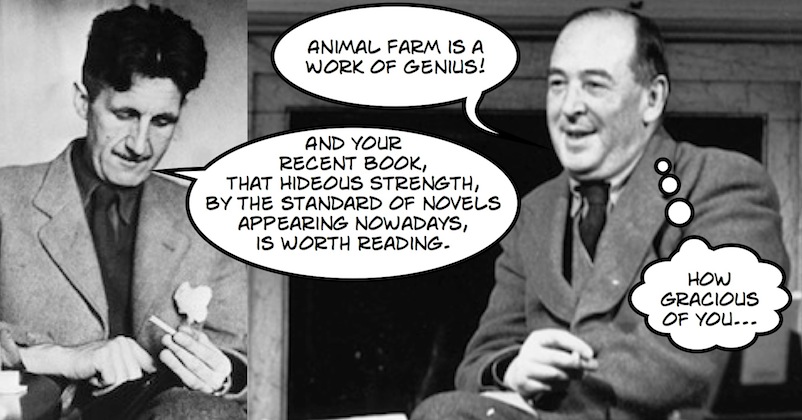
As the graphic I created above reveals (from actual quotations), Lewis had a better opinion of Orwell’s work than vice versa. Orwell disliked Lewis and resented the fact that he was popular among many common people. He particularly disliked Lewis’ traditional (evangelical) Christianity. In his review of That Hideous Strength, Orwell dismissed the biblically based supernatural as a version of “magic.”

Much is made of the fact that the scientists are actually in touch with evil spirits, although this fact is known only to the inmost circle. Mr. Lewis appears to believe in the existence of such spirits, and of benevolent ones as well. He is entitled to his beliefs, but they weaken his story . . .

Orwell was one of those “professing” Christians who is accurately labeled a hypocrite. He was a communing member of the Church of England, and advocated a Judeo-Christian moral code, but did not believe in an afterlife. The following letter, written to Eleanor Jaques in 1932, reveals his hypocrisy.

It seems rather mean to go to HC [Holy Communion] when one doesn’t believe, but I have passed myself off for pious & there is nothing for it but to keep up with the deception.

In a comment to my last post, a good friend of Mere Inkling, Brenton Dickieson at A Pilgrim in Narnia, reminded me of a thought-provoking essay on English written by Orwell. His essay, “Politics and the English Language,” addresses a number of problems with the language. He considers dying metaphors, verbal false limbs, pretentious diction, and meaningless words.

A Similarity in the Two Writers’ Advice

Orwell’s goal is “the scrapping of every word or idiom which has outworn its usefulness. It has nothing to do with correct grammar and syntax, which are of no importance so long as one makes one’s meaning clear, or with the avoidance of Americanisms, or with having what is called a ‘good prose style.’”  [As irritating as I imagine most Europeans find Americanisms!] Writers of fiction will enjoy the way Orwell explains the challenge of “showing, not telling.”

What is above all needed is to let the meaning choose the word, and not the other way around. In prose, the worst thing one can do with words is surrender to them. When you think of a concrete object, you think wordlessly, and then, if you want to describe the thing you have been visualizing you probably hunt about until you find the exact words that seem to fit it.

When you think of something abstract you are more inclined to use words from the start, and unless you make a conscious effort to prevent it, the existing dialect will come rushing in and do the job for you, at the expense of blurring or even changing your meaning. Probably it is better to put off using words as long as possible and get one’s meaning as clear as one can through pictures and sensations. Afterward one can choose—not simply accept—the phrases that will best cover the meaning, and then switch round and decide what impressions one’s words are likely to make on another person.

This last effort of the mind cuts out all stale or mixed images, all prefabricated phrases, needless repetitions, and humbug and vagueness generally. But one can often be in doubt about the effect of a word or a phrase, and one needs rules that one can rely on when instinct fails. I think the following rules will cover most cases:

1. Never use a metaphor, simile, or other figure of speech which you are used to seeing in print.

2. Never use a long word where a short one will do.

3. If it is possible to cut a word out, always cut it out.

4. Never use the passive where you can use the active.

5. Never use a foreign phrase, a scientific word, or a jargon word if you can think of an everyday English equivalent.

6. Break any of these rules sooner than say anything outright barbarous.

These rules sound elementary, and so they are, but they demand a deep change of attitude in anyone who has grown used to writing in the style now fashionable.

Students of Lewis will note in the final passage the parallel with advice he provided to a correspondent in 1956. Although the context is different—Orwell’s is a formal essay and Lewis’ a casual correspondence written to a child, the similarities are significant. Lewis would have been familiar with Orwell’s essay, composed a decade before his letter, but the resemblance between their words is better attributed to shared literary philosophies and the self-evident nature of the principles. Lewis identified five important considerations when writing.

1. Always try to use language so as to make quite clear what you mean and make sure [your] sentence couldn’t mean anything else.

2. Always prefer the plain, direct word to the long, vague one. Don’t implement promises, but keep them.

3. Never use abstract nouns when concrete ones will do. If you mean “More people died” don’t say “Mortality rose.”

4. Don’t use adjectives which merely tell us how you want us to feel about the things you are describing. I mean, instead of telling us a thing was “terrible,” describe it so that we’ll be terrified. Don’t say it was “delightful;” make us say “delightful” when we’ve read the description. You see, all those words (horrifying, wonderful, hideous, exquisite) are only like saying to your readers, “Please, will you do my job for me?”

5. Don’t use words too big for the subject. Don’t say “infinitely” when you mean “very;” otherwise you’ll have no word left when you want to talk about something really infinite.

Whatever the two authors thought about the other, they certainly shared some similar views on the subject of effective writing. And, I think we can assume with confidence that Lewis would concur with Orwell’s final rule. Under no circumstances should we resort to barbarity! For, as Lewis wrote in The Four Loves, “Who does not prefer civility to barbarism?”

____

If you are interested in reading Orwell’s “Politics and the English Language” in its entirety, you can find it here.

Literary Criticism, Inklings Style

bandersnatchIf you’re a writer and you’ve never been part of a critique group, you’ve missed out on some beneficial (and occasionally annoying) experiences.

Critiquing is, of course, the process of providing constructive criticism to someone, in the hopes of improving their work. Good criticism is priceless. The problem is that it takes true skill to offer useful advice . . . and it requires the proper degree of self-assurance to receive the criticism itself.

Those who have been burned by scathing criticism are reticent to “invite” more of the same. However, when the criticism begins with affirmation (about positive aspects of the work), that tiny spoonful of sugar certainly helps the more difficult parts of the evaluation easier to swallow.

And yet, for some, even expertly delivered criticism—covered by a chocolate layer of affirmation and accolades—remains nearly impossible to accept.

A fine example of this truth comes in C.S. Lewis’ description of a prominent member of the Inklings writing fellowship. J.R.R. Tolkien was a virtual perfectionist when it came to all things Middle Earth. Because of this “flaw,” Lewis and the other Inklings were frustrated when it came time to review the progress of The Hobbit and elements of Lord of the Rings. As Lewis described it in a 1959 letter:

No one ever influenced Tolkien—you might as well try to influence a bander-snatch. We listened to his work, but could affect it only by encouragement. He has only two reactions to criticism; either he begins the whole work over again from the beginning or else takes no notice at all.

To learn the nature of a bandersnatch, we must travel Through the Looking Glass into Lewis Carroll’s 1872 novel. Carroll coined the word and introduced it to the world in a poem called “Jabberwocky,” which appears in Alice’s wonderful adventures.

Lewis, of course, was not likening his dear friend to a frumious* bandersnatch in terms of it’s overall personality. Rather, he was describing the severity of Tolkien’s inability to positively process criticism of his work, to the bandersnatch’s incapacity to do the same. It is similar to the sense in which the White King alludes to the creature’s swiftness in describing his wife: “She runs so fearfully quick. You might as well try to catch a Bandersnatch!”

Although few of us are destined to be members of so illustrious a critique community as the Inklings, I highly commend joining one of your local parallels. While you may encounter a bandersnatch or two, on the whole you’ll likely find the process quite beneficial.

____

* “Frumious,” like bandersnatch itself, was coined by Lewis Carroll and is a blending of the words “fuming” and “furious.”

The bandersnatch, as envisioned above, is used with the permission of New Zealand illustrator David Elliot.

Lengthening Good Stories

bayeuxWe’re all familiar with the saying “too much of a good thing.” Because it’s a cliché, most reviewers wisely avoid the phrase, but in reading a fair number of reviews of The Hobbit, I’ve heard this very thought expressed in a number of ways.

Everyone is familiar with Director Peter Jackson’s Oscar-winning trilogy of The Lord of the Rings. Most fans were thrilled when it was announced he would also film J.R.R. Tolkien’s much “smaller” tale of The Hobbit. Some were surprised when they learned he would divide it into two parts. Still, the general sentiment was “the more the better” (another tired phrase). However, when it was ultimately announced that Jackson intended to stretch the modest novel into a trilogy of its own, many fans were incredulous.

There is a tad of irony in transforming Tolkien’s beloved adventure of a hobbit assisting dwarves in a regional quest into an epic to rival the high fantasy of The Lord of the Rings with its conflict enmeshing every corner of Middle Earth.

As I write this column, The Hobbit: An Unexpected Journey is doing well. It is ranked sixth at the box office, and held the number one position for three full weeks, against tough competition.

In order to discover sufficient content to expand the story, Jackson has incorporated a number of Middle Earth tales Tolkien had written about its history in other sources. The primary sourcebook was The Silmarillion, a collection published posthumously by Tolkien’s son Christopher in 1977. Some regard the importing of these elements as a sort of corruption of the simpler story of the single volume. Others welcome the elaboration on the essential story, since the additions are certainly “genuine Tolkien,” and they provide a more elaborate portrayal of Middle Earth.

The reactions to the expansion have been mixed. I don’t have strong feelings either way, but I treasure my time in Middle Earth so highly, that I would likely pitch my tent in the camp of those who approve of the increase. (Not to the point, of course, where I would behead those who objected, as we see on the fragment from the Bayeux Tapestry above.)

In the energetic conversation about the expansion of the saga, people frequently interject the name of the author, and offer suppositions about how he would have reacted. I find this interesting, but somewhat futile. Frankly, there is far too much that we simply don’t know about Middle Earth to authoritatively render Tolkien’s judgment on these things. Yes, we know that he was reluctant to see his work on the screen, but he did sell those rights to his creations. Of course we are aware of his lack of confidence in material originating in the colonies.

In a 1937 letter he writes about a possible publisher in the United States: “As for the illustrations: I am divided between knowledge of my own inability and fear of what American artists (doubtless of admirable skill) might produce.” It is in this same letter that he offers his criticism about a Disneyesque presentation: “It might be advisable, rather than lose the American interest, to let the Americans do as seems good to them—as long as it was possible (I should like to add) to veto anything from or influenced by the Disney studios (for all whose works I have a heartful loathing).”

In an essay entitled “On Criticism,” C.S. Lewis described the limitations of outsiders attempting to discern the intent of authors.

Nearly all reviewers assume that your books were written in the same order in which they were published and all shortly before publication. There was a very good instance of this lately in the reviews of Tolkien’s Lord of the Rings. Most critics assumed (this illustrates a different vice) that it must be a political allegory and a good many thought that the master Ring must “be” the atomic bomb.

Anyone who knew the real history of the composition knew that this was not only erroneous, but impossible; chronologically impossible. Others assumed that the mythology of his romance had grown out of his children’s story The Hobbit. This, again, he and his friends knew to be mainly false. Now of course nobody blames the critics for not knowing these things: how should they? The trouble is that they don’t know they don’t know. A guess leaps into their minds and they write it down without even noticing that it is a guess.

Learning from Lewis, I won’t hazard a guess about Tolkien’s ultimate attitude towards the cinematic portrayals of his works—which will now, I assume, come to carry greater weight in the public psyche than the novels themselves. Well, at least until the current mode of motion pictures becomes obsolete. Then, once again, the words as Tolkien wrote them will reign supreme.

For those who are interested, I created the faux Bayeux Tapestry scrap at the top of the column using a program that allows manipulation of a variety of the hand-stitched images. Then I simply added the text in a simple graphics program. The Historic Tale Construction Kit is available here.

There is also a more sophisticated software interface that I haven’t tried called the “interactive” Bayeux Tapestry.