A Pair of Brilliant Writers

csl & chesterton

Sadly, politics are by definition nearly always polarizing. In the linguistic battleground of political warfare, we seem to more and more frequently encounter a “take no prisoners” attitude. It’s ominous.

I recently read the following words which describe, quite well I think, the positions of the two main rivals in virtually all political campaigns. (And, in this sentence, I’m referring to the military definition of “campaign.”)

“The whole modern world has divided itself into Conservatives and Progressives. The business of Progressives is to go on making mistakes. The business of the Conservatives is to prevent the mistakes from being corrected.”

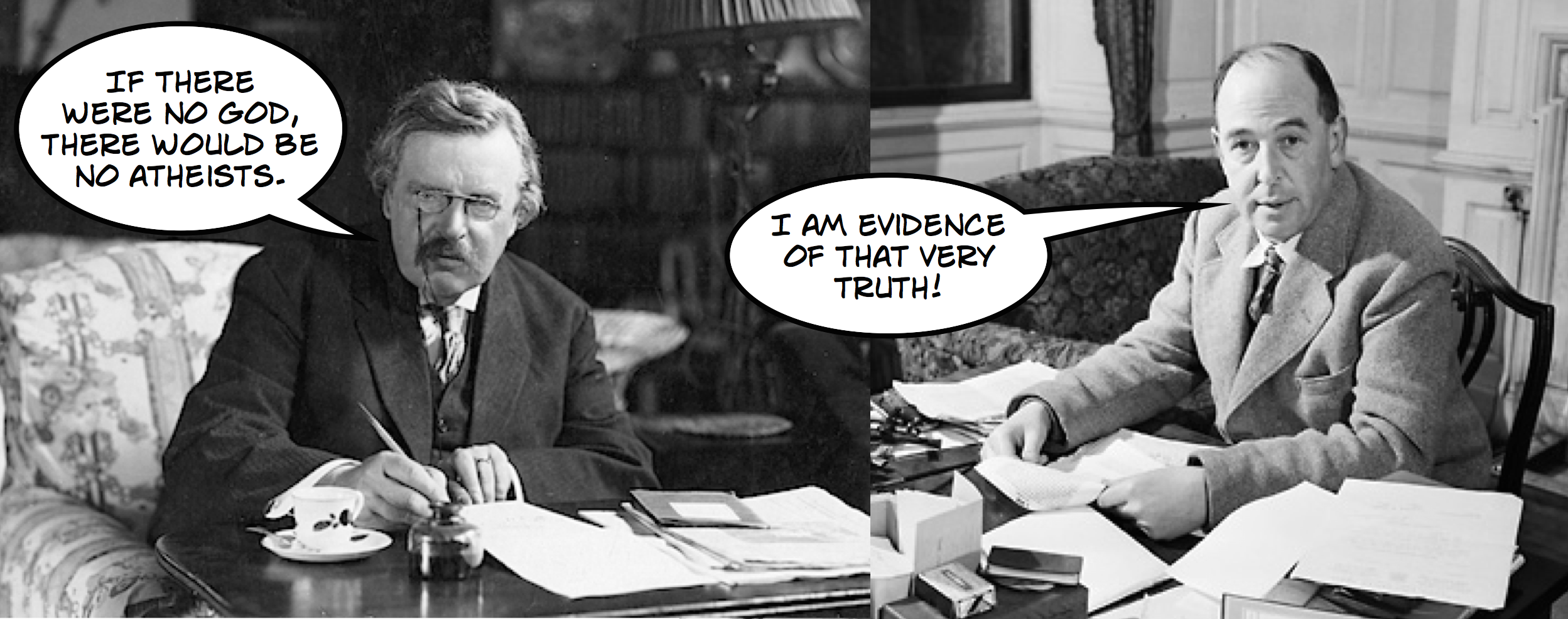
Some things never change. This cutting critique appeared nearly a century ago (in the 19 April 1924 issue of the Illustrated London News). It was penned by G.K. Chesterton, a British writer who was admired by many of his contemporaries, from a number of different perspectives. George Bernard Shaw, a Socialist, considered the conservative journalist a “man of colossal genius.”

Chesterton was one of the Christian writers whose faith made a significant impression on the unbelieving C.S. Lewis. Before encountering Jesus, the atheist Lewis resented the “intrusions” of Christian references into the writings of authors he otherwise enjoyed. He describes this conundrum delightfully in Surprised by Joy.

All the books were beginning to turn against me. Indeed, I must have been as blind as a bat not to have seen, long before, the ludicrous contradiction between my theory of life and my actual experiences as a reader. George MacDonald had done more to me than any other writer; of course it was a pity he had that bee in his bonnet about Christianity. He was good in spite of it.

Chesterton had more sense than all the other moderns put together; bating, of course, his Christianity. Johnson was one of the few authors whom I felt I could trust utterly; curiously enough, he had the same kink. Spenser and Milton by a strange coincidence had it too.

Even among ancient authors the same paradox was to be found. The most religious (Plato, Aeschylus, Virgil) were clearly those on whom I could really feed.

On the other hand, those writers who did not suffer from religion and with whom in theory my sympathy ought to have been complete—Shaw and Wells and Mill and Gibbon and Voltaire—all seemed a little thin; what as boys we called “tinny.” It wasn’t that I didn’t like them. They were all (especially Gibbon) entertaining; but hardly more. There seemed to be no depth in them. They were too simple. The roughness and density of life did not appear in their books. . . .

The upshot of it all could nearly be expressed in a perversion of Roland’s great line in the Chanson—Christians are wrong, but all the rest are bores. The natural step would have been to inquire a little more closely whether the Christians were, after all, wrong.

And C.S. Lewis, to his eternal joy, did just that. He inquired more deeply into the faith held by the writers he so respected. This included, of course, Chesterton. Echoes of Chesterton’s masterful expressions of Christian faith recur in the work of Lewis. For example, in his essay “Membership,” Lewis writes:

Equality is a quantitative term and therefore love often knows nothing of it. . . . Even in the life of the affections, much more in the body of Christ, we step outside that world which says “I am as good as you.” . . . We become, as Chesterton said, taller when we bow; we become lowlier when we instruct.

Similarly, in A Preface to Paradise Lost, Lewis describes how best to savor the historical work of writers from different eras. Although the reference to Chesterton here is given in passing, I will reproduce the larger passage in light of its insight into how best to benefit from what we read.

The things which separate one age from another are superficial. Just as, if we stripped the armour off a medieval knight or the lace off a Caroline courtier, we should find beneath them an anatomy identical with our own, so, it is held, if we strip off from Virgil his Roman imperialism, from Sidney his code of honour, from Lucretius his Epicurean philosophy, and from all who have it their religion, we shall find the Unchanging Human Heart, and on this we are to concentrate.

I held this theory myself for many years, but I have now abandoned it. I continue, of course, to admit that if you remove from people the things that make them different, what is left must be the same, and that the Human Heart will certainly appear as Unchanging if you ignore its changes. . . .

Instead of stripping the knight of his armour you can try to put his armour on yourself; instead of seeing how the courtier would look without his lace, you can try to see how you would feel with his lace; that is, with his honour, his wit, his royalism, and his gallantries out of the Grand Cyrus. I had much rather know what I should feel like if I adopted the beliefs of Lucretius than how Lucretius would have felt if he had never entertained them. The possible Lucretius in myself interests me more than the possible C.S. Lewis in Lucretius.

There is in G.K. Chesterton’s Avowals and Denials a wholly admirable essay called “On Man: Heir of All the Ages.” An heir is one who inherits and “any man who is cut off from the past . . . is a man most unjustly disinherited.” . . .

You must, so far as in you lies, become an Achaean chief while reading Homer, a medieval knight while reading Malory, and an eighteenth century Londoner while reading Johnson. Only thus will you be able to judge the work “in the same spirit that its author writ” and to avoid chimerical criticism.

G.K. Chesterton is well worth reading, and most fans of Lewis will appreciate his prodigious work. The best thing about Chesterton, is that since he entered the presence of his Lord in 1936, nearly everything he wrote is in the public domain. His essays, poetry, apologetic works—and even the tales of his fictional detective Father Brown—are readily accessible online.

For a friendly introduction to the relationship between Lewis and Chesterton, I recommend “Chesterton and Lewis, Side by Side.” In an issue devoted entirely to comparing the two pillars of Twentieth Century Christian apologetics, the St. Austin Review, we read:

In 1946, ten years after Chesterton died, Lewis wrote a short article defending Chesterton against the two charges with which he is still attacked—or dismissed—by most academicians: one, that he was popular, and two, that he was dated. Of course, Lewis is attacked for the same two reasons.

The entire article is available here. Those interested in one of the areas where Chesterton’s writing overlapped with that of Lewis and his good friend, J.R.R. Tolkien, will also enjoy “G.K. Chesterton: Fairy Tale Philosopher,” which is available here.

Following Your Heart

trust your heartI read a lot. That’s no surprise, and it’s true of most readers of Mere Inkling. We read a lot.

It is not easy to resist the temptation to pass on many more of the profound insights I encounter on my literary meanderings. I am encouraged there are so many brilliant people in the world who understand what it means live life with integrity and influence in this new millennium.

I want to share a comment taken from a recent interview with Steven James.* He has authored more than thirty books, and won a number of awards. Since most of my reading is nonfiction, I confess I’m not familiar with his writings, but based on the interview I am quite intrigued about his work.

James was asked: “Are non-Christian books and movies more often either manic or depressant?”

That’s a nicely provocative question. There are certainly many examples that could justify either response. In his response, James identifies one of the lies that has come to dominate Western thinking—that there is no ultimate, objective truth.

Building upon that underlying premise, we see the inevitable consequence. Today’s governing philosophy has become one of personal freedom and choice. Nothing (certainly not a nonexistent agreement on right and wrong) can stem the resultant  moral and ethical chaos.

“To thine own self be true,” reads one of Shakespeare’s best recalled lines. Its power arises from the fact it resonates with our deepest desires. Don’t impose your standards on me, our flesh cries out, I will be the master of my own destiny. Of course we wouldn’t want to be untrue to our own conscience. The part that is so often left out here, is the need to pursue truth (Truth).

The Book of Proverbs includes the following maxim: “Every way of a man is right in his own eyes . . .” (We prefer to dispense with the second part of the wisdom saying: “. . . but the Lord weighs the heart.”)

What, you may be wondering, was James’ response to the interview question. Trust me, it was worth the wait.

Some movies and books say life is just terrible now: Slit your wrists. Disney on the other hand is: Follow your dreams and everything will be wonderful in the end. This whole idea of follow your heart—that’s not Christian either. Rapists follow their hearts. Pedophiles are true to themselves.

Nazis pursued their dreams. The Bible says that the heart’s deceitful above all things. Why would you want to follow something deceitful? We believe you should follow something greater than your heart, that you need Someone else to inform your dreams. We turn to God.

Point made. Nihilistic films aside, even the sentimental, idealistic, “positive” types of entertainment are fundamentally flawed. Neither reflects reality. And, while the poisoned fruit of the former may be more apparent in its corruption than the latter, the produce of unrealistic optimism is also tainted.

C.S. Lewis describes the untrustworthiness of personal desires, consciences and hearts.

“If our heart condemn us, God is greater than our heart.” And equally, if our heart flatter us, God is greater than our heart.

I sometimes pray not for self-knowledge in general but for just so much self-knowledge at the moment as I can bear and use at the moment; the little daily dose. Have we any reason to suppose that total self-knowledge, if it were given us, would be for our good?

Children and fools, we are told, should never look at half-done work; and we are not yet, I trust, even half-done. You and I wouldn’t at all stages, think it wise to tell a pupil exactly what we thought of his quality. It is much more important that he should know what to do next. . . . The unfinished picture would so like to jump off the easel and have a look at itself! (Letters to Malcolm).

This isn’t all bad news, of course. As Lewis says, we are freed from depending on our hearts—the emotions of the moment—for our understanding. We no longer need to be “tossed about by the waves” of circumstance.

In the scriptural passage Lewis cites, we are reminded that “God is greater than our hearts.” He alone deserves to be the “Someone else” who “informs our dreams” and reveals to us reality. And, the wonderful result is that when we listen to God, we learn just how deeply he loves us.

_____

* The interview was entitled “Truth Teller,” and appears in the 14 December 2013 issue of World magazine.

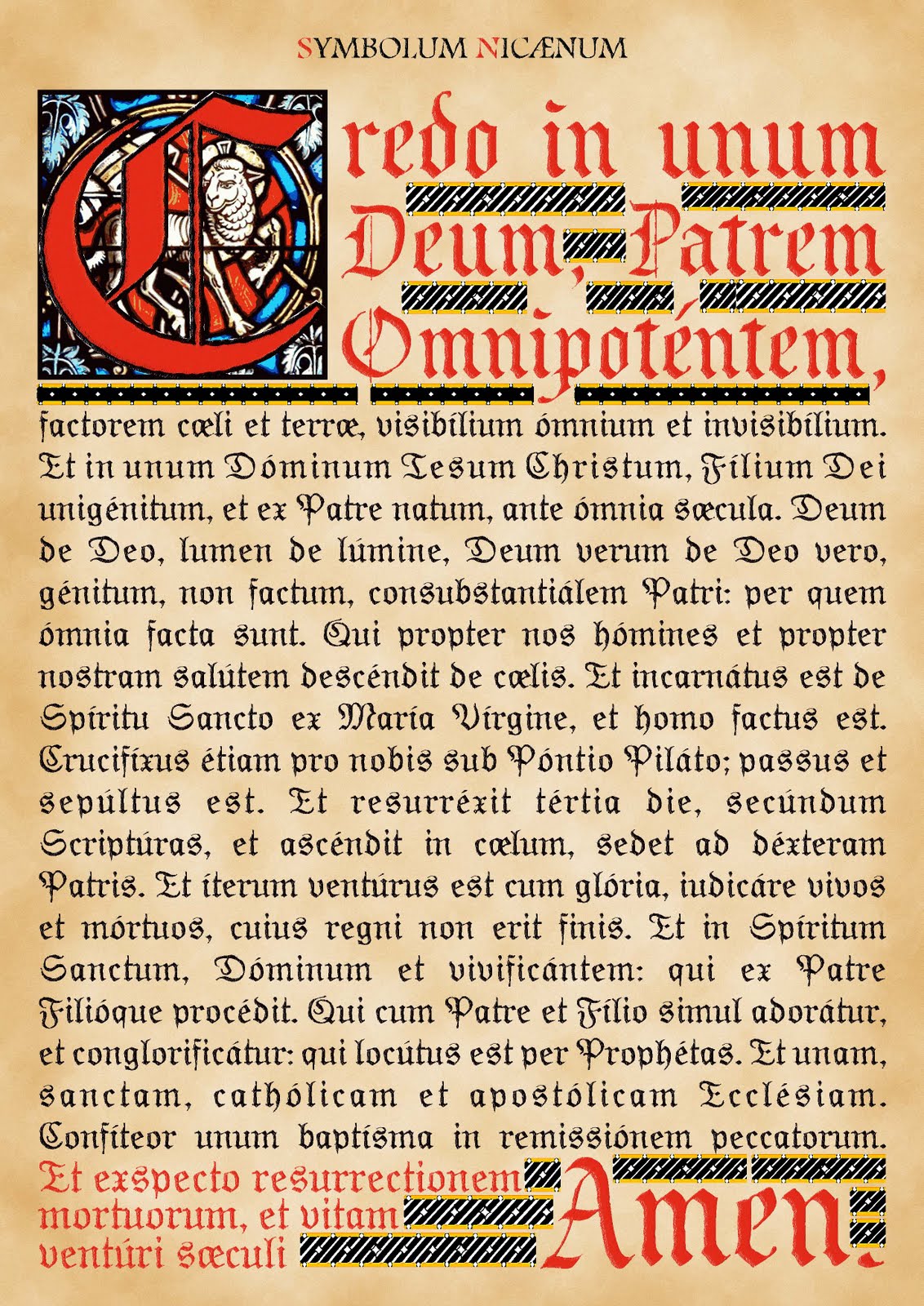
Confusing Creeds

Nicene CreedThere are a couple of sentences in the traditional translation of the basic Christian creeds (statements of faith) that lead to confusion.

Due to the literary examples below, Christian readers may find the following discussion more interesting than non-Christians—but everyone interested in clarity versus confusion should find something intriguing.

The creeds offer a prime example of why it is absolutely crucial to ensure that gradual shifts in language do not undermine or blur the intended meaning of a given sentence. To illustrate, consider this line from the Nicene Creed.

. . . [Jesus] who for us men and for our salvation came down from heaven and was incarnate by the Holy Spirit of the virgin Mary and was made man. (1662, Anglican Book of Common Prayer).*

The potential confusion here lies in the archaic usage of the word “of.” Whose Holy Spirit are we referring to? Mary’s innate holiness and purity? The educated Christian may stumble over that dated phrase—which is still used in some denominations—but a person not acquainted with the doctrine of the Trinity might easily misinterpret it as a Maryological, rather than Christological, confession.

Let’s consider two more recent translations, and note how the first restores the intent of the original writers. The second of these commonly used translations reflects the hand(s) of “politically correct” revisers.

For us and for our salvation he [Jesus] came down from heaven: by the power of the Holy Spirit he became incarnate from the Virgin Mary, and was made man. (1975 International Consultation on English Texts version).

For us and for our salvation he came down from heaven, was incarnate of the Holy Spirit and the Virgin Mary and became truly human. (1988, English Language Liturgical Consultation version).

We will consider a second example momentarily, but let’s first look at something C.S. Lewis wrote about reflecting on the importance of the creeds. He noted that too often we rattle through the words without considering their significance. This is unfortunate.

In an essay entitle “On Forgiveness,” Lewis describes a personal epiphany and offers counsel to those tempted to take familiar words for granted.

We say a great many things in church (and out of church too) without thinking of what we are saying. For instance, we say in the Creed “I believe in the forgiveness of sins.” I had been saying it for several years before I asked myself why it was in the Creed. At first sight it seems hardly worth putting in. “If one is a Christian,” I thought “of course one believes in the forgiveness of sins. It goes without saying.”

But the people who compiled the Creed apparently thought that this was a part of our belief which we needed to be reminded of every time we went to church. And I have begun to see that, as far as I am concerned, they were right. To believe in the forgiveness of sins is not so easy as I thought. Real belief in it is the sort of thing that easily slips away if we don’t keep on polishing it up.

As usual, the Oxford don was correct. However, just as good translations possess the power to inspire, so too poor or antiquated translations exercise the ability to confuse.

Here is the promised second example.

And the third day he rose again according to the Scriptures . . . (1662).

Ah, I understand, think the uncatechized, the Bible teaches us that Jesus rose from the dead on Easter. Well, yes it does, but that is not the sense in which the second phrase is intended. Here, “according to the Scriptures,” means that Jesus’ life, death and resurrection were all accomplished in accordance with the promises of the Word of God.

In other words, “just as was promised in the Garden of Eden and foretold by the prophets, Jesus won victory when he rose from the grave in accordance with the loving plan of God the Father.” The newer versions make that fact only slightly clearer.

On the third day he rose again in accordance with the Scriptures . . . (1975 and 1988).

Perhaps a future revision will replace “in accordance with,” using something like “as foretold in” or “fulfilling the scriptural promises.”

Some of us worship in congregations using a variant of the seventeenth century creed, but at least we can take comfort in the fact that most of them have at least replaced “And he shall come again with glory to judge both the quick and the dead” with “both the living an the dead.” After all, we wouldn’t want people to think that one’s salvation is dependent upon their speed.

_____

* This slightly contemporized version of the creed has already remedied the terribly confusing term “Holy Ghost,” which evokes images of disembodied souls and hauntings.

Face to Face with God

Jesus with animalsA recent letter to the editor of Lutheran Witness includes a delightful example of the wondrous glory of childhood simplicity.

When our four-year-old son . . . saw a bird outside the window, he commented “I wish I were a bird with wings so I could fly up to heaven and talk to Jesus.” [His parents] asked what he would say to Jesus if he were a bird. His simple reply . . . “Tweet, tweet.”

How gloriously innocent. So unpretentious and joyously pure. I think this captures the essence of what Jesus was referring to when he said “Truly, I say to you, unless you turn and become like children, you will never enter the kingdom of heaven. Whoever humbles himself like this child is the greatest in the kingdom of heaven” (Matthew 18:3-4, ESV).

C.S. Lewis discussed the innocence of children in his essay “The Abolition of Man.” He is discussing the monolithic power of society, or government, in reshaping what it means to be human. God preserve us from those who would redefine and eradicate the very qualities of humanity Jesus praised.

Human nature will be the last part of Nature to surrender to Man. The battle will then be won. . . . But who, precisely, will have won it? For the power of Man to make himself what he pleases means, as we have seen, the power of some men to make other men what they please. . . .

Hitherto the plans of educationalists have achieved very little of what they attempted and indeed, when we read them—how Plato would have every infant “a bastard nursed in a bureau,” and Elyot would have the boy see no men before the age of seven and, after that, no women, and how Locke wants children to have leaky shoes and no turn for poetry—we may well thank the beneficent obstinacy of real mothers, real nurses, and (above all) real children for preserving the human race in such sanity as it still possesses.

But the man-moulders of the new age will be armed with the powers of an omnicompetent state and an irresistible scientific technique: we shall get at last a race of conditioners who really can cut out all posterity in what shape they please.

When you and I stand in the presence of God, our adult words will vary. We’ll all drop to our knees—some in adoration, others perhaps in fear—but what will we say?

I can imagine some of the words that will come to our lips.

“Thank you.”

“Why did you allow . . ?”

“I love you.”

“I despise you because . . ?”

“Hallelujah.”

Or, perhaps, “Why did you delay so long?”*

I suspect we will probably be speechless. Certainly, at first. There’s a song that captures well the mystery that awaits us when we find ourselves face to face with our Creator. It’s more in spirit with the response of the young child who simply tweeted out his greeting to God.

Surrounded by Your Glory, what will my heart feel?

Will I dance for you, Jesus? Or in awe of You, be still?

Will I stand in Your presence, or to my knees will I fall?

Will I sing ‘Hallelujah!’? Will I be able to speak at all?

I can only imagine! I can only imagine!

We used to sing this song at chapel services in southwest Asia. I have often thought it would be very meaningful to record this song in my own voice, to be played at my own funeral (should the Lord tarry).

That’s not nearly as morbid as some might think. It’s a song of praise, awe and wonder, in my rendition I would end it with the words “I no longer imagine,” for my faith in God will have given way to sight.

_____
* The answer to that question is actually found in the Scriptures. From the third chapter of Peter’s second epistle:

This is now the second letter that I am writing to you, beloved. In both of them I am stirring up your sincere mind by way of reminder, that you should remember the predictions of the holy prophets and the commandment of the Lord and Savior through your apostles, knowing this first of all, that scoffers will come in the last days with scoffing, following their own sinful desires. They will say, “Where is the promise of his coming? For ever since the fathers fell asleep, all things are continuing as they were from the beginning of creation.” For they deliberately overlook this fact, that the heavens existed long ago, and the earth was formed out of water and through water by the word of God, and that by means of these the world that then existed was deluged with water and perished. But by the same word the heavens and earth that now exist are stored up for fire, being kept until the day of judgment and destruction of the ungodly.

But do not overlook this one fact, beloved, that with the Lord one day is as a thousand years, and a thousand years as one day. The Lord is not slow to fulfill his promise as some count slowness, but is patient toward you, not wishing that any should perish, but that all should reach repentance. But the day of the Lord will come like a thief, and then the heavens will pass away with a roar, and the heavenly bodies will be burned up and dissolved, and the earth and the works that are done on it will be exposed.

Since all these things are thus to be dissolved, what sort of people ought you to be in lives of holiness and godliness, waiting for and hastening the coming of the day of God, because of which the heavens will be set on fire and dissolved, and the heavenly bodies will melt as they burn! But according to his promise we are waiting for new heavens and a new earth in which righteousness dwells.

Unimpressive Clergy

sheeps clothingI recently read something alarming. Apparently pastors merit little respect nowadays.

I guess that didn’t surprise me, but it did sadden me, that the once respected “profession” of the ministry has fallen so far in the public’s esteem.

Christianity Today, a fine magazine, reported a Pew Research poll that inquired as to whether people believed that “pastors contribute ‘a lot’ to the well-being of society.”

37% of adults agreed

52% of weekly churchgoers agreed

I’m not surprised only a third of the general American population agrees with that notion . . . but I’m amazed that only half of the people who actually attend religious services concur with the statement.

Only half of the people who go to church think pastors do anything worthwhile!

Perhaps they’re like most people who think so little of members of Congress. They like their own representatives and senators (readily reelecting them), but hold the rest of Congress in disdain.

Students of poll-taking recognize the results depend on a wide range of factors. Most significant is precisely how the question is posed. I suppose the phrasing “a lot” to rate magnitude of the clergy’s contribution could account for some of the negative responses.

Still, it’s logical that most of the people who disagreed with the premise, really do possess a low opinion of clergy. In the wake of child abuse scandals and those infrequent but well publicized cases where ministers commit outrageous crimes, it should come as no surprise.

I suppose it wouldn’t bother me quite so much that clergy were held in low regard, if I wasn’t a pastor myself.

But, as I was ruminating over this gloomy fact, it dawned on me that I actually share the less than glowing opinion of many of the poll’s respondents. I too don’t think that highly of many of the so-called ministers out there either. Especially the self-ordained ones or those pseudo-clergy who just buy a diploma off the internet. (The latter group really irritates me, since I belong to a denomination that requires four full years of seminary education prior to ordination.)

Not that education is all that significant in evaluating ministries. Many highly dedicated and productive ministers never attended seminary at all. And, on the reverse side of the coin, many people who have highly advanced theological degrees are self-aggrandizing hypocrites.

I’m reminded of one of my favorite passages from C.S. Lewis’ allegory about the separation between heaven and hell. In The Great Divorce he relates a conversation involving a lost soul who was a highly regarded theologian while he was alive.

Lewis calls him the “episcopal ghost,” but that’s not a reference to his denomination, merely his ostentatious persona and the fact that he attained the lofty office of “bishop.” Unfortunately, I’ve met more than one person during my life who greatly resembles the misguided theologian in the story.

I enjoy this particular literary encounter so much that I wrote an article about it for a C.S. Lewis journal some years ago.*

If you’ve never read The Great Divorce, you’re missing out on a real gem. It is one of the very few books I have ever read in a single sitting. Once I began it, I couldn’t put it down. (I know that’s a cliche, but in this case it’s literally true.)

The passage I find so provocative appears below. (I didn’t have the heart to edit it, since some readers will want to follow the entire conversation.) After rereading it, I’m beginning to wonder why anyone in Pew’s poll considered clergy praiseworthy.

To understand the dialog, allow me to set the stage. In this fictional work, various “ghosts” (insubstantial souls of those who died without a relationship to Christ) are met at the outskirts of heaven by “bright people” (redeemed, truly real human beings) with whom they were acquainted during their mortal lives. The redeemed individuals attempt to persuade the lost to desire in some small way to draw close to God, so that they might continue a journey drawing closer to his grace.

In this scenario, the two men were both liberal theologians, but one of them, before he died, came to believe that what the Scriptures teach was actually true.

_____

* “Confused Clerics,” The Lamp-Post 18.1 (March 1994): 15-22.

One Sad Pastor

‘My dear boy, I’m delighted to see you,’ [the Ghost] was saying to the Spirit, who was naked and almost blindingly white.** ‘I was talking to your poor father the other day and wondering where you were.’

‘You didn’t bring him?’ said the other.

‘Well, no. He lives a long way from the bus, and, to be quite frank, he’s been getting a little eccentric lately. A little difficult. Losing his grip. He never was prepared to make any great efforts, you know. If you remember, he used to go to sleep when you and I got talking seriously! Ah, Dick, I shall never forget some of our talks. I expect you’ve changed your views a bit since then. You became rather narrow-minded towards the end of your life: but no doubt you’ve broadened out again.’

‘How do you mean?’

‘Well, it’s obvious by now, isn’t it, that you weren’t quite right. Why, my dear boy, you were coming to believe in a literal Heaven and Hell!’

‘But wasn’t I right?’

‘Oh, in a spiritual sense, to be sure. I still believe in them in that way. I am still, my dear boy, looking for the Kingdom. But nothing superstitious or mythological…’

‘Excuse me. Where do you imagine you’ve been?’

‘Ah, I see. You mean that the grey town with its continual hope of morning (we must all live by hope, must we not?), with its field for indefinite progress, is, in a sense, Heaven, if only we have eyes to see it? That is a beautiful idea.’

‘I didn’t mean that at all. Is it possible you don’t know where you’ve been?’

‘Now that you mention it, I don’t think we ever do give it a name. What do you call it?’

‘We call it Hell.’

‘There is no need to be profane, my dear boy. I may not be very orthodox, in your sense of that word, but I do feel that these matters ought to be discussed simply, and seriously, and reverently.’

‘Discuss Hell reverently? I meant what I said. You have been in Hell: though if you don’t go back you may call it Purgatory.’

‘Go on, my dear boy, go on. That is so like you. No doubt you’ll tell me why, on your view, I was sent there. I’m not angry.’

‘But don’t you know? You went there because you are an apostate.’

‘Are you serious, Dick?’

‘Perfectly.’

‘This is worse than I expected. Do you really think people are penalised for their honest opinions? Even assuming, for the sake of argument, that those opinions were mistaken.’

‘Do you really think there are no sins of intellect?’

‘There are indeed, Dick. There is hide-bound prejudice, and intellectual dishonesty, and timidity, and stagnation. But honest opinions fearlessly followed—they are not sins.’

‘I know we used to talk that way. I did it too until the end of my life when I became what you call narrow. It all turns on what are honest opinions.’

‘Mine certainly were. They were not only honest but heroic. I asserted them fearlessly. When the doctrine of the Resurrection ceased to commend itself to the critical faculties which God had given me, I openly rejected it. I preached my famous sermon. I defied the whole chapter. I took every risk.’

‘What risk? What was at all likely to come of it except what actually came—popularity, sales for your books, invitations, and finally a bishopric?’

‘Dick, this is unworthy of you. What are you suggesting?’

‘Friend, I am not suggesting at all. You see, I know now. Let us be frank. Our opinions were not honestly come by. We simply found ourselves in contact with a certain current of ideas and plunged into it because it seemed modern and successful. At College, you know, we just started automatically writing the kind of essays that got good marks and saying the kind of things that won applause. When, in our whole lives, did we honestly face, in solitude, the one question on which all turned: whether after all the Supernatural might not in fact occur? When did we put up one moment’s real resistance to the loss of our faith?’

‘If this is meant to be a sketch of the genesis of liberal theology in general, I reply that it is a mere libel. Do you suggest that men like…’

‘I have nothing to do with any generality. Nor with any man but you and me. Oh, as you love your own soul, remember. You know that you and I were playing with loaded dice. We didn’t want the other to be true. We were afraid of crude salvationism, afraid of a breach with the spirit of
the age, afraid of ridicule, afraid (above all) of real spiritual fears and hopes.’

‘I’m far from denying that young men may make mistakes. They may well be influenced by current fashions of thought. But it’s not a question of how the opinions are formed. The point is that they were my honest opinions, sincerely expressed.’

‘Of course. Having allowed oneself to drift, unresisting, unpraying, accepting every half-conscious solicitation from our desires, we reached a point where we no longer believed the Faith. Just in the same way, a jealous man, drifting and unresisting, reaches a point at which he believes lies about his best friend: a drunkard reaches a point at which (for the moment) he actually believes that another glass will do him no harm. The beliefs are sincere in the sense that they do occur as psychological events in the man’s mind. If that’s what you mean by sincerity they are sincere, and so were ours. But errors which are sincere in that sense are not innocent.’

‘You’ll be justifying the Inquisition in a moment!’

‘Why? Because the Middle Ages erred in one direction, does it follow that there is no error in the opposite direction?’

‘Well, this is extremely interesting,’ said the Episcopal Ghost. ‘It’s a point of view. Certainly, it’s a point of view. In the meantime…’

‘There is no meantime,’ replied the other. ‘All that is over. We are not playing now. I have been talking of the past (your past and mine) only in order that you may turn from it forever. One wrench and the tooth will be out. You can begin as if nothing had ever gone wrong. White as snow. It’s all true, you know. He is in me, for you, with that power. And—I have come a long journey to meet you. You have seen Hell: you are in sight of Heaven. Will you, even now, repent and believe?’

‘I’m not sure that I’ve got the exact point you are trying to make,’ said the Ghost.

‘I am not trying to make any point,’ said the Spirit. ‘I am telling you to repent and believe.’

‘But my dear boy, I believe already. We may
not be perfectly agreed, but you have completely misjudged me if you do not realise that my religion is a very real and a very precious thing to me.’

‘Very well,’ said the other, as if changing his plan. ‘Will you believe in me?’

‘In what sense?’

‘Will you come with me to the mountains? It will hurt at first, until your feet are hardened. Reality is harsh to the feet of shadows. But will you come?’

‘Well, that is a plan. I am perfectly ready to consider it. Of course I should require some assurances…I should want a guarantee that you are taking me to a place where I shall find a wider sphere of usefulness—and scope for the talents that God has given me—and an atmosphere of free inquiry—in short, all that one means by civilisation and—er—the spiritual life.’

‘No,’ said the other. ‘I can promise you none of these things. No sphere of usefulness: you are not needed there at all. No scope for your talents: only forgiveness for having perverted them. No atmosphere of inquiry, for I will bring you to the land not of questions but of answers, and you shall see the face of God.’

‘Ah, but we must all interpret those beautiful words in our own way! For me there is no such thing as a final answer. The free wind of inquiry must always continue to blow through the mind, must it not? “Prove all things”…to travel hopefully is better than to arrive.’

‘If that were true, and known to be true, how could anyone travel hopefully? There would be nothing to hope for.’

‘But you must feel yourself that there is something stifling about the idea of finality? Stagnation, my dear boy, what is more soul-destroying than stagnation?’

‘You think that, because hitherto you have experienced truth only with the abstract intellect. I will bring you where you can taste it like honey and be embraced by it as by a bridegroom. Your thirst shall be quenched.’

‘Well, really, you know, I am not aware of a thirst for some ready-made truth which puts an end to intellectual activity in the way you seem to be describing. Will it leave me the free play of Mind, Dick? I must insist on that, you know.’

‘Free, as a man is free to drink while he is drinking. He is not free still to be dry.’

The Ghost seemed to think for a moment. ‘I can make nothing of that idea,’ it said.

‘Listen!’ said the White Spirit. ‘Once you were a child. Once you knew what inquiry was for. There was a time when you asked questions because you wanted answers, and were glad when you had found them. Become that child again: even now.’

‘Ah, but when I became a man I put away childish things.’

‘You have gone far wrong. Thirst was made for water; inquiry for truth. What you now call the free play of inquiry has neither more nor less to do with the ends for which intelligence was given you than masturbation has to do with marriage.’

‘If we cannot be reverent, there is at least no need to be obscene. The suggestion that I should return at my age to the mere factual inquisitiveness of boyhood strikes me as preposterous. In any case, that question-and-answer conception of thought only applies to matters of fact. Religious and speculative questions are surely on a different level.’

‘We know nothing of religion here: we think only of Christ. We know nothing of speculation. Come and see. I will bring you to Eternal Fact, the Father of all other fact-hood.’

‘I should object very strongly to describing God as a “fact”. The Supreme Value would surely be a less inadequate description. It is hardly…’

‘Do you not even believe that He exists?’

‘Exists? What does Existence mean? You will keep on implying some sort of static, ready-made reality which is, so to speak, “there”, and to which our minds have simply to conform. These great mysteries cannot be approached in that way. If there were such a thing (there is no need to interrupt, my dear boy) quite frankly, I should not be interested in it. It would be of no religious significance. God, for me, is something purely spiritual. The spirit of sweetness and light and tolerance—and, er, service, Dick, service. We mustn’t forget that, you know.’

‘If the thirst of the Reason is really dead…,’ said the Spirit, and then stopped as though pondering. Then suddenly he said, ‘Can you, at least, still desire happiness?’

‘Happiness, my dear Dick,’ said the Ghost placidly, ‘happiness, as you will come to see when you are older, lies in the path of duty. Which reminds me…Bless my soul, I’d nearly forgotten. Of course I can’t come with you. I have to be back next Friday to read a paper. We have a little Theological Society down there. Oh yes! there is plenty of intellectual life. Not of a very high quality, perhaps. One notices a certain lack of grip—a certain confusion of mind. That is where I can be of some use to them. There are even regrettable jealousies…I don’t know why, but tempers seem less controlled than they used to be. Still, one mustn’t expect too much of human nature. I feel I can do a great work among them. But you’ve never asked me what my paper is about! I’m taking the text about growing up to the measure of the stature of Christ and working out an idea which I feel sure you’ll be interested in. I’m going to point out how people always forget that Jesus (here the Ghost bowed) was a comparatively young man when he died. He would have outgrown some of his earlier views, you know, if he’d lived. As he might have done, with a little more tact and patience. I am going to ask my audience to consider what his mature views would have been. A profoundly interesting question. What a different Christianity we might have had if only the Founder had reached his full stature! I shall end up by pointing out how this deepens the significance of the Crucifixion. One feels for the first time what a disaster it was: what a tragic waste… so much promise cut short. Oh, must you be going? Well, so must I. Goodbye, my dear boy. It has been a great pleasure. Most stimulating and provocative. Goodbye, goodbye, goodbye.’

The Ghost nodded its head and beamed on the Spirit with a bright clerical smile—or with the best approach to it which such unsubstantial lips could manage—and then turned away humming softly to itself ‘City of God, how broad and far.’

_____

** Lewis’ use of the nakedness metaphor here is obviously an allusion to the creation of Adam and Eve who, while in a sinless state, required no clothing. It is in no way lewd. Rather, it is an image of purity.

Stephen King Echoes C.S. Lewis

csl and kingAuthor Stephen King surprised quite a few fans during a recent PBS interview when he expressed his belief in the universe’s intelligent design. In nature and the cosmos, like theist C.S. Lewis before him, he views a creation so complex and wondrous that he thinks it makes more sense to believe in a divine power than to dismiss faith.

During the interview, King said,

I choose to believe it, yeah. I think that . . . there’s no downside to that, and the downside—if you say, well, OK, I don’t believe in God, there’s no evidence of God—then you’re missing the stars in the sky, and you’re missing the sunrises and sunsets, and you’re missing the fact that bees pollinate all these crops and keep us alive and the way that everything seems to work together at the same time.

In an essay, “Christianity and Culture,” C.S. Lewis alludes to the “Theist” phase of his own life. He points out how limiting a faith that recognizes God only abstractly, in his handiwork, can be.

There is an easy transition from Theism to Pantheism; but there is also a blessed transition in the other direction. For some souls I believe, for my own I remember, Wordsworthian contemplation can be the first and lowest form of recognition that there is something outside ourselves which demands reverence.

To return to Pantheistic errors about the nature of this something would, for a Christian, be very bad. But once again, for “the man coming up from below” the Wordsworthian experience is an advance. Even if he goes no further he has escaped the worst arrogance of materialism: if he goes on he will be converted.

King is, of course, far from what one would properly call a “person of faith.”** Still, it may be that he is presently moving in a positive direction. The following words reveal his yearning for hope, criticism of institutional religion, and his as yet unanswered questions about why God allows suffering in our world.

It’s certainly a subject that’s interested me, and I think it interests me more the older that I get. And I think we’d all like to believe that after we shuffle off this mortal coil, that there’s going to be something on the other side because for most of us, I know for me, life is so rich, so colorful and sensual and full of good things, things to read, things to eat, things to watch, places to go, new experiences, that I don’t want to think that you just go to darkness. . . .

But as far as God and church and religion and . . . that sort of thing, I kind of always felt that organized religion was just basically a theological insurance scam where they’re saying if you spend time with us, guess what, you’re going to live forever, you’re going to go to some other plain where you’re going to be so happy, you’ll just be happy all the time, which is also kind of a scary idea to me. . . .

Everything is sort of built in a way that to me suggests intelligent design. But at the same time there’s a lot of things in life where you say to yourself, well, if this is God’s plan, it’s very peculiar. And you have to wonder about that guy’s personality, the big guy’s personality. . . . What I’m saying now is I choose to believe in God, but I have serious doubts.

For many intelligent people, like C.S. Lewis and Stephen King, coming to faith cannot be severed from their reason. They desire to make sense of the world. Some, sadly, determine that human beings perish forever with their final breath. With that worldview, using King’s words, “you just go to darkness.”

Fortunately many others—brilliant and simple people alike, for God shows no partiality—possess true wisdom and heed the words of Jesus, that he is the way, the truth and the life. Both of these writers experienced an ineffective exposure to the church when they were young. Unfortunately, it served as more of an inoculation than a foundation.

Eventually C.S. Lewis followed that path from theism to Christianity. It’s not impossible that Stephen King may, as well.

_____

* A full transcript of the PBS interview is available here.

** In the interview, King “commends” the entertainment value of enthusiastic, emotionally-charged preaching, while disparaging his own mainline upbringing.

I went to a Methodist church for years as a kid, and Methodist youth fellowship on Thursday nights, and it was all pretty – you know, think of a bottle of soda with the cap off for 24 hours. There weren’t very many bubbles left in that stuff by then. It was pretty – it was Yankee religion, Terry, and there’s really not much in the world that’s any more boring than that. They tell you that you’re going to go to hell, and you’re half-asleep.

Not to be Missed

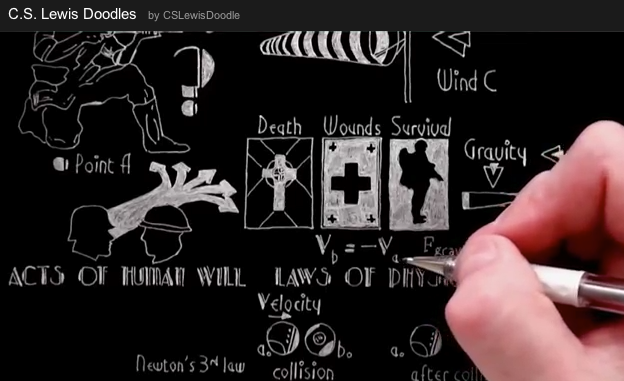
csl doodlesA recent post at the wonderful C.S. Lewis Minute blog introduced me to an amazing new way to experience the brilliance of the great author. I want to pass on the information so that you too can enjoy it.

The site is called “C.S. Lewis Doodles,” and it is the creation of a Kiwi (New Zealander) named Kalman Kingsley.

Kingsley uses a skillful artistic presentation of the clearly read original essays, to give Lewis’ words a particularly engaging and comprehensible air. It is, in a sense, C.S. Lewis “updated” to contemporary media.

Lewis himself alluded to the value of different types of media in communicating. In “Studies in Words” he says, “Language exists to communicate . . . Some things it communicates so badly that we never attempt to communicate them by words if any other medium is available.” Of course, in this case Lewis’ words are profound—in and of themselves. However, the addition of the illustrations serves to highlight and amplify his message.

Lewis, after all, passed away nearly sixty years ago, when most homes still owned black and white televisions. Technology has advanced light years since then, and transposing Lewis’ timeless wisdom to new formats such as this is an important work worthy of the talents of innovative men and women.

C.S. Lewis Doodles is available here, but don’t head there until you finish reading this Mere Inkling post.

The YouTube “Channel” offers three essays:

“The Grand Miracle” (from a sermon about the Incarnation preached in 1945)

“The Laws of Nature” (a 1945 consideration of the interplay between Nature and prayer)

“On ‘Sexual’ Morality” (a 1963 essay entitled “We have No ‘Right to Happiness’”)

All three of these essays are found in the collection published as God in the Dock. (For Americans the last word in that title refers not to a marina, but to a courtroom.)

Because each presentation covers an entire essay, they range in length from eight to ten minutes. Nevertheless, they are so well presented that they will certainly hold your interest.

I believe Lewis would have enjoyed this presentation of his work. Had he been an artist and had access to this technology, he may have experimented with it himself. As he wrote to Arthur Greeves in 1933, his book Pilgrim’s Regress is “going to be decorated by a map on the end leaf which I had great fun in drawing the sketch for.”

You can hear (and view) Lewis’ thoughts on “the Laws of Nature,” by clicking on the image below.

_____

C.S. Lewis Minute is a website every true Lewis fan should be following. You can read the column I referred to—and subscribe to the blog—here.

Seeking the Living

tombOne of the readings at our celebration of the Resurrection, this Easter morning, came from the Gospel according to Saint Luke. It included the powerful words of the angels waiting beside the empty tomb. To Mary Magdalene and the other women who had arrived to complete the ceremonial preparations for Jesus’ burial, they said: “Why do you seek the living among the dead?”

That’s precisely what separates Christianity from every other religious faith; for two millennia, Jesus’ disciples have followed a resurrected and living Lord.

This is what non-Christians are ultimately unable to fathom. Christianity is far more than the adoption of a particular lifestyle. It is infinitely more than a cognitive acquiescence a set of doctrines. It is nothing less than a dynamic, living relationship with our Creator through his only begotten Son.

Many regard Jesus as a great teacher from an ancient epoch—whose words are worthy of preserving. This is a good thing . . . but it’s not Christianity.

Many consider Jesus the model of a noble life—and strive to emulate his compassion and humility. This too is a good thing . . . but it’s not Christianity.

Many regard Jesus as an object of superstition—and they spout religious jargon while living hypocritical lives utterly devoted to their carnal appetites. This is not a good thing . . . and it’s most certainly not Christianity.

C.S. Lewis refers to this inherent inability to “persuade” an unbeliever to see beyond Christianity as a creedal profession or even a simple lifestyle and comprehend it as a relationship.

Our opponents, then, have a perfect right to dispute with us about the grounds of our original assent. But they must not accuse us of sheer insanity if, after the assent has been given, our adherence to it is no longer proportioned to every fluctuation of the apparent evidence. They cannot of course be expected to know on what assurance feeds, and how it revives and is always rising from its ashes.

They cannot be expected to see how the quality of the object which we think we are beginning to know by acquaintance drives us to the view that if this were a delusion then we should have to say that the universe had produced no real thing of comparable value and that all explanations of the delusion seemed somehow less important than the thing explained.

That is knowledge we cannot communicate. But they can see how the assent, of necessity, moves us from the logic of speculative thought into what might perhaps be called the logic of personal relations. What would, up till then, have been variations simply of opinion become variations of conduct by a person to a Person. Credere Deum esse turns into Credere in Deum. And Deum here is this God, the increasingly knowable Lord. (C.S. Lewis, “On Obstinacy in Belief”).

Ultimately, inviting others to share the joy and peace that we disciples of Jesus know—undeserving as all of us are—is not about persuasion. It is about introducing them to Jesus.

It’s about echoing the words of the angels in that Judean cemetery. “Don’t seek Jesus among the dead. He is risen and living, and he offers eternal life to all who call upon his name.”

On Burying One’s Father

marine flagI just buried my father yesterday. Well, not literally, since the service was held in a chapel at the cemetery, but my family and I said goodbye to him in a traditional Christian service. Because he was a combat veteran Marine Corps sergeant major, he received also very impressive military honors at graveside.

It was quite nice. Although he had passed rather quickly, and completely unexpectedly, he had lived a long and full life. That sounds cliché, but during his 84 years he had a successful career in the Corps, enjoyed a long and peaceful retirement, was blessed with a loving and faithful wife, and found great joy in his three children, nine grandchildren and ten great-grandchildren.

Best of all, though, after what some would call a rather misspent youth, he became a good man . . . and ended his days with faith in Christ and with virtues such as repentance, forgiveness and charity evident in his life.

As the day of the funeral was approaching, I recalled one of Jesus’ conversations with several prospective disciples.

As they were going along the road, someone said to [Jesus], “I will follow you wherever you go.” And Jesus said to him, “Foxes have holes, and birds of the air have nests, but the Son of Man has nowhere to lay his head.” To another [Jesus] said, “Follow me.” But he said, “Lord, let me first go and bury my father.” And Jesus said to him, “Leave the dead to bury their own dead. But as for you, go and proclaim the kingdom of God.” (Luke 9:57-60, ESV).

To some, Jesus’ words here sound harsh. However, the Messiah was not encouraging people to cease honoring their parents. After all, that would be in direct disobedience to the Commandments God delivered to us through Moses. No, Jesus affirmed our call to respect and care for our parents. What he was condemning was the excuses we make to delay accepting his invitation to follow him.

While we might offer a truly important reason for our procrastination, we often push back the spiritual “season” of our life with far more lame reasoning. “I’ll settle down after I get married, but right now I just need some time to “enjoy” life.” or “I’ll start going to church once I have kids and they can benefit from it.”

On Sundays we rarely think twice about disobeying another of the Commandments by ignoring the Sabbath and not preserving it’s holiness. Years ago Keith Green wrote a song “Asleep in the Light,” which featured the convicting lyrics:

How can you be so dead

When you’ve been so well fed

Jesus rose from the grave

And you, you can’t even get out of bed.

Most of us live long enough to suffer the loss of a parent. It’s something, perhaps, that you don’t really understand until you experience it yourself. Even then it’s difficult to console others by saying we’ve shared their loss. After all, every relationship is unique, and each human being processes grief in a unique manner.

C.S. Lewis knew well what it was like to lose his parents. His beloved mother died when he was quite young. In Surprised by Joy, he describes the pain. With my mother’s death all settled happiness, all that was tranquil and reliable, disappeared from my life. There was to be much fun, many pleasures, many stabs of Joy; but no more of the old security. It was sea and islands now; the great continent had sunk like Atlantis.

Alas, Lewis does not describe his father’s passing in his too-brief autobiography. What he does say, reminds me of my own father’s vast reservoir of humor and encouragement as his health waned. Lewis simply writes: “My father’s death, with all the fortitude (even playfulness) which he displayed in his last illness, does not really come into the story I am telling.”

Many of you who have lost your parents can empathize with me, and with the journey I am facing as I adjust to life without either of my parents. Because I loved them, I miss them. And the love makes the pain worth it. Besides, as Paul reminded young Christians in his first letter to the Church in Thessalonica, we “do not grieve as other do who have no hope.” Our hope is secure, resting in the very One who said, “I am the resurrection and the life.”

Theological Training

I’m proud I graduated from a well-respected seminary. And I’m proud of following that Master of Divinity degree with an advanced Master of Theology degree in Patristics. And that’s precisely the problem . . . I’m proud.

As a Christian, I recognize that pride is one of the most destructive and insidious sins. As a pastor and chaplain, I have seen all too frequently how pride expressly targets members of the clergy. Our vulnerability to the temptation to be proud is one of the common chinks in the armor of the ordained.

C.S. Lewis recognized this fact. In A Severe Mercy, he wrote:

I think there is a great deal to be said for having one’s deepest spiritual interest distinct from one’s ordinary duty as a student or professional man. St. Paul’s job was tent-making. When the two coincide I shd. have thought there was a danger lest the natural interest in one’s job and the pleasures of gratified ambition might be mistaken for spiritual progress and spiritual consolation; and I think clergymen sometimes fall into this trap. . . .

In fact, the change [to a Christian ministry] might do good or harm. I’ve always been glad myself that Theology is not the thing I earn my living by. On the whole, I’d advise you to get on with your tent-making. The performance of a duty will probably teach you quite as much about God as academic Theology wd. do. Mind, I’m not certain: but that is the view I incline to.

Lewis understood that “advancement” in ecclesiastical contexts can mask the inner heart and be mistaken as a form of holiness when it is in actuality vanity. I was reminded of this weakness in clerical armor recently, when I read a tribute to a Chinese Christian whose name is little known beyond his homeland. Dr. Sun Yi-yin, known in America as “Freddie Sun,” died in August at the age of 76. A professor of Geology, he lost his faculty position for failing to deny Christ.

Like thousands of other Christians living under the atheist regime, he was imprisoned for his work in establishing churches and Bible schools. He raised the funds to start no fewer than 154 of these training centers, and was key to the equipping of approximately 60,000 underground pastors and teachers. The “underground” Church in China is distinguished from the government-controlled “Three-Self Patriotic Movement.”

For his labors, Sun endured a decade in a Chinese labor camp. (His wife, Dorothy Chang, was also imprisoned. Rather than reducing his faith, during his sojourn in the harshest of conditions, Sun experienced a personal revival and his zeal increased.

His story is amazing, but here is the aspect that hit the mark in the center of my conscience. In his autobiography, The Man in the Fiery Furnace, Sun described his imprisonment as his “seminary” experience: “Instead of learning homiletics, hermeneutics, Greek, and Hebrew, I was being taught the greater lessons of obedience, submission, forgiveness, love, endurance, and patience.”

Now, I am grateful that God has preserved me from the “fiery furnace,” but I do long to experience the fruit of the spirit that Sun so richly harvested in prison. While not dismissing the importance of the classical subjects of homiletics and hermeneutics, as the Apostle says, “If I speak in the tongues of men and of angels, but have not love, I am a noisy gong or a clanging cymbal. And if I have prophetic powers, and understand all mysteries and all knowledge, and if I have all faith, so as to remove mountains, but have not love, I am nothing. If I give away all I have, and if I deliver up my body to be burned, but have not love, I gain nothing.” (I Corinthians 13:1-3, ESV).

In The Problem of Pain, Lewis’ treatise on suffering, he addresses how God can redeem terrible things such as unjust punishments. For those desiring to understand how an omnipotent God can allow evil to occur, Lewis’ presentation is quite helpful. And, the life example of Dr. Sun provides a superb example of its validity.

I advance six propositions necessary to complete our account of human suffering which do not arise out of one another and must therefore be given in an arbitrary order. 1. There is a paradox about tribulation in Christianity. Blessed are the poor, but by ‘judgement’ (i.e., social justice) and alms we are to remove poverty wherever possible. Blessed are we when persecuted, but we may avoid persecution by flying from city to city, and may pray to be spared it, as Our Lord prayed in Gethsemane.

But if suffering is good, ought it not to be pursued rather than avoided? I answer that suffering is not good in itself. What is good in any painful experience is, for the sufferer, his submission to the will of God, and, for the spectators, the compassion aroused and the acts of mercy to which it leads. In the fallen and partially redeemed universe we may distinguish (1) the simple good descending from God, (2) the simple evil produced by rebellious creatures, and (3) the exploitation of that evil by God for His redemptive purpose, which produces (4) the complex good to which accepted suffering and repented sin contribute.

Now the fact that God can make complex good out of simple evil does not excuse—though by mercy it may save—those who do the simple evil. And this distinction is central. Offences must come, but woe to those by whom they come; sins do cause grace to abound, but we must not make that an excuse for continuing to sin. The crucifixion itself is the best, as well as the worst, of all historical events, but the role of Judas remains simply evil.

I thank God for the life and testimony of Sun. I pray God will reap an abundance of believers in China, and elsewhere, due to his faithfulness. And I thank God for using Sun’s words to cause me to stop in the midst of my busy activities and take the time to examine my own heart and motives.