
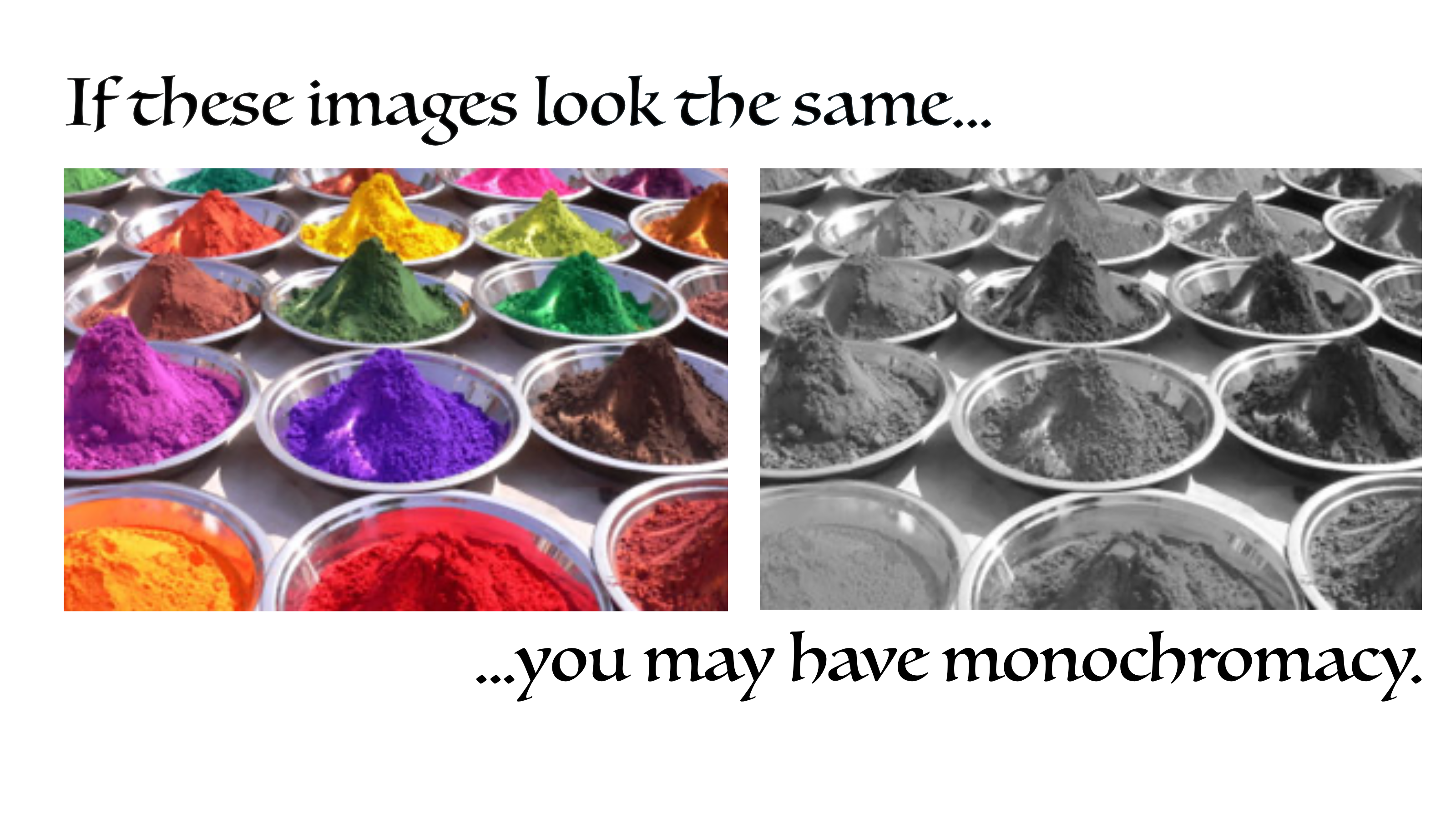
What wonders await the color blind in Heaven! That thought recently occurred to me out of the proverbial blue.
I was sitting on my patio, tossing a ball to my border collie, when she decided to explore some of the local forest scents, as she is wont to do. As I normally do, I used that peaceful, shalom moment, to pray.
I don’t recall whether I closed my eyes, or gazed at the brilliantly white clouds dancing above me. In either case, my mind and spirit were focused on prayer. Prayer for those I love, and for strangers I have never met.
What wonders await the color blind in the presence of God. Too profound for me to take credit for thinking, but perhaps one of those serendipitous epiphanies God offers unexpectedly to his children.
In The Great Divorce, C.S. Lewis describes an excursion to the foothills of Heaven. The sheer reality of Heaven exceeds fallen humanity’s ability to comprehend it.
Before me green slopes made a wide amphitheatre, enclosing a frothy and pulsating lake into which, over many-coloured rocks, a waterfall was pouring.
Here once again I realised that something had happened to my senses so that they were now receiving impressions which would normally exceed their capacity. On Earth, such a waterfall could not have been perceived at all as a whole; it was too big. Its sound would have been a terror in the woods for twenty miles. Here, after the first shock, my sensibility ‘took’ both as a well-built ship takes a huge wave. I exulted. . . .
Near the place where the fall plunged into the lake there grew a tree. Wet with the spray, half-veiled in foam-bows, flashing with the bright, innumerable birds that flew among its branches, it rose in many shapes of billowy foliage, huge as a fen-land cloud. From every point apples of gold gleamed through the leaves.
When the Narnians sail to the “edge of the world,” they are greeted by a wonder that hints at the beauty of Heaven beyond. Barring their way into that place it rose “between them and the sky, a greenish-gray, trembling, shimmering wall.”
Then up came the sun, and at its first rising they say it through the wall and it turned into wonderful rainbow colors. Then they knew that the wall was really a long, tall wave – a wave endlessly fixed in one place . . . (Voyage of the Dawn Treader).
At the end of the Chronicles of Narnia, C.S. Lewis ushers his heroes into Heaven. They too experience the overwhelming awe inspired by their divine surroundings.
It is as hard to explain how this sunlit land was different from the old Narnia as it would be to tell you how the fruits of that country taste. Perhaps you will get some idea of it if you think like this. You may have been in a room in which there was a window that looked out on a lovely bay of the sea or a green valley that wound away among mountains.
And in the wall of that room opposite to the window there may have been a looking-glass. And as you turned away from the window you suddenly caught sight of that sea or that valley, all over again, in the looking-glass. And the sea in the mirror, or the valley in the mirror, were in one sense just the same as the real ones: yet at the same time they were somehow different – deeper, more wonderful, more like places in a story: in a story you have never heard but very much want to know.
The difference between the old Narnia and the new Narnia was like that. The new one was a deeper country: every rock and flower and blade of grass looked as if it meant more. I can’t describe it any better than that: if you ever get there you will know what I mean (The Last Battle).
I find Lewis’ fictional visions of Heaven inspiring in their self-confessed inadequacies. Heaven, no doubt, is profoundly more glorious than any human being can imagine.
The Bible employs brilliant colors to help describe Heaven’s beauty. In John’s vision of Heaven we find these descriptions:
And he who sat [upon the throne] had the appearance of jasper and carnelian, and around the throne was a rainbow that had the appearance of an emerald. Around the throne were twenty-four thrones, and seated on the thrones were twenty-four elders, clothed in white garments, with golden crowns on their heads.
From the throne came flashes of lightning, and rumblings and peals of thunder . . . and before the throne there was as it were a sea of glass, like crystal (Revelation 4).
[An angel] showed me the holy city Jerusalem coming down out of Heaven from God, having the glory of God, its radiance like a most rare jewel, like a jasper, clear as crystal. . . .
The wall was built of jasper, while the city was pure gold, like clear glass. The foundations of the wall of the city were adorned with every kind of jewel. The first was jasper, the second sapphire, the third agate, the fourth emerald, the fifth onyx, the sixth carnelian, the seventh chrysolite, the eighth beryl, the ninth topaz, the tenth chrysoprase, the eleventh jacinth, the twelfth amethyst. And the twelve gates were twelve pearls, each of the gates made of a single pearl, and the street of the city was pure gold, like transparent glass (Revelation 21).
The Power of Color
Colors are not merely aesthetic. Their influence on human perception has been studied for many years. One key researcher, Faber Birren (1900-88), served as a respected consultant on the subject for numerous businesses and even the United States government itself.
“Shades of Meaning” relates that “in 1939, Walt Disney invited Birren to work as a color consultant. He ended up advising Disney animators on the design of Bambi, Fantasia, and Pinocchio.”
In Color Psychology and Color Therapy, Birren begins his discussion of the subject with the proposal that “it is perhaps a mistaken notion that man in his love of color was impelled by some aesthetic urge.” He contends that:
The greatest weight of evidence points to the fact that color was involved with the supernatural and therefore had significance that went beyond what might be thought of as mere sensuous delight. . . .
Color, being a manifestation of light, held divine meaning. Historical records of color show little interest in the physical nature of color, nor yet in its abstract beauty, but in a symbolism that attempted to resolve the strange workings of creation and give it personal and human meaning.
If this spiritual aspect of color is actual, then being colorblind carries a liability beyond simply missing out on one of life’s simple pleasures.
Color Blindness Among Humanity
You may not know anyone who is color blind. That’s not surprising, since it isn’t a common subject of conversation. Nevertheless, in the general population, approximately eight percent – or 1 in 12 – men suffer from some form of it. Meanwhile, the rate of this condition, which is most frequently genetic, for women is far lower. Only about one in two hundred.
There are several varieties of color vision deficiency, with most people able to perceive some shades of certain colors. The most severe form of the problem involves a failure to see any colors. Only shades of gray distinguish between different hues. It’s called achromatopsia, and is quite rare.
Achromatopsia is a congenital hereditary condition found in only one birth in every 33,000 to 50,000 births. Thus less than 10,000 Americans may have achromatopsia. There are two basic forms . . . Rod Monochromatism, . . . is the most common [and] routinely occurs in both men and women. . . .
Blue Cone Monochromatism has an incidence of 1 in 50,000-100,000 births in males and could be as rare as 1 in 10 billion in females.
If you are curious about achromatopsia, you should definitely read about research on a Micronesian Island where ten percent of the people share this affliction.
Many individuals first learned of achromatopsia in 1997, when Oliver Sacks published his classic book, Island of the Color Blind. This story beautifully chronicles Oliver Sack’s 1994 quest with Knut Nordby and Bob Wasserman to the isolated atoll of Pingelap in Micronesia, where 10% of the population have rod monochromatism. A video of the journey is available here.
Possible Visions of Heaven
Although I am quite wary of so-called near death experiences (with some being spurious, and others, spiritual deception), it is intriguing how color has entered into a number of the stories. The following examples appear in the accounts of several different individuals in Imagine Heaven: Near-Death Experiences, God’s Promises, and the Exhilarating Future that Awaits You.
The entire city was bathed in light, an opaque whiteness in which the light was intense but diffused. In that dazzling light every color imaginable seemed to exist and – what’s the right word? – played. The colors seemed to be alive, dancing in the air. I had never seen so many different colors. It was breathtaking.
Below me lay the purest, most perfect grass, precisely the right length and not a blade that was bent or even out of place. It was the most vibrant green I had ever seen. If a color can be said to be alive, the green I saw was alive, slightly transparent and emitting light and life from within each blade. The iridescent grass stretched endlessly over gently rolling hills upon which were sprinkled the most colorful wild flowers, lifting their soft-petaled beauty skyward, almost as if they were a chorus of flowers caught up in their own way of praising God.
The most gorgeous sky ever seen here on earth cannot even come close to the atmosphere in Heaven. It is bright because of the glory of our God. . . . The atmosphere is something you experience, not just see. It is golden, yellow, white, and had more colors moving throughout it . . . like the Aurora Borealis lights.
The sky [and] the firmament surrounding the heavens, were a wilder and bluer yonder than you would ever believe. . . . The closest shade I can associate this otherworldly blue with is the surreal tones of the water in the Caribbean or off the coast of Hawaii at sunset. . . . That color is waiting for you and me on the other side.
The colors and lights in Heaven were simply sublime. . . . They were the deepest, richest, most gloriously lush colors I had ever seen, and some I had never seen before. Heaven is a dream-come-true for those who love all things colorful, and our home there is lit by the Father of Lights. . . . [There were] robust and bold and vigorous beams that were somehow gentle to my eyes. I simply don’t think those colors and lights exist on earth.
I saw the most dazzling colors, which was all the more surprising because I’m color-blind. I can distinguish the primary colors, but pastels all look the same to me. But suddenly I could see them, all kinds of different shades. Don’t ask me to name them because I lack the necessary experience for that.
Take a Moment to Test Your Own Color Vision
There are a number of simple, free vision tests available online. If you want to assure yourself that you can see all of the normal colors – though not necessarily all of the heavenly colors awaiting us – check out one of the following.
Final Thoughts
When I described the wonders awaiting the color blind in Heaven, I was referring to all of us. (In this life, as the Scriptures say, “For now we see in a mirror dimly . . .” (1 Corinthians 13).
All who trust in the love of Jesus Christ, and thereby enter Heaven’s environs by the unmerited grace of God’s mercy, will be overwhelmed by its beauty and wonder.
The million or more colors a person with full vision can now see, will be eclipsed by the infinite tapestry of hues in our Creator’s mind. Even those with the scientifically-presumed capability to currently perceive distinctions between up to 100 million will surely be in awe.
C.S. Lewis closes our discussion of Heaven’s colors with a fascinating thought related to the angels who worship God in that divine place. Lewis begins by noting a significant distinction between God’s angels and humanity.
But for our body one whole realm of God’s glory – all that we receive through the senses-would go unpraised. For the beasts can’t appreciate it and the angels are, I suppose, pure intelligences.
They understand colors and tastes better than our greatest scientists; but have they retinas or palates?
I fancy the “beauties of nature” are a secret God has shared with us alone. That may be one of the reasons why we were made-and why the resurrection of the body is an important doctrine (Letters to Malcolm: Chiefly on Prayer).

 Mere Inkling Press