
Peculiar Poetic Themes

Would you purchase a collection of poetry inspired by pigs? It was certainly not what I was looking for, but my local library has once again seduced me by conducting one of their periodic “used book sales.” 

I find them irresistible. Just as I was unable to bypass, without browsing, any “secondhand bookshop” while I lived in the United Kingdom.

One never knows what treasures are buried in the stacks, since many of the volumes came from personal libraries where they may have rested for decades.

We had just finished our regular writing critique meeting when I accompanied two of my companions into the wilderness of temptation. Alas, on one of the first shelves I perused, I encountered an oddity I was unable to resist. 

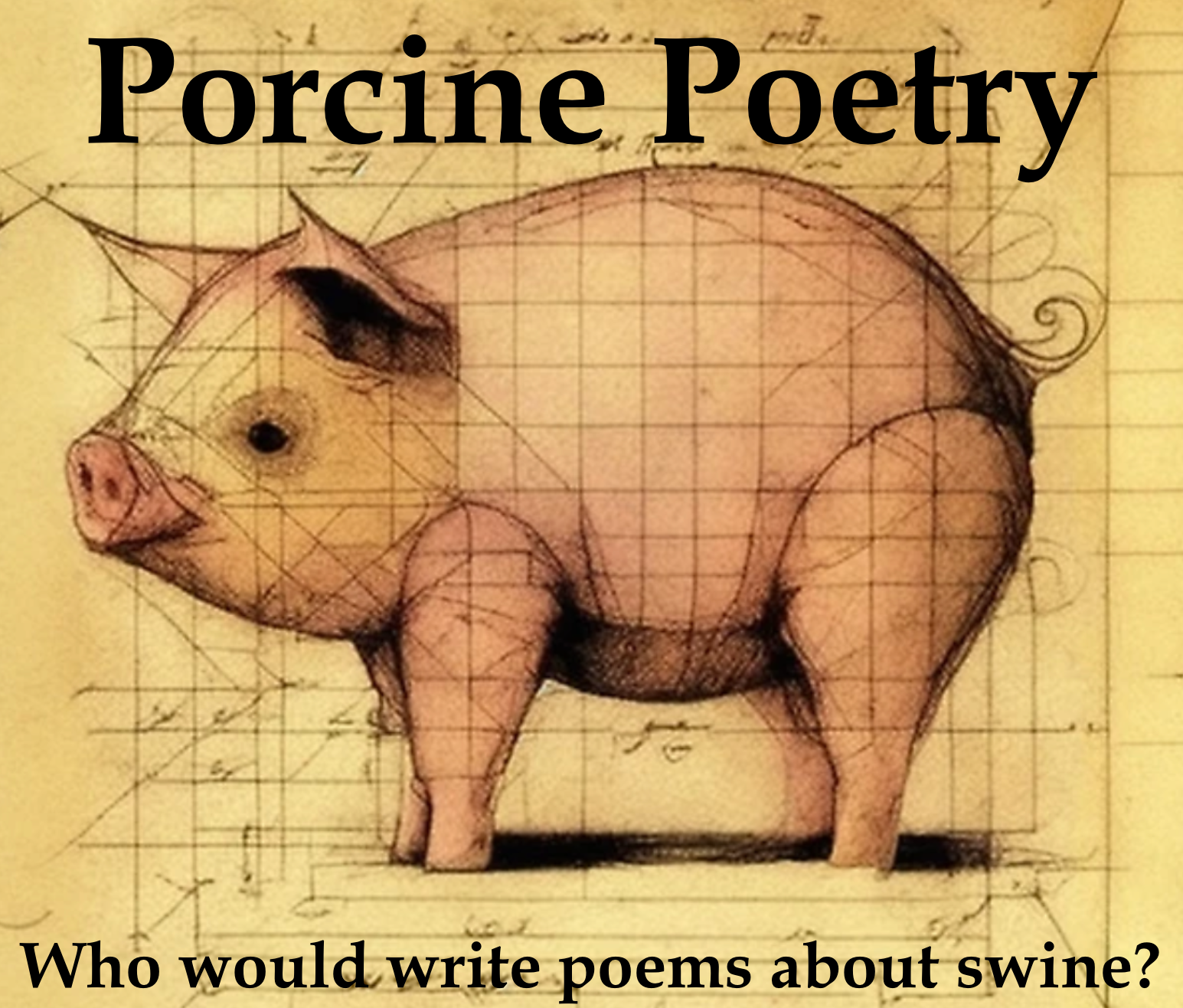
The title attracted my interest – The Porcine Legacy. The minimalist sketches of pigs illustrating the text drew me in. And the final element, which captured me, was that it was autographed by both the author and the artist. The bargain price sealed the deal.

Scanning the poems I saw curious mentions of God, which I considered intriguing. The swinish images reminded me of some of DaVinci’s quick sketches of animals.

Sadly, although he professes the love he had for his hogs and piglets, the author did consign them to the market. I understand that’s their intended fate, and I do enjoy lean bacon, but it seems sad. Especially in an ode to porcine intelligence and their congeniality as pets.

The author, David Lee, moved on from animal husbandry to teaching at a university in Utah. Presumably it was his contributions there, rather than on his farmstead, which earned him the honor of becoming the very first poet laureate of Utah.

A Taste of Porcine Poetry

The poem which follows is entitled “Jubilate Agno, 1975.” As often happens when I expose myself to unfamiliar works, I learned far more than I anticipated. In this case, I discovered the “1975” in the title was included because the poem was based upon a religious poem originally penned between 1759 and 1763, while its author, Christopher Smart, was convalescing as a “Curable Patient” at London’s St. Luke’s Hospital for Lunatics.

Lee’s version follows the basic structure of Smart’s 1200 line work. Cat lovers will enjoy a section of seventy-four lines where the original author praises the wonders of his cat, Jeoffry. This is the portion of the original which most closely resembles the copy, since the latter extols its author’s favorite sow. Lee also proposes a shift in the deity upon whom the creature focuses.

For I will consider my Cat Jeoffry.
For he is the servant of the Living God duly and daily serving him.
For at the first glance of the glory of God in the East he worships in his Way.

~~~~~~

For I will consider my black sow Blackula.
For she is the servant of the god of the feed bucket and serveth him.
For she worships the god in him and the secret of his pail in her way.

The title, “Jubilate Agno” actually translates as “Rejoice in the Lamb.” And, while Lee includes no such reference, the beginning lines of Smart’s work proclaim its vision in inspiring terms.

Rejoice in God, O ye Tongues; give the glory to the Lord, and the Lamb.
Nations, and languages, and every Creature, in which is the breath of Life.
Let man and beast appear before him, and magnify his name together.

I encourage interested readers to read the edifying “Jubilate Agno” by Christopher Smart, which is available here. Ailurophiles (cat lovers) can go directly to the feline section here. The complete text of  “Jubilate Agno, 1975” is available at the Poetry Foundation.

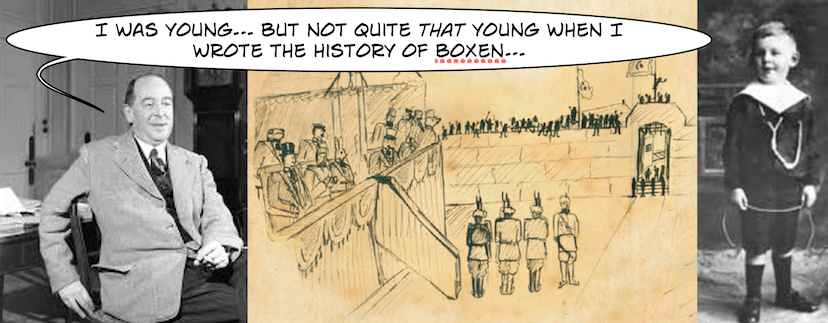
Although I don’t believe C.S. Lewis ever wrote porcine poetry, there is an interesting passage which appears in Boxen, the collection of his childhood stories. Apparently, the first king of the northern region of Animal-Land, set out to add Pig-Land to his domain.

The pigs under their various chiefs (who had now united against Hacom, as a common enemy) advanced to meet him. The 2 armies met at a place called Kuckton (near where Marston now stands). Hacom fought well, and would have won had he not been outwitted by a clever feint on the part of the pigs.

The [invading] force was beaten, but still, much had been done towards the subjection of the pigs. Hacom was severely wounded by a stray arrow, but might have recovered, had he not been obliged to spend the night in the fields. It was winter, and the wound froze causing instant death. He had been an excellent king.

Surprisingly, to me at least, there are many other poems inspired by pigs. Since I’ve written in the past about Roald Dahl (and his slight connection to C.S. Lewis), seeing his poem entitled “The Pig” incited my curiosity. The All Poetry website includes the poem, and offers as part of its analysis:

“The Pig” by Roald Dahl is a humorous and macabre poem that explores the existential crisis of a highly intelligent pig. The poem is characterized by its playful language, which contrasts with the gruesome subject matter. . . .

The pig’s realization that he is destined for slaughter also highlights the existential themes of meaninglessness and the inevitability of death. Overall, “The Pig” is a clever and thought-provoking poem that combines humor, darkness, and a touch of existential angst, showcasing Dahl’s versatility as a storyteller.

So, if you want to end this peculiar discussion with a bit of existential porcine angst, ponder Dahl’s poem, “The Pig.”

In England once there lived a big,
A wonderfully clever pig.
To everybody it was plain
That Piggy had a massive brain.
He worked out sums inside his head,
There was no book he hadn’t read.
He knew what made an airplane fly,
He knew how engines worked and why.
He knew all this, but in the end
One question drove him round the bend:
He simply couldn’t puzzle out
What LIFE was really all about.

What was the reason for his birth?
Why was he placed upon this earth?
His giant brain went round and round.
Alas, no answer could be found.
Till suddenly one wondrous night.
All in a flash he saw the light.
He jumped up like a ballet dancer
And yelled, “By gum, I’ve got the answer!”
“They want my bacon slice by slice
“To sell at a tremendous price!
“They want my tender juicy chops
“To put in all the butcher’s shops!
“They want my pork to make a roast
“And that’s the part’ll cost the most!
“They want my sausages in strings!
“They even want my chitterlings!
“The butcher’s shop! The carving knife!
“That is the reason for my life!”

Such thoughts as these are not designed
To give a pig great peace of mind.
Next morning, in comes Farmer Bland,
A pail of pigswill in his hand,
And piggy with a mighty roar,
Bashes the farmer to the floor . . .
Now comes the rather grizzly bit
So let’s not make too much of it,
Except that you must understand
That Piggy did eat Farmer Bland,
He ate him up from head to toe,
Chewing the pieces nice and slow.
It took an hour to reach the feet,
Because there was so much to eat,
And when he finished, Pig, of course,
Felt absolutely no remorse.

Slowly he scratched his brainy head
And with a little smile he said,
“I had a fairly powerful hunch
“That he might have me for his lunch.
“And so, because I feared the worst,
“I thought I’d better eat him first.”
C.S. Lewis and Rabbits

C.S. Lewis loved rabbits. His affection for the cuddly rodents went all the way back to his childhood. And it continued through the whole of his life. In fact, you can read about “C.S. Lewis as an Advocate for Animals” at a Humane Society link below.*

Despite this affection, rabbits do not feature prominently in The Chronicles of Narnia. They are among the “statues” turned to stone by the Witch. In the description of Aslan breathing life back into them, it says, “then [Aslan] pounced on a tall stone dryad which stood beyond the dwarf, turned rapidly aside to deal with a stone rabbit on his right, and rushed on to two centaurs” (The Lion, the Witch and the Wardrobe).

Rabbits helped spread the word about an impending attack on Archenland in The Horse and His Boy. Shasta urges the animals to spread the word.

“Oughtn’t your High King to be told?”

“Certain sure, something ought to be done about it,” said the Hedgehog. “But you see I’m just on my way to bed for a good day’s sleep. Hullo, neighbor!”

The last words were addressed to an immense biscuit-colored rabbit whose head had just popped up from somewhere beside the path. The Hedgehog immediately told the Rabbit what it had just learned from Shasta.

The Rabbit agreed that this was very remarkable news and that somebody ought to tell someone about it with a view to doing something. And so it went on. Every few minutes they were joined by other creatures, some from the branches overhead and some from little underground houses at their feet, till the party consisted of five rabbits, a squirrel, two magpies, a goat-foot faun, and a mouse, who all talked at the same time and all agreed with the Hedgehog.

For the truth was that in that golden age when the Witch and the Winter had gone and Peter the High King ruled at Cair Paravel, the smaller woodland people of Narnia were so safe and happy that they were getting a little careless.

In The Last Battle we see a clear contrast between the types of animals which populate Narnia. Tirian, the last king of Narnia, is leading the children toward their destiny.

First, he had given Jill some practice in archery and found that, though not up to Narnian standards, she was really not too bad.

Indeed she had succeeded in shooting a rabbit (not a Talking rabbit, of course: there are lots of the ordinary kind about in Western Narnia) and it was already skinned, cleaned, and hanging up.

Back to the Beginning

When he was a child, beginning at age eight, Lewis began writing stories about “Animal Land.” His brother Warnie, several years older, joined him in composing stories inspired in part by their reading of the words of Beatrix Potter.

Animal Land is clearly the product of young children—children with wonderful imaginations—but children nonetheless. These various works have been published by Lewis’ stepson in a collection called Boxen. As Douglas Gresham writes, “In developing the world of Boxen, Jack appropriated the ‘dressed animals’ of Beatrix Potter and that part of their fictional world they called ‘Animal-Land,’ while Warnie (whose interests were always a touch more prosaic than Jack’s) made his half ‘India.’”

The world was thoroughly thought out, complete with maps and a historic chronology.

Animal-land is divided into 13 provinces. Bear-land, Wolf-land, Squirrel-land, Mouse-land, Rabbit-land, Pig-land, Bird-land, Horse-land, Fox-land, Land of Typical Animals, Insect-land, Rat-land, With the island of Piscia, or Fishland. . . . Rabbit-land is the first provence in learning and art.

Rabbits feature prominently in Boxen. The very first element is a script, entitled “The King’s Ring (A Comedy).” The introduction is delightfully childlike: “Interesting carictars. Famous ones. For instance, Sir Big, a world-famed gentleman. A very good choreus and nice scenry. (Slight comic tints in and out threw it.)”

The two protagonists are King Bunny, whose ring is stolen, and Sir Peter Mouse, his “knight in waiting” who aids him in finding it. It is filled with silly dialog, despite the serious plot. For example:

KING BUNNY: Tell Sir Goose to tell Sir Big to tell Mr Gold Fish to tell Gollywog to tell Mr Icthus-oress to tell Dorimie to tell the sailors to take Hit [the villain] away.

In his autobiography, Lewis wrote of his childhood home. “Here my first stories were written, and illustrated, with enormous satisfaction. They were an attempt to combine my two chief literary pleasures—‘dressed animals’ and ‘knights-in-armour.’

Drawing Pleasure from Real Life Rabbits

Lewis’ correspondence includes passing references to rabbits, always expressed in an approving way. For instance, in 1947 he mentions enjoying a memorable event during a boring time. “I wonder how you are all getting on? Nothing much has happened to me except that I saw a rabbit yawn. I suppose people who keep tame ones have seen it often but this was a wild rabbit and I thought it a very curious sight. It was a very bored triangular yawn in the middle of a long hot afternoon.”

During WWII, he penned a curious comment about rabbits recently added to his home.

We are keeping rabbits at the Kilns now, in addition to the hens! But they are very much nicer. As I passed the enclosure in which all the young ones are the other evening, I saw they had all got into a box which happened to be lying there.

They were all standing (or sitting) up on their hind legs and all facing in the same direction: so that they looked exactly as if they were conducting some kind of evening service—the box looked just like a pew.

While the rabbits were almost certainly present to supplement food rations during the war, they were not treated as commodities. Lewis appreciated them in the way he respected other creatures designed by God’s hand. Thus, he had what my wife and I would consider to be a well-rounded family—including one or more members of the non-human variety.

Lewis described this diverse household in a 1943 letter to June Flewett,⁑ one of the children evacuated to his home during the war.

Bruce [Lewis’ dog] behaved with great lack of fortitude during the thunderstorm last night and two of the rabbits made it an excuse for absenting themselves without leave. Pushkin [his cat] behaved better, but not well. In fact there is a general lack of keenness and discipline among the four-footed members of the household which I deplore.

One more story about an actual rabbit with which the great author developed an ongoing relationship.

In a 1942 letter to Sister Penelope CSMV, he says, “I am establishing quite a friendship with one of the rabbits which we now keep along with the deer in Magdalen grove. It was done by the discovery that he relishes chestnut leaves which grow too high for his reach. He doesn’t yet allow me any familiarities but he comes and eats from my hand.”

Lewis continues to describe his new friend, and adds a keen theological observation. “But oh!, the great lollipop eyes and the twitching velvet nose! How does [God] come to create both this and the scorpion?”

Later that same year, Lewis updates the Anglican nun on the status of his animal-friend.

The Rabbit and I have quarrelled. I don’t know why, unless I gave him something that disagreed with him. At any rate, he has cut me dead several times lately—so fair and so fickle! Life is full of disappointments.”

At that time he shared his disappointment with his lifelong friend, Arthur Greeves. “Did I tell you in my last letter that I’d struck up quite an acquaintance (almost a friendship) with a rabbit in Magdalen Grove who used to come and eat leaves from my hand? Alas, I must have given something that disagreed with him, for he disappeared for about 10 days, and since his reappearance has refused to look at me.”

It may be that same rabbit, or one of its kin, renewed its relationship with Lewis, because he referred to a similar experience in two 1944 letters to other children.

I live in a College here: a college is something rather like a castle and also like a church. It stands just beside a bridge  over a river. At the back of the part I live in there is a nice grove of Trees. There are a lot of Rabbits there. One very old rabbit is so tame that it will run after me and take things out of my hand. I call her Baroness Bisket because she is a kind of biscuit colour.

It’s not easy, nor is it usually relevant, to determine a bunny’s gender. So, Lewis may be excused for writing the following to the second young correspondent, six months earlier.

I am getting to be quite friends with an old Rabbit who lives in the Wood at Magdalen. I pick leaves off the trees for him because he can’t reach up to the branches and he eats them out of my hand. One day he stood up on his hind legs and put his front paws against me, he was so greedy. I wrote this about it:

A funny old man had a habit
Of giving a leaf to a rabbit.
At first it was shy
But then, by and by,
It got rude and would stand up to grab it.

But it’s a very nice Rabbit all the same: I call him ‘Baron Biscuit.’

Like C.S. Lewis, I adore rabbits. Years ago we had an indoor bunny, appropriately named “Sweetheart.” In her youth she acted like the cartoon character Ricochet Rabbit, pinging from place to place. In her senior years she settled down and was contented to be a cuddly lap bunny. I add my own “thank you” to Lewis’ for these precious parts of God’s creation.


* The Humane Society pdf is available here.

⁑ June Flewett is regarded as the inspiration for Lucy Pevensie in the Chronicles, and grew up to become an actress and theater director. C.S. Lewis paid for her tuition at the Royal Academy of Dramatic Art. When she and her two sisters were sent from London to the Kilns, her favorite author was C.S. Lewis. Ironically, it was a while before she learned that he and their host were one and the same.