
Jesus & Gandalf

Today Christians celebrated our Lord’s Transfiguration. (If you attend a church that doesn’t follow the historic “Church Year,” ask your pastor about it. It can be a healthy and educational spiritual discipline.)

The Transfiguration took place on a mountaintop where God the Father brought Moses and Elijah to speak with Jesus. During this encounter, Jesus and his garments shined with a pure, clear light that dazzled the eyes.

It was quite likely the Transfiguration that inspired J.R.R. Tolkien to include one powerful image in his Lord of the Rings tale. (The Lord of the Rings is often referred to as a trilogy, although it is actually a single intricate novel which consists of six “books” plus appendices.)

In the Middle Earth myth, the heroic Gandalf dies in battle with a champion of evil . . . only to be resurrected with even greater power and focus. In this point, the two events differ, since Jesus’ nature never changed. He was incarnate and born as both God and human being. The Transfiguration merely revealed momentarily a portion of his divine identity which was masked, in a sense, by his human flesh.

The aspect in which the accounts are similar comes in the appearance of the glorified Savior and the resurrected Wizard . . . they exude a holy radiance so powerful it even affects their garb.

Thus, Tolkien’s beloved Gandalf the Grey is transformed into the triumphant Gandalf the White.

The Transfiguration of Jesus was one small piece of evidence that he was who he claimed to be. It wasn’t given to the disciples to persuade them of his divinity; in fact, those who witnessed it were enjoined not to share the miracle with others until much later.

Ultimately, what one believes about Jesus does not come down to adding up his miracles and weighing them against the claims of other faiths. Jesus claimed to be the Son of God, the promised Messiah, and humanity’s Savior. If he wasn’t exactly that, he should be condemned and his memory forgotten. As the brilliant C.S. Lewis wrote:

Christians believe that Jesus Christ is the Son of God because He said so. The other evidence about Him has convinced them that He was neither a lunatic nor a quack. (C.S. Lewis, “The Language of Religion”)

Those familiar with Lewis’ writings may recognize how this quotation echoes others where he discusses his divine trilemma.

The world is full of hypocrites who want to force Jesus into their warped pantheons as a “prophet” or “teacher.” Jesus doesn’t allow himself to be embraced as anything other than who he is—God’s Son. Since he made that claim so clearly, he is either precisely that, or he is a liar. Or, it’s possible as Lewis points out, that he may have been insane. In which case he also falls short of being someone who should be followed.

For those who do not presently know Christ, simply pray in humility that God would open your eyes in a personal epiphany. God desires that no one would remain separated from him. And then, one day we can all look forward to seeing our Lord in the fullness of his glory.
Christian Marriage

Not all people should marry. But those who are led to marry—if they establish their marriage on the cornerstone of Christ—are in for a most glorious adventure. Yet, even with faith, marriages still require effort (i.e. proper choices) to bloom.

Sadly, it is possible for a marriage to end, even when one of the members is unreservedly devoted to “making it work.” Still, when wife and husband focus their eyes heavenward . . . when they recognize their marriage is, in a sense, a figure of the Trinity, including God as well as themselves . . . it can weather any storm the world throws at it. That’s one consequence of possessing that earnest love which “covers a multitude of sins” (I Peter 4:8).

And, never doubt it, the world and the lord of this world, love few things more than destroying a marriage. All of that holy promise, crushed. The joy and peace that come from living in lifelong intimacy, devastated. The miracle of two becoming one, forfeited.

One of the things that often surprises young Christian converts as they enter the Church, is the longevity of the marriages there. In some congregations, the thirty-five years my wife and I have been married still qualify us as “newlyweds.”

In light of these thoughts on this Valentine’s Day, the following quotation from C.S. Lewis is extremely apropos.

The Christian idea of marriage is based on Christ’s words that a man and wife are to be regarded as a single organism . . . The male and female were made to be combined together in pairs, not simply on the sexual level, but totally combined. The monstrosity of sexual intercourse outside marriage is that those who indulge in it are trying to isolate one kind of union (the sexual) from all the other kinds of union which were intended to go along with it and make up the total union. The Christian attitude does not mean that there is anything wrong about sexual pleasure, any more than about the pleasure of eating. It means that you must not isolate that pleasure and try to get it by itself, any more than you ought to try to get the pleasures of taste without swallowing and digesting, by chewing things and spitting them out.

As a consequence, Christianity teaches that marriage is for life.

Screwtape Letters Anniversary

I was recently reminded that February 2012 marks the seventieth anniversary of C.S. Lewis’ masterpiece, The Screwtape Letters. Other bloggers have remarked on the anniversary, for example here and here.

Lewis dedicated the book to his dear friend and fellow Inkling, J.R.R. Tolkien.

If you’re unfamiliar with the letters, you really should rectify that gap in your knowledge. The letters are penned by Screwtape, a senior Devil, to Wormword, a less experienced tempter. They illuminate Satan’s demonic tactics and provide keen insight into our fallen human nature, replete with its countless vulnerabilities.

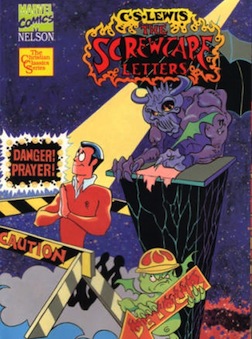
There’s even a graphic novel version of the collection which was published in 1994 by Thomas Nelson in partnership with Marvel Comics.

While the anniversary of the Letters in and of itself is certainly significant enough to merit a blog announcement . . . this post includes something quite rare. The fact is we’ve come into possession of one of Screwtape’s instructional emails, written to another subordinate demon.

For the benefit of those who would arm themselves against the snares of the Enemy, we reproduce it in full below.

(Oh, and as a reminder, when Screwtape refers to his Enemy, he is actually talking about the Creator of heaven and earth. Also, you can’t actually trust anything he writes since he’s a Liar, just like the archangel he followed so long ago. For example, note his incorrect reference to his own “immortality.”)

My Dear Esculentus,*

Another decade has passed since that puppet of the Enemy released to the world a portion of my correspondence with Wormwood. Of course, the lamentable Wormwood has had ample time to regret his carelessness in that matter, as I often remind you.

A decade’s but a snippet to immortals such as us, of course, but to the mortals it marks a significant portion of their brief lives. Why the Enemy loves those pitiable insects so much goes beyond logic!

Still, another halfscore has flown past and that damaging treatise remains in print. In fact, if anything, it continues to grow in popularity.

We simply cannot have our “patients” made aware of our treatment regimen for them. If they come to realize that our most successful deception is untrue, the relentless work of centuries will be undone.

We have labored tirelessly up to the present day to persuade humanity that all truth is subjective! Fortunately, the vast majority of the population in what are ironically labeled “enlightened nations,” has accepted our suggestion. This allows them to eagerly swallow the comforting lie that “all roads lead to god.” If they realize that all roads do indeed lead to a ‘god,’ they might abandon one of the many paths that lead to our Master who is ever-eager to “swallow” them in turn.

Better by far that those entrusted to our misleading, nourish our infernal Father than that you and I sate his appetite. (As you know, I say that figuratively, since our Father’s hunger for power can never be truly satiated. His all consuming hunger is one of his infinite qualities, which we rightly extol.)

But, back to your primary concern my appetizing friend, your patient. By all means keep him from reading The Screwtape Letters. In fact, the farther you keep him from anything written by Clive Staples Lewis, the better!

Keep him in the company of liberal companions who have embraced the myth of there being no objective truth. That way, we can prevent him from ever meeting the Enemy who proclaims himself to be—yes, disgusting isn’t it—the Way, the Truth and the Life.

Never pass up an opportunity to impress upon your patient that such a claim is politically incorrect to the utmost. Remind him he will be shunned by society if he argued there was a single truth. Indeed, make him think the very suggestion that anyone sincerely following another path might be lost, is repugnant.

Many of your fellow tempters have experienced great success in motivating the humans they treat to replace in their world views the virtue of Truth with the sentimentality of Sincerity. This you must do as well.

Persuade him that the eternal destiny of all who believe in something, is secure. Convince him that it is by their sincerity that they are saved. Oh how sweet it is when they accept this dark epiphany!

And it has never been easier to win humans over to this view than it is today. If you wish to embellish the doctrine with vague language about “God being love” and all that, so be it. Just see to it that they never open the Enemy’s book to recognize how grossly they have edited and distorted that concept!

Oh, and in closing, allow me to once again remind you of how I began this digital epistle. (We both know that it frequently takes a dozen or more reminders to make a firm impression on your dull mind.)

Do whatever it takes to ensure that your patient never reads the Letters! And, be wise to guard our own correspondence, lest you end up in the agonizing company of the afore-censured Wormwood.

Your affectionate adoptive Uncle,

Screwtape

*Esculentus translates from the Latin as either “delicious” or “succulent,” and if you have read The Screwtape Letters you know what that suggests about Screwtape’s interest in his protégé.

Pets in Heaven?

One of my favorite features in the Wittenburg Door of the 1980s was a running account of “Dogs Who Know the Lord.” Having witnessed more Christlike traits in some pets than I’ve seen in many human lives, I considered the tongue in cheek title a definite possibility.

This week we bid farewell to a gentle and loving border collie who had been part of our family for more than a decade. She lived a long and full life, and like her our previous border collie, she enjoyed her family and the outdoors (both gifts of God) right up until the end. (Both had been “rescued” by us.) Then, when Tanner and Lady were each over 15 years old, simply remained on their blankets when the day arrived that they knew they had not the strength to rise.

There are two kinds of people. Pet lovers, and those whose hearts are desensitized to their affections. The latter group has already stopped reading this post. But pet lovers, yes you, can empathize with my family’s current grief. You understand our loss because you’ve suffered the same pain. And, some of you may even pause to say a short prayer for us.

As a pastor, I’ve had numerous conversations with people about the question of whether or not we’ll see our pets in heaven. It’s a provocative subject, and the fact that such questions persist is a tribute to the significance of these animals in our lives.

Contrary to what some would allege, posing questions about this matter does not trivialize faith; it reveals how our restored relationship with our Creator affects every dimension of our existence.

We cannot know, of course, the answer to the question. That’s something that those who respond with a snide “of course not!” should take care to realize.

Over the years my own views on this have broadened, and far from seeing the deliverance (i.e. not “salvation”) of animals as something unlikely . . . I now consider it likely that we will be greeted by our beloved pets in the new creation. Here are some reasons I consider this a definite possibility:

  1. First, it is true that Jesus died to redeem (save) human beings (not animals).
  2. Animals are “innocent” sufferers of humanity’s disobedience and fall.
  3. Some animals are uniquely precious and beloved by God’s children.
  4. Their presence in heaven would enhance our joy.
  5. The same God who created them would have no difficulty re-creating or restoring them.
  6. If the lion and the lamb will lie together in harmony, why should there not be room for our much-loved pets to frolic alongside them?

And, lest you consider the words above merely the sentimental ramblings of a grieving man, I take comfort in the fact that C.S. Lewis too regarded this as a possibility. In a 1962 letter, he wrote:

. . . in The Problem of Pain I ventured the supposal—it could be nothing more—that as we are raised in Christ, so at least some animals are raised in us. Who knows, indeed, but that a great deal even of the inanimate creation is raised in the redeemed souls who have, during this life, taken its beauty into themselves? That may be the way in which the “new heaven and the new earth” are formed. Of course we can only guess and wonder. But these particular guesses arise in me, I trust, from taking seriously the resurrection of the body.

C.S. Lewis’ Lion

The Chronicles of Narnia rank among the finest children’s literature ever written. And the introduction of the noble Aslan in The Lion, the Witch and the Wardrobe is a wondrous highlight of the series.

In 1951, Lewis wrote a letter to some fans of his “new” book. He said:

I am glad you all liked The Lion. A number of mothers, and still more, schoolmistresses, have decided that it is likely to frighten children, so it is not selling very well. But the real children like it, and I am astonished how some very young ones seem to understand it. I think it frightens some adults, but very few children.

As usual, the Oxford don was astute. There are those who have considered some of the themes in The Chronicles to be overly mature for some children. But that is a more insidious reason for some objections leveled against the books. More on that momentarily.

The stories are admired by many secular readers, and they are beloved by Christian readers of all ages. Some liberal readers object to what they consider to be “dated” (i.e. traditional) attitudes in the books. Honest literary critics recognize that literature written more than a half century ago would reflect the mores of their era and provenance. Lewis’ skepticism about “public” schools (i.e. in American parlance, “private” academies) is one such example.

But behind some objections to Lewis’ children’s books lies a more sinister agenda. Some secularists believe that only their own agnostic faith should be promoted, and they object to any expression of Christianity in the public forum. Some such activists have even advocated that The Chronicles barred from schools because they recognize that Aslan has a “different name” in our world.

Fortunately, The Chronicles of Narnia overflow with so much intrinsic merit that only the most cynical object to them. They are popular today, and that is likely to remain true in the foreseeable future. They have translated well to digital, audio and cinematic formats. But, for most of us, the soft caress of the printed page remains the medium of choice . . . when we cross through the wardrobe door into this land of awe.

Discerning Good

Some years ago a comedy program used to scan their audience during applause and segment transitions. They would stop on a random individual and superimpose an absurd comment below their image on the screen. It was quite funny, and my favorite adage was “who are you to judge this man?”

Our society has certainly grown timid when it comes to judging the (mis)behavior of people. It seems you can’t make any observations about others without having some misguided soul—too dimwitted to understand they’re guilty of the very thing they condemn—declaring that you shouldn’t judge others.

Actually, the Scriptures repeatedly tell Christians they are supposed to judge the difference between good and evil (actions and people). Jesus asks the crowds on a number of occasions, most notably in response to his parable about the Good Samaritan, which of the choices were right and which were wrong.

Followers of God are not only enjoined to do good. They are also directed to avoid doing what is wrong. Psalm 36 describes the disposition of the wicked: “He plots trouble while on his bed; he sets himself in a way that is not good; he does not reject evil.”

C.S. Lewis provides an insightful juxtaposition of good and evil. “If we find a man giving pleasure it is for us to prove (if we criticise him) that his action is wrong. But if we find a man inflicting pain it is for him to prove that his action is right. If he cannot, he is a wicked man.”

The Church has a responsibility to call sin “sin.” And to influence people to choose better paths which will lead to healing and wholeness. Helping people make choices which lead to life rather than death is the essence of the Great Commission.  So, far from being something we should avoid—discerning or judging is an activity central to Christian life.

The key is remembering that our judgments should always be given in love. Genuine compassion for the victims of sin (which include the perpetrators themselves) is a hallmark of Christ-like judgment.

C.S. Lewis on Xmas

Advent has begun! As the Christian Church celebrates its “New Year,” it’s fun to look at C.S. Lewis’ essay, “Xmas and Christmas: A Lost Chapter from Herodotus.” He describes the predicament of secularized western civilization. Reversing the spelling of “Britain,” Lewis points out how a new holiday has displaced a profound holy-day.

In the middle of winter when fogs and rains most abound, [the Niatirbians] have a great festival called Exmas, and for 50 days they prepare for it (in the manner which is called,) in their barbarian speech, the Exmas Rush.

When the day of the festival comes, most of the citizens, being exhausted from the (frenzies of the) Rush, lie in bed till noon. But in the evening they eat five times as much as on other days, and crowning themselves with crowns of paper, they become intoxicated. And on the day after Exmas, they are very grave, being internally disordered by the supper and the drinking and the reckoning of how much they have spent on gifts and on the wine.

A few among the Niatirbians have also a festival, separate and to themselves, called Crissmas, which is on the same day as Exmas. And those who keep Crissmas, doing the opposite to the majority of Niatirbians, rise early on that day with shining faces and go before sunrise to certain temples where they partake of a sacred feast.

But as for what Hecataeus says, that Exmas and Crissmas are the same, this is not credible. It is not likely that men, even being barbarians, should suffer so many and so great things (as those involved in the Exmas Rush), in honor of a god they do not believe in.

Niatirb might just as well be the Setats Detinu. We see the same signs all around us. One shocking fact is how the secular seasonal movies now do not even feel compelled to offer the slightest nod to the true meaning of the season. Santa, for many, has utterly eclipsed the Babe in the manger. And “Christ” has literally been crossed out of Xmas.

May this entertaining portrait remind each of us of the true significance of the approaching season. And, may God also use the season of Advent to prepare our individual hearts to receive the most priceless and precious Christmas gift ever given.

Alone—With God

“In prayer God shows himself to us. That he answers prayers is a corollary—not necessarily the most important one—from that revelation.” (C.S. Lewis, “The Efficacy of Prayer”)

Most people think of prayer primarily as a (frequently formal) conversation in which we appeal to God for particular blessings—followed by his response with a “yes,” “no,” or “not yet.” The formulation might look like this: Human Petition = Divine Response.

While prayer truly is a conversation with our Creator . . . this simplistic view is incomplete. In focusing on the answer, it misses out on the holy awe of being in the presence of God itself. C.S. Lewis grasps this precious truth. “In prayer God shows Himself to us.”

I was chatting with my grandson the other day. He’s home on leave from his assignment at Kadena Air Base in Okinawa. Andrew was describing how his Christian lifestyle has isolated him from many of his fellow airmen. They sometimes ridicule him for his chastity and can’t fathom his choice not to squander his time at the club.

But Andrew also shared with me how the ostracism has positively impacted his spiritual life. He’s discovered deep joy in spending time alone with the Lord. He’s active in church worship too, of course, but he also enjoys his time alone. And that is a spiritual epiphany for a gregarious young man who is intensely social by nature.

He shared with me this verse from a song by a contemporary Christian band we both enjoy:

“Loneliness and solitude are two things not to get confused ’cause I spend my solitude with You.” (Reliant K, Lyrics from “Therapy”)

I hear in these words an echo of Lewis’ insight. As Christians, we are never alone. And sometimes in “solitude” we experience the most amazing intimacy a human being can ever know.

Addendum:

True . . . God is ever with us. As Saint John Chrysostom, Patriarch of Constantinople, said: “Quietude in solitude is no small teacher of virtue.”

Pornography Pays . . . and Costs

See No Evil

Some years ago I was a member of an “online” fiction critique group. It was secular, and few members worked with religious themes. I recall how one of the other writers bemoaned the fact that she had become “trapped” in a cycle of needing to write pornography. She said, “I can’t stop because it’s so easy to write and the market pays so well.” Now, I can’t attest to either of those statements . . . but her next sentence sure rang true.

“It simple to write and profitable . . . but writing this stuff makes me feel dirty.”

This impressed me. Even the theologically unenlightened mind (spirit/soul) recognizes the corrupting influence of immersing oneself in filth. God has written his (natural) law on the conscience of all those created in his image.

An article in today’s news brought this story to my mind. It appears a Roman Catholic publishing house has been found to include pornography in its frontlist. My first reaction is that this had to be a mistake, but the evidence seems quite significant.

The facts are simple. The press is in Germany and called Weltbild, and it’s second only to Amazon in book sales there. It publishes material most would deem pornographic. (The legal but vile industry calls itself “erotic” literature, but it’s eros-defiled.) While it’s sad enough that such material even exists, that’s not all. The more depressing issue is that Weltbild is owned in whole by the dioceses of the Roman Catholic Church in Germany.

Now, if you’re like me, you’ll want to give the church the benefit of the doubt. After all, you think, some unknown editor probably slipped a single title into their immense publishing list. I’m sure the senior people were never even aware of the mistake.

If you’re like me, you’d be mistaken. Turns out over 2,000 titles are found in their online store under the category of erotica. And, back in 2008 a group of concerned Catholics brought this matter to the attention to the attention of the bishops. In a seventy-page document.

What a tragedy.

But there is a lesson here. Those of us who call ourselves “Christian” should strive to maintain the highest possible standards. Associating ourselves with ugly things reflects poorly not only on us, but also on our Lord. This story is shameful, and I pray the leaders involved will repent of their error, no matter what the financial consequences may be. On the other hand, I too need to avoid shameful actions. And, whenever I do fall short of the Christian ideals which are my goal—I need to be swift to acknowledge my sin and seek to restore what has been lost.

Addendum:

Very true. Paul’s counsel to the church in Philippi remains timely. “Whatever is true, whatever is honorable, whatever is just, whatever is pure, whatever is lovely, whatever is commendable, if there is any excellence, if there is anything worthy of praise, think about these things.”

Sharing Surnames

“‘It isn’t Narnia, you know,’ sobbed Lucy. ‘It’s you. We shan’t meet you there [again]. And how can we live, never meeting you?’

‘But you shall meet me, dear one,’ said Aslan.

‘Are—are you there too, Sir?’ said Edmund.

‘I am,’ said Aslan. ‘But there I have another name. You must learn to know me by that name. This was the very reason why you were brought to Narnia, that by knowing me here for a little, you may know me better there.’”

C.S. Lewis, The Voyage of the Dawn Treader

 Names are precious, and the way that others who share your name bring to it honor or dishonor is important. As Ecclesiastes says, “A good name is better than precious ointment . . .”

I may be more sensitive to this truth than most people, because I grew up with a modestly (in)famous name. Fewer people recognize the link today, since the Burt Lancaster film that publicized the Birdman of Alcatraz is rarely aired. When I was a kid, it seemed to be run annually, like the Wizard of Oz, and I invariably could count on someone making the name connection every time it ran.

Actually, it wasn’t all that bad. Lancaster’s portrayal of the compassionate inmate was extremely sympathetic. The connection didn’t bother me much. Well, not until I read about the genuine Robert Stroud. Not quite as appealing a human being. Enough said.

Anya Stroud, WarriorIf you conduct some web searches on variations of your family name, you’ll be surprised what you find. I recently came across a fictional “relative” named Anya Stroud. She looks like someone you’d like to have at your side in an apocalyptic battle, doesn’t she? I understand she is a resident of just such a violent world, in the game system she inhabits.

Returning though to the real world . . . what we do with our name means a great deal to others who share it, especially to our family. Perhaps most of all, to our descendants. Much better for them to look back upon an honorable and godly ancestor rather than a vile example of unredeemed humanity.

And there is another aspect to guarding our name. One of the names followers of Jesus are known by is “Christian.” This is the most precious name we can hold. It is because of this name we can approach our Creator and call him “Father.”

This is a name we should strive to protect and make praiseworthy. We should not however try to earn it, since that’s impossible. It’s a name given simply as a gift, to all who believe Jesus is the Christ, the Messiah promised to be our Redeemer.

Addendum:

Parents are blessed when their children bring honor to their name. So too our Father in heaven. In a world where many hypocrites appeal to his name to defraud and mislead others, it is good to be reminded that our calling as disciples is to live in a manner that conforms to God’s command: “You shall therefore be holy, for I am holy.”