No Child Unwanted

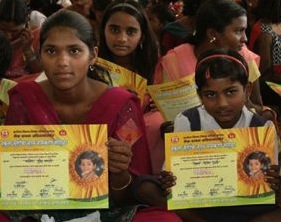
Certificates Bearing Their New NamesIt’s difficult for people who are products of Western civilization to comprehend the different view of the value of life held by many in our world.

An article today described a terrible practice in India, home to more than 1.2 billion human beings. Like many less developed nations, male children are often preferred to female offspring. Sons are viewed as a blessing and daughters (primarily due to dowries, in the case of India) are less welcome.

And because of that sad fact, it has become common for some families to name their innocent daughters Nakusha, which sounds rather pleasant, but means “unwanted.” It would be difficult to imagine an uglier name.

Recently a movement has arisen to rename girls cursed by their parents with this crippling birthright. Yesterday, in fact, just such a renaming ceremony was conducted in Satara District. The girls were allowed to choose their own name to replace the vile one that had shadowed their lives up to this point.

While there are millions of Christians in India, they have hardly made an impact on the Hindu worldview that dominates the land. It is inconceivable that in a Christian land (i.e. one rooted in the biblical documents and principles like most nations in the West), that children would be named “Unwanted.”

On the contrary, children are esteemed in the Christian context. Listen to these gracious words of Jesus the Christ:

At that time the disciples came to Jesus, saying, “Who is the greatest in the kingdom of heaven?” And calling to him a child, he put him in the midst of them and said, “Truly, I say to you, unless you turn and become like children, you will never enter the kingdom of heaven. Whoever humbles himself like this child is the greatest in the kingdom of heaven.

“Whoever receives one such child in my name receives me, but whoever causes one of these little ones who believe in me to sin, it would be better for him to have a great millstone fastened around his neck and to be drowned in the depth of the sea.”

Let us say a prayer for each little girl and boy—in every land around the globe—who finds themselves unwanted by their family. And let’s support worthwhile agencies that work to rescue them.

Because every child is precious to God.

Addendum:

…and every child is precious to all of those who already know God as their Father, as well.
Biblical Illiteracy

A person does not have to be religious to recognize the importance of the Ten Commandments on western civilization, literature and life. Even when one disregards their intrinsic merit, their literary significance remains. That said, it is important that those who consider themselves well educated should be acquainted with the message of this foundational document.

The statistics reveal a rather surprising picture. It turns out sixty percent of Americans cannot identify even half of the commandments. What I find stunning about that is the fact that since they are mostly prohibitions of destructive behavior, even the illiterate should be able to guess half of them. “Okay . . . we shouldn’t commit murder . . . steal from others . . . or lie about and slander others.” Pretty common sense, and we’re already over halfway there.

“Let’s see . . . the commandments are about God, so there’s probably one that says ‘worship the real God.’” Simple logic, and we’ve nearly arrived. Four out of the five and it wasn’t all that challenging. But how do we arrive at a fifth commandment? Here are two possible paths:

“Oh, doesn’t ‘religion’ believe that it’s sinful to cheat on your spouse . . . that’s probably on the list.”

or

“What’s that weird word the Bible uses about wanting stuff that belongs to others . . . oh yeah, ‘coverting’ or something like that . . . we’re not supposed to desire the possessions of others.”

Since our world has programmed us all with insatiable materialistic desires, it’s probably unlikely that someone would “guess” that coveting our neighbor’s property is wrong, so let’s substitute a more likely alternative.

“Christians get so worked up about swearing, especially when people curse using ‘God’ or ‘Jesus’ . . . so there’s probably something about that in the Ten Commandments.”

Congratulations, we’ve reached our goal of five.

As for the enumeration of the commandments—which varies among Jewish, Roman Catholic and Protestant communions—that’s a subject for another day.

Addendum:

Don’t forget the observance of this commandment which would transform our world: “Honor your father and mother” (this is the first commandment with a promise), “that it may go well with you and that you may live long in the land.”

Faith Makes Sense of Our Existence

“If we discover a desire within us that nothing in this world can satisfy, also we should begin to wonder if perhaps we were created for another world.” (C.S. Lewis, Mere Christianity).

It would be a sad thing if we existed only for this brief lifetime. And an awareness of this tragic fact rests like a dark cloud over human existence. Many atheists cling to this as a fundamental justification for their rejection of God. “Because of our awareness of our own mortality,” they argue, “people create gods to worship.”

Now, we Christians can acknowledge one aspect of their reasoning. It actually is reasonable to think that if there were no Creator, people would be inclined to invent something to explain the cosmos. We see evidence of this in the fact that when people reject the Son of God—they vainly strive to fill the vacuumleft in their spirits. Human beings share a deep spiritual emptiness (called by some a “God-shaped hole”). And while atheists use that fact to argue against faith . . . C.S. Lewis provides us with the true reason for the conundrum.

It is precisely because of our broken relationship with God—because we were created for a perfect world we no longer inhabit—that we have an innate yearning for the eternal which only God can satisfy. You and I were created to live in the presence of our Lord in a Garden richer than we could ever imagine. And those who trust Christ now will find that a place has been prepared for us in a glorious new home.

 †††

Our faithful commentatorComment: Amen. As the North African Church father Augustine of Hippo wrote: Crede, ut intelligas. “Seek not to understand that you may believe, but believe that you may understand.”

What’s So Important about the Milvian Bridge?

Constantinian Triumph CoinWhile pondering what to write about today, I visited one of those “This Day in Christian History” websites. It cited 27 September as the day of Constantine the Great’s “conversion” (in the year A.D. 312). Ironically, the website was in error, with the actual date being the evening of 27 October.

Many people might say “what difference does it make?” but writers will be reminded once again of the necessity of accuracy in their writings! What sort of credibility do you think that website now holds for me?

At any rate, returning to the subject of Constantine’s October 312 conversion . . . it was one of the pivotal events in the history of the world. Not only did Constantine end the persecution of the Church, he raised Christianity to the status of favored religion. Contrary to most quasi-historians, it would be left to a later emperor to establish Christianity as the empire’s official faith.

The early fourth century was a turbulent and fascinating time. Constantine had to battle a number of other so-called Imperators. (“Caesar” remained one of their many titles, but it was no longer the synonym for the ultimate ruler.) One of Constantine’s challengers—who allied himself completely with the pagan faction which still vastly outnumbered the Christians—was Maxentius.

On the evening before the battle, in response to a divine vision, Constantine had his soldiers mark their shields with a symbol for Christ (most likely, a chi-rho). He would ultimately march under that sign to victory over all of his enemies. Licinius, his final foe, would also throw his lot with the pantheon of Rome and other pagan deities. Like Maxentius, he too would fall.

This coin was minted by Constantine to commemorate his victory over these agents of the “Serpent.” The Labarum (Constantine’s standard, topped by the chi-rho) pierces the creature. The legend on the coin reads “Spes Publica,” which means “hope of the people.”

On the matter of just how transformative Constantine’s spiritual conversion actually was . . . well, that’s a subject for another day. Suffice it to say now that he regarded his allegiance to Christ as sincere, and he never recanted. Oh, and the importance of the Milvian Bridge . . . if Maxentius had not fallen there, history would read quite differently today.

Does More Education = Greater Faith?

A new study has found that advanced education does not necessarily result in a decrease in religious orientation.

Liberals have long held the ramparts of academic bastions. They make it difficult for conservative (especially Christian) faculty members to enter their ranks. This is a great irony, since one of their hypocritical mantras is that everyone should maintain an “open mind.” Apparently they believe the mind should remain open to virtually everything except for traditional values and faith. Case in point, the gifted C.S. Lewis was denied a full professorship at Oxford, and ended his career teaching at Cambridge University, where the faculty at the time was less prejudiced.

The recent study by sociologist Philip Schwadel offered some shocking results. For example, highly educated individuals are actually more likely than their less educated counterparts to attend worship services. You read that correctly, they are more apt to practice their faith by participating in corporate worship. In fact, data from the General Social Survey revealed that with each additional year of education, the likelihood of attending religious services increased 15 percent!

Lest Christians get too excited over the study, however, there are a couple of caveats. In essence, more highly educated people tend to become more liberal in their theology. This manifests itself in a lower view of Scripture’s authority, and a corresponding tendency toward viewing the God who was incarnate in Jesus Christ as a generic “higher power.”

So, at the end of the day we find ourselves where we began. There are devout Christians across the educational spectrum. Some hold impressive degrees from prestigious universities. Many of them teach, and we should pray that they are able to do so without compromising their integrity.

God and the world don’t value things in the same way. As Paul wrote to the Christians in Corinth: “For the word of the cross is folly to those who are perishing, but to us who are being saved it is the power of God . . . For consider your calling, brothers: not many of you were wise according to worldly standards, not many were powerful, not many were of noble birth. But God chose what is foolish in the world to shame the wise; God chose what is weak in the world to shame the strong . . . so that no human being might boast in the presence of God. And because of him you are in Christ Jesus, who became to us wisdom from God, righteousness and sanctification and redemption, so that, as it is written, ‘Let the one who boasts, boast in the Lord.’”

Ultimately I’m unimpressed by the new data—I’ve always recognized the truly intelligent people in the world are those who follow Jesus.