Dangerous Slang

toilet 2When we moved to Alabama, my wife innocently offended some of her young students by using a slang word that in our family simply meant “stuff,” but apparently is used elsewhere for more vulgar purposes.

In a reference to something such as things being in the way, she said the word “crap.” Obviously she was definitely not using it in the Thomas Crapper sense. But some of the Southern kids had never heard it applied in an innocent way, so they naturally assumed she was using it in a crasser sense.

She wasn’t. I grew up with the word meaning “junk, stuff or clutter” with the connotation that they were unwelcome, and “in the way.” My sainted mother—from whose lips I do not ever once recall hearing a vulgar word pass—used the word “crap” often.

And because the source of the word’s usage was so pure and unadulterated (my mom), I mistakenly assumed I fully understood the word’s meaning.

Still, old habits are hard to change, and I find myself occasionally using that very word. And, I must confess, I sometimes even use it as a minor expression of irritation. For example, I just used it in the subject line of an email I sent to some fellow students of ancient Roman history. “Crap, I Just Missed This” was the exact phrase, and the body of the message consisted only of a link to a fascinating conference held in Rome just a few days before I learned about it.

The link was to this site. . . and if you don’t have the time or inclination to check it out, allow me to share the fascinating subject it addressed:

It was sponsored by the Royal Netherlands Institute in Rome, quite a prestigious organization. No fewer than seven scholars who have been excavating Rome’s ancient latrines were slated to speak—I’m eager to learn whether or not their presentations will be published for the benefit of those of us unable to attend.* They generously offered “free seating” to members of the public desiring to attend the historic programme.**

C.S. Lewis apparently respected the Roman Empire enough to take the Roman name of an ancient Italian city for the name of fabled “Narnia.” While I’ve yet to find any references in Lewis’ corpus to Roman plumbing, I found this appraisal of a History of Rome which he noted in his diary (16 March 1924). During an extended country walk with two friends, he dined at an inn and browsed through its public library.

After some time we went on to Stanton Harcourt where we were to lunch. Before we reached it the sun suddenly disappeared and the sky got white and a cold wind sprang up. In the inn parlour we consumed large quantities of bread and cheese and draft cider. Harwood found a delightful book here—a History of Rome “related in conversations by a father to his children with instructive comments”. The children made such comments as “How pleasing is filial piety, Papa!” and “My dear Sir, surely you have been too indulgent in describing the vices of Honorius as weakness.”

One wonders what sort of refined comments the children would have made about the recent conference. Perhaps something like, “Most honored patriarch, it is enlightening to learn just how elaborate was the attention the Romans devoted to the facilities dedicated to their private bodily functions.”

Well, enough about such matters. We have terribly digressed in a post originally intended to serve as a warning about the dangers of using slang. I guess I am just so disappointed about missing the conference that I needed to vent that here.

_____

* One wonders how they were able to adequately address this complex subject in a one-day seminar.

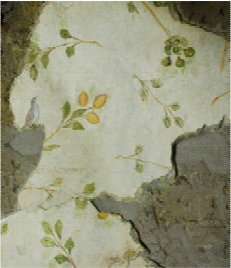
toilet 1** The invitation does not expressly say whether it would consist of individual seats, or in a bench design, similar to that pictured below, from the workshop’s brochure. Speaking of pictures, the one at the top of the column, also from the promotional publication, is a fresco from the ceiling of a toilet on the Palatine. (And we think our bathrooms are fancy!)
Unflattering Likenesses

Nero 1We tend to caricature those we dislike. We usually do it with words, either dismissive or insulting. Sometimes we do it with images.

I wrote an essay once entitled “Demonizing Our Enemies,” and in this world of constant turmoil it includes a message we cannot afford to forget. If you’re interested in reading it, it’s on page fifty-four of the first issue of Curtana: Sword of Mercy, and you can read (or download) it for free here.

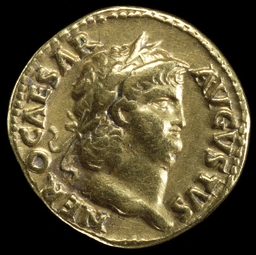
Sometimes, however, what appears on the surface to be an insult . . . may simply be a reflection of accuracy. That, I think, is the case in the coin pictured above. It displays a portrait of the Emperor Nero, in all of his porcine grandeur. It is, in a single word, grotesque.

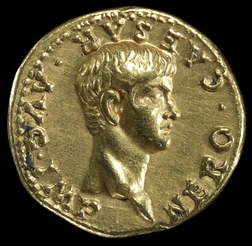
Nero 2Consider this image, of the emperor in his youth. It’s rather disgusting to see what he had become. But the fruits of unrelenting debauchery and murder do take a toll.

Still, one wonders how an image like this ever came to be. What emperor, in his right mind, would allow us a graphic reproduction of his ugliness? Especially when it would have been a simple thing to circulate at the mints an idealized portrait for official use. (That, of course, has been a common practice throughout history.)

As a bit of a numismatist, I was curious as to how it came to be. My first impression upon seeing the bizarre likeness of the imperator was that it must be a “barbarous” imitation of a Roman coin. Such counterfeits became fairly common in the fourth century, and they are usually identified by terribly garbled legends (inscriptions).

After doing enough research to determine this was a genuine imperial issue, I wondered if the celator (die-carver) might have been put to death for his presumption. No evidence of that, though it may have happened.

I have to assume that Nero was so self-consumed that he was oblivious to the way the corpulent image must have invited silent ridicule. He was, after all, despised by virtually everyone for his countless excesses.

So, ultimately, the doomed emperor unintentionally played the proverbial joke upon himself. By allowing an accurate portrayal of the imperial profile, he preserved for all time a true testimony to himself. He may have falsely blamed the Christians for Rome’s terrible fire, but he had no one other than himself to indict for his metallic legacy.

For those curious as to how I might work a Lewisian theme into this unusual post, allow me to include the following passing reference to the self-acclaimed master of the lyre. It appears in the essay “Learning in War-Time”

A University is a society for the pursuit of learning. . . . At first sight this seems to be an odd thing to do during a great war. What is the use of beginning a task which we have so little chance of finishing. . . Is it not like fiddling while Rome burns?

Now it seems to me that we shall not be able to answer these questions until we have put them by the side of certain other questions which every Christian ought to have asked himself in peace-time. I spoke just now of fiddling while Rome burns. But to a Christian the true tragedy of Nero must be not that he fiddled while the city was on fire but that he fiddled on the brink of hell.

And—lest any of us smugly nod in agreement that such an evil man most assuredly deserved his searing fate—here is another passage from Lewis that offers a sobering truth.

In the long run the answer to all those who object to the doctrine of hell, is itself a question: “What are you asking God to do?” To wipe out their past sins and, at all costs, to give them a fresh start, smoothing every difficulty and offering every miraculous help? But He has done so, on Calvary. To forgive them? They will not be forgiven [editor: they will not accept God’s forgiveness]. To leave them alone? Alas, I am afraid that is what He does.

One caution, and I have done. In order to rouse modern minds to an understanding of the issues, I ventured to introduce in this chapter a picture of the sort of bad man whom we most easily perceive to be truly bad. But when the picture has done that work, the sooner it is forgotten the better.

In all discussions of Hell we should keep steadily before our eyes the possible damnation, not of our enemies nor our friends (since both these disturb the reason) but of ourselves. This chapter is not about your wife or son, nor about Nero or Judas Iscariot; it is about you and me. (The Problem of Pain).

Our Common Tongue

Bruegel BabelThe ancestors of Europeans and Asians spoke a common language 15,000 years ago, as the ice age was ending.

That “discovery” sounds remarkably familiar to those acquainted with an ancient story about a colossal edifice erected in the ancient past. The Hebrews preserved a record of the achievement in the eleventh chapter of the book of Genesis. At the time of the tower’s construction, all of humanity consisted of “one people [sharing] one language.”

The argument for just such a common language is made in a detailed study published this week in the Proceedings of the National Academy of Sciences. After finishing this column, you may wish to read the original journal article, which is available here.

The mechanics of the study will be of great interest to all logophiles (word lovers).

Using sophisticated statistical analysis, the researchers identified 23 different words that have remained recognizable for fifteen millennia. These “ultraconserved” words include some of the fundamental building blocks of basic communication. They include: not, mother, man (i.e. male), we, this, hand, old, fire, ashes and (rather oddly) worm.

The study identifies “proto-words” that underlie common terms in extremely diverse languages. It is no accident that these universal words are the ones that are the most concrete, frequent and essential for human communication.

The Languages of the World Etymological Database, part of the Tower of Babel project . . . records reconstructed proto-words for language families from around the world. Proto-words are hypotheses as to the form of the word used by the common ancestor or proto-language of a given language family to denote a given meaning.

These words are reconstructed by first identifying cognate words among the languages of a given family and then, because cognate words derive from a common ancestral word, working back in time to reconstruct the probable features of that shared ancestral form.

J.R.R. Tolkien was a brilliant linguist, and his abiding love of languages provided the impulse for the creation (and intricate history) of all of Middle Earth.

C.S. Lewis was one of the twentieth centuries greatest writers. He was also a scholar—one with an outstanding grasp of literature. Lewis acknowledged that words describing immediate, touchable concerns can be distinct and firm, just like the realities they connote. However, when language moves farther from such elements, it invariably grows more abstract.

All language, except about objects of sense, is metaphorical through and through. To call God a “Force” (that is, something like a wind or a dynamo) is as metaphorical as to call Him a Father or a King. On such matters we can make our language more polysyllabic and duller: we cannot make it more literal. The difficulty is not peculiar to theologians. Scientists, poets, psychoanalysts, and metaphysicians are all in the same boat. (God in the Dock, “Horrid Red Things”).

The linguistic study described here notes that frequency of usage exerts a stabilizing influence on words. Whereas less common (and more abstract) vocabulary “evolves” more rapidly.

A rule-of-thumb emerges that words used more than around once per 1,000 in everyday speech evolve slowly enough to have a high chance of being judged cognate among more than two of the language families; this might equate to around 16 uses per day per speaker of these high-frequency words.

Throughout history various languages have vied with one another for precedence. In the Mediterranean world Greek, for a season, and then Latin for another, were the “universal” tongues. The phrase lingua franca (literally, the “Frankish language”) has now come to refer to any language that is extensively used as a common bridge between speakers of different tongues.

Such languages, of course, enhance communication. That is not to suggest, however, that the development of these “dominant” languages is without critics. It seems, for example, that France was delighted in their language serving for many years as a standard for international diplomacy. Today however, France continues to staunchly resist the advances of English. (In 1994 the initial version of the Toubon Law overreached in requiring the extensive use of French in nearly all contexts. You can read about some implications for international businesses here.)

Even C.S. Lewis regretted some of the negative influences of American English on the mother tongue. In his book Studies in Words, he mourns:

I have an idea of what is good and bad language. . . . Language is an instrument for communication. The language which can with the greatest ease make the finest and most numerous distinctions of meaning is the best. It is better to have like and love than to have aimer for both.

It was better to have the older English distinction between “I haven’t got indigestion” (I am not suffering from it at the moment) and “I don’t have indigestion” (I am not a dyspeptic) than to level both, as America has now taught most Englishmen to do, under “I don’t have.”

It remains to be seen whether any single language will come to truly dominate the world scene. Being able to communicate freely across all political borders sounds like a noble goal. It is ironic that should that day ever arrive it will mark a return to how things once began.

_____

The painting reproduced above was painted circa 1563 by the Flemish artist Pieter Bruegel the Elder.

Beware of Zoolatry

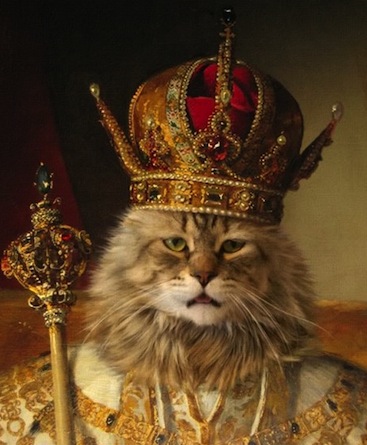
royal catWhen my wife and I dated, I praised her beautiful cat when I visited her home. The cat maintained that imperial posture and attitude that is common in virtually all felines. And that came as no surprise, since she was an Egyptian Mau, one of the most ancient of breeds. She passed on long decades ago, but her haughty, regal bearing is etched in my memory.

I thought of her today when I read the following in the December issue of First Things, in the executive editor’s column.

Wandering around the American Kennel Club’s big “Meet the Breeds” event with my two youngest children recently, I saw a big banner in the cat section proclaiming that a particular breed had been considered a god by an ancient civilization. Of course, our understanding of the genuine religious impulses of ancient religions has increased, but still, one of the gifts the Jewish people have brought the world is that no one who knows about the God of Abraham, Isaac, and Jacob is the least bit tempted to worship cats.

I mean, would you want to worship a murderous narcissistic psychopath? This is not an image of God to make anyone happy. If you’re going to worship an animal, why not the Border Collie, frantically eager to please, or the loving, soulful-eyed Lab? Or the alert and protective German Shepherd? Or the indomitable Saint Bernard? Or the classic loyal and even-tempered mutt?

I don’t intend to offend any cat lovers by repeating this observation—my son has an affectionate tabby he rescued as a kitten while a senior in high school, that’s welcome in our home anytime. Still, as an unrepentant dog person, and “papa” to a rescued border collie, the words above brought a smile to me.

C.S. Lewis painted a graphic image of one animal-headed deity. It was Tash, the god of the Calormenes. In The Last Battle, we see that in Narnia, the reality behind the lifeless image can be most terribly revealed.

In the shadow of the trees on the far side of the clearing something was moving. It was gliding very slowly Northward. At a first glance you might have mistaken it for smoke, for it was grey and you could see things through it. But the deathly smell was not the smell of smoke. Also, this thing kept its shape instead of billowing and curling as smoke would have done. It was roughly the shape of a man but it had the head of a bird; some bird of prey with a cruel, curved beak. It had four arms which it held high above its head, stretching them out Northward as if it wanted to snatch all Narnia in its grip; and its fingers—all twenty of them—were curved like its beak and had long, pointed, bird-like claws instead of nails. It floated on the grass instead of walking, and the grass seemed to wither beneath it. . . .

The others watched it for perhaps a minute, until it streamed away into the thicker trees on their right and disappeared. Then the sun came out again, and the birds once more began to sing. Everyone started breathing properly again and moved. They had all been still as statues while it was in sight. “What was it?” said Eustace in a whisper. “I have seen it once before,” said Tirian. “But that time it was carved in stone and overlaid with gold and had solid diamonds for eyes. It was when I was no older than thou, and had gone as a guest to The Tisroc’s court in Tashbaan. He took me into the great temple of Tash. There I saw it, carved above the altar.”

“Then that—that thing—was Tash?” said Eustace.

In our world, idolatry has certainly evolved since it’s pantheistic and zoolatrous beginnings. Today we are tempted by material indulgences and corruptions aplenty. While few of us impute divinity to animals or objects of stone or wood, we don’t have to look far to find something we deem worthy of adoration.

Our favorite idol is neither beast nor mammon. It is ourselves. As C.S. Lewis wrote in The Problem of Pain:

This act of self-will on the part of the creature, which constitutes an utter falseness to its true creaturely position, is the only sin that can be conceived as the Fall. For the difficulty about the first sin is that it must be very heinous, or its consequences would not be so terrible, and yet it must be something which a being free from the temptations of fallen man could conceivably have committed. The turning from God to self fulfils both conditions. It is a sin possible even to Paradisal man, because the mere existence of a self—the mere fact that we call it “me”—includes, from the first, the danger of self-idolatry. Since I am I, I must make an act of self-surrender, however small or however easy, in living to God rather than to myself. This is, if you like, the “weak spot” in the very nature of creation, the risk which God apparently thinks worth taking.

Now, this is a sin to which I frequently find myself succumbing. I far too often think first about my own desires and appetites . . . only later (if ever) becoming concerned with the needs of my neighbor.

No, it’s neither cat nor dog that needs to be evicted from the throne in my soul reserved for my Creator—it’s me.

Greek Mythology & Modern Humanity

narcissusThere is a very important mental health tome that describes psychological disorders in detail. It’s called The Diagnostic and Statistical Manual of Mental Disorders (DSM).

Since the American Psychiatric Association is constantly discovering new mental ailments—and they occasionally recognize that previously unhealthy mindsets and behaviors have become so pervasive they can no longer be considered aberrations—the DSM requires periodic revision.

The current authoritative version is DSM-IV-TR, or DSM, fourth edition, text revision. That means that if you were diagnosed with a defect according to the third edition standards, you may now have a clean bill of health. And, for those of you whose diagnosis is still included in DSM IV, don’t despair; they are currently consulting about version five, and who knows what psychoses may soon become “normal.”

I had to study these things during my seminary training, for my counseling work as a chaplain and civilian pastor. I was thinking about the manual recently as I pondered the spirit of Narcissus that seems to hold sway in our age. Like C.S. Lewis, I understand there is value in studying Greek and Roman myths, as many contain seeds of Truth. (Lewis’ appreciation for myth is most evident in Till We Have Faces, which is a reworking of one ancient Greek tale.)

Narcissus, of course, is the mythological Greek who was so consumed by his own handsomeness that he perished because he was unable to tear himself away from gazing at his own likeness. (The image above was painted by Michelangelo Caravaggio in the sixteenth century.)

Narcissism, which echoes his name, describes the unbridled vanity and self-concern (i.e. selfishness) that motivates growing numbers in our individualistic and hedonistic world. Since narcissism has become so rampant, the DSM now concerns itself only with “pathological narcissism.” That distinction will probably remain, even if Narcissistic Personality Disorder (NPD) is eliminated from the fifth edition as a distinct illness, as many have recommended.

God Save Us from the Narcissists

Pathological narcissists are terrible indeed. Their characteristic arrogance, envy, sense of entitlement and lack of empathy make them unhealthy members of society. In fact, large numbers of sociopaths and psychopaths are also narcissists.

But here’s the problem. At the rotten core of the disorder we find a putrid seed that negatively affects many of us who appear otherwise to be so normal. The source of the corruption is, in part, sinful pride.

Let’s take a look at the “diagnostic criteria” for NPD which confronted me when I first studied DSM III. (Perhaps you may wish to skip this section, since modest hints of some of these traits may strike close to home.) I’ve added my own introspective comments in italics.

Diagnostic criteria for 301.81, Narcissistic Personality Disorder:

A pervasive pattern of grandiosity (in fantasy or behavior) hypersensitivity to the evaluation of others, beginning by early adulthood and present in a variety of contexts, as indicated by at least five of the following:

(1) Reacts to criticism with feelings of rage, shame, or humiliation (even if not expressed).

— I’ve never “raged,” but it’s embarrassing to be criticized in public

(2) Is interpersonally exploitive: takes advantage of others to achieve his or her own ends.

— Never. I won’t tolerate manipulation–either as the manipulator or the manipulatee.

(3) Has a grandiose sense of self-importance, e.g., exaggerates achievements and talents, expects to be noticed as “special” without appropriate achievement.

— Have I told you lately about being Thespian of the Year when I graduated from high school . . ?

(4) Believes that his or her problems are unique and can be understood only by other special people.

— Not this trait, I’m aware everyone in this fallen world is faced with challenges . . . many of them worse than my own.

(5) Is preoccupied with fantasies of unlimited success, power, beauty, or ideal love.

— I do daydream about accomplishing special goals, although I never lusted after power and I accepted the facts about “beauty” long ago. I have, however, found ideal love, and we’ve been married 37 years!

(6) Has a sense of entitlement: unreasonable expectations of especially favorable treatment, e.g., assumes that he or she does not have to wait in line when others must do so.

— I’m the opposite. I always pick the longest and slowest line to stand in.

(7) Requires constant attention and admiration, e.g., keeps fishing for compliments.

— If people weren’t so frugal with compliments, I wouldn’t need to.

(8) Lack of empathy: inability to recognize and experience how others feel, e.g., annoyance and surprise when a friend who is seriously ill cancels a date.

— Nope. I really do care about others. That’s the reason good clergy and caregivers often suffer compassion fatigue.

(9) Is preoccupied with feelings of envy.

— Well, what about those cases where the person doesn’t deserve the honors they’ve received . . ?

There, I feel much better, having made a public confession of my almost-narcissistic human self-centeredness.

In his essay “Christianity and Culture,” C.S. Lewis warns that “A man is never so proud as when striking an attitude of humility.”

When we admit, instead, that there remains much in our soul that is base and prideful, we’re on the proper path. The course that leads to a rejection of Narcissus-in-us, and the embracing of what is precious in our neighbors and our world, is the road that leads to contentment.

C.S. Lewis’ Beloved Dogs

When the internet throws unsolicited information at me, I do my best to ignore it. Yesterday I failed to duck at the right moment and Wikipedia suggested to me a “featured article” I found irresistible. It featured the earliest reference to a named dog—Abuwtiyuwwho died more than four thousand years ago and was buried in Giza in accordance with the wishes of the unknown pharaoh he guarded.

He was almost certainly a Tesem (“hunting dog”), an ancient breed resembling modern greyhounds. (Curiously, a 2004 DNA study found greyhounds are more closely related to herding breeds.)

We contemporary dog lovers understand how a pharaoh could love one of his canine companions enough to have him mummified and buried in an elaborate ceremony. In the image above, our border collie mix is juxtaposed to a hieroglyph tesem. If you’re interested in the subject, you might enjoy one of my February blogs entitled “Pets in Heaven.”

C.S. Lewis was also a dog lover. Pastor Bruce Johnson wrote a delightful article about eight of his dogs, entitled “All My Dogs Before Me.” You can read the brief but thorough article here.

Johnson walks us from Jacksie (who provided Lewis with his “adopted” name of Jack) to the friendly Ricky who was ever “anxious to be friendly.” In between, the author’s family included Tim, Pat, Mr. Papworth, Troddles, Bruce and Susie. Lewis spoke fondly of all of them, with the exception of Bruce, who possessed a predilection for barking through the night and was terribly spoiled by Mrs. Moore.

I also recommend a fine post about one of Lewis’ dogs which appeared on A Pilgrim in Narnia. It’s entitled “The Society of Tim.” The author of the blog is Brenton Dickieson, a Canadian professor and Lewisian scholar.

Roman Realism

There are many things about ancient Rome that fascinate me. My love for the era finds its roots in the wonderful books of Rosemary Sutcliff and the spectacular cinematic epics like “Ben Hur” that were released during my childhood.

Over the years I’ve studied the Roman world in great depth. I shifted my numismatic interested to coins of the Constantinian era. (You can still purchase the genuine articles relatively inexpensively. Thanks to the tragic individuals who buried their hoards during troubled times and never returned to recover them.)

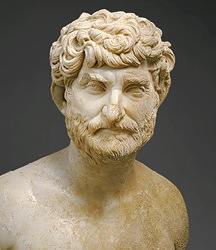
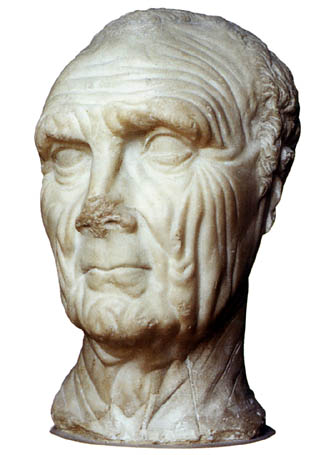
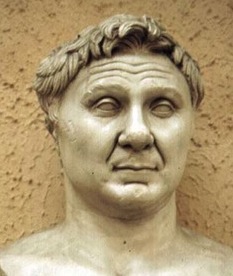
One of my favorite things about the Romans was their realism which manifested itself even in the busts they carved. Unlike the Greeks who strove to idealize everything, the Romans were pragmatic. If the honoree’s face lacked character (or suffered from an excess of the same), then the artist was expected to reflect that fact.

Just look at all the character in the face of the unknown Roman portrayed above. Or, how about this one. So vivid. Imagine just how difficult life must have been for this thirty-two year citizen.* Yes, they did an impressively faithful job portraying the subjects of their artistic studies.

I’m not naïve enough to think that the emperors’ likenesses weren’t “airbrushed” just a tad. But take a look at the image to the left. It was made of an extremely important person, Pompey the Great, and it’s obviously intended to be a true likeness. This image always reminds me of a troubled chaplain assistant who served with me during my isolated tour in Korea. That sergeant’s tussled coiffure witnessed to a nasty hangover. I cannot attribute Pompey’s unruly mane to the same cause.

C.S. Lewis said the first requirement of art is to engage, to connect in some fashion with the interests of the viewer. He wrote this in his essay “Hamlet: The Prince or the Poem,” which he wrote in 1942.

To interest is the first duty of art; no other excellence will even begin to compensate for failure in this, and very serious faults will be covered by this, as by charity.

If I lined up a dozen beautiful and stylized Grecian busts against one wall and the same number of Roman examples against another, I have no doubt which would merit and receive the greatest attention. Idealized portraiture can be appreciated. But realistic likenesses, that celebrate the uniqueness of each human being, these are truly engaging.

Oh, and in closing let me say that I’m just vain enough—should anyone undertake to create a bust of me—to want it crafted in the Greek style, rather than the Roman . . .

* True age unknown . . . but you already knew that, right?

Agnostic or Atheist: Does It Matter?

I haven’t forgotten. Well, I have forgotten far too many things in recent years, but I didn’t forget my recent “promise” to address the challenging subject of the distinction between agnosticism and atheism. Last week I wrote: “I suspect that the intimately personal nature of God’s love for us is one of the things that moves some people from agnosticism to atheism.”

It’s not my desire to offend anyone with the discussion which follows. After all, God loves the “lost” just as much as he loves those who have surrendered their lives to him. In fact, there’s an amazing passage that hints at how the rescue of one of those who has “strayed” is even more exciting to the hosts of heaven than the faithfulness of his dedicated disciples. (Check out verses 12-14 in chapter 18 of the Gospel according to Matthew . . . and remember what I have said in the past about how eager any of your Christian acquaintances will be to provide you with a copy of the Bible if you don’t already have one.)

Every soul is precious to God. And yet, many don’t recognize that fact. Many worship false gods (religious and secular). Among those who deny the existence of supernatural deities, there are essentially two camps. Agnostics who (technically) do not deny God’s existence, but merely profess that it is unknowable. Thus they personally remain unpersuaded. Atheists, on the alternative hand, are more adamant about denying God’s existence. Some, in fact, make a living by stridently refuting God himself and all things holy.

Intuitively, most people assume agnostics are not quite as distant from faith as are atheists. After all, agnostics are generally more polite and respectful toward those of us who naively cling to such superstitions . . . right? Atheists, by contrast, tend to ridicule those who would worship a God who laid down his very life, and died a human death.

Take, for example, what is arguably the earliest surviving illustration of Christ’s crucifixion. The illustration above was carved on an ancient plaster wall near Palatine Hill.

It’s a bit difficult to discern, but historical consensus sees the graffito as a pagan insult directed towards a Greek Christian. The scribbled inscription reads: “Alexamenos worships [his] god.” The crucified figure on the cross clearly bears the head of a donkey. The Church Father Tertullian wrote in the second century of slanders alleging Christians followed just such a deity.

Would something like this be likelier to come from the mind of an agnostic, or an atheist?

Agnostics would rarely summon the energy to rail against God like this. However, atheists sometimes feel so imposed upon by God’s children that they lash out with invectives.

So, as I noted above, the gut feeling of most observers would be to say vocal atheists are farther from God than their kindred disbelievers. However—I am convinced that is not the case!

Ironically, it is the tepid individual who lacks any serious conviction who is in greater danger of perishing without seeing God. This is due to the fact that agnostics have, as a rule, come to grips with the fact that there may or may not be a God . . . but they are content to proceed through life without caring much either way. To them the issue is rather trivial, in a sense, since they rarely lose sleep over it.

This is not true of the atheist, who recognizes that the matter is of the utmost importance; that’s why he is not content to simply ignore it. If God truly exists—they comprehend in the core of their being—nothing could be of greater significance.

Agnostics typically have an unreasoned impression that if there is a God, he is probably benevolent, and most likely more concerned with other elements of the universe he created than their small life. They echo the thinking of liberal “Deists” who imagined God as a distant “watchmaker” who set creation in motion and then left it forgotten on the shelf. This Great Watchmaker is not threatening. He isn’t angry at us, because he doesn’t even deign to notice us. He remains oblivious to humanity, just as we presumably live out our lives anonymous to him.

Atheists don’t want to believe in God, because of their overwhelming doubt. Simultaneously, they recognize that the stakes of the gamble are enormous. Eternal, in fact. And they resent God for placing them in this difficult predicament. Why can’t he just make his existence undeniably evident? Faith is the leap they are unwilling to take. But, by the same rational premise, the wise among them realize that in opting against theism, they are actually placing their faith in an equally unprovable tenet. And this has a tendency to make some of them mildly cranky.

Which brings us back to my suspicion that “the intimately personal nature of God’s love for us is one of the things that moves some people from agnosticism to atheism.” You see, when someone deeply ponders the mystery of whether there is a Creator, they understand he would never have created a sentient being with this yearning to cleave to him, without possessing a compassion for them in return.

Agnostics walk about like spiritual zombies, pursuing their various interests. Atheists, though, are tormented by the nagging “fear” that a loving God just may exist. Certainly, they do whatever they can to exorcize the notion, and they publicly celebrate their liberation from ancient and medieval superstitions, but unlike their unaffected agnostic relations, they have recognized the enormity of their choice. Oh to be a blissfully ignorant agnostic, the more thoughtful might muse.

Sadly (from their present perspective), the lot of the atheist is to be closer to God than the agnostic. Atheists may rail against their Maker, but the agnostic’s spiritual indifference causes them to drift farther and farther from the Truth.

The Scriptures offer a parallel to this distinction in the description of one of the early Christian churches. Apparently the believer in Laodicea had grown lackadaisical about their faith and lived lives that differed little from their pagan and agnostic neighbors. The Lord’s judgment of them begins: “I know your works: you are neither cold nor hot. Would that you were either cold or hot! So, because you are lukewarm, and neither hot nor cold, I will spit you out of my mouth.”

Strange, it seems to us, that God might prefer a militant atheistic mindset to an aimless agnostic worldview. But the amazing truth is that, in most cases, atheists are closer to the kingdom of God than their disinterested peers.

In Surprised by Joy, C.S. Lewis describes his own pre-Christian disposition. The grandson of an Anglican priest, he had consciously rejected the faith. Yet, as the possibility of its truth grew more real to him as an adult, he reacted against it. He clearly describes his condition as differing from that of the lukewarm agnostics I’ve described above.

Amiable agnostics will talk cheerfully about “man’s search for God.” To me, as I was then, they might as well have talked about the mouse’s search for the cat.

In the same volume he elaborates on the sentiments I’ve been describing.

I was at this time living, like so many Atheists or Antitheists, in a whirl of contradictions. I maintained that God did not exist. I was also very angry with God for not existing. I was equally angry with Him for creating a world.

So, if you consider yourself “angry with God for not existing,” you may be closer to meeting him than you ever imagined. If you do follow C.S. Lewis’ example, heaven will host a more resounding celebration for you than it does for the ninety-nine who have always remained part of his flock. And, if you’re a dispassionate agnostic who is weakly amused by this thought . . . my sincere prayer is that you, my friend, would become either hot or cold!

It’s Tough being a Colony

During the early 1990s I was stationed at RAF Greenham Common and RAF Alconbury in the United Kingdom. Our family loved our three brief years in that inspiring land. One of the quaint things I recall was the relatively frequent question I was asked when meeting someone new. They would inquire as to “how things were going in the colonies.” It was actually a pleasant ice-breaker, and never said maliciously.

The comment offered no cause for offense. It’s been too long since the United States was a British colony for it to be more than a historical comment. The heated issues that once led to bloodshed have become historical trivia. There are, of course, many “younger” nations in our world that are still struggling to discover their post-colonial identities. This has been notoriously difficult where occidental powers established arbitrary boundaries that failed to recognize ethnic, religious or cultural considerations.

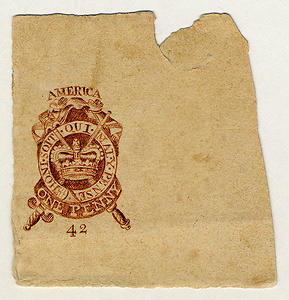
So, why is today’s post pondering the concept of colonialism? It just so happens that today is the anniversary of the imposition of the Stamp Act (tax) on her colonies by the British. It became law in 1765, a full decade before the War of Independence, but it was one of the alienating actions that laid the foundation for the upcoming rebellion.

Apparently, our paternalistic government in Europe regarded North America as a sort of bank from which they could make continuous withdrawals without ever repaying the funds. (“No taxation without representation” was a common battle cry.) The Stamp Act directly taxed all commercially published colonial materials, including newspapers and pamphlets. The Stamp Act would have been burdensome enough by itself, but the colonies were still reeling from three other onerous taxes that had recently been levied:

Sugar Act (1764)

…which covered textiles, wines, and coffee, in addition to sugar.

Currency Act (1764)

…which undermined colonial mercantilism and freedom.

Quartering Act (1765)

…which transformed every American home into a free bed & breakfast for British soldiers.

You get the idea. Georgia, Pennsylvania, Maryland and their like were merely colonies, so why should their concerns be factored into the equation? Extremely shortsighted. Not to mention, quite selfish.

C.S. Lewis addressed this subject in his major historical work.

The best European minds were ashamed of Europe’s exploits in America. Montaigne passionately asks why so noble a discovery could not have fallen to the Ancients who might have spread civility where we have spread only corruption. (English Literature in the Sixteenth Century).

We recognize that Montaigne’s notion is just a tad idealistic. If the Romans had colonized the Americas, for example, the indigenous people would hardly have been treated any differently. And the introduction of gladiatorial arenas would have presented an arguable civic improvement.

Still, Lewis’ point is completely valid. Whenever humans conquer or “colonize” their fellows, the colonies always get the proverbial “short end of the stick.” Thus, we recognize that it’s tough being a colony.

So, where does that leave us? Historically informed, perhaps we can make better decisions in the future. Weaker nations and peoples should never be exploited. It’s not just a matter of justice. Ethics aside, history teaches that sowing seeds of alienation and discontent invariably reap an unwelcome harvest.

One word of hope that we see in this historical snippet is that despite a combative history, lands (and people) can lay aside their animosity and become sincere allies. Which brings me back to the place where I began this column . . . living in an era when these nations that fought not one, but two wars, are steadfast friends.