A Literary Phobia

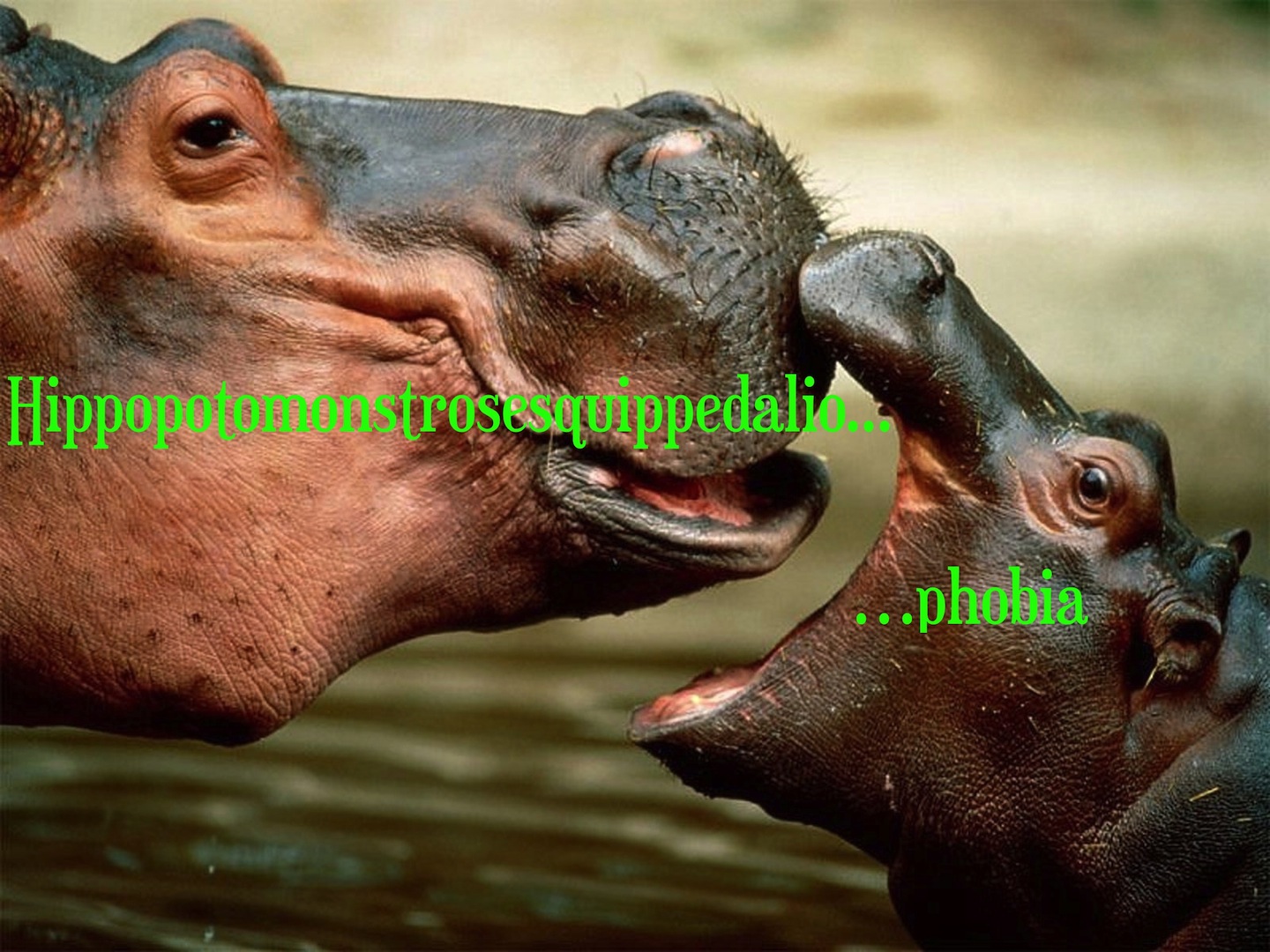
hipposWhat in the world does this protracted word mean?

Hippopotomonstrosesquippedaliophobia

From the suffix, we can assume that it refers to some sort of “fear.” But fear of what? Hippopotami?

No, this lengthy word doesn’t refer to the African “river horses” from which it derives its beginning. This peculiar construction describes nothing other than a fear of long words!

I know people who find long words daunting . . . but none who have admitted to be in fear of them. I myself am a bit intimidated by unfamiliar words that I have to pronounce in front of others. (I recently visited a writing group that caught me off guard with their practice of reading one another’s work out loud. Not only was I the first person expected to begin reading the first article critiqued that morning—it included a number of words from French cuisine with which I was unfamiliar.)

I don’t mind encountering unfamiliar words in a text (that I’m reading privately), especially when the meaning is evident from the context. In fact, I often enjoy the introduction, since it expands my own vocabulary.

The fact his, however, that many very gifted writers warn their readers to avoid lengthy or complicated words.

Just last week I contrasted George Orwell’s writing advice with that of C.S. Lewis. Orwell said,

“Never use a long word when a short one will do.”

C.S. Lewis, included in his short list of advice the encouragement to,

“Always prefer the plain, direct word to the long, vague one.”

While these suggestions may “sound” identical, they are not. Orwell is concerned here with simplicity (rather than brevity, per se). Lewis, though, is advocating clarity.

Lewis does not object at all to using a multisyllabic word. He merely argues that the choice needs to be one that helps communicate rather than confuse. Allow me to share a simple example. Following Lewis’ counsel, one of these sentences would be problematic, while the other would be okay.

Life is all about love.

Experiencing contentment and joy relates directly to one’s ability to offer, and receive, affection from other human beings.

Obviously one sentence is far more complex than the other. However, it’s meaning is quite clear. The simpler, five word sentence is so vague as to allow for any number of interpretations. For example, in addition to the alternative above, it might mean (to its writer):

Without a foundation of self-love, we cannot experience life to its fullest.

     or . . .

At the Final Judgment, it is only our acts of love that will pass intact through the “purifying fire.”

     or . . .

The more people with whom you can “sow your wild oats,” the happier you will be.

The Government Intervenes

Amazing as it may seem, the United States government actually has a website devoted to promoting simple language: plainlanguage.com. It exists to help implement the Plain Writing Act of 2010.

While the effectiveness of the statute is debatable, it’s intention is praiseworthy.

On one page it directs agencies to avoid complex words. Instead of “endeavoring to assist,” writers are told to use “told to help.” While that is absolutely commendable in governmental documents, I prefer a bit more flavor when I’m reading for pleasure.

I strongly encourage anyone suffering from hippopotomonstrosesquippedaliophobia to seek professional help. This is especially true for those who desire to express themselves clearly. We need never fear a lengthy word—as long as we are using the right word!

Books C.S. Lewis Loved

csl booksThose of us who admire C.S. Lewis respect his words on many subjects, not least of which would include literary matters. He was, after all, both a gifted writer and a professor teaching related subjects at two of the world’s most prestigious universities.

In 1962 The Christian Century asked him to list the ten titles most influential in his professional and philosophical life. (Most of these are available as free downloads on the internet.)

1. Phantastes by George MacDonald

2. The Everlasting Man by G. K. Chesterton.

3. The Aeneid by Virgil

4. The Temple by George Herbert

5. The Prelude by William Wordsworth

6. The Idea of the Holy by Rudolf Otto

7. The Consolation of Philosophy by Boethius

8. Life of Samuel Johnson by James Boswell

9. Descent into Hell by Charles Williams

10. Theism and Humanism by Arthur James Balfour

The following year Lewis was interviewed by Sherwood Wirt, longtime editor of Decision magazine. (Decision is published by the Billy Graham Evangelistic Association, and you can learn more about the publication here.)

During his interview, Wirt focused on spiritual rather than professional benefits from books Lewis had found beneficial.

Sherwood Wirt: What Christian writers have helped you?

C.S. Lewis: The contemporary book that has helped me the most is Chesterton’s The Everlasting Man. Others are Edwyn Bevan’s book, Symbolism and Belief, and Rudolf Otto’s The Idea of the Holy, and the plays of Dorothy Sayers.

Fortunately all of these titles are readily available for those who would like to explore works that influenced Lewis’ conversion and Christian growth. Let’s briefly consider them in the order Lewis cited them.

Gilbert Keith Chesterton (1874-1936) was a prolific English writer. Just how prolific, one might ask. Well, he wrote approximately eighty books, hundreds of poems, hundreds of short stories and about 4,000 essays. His works continue to inspire many today, and merit contemporary reading.

Chesterton shared many of the same values as Lewis, and preferred calling himself an “orthodox” Christian rather than adhering to denominational labels. (In this he foreshadows Lewis’ invaluable emphasis on “mere” Christianity.)

The Everlasting Man was published in 1925 and ponders the universal significance of Jesus Christ. It was composed in reaction to The Outline of History, in which H.G. Wells paints Jesus as just one more political agitator in a political backwater of the Roman empire. Honestly, he does describe him as being remarkable, but mostly in terms of having a charismatic persona.

Lewis said that Chesterton’s Everlasting Man “baptised” his intellect, which is no small expression of praise.

You can purchase The Everlasting Man through normal channels or download a free text format version at this site. If you enjoy listening to audiobooks, you can obtain a free audio copy of the volume here.

Edwyn Robert Bevan (1870-1943) was an English philosopher and historian who specialized in the Hellenistic world.

In Symbolism and Belief, based on a series of lectures presented in 1933-34, Bevan discusses major religious symbols and metaphors. He illustrates how figurative language is best capable of describing spiritual truth. He argues that the greater precision offered by philosophical terminology is actually counterproductive in this quest.

The volume offers insight into the rationality of religious faith, although it concludes with his conviction that it ultimately boils down to a genuine encounter with God—“what actually causes anyone to believe in God is direct perception of the Divine.”

Symbolism and Belief is available for free download in a variety of formats at this site.

Rudolf Otto (1869-1937) was a German Lutheran theologian. He spent most of his ministry teaching at one of the most prominent seminaries in the world, the University of Marburg Divinity School.

In The Idea of the Holy Otto espoused the concept that the things of God were “numinous.” He defined this as a “non-rational, non-sensory experience or feeling whose primary and immediate object is outside the self.” The word itself was derived from the Latin numen which refers to divine power.

Otto explains how the numinous is a mystery (mysterium) that is simultaneously terrifying (tremendum) and fascinating (fascinans). C.S. Lewis found the notion of the numinous particularly useful in his book, The Problem of Pain.

The Idea of the Holy: an Inquiry into the Non-rational Factor in the Idea of the Divine and Its Relation to the Rational is available in multiple formats here.

Dorothy Leigh Sayers (1893-1957) was a personal friend of C.S. Lewis. In a 1963 letter he wrote: “She was the first person of importance whoever wrote me a fan letter. I liked her, originally, because she liked me; later, for the extraordinary zest and edge of her conversation—as I like a high wind. She was a friend, not an ally.”

Sayers was an extremely successful English writer. Her versatility allowed her renown to grow as a poet, playwright, essayist and as a writer of popular detective mysteries. She was also a classicist, and regarded her translation of Dante’s Divine Comedy as her finest work.

Fortunately, four of her plays are available in a collection available here. They include “The Zeal of Thy House,” “The Devil to Pay,” “He That Should Come,” and “The Just Vengeance.” And, although you can’t download the file, if you would like to stream the recording, an audio version of her famous “The Man Born to be King” is available here.

Orwellian Advice

cls orwellThe title of this post is slightly misleading. In truth, it does contains advice from Eric Arthur Blair (1903-1950) whose pen name was George Orwell. However, because of the impact of his two dystopian classics, Nineteen Eighty-Four and Animal Farm, the author’s name has actually become a true English adjective . . . one that might suggest I’m alluding to futuristic or totalitarian matters.

Or·well·i·an [awr-wel-ee-uhn] means something that resembles his literary work, especially as described in the aforementioned novel and novella. (Within the Christian literary community, “Lewisian” is common shorthand for referring to C.S. Lewis . . . but that word is unlikely to ever find its way into standard dictionaries.)

Despite the enormous (and eternal) differences between Orwell and Lewis, they did have something significant in common. More about that in a moment.

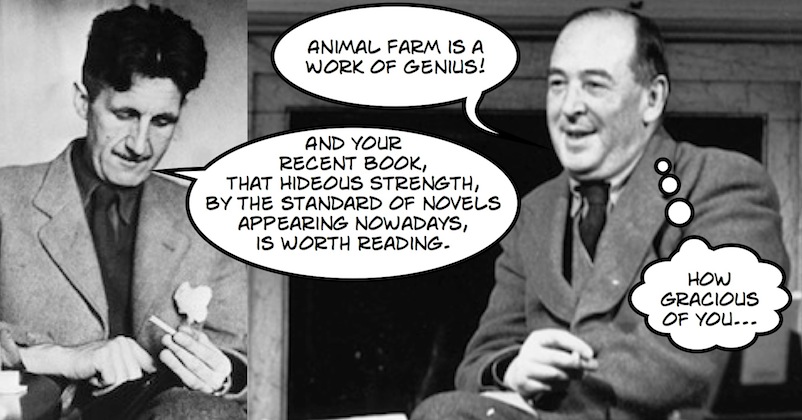
As the graphic I created above reveals (from actual quotations), Lewis had a better opinion of Orwell’s work than vice versa. Orwell disliked Lewis and resented the fact that he was popular among many common people. He particularly disliked Lewis’ traditional (evangelical) Christianity. In his review of That Hideous Strength, Orwell dismissed the biblically based supernatural as a version of “magic.”

Much is made of the fact that the scientists are actually in touch with evil spirits, although this fact is known only to the inmost circle. Mr. Lewis appears to believe in the existence of such spirits, and of benevolent ones as well. He is entitled to his beliefs, but they weaken his story . . .

Orwell was one of those “professing” Christians who is accurately labeled a hypocrite. He was a communing member of the Church of England, and advocated a Judeo-Christian moral code, but did not believe in an afterlife. The following letter, written to Eleanor Jaques in 1932, reveals his hypocrisy.

It seems rather mean to go to HC [Holy Communion] when one doesn’t believe, but I have passed myself off for pious & there is nothing for it but to keep up with the deception.

In a comment to my last post, a good friend of Mere Inkling, Brenton Dickieson at A Pilgrim in Narnia, reminded me of a thought-provoking essay on English written by Orwell. His essay, “Politics and the English Language,” addresses a number of problems with the language. He considers dying metaphors, verbal false limbs, pretentious diction, and meaningless words.

A Similarity in the Two Writers’ Advice

Orwell’s goal is “the scrapping of every word or idiom which has outworn its usefulness. It has nothing to do with correct grammar and syntax, which are of no importance so long as one makes one’s meaning clear, or with the avoidance of Americanisms, or with having what is called a ‘good prose style.’”  [As irritating as I imagine most Europeans find Americanisms!] Writers of fiction will enjoy the way Orwell explains the challenge of “showing, not telling.”

What is above all needed is to let the meaning choose the word, and not the other way around. In prose, the worst thing one can do with words is surrender to them. When you think of a concrete object, you think wordlessly, and then, if you want to describe the thing you have been visualizing you probably hunt about until you find the exact words that seem to fit it.

When you think of something abstract you are more inclined to use words from the start, and unless you make a conscious effort to prevent it, the existing dialect will come rushing in and do the job for you, at the expense of blurring or even changing your meaning. Probably it is better to put off using words as long as possible and get one’s meaning as clear as one can through pictures and sensations. Afterward one can choose—not simply accept—the phrases that will best cover the meaning, and then switch round and decide what impressions one’s words are likely to make on another person.

This last effort of the mind cuts out all stale or mixed images, all prefabricated phrases, needless repetitions, and humbug and vagueness generally. But one can often be in doubt about the effect of a word or a phrase, and one needs rules that one can rely on when instinct fails. I think the following rules will cover most cases:

1. Never use a metaphor, simile, or other figure of speech which you are used to seeing in print.

2. Never use a long word where a short one will do.

3. If it is possible to cut a word out, always cut it out.

4. Never use the passive where you can use the active.

5. Never use a foreign phrase, a scientific word, or a jargon word if you can think of an everyday English equivalent.

6. Break any of these rules sooner than say anything outright barbarous.

These rules sound elementary, and so they are, but they demand a deep change of attitude in anyone who has grown used to writing in the style now fashionable.

Students of Lewis will note in the final passage the parallel with advice he provided to a correspondent in 1956. Although the context is different—Orwell’s is a formal essay and Lewis’ a casual correspondence written to a child, the similarities are significant. Lewis would have been familiar with Orwell’s essay, composed a decade before his letter, but the resemblance between their words is better attributed to shared literary philosophies and the self-evident nature of the principles. Lewis identified five important considerations when writing.

1. Always try to use language so as to make quite clear what you mean and make sure [your] sentence couldn’t mean anything else.

2. Always prefer the plain, direct word to the long, vague one. Don’t implement promises, but keep them.

3. Never use abstract nouns when concrete ones will do. If you mean “More people died” don’t say “Mortality rose.”

4. Don’t use adjectives which merely tell us how you want us to feel about the things you are describing. I mean, instead of telling us a thing was “terrible,” describe it so that we’ll be terrified. Don’t say it was “delightful;” make us say “delightful” when we’ve read the description. You see, all those words (horrifying, wonderful, hideous, exquisite) are only like saying to your readers, “Please, will you do my job for me?”

5. Don’t use words too big for the subject. Don’t say “infinitely” when you mean “very;” otherwise you’ll have no word left when you want to talk about something really infinite.

Whatever the two authors thought about the other, they certainly shared some similar views on the subject of effective writing. And, I think we can assume with confidence that Lewis would concur with Orwell’s final rule. Under no circumstances should we resort to barbarity! For, as Lewis wrote in The Four Loves, “Who does not prefer civility to barbarism?”

____

If you are interested in reading Orwell’s “Politics and the English Language” in its entirety, you can find it here.

Literary Criticism, Inklings Style

bandersnatchIf you’re a writer and you’ve never been part of a critique group, you’ve missed out on some beneficial (and occasionally annoying) experiences.

Critiquing is, of course, the process of providing constructive criticism to someone, in the hopes of improving their work. Good criticism is priceless. The problem is that it takes true skill to offer useful advice . . . and it requires the proper degree of self-assurance to receive the criticism itself.

Those who have been burned by scathing criticism are reticent to “invite” more of the same. However, when the criticism begins with affirmation (about positive aspects of the work), that tiny spoonful of sugar certainly helps the more difficult parts of the evaluation easier to swallow.

And yet, for some, even expertly delivered criticism—covered by a chocolate layer of affirmation and accolades—remains nearly impossible to accept.

A fine example of this truth comes in C.S. Lewis’ description of a prominent member of the Inklings writing fellowship. J.R.R. Tolkien was a virtual perfectionist when it came to all things Middle Earth. Because of this “flaw,” Lewis and the other Inklings were frustrated when it came time to review the progress of The Hobbit and elements of Lord of the Rings. As Lewis described it in a 1959 letter:

No one ever influenced Tolkien—you might as well try to influence a bander-snatch. We listened to his work, but could affect it only by encouragement. He has only two reactions to criticism; either he begins the whole work over again from the beginning or else takes no notice at all.

To learn the nature of a bandersnatch, we must travel Through the Looking Glass into Lewis Carroll’s 1872 novel. Carroll coined the word and introduced it to the world in a poem called “Jabberwocky,” which appears in Alice’s wonderful adventures.

Lewis, of course, was not likening his dear friend to a frumious* bandersnatch in terms of it’s overall personality. Rather, he was describing the severity of Tolkien’s inability to positively process criticism of his work, to the bandersnatch’s incapacity to do the same. It is similar to the sense in which the White King alludes to the creature’s swiftness in describing his wife: “She runs so fearfully quick. You might as well try to catch a Bandersnatch!”

Although few of us are destined to be members of so illustrious a critique community as the Inklings, I highly commend joining one of your local parallels. While you may encounter a bandersnatch or two, on the whole you’ll likely find the process quite beneficial.

____

* “Frumious,” like bandersnatch itself, was coined by Lewis Carroll and is a blending of the words “fuming” and “furious.”

The bandersnatch, as envisioned above, is used with the permission of New Zealand illustrator David Elliot.

Literature is the Lifeblood

BonnevilleAs an American, I find there is something distinctive about British programs. When my family lived in the United Kingdom we enjoyed access to all the offerings of the BBC and the commercial network or two that existed twenty-two years ago.

Returning to the States, we had to become content with viewing the occasional British import, mostly through the auspices of PBS. Since I watch far less television than I used to, I haven’t seen one of the current offerings that’s become quite popular.

Downton Abbey is essentially a soap opera which examines the lives of a noble family, and the myriad servants who attend to their needs. Contrasting their culturally different lifestyles is doubtless quite intriguing.

The reason I’m mentioning a program I’ve never seen, is because I read an interview with one of its co-stars, Hugh Bonneville. His response to the question “Did you make a New Year’s resolution?” was wonderful.

I’ve had the same resolutions for about 20 years, which is to read The Complete Works of Charles Dickens, and I’m only on about book number three. I’m a terrible reader, which is a great shame because literature is the lifeblood of everything, really, in terms of inspiration and nourishment of the soul.

C.S. Lewis often speaks about the value of reading the “classics.” One benefit he describes in “The Reading of Old Books,” is that they provide us with a grounded perspective in a rapidly shifting world. “Every age has its own outlook. It is specially good at seeing certain truths and specially liable to make certain mistakes. We all, therefore, need the books that will correct the characteristic mistakes of our own period. And that means the old books.”

Lewis apparently enjoyed Dickens. Below are a couple of passages where he refers to him in very good company. In his essay “Sir Walter Scott,” he writes:

. . . there are two things of which I feel certain. One is, that if we do overvalue art, then art itself will be the greatest sufferer; when second things are put first, they are corrupted. The other is that, even if we of all generations have first valued art aright, yet there will certainly be loss as well as gain. We shall lose the fine careless, prodigal artists. For, if not all art, yet some art, flows best from men who treat their work as a kind of play. I at any rate cannot conceive how the exuberance, the elbow-room, the heart-easing quality of Dickens, or Chaucer, or Cervantes, could co-exist with that self-probing literary conscience we find in [Walter Horatio] Pater or Henry James.

And, again, in  Studies in Medieval and Renaissance Literature he praises Edmund Spenser’s The Faerie Princess, saying:

From the time of its publication down to about 1914 it was everyone’s poem—the book in which many and many a boy first discovered that he liked poetry; a book which spoke at once, like Homer or Shakespeare or Dickens, to every reader’s imagination.

Ironically, Lewis’ own writings have become classics, to which many of us return over and over. And, even though a month has passed since the traditional day for making New Year resolutions, I can’t think of a better one than planning to read the “complete works” of C.S. Lewis himself.

Skillful Turns of Phrase

frank burnsEveryone loves an exquisite turn of phrase. Those of us who dabble in writing are particularly susceptible to their numinous power.

I’ve been doing some research on the Father Mulcahy character from M*A*S*H. William Christopher transformed the fictional character from a caricature of military chaplaincy, into a compassionate and respected representative of the Holy. During my research, I’ve been reviewing episodes of the series in which he was featured.

In “Alcoholics Unanimous,” which originally aired in 1974, Mulcahy has been tasked with delivering a lecture on temperance. In an interesting twist he wears full clerical garb and prepares what is essentially a sermon. Since the lecture is a “mandatory formation,” the mess tent (which doubles as the chapel) is filled to capacity.

Sitting in the front row are the hypocritical Majors Burns and Houlihan. (For those unfamiliar with the show, they constantly call for the most rigid of military standards, even as they are all the while breaking the military’s Uniform Code that prohibits adultery.) Major Houlihan’s nickname, in fact, is “Hotlips.”

In the aforementioned episode they have a delightful little exchange that illustrates through its witty banter the skill of the Hollywood writers at their best. As the hospital’s temporary commander, Burns has banned all alcohol and mandated attendance at the lecture. The tent is filled to its limits as Houlihan turns adoring towards her paramour and says:

Houlihan: Frank, what a turnout!

Burns: Lemmings must be directed to the sea.

Houlihan: You’re magic with a phrase!

It requires skill to create a well-crafted turn of phrase. Well, even a fool like Frank Burns can stumble across a clever phrase, but only a master can repeatedly coax them from their ethereal realms.

C.S. Lewis was just such a master. His works abound with profound and captivating language. And he recognized it in the works of others. In “Dante’s Similes,” in Studies in Medieval and Renaissance Literature, he wrote:

[Dante] is the most translatable of the poets—not, probably, that he entrusts less wealth than others to the music of the words and the nuance of the phrase but that he entrusts more than others to the “plain sense.”

In The Four Loves, Lewis reveals just how impoverished much of our language is . . . even when it relates to the most inspiring of matters. Describing the difference between carnal “love” and genuine love, he shows that even impoverished phrases can begin to grasp the truth behind the dynamics of affection and commitment.

We must do the works of Eros when Eros is not present. This all good lovers know, though those who are not reflective or articulate must be able to express it only in a few conventional phrases about “taking the rough along with the smooth,” not “expecting too much,” having “a little common sense,” and the like. And all good Christian lovers know that this programme, modest as it sounds, will not be carried out except by humility, charity and divine grace; that it is indeed the whole Christian life seen from one particular angle.

Surely those who are more articulate can more expressively communicate our love for our spouse. Yet, even in so-called matters of the heart, we frequently utter phrases that are utterly mundane.

The History of the Phrase “Turn of Phrase”

One online dictionary uses these definitions:

a turn of phrase

1. a way of saying something “Significant other,” meaning “partner,” now that’s an interesting turn of phrase.

2. the ability to express yourself well She has a nice turn of phrase which should serve her well in journalism.

The Phrase Finder website provides excellent information about numerous phrases. And, in discussing this idiomatic phrase about phrases, they do not disappoint.

So, a phrase was a style of speaking or writing, and style meant beauty of expression. We can now interpret a fine “turn of phrase” as analogous to a skillfully crafted piece of wood turned on a lathe. John Dryden referred to the “turning” of words in this sense in The Satires of Decimus Junius Juvenalis, 1693: “Had I time, I cou’d enlarge on the Beautiful Turns of Words and Thoughts; which are as requisite in this, as in Heroique Poetry.”

Check out their entire article about turns of phrase at the link above. And, may your own writing be filled with impressive verbal ballets, replete with inspiring leaps and unforgettable pirouettes.

It’s Still Christmas

nativity iconMerry Christmas!

One of the sad things about living in a secular nation is that people understand very little about the real meaning of Christmas. For example, many people take their trees down on 26 December, mistakenly thinking Christmas is “over.” In reality, the Christian celebration of the Nativity of Jesus only begins on Christmas Day!

The commercial world celebrates the season of Advent and deceptively calls it “Christmas.” These weeks, which should mark a spiritual preparation akin to Lent, are instead transformed into a frantic race to accumulate the perfect gifts to show others just how much we value each of them. And, since we love our family and close friends, there is a constant temptation to be far more extravagant in our gift giving than we can afford.

Returning to the season of Christmas, in which we find ourselves this day . . . we discover a brief occasion to focus our spiritual reflections on the singular Christmas miracle, the Incarnation. God becoming a human being. The Word through whom all things were created, becoming a mortal like the sons of Adam and daughters of Eve fashioned in his own likeness.

Christmas is, indeed, a glorious season.

C.S. Lewis had many insights into the Incarnation miracle. It is most certainly worthy of our serious attention. If it did not actually happen, Jesus should be dismissed altogether, for he claimed to be one with our heavenly Father. However, as Lewis declared in Miracles, “If the thing happened, it was the central event in the history of the Earth.”

One of the great literary treasures of the world is a precious book written before the year Anno Domini 318. Athanasius of Alexandria wrote a treatise called “On the Incarnation,” which makes great reading and is readily available online. A fairly modern translation was written by Sister Penelope Lawson, an Anglican nun.

Sister Penelope prevailed upon C.S. Lewis to write an introduction to her translation, in which he said, “This is a good translation of a very great book.” The full volume, complete with Lewis’ outstanding preface, is available. Here is just one of his gems:

Every age has its own outlook. It is specially good at seeing certain truths and specially liable to make certain mistakes. We all, therefore, need the books that will correct the characteristic mistakes of our own period. And that means the old books. All contemporary writers share to some extent the contemporary outlook—even those, like myself, who seem most opposed to it. Nothing strikes me more when I read the controversies of past ages than the fact that both sides were usually assuming without question a good deal which we should now absolutely deny. They thought that they were as completely opposed as two sides could be, but in fact they were all the time secretly united—united with each other and against earlier and later ages—by a great mass of common assumptions.

Still, as wonderful as Lewis’ introductory comments are, the greatest treasures here are the bishop’s teachings about Jesus. To whet your appetite, taste the following wisdom from Athanasius’ own introduction to his work:

You must understand why it is that the Word of the Father, so great and so high, has been made manifest in bodily form. He has not assumed a body as proper to His own nature, far from it, for as the Word He is without body. He has been manifested in a human body for this reason only, out of the love and goodness of His Father, for the salvation of us men. We will begin, then, with the creation of the world and with God its Maker, for the first fact that you must grasp is this: the renewal of creation has been wrought by the Self-same Word Who made it in the beginning. There is thus no inconsistency between creation and salvation for the One Father has employed the same Agent for both works, effecting the salvation of the world through the same Word Who made it in the beginning.

You can read the entire work at this site. Have a blessed Christmas season!

A Multiplicity of Polls

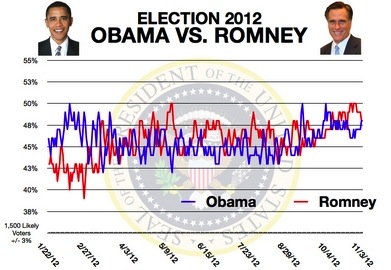
Here in the United States, our presidential election season is nearing its end. This is something people on both sides of the political spectrum are anticipating with joy. It’s been a grim process, grimmer than usual. The nation’s financial woes appear to have ramped up the vitriol. Christian values, especially, are maligned by many candidates and the partisan press that ingenuously professes objectivity. Yes, it will be a relief when it ends.

One of the features of modern elections that continues to grow in importance is polling. Scores of different pollsters—with widely varying results—compete for the public’s attention. Some of it is quite interesting, but the dizzying whirlwind of contradictory results creates confusion about their accuracy.

That, however, doesn’t slow their multiplication. Polling as we know it today is a fairly recent invention. It was 1958, when George Gallup gathered all of his nascent polling operations into a single organization. Gallup founded the American Institute of Public Opinion, the precursor of The Gallup Organization, in 1935. Gallup has maintained its reputation for integrity by refusing to accept any funding from political parties or candidates. Today, the company conducts opinion polls in more than 140 countries around the world.

As I was pondering the surplus of polls, I grew curious as to whether or not C.S. Lewis had ever commented on their like. I’m no expert on British politics, but I imagine they had occasional surveys, projections or prognostications. C.S. Lewis and his works have been the subject of innumerable contemporary polls . . . but did the Oxford don ever discuss such matters?

Desiring to avoid superficial attachments that might prove distracting to his literary goals, Lewis maintained a distance from political issues. It was for this reason he declined the well-deserved honor of becoming a “Commander of the British Empire.”

Lewis’ thoughts about politics reflect those of all who have grown tired of empty promises and venomous threats related to the election of “the opposition.” He would have longed, like many of us, for a reasonable and respectful conversation about charting the best course for his country.

Lewis longed for peace, in the spirit of Paul’s exhortation in his epistle to the young pastor, Timothy: “I urge that supplications, prayers, intercessions, and thanksgivings be made for all people, for kings and all who are in high positions, that we may lead a peaceful and quiet life, godly and dignified in every way.” (I Timothy 2:1-2, ESV).

In that spirit he wrote to his brother Warnie in 1940 about the tragedy of living in an epic era, wracked by not one, but two global conflicts.

Lord! How I loathe great issues! ‘Dynamic’ I think is one of the words invented by this age which sums up what it likes and I abominate. Could one start a Stagnation Party—which at General Elections would boast that during its term of office no event of the least importance had taken place? (Maundy Thursday, 21 March 1940).

Lewis’ collected Poems include the following delightful reflection on political campaigning.

Lines During a General Election

Their threats are terrible enough, but we could bear

All that; it is their promises that bring despair.

If beauty, that anomaly, is left us still,

The cause lies in their poverty, not in their will.

If they had power (‘amenities are bunk’), conceive

How their insatiate gadgetry by this would leave

No green, nor growth, nor quietude, no sap at all

In England from The Land’s-End to the Roman Wall.

Think of their roads—broad as the road to Hell—by now

Murdering a million acres that demand the plough,

. . .

And all our coasts one Camp till not the tiniest wave

Stole from the beach unburdened with its festal scum

Of cigarette-ends, orange-peel, and chewing-gum.

Nor would one island’s rape suffice. Their visions are

Global; they mean the desecration of a Star;

Their happiest fancies dwell upon a time when Earth,

Flickering with sky-signs, gibbering with mechanic mirth,

One huge celestial charabanc [tour bus], will stink and roll

Through patient heaven, subtopianized from pole to pole.

As I mentioned above, there are an abundance of polls about Lewis and his writings. It’s fitting to close this post with a related discussion from the introduction to The Quotable C.S. Lewis.

A quick survey of the Encyclopedia Britannica’s great books of the Western world reveals that an average of approximately three authors per century have been included in that august collection. This being so, what authors from this century will be read in the next? Of course, we can no more than guess; only time will tell. If votes are going to be cast, however, the name C. S. Lewis ought at least to be on the ballot.

The influence of his pen can hardly be overestimated. One observer noted that Lewis “is read with enormous affection and loyalty by a wide and diversified audience today. . . . In fact, more of his books are sold today than those of any other Christian writer in history.” Indeed, with over sixty of his books in print, Lewis has for many in this century become the dominant exponent and champion of thoughtful Christianity. Lewis wrote on a wide variety of subjects in many literary forms.

These words were written during the twentieth century. A decade into the new century they ring just as true. Lewis’ contributions to literature and faith are passing the test of time. And I suspect that will remain true at the close of this century, whether polls anticipate it or not.

Those of you with extra time on your hands may wish to participate in Mere Inkling’s nonscientific poll, below.

Vivacious Vocabularies

One reason I love reading C.S. Lewis arises from his adroit use of the English language. His vocabulary is immense. It is pleasant to run into words one seldom encounters on the drab byways of modern journalism and tangled thoroughfares of contemporary “social media.”

Consider the following example. I was exploring The Allegory of Love when I read this: “There is nothing in literature which does not, in some degree, percolate into life.”

What a delightful verb! It evokes for me recollections of my youth when my parents would refer to our coffee pot as the percolator. Simultaneously, it reminds me of more recent—less happy—usages: “I’m sorry, but inadequate soil percolation means you’ll have to install a far more expensive septic system than normally required.”

It’s discouraging when you consider the sad state of modern vocabularies. I read somewhere that people typically only use about 10% of the words they know. So a common vocabulary of 5,000 spoken words would mean they know (i.e. can recognize written or audible forms of) about 50,000 words. Shakespeare used 29,000 words in his plays and sonnets, suggesting an expansive vocabulary. Likewise, brilliant authors like C.S. Lewis would boast a praiseworthy mental dictionary.

I am sometimes curious about my own vocabulary. I consciously attempt—in conversation as well as writing—to utilize at least 15% of the words I know. After all, the English language is so rich, it’s criminal to limit ourselves to pedestrian words. It’s like having all the ingredients for a delicious feast available to us and settling for slapping together a peanut butter sandwich.

I also love the precision that comes from using the exact word that suits the occasion. For example, in a thriller it matters greatly how the hero’s nemesis inflicts injury. A skilled writer would never say “Professor Moriarty cut Holmes.” Instead, we would learn that he slashed . . . stabbed . . . sliced . . . scarred . . . carved . . . or perhaps he merely nicked the detective. Likewise, we would probably know the type of weapon he was using. It would not be a mere “knife.” It might be a saber . . . a dagger . . . a pocketknife . . . scalpel . . . carving knife . . . or perhaps even a bayonet.

Lewis addressed this richness in vocabulary in an essay on “Transposition” which appears in The Weight of Glory.

If the richer system is to be represented in the poorer at all, this can only be by giving each element in the poorer system more than one meaning. The transposition of the richer into the poorer must, so to speak, be algebraical, not arithmetical. If you are to translate from a language which has a large vocabulary into a language that has a small vocabulary, then you must be allowed to use several words in more than one sense. If you are to write a language with twenty-two vowel sounds in an alphabet with only five vowel characters than you must be allowed to give each of those five characters more than one value. If you are making a piano version of a piece originally scored for an orchestra, then the same piano notes which represent flutes in one passage must also represent violins in another.

It is wonderful to be fortunate enough to speak a language with a diverse vocabulary. English is such a tongue. Now, if we could just simplify its complexities and purge its irregularities, we would enjoy the best of all linguistic worlds.

Treasuring Books

Most of us love and respect books, don’t we? We take care of our literary treasures, and the more deeply we are attached to a particular volume, the better we treat it.

Many of us are reluctant to loan out the books which line our shelves like so many gems, resting in a jeweler’s pristine cases. When we do agree to share them, we’re afraid they may never find their way home. And, when they eventually return to our welcoming grasp, they sometimes bear the scars of their sojourn in the paws of others who do not esteem them as they ought to. Page corners may be scored. Coffee or tea stains may have “embellished” the text. Bindings may have been carelessly mistreated. And, unbelievably, the borrowers are likely to be unaware of how they have abused the tome’s dignity and disfigured its beauty.

Speaking honestly, my own bookshelves are in constant disarray, and too many of my books still remain unpacked after our move into our retirement home. But I am absolutely serious about how painful I find it to witness the mistreatment of books by those ignorant of their value.

C.S. Lewis loved books. He recognized their power. He embraced their wonder. And—most wonderfully for us—he penned a number of classics that will continue to inspire readers for generations.

Yet, as much as Lewis treasured books, he took his own creations for granted. This changed in December of 1954, when he received a precious package from his publisher. Among his Christmas gifts that year were specially bound copies of Surprised by Joy and Mere Christianity. Receipt of the thoughtful present opened his eyes to an interesting notion. On the twenty-second day of the month, he wrote:

I never had a handsomer present. . . . Perhaps these two charming volumes will teach me at last to have for the bodies of my own books the same reverence I have for the bodies of all other books. For it is a curious fact that I never can regard them as being really books; the boards and print, in however mint a condition, remain a mere pretense behind which one sees the scratchy, inky old manuscript.

I daresay that those writers among us can relate to Lewis’ mindset. Even with the pride that accompanies having books or articles in print, our work somehow seems “different” than the other published materials we invariably respect. This is due in large part, I believe, to their familiarity. Writers, better than most, understand what familiarity breeds. We know these works that flowed from our own consciousness and sweat . . . we know them intimately. And we are keenly aware that if given another opportunity, there are parts of them we would even now edit to be clearer, sharper, and more eloquent.

I never cease to be surprised by the humility of new writers who almost whisper their accomplishments to others. It’s as though they are embarrassed . . . that they assume their friends would consider them braggarts if they spoke with the pride they genuinely feel about their work. Some of us hold onto our rejection letters. (I do.) How much better though, to print out high quality copies of articles or devotions we’ve written and place them in a prominent binder or display located near our keyboard.

Who knows, I may actually follow my own advice and do something like that. Sadly, I don’t have a grateful publisher eager to prepare special editions for me. Nevertheless, I’m glad Lewis did. I learned from his insight that whenever we release our literary progeny to the world, they merit the same degree of respect and affection that we book-lovers bestow so generously on the works of others.

___

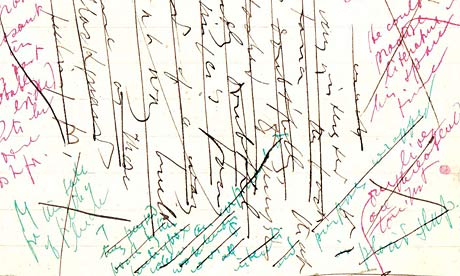
Postscript: The image above is an actual manuscript page from James Joyce’s Ulysses. (It makes me feel much more confident about my own initial scribblings.)