
Most American think C.S. Lewis was English. But that’s not quite right, is it? After all, he was born in Belfast, which is in Northern Ireland. And that makes him Irish, doesn’t it? Well, yes but not exactly.
The most accurate description is that C.S. Lewis was Anglo-Irish, with an identity linked to both English and Irish identities. Unfortunately, even that designation is subject to potential confusion, since it holds more than one definition. It is sometimes used for persons of English descent living in Ireland, Irish folks living in England, or those of mixed Irish and English ancestry.
The classical definition, directly applicable to C.S. Lewis, is: “of English descent but born or resident in Ireland, or a member of such a family, and associated particularly with the Protestant Ascendancy” (Oxford Reference).
The Emerald Isle is particularly confusing to most Americans. Only a minority possess any awareness of the history which led to the division of Ireland into today’s Republic of Ireland and Northern Ireland, which is part of the United Kingdom. (Read to the end and discover a little known aspect about America’s dominant ethnicities.)
If Ireland is a mystery to those in the United States, so too are other identifications. The “United Kingdom” itself is perplexing to many on “this side of the pond” (i.e. the Atlantic).
People find it baffling that a nation consists of three one-time kingdoms (England, Wales and Scotland) and the northeast counties on the island of Ireland. Add to that the fact that the initial three also comprise “Great Britain,” and eyes can glaze over.
Why does it matter? Because a person’s background and heritage often influences many aspects of their personality and values. And the outcome of this blending is particularly manifest in the unique combination of the Irish and English cultures. The Hiberno-English dialect provides a colorful example, with words like the adjective “cats” (awful), “amn’t” (am not), plámás (flattery), and “the jacks” (bathroom), plus phrases such as “acting the maggot” (misbehaving).
Like all other tongues, Hiberno-English continues to evolve.
Anglo-Irish Writers
Anglo-Irish literature constitutes a distinct category of poetry and prose. Ironically, it is the essential Irishness of the style in “Anglo-Irish literature [which] registers itself [as] the most difficult . . . and the most important” element to be identified.
Few non-Europeans recognize there are many prominent Anglo-Irish writers.* Many, including C.S. Lewis who studied and taught in England, celebrated their Irish heritage. An example taken from a letter written in 1917 to his friend Arthur Greeves provides an illustration of this pride. Describing a day spent walking with a classmate while debating the merits of various authors, he wrote:
Like all Irish people who meet in England we ended by criticisms on the invincible flippancy and dulness of the Anglo-Saxon race. After all, there is no doubt, ami, that the Irish are the only people: with all their faults I would not gladly live or die among another folk.
While this tongue in cheek remark reflects Lewis’ youthful humor, you can read a more brilliant study of the subject in “C.S. Lewis: An Irish Writer.”
It discusses, among other matters, why “Lewis, a proud Irishman, [chose] not to promote himself as an Irish writer or write more regularly about Irish themes.”
American Geographical Eccentricities
Sadly, geography is quite undervalued in the American educational system. The common ignorance about the makeup of other continents is nothing less than embarrassing. Of course, Americans aren’t the only people ignorant about such matters, as GeoCurrents notes.
But if geographical ignorance is pronounced in the United States . . . the problem does seem to be even more extreme in some other parts of the world.
The United States as it exists today, is the product of constant immigration. During the early years of the colonies and Republic, most arrivals were Europeans, with nearly eleven million Africans brought involuntarily to North America, most during the rule of the British (Gilder Lehrman Institute of American History).
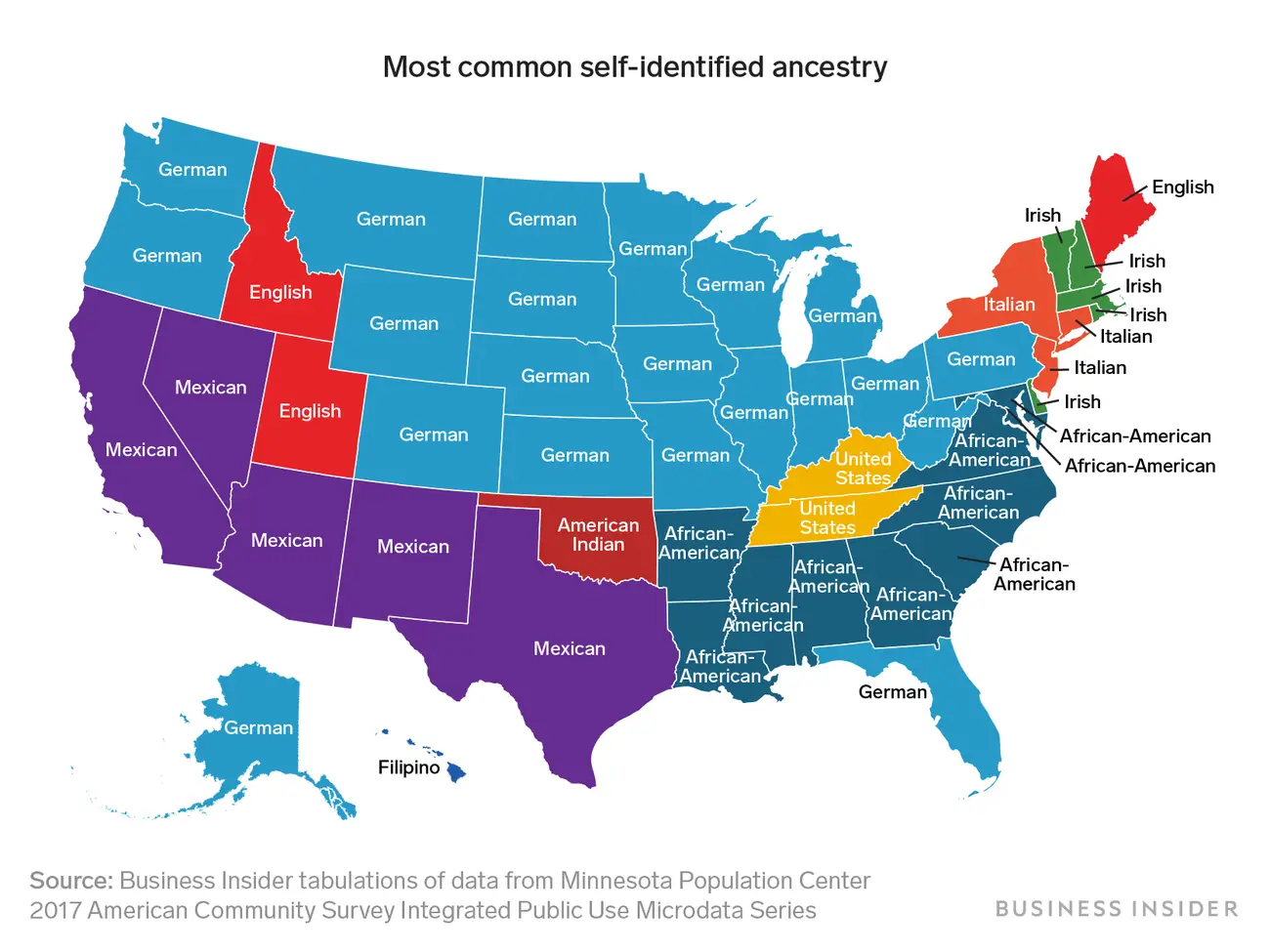
As a result of this influx of foreigners, each state possesses its own unique identity (or, more accurately, identities). The following map shows the largest single ancestral ethnicity of the residents of each state. It contains a few surprises.
The fact that Irish descendants represent a plurality in five states raises the question of just how many talented Irish-American writer may have shared the intercultural experiences of C.S. Lewis.
* A list of noteworthy Anglo-Irish writers would include, in addition to C.S. Lewis:
Jonathan Swift (1667 – 1745)
Oliver Goldsmith (c. 1730 – 1774)
Maria Edgeworth (1768 – 1849)
Joseph Sheridan LeFanu (1814 – 1873)
Dionysius Boucicault (1820 – 1890)
Lady Augusta Gregory (1852 – 1932)
Oscar Wilde (1854 – 1900)
George Bernard Shaw (1856 – 1950)
John Bagnell Bury (1861 – 1927)
William Butler Yeats (1865 – 1939)
James Owen Hannay (aka George A. Birmingham) (1865 – 1950)
John M. Synge (1871 – 1909)
Edward John Moreton Drax Plunkett (aka Lord Dunsany) (1878 – 1957)
Lady Clodagh Beresford (1879 – 1957)
Emily Lorimer (1881 – 1911)
James Joyce (1882 – 1941)
Terence James Stannus Gray (aka Wei Wu Wei) (1895 – 1986)
Elizabeth Bowen (1899 – 1973)
Cecil Day-Lewis (1904 – 1972)
Samuel Beckett (1906 – 1989)
Louis MacNeice (1907 – 1963)
Mitch Teemley
 Mere Inkling Press
That is an impressive list of noteworthy Anglo-Irish writers. I’ve read a few of them. Like you say World Geography is not a strong point for many Americans. When I arrived in the US as an exchange student from Sweden I got some strange questions including “did you drive here?”, Sweden, is that where all the men wear skirts? (me: no that’s Scotland). Sweeting, what a cute name for a country. On the other hand, I met Swedes who were quite weak in that department too. I told a Swedish friend of mine that I lived in Texas, and he asked “that’s in Mexico right?” (me: umm no).
Wow, Thomas. Those were certainly some dumb questions you received as an exchange student. Hopefully, by the end of the year, your entire graduating class were experts on the noble history of the Swedes.
As for the European misconceptions about America… you offer a great example.
Your mention of Mexico reminds me of when a woman in her late twenties asked my mother-in-law: “Why do some maps show all of Mexico, and other maps only show the ‘New‘ part?”
Ha ha, yes I guess the name New Mexico can confuse those weak in Geography. I am not sure how much knowledge about Sweden I spread, but I was surprised when I met an American classmate a few years after graduation and she spoke Swedish to me, perfectly. She had decided to learn Swedish after graduating and I was very impressed how well she did that. After that she learned Danish, which is somewhat similar to Swedish but different enough that I have a very hard time understanding it. Reading it is easier. Norwegian is much easier. Now she speaks perfect Swedish, Danish, Spanish, understands Norwegian, all that in addition to her native Pennsylvania English. Some people are language geniuses. She also beat me in a World Geography game. She was not among those who thought you could drive from Sweden to Ohio.
I wish I had a faculty for mastering languages.
But if I did, my life may have followed a different course. If my Latin, Greek and Hebrew were actually strong when I was in seminary, I may have been tempted to study German and pursue a PhD rather than directly entering parish ministry.
It is interesting how our circumstances guide us
True. Many a mistake has resulted from having an immediate, but temporary, matter push aside logical reasoning.
Of course, our accumulated experiences, based upon a wide range of circumstances, become a major resource for making good decisions, as well.
Yes you are right
With my mother growing up in South Dakota, my son and family having church-planted in California and our visiting there, and most of all excellent Geography classes in my South African school days, I’m grateful for a reasonable understanding of these matters. Thanks for your enriching input, Rob.
I see you appreciate how fortunate you are, Erroll, to have this wonderful background.
While I celebrate the security that comes from having deep roots in a single locale, being personally exposed to diverse cultures provides unique benefits of its own. That’s why I’m glad my kids got to live in the U.K. and Micronesia (as well as in a variety of states) as they were growing up.
But, even when we are not able to physically travel to other lands, a knowledge of geography and history can still transport us there. That is amazing, especially for the majority of us believers who never get to visit the Holy Land in the flesh.
Another cool post… and actually something I have been thinking about recently, but also touch on when I teach poetry. Especially geography / nature. Of course some classic poets Wordworths as an example are known for their use of nature. The mix of heritage and location is a powerful force in developing any artist’s voice. Enjoyed this post!
Thanks for the comment Jamey, and glad you enjoyed the post.
I think one reason I have always loved geography is because from an early age I realized these places were inhabited by other human beings. I was very curious what it was like for the people living in those diverse lands, and how they might be different from me (or just like me).
This fit well with my hunger to learn about history… since it too shapes humanity.
Nice to hear that you include important thoughts such as this in your teaching.
I enjoy history… partly for the ‘story’ aspect that people before us have gone through much of the same things… same doubts, same worries, same love stories. Yet, where they live (us too) influences the expression of those stories. Such a cool connection.
Yes, in all of the most important ways, all human beings are the same. Our individual stories do, though, vary because of so many complex factors.
For example, I had a history prof at the U of Washington who noted that most “history” revolved around watershed moments like wars. So he said “happy are the people who have no history,” by which he meant those who live in peaceful, calm times.
Great overview, Rob! I too am among those Anglo-Irish Americans you mention (with healthy doses of Scottish and Welsh thrown in).
Check it out, Mitch. I already added you to the list!
;>)
Rob,
People are not cut outs. What a variety just one nation can have, even “white” central England.
Thanks, Gary
Forbear Productions
garyavants66@gmail.com
Quite true. These types of descriptions are always based on generalizations. Still, accurate generalizations can be based on some sort of logical process.
Bravo for the Irish and every other ethnicity! The vast number of cultures in the world reflect the amazing individuality God imparted to us. That said, I have enjoyed the works of many Anglo-Irish authors. Readers are enriched by the insight into cultures other than their own. The shared information increases our empathy, making us better human beings. Geography notwithstanding, we are, after all, brothers under the skin.
So true in all of your assessments!
My father used to say he was part Irish, part Scotch, and part Bourbon.
I hope his overall identity was only a small part of each… :)
I don’t think my father actually knew his family heritage. It was just something his father used to say to him.
Yeah, it’s a humorous saying. But the fact that so many people are confused about their ethnic backgrounds amazes me. Seems to be such a small thing to be passed on by parents and grandparents…
One example is found in the number of Americans who “believe” they have some Native American blood. My own dad said he thought there was some Native blood in his own background. I’d be proud to know that was a fact… but other than some aspects of his own appearance (a very subjective notion), there is no true evidence.