
The United States is schizophrenic about its religious heritage, and the armed forces provide us with today’s example. Most people, including veterans themselves, are unaware of the fact that while we have official songs for the different branches of the armed forces, we don’t have any official hymns.
C.S. Lewis and J.R.R. Tolkien, both combat veterans, were quite familiar with martial music. However, as members of a (nominally) Christian kingdom, neither would have been uncomfortable with explicitly Christian elements in their military’s hymnody. Across the ocean in the former colonies, it’s a different matter.
Here, the confusion about the “official” status of religious military hymns abounds because spiritual hymnody has been part of our nation’s martial history ever since the colonies decided to band together and seek independence. Yet, some consider that to be unlawful.
The rejection of music expressing faith in God can be attributed to the modern crusade against such hymns by strident anti-theists. Many in this camp are practicing atheists, who misinterpret the two clauses of the First Amendment which the nation’s founders did not consider mutually exclusive.
Congress shall make no law respecting an establishment of religion, or prohibiting the free exercise thereof . . .
Since most of the creators of the Constitution – and the majority of American citizens up to this day – have been theists (believing in a Supreme Being), it is self-evident that they did not intend to exorcise all expressions of faith from the public forum. Some states, in fact, already had their own “established churches when the First Amendment was ratified.”
Up until this generation, generic references to a heavenly Father or a benevolent Creator have traditionally remained welcome at civic events.
Even the non-Christian Thomas Jefferson (who argued against religious establishment) was essentially a Deist, acknowledging “the god who gave us life, gave us liberty at the same time . . .”
Jefferson even edited the New Testament Gospels, deleting “objectionable passages” and producing his personally-sanctioned Life and Morals of Jesus of Nazareth.
So, What about the Music?
My goal is not to discuss the First Amendment per se – though I included the introductory note above for the benefit of the many international readers who find their way to Mere Inkling.
Rather, I wish to discuss the premise above, that America celebrates generally secular martial music, while remaining wary of military hymnody with religious themes.
Ironically, soldiers throughout the nation’s history passively assumed that the songs they heard at rallies and civic events had the government’s tacit imprimatur, that was questionable. Take the “Battle Hymn of the Republic,” for example. Composed in 1861 by abolitionist Julia Ward Howe, Union soldiers would have been shocked to learn that some would deem its use in the ranks as a violation of the First Amendment.
Mine eyes have seen the glory of the coming of the Lord;
He is trampling out the vintage where the grapes of wrath are stored;
He hath loosed the fateful lightning of His terrible swift sword:
His truth is marching on.I have read a fiery gospel writ in burnished rows of steel:
“As ye deal with My contemners, so with you My grace shall deal;”
Let the Hero, born of woman, crush the serpent with His heel,
Since God is marching on.
Modern Military Hymns
The Department of Defense hosts a website titled Guide to U.S. Military Bands and Music. It describes the wide repertoire of military musicians.
Whether you like jazz music, a marching band or orchestra music, the U.S. military has you covered. Each branch of the military boasts a diverse offering of musical talent that serves for ceremonial purposes but also for entertainment and outreach. Check out these bands to stay in tune with military music.
One Christian hymn has deep roots in the military community. The song traditionally referred to as “The Navy Hymn” in America, originated in Britain. It is also used by the French. Its maritime themes make it popular in civilian communities as well.
Eternal Father, strong to save,
Whose arm does bind the restless wave,
Who bids the mighty ocean deep
Its own appointed limits keep;
O hear us when we cry to Thee
For those in peril on the sea.O Savior, whose almighty word
The winds and waves submissive heard,
Who walked upon the foaming deep,
And calm amid the rage did sleep;
O hear us when we cry to Thee
For those in peril on the sea.
“There exist a myriad of alternate verses to the hymn. One, for example, was written by David B. Miller in 1965 and specially dedicated to naval submariners.”
Musicians were not just present for official ceremonies and off-duty entertainment. They could also inspire the troops in the violent din of battle. More common in distant ages, even in twentieth century Europe, we find a dramatic illustration.
In the military archives of the Irish Republican Army, Michael J. Crowley described the inspiration provided by the brigade’s musician in the heat of the battle called the “Battle of Crossbarry” and the “Crossbarry Ambush,” by the IRA and the Brits respectively.
From the opening shot of the engagement, our piper, Florrie Begley of Brandon, played warlike airs on the bagpipes until the last shot was fired.
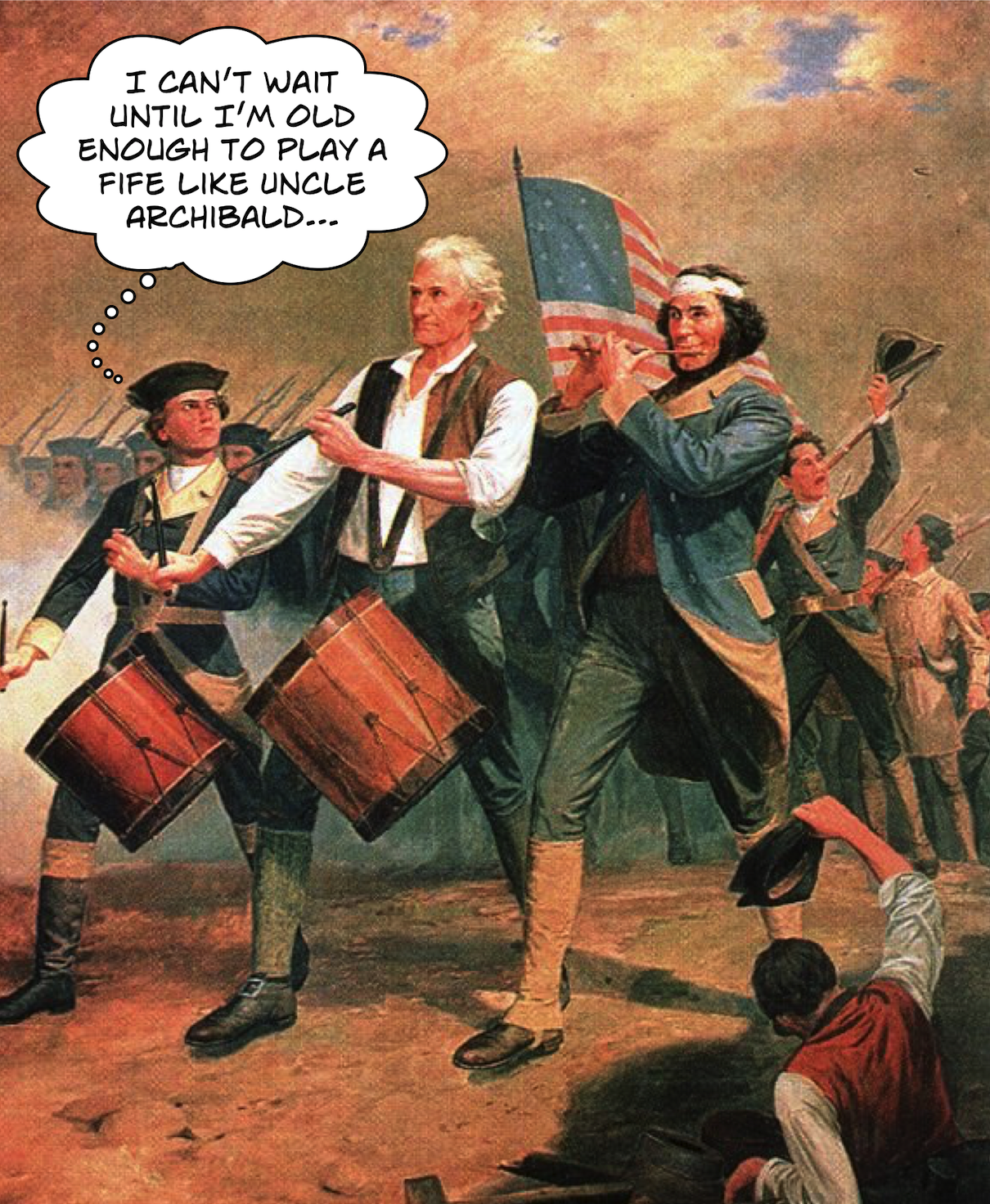
The illustration above provides an idealized portrait of military musicians bravely facing enemy fire. “The Spirit of ’76,” painted for the centenary of the American Revolution, met with tepid enthusiasm during the 1876 Centennial Exposition in Philadelphia. However, it rose in popularity when it subsequently toured the country.
For centuries, armies used music as the means to communicate the military orders of the day to soldiers. The high pitch of the fife and the sharp sound of the drum allowed messages to be heard at great distance . . .
Leaping from the Revolution to the twenty-first century, the recently birthed United States Space Force now has a hymn. Well, sort of. It is an unsolicited hymn composed by a former Air Force officer. You can hear “Creator of the Universe” here.
For more space music, check out the official anthem of “the mighty watchful eye.” Some consider this proposed anthem far more inspiring.
My personal favorite is the version of the Space Force Anthem proposed by its original, cinematic commander, General Naird, played by Steve Carell. (Carell even plays his own fife in the episode.)
The Middle Earth Military March
Howard Shore composed a powerful soundtrack for Lord of the Rings. Yet he wasn’t the first to create music for the great saga. One Tolkienist writes:
My first contact with Tolkien-inspired music dates back to the late 1980s . . . I was watching TV with my parents seeing a performance of Military Bands. Later I would discover that it was the Dutch composer Johan de Meij’s Symphony No. 1 (The Lord of the Rings) I’d heard.
From among the ranks of the Inklings, only one writer wrote an explicit military song. J.R.R. Tolkien provided the timeless Ents with a somber marching song as they face the powers of Isengard.
We come, we come with roll of drum: ta-runda runda runda rom!
We come, we come with horn and drum: ta-rūna rūna rūna rom!To Isengard! Though Isengard be ringed and barred with doors of stone;
Though Isengard be strong and hard, as cold as stone and bare as bone,
We go, we go, we go to war, to hew the stone and break the door;
For bole and bough are burning now, the furnace roars – we go to war!
To land of gloom with tramp of doom, with roll of drum, we come, we come;
To Isengard with doom we come!
With doom we come, with doom we come!
If you have a moment, you will likely enjoy the performance of this song as arranged by Clamavi De Profundis.
 Mere Inkling Press
Very well-written!
Enjoyed every bit of this musical feast and the martial arrangement of the Ents’ Marching Song. The latter made me wonder what song the Ents would sing if they finally did find their Ent wives. Something akin to cats purring, wordless, untuned? Or a stunned but majestic outpouring? I do wish Tolkien had given us a clue!
Ah, the Entwives… I doubt the male ents would have been particularly cuddly (which may be why the ladies originally departed to start their own garden east of Fangorn Forest).
I’m sure the ents would have been thrilled. But even if they did become particularly loquacious on the occasion, we can surer of one thing — it would have taken them weeks to simply say “hello.”
There are still a few remnants, I think. “The Battle Hymn of the Republic” speaks of the Lord “trampling out the vintage where the grapes of wrath are stored.” The final verse of “The Star Spangled Banner” has the line: “And this be our motto – ‘In God is our trust.'”
While perhaps not a military hymn per se, “America the Beautiful” includes the following lines:
“America! America!
God shed His grace on thee,
And crown thy good with brotherhood
From sea to shining sea!…
“America! America!
God mend thine every flaw,
Confirm thy soul in self-control,
Thy liberty in law!”
Now if only we would live by these precepts.
By the way, I agree completely that Christians have the right (and obligation) to take a public stand on issues of importance (Prov. 31: -9; Ezek. 3: 18).
Yes, a number of grand hymns are part of our heritage… but nearly all evidence in the current age (at least, as I perceive it) suggests that those days are past.
Informative and interesting, as ever. We sang the patriotic songs in the LDS Hymnbook today, whilst attending church. I love the marching hymns!
Our church accompanist always wants to sing 100% patriotic hymns on Independence Day… but fortunately we always include music that focuses on the biblical readings for the day, as well.
Glad you enjoyed the post, Chel. And congratulations on the publication of your children’s book!
That is a good compromise.
Thank you, Rob!
Rob,
Love the music and the ents. Has someone taken all of Tolkein songs and set them to music?
Thanks, Gary
Gary Avants Forbear Productions * *garyavants66@gmail.com garyavants66@gmail.com
This is the only one composition for a specific song that I’m aware of… but I wouldn’t be surprised to learn there are more.
Very cool. People are creating some great pieces of music. Thank you, Gary
Gary Avants Forbear Productions * *garyavants66@gmail.com garyavants66@gmail.com
Pingback: Do Not Read the Bible – Mere Inkling Press