The Anticipation of Publication

autographThe advent of the internet instigated some confusion about what it means to “be published.” That accolade is, of course, the dream of most women and men who write.

To be published—historically speaking—has meant that your words have been:

  1. Deemed worthy of being placed in print (at least, by one editor’s subjective determination).
  2.  Made available in some number of copies to millions, thousands, hundreds, scores, or perhaps dozens of eager readers.

Writing “online” was initially dismissed by the publishing industry (and many writers themselves). “It’s not the same,” they would say. Of course not. Yet they accomplish the same purpose, making writers’ heartfelt messages available for others. And, in short time we have witnessed a publishing revolution in which many of the most vibrant and thought-provoking “periodicals” are primarily (or exclusively) online entities.

So, it is quite appropriate to consider oneself published, I believe, if our work has been included in an online publication.

The arrival of print-on-demand technology (and ebooks) magnified the confusion. Now, it costs very little to become your very own Publishing House, and anyone with a few dollars can see their word in literal print. This has had two major consequences.

  1. Freed from the arbitrary whim of editorial bottlenecks, first-class literary works have been published. Works that formerly would have been returned to their creators with form letters expressing the editors’ regret that they cannot find a place in their exclusive booklist for them.
  2. Material that should would have greatly benefited from thorough editing and rewrites now look for all intents, just like real books that merit reading. Works the afore-insulted editors would formerly have protected the world from.

So, it is quite appropriate to consider oneself published, I believe, even when we have self-published our work—assuming, of course, that our book falls into the first category described above.

And today we have blog boom. Millions of posts and columns. Some creative sprouts withered before they had a chance to bloom. But many exquisite writers sowed rich gardens of wisdom and fancy that continue to be pruned and expanded.

All writers hope to become published. And most would like to one day see their words appreciated by as large an audience as possible. When we have an article or book we’ve written accepted by a recognized periodical or publisher, we experience the joy of anticipation. As we look forward to receiving a copy of the final product, our eagerness is tempered by a bit of anxiety. I mean, anything could happen, right? The publication could even go out of business—and that’s actually happened to me.

C.S. Lewis shared this same sort of expectation as his work neared the presses. And, being C.S. Lewis, he was able to reflect on his own thoughts in a brilliant manner. In 1918, as his first book, a collection of poetry, was being published, he wrote his close friend, Arthur Greeves:

So at last dreams come to pass and I have sat in the sanctum of a publisher discussing my own book (Notice the hideous vulgarity of success already growing in me). Yet—though it is very pleasant—you will understand me when I say that it has not the utter romance which the promise of it had a year ago. Once a dream has become a fact I suppose it loses something. This isn’t affectation: we long & long for a thing and when it comes it turns out to be just a pleasant incident, very much like others.

Like Lewis, most of us find the accomplishment of publishing our work “very pleasant.” Still, it’s seldom if ever the mountaintop experience it flirts at being. Literary Sirens sing “once you are published all your dreams will be realized . . . all who meet you will bow in respect at your wondrous achievement.”

Reality is different. Becoming a “published writer” is something about which we can justifiably be proud. But it doesn’t make us better than anyone else. After all, is not a mechanic who can make an engine purr just as talented as a wordsmith who composes music out of prose?
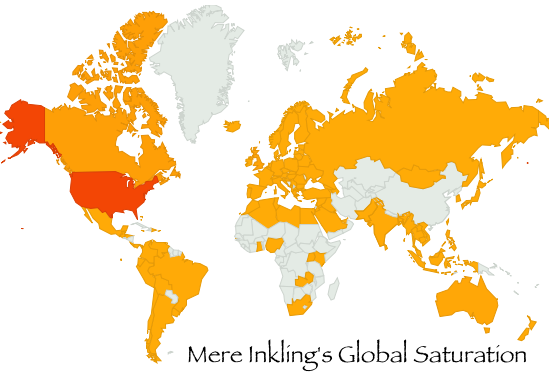
International Blogging

countries

Who reads blogs? Well, initially, we find just two sources of readers.

  1. Family & Close Friends who we can coerce into reading it, and put on the spot by publicly asking questions related to our recent columns to tighten the screws just a smidge.
  2. Fellow bloggers who search for interesting reads with the ulterior hope that the writers of posts they “like” will make a reciprocal journey to their site.

Expanding beyond those two categories is the challenge. I suspect that most bloggers are resigned to only reaching a relatively small audience. And that’s not necessarily a bad thing. After all, junk mail reaches the boxes of millions, but it is tossed into recycling without a second thought. On the other hand, a blog may only be read by a handful of people, but one or two of them may be wonderfully touched or encouraged through that brief encounter. Junk mail is deleted with a groan. Our posts, in sharp contrast, may elicit a smile, a laugh, or perhaps even an appropriate tear.

I can settle for that.

One of the nice things about being part of the WordPress community is the way writers can monitor their site statistics. One fascinating feature is “Views by Country,” which tracks the national origin of visitors to a blog. (Well, not necessarily their ethnic origin, but the country from which they established their online connection with the website.)

Checking out this resource is fantastic for several reasons. First, it’s pleasant as we note visits from locales with which we have a special bond. Republic of Korea, spent a busy year there ministering to those guarding democracy, but still managed to visit many beautiful sites and established many friendships. United Kingdom, got to live there with my family, and visited amazing historic locations too numerous to list. (But, shouldn’t the UK count as three or four countries?) Guam, we got to live there too and enjoy the scenic ocean vistas. (Of course, it’s not a separate country either, being a Territory of the United States.) So what if the word “country” is applied a bit loosely, the sheer breadth of the program’s coverage is impressive.

A second value of the list is that it is educational. You can learn about the existence and/or location of many exotic lands. I’ve had visitors from the Mongolian steppes of the Khans, WWI catalyst Montenegro, freedom-seeking Syria, and the Viking-haunted Faroe Islands.

The third major benefit of visiting the statistics tool is that it can actually reinforce a writer’s sense that someone out there in the vast global unknown is actually interested in their words. I’m amazed, and a mite humbled, to have had visitors to MereInkling from 129 “countries.” Pretty amazing. When I revisit the list every two or three months I see one or two newly reached populations. Yet, as I look at the map, I see many nations remain to be reached. For example, most of the “-stans” and many countries in Africa have yet to feel the warm and liberating glimmer of light MereInkling attempts to deliver.

The Remaining Mystery

I am still plagued by one unanswered question though.

I readily understand why the People’s [misnamed] “Republic” of China has barred MereInkling from internet availability for their billions of prisoners residents.

What perplexes me is why the Kingdom of Denmark has barred access to MereInkling for the subjugated country of Greenland?!? One would think that, in light of their 5 day summer and 360 winter that they would be eager to read something as entertaining as MereInkling. Why has an internet wall been erected to prevent them from doing so? What, we must wonder, is going on behind that impenetrable Ice Curtain?

Yes, for those who think they’ve noted a flaw in my conspiracy theory, I am fully aware that the Faroe Islands are also technically part of the Danish empire. So, why would citizens of Denmark proper and the occupied Faroes be allowed to visit MereInkling while the Greenlanders are left to find enjoyment in measuring the advance and retreat of massive glaciers? The mystery deepens.

As C.S. Lewis wrote in “The Efficacy of Prayer,” in a passage I’ve wrenched completely out of context: “There is a mystery here which, even if I had the power, I might not have the courage to explore.”

Literary Criticism, Inklings Style

bandersnatchIf you’re a writer and you’ve never been part of a critique group, you’ve missed out on some beneficial (and occasionally annoying) experiences.

Critiquing is, of course, the process of providing constructive criticism to someone, in the hopes of improving their work. Good criticism is priceless. The problem is that it takes true skill to offer useful advice . . . and it requires the proper degree of self-assurance to receive the criticism itself.

Those who have been burned by scathing criticism are reticent to “invite” more of the same. However, when the criticism begins with affirmation (about positive aspects of the work), that tiny spoonful of sugar certainly helps the more difficult parts of the evaluation easier to swallow.

And yet, for some, even expertly delivered criticism—covered by a chocolate layer of affirmation and accolades—remains nearly impossible to accept.

A fine example of this truth comes in C.S. Lewis’ description of a prominent member of the Inklings writing fellowship. J.R.R. Tolkien was a virtual perfectionist when it came to all things Middle Earth. Because of this “flaw,” Lewis and the other Inklings were frustrated when it came time to review the progress of The Hobbit and elements of Lord of the Rings. As Lewis described it in a 1959 letter:

No one ever influenced Tolkien—you might as well try to influence a bander-snatch. We listened to his work, but could affect it only by encouragement. He has only two reactions to criticism; either he begins the whole work over again from the beginning or else takes no notice at all.

To learn the nature of a bandersnatch, we must travel Through the Looking Glass into Lewis Carroll’s 1872 novel. Carroll coined the word and introduced it to the world in a poem called “Jabberwocky,” which appears in Alice’s wonderful adventures.

Lewis, of course, was not likening his dear friend to a frumious* bandersnatch in terms of it’s overall personality. Rather, he was describing the severity of Tolkien’s inability to positively process criticism of his work, to the bandersnatch’s incapacity to do the same. It is similar to the sense in which the White King alludes to the creature’s swiftness in describing his wife: “She runs so fearfully quick. You might as well try to catch a Bandersnatch!”

Although few of us are destined to be members of so illustrious a critique community as the Inklings, I highly commend joining one of your local parallels. While you may encounter a bandersnatch or two, on the whole you’ll likely find the process quite beneficial.

____

* “Frumious,” like bandersnatch itself, was coined by Lewis Carroll and is a blending of the words “fuming” and “furious.”

The bandersnatch, as envisioned above, is used with the permission of New Zealand illustrator David Elliot.

Lengthening Good Stories

bayeuxWe’re all familiar with the saying “too much of a good thing.” Because it’s a cliché, most reviewers wisely avoid the phrase, but in reading a fair number of reviews of The Hobbit, I’ve heard this very thought expressed in a number of ways.

Everyone is familiar with Director Peter Jackson’s Oscar-winning trilogy of The Lord of the Rings. Most fans were thrilled when it was announced he would also film J.R.R. Tolkien’s much “smaller” tale of The Hobbit. Some were surprised when they learned he would divide it into two parts. Still, the general sentiment was “the more the better” (another tired phrase). However, when it was ultimately announced that Jackson intended to stretch the modest novel into a trilogy of its own, many fans were incredulous.

There is a tad of irony in transforming Tolkien’s beloved adventure of a hobbit assisting dwarves in a regional quest into an epic to rival the high fantasy of The Lord of the Rings with its conflict enmeshing every corner of Middle Earth.

As I write this column, The Hobbit: An Unexpected Journey is doing well. It is ranked sixth at the box office, and held the number one position for three full weeks, against tough competition.

In order to discover sufficient content to expand the story, Jackson has incorporated a number of Middle Earth tales Tolkien had written about its history in other sources. The primary sourcebook was The Silmarillion, a collection published posthumously by Tolkien’s son Christopher in 1977. Some regard the importing of these elements as a sort of corruption of the simpler story of the single volume. Others welcome the elaboration on the essential story, since the additions are certainly “genuine Tolkien,” and they provide a more elaborate portrayal of Middle Earth.

The reactions to the expansion have been mixed. I don’t have strong feelings either way, but I treasure my time in Middle Earth so highly, that I would likely pitch my tent in the camp of those who approve of the increase. (Not to the point, of course, where I would behead those who objected, as we see on the fragment from the Bayeux Tapestry above.)

In the energetic conversation about the expansion of the saga, people frequently interject the name of the author, and offer suppositions about how he would have reacted. I find this interesting, but somewhat futile. Frankly, there is far too much that we simply don’t know about Middle Earth to authoritatively render Tolkien’s judgment on these things. Yes, we know that he was reluctant to see his work on the screen, but he did sell those rights to his creations. Of course we are aware of his lack of confidence in material originating in the colonies.

In a 1937 letter he writes about a possible publisher in the United States: “As for the illustrations: I am divided between knowledge of my own inability and fear of what American artists (doubtless of admirable skill) might produce.” It is in this same letter that he offers his criticism about a Disneyesque presentation: “It might be advisable, rather than lose the American interest, to let the Americans do as seems good to them—as long as it was possible (I should like to add) to veto anything from or influenced by the Disney studios (for all whose works I have a heartful loathing).”

In an essay entitled “On Criticism,” C.S. Lewis described the limitations of outsiders attempting to discern the intent of authors.

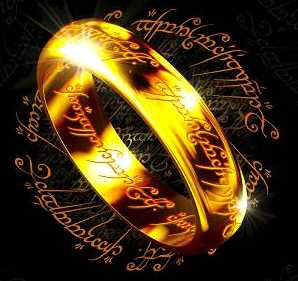
Nearly all reviewers assume that your books were written in the same order in which they were published and all shortly before publication. There was a very good instance of this lately in the reviews of Tolkien’s Lord of the Rings. Most critics assumed (this illustrates a different vice) that it must be a political allegory and a good many thought that the master Ring must “be” the atomic bomb.

Anyone who knew the real history of the composition knew that this was not only erroneous, but impossible; chronologically impossible. Others assumed that the mythology of his romance had grown out of his children’s story The Hobbit. This, again, he and his friends knew to be mainly false. Now of course nobody blames the critics for not knowing these things: how should they? The trouble is that they don’t know they don’t know. A guess leaps into their minds and they write it down without even noticing that it is a guess.

Learning from Lewis, I won’t hazard a guess about Tolkien’s ultimate attitude towards the cinematic portrayals of his works—which will now, I assume, come to carry greater weight in the public psyche than the novels themselves. Well, at least until the current mode of motion pictures becomes obsolete. Then, once again, the words as Tolkien wrote them will reign supreme.

For those who are interested, I created the faux Bayeux Tapestry scrap at the top of the column using a program that allows manipulation of a variety of the hand-stitched images. Then I simply added the text in a simple graphics program. The Historic Tale Construction Kit is available here.

There is also a more sophisticated software interface that I haven’t tried called the “interactive” Bayeux Tapestry.

Skillful Turns of Phrase

frank burnsEveryone loves an exquisite turn of phrase. Those of us who dabble in writing are particularly susceptible to their numinous power.

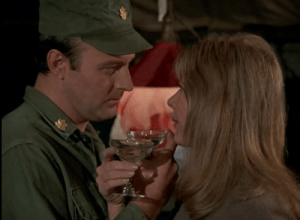
I’ve been doing some research on the Father Mulcahy character from M*A*S*H. William Christopher transformed the fictional character from a caricature of military chaplaincy, into a compassionate and respected representative of the Holy. During my research, I’ve been reviewing episodes of the series in which he was featured.

In “Alcoholics Unanimous,” which originally aired in 1974, Mulcahy has been tasked with delivering a lecture on temperance. In an interesting twist he wears full clerical garb and prepares what is essentially a sermon. Since the lecture is a “mandatory formation,” the mess tent (which doubles as the chapel) is filled to capacity.

Sitting in the front row are the hypocritical Majors Burns and Houlihan. (For those unfamiliar with the show, they constantly call for the most rigid of military standards, even as they are all the while breaking the military’s Uniform Code that prohibits adultery.) Major Houlihan’s nickname, in fact, is “Hotlips.”

In the aforementioned episode they have a delightful little exchange that illustrates through its witty banter the skill of the Hollywood writers at their best. As the hospital’s temporary commander, Burns has banned all alcohol and mandated attendance at the lecture. The tent is filled to its limits as Houlihan turns adoring towards her paramour and says:

Houlihan: Frank, what a turnout!

Burns: Lemmings must be directed to the sea.

Houlihan: You’re magic with a phrase!

It requires skill to create a well-crafted turn of phrase. Well, even a fool like Frank Burns can stumble across a clever phrase, but only a master can repeatedly coax them from their ethereal realms.

C.S. Lewis was just such a master. His works abound with profound and captivating language. And he recognized it in the works of others. In “Dante’s Similes,” in Studies in Medieval and Renaissance Literature, he wrote:

[Dante] is the most translatable of the poets—not, probably, that he entrusts less wealth than others to the music of the words and the nuance of the phrase but that he entrusts more than others to the “plain sense.”

In The Four Loves, Lewis reveals just how impoverished much of our language is . . . even when it relates to the most inspiring of matters. Describing the difference between carnal “love” and genuine love, he shows that even impoverished phrases can begin to grasp the truth behind the dynamics of affection and commitment.

We must do the works of Eros when Eros is not present. This all good lovers know, though those who are not reflective or articulate must be able to express it only in a few conventional phrases about “taking the rough along with the smooth,” not “expecting too much,” having “a little common sense,” and the like. And all good Christian lovers know that this programme, modest as it sounds, will not be carried out except by humility, charity and divine grace; that it is indeed the whole Christian life seen from one particular angle.

Surely those who are more articulate can more expressively communicate our love for our spouse. Yet, even in so-called matters of the heart, we frequently utter phrases that are utterly mundane.

The History of the Phrase “Turn of Phrase”

One online dictionary uses these definitions:

a turn of phrase

1. a way of saying something “Significant other,” meaning “partner,” now that’s an interesting turn of phrase.

2. the ability to express yourself well She has a nice turn of phrase which should serve her well in journalism.

The Phrase Finder website provides excellent information about numerous phrases. And, in discussing this idiomatic phrase about phrases, they do not disappoint.

So, a phrase was a style of speaking or writing, and style meant beauty of expression. We can now interpret a fine “turn of phrase” as analogous to a skillfully crafted piece of wood turned on a lathe. John Dryden referred to the “turning” of words in this sense in The Satires of Decimus Junius Juvenalis, 1693: “Had I time, I cou’d enlarge on the Beautiful Turns of Words and Thoughts; which are as requisite in this, as in Heroique Poetry.”

Check out their entire article about turns of phrase at the link above. And, may your own writing be filled with impressive verbal ballets, replete with inspiring leaps and unforgettable pirouettes.

Avoiding Fantasy Clichés

We’re all familiar with that classic paradigm of suspenseful introductions: “It was a dark and stormy night.” While this is not intrinsically poor writing, it has been parroted and ridiculed for so long as a lightweight cliché, that the author’s name has become a byword for writing “purple prose.”

In the same way, there are certain plotlines or story devices that are overused, particularly in genre literature. For example, J.R.R. Tolkien’s genius in creating Middle Earth cannot be exaggerated. Yet, since his epic, dwarves, elves and orcs innumerable have been written about in chronicles ad nauseum by lesser poets. Many of Tolkien’s inventions seem rather tired when repeated by contemporary writers for the hundredth time. (Hundred thousandth time, if you count fan fiction.)

This literary dilemma has led to the creation of “The Fantasy Novelist’s Exam,” designed to be taken by aspiring authors before submitting their manuscripts for publication. (The link for the exam will be found below.)

The purpose of the test is to determine how derivative your storytelling is. If you use too many of the listed elements, you are in danger of composing a parody rather than a masterpiece. Some of the questions posed in the exam are astute, many are glib, and most are humorous. Here’s a sampling, with my responses (speculative, of course, since I haven’t written any fantasy proper).

Is your main character the heir to the throne but doesn’t know it?

How about an anonymous member of minor nobility?

Do inns in your book exist solely so your main characters can have brawl?

I never visit bars, but isn’t hosting altercations a primary purpose of all drinking establishments?

Do you think you know how feudalism worked but really don’t?

Ah, a conundrum. If I know I don’t really know . . .

Do any of your female characters exist solely to be captured and rescued?

You mean they have another role they can perform? (Wait, I’m just joking!)

Do you think that “mead” is just a fancy name for “beer?”

My Viking ancestors would never forgive me if I did!

Do you think horses can gallop all day long without rest?

I wasn’t raised on a ranch, but I’m not that stupid.

Is this the first book in a planned trilogy?

Whoops.

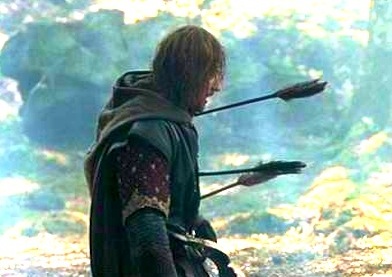
As you see, the questions are fun to read, but there’s one that bothered me a bit. Well, not the question itself. It’s innocent enough. But it alludes to a particular scene in The Lord of the Rings films which I find stunning—in the original sense of the word. It strikes me viscerally, almost leaving me breathless.

Do you really think it frequently takes more than one arrow in the chest to kill a man?

Generally, no . . . but if that hero is Boromir, most certainly!

The Death of Boromir

One of the most moving scenes in The Lord of the Rings involves the death of Boromir as he sacrifices his life in a futile battle to allow the hobbits time to escape the Uruk-hai. It’s impact is magnified by the fact that it immediately follows Boromir’s near-betrayal, under the corrupting influence of the Ring.

The irony is that this spectacular scene is not described in detail in Tolkien’s book. It is a tribute to director Peter Jackson’s cinematic brilliance. This is the original telling:

Even as [Aragorn] gazed his quick ears caught sounds in the woodlands below, on the west side of the River. He stiffened. There were cries, and among them, to his horror, he could distinguish the harsh voices of Orcs. Then suddenly with a deep-throated call a great horn blew, and the blasts of it smote the hills and echoed in the hollows, rising in a mighty shout above the roaring of the falls.

“The horn of Boromir!” he cried. “He is in need!” He sprang down the steps and away, leaping down the path. “Alas! An ill fate is on me this day, and all that I do goes amiss. Where is Sam?”

As he ran the cries came louder, but fainter now and desperately the horn was blowing. Fierce and shrill rose the yells of the Orcs, and suddenly the horn-calls ceased. Aragorn raced down the last slope, but before he could reach the hill’s foot, the sounds died away; and as he turned to the left and ran towards them they retreated, until at last he could hear them no more. Drawing his bright sword and crying Elendil! Elendil! he crashed through the trees.

A mile, maybe, from Parth Galen in a little glade not far from the lake he found Boromir. He was sitting with his back to a great tree, as if he was resting. But Aragorn saw that he was pierced with many black-feathered arrows; his sword was still in his hand, but it was broken near the hilt; his horn cloven in two was at his side. Many Orcs lay slain, piled all about him and at his feet.

Aragorn knelt beside him. Boromir opened his eyes and strove to speak. At last slow words came. “I tried to take the Ring from Frodo” he said. “I am sorry. I have paid.” His glance strayed to his fallen enemies; twenty at least lay there. “They have gone: the Halflings: the Orcs have taken them. I think they are not dead. Orcs bound them.” He paused and his eyes closed wearily. After a moment he spoke again. “Farewell, Aragorn! Go to Minas Tirith and save my people! I have failed.”

“No!” said Aragorn, taking his hand and kissing his brow. “You have conquered. Few have gained such a victory. Be at peace! Minas Tirith shall not fall!” Boromir smiled.

“Which way did they go? Was Frodo there?” said Aragorn.

But Boromir did not speak again.

“Alas!” said Aragorn. “Thus passes the heir of Denethor, Lord of the Tower of Guard! This is a bitter end. Now the Company is all in ruin. It is I that have failed. Vain was Gandalf’s trust in me. What shall I do now? Boromir has laid it on me to go to Minas Tirith, and my heart desires it; but where are the Ring and the Bearer? How shall I find them and save the Quest from disaster?”

He knelt for a while, bent with weeping, still clasping Boromir’s hand. So it was that Legolas and Gimli found him. (Lord of the Rings, Book III Chapter 1).

So, we understand that while a single arrow might slay a common warrior, it could well take a quiver full to lay low a champion such as this.

___

If you would like to review “The Fantasy Novelist’s Exam,” simply follow this link.

Vivacious Vocabularies

One reason I love reading C.S. Lewis arises from his adroit use of the English language. His vocabulary is immense. It is pleasant to run into words one seldom encounters on the drab byways of modern journalism and tangled thoroughfares of contemporary “social media.”

Consider the following example. I was exploring The Allegory of Love when I read this: “There is nothing in literature which does not, in some degree, percolate into life.”

What a delightful verb! It evokes for me recollections of my youth when my parents would refer to our coffee pot as the percolator. Simultaneously, it reminds me of more recent—less happy—usages: “I’m sorry, but inadequate soil percolation means you’ll have to install a far more expensive septic system than normally required.”

It’s discouraging when you consider the sad state of modern vocabularies. I read somewhere that people typically only use about 10% of the words they know. So a common vocabulary of 5,000 spoken words would mean they know (i.e. can recognize written or audible forms of) about 50,000 words. Shakespeare used 29,000 words in his plays and sonnets, suggesting an expansive vocabulary. Likewise, brilliant authors like C.S. Lewis would boast a praiseworthy mental dictionary.

I am sometimes curious about my own vocabulary. I consciously attempt—in conversation as well as writing—to utilize at least 15% of the words I know. After all, the English language is so rich, it’s criminal to limit ourselves to pedestrian words. It’s like having all the ingredients for a delicious feast available to us and settling for slapping together a peanut butter sandwich.

I also love the precision that comes from using the exact word that suits the occasion. For example, in a thriller it matters greatly how the hero’s nemesis inflicts injury. A skilled writer would never say “Professor Moriarty cut Holmes.” Instead, we would learn that he slashed . . . stabbed . . . sliced . . . scarred . . . carved . . . or perhaps he merely nicked the detective. Likewise, we would probably know the type of weapon he was using. It would not be a mere “knife.” It might be a saber . . . a dagger . . . a pocketknife . . . scalpel . . . carving knife . . . or perhaps even a bayonet.

Lewis addressed this richness in vocabulary in an essay on “Transposition” which appears in The Weight of Glory.

If the richer system is to be represented in the poorer at all, this can only be by giving each element in the poorer system more than one meaning. The transposition of the richer into the poorer must, so to speak, be algebraical, not arithmetical. If you are to translate from a language which has a large vocabulary into a language that has a small vocabulary, then you must be allowed to use several words in more than one sense. If you are to write a language with twenty-two vowel sounds in an alphabet with only five vowel characters than you must be allowed to give each of those five characters more than one value. If you are making a piano version of a piece originally scored for an orchestra, then the same piano notes which represent flutes in one passage must also represent violins in another.

It is wonderful to be fortunate enough to speak a language with a diverse vocabulary. English is such a tongue. Now, if we could just simplify its complexities and purge its irregularities, we would enjoy the best of all linguistic worlds.

Treasuring Books

Most of us love and respect books, don’t we? We take care of our literary treasures, and the more deeply we are attached to a particular volume, the better we treat it.

Many of us are reluctant to loan out the books which line our shelves like so many gems, resting in a jeweler’s pristine cases. When we do agree to share them, we’re afraid they may never find their way home. And, when they eventually return to our welcoming grasp, they sometimes bear the scars of their sojourn in the paws of others who do not esteem them as they ought to. Page corners may be scored. Coffee or tea stains may have “embellished” the text. Bindings may have been carelessly mistreated. And, unbelievably, the borrowers are likely to be unaware of how they have abused the tome’s dignity and disfigured its beauty.

Speaking honestly, my own bookshelves are in constant disarray, and too many of my books still remain unpacked after our move into our retirement home. But I am absolutely serious about how painful I find it to witness the mistreatment of books by those ignorant of their value.

C.S. Lewis loved books. He recognized their power. He embraced their wonder. And—most wonderfully for us—he penned a number of classics that will continue to inspire readers for generations.

Yet, as much as Lewis treasured books, he took his own creations for granted. This changed in December of 1954, when he received a precious package from his publisher. Among his Christmas gifts that year were specially bound copies of Surprised by Joy and Mere Christianity. Receipt of the thoughtful present opened his eyes to an interesting notion. On the twenty-second day of the month, he wrote:

I never had a handsomer present. . . . Perhaps these two charming volumes will teach me at last to have for the bodies of my own books the same reverence I have for the bodies of all other books. For it is a curious fact that I never can regard them as being really books; the boards and print, in however mint a condition, remain a mere pretense behind which one sees the scratchy, inky old manuscript.

I daresay that those writers among us can relate to Lewis’ mindset. Even with the pride that accompanies having books or articles in print, our work somehow seems “different” than the other published materials we invariably respect. This is due in large part, I believe, to their familiarity. Writers, better than most, understand what familiarity breeds. We know these works that flowed from our own consciousness and sweat . . . we know them intimately. And we are keenly aware that if given another opportunity, there are parts of them we would even now edit to be clearer, sharper, and more eloquent.

I never cease to be surprised by the humility of new writers who almost whisper their accomplishments to others. It’s as though they are embarrassed . . . that they assume their friends would consider them braggarts if they spoke with the pride they genuinely feel about their work. Some of us hold onto our rejection letters. (I do.) How much better though, to print out high quality copies of articles or devotions we’ve written and place them in a prominent binder or display located near our keyboard.

Who knows, I may actually follow my own advice and do something like that. Sadly, I don’t have a grateful publisher eager to prepare special editions for me. Nevertheless, I’m glad Lewis did. I learned from his insight that whenever we release our literary progeny to the world, they merit the same degree of respect and affection that we book-lovers bestow so generously on the works of others.

___

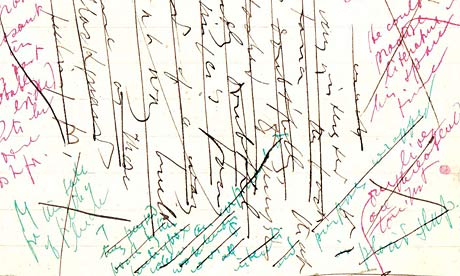
Postscript: The image above is an actual manuscript page from James Joyce’s Ulysses. (It makes me feel much more confident about my own initial scribblings.)

Discovering Your Elvish Name

Most readers of Mere Inkling are either fans of C.S. Lewis and his fellow Inklings, or writers interested in similar topics such as adventure, virtue, imagination, and spirituality. In light of that, and the fact that the finale of the trilogy won Oscar for Best Film, I assume the vast majority have seen “The Lord of the Rings.”

When you watched the films, with whom did you most identify? Ladies had options from warriors, to counselors, to royalty. Likewise for the men. Then there were the different races of Middle Earth . . . did you cast yourself as human, elf or dwarf? Or perhaps, as a modest, earthy hobbit? (I hope there weren’t too many who identified with the orcs, and if you did, I’d suggest an appointment with your local therapist.)

If the notion of living a long, peaceful life, studying the arts and enjoying God’s creation inspires you, then it may be you possess a kinship with the Elvish soul. And if you do (or even if you’re merely curious) there is a wonderful website where you can learn not only how to speak your name in the Elf tongue, but also to write it in the Elf script.

J.R.R. Tolkien, C.S. Lewis’ treasured friend, was at heart a philologist. Few people have ever lived who shared the intensity of his love for language. Not everyone knows though, that the matchless realm of Middle Earth with its timeless sagas grew neither from a vision for the heroic story nor out of the visualization of any of its vibrant inhabitants. No, the seeds of the most renowned fantasy realm ever envisioned, were planted and watered by Tolkien’s love of language.

It was primarily linguistic in inspiration and was begun in order to provide the necessary background of ‘history’ for Elvish tongues. (J.R.R. Tolkien, Forward to the Second Edition of The Lord of the Rings).

Tolkien’s passion for the languages of Middle Earth is legend. Today, other linguists continue to study, document and teach the sophisticated system. Tolkien’s creation was so complex that it resulted in the creation (and evolution) of several languages—distinguished by both history and geography. In the same way, Tolkien was not content to settle for a single version of text with which to pen these musical dialects. He created no fewer than three styles, with Tengwar being most familiar. (You can download these and related fonts here.)

So, how exactly do you discover your Elvish name?

There have long been “random generators” for Middle Earth-sounding names. The generator at one site renders my Elvish name as Eöl Séregon, which does sound fairly distinguished. (Who knows whether or not it means anything?) These programs may satisfy the curiosity of the passing surfer seeking random oddities. However, for those who respect the love Tolkien invested in his linguistic progeny, this will never suffice.

Fortunately, there is an amazing website, overseen by a bona fide lover of languages. Moreover, his site is devoted to maintaining the integrity of Tolkien’s Elvish tongues. (And many of us who are writers are similarly enamored with language itself, making this a worthwhile domain to visit.)

The host of Quenya101 embraced the tongue so completely that in college he even took lecture notes in the language! Today he teaches Quenya through his website and other means. Although there’s a long waiting list (that can be circumvented, I believe, by donating to the site) he will actually translate names into Quenya. Note that I said “translate.” This is no mere transposing of letters.

He does not waste his time with transliterations. He actually applies the etymology of your given name to rendering the very same meaning in the Elvish language. For good measure, he provides a Tengwar rendition of your Elvish name. (It may be that he has already translated your name and has it posted at the site.)

Here’s how it works, as illustrated by my own name. Fortunately, my father’s name has also been translated, so I am seeking the Quenya for “Robert (son of) Charles.”

Robert

From: Germanic name Hrodebert.

Meaning: Bright fame, derived from the Germanic elements

     hrod ”fame” and beraht “bright”.

Quenya: Calialcaro

     (calima+alcar+[o] = bright+splendour, glory+[masculine names suffix])

Charles

From: Germanic name Karl, which was derived from the same Germanic word. However, an alternative theory states that it is derived from the common Germanic element hari

Meaning: Karl means “man” & hari means “army, warrior”

Quenya: Nér (nér = man) or Ohtatyaro (ohtatyaro = warrior)

So, henceforth you may address me as Calialcaro Ohtatyaro!

It is encouraging to see people keeping alive the vision and wonder of Middle Earth. The same is true for Narnia, of course, though you cannot really compare the purpose. These magical realms were both created by geniuses. It is a divine coincidence that these men, with major differences in their temperaments and imaginations, were lifelong friends.

Discovering your unique Elvish name can establish a dramatic connection with an imaginary, but at the same time gloriously real, realm.