Misinterpreted Symbols

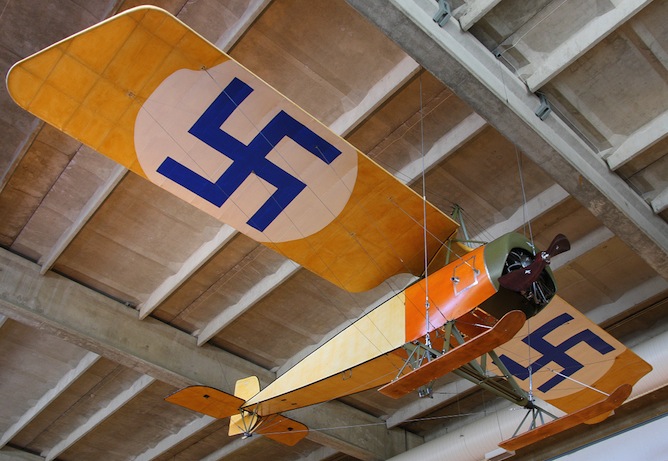
finn planeFew symbols evoke the intense reaction caused by the swastika. Regardless of the color in which it is rendered, it is inescapably associated with the Nazi insanity of the Third Reich.

And yet, for millennia it meant something else. And even today, in many lands it is recognized as representing something completely different.

I recently read a fascinating article* about the 1939-40 Winter War between the Soviet Union (Hitler’s “ally” at the time!) and tiny Finland. The Finns fought valiantly, and although in the peace settlement they forfeited territory to the insatiable communists, they inflicted terrible casualties on the aggressors.

Finnish bitterness toward the Soviets, due to their invasion, led them to ally with the Germans once the nonaggression pact between Germany and the Soviet Union ended. Without any sympathy for Nazi beliefs, they naturally hoped to regain the land they had been forced to surrender in 1940.

Prior to the Finnish alliance with Germany, the swastika already served as the official symbol of their small but talented Air Force. Ironically, they had adopted it in homage to the Swedish noble who donated one of the first foreign planes imported to fight the Russians.

The plane pictured above is the modest aircraft donated by Count Eric Von Rosen. The symbols adorning it are based on his personal crest, which was in turn based upon ancient Viking runes. It represented good luck.

After the decisive defeat of the National Socialist Party, the offensive symbol was virtually wiped away. However, as one writer says, “Although de-Nazification was enforced throughout Scandinavia, it was taken rather lightly in Finland, where the symbol had become an integral symbol for their Air Forces.

This is understandable because in Finland, the symbol meant something completely different than the common association linked to Hitler’s mania.

This should serve as an important lesson for those of us who work with words (which in large part are symbolic). A meaning we may consider patently obvious might turn out to be missed entirely by a reader for whom the “symbols” mean something else entirely. In Mere Christianity C.S. Lewis provides an entertaining illustration of this.

There is no need to be worried by facetious people who try to make the Christian hope of “Heaven” ridiculous by saying they do not want “to spend eternity playing harps.” The answer to such people is that if they cannot understand books written for grown-ups, they should not talk about them.

All the scriptural imagery (harps, crowns, gold, etc.) is, of course, a merely symbolical attempt to express the inexpressible. . . . People who take these symbols literally might as well think that when Christ told us to be like doves, He meant that we were to lay eggs.

The fact that we know the swastika has an ancient pedigree, and that it continues to mean something completely different than Nazism in some locales today, is unlikely to calm the minds of the vast majority of people who will never become comfortable with it.

Turning to Lewis once more we find a dynamic image that is perfectly apropos to our discussion of the swastika as a symbol. Symbols, he reminds us, are inherently powerful. Although written in a different context (“Williams and the Arthuriad”), Lewis could easily have had in mind the preeminent symbol of Nazism and the Holocaust when he wrote:

A symbol has a life of its own. An escaped metaphor—escaped from the control of the total poem or philosophy in which it belongs—may be a poisonous thing.

_____

* You can download a copy of “The Winter War” from Air Force magazine at this link.

Powerful Names

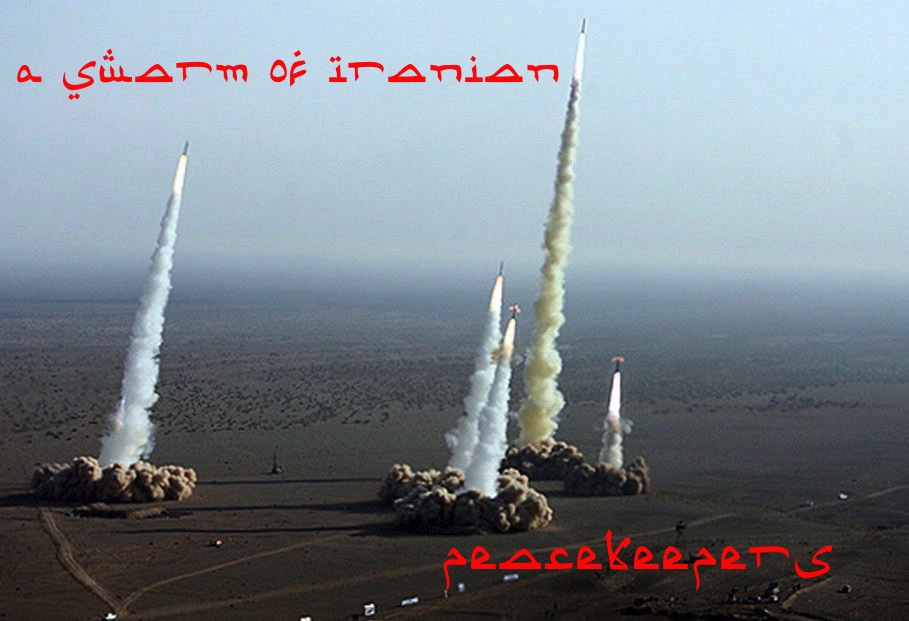
missilesIt’s all in the name. The person who succeeds in naming (or labeling) something wields great power.

Whether it be a concrete object, or an idea, the power to name carries the power to shape perceptions.

Philosophically, we might agree that:

“That which we call a rose by any other name would smell as sweet” (Juliet, Romeo and Juliet).

But, if we are perfectly honest, calling it “skunk cabbage” might affect our perception of its aroma.

A classic example of the power of naming comes from the era of Norse exploration. In the ninth century, Vikings began settling in the inhospitably named “Iceland.” The island was majestic, and its spectacular glaciers and volcanoes still allowed room for extremely fertile farmsteads.

Less than a century and a half later, Erik the Red was exiled from Iceland. He sailed west and established the first colony on a much larger island that he enticingly named Greenland. Erik’s brilliant advertising ploy was quite effective, and hundreds of settlers joined him in the much harsher climes to Iceland’s west.

The specific appellations which led me to ponder the power that resides in naming once again,* actually came from a much more modern source—weaponry.

Military leaders have a knack for generating striking names. Often they are brilliant; occasionally they completely miss the mark. In either case, it’s curious to note the message their choice of nomenclature seeks to emphasize. Consider for a moment two different American missiles.

The AGM-114 Hellfire and the LGM-118A Peacekeeper

The reader naturally assumes the purpose of the former is to rain sulfur and brimstone down on the enemy, while the mission of the latter is to benignly maintain peace. One suspects, however, that being at the epicenter of either explosive device would be equally disastrous.

Another example we might consider is a bit more controversial, but fascinating nonetheless. Consider these labels for movements involved in the abortion debate.

Self-Preferred  ||  Used by Opponents  ||  Used by the Media

Pro-Choice  ||  Pro-Abortion  ||  Pro-Choice

Pro-Life  ||  Anti-Choice  ||  Anti-Abortion

It doesn’t require a brilliant intellect to comprehend the tone each of these labels evokes. Nor should it come as a surprise how the mainstream media tends to line up in the debate.

It’s all in the name. The person who succeeds in naming something wields great power.

C.S. Lewis was a master of language. He knew names exercise significant influence on how things are perceived. In the following passage from “The Humanitarian Theory of Punishment,” he describes how a powerful word—in this case “mercy”—can be dangerously misleading when applied to something inimical to itself.

Mercy, detached from Justice, grows unmerciful. That is the important paradox. As there are plants which will flourish only in mountain soil, so it appears that Mercy will flower only when it grows in the crannies of the rock of Justice: transplanted to the marshlands of mere Humanitarianism, it becomes a man-eating weed, all the more dangerous because it is still called by the same name as the mountain variety.

In another essay, “‘Bulverism:’ or, the Foundation of 20th Century Thought,” Lewis actually coins a word which has found favor with a literate subculture. The peculiar word he created conveys a sense of obtuse, opinionated self-smugness. (Yes, I may be reading just a little bit into “Bulverism,” but I really don’t think so. The aristocratic or remote sounding surname “Bulver,” the “ism” suffix and, of course, the “Bul” prefix all combine to engender an odd and unappealing impression.)

The subject Lewis addresses in this work is the unwillingness of disagreeing parties to honestly debate the merits of an issue. Instead, they rush to employ the invalid (and terribly effective) ad hominem approaches that characterize so much of modern politics.

C.S. Lewis is so talented (and ingenious) that he provides us with a biographical note on the fictional creator of the deficient form of “debate” prevalent in the modern era. “The modern method [of argument],” Lewis begins, “is to assume without discussion [your opponent] is wrong and then distract his attention from this (the only real issue) by busily explaining how he became so silly.”

In the course of the last fifteen years I have found this vice so common that I have had to invent a name for it. I call it “Bulverism.” Some day I am going the write the biography of its imaginary inventor, Ezekiel Bulver, whose destiny was determined at the age of five when he heard his mother say to his father—who had been maintaining that two sides of a triangle were together greater than the third—“Oh, you say that because you are a man.”

“At that moment,” E. Bulver assures us, “there flashed across my opening mind the great truth that refutation is no necessary part of argument. Assume your opponent is wrong, and then explain his error, and the world will be at your feet. Attempt to prove that he is wrong or (worse still) try to find out whether he is wrong or right, and the national dynamism of our age will thrust you to the wall.” That is how Bulver became one of the makers of the Twentieth Century.

. . . Bulverism is a truly democratic game in the sense that all can play it all day long, and that it gives no unfair privilege to the small and offensive minority who reason.

Sadly, Bulver’s disciples continue to increase, rather than diminish.

Since it was military missiles that initially got me thinking about the subject of the power of naming, it might be fitting to end with a few more evocative labels. They certainly elicit a wide range of impressions.

Condor: Argentina’s avian contribution

Piranha: Tiny but vicious and straight from Brazil’s Amazon

Velvet Glove: Canada’s mixed message

Sky Sword: China’s blending of the ancient and modern

Apache: French, which confuses this American veteran**

Meteor: A European offering sure to land hard if it doesn’t disappear in the atmosphere

Martel: Anglo-French venture they surely don’t want Islamists to think is a tribute to Charles Martel, Hero of the Battle of Tours***

V-1 Flying Bomb: Got to Hand it to the Germans for straight-forward labeling.

Rhinemaidens (Rheintöchter): There’s apparently Teutonic Poetry as well

Fateh: Iran’s “Conqueror”

Zelzal: Iran’s “Earthquake”

Sejjil: Iran’s “Baked Clay” (well we can’t expect all the Persian names to be winners)

Jericho: From Israel where we know whose walls tumbled down

Spike: Israeli and probably not a reference to Jael and the Book of Judges****

Hatf: Pakistani “Vengeance” (derived from the gentle sword of Muhammad)

Hyunmoo: Korea’s mythical “Guardian of the Northern Sky” (mayhap a reference to their aggressive northern neighbor)

Penguin: Those Norwegians really know how to frighten their enemies

Malakhit (Малахит): Just one of Russia’s curiously named explosives in their “mineral missile series”

Umkhonto: South African “Spear” from the Zulu tongue

The Brits are uniquely creative when it comes to naming missiles. They include: Blowpipe, Brimstone, Green Cheese, Rapier, Sea Skua and, of course, Fairey Fireflash and it’s less intimidating companion Fairey Stooge.

For some reason, I find a missile named “Green Cheese” particularly disconcerting. Whoever named that specific weapon was devilishly clever. If I were a world leader, I’d surrender immediately, rather than face a foe confident enough in their military prowess to use that sort of twisted culinary nomenclature for their armaments.

______

* I have written on the subject of personal names in the past.

** It just may translate as “Ruffian,” but I don’t think I want to go there, since it hints at political incorrectness.

*** It’s actually a combination of the missile’s guidance options: Missile, Anti-Radiation, Television. I’m sure the parallel with the Frankish defender of the Christian Church is a mere coincidence.

**** The fourth chapter of the Book of Judges.

Why War?

bulletsI recently read a profound statement penned by G.K. Chesterton. Although he was not a military veteran himself, he was absolutely on target when he wrote: “The true soldier fights not because he hates what is in front of him, but because he loves what is behind him.”

Terrible things are happening today in Syria. Yesterday, over lunch, I “debated” one of my sons regarding the merits (and drawbacks) of American intervention in that Levantine cauldron.

He believes we can’t “stand by” while the world watches as a civil war rages around another of the world’s mad dictators. I argued the United States isn’t morally responsible to serve as the world’s guardian of peace. And, even if we as a single, fallible, divided people were accountable . . . what about the violence and injustice in so very many other places. Sudan, Myanmar (Burma), the Congo, and scores of other lands cry out for intervention on behalf of the oppressed.

There is an almost unlimited amount of injustice around the globe today. And, looking in the mirror, it’s evident we have problems to resolve right here.

Sending American troops to intervene in foreign civil wars is ugly business. Taking sides against dictators does not always provide a safer and more just world—we need look no further than the so-called Arab Spring to reveal that.

I was proud to serve my nation—and causes I believed in—during the liberation of Kuwait and the retaliation for the September 11 attacks on the United States a decade later.

I am now retired from active duty, and I’ve lived long enough to witness how little positive fruit seems to follow war.

Like C.S. Lewis, I remain persuaded that some evils are so malevolent (Hitler, for example, comes to mind) . . . that they must be confronted. As he wrote in “The Conditions for a Just War,”

If war is ever lawful, then peace is sometimes sinful.

At the same time, however, war is something into which we should never rush. It demands our conscious consideration of the cost and an accurate determination that the blood spilled—include that of noncombatants inevitably caught up in the horror—is a price worth paying.

It is that question which moral men and women must debate and ponder.

“Learning in War-Time” is a brilliant essay included in the collection which goes by the name of Lewis’ speech, “The Weight of Glory.” In the essay, Lewis discusses the seriousness of war. As a combat casualty during the First World War, he vividly understood its nature.

However, as a Christian, Lewis recognized that warfare is not the worst thing that can befall a human being.

What does war do to death? It certainly does not make it more frequent: 100 percent of us die, and the percentage cannot be increased. It puts several deaths earlier, but I hardly suppose that that is what we fear. Certainly when the moment comes, it will make little difference how many years we have behind us.

Does it increase our chances of painful death? I doubt it. As far as I can find out, what we call natural death is usually preceded by suffering, and a battlefield is one of the very few places where one has a reasonable prospect of dying with no pain at all.

Does it decrease our chances of dying at peace with God? I cannot believe it. If active service does not persuade a man to prepare for death, what conceivable concatenation of circumstances would? Yet war does do something to death. It forces us to remember it.

True. To die at enmity with God is a fearful thing. Still, even better than coming to faith during war (Lewis would surely agree), is recognizing God’s love and living a life of peace.

Avoid Living in Fear

nuclear blast

Nuclear war. It’s an extremely unpleasant subject, and its grim specter still haunts the world. Oddly, though—even as we anticipate the day when Iran’s lunatic Mullah’s develop them and North Korea’s deranged generals learn how to deliver them—the world is in a sort of “nuclear hiatus” at this very moment.

The Mutual Assured Destruction apparently worked, as the former Soviet Union and the United States decided against nuclear suicide. At the present moment the three world powers show little appetite for total war, so today’s children don’t have to learn the Civil Defense precautions that kept an earlier generation safe.

I was one of those young Americans indoctrinated in the sophisticated “duck and cover” method of nuclear blast survival. This video provides a nostalgic look at the paramilitary training we received. (A link to the full training film appears below.)

C.S. Lewis lived during the height of nuclear paranoia. Yet he retained his composed Northern Irish demeanor as he reflected on the threat. In an essay entitled “On Living in an Atomic Age” he wisely advised:

If we are all going to be destroyed by an atomic bomb, let that bomb when it comes find us doing sensible and human things—praying, working, teaching, reading, listening to music, bathing the children, playing tennis, chatting to our friends over a pint and a game of darts—not huddled together like frightened sheep and thinking about bombs. They may break our bodies (any microbe can do that) but they need not dominate our minds.

In his essay “Is Progress Possible,” Lewis addresses those who used the uncertainty of the future as an excuse for making irresponsible life choices. His words ring just as true today, when so many youth turn to nihilism and self-destructive behaviors.

As a Christian I take it for granted that human history will some day end; and I am offering Omniscience no advice as to the best date for that consummation. I am more concerned by what the Bomb is doing already. One meets young people who make the threat of it a reason for poisoning every pleasure and evading every duty in the present. Didn’t they know that, Bomb or no Bomb, all men die (many in horrible ways)? There’s no good moping and sulking about it.

If only remaining safe in this fallen world was as simple as dropping to the ground and sheltering one’s head. It isn’t, of course, but we need not live our lives under the shadow of fear.

Returning to “On Living in an Atomic Age,” Lewis adroitly places the entire menace—and all perils to human life—in their proper perspective. It may not be the most comforting words we will ever read, but they are certainly true.

In one way we think a great deal too much of the atomic bomb. “How are we to live in an atomic age?” I am tempted to reply: “Why, as you would have lived in the sixteenth century when the plague visited London almost every year, or as you would have lived in a Viking age when raiders from Scandinavia might land and cut your throat any night; or indeed, as you are already living in an age of cancer, an age of syphilis, an age of paralysis, an age of air raids, an age of railway accidents, an age of motor accidents.”

In other words, do not let us begin by exaggerating the novelty of our situation. Believe me, dear sir or madam, you and all whom you love were already sentenced to death before the atomic bomb was invented: and quite a high percentage of us were going to die in unpleasant ways. We had, indeed, one very great advantage over our ancestors—anaesthetics; but we have that still. It is perfectly ridiculous to go about whimpering and drawing long faces because the scientists have added one more chance of painful and premature death to a world which already bristled with such chances and in which death itself was not a chance at all, but a certainty.

_____

You can watch the entire “Stop and Drop” Civil Defense Video here.

Wasp Wars

This fall I’ve entered into combat with some of fallen nature’s most ferocious and merciless creatures. Thus far, they are winning the war.

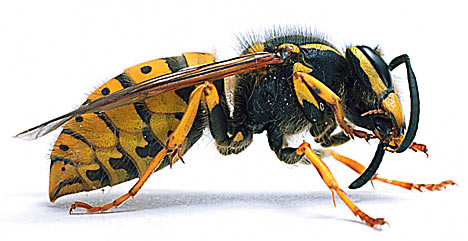
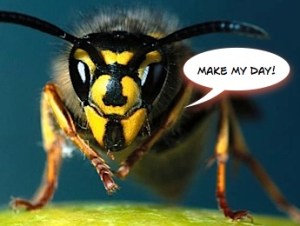
A couple months ago my castle (i.e. home) was invaded by a ruthless tribe of wasps or hornets (the latter is a subset of the species, as are yellow jackets, so they are all members of a single horrific animal family).

They found a small, un-caulked opening into our attic . . . strategically placed just above our front door. I’m sure they had thousands of alternative bastions in the forest that surrounds our house but, being wasps, they knew this was the precise location from which they could wreak the most violent havoc.

The initial fray was brief. I sprayed copious amounts of wasp insecticide into the crevice, in the hope of encouraging them to nest elsewhere. It appeared to act as an attractant. After it failed and added more recruits to their number, I donned armor and climbed a ladder after dusk when they had settled in for the night, and noiselessly attempted to close the space with insect-proof sealant.

Alas, their sentinels were vigilant. They swarmed me, and pushed me off of the ladder causing me to land on my back and crash my head on the ground. Unfortunately, my long sleeved armor did not include a concussion proof helmet. Like a craven coward I lifted my bruised body from the rocky ground (nope, we haven’t planted a lawn yet) . . . and I ran for my life. All the while I was thanking God that I was only standing on the third rung.

Aside from my bruises, they had only inflicted a single piercing wound—on my index finger. Of course, being predators, wasps carry a very nasty venom, and for the next week it failed to heal as the poison festered, despite diligent attention from my corpsman-wife.

I’m waiting patiently for winter now, when they are partially dormant and “hibernating.” When the queen wakes up in the spring, she’ll find herself sealed in a crypt. (At least, that’s what I’m hoping.)

Wasps in Narnia

C.S. Lewis, being a lover of the outdoors, was well acquainted with the hazard posed by wasps. In The Chronicles of Narnia,

When the Pevensie children are drawn back to Narnia for a second time, it is a jarring and initially frightening experience. As we read in Prince Caspian:

It was an empty, sleepy, country station and there was hardly anyone on the platform except themselves. Suddenly Lucy gave a sharp little cry, like someone who has been stung by a wasp. “What’s up, Lu?” said Edmund—and then suddenly broke off and made a noise like “Ow!”

“What on earth—” began Peter, and then he too suddenly changed what he had been going to say. Instead, he said, “Susan, let go! What are you doing? Where are you dragging me to?”

“I’m not touching you,” said Susan. “Someone is pulling me. Oh—oh—oh—stop it!” Everyone noticed that all the others’ faces had gone very white.

“I felt just the same,” said Edmund in a breathless voice. “As if I were being dragged along. A most frightful pulling—ugh! It’s beginning again.”

“Me too,” said Lucy. “Oh, I can’t bear it.”

“Look sharp!” shouted Edmund. “All catch hands and keep together. This is magic—I can tell by the feeling. Quick!”

“Yes,” said Susan. “Hold hands. Oh, I do wish it would stop—oh!” Next moment the luggage, the seat, the platform, and the station had completely vanished.

The four children, holding hands and panting, found themselves standing in a woody place—such a woody place that branches were sticking into them and there was hardly room to move. They all rubbed their eyes and took a deep breath. “Oh, Peter!” exclaimed Lucy. “Do you think we can possibly have got back to Narnia?”

Later, Edmund offers some wise advice in The Voyage of the Dawn Treader. He alludes to the deceptive natural and inherent ninja skills possessed by the killers.

“We must all show great constancy,” Caspian was saying. “A dragon has just flown over the tree-tops and lighted on the beach. Yes, I am afraid it is between us and the ship. And arrows are no use against dragons. And they’re not at all afraid of fire.”

“With your Majesty’s leave—” began Reepicheep.

“No, Reepicheep,” said the King very firmly, “you are not to attempt a single combat with it. And unless you promise to obey me in this matter I’ll have you tied up. We must just keep close watch and, as soon as it is light, go down to the beach and give it battle. . . .”

“Perhaps it will go away,” said Lucy.

“It’ll be worse if it does,” said Edmund, “because then we shan’t know where it is. If there’s a wasp in the room I like to be able to see it.”

Back to My Own Campaign

Just as I became resigned to my strategy with the vicious intruders, I became aware of a second army of insect brigands. This multitude had invaded the crawlspace under my home, through some weakness in the screens guarding my ventilation openings.

Noting that I would not require a ladder to engage them in combat I foolishly thought, oh how you will rue the day you trespassed in my domain!

I purchased a new screen to cover the entire opening, but their guards remained vigilant even during the night and before I could even begin the project, they swarmed and had me fleeing across our back lawn (yes, we do have some grass). Running recklessly in the dark I naturally stumbled and still bear some significant bruises. These would be bad enough, but two of the villains stabbed me with their poisonous stingers before I secured myself in the house.

With the aid of my faithful border collie, I discovered an infiltrator who insidiously snuck into the castle proper clinging to my pants. I immediately dropped my leggings and proceeded to stomp on them for several minutes. I was thorough, walking repeatedly over every part of the crumpled clothing. Naturally, he survived. I did manage to rewrap him in the trousers and see to his demise.

I am reconsidering my strategy now, and leaning towards placing commercial wasp traps directly outside the vent when the vermin reawaken in the spring. I’m also contemplating periodically banging a hammer near their hidden nest to disturb their rest during their hibernation. I haven’t determined yet whether this would be effective, as it is when interrogating terrorists, or whether it would simply be sadistic.

Trying to learn their weaknesses (they don’t have any) I did learn one reason why wasps are so aggressive and merciless. They are almost all female! While queens alone reproduce, and they keep a few males handy for their sole role of mating and dying, the rest of the army consists of “asexual female workers.” These perform community duties such as building the hive, gathering food, feeding the young, and protecting the colony!

Now, lest I be unfairly accused of misogyny, let me make clear that it is not their “feminine” nature that makes them violent. Rather, it is a corruption of their natural maternal instincts which cause them to guard their nest so belligerently that all rationally minded people desire their utter annihilation.

And, Once Again, to Narnia

The final book in the Chronicles has been my favorite ever since I first read the series forty years ago. I gained an even greater appreciation for The Last Battle when I read this description of the heavenly Narnia into which all of Aslan’s faithful were ushered.

Tirian had thought—or he would have thought if he had time to think at all—that they were inside a little thatched stable, about twelve feet long and six feet wide. In reality they stood on grass, the deep blue sky was overhead, and the air which blew gently on their faces was that of a day in early summer. Not far away from them rose a grove of trees, thickly leaved, but under every leaf there peeped out the gold or faint yellow or purple or glowing red of fruits such as no one has seen in our world. The fruit made Tirian feel that it must be autumn but there was something in the feel of the air that told him it could not be later than June.

They all moved toward the trees. Everyone raised his hand to pick the fruit he best liked the look of, and then everyone paused for a second. This fruit was so beautiful that each felt “It can’t be meant for me . . . surely we’re not allowed to pluck it.”

“It’s all right,” said Peter. “I know what we’re all thinking. But I’m sure, quite sure, we needn’t. I’ve a feeling we’ve got to the country where everything is allowed.”

“Here goes, then!” said Eustace. And they all began to eat. What was the fruit like? Unfortunately no one can describe a taste. All I can say is that, compared with those fruits, the freshest grapefruit you’ve ever eaten was dull, and the juiciest orange was dry, and the most melting pear was hard and woody, and the sweetest wild strawberry was sour. And there were no seeds or stones, and no wasps.

Despite our repeated failings, the victory will ultimately be won by our divine Champion!
Our Eagle Allies

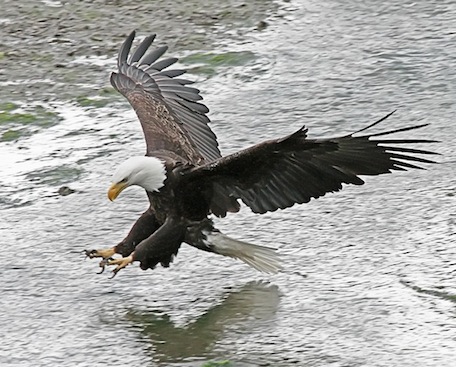
Eagles are majestic creatures. Living in the midst of a large bald eagle nesting area is something my wife and I don’t take for granted. Each year we see scores of the graceful raptors courting and then raising their young right here on Hood Canal.

Hood Canal is actually an 80 kilometer long fjord, which lies just to the east of the Olympic National Forest. It features deep blue waters at the foot of an impressive mountain range.

Eagles make a significant impression on nearly everyone fortunate enough to see them. Even though they are birds of prey, they look extremely noble. In light of that fact, it’s no accident many nations include an eagle as part of their coat of arms or national seal. These include: Albania, Armenia, Austria, Germany, Ghana, Iceland, Indonesia, Iraq, Mexico, Moldova, Montenegro, Nigeria, Panama, Russia, the United States and at least ten additional countries.

Eagles have also figured prominently in literature. For example, both of the preeminent Inklings, J.R.R. Tolkien and C.S. Lewis, featured eagles as heroes in their fictional classics.

Eagles in the Work of C.S. Lewis

Eagles are among those granted speech by Aslan at the dawn of Narnia’s creation. They reward their Creator’s gift by serving faithfully throughout the entire history of the land. Eagles play a role in virtually every battle that occurs in Narnia. They are always on the side of good.

In addition to fighting in the campaign against the White Witch, eagles are responsible for the rescue of Edmund from her camp. When Aslan calls his army to rush toward the climactic battle in The Lion, the Witch and the Wardrobe, he says:

And now! Those who can’t keep up—that is, children, dwarfs, and small animals—must ride on the backs of those who can—that is, lions, centaurs, unicorns, horses, giants and eagles. Those who are good with their noses must come in the front with us lions to smell out where the battle is.

The most noteworthy passages relate to Farsight, who is a prominent eagle during the final days of Narnia. He it is who brings to King Tirian the sad news that Narnia’s capital has fallen.

“Sire,” said the Eagle, “when you have heard my news you will be sorrier of my coming than of the greatest woe that ever befell you.” Tirian’s heart seemed to stop beating at these words, but he set his teeth and said, “Tell on.” “Two sights have I seen,” said Farsight. “One was Cair Paravel filled with dead Narnians and living Calormenes . . . And the other sight, five leagues nearer than Cair Paravel, was Roonwit the Centaur lying dead with a Calormene arrow in his side. I was with him in his last hour and he gave me this message to your Majesty: to remember that all worlds draw to an end and that noble death is a treasure which no one is too poor to buy.” “So,” said the King, after a long silence, “Narnia is no more.” (The Last Battle)

After this sad entrance, and following the “Last Battle,” Farsight is one of the leaders as the victor’s army enters into the foothills of heaven.

. . . the dogs barked, “Faster, faster!” So they ran faster and faster till it was more like flying than running, and even the Eagle overhead was going no faster than they. And they went through winding valley after winding valley and up the steep sides of hills and, faster than ever, down the other side, following the river and sometimes crossing it and skimming across mountain lakes as if they were living speedboats . . . “Further up and further in!” roared the Unicorn, and no one
held back. . . .

Only when they had reached the very top did they slow up; that was because they found themselves facing great golden gates. And for a moment none of them was bold enough to try if the gates would open. . . . “Dare we? Is it right? Can it be meant for us?” But while they were standing thus a great horn, wonderfully loud and sweet, blew from somewhere inside that walled garden and the gates swung open. (The Last Battle)

Eagles in the Work of J.R.R. Tolkien

Similar to Lewis’ distinction between dumb and speaking eagles, Tolkien distinguishes between “common” and Great Eagles. In The Hobbit he writes, “Eagles are not kindly birds. Some are cowardly and cruel. But the ancient race of the northern mountains were the greatest of all birds; they were proud and strong and noble-hearted.”

It is these noble mountain eagles who populate the six books (three volumes) of the Lord of the Rings and Tolkien’s other fiction.

At the end of the First Age, eagles fight alongside the Valar, Elves and Men in the War of Wrath. They especially contend against the dragons of Morgoth as recounted in The Silmarillion. The eagles emerge victorious, destroying most of their enemy during an aerial battle.

Near the end of the Third Age, the eagles from the Misty Mountains rescue Thorin’s troop from goblins and wargs, as related in The Hobbit. Without their aid, the Dwarves, Elves and Humans would likely have met defeat at the Battle of Five Armies.

In The Lord of the Rings (including the cinematic version) the eagles feature prominently. They are even capable of clashing head-to-head with the fearsome Nazgûl-mounted dragons.

And, of course, several of them rescued Frodo Baggins and Samwise Gamgee following the destruction of the One Ring.

Two named eagles should be mentioned. Thorondor was the initial Lord of Eagles and according to The Silmarillion was the “mightiest of all birds that have ever been.”

His descendant Gwaihir is the leader of those who aid Gandalf throughout the events of The Lord of the Rings. Not only does he rescue the wizard from the tower, but he returns him after his “resurrection” which followed the battle with the Balrog.

“Naked I was sent back—for a brief time, until my task is done. And naked I lay upon the mountain-top. . . . I was alone, forgotten, without escape upon the hard horn of the world. . . . And so at the last Gwaihir the Windlord found me again, and he took me up and bore me away. ‘Ever am I fated to be your burden, friend at need,’ I said.”

“A burden you have been,” the Eagle answered, “but not so now. Light as a swan’s feather in my claw you are. The Sun shines through you. Indeed I do not think you need me any more: were I to let you fall, you would float upon the wind.” (The Two Towers)

It may be that for this life we must remain content with seeing only the common and mute eagles that populate this mortal world. But even they, are glorious to behold.

Military Helmets

War is deadly business. And, if a kingdom or nation hopes to emerge victorious, they are wise to equip their soldiers properly. That’s why this fact, included in today’s Ripley’s Believe It or Not comic, is so shocking.

It’s inconceivable that as the world marched to war in 1914, not a single one of the world powers equipped their troops with steel helmets. Elegant helms that looked superb on the parade ground . . . yes. Elaborate crests that exaggerated height to intimidate the foe . . . of course. Comfortable fabrics that kept the scorching sun off of the scalp . . . certainly.

But steel helmets that might actually spare men from bullet and shrapnel wounds . . . not those.

It’s not like the danger of ballistic wounds caught the Europeans off guard. Muskets had given way to deadly rifles long before. Artillery had advanced to the point where the Germans actually built not one, but two unique weapons: (1) Big Bertha, a huge howitzer that lobbed an eighteen hundred pound shell nearly eight miles, and (2) the Paris Gun, a siege cannon able to fire its shell eighty miles!

As soldiers like C.S. Lewis and J.R.R. Tolkien rallied to the flag and fought the Huns, they would eventually be issued more protective equipment. But it didn’t exist at the war’s outset. And even with it, Lewis was severely wounded in combat. in 1939 he wrote, “My memories of the last war haunted my dreams for years.”

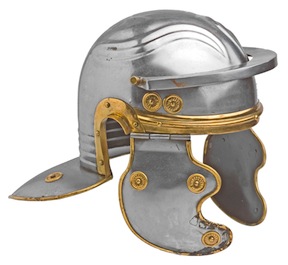
The irony about metal helmets is that even ancient peoples recognized the importance of protecting the skulls of their warriors with the strongest materials available. In my office I have a replica Roman legionary helmet. Trust me, it was capable of saving lives.

Today’s combat helmets are highly advanced, and great effort is made to protect military members from head trauma. Sending them into battle with anything less than the best equipment available should be a crime.

Veterans Day: Joyous or Somber?

Much of the world commemorates Armistice Day, or as it has come to be known in the United States, Veterans Day. It is fitting to offer thanks for those who have gone to war to defend our freedoms, especially those who sacrificed their lives in that cause.

C.S. Lewis was a veteran of the “war to end all wars.” He was recuperating from severe battle wounds in an army hospital when WWI came to its conclusion. Just a few days after the Armistice, he wrote to his father:

As to the great news which is uppermost in our minds, I can only echo what you have already said. The man who can give way to mafficking [celebrating with boisterous public demonstrations] at such a time is more than indecent—he is mad. I remember five of us at Keble, and I am the only survivor: I think of Mr. Sutton, a widower with five sons, all of whom have gone. One cannot help wondering why.

Lewis knew what all veterans of war have learned. War is a terrible thing. It is something to be avoided whenever possible . . . but there are some things even worse than war. And in those circumstances, when war becomes the necessary lesser evil, it is never something to be celebrated. Innocents die in war. Innocence dies in war.

Yes, it is certainly good to express our appreciation to the veterans who have counted the cost and served in uniform. But we should do so with sober, deep and quiet gratitude.