
Confusing Creeds

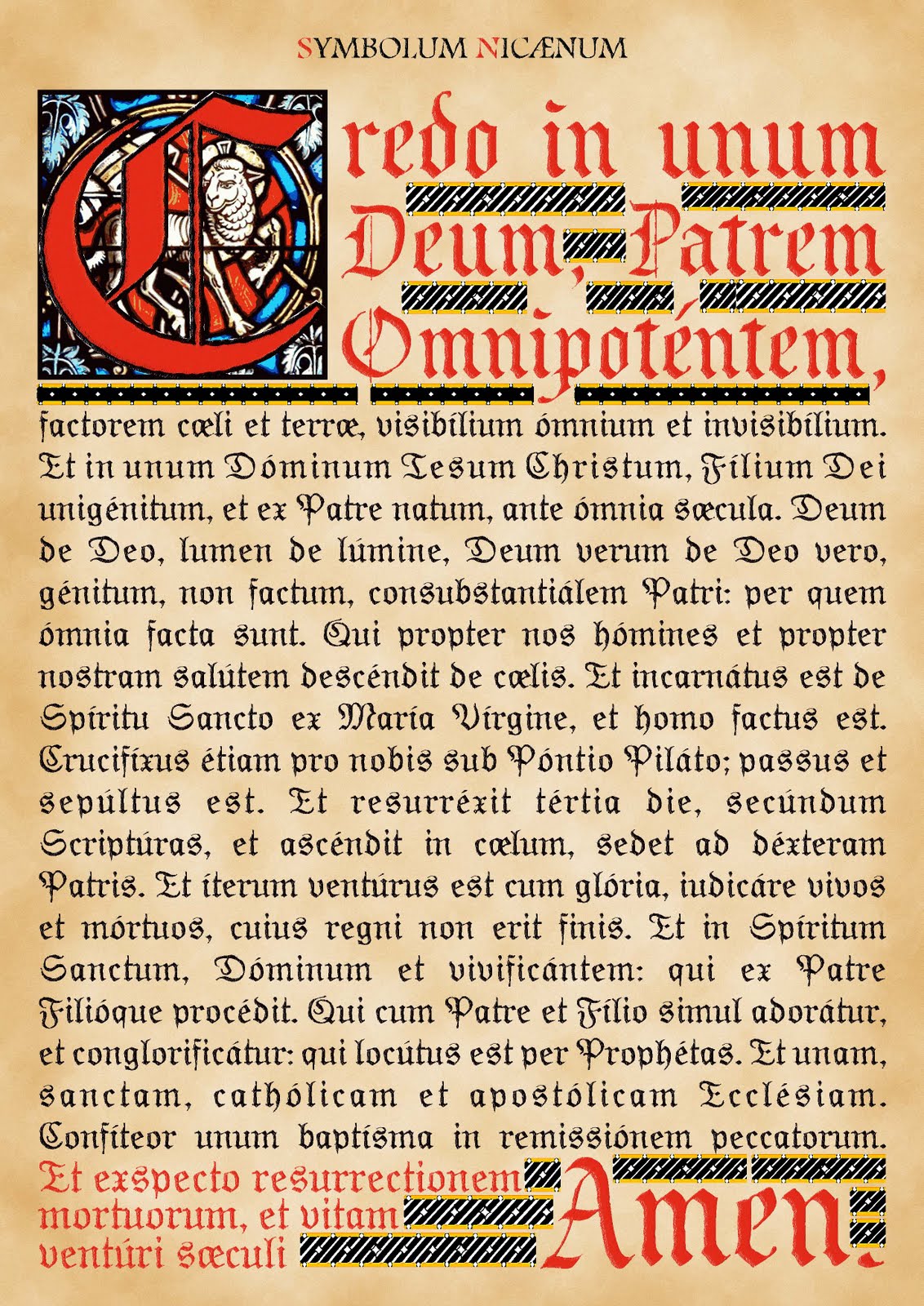
Nicene CreedThere are a couple of sentences in the traditional translation of the basic Christian creeds (statements of faith) that lead to confusion.

Due to the literary examples below, Christian readers may find the following discussion more interesting than non-Christians—but everyone interested in clarity versus confusion should find something intriguing.

The creeds offer a prime example of why it is absolutely crucial to ensure that gradual shifts in language do not undermine or blur the intended meaning of a given sentence. To illustrate, consider this line from the Nicene Creed.

. . . [Jesus] who for us men and for our salvation came down from heaven and was incarnate by the Holy Spirit of the virgin Mary and was made man. (1662, Anglican Book of Common Prayer).*

The potential confusion here lies in the archaic usage of the word “of.” Whose Holy Spirit are we referring to? Mary’s innate holiness and purity? The educated Christian may stumble over that dated phrase—which is still used in some denominations—but a person not acquainted with the doctrine of the Trinity might easily misinterpret it as a Maryological, rather than Christological, confession.

Let’s consider two more recent translations, and note how the first restores the intent of the original writers. The second of these commonly used translations reflects the hand(s) of “politically correct” revisers.

For us and for our salvation he [Jesus] came down from heaven: by the power of the Holy Spirit he became incarnate from the Virgin Mary, and was made man. (1975 International Consultation on English Texts version).

For us and for our salvation he came down from heaven, was incarnate of the Holy Spirit and the Virgin Mary and became truly human. (1988, English Language Liturgical Consultation version).

We will consider a second example momentarily, but let’s first look at something C.S. Lewis wrote about reflecting on the importance of the creeds. He noted that too often we rattle through the words without considering their significance. This is unfortunate.

In an essay entitle “On Forgiveness,” Lewis describes a personal epiphany and offers counsel to those tempted to take familiar words for granted.

We say a great many things in church (and out of church too) without thinking of what we are saying. For instance, we say in the Creed “I believe in the forgiveness of sins.” I had been saying it for several years before I asked myself why it was in the Creed. At first sight it seems hardly worth putting in. “If one is a Christian,” I thought “of course one believes in the forgiveness of sins. It goes without saying.”

But the people who compiled the Creed apparently thought that this was a part of our belief which we needed to be reminded of every time we went to church. And I have begun to see that, as far as I am concerned, they were right. To believe in the forgiveness of sins is not so easy as I thought. Real belief in it is the sort of thing that easily slips away if we don’t keep on polishing it up.

As usual, the Oxford don was correct. However, just as good translations possess the power to inspire, so too poor or antiquated translations exercise the ability to confuse.

Here is the promised second example.

And the third day he rose again according to the Scriptures . . . (1662).

Ah, I understand, think the uncatechized, the Bible teaches us that Jesus rose from the dead on Easter. Well, yes it does, but that is not the sense in which the second phrase is intended. Here, “according to the Scriptures,” means that Jesus’ life, death and resurrection were all accomplished in accordance with the promises of the Word of God.

In other words, “just as was promised in the Garden of Eden and foretold by the prophets, Jesus won victory when he rose from the grave in accordance with the loving plan of God the Father.” The newer versions make that fact only slightly clearer.

On the third day he rose again in accordance with the Scriptures . . . (1975 and 1988).

Perhaps a future revision will replace “in accordance with,” using something like “as foretold in” or “fulfilling the scriptural promises.”

Some of us worship in congregations using a variant of the seventeenth century creed, but at least we can take comfort in the fact that most of them have at least replaced “And he shall come again with glory to judge both the quick and the dead” with “both the living an the dead.” After all, we wouldn’t want people to think that one’s salvation is dependent upon their speed.

_____

* This slightly contemporized version of the creed has already remedied the terribly confusing term “Holy Ghost,” which evokes images of disembodied souls and hauntings.

It’s Still Christmas

nativity iconMerry Christmas!

One of the sad things about living in a secular nation is that people understand very little about the real meaning of Christmas. For example, many people take their trees down on 26 December, mistakenly thinking Christmas is “over.” In reality, the Christian celebration of the Nativity of Jesus only begins on Christmas Day!

The commercial world celebrates the season of Advent and deceptively calls it “Christmas.” These weeks, which should mark a spiritual preparation akin to Lent, are instead transformed into a frantic race to accumulate the perfect gifts to show others just how much we value each of them. And, since we love our family and close friends, there is a constant temptation to be far more extravagant in our gift giving than we can afford.

Returning to the season of Christmas, in which we find ourselves this day . . . we discover a brief occasion to focus our spiritual reflections on the singular Christmas miracle, the Incarnation. God becoming a human being. The Word through whom all things were created, becoming a mortal like the sons of Adam and daughters of Eve fashioned in his own likeness.

Christmas is, indeed, a glorious season.

C.S. Lewis had many insights into the Incarnation miracle. It is most certainly worthy of our serious attention. If it did not actually happen, Jesus should be dismissed altogether, for he claimed to be one with our heavenly Father. However, as Lewis declared in Miracles, “If the thing happened, it was the central event in the history of the Earth.”

One of the great literary treasures of the world is a precious book written before the year Anno Domini 318. Athanasius of Alexandria wrote a treatise called “On the Incarnation,” which makes great reading and is readily available online. A fairly modern translation was written by Sister Penelope Lawson, an Anglican nun.

Sister Penelope prevailed upon C.S. Lewis to write an introduction to her translation, in which he said, “This is a good translation of a very great book.” The full volume, complete with Lewis’ outstanding preface, is available. Here is just one of his gems:

Every age has its own outlook. It is specially good at seeing certain truths and specially liable to make certain mistakes. We all, therefore, need the books that will correct the characteristic mistakes of our own period. And that means the old books. All contemporary writers share to some extent the contemporary outlook—even those, like myself, who seem most opposed to it. Nothing strikes me more when I read the controversies of past ages than the fact that both sides were usually assuming without question a good deal which we should now absolutely deny. They thought that they were as completely opposed as two sides could be, but in fact they were all the time secretly united—united with each other and against earlier and later ages—by a great mass of common assumptions.

Still, as wonderful as Lewis’ introductory comments are, the greatest treasures here are the bishop’s teachings about Jesus. To whet your appetite, taste the following wisdom from Athanasius’ own introduction to his work:

You must understand why it is that the Word of the Father, so great and so high, has been made manifest in bodily form. He has not assumed a body as proper to His own nature, far from it, for as the Word He is without body. He has been manifested in a human body for this reason only, out of the love and goodness of His Father, for the salvation of us men. We will begin, then, with the creation of the world and with God its Maker, for the first fact that you must grasp is this: the renewal of creation has been wrought by the Self-same Word Who made it in the beginning. There is thus no inconsistency between creation and salvation for the One Father has employed the same Agent for both works, effecting the salvation of the world through the same Word Who made it in the beginning.

You can read the entire work at this site. Have a blessed Christmas season!

Screwtape Letters Anniversary

I was recently reminded that February 2012 marks the seventieth anniversary of C.S. Lewis’ masterpiece, The Screwtape Letters. Other bloggers have remarked on the anniversary, for example here and here.

Lewis dedicated the book to his dear friend and fellow Inkling, J.R.R. Tolkien.

If you’re unfamiliar with the letters, you really should rectify that gap in your knowledge. The letters are penned by Screwtape, a senior Devil, to Wormword, a less experienced tempter. They illuminate Satan’s demonic tactics and provide keen insight into our fallen human nature, replete with its countless vulnerabilities.

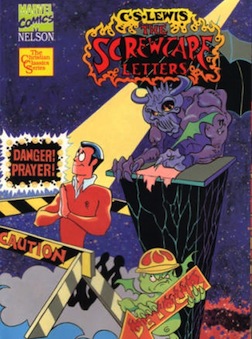
There’s even a graphic novel version of the collection which was published in 1994 by Thomas Nelson in partnership with Marvel Comics.

While the anniversary of the Letters in and of itself is certainly significant enough to merit a blog announcement . . . this post includes something quite rare. The fact is we’ve come into possession of one of Screwtape’s instructional emails, written to another subordinate demon.

For the benefit of those who would arm themselves against the snares of the Enemy, we reproduce it in full below.

(Oh, and as a reminder, when Screwtape refers to his Enemy, he is actually talking about the Creator of heaven and earth. Also, you can’t actually trust anything he writes since he’s a Liar, just like the archangel he followed so long ago. For example, note his incorrect reference to his own “immortality.”)

My Dear Esculentus,*

Another decade has passed since that puppet of the Enemy released to the world a portion of my correspondence with Wormwood. Of course, the lamentable Wormwood has had ample time to regret his carelessness in that matter, as I often remind you.

A decade’s but a snippet to immortals such as us, of course, but to the mortals it marks a significant portion of their brief lives. Why the Enemy loves those pitiable insects so much goes beyond logic!

Still, another halfscore has flown past and that damaging treatise remains in print. In fact, if anything, it continues to grow in popularity.

We simply cannot have our “patients” made aware of our treatment regimen for them. If they come to realize that our most successful deception is untrue, the relentless work of centuries will be undone.

We have labored tirelessly up to the present day to persuade humanity that all truth is subjective! Fortunately, the vast majority of the population in what are ironically labeled “enlightened nations,” has accepted our suggestion. This allows them to eagerly swallow the comforting lie that “all roads lead to god.” If they realize that all roads do indeed lead to a ‘god,’ they might abandon one of the many paths that lead to our Master who is ever-eager to “swallow” them in turn.

Better by far that those entrusted to our misleading, nourish our infernal Father than that you and I sate his appetite. (As you know, I say that figuratively, since our Father’s hunger for power can never be truly satiated. His all consuming hunger is one of his infinite qualities, which we rightly extol.)

But, back to your primary concern my appetizing friend, your patient. By all means keep him from reading The Screwtape Letters. In fact, the farther you keep him from anything written by Clive Staples Lewis, the better!

Keep him in the company of liberal companions who have embraced the myth of there being no objective truth. That way, we can prevent him from ever meeting the Enemy who proclaims himself to be—yes, disgusting isn’t it—the Way, the Truth and the Life.

Never pass up an opportunity to impress upon your patient that such a claim is politically incorrect to the utmost. Remind him he will be shunned by society if he argued there was a single truth. Indeed, make him think the very suggestion that anyone sincerely following another path might be lost, is repugnant.

Many of your fellow tempters have experienced great success in motivating the humans they treat to replace in their world views the virtue of Truth with the sentimentality of Sincerity. This you must do as well.

Persuade him that the eternal destiny of all who believe in something, is secure. Convince him that it is by their sincerity that they are saved. Oh how sweet it is when they accept this dark epiphany!

And it has never been easier to win humans over to this view than it is today. If you wish to embellish the doctrine with vague language about “God being love” and all that, so be it. Just see to it that they never open the Enemy’s book to recognize how grossly they have edited and distorted that concept!

Oh, and in closing, allow me to once again remind you of how I began this digital epistle. (We both know that it frequently takes a dozen or more reminders to make a firm impression on your dull mind.)

Do whatever it takes to ensure that your patient never reads the Letters! And, be wise to guard our own correspondence, lest you end up in the agonizing company of the afore-censured Wormwood.

Your affectionate adoptive Uncle,

Screwtape

*Esculentus translates from the Latin as either “delicious” or “succulent,” and if you have read The Screwtape Letters you know what that suggests about Screwtape’s interest in his protégé.