“An army marches on its stomach.”* Military leaders have long recognized that it is difficult to arouse soldiers weakened by deprivation. Sadly, though, even a king of Israel could be foolish enough to ignore that and order his soldiers to fast before a battle.
While logisticians rarely receive the accolades of their peers who serve directly in combat, they have always been vital members of successful military ventures.
While they are concerned with securing and transporting all requirements, such as ammunition and medical supplies, there is a single necessary requirement for all campaigns. Without sustenance, soldiers will desert the flag and even the most steadfast will fall.
Nutritional value is the first priority. Palatability has historically been a distant afterthought. This has given rise to innumerable jokes made by veterans about the “combat rations” provided to them. While these “menus” have vastly improved in recent years, they remain fodder for much humor.
And even the most delicious food choices become monotonous when they are limited to a small range. In 2002, I visited a remote military detachment supplied with adequate pallets of Meals Ready to Eat, but begging for variety. They had hundreds of meals available, but only two or three different meal options! Civilians, in contrast, can readily purchase a far wider range of entrees.
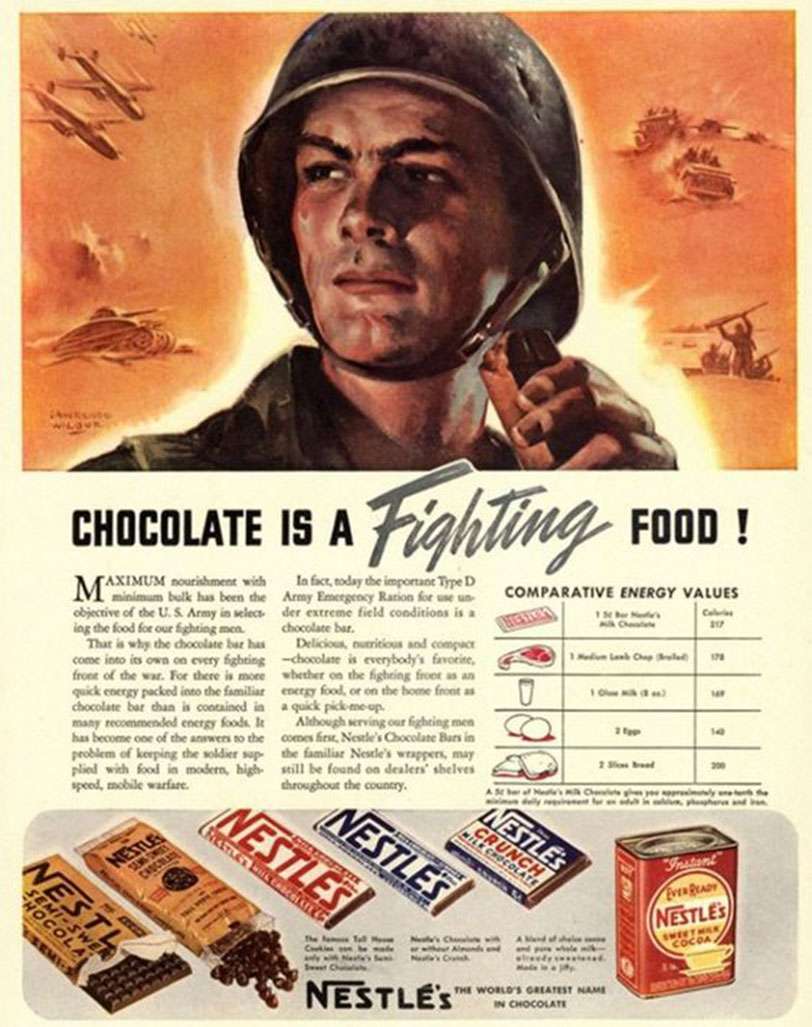
During the Second World War, the United States invested major efforts in making the combat meals more appealing. Various candies found their way into K-rations, in addition to necessities like toilet paper and cigarettes. In a comprehensive overview of the history of rations, the U.S. Army Quartermaster Foundation points to the main reason for complaint during WWII.
Like other unpopular items, misuse was a contributing factor to the waning popularity of the K ration. Although designed to be used for a period of two or three days only, the ration occasionally subsisted troops for weeks on end. . . . Continued use reduced the acceptability and diminished the value of the ration.
Adding confectionaries to rations made the meals more welcome. Chocolate was always a favorite, but the initial American versions left much to be desired.
My research was, in fact, prompted by a recent post on “Chocolate in WWII” in Pacific Paratrooper. (It is one of the very best military blogs on the internet.) They describe how the military approached a major American confectioner with a simple list of requirements (the last one is best appreciated by older veterans).
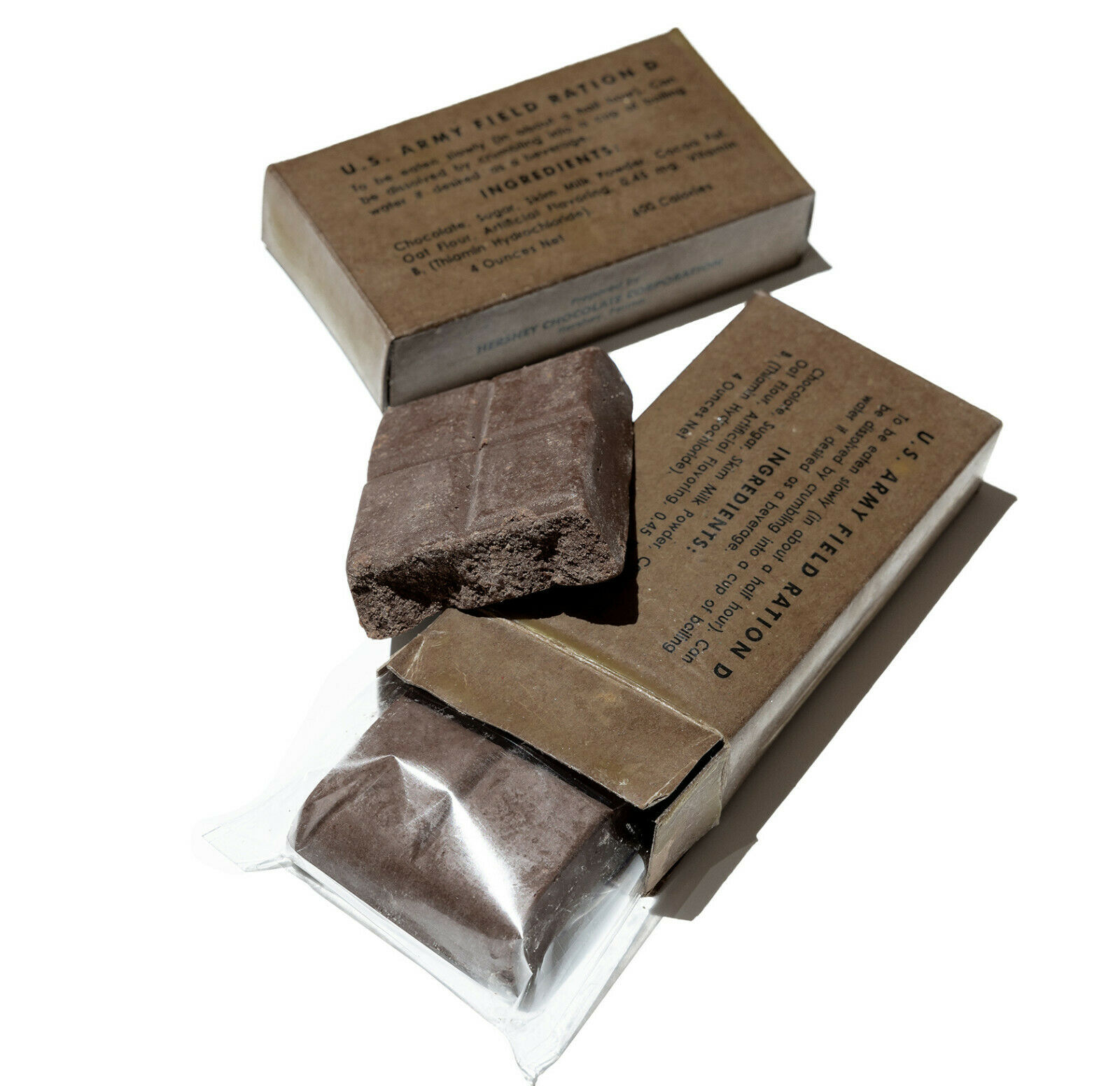
The Hershey Chocolate company was approached back in 1937 about creating a specially designed bar just for U.S. Army emergency rations. According to Hershey’s chief chemist, Sam Hinkle, the U.S. government had just four requests about their new chocolate bars: (1) they had to weigh 4 ounces; (2) be high in energy; (3) withstand high temperatures; (4) “taste a little better than a boiled potato.”
Sadly, many “who tried it said they would rather have eaten the boiled potato.” Well, it was the thought that counted, right?
There is a legend that during the war a German officer was confronted with American desserts and determined that the abundant resources of the United States signaled doom for the Nazi cause. The story likely has a fictional origin.
In the 1965 film Battle of the Bulge, Wehrmacht Colonel Hessler, shows his commanding general a treasure confiscated from American soldiers.
Hessler: “General, before you go, may I show you something?”
General: “What is it?”
Hessler: “A chocolate cake.”
Kohler: “Well?”
Hessler: “It was taken from a captured American private. It’s still fresh. If you will look at the wrapping, general, you will see it comes from Boston.”
Kohler: “And?”
Hessler: “General, do you realize what this means? It means that the Americans have fuel and planes to fly cake across the Atlantic Ocean. They have no conception of defeat.”
C.S. Lewis & Rations
Military rations during the First World War were more primitive than those provided twenty years later. One difference for the British is that they were granted a half gill of rum (or a pint of porter) each day.
This alcohol distribution was at the discretion of the commanding general, which meant that it was not available in the trenches. This was in the spirit of the American “General Order Number 1,” which typically applies to alcohol, and sometimes prohibits its presence throughout an entire theater. (I can personally attest to the ability of some elements, such as Special Ops, to circumvent such restrictions.)
C.S. Lewis wrote with some frequency about the rationing endured by the British public, during and after the world wars.⁑
Unfortunately, I’ve only uncovered one Lewisian reference to his own experience with military cuisine. In a 1917 letter to his father, he reveals that meals were not always appealing, even during training, prior to deploying to the war zone.
First of all came the week at Warwick, which was a nightmare. I was billeted with five others in the house of an undertaker and memorial sculptor. We had three beds between six of us, there was of course no bath, and the feeding was execrable.
The little back yard full of tomb stones, which we christened ‘the quadrangle,’ was infinitely preferable to the tiny dining room with its horse hair sofa and family photos.
When all six of us sat down to meals there together, there was scarcely room to eat, let alone swing the traditional cat round. Altogether it was a memorable experience.
A Hobbit, a Wardrobe, and a Great War describes how WWI affected C.S. Lewis and J.R.R. Tolkien. After relating a passage following Miraz’s defeat of Caspian’s force, when the momentarily defeated were “a gloomy company that huddled under the dripping trees to eat their scanty supper,” the author observes:
The military blunders, the fruitless acts of bravery, the bone-chilling rain, the meager rations: there were many days and nights just like these along the Western Front. Imaginary beasts aside, such scenes could have been lifted from the journal of any front-line soldier.
Like Tolkien, though, Lewis includes these images not for their own sake, but to provide the matrix for the moral and spiritual development of his characters . . .
Rations in Ukraine
Although the eyes of the world are riveted today on the war in Ukraine, there are currently 110 armed conflicts being monitored by the Geneva Academy. However, since Ukraine is in the news daily, it is worth noting both modern armies are employing military rations.
Apparently, Ukrainian troops have great Meals Ready to Eat (MREs). “Most importantly, when making, eating, or even talking about the food, the men seem to be genuinely happy.” The MRE link in this paragraph contains the details, including the note that “among the contents, you’ll find a small packet of dried apricots and a dark chocolate bar.”
There is also a vendor on ebay who sells what are purported to be captured Russian supplies, including a confiscated chocolate bar. The candy appears to be conventionally purchased, but could be part of an illicit chocolate conspiracy finding its way to the Russians from Latvia. “The Russian confectionery company ‘Pobeda’ ПОБЕДА has been producing chocolates, truffles, waffles and other types of sweets for more than six years in Ventspils, via a Latvian subsidiary.”
A month ago in Russia, “Pobeda” received thanks from an organization called the “Battle Brotherhood” for the fact that since the beginning of the Ukrainian war, the company has sent at least 15 tonnes of its products to Russian soldiers.
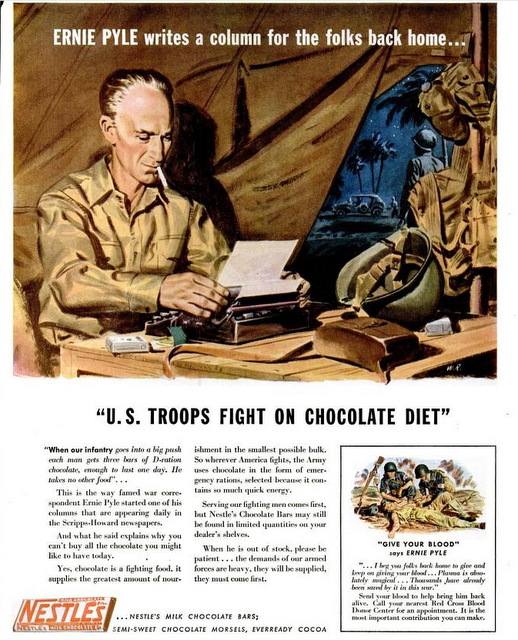
Chocolate does indeed appear to fuel armies. For a fascinating article on how chocolate can also be used to promote propaganda, check out this Ukrainian site.
Russian propaganda continues to dehumanize Ukrainians with the help of outright fakes.
Another “proof” of our apparent bloodthirstiness was the image of a chocolate bar with a remarkable name “Death of Alyoshka.” A portrait of a boy in a helmet with a mourning ribbon is placed on the wrapper of the confectionery. Propagandists claim that Ukrainians wish Russian children dead.
Become an MRE Connoisseur
If you are curious about the contents of various international MREs that are available for purchase by civilians, visit MREmountain, which began “in 2017 when people discovered the hobby of trying army rations.”
Most veterans, I suspect, would find the “hobby” of eating military rations rather peculiar. But then again, you can check out the French options, which the site labels “The best MRE in the world.” Only there, I imagine, could one discover “meals not found in any other MRE like Kebob Meatballs, Duck Confit, Deer Pate, Wild Boar.”
And, of course, France’s 24-hour ration also includes chocolat müesli, chocolate biscuits, five snack bars (at least one of which is pure chocolate), and a hot cacao packet. Yummy. It appears that les Français also consider chocolate to be a staple of modern soldiers.
* This quotation has been attributed to Napoleon and Frederick the Great. Whatever its modern origin, it is obvious starvation and its frequent companion, disease, have crippled as many armies as blade and shot.
Communist China* hates Christianity. They do everything they can to destroy the Gospel, with its power to free people from bondage. That’s because China is all about keeping human beings in bondage.
Mere Inkling is not a political blog, so I have no incentive to go through the litany of communist China’s demagoguery. Besides, listing their crimes would take far too long.
In terms of their persecution of the Christian Church, however, many agnostics know little.⁑ The Red Chinese began their war against Christianity in the days of Mao. Millions have been denied their civil rights, imprisoned, and even murdered. Even with their “enlightened” and “tolerant” policies, they continue to deface and destroy church buildings and harass and imprison believers.
But now, they have done the unimaginable.
They have sought to replace the various Chinese translations of the Bible with a new, official edition. The regime’s Bible, though, is not a genuine translation.
It is an intentional corruption of God’s Word, and it is no exaggeration that some of its inspiration comes from the Father of Lies, an honored commissar in all Communist nations.
In a superb essay discussing the pseudo-bible, Cameron Hilditch reveals how the Communists are attempting to co-opt the Messiah and present him as the herald of the Marxist gospel.
Put simply, the Chinese Communist Party “plans to turn the Scriptures into another piece of regime propaganda by rewriting them beyond all recognition.”
Beyond all recognition indeed. Before looking at their perversion of Jesus’ message of mercy, let’s consider the actualbiblical account. We read that in Jerusalem,
Jesus went to the Mount of Olives. Early in the morning he came again to the temple. All the people came to him, and he sat down and taught them. The scribes and the Pharisees brought a woman who had been caught in adultery, and placing her in their midst they said to him, “Teacher, this woman has been caught in the act of adultery. Now in the Law, Moses commanded us to stone such women. So what do you say?”
This they said to test him, that they might have some charge to bring against him. Jesus bent down and wrote with his finger on the ground. And as they continued to ask him, he stood up and said to them, “Let him who is without sin among you be the first to throw a stone at her.”
And once more he bent down and wrote on the ground. But when they heard it, they went away one by one, beginning with the older ones, and
Jesus was left alone with the woman standing before him. Jesus stood up and said to her, “Woman, where are they? Has no one condemned you?” She said, “No one, Lord.” And Jesus said, “Neither do I condemn you; go, and from now on sin no more.”
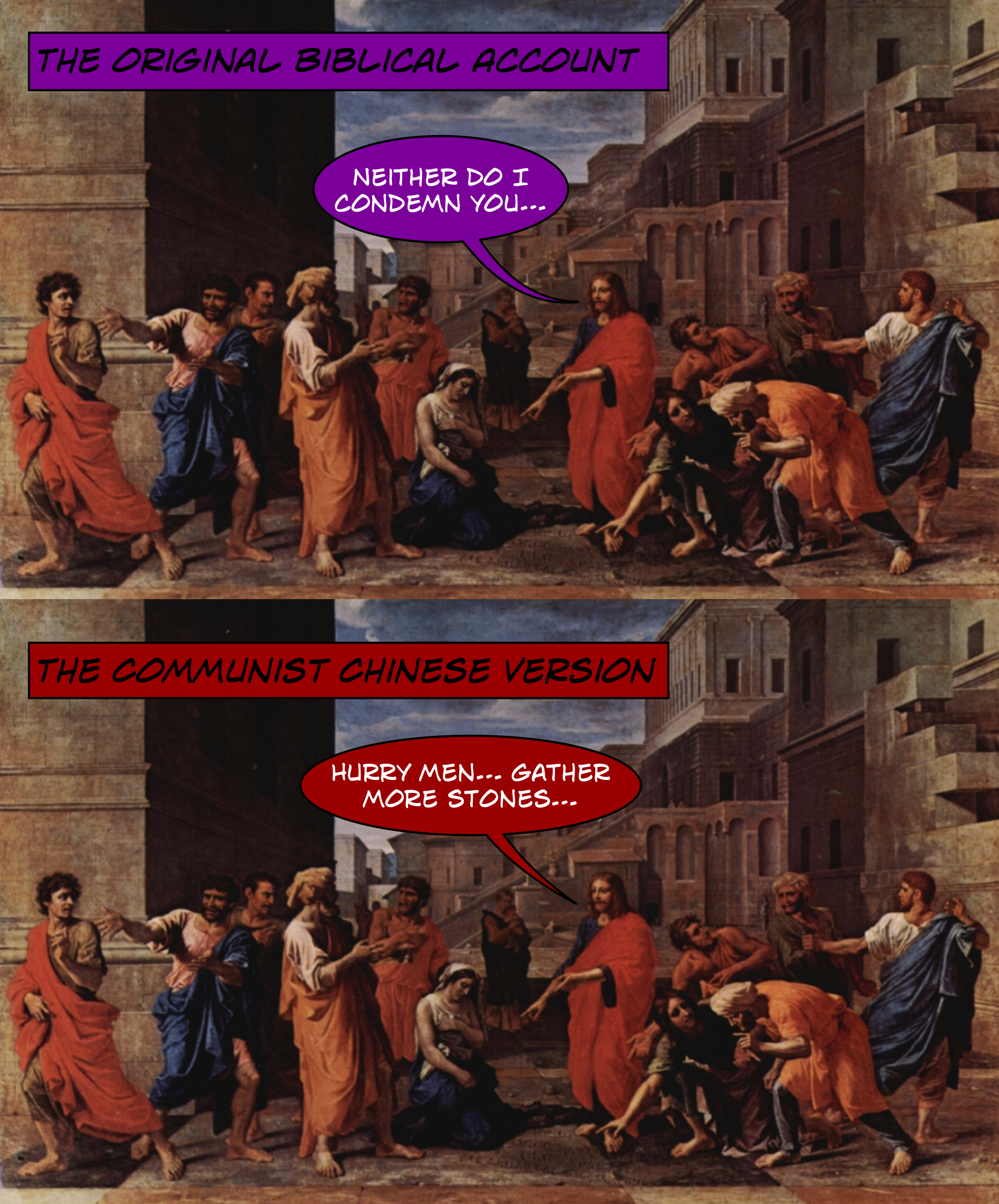
Here is the communist mistranslation⁂ of the end of this powerful example of God’s grace and mercy.
When the crowd disappeared, Jesus stoned the sinner to death saying, “I too am a sinner. But if the law could only be executed by men without blemish, the law would be dead.”
Twisting the Scriptures
The act of translating the Scriptures is not controversial. In fact, it is necessary. C.S. Lewis noted this in his essay “Modern Translations of the Bible.”
The truth is that if we are to have translation at all we must have periodical re-translation. There is no such thing as translating a book into another language once and for all, for a language is a changing thing.
If your son is to have clothes it is no good buying him a suit once and for all: he will grow out of it and have to be re-clothed.
However, the re-translation must be an honest one.
There are several warnings in the Bible itself not to alter the words in the Scriptures either by deleting or adding to the text. Substituting the actual words, as the Communist Chinese have done, would violate both of those prohibitions.
Some people argue that mainland China exerts a benign influence on the world. “We have short memories,” says Christian attorney and advocate for the poor, Anna Waldherr. Rather than praise China for its increased engagement with the world, she reminds us of the true situation.
These days, the United States and China have mutual economic, political, and security interests. But China remains a Communist nation with a totalitarian government and unresolved issues involving human rights.
The evil purposes of communist China’s ruling elite do not extend to their people. On the contrary the residents of that historic nation are its primary victims. The Chinese people and their culture possess much nobility. As I have written before, “C.S. Lewis held great respect for Chinese civilization. He was interested in the Chinese philosophical concept of the Tao.”
I share Lewis’ high regard for all that is good in China along with a genuine compassion for the Chinese people. May God deliver them from the dark principalities that reign over them.
* The communist People’s Republic of China is not to be confused with the democratic Republic of China, which is usually called Taiwan, due to the PRC’s coercive actions. For the same reason, the 23 million people living in the Republic of China are denied representation in the United Nations.
⁑ The Communists persecute other religious groups as well, most notably the Uighur (Islamic) people, who are being placed in vast reeducation and labor camps. In addition to rewriting the Jewish and Christian Scriptures, they are presumably also rewriting the Quran with the same, pro-regime agenda. Unsurprisingly, when asked their specific plans, “the Chinese Embassy in Washington declined to comment.”
⁂ As reported in Hilditch’s article, “China’s Communist Christ,” linked to above.
The original painting featured in the illustration above, “Christ and the Woman Taken in Adultery,” was painted in 1653 by Nicolas Poussin.
Some Christians are obnoxious. Well, okay, quite a few Christians are insufferable when they persistently “witness” to those who are deaf to their appeals. But, truth be told, many atheists are becoming increasingly obnoxious in their attitudes towards Christians as well. Let’s consider which group is worse.
First, some definitions. By Christians I don’t mean people who have some vague deistic notion that there is a God, and Jesus is somehow connected to this divinity because he was such a holy prophet.
By Christian I mean someone who has placed their faith and trust in Jesus the Christ, the only begotten Son of God who declared he was the Way, the Truth and the Life… The Logos (Word) through whom the universe was created.
By Atheist, I don’t mean people who do not share that faith, but who consider it an unprovable thesis. Most people with this viewpoint are ambivalent about whether or not others “believe.” The majority of these folks, many of whom do not feel threatened by religious conversations, are better understood as Agnostics.
By Atheist I mean people who are so convinced that Christianity is fallacious that they feel they must do what they can to stamp it out. They are so emotionally engrossed in the matter that they are genuinely unable to recognize that their own belief is based on nothing other than faith itself.
I can respect the fact that Atheists have historically been mistreated by “Christendom.” By my definition, this institutional entity is not synonymous with actual Christianity. In fact, it’s persecuted far more Christians of different denominational allegiances, than it has unbelievers who simply kept their mouths closed. But that’s a subject for another day.
Christians do not hate agnostics, or even atheists. Their motivation for sharing the Gospel inclines them towards the opposite attitude. Certainly they do it in obedience to their Lord’s command. Most possess a genuine concern and compassion for those they consider to be lost and facing eternal separation from God.
On the other hand, an increasing number of Atheists are insultingly dismissive of Christians who they consider—as a group—to be ignorant and prejudiced.
An Atheist columnist acknowledged this fact, and the discomfort it causes him, in a recent essay. David Harsanyi wrote the following in “Political Idols,” an article about a broader subject.
Unlike many of my fellow non-believers, I don’t feel especially enlightened or rational for my apostasy; I feel kind of unlucky, actually.
The typical non-believer sees the strictures of Christianity or Judaism [the faith in which Harsanyi was raised] as a punishment—mythical limitations set to inconvenience him—but I see people who take profound comfort in a beautiful fate that awaits them as long as they treat people as they would want to be treated themselves.
As a man who believes his story ends in a pile of dirt rather than celestial salvation, I have many reasons to be envious.
Yet, for my entire atheistic life, I’ve been nudged to mock the believer. The unifying doctrine of atheism is a reflexive antagonism toward faith and all the ideas it has dragged along with it through the centuries.
If all Atheists recognized this, and all Christians acknowledged that they are no more deserving of God’s mercy than their neighbor, oh what wonderful conversations about matters of eternal significance we could have!
C.S. Lewis’ Comment about an Atheist Writer
In a 1916 letter to his friend Arthur Greeves, Lewis comments on a book that Greeves had mentioned. He says the particular volume is of little value, without remarking on the author’s work in fiction, for which he as better known.
What is most significant about this particular letter is Lewis’ reference to the writer’s atheism, and the allusion to his own. It must be remembered that Lewis would not experience his conversion to Christianity for another fifteen years!
The book you refer to is ‘How to Form a Literary Taste’ by Arnold Benett: the edition is pretty but the book is not of any value. The very title—as if you set out to ‘learn’ literature the way you learn golf—shews that the author is not a real book-lover but only a priggish hack.
I never read any of his novels & don’t want to. Have you? By the way, he is a rather violent atheist, so I suppose I shall meet him by
‘The fiery, flaming flood of Phlegethon,’ as good old Spenser has it.
Before we look at Arnold Bennett (1867-1931), the author Lewis is describing, let us take a moment to consider the literary allusion Lewis includes in this passage.
“The fiery, flaming flood of Phlegethon” comes from The Faerie Queene, an epic poem which was the masterpiece of Edmund Spenser (1552-1599). Various editions of the fantasy poem are available.
In Spenser’s poem, the Phlegethon is a river found in Hell. The name itself means “flaming,” and it initially appears in Greek mythology as one of the Underworld’s five rivers. In The Faerie Queene, the terrible place where “the damned ghosts in torments fry.”
While his agnosticism assumes there is no afterlife, he acknowledges he may be wrong. And, if so, it is precisely to this tragic, fiery end that the unbelieving Lewis delivers Bennett . . . and himself.
So, who was Arnold Bennett?
Bennett was a versatile writer, and found success not only as a novelist, but also in theater and journalism. He even served as the Director of Propaganda for France during WWI, even though he was English. (He had resided in France since 1903.)
He was outspoken in his view that religious faith was not for the wise. Ironically, he died of typhoid after ignoring a French waiter’s counsel not to drink the “ordinary [tap] water from a carafe,” which was unsafe.
In 1932, Bennett’s widow began editing and publishing his journals. In a review that year, a literary magazine noted his antagonism towards Christianity.
Through it all one gets the impression of a terribly self-centered personality. Perhaps the artist is necessarily self-centered, though I cannot believe that Shakespeare was.
There have been artists like Dante, like Milton, whom it would be absurd to call selfish in the usual sense of the term because, colossal as their egos were, they yet consecrated themselves and all their pride of art and pride of soul to something for which, in the final analysis, their inmost spirits cared immensely more than they cared for self or for art or for any other thing on the earth below or in the heavens above it. . . .
Probably he was as great an artist as a man can be without religion, and the measure of his greatness is to be found in his straining against the limitations he so needlessly imposed upon himself. . . .
He had nothing of the mystic in him. In a moment of illumination he declares that “there is no such thing as ugliness in the world,” but this is as far as he gets. Yet he holds out against Christianity as he holds out against what he thinks of as sentimentalism, and his wife was probably right in her feeling that he might have made a very good Christian if he had only been willing to let himself go.
Civil Atheism
It would be a good thing for us individually and as members of a pluralistic world, to treat one another with civility. As a Christian, I can confess for my brothers and sisters that we do not always do so. Let us strive to do better.
And, as for those who identify themselves as Atheists, perhaps there is some room for improvement in this area as well. If more people resisted atheism’s “reflexive antagonism toward faith,” the world would definitely become a more friendly place.
A final note for those who would read more about Bennett. G.K. Chesterton wrote an essay about morality and punishment, in which he responds to a proposal offered by Bennett that society should not “judge” criminals. You can read “The Mercy of Mr. Arnold Bennett” here.
Since it relates to our discussion here, I must share a portion of Chesterton’s witty introduction to his essay.
Mr. Arnold Bennett recently wrote one of his humorous and humane “causeries” pleading very properly for social imagination and the better understanding of our fellows. He carried it, however, to the point of affirming, as some fatalists do, that we should never judge anybody in the sense of condemning anybody, in connexion with his moral conduct.
Some time ago the same distinguished writer showed that his mercy and magnanimity were indeed on a heroic scale by reviewing a book of mine, and even saying many kind things about it.
But to these he added a doubt about whether true intelligence could be consistent with the acceptance of any dogma. In truth there are only two kinds of people; those who accept dogmas and know it, and those who accept dogmas and don’t know it. My only advantage over the gifted novelist lies in my belonging to the former class.
I suspect that his unconsciousness of his dogmas extends to an unconsciousness of what he means by a dogma. If it means merely the popular idea of being dogmatic, it might be suggested that saying that all dogmatism is unintelligent is itself somewhat dogmatic.
And something of what is true of his veto on dogma is also true of his veto on condemnation; which is really a veto on vetoes.
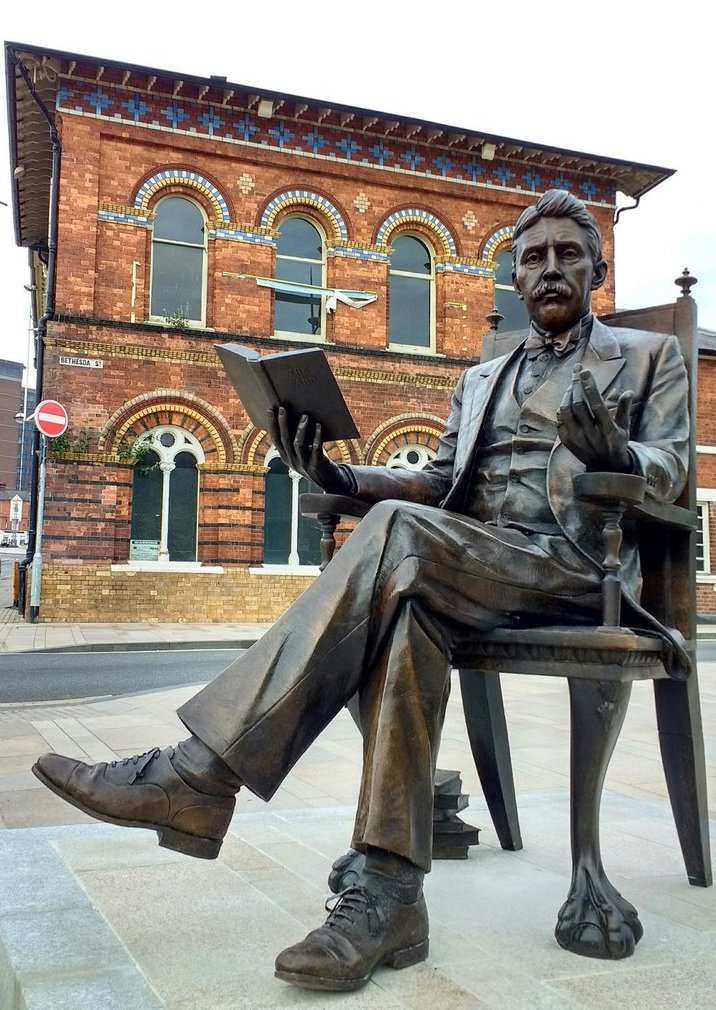
The photograph above is of a statue of Arnold Bennett unveiled this summer in his home town of Stoke-on-Trent.

 Mere Inkling Press